
Józef Bogacki (c. 1826–1919) and Apolonia (Prusiecka) Bogacka (c. 1822–1906) were some of my husband’s great-great-great-grandparents. They were Polish immigrants from the Prussian partition of Poland who settled in Buffalo, New York, along with some of their children, who were known to include Teka (Bogacka) Wolińska (1860–1906), and Antoni Bogacki (c. 1858–1915).
Although Tekla (Bogacka) Wolińska and her husband, Józef, are buried in a different location in the cemetery, there is a large monument for other members of the Bogacki family in St. Stanislaus Cemetery in Cheektowaga, New York (Figures 1 and 2).
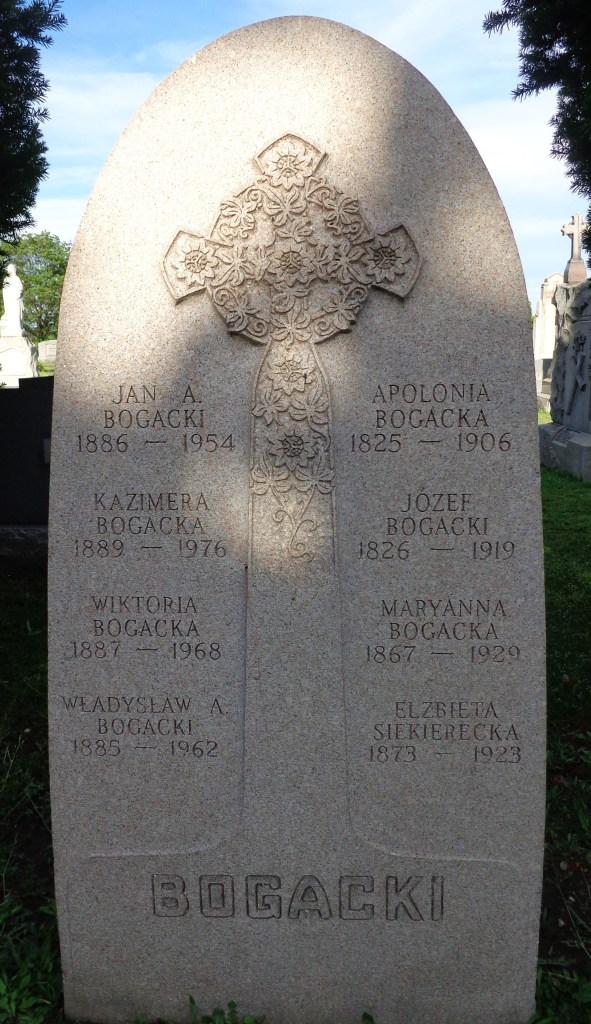
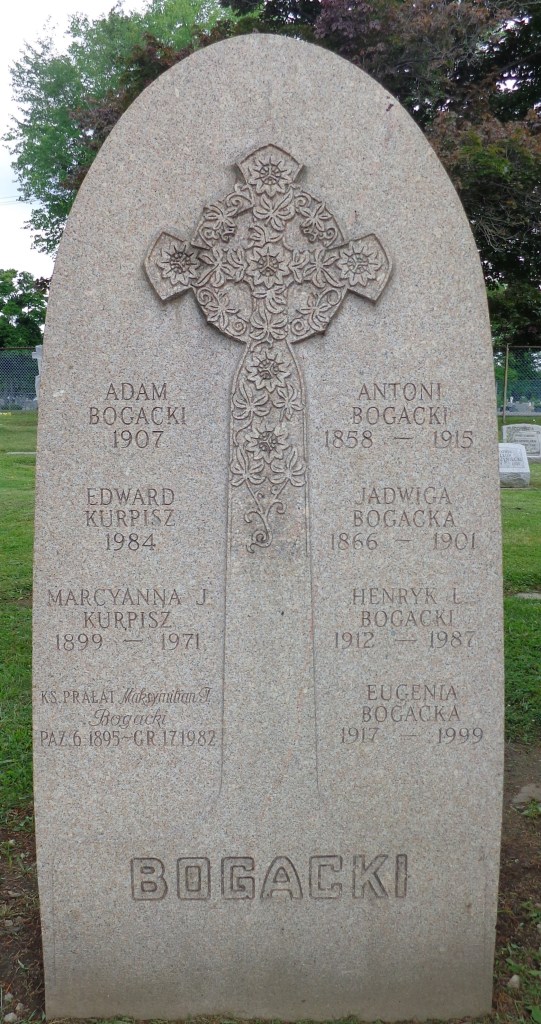
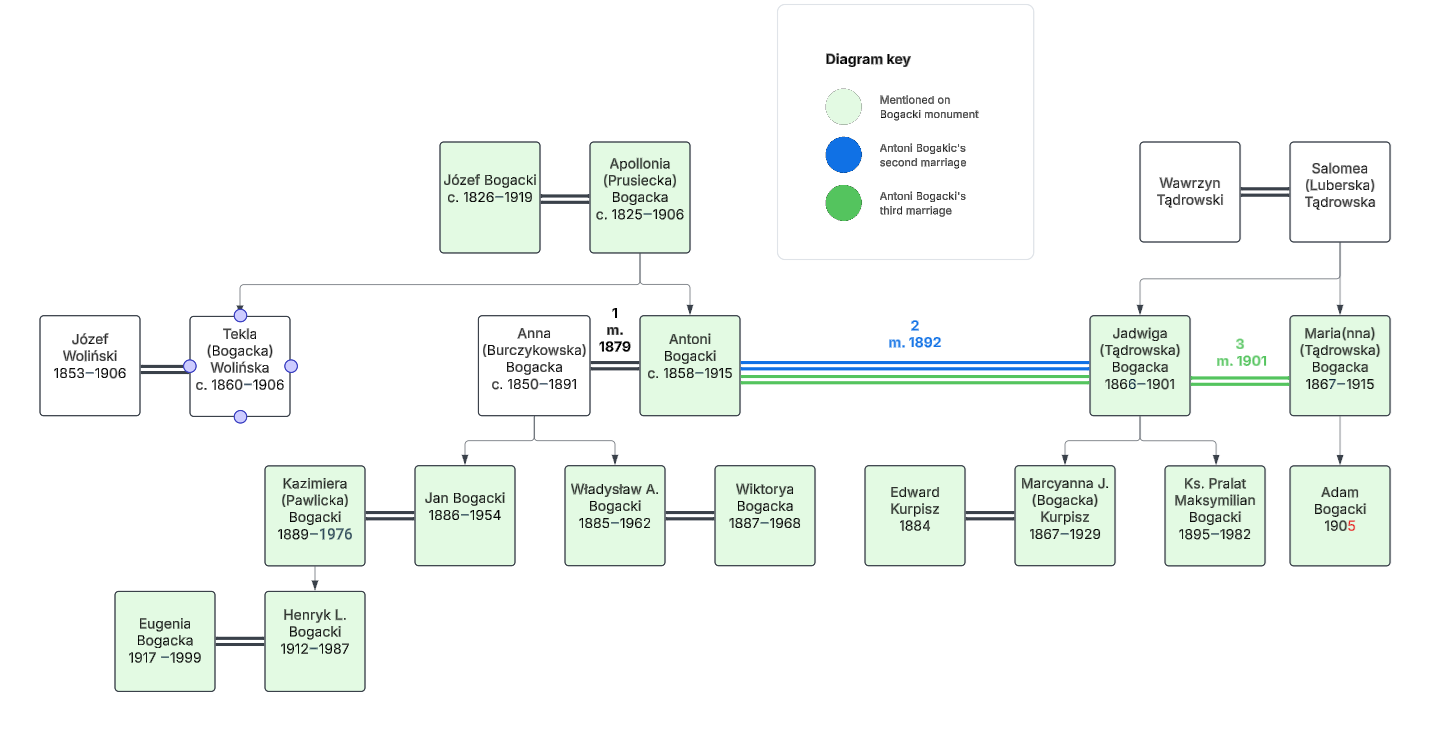
Of course, having so many names on a monument just begs their placement into a family tree.
Judging from the dates on the marker alone, Józef Bogacki and Apolonia Bogacka, born in 1826 and 1825, respectively, are the earliest generation shown. Maryanna Bogacka (b. 1867), Antoni Bogacki (b. 1858), Jadwiga Bogacka (b. 1866), and Elżbieta Siekierecka (b. 1873) comprise the next generation of the family, but we need additional evidence to establish their relationships.
Indexed records from the PGSNYS databases provide a quick-and-dirty clarification (Figure 3).

These results include two marriage records (marked in red) from St. Stanislaus for Antoni Bogacki, one to Jadwiga Tądrowska in 1892and the other to Marya Tondrowska in 1901.[1] The “Page” column provides the specific volume, page, and record number for locating the results in the the original church books. Since marriage records from St. Stanislaus are imaged at FamilySearch from 1874–1917, both of these records are readily available.
The marriage records identify Antoni’s parents are Josef Bogacki and Apollonia Prusiecka. Although the maiden names of Antoni’s brides are spelled somewhat differently, Tądrowska and Tondrowska are phonetically similar in Polish. The fact that his wives had the same maiden name suggests that they might have been sisters. A second search in the database collection for “Jadwiga Tadrowska” and “Marya Tondrowska,” confirms this suspicion; both were daughters of Wawrzyn (Lawrence) Tądrowski/Tondrowski and Salomea Luberska.
The search shown in Figure 3 for Antoni Bogacki also confirms that he died in 1915 at the age of 57, which suggests a birth in 1858, and these dates match those on the grave marker (Figure 4).

Antoni Bogacki was buried from Transfiguration parish in Buffalo, and those images, too, are online at FamilySearch.[2] Church records from ethnic Polish parishes like St. Stanislaus and Transfiguration can be a wonderful source for evidence of place of origin, and in this regard, Antoni’s death record and marriage records do not disappoint. His death record reveals that he was born in “Chelmno, Pruss. Zach.,” while both the marriage records state “Chełmno, Boruss.” Borussia is the Latin name for Prussia, and Prusy Zachodnie is the Polish name for West Prussia, so all the documents point to the same location, the town of Chełmno which is presently located in the Kujawsko-Pomorskie province of Poland.
So far we’ve identified the parents, Józef and Apollonia, and three of the four individuals in the Bogacki “children” generation, Antoni and his wives, Jadwiga and Maria (Tądrowska) Bogacki. Elżbieta Siekierecka remains to be placed on the tree, but hers is an interested story, so we’ll come back to her.
Moving on now to the “grandchildren” generation, based on birth years recorded on the monument, we have Jan Bogacki (born 1886), Kazimiera Bogacka (born 1889), Wiktoria Bogacka (born 1887), Władysław Bogacki (born 1885), Marcyanna J. Kurpisz (born 1899) and a priest, Ks. Prałat [ksiądz prałat] Maksymilian T. Bogacki, whose dates of birth and death are specified as Paź. 6 [Październik, October]1895 and Gr. 17 [Grudzień, December] 1982. A search for Jan Bogacki in the PGSNYS databases produces a number of useful records, including his death notice, which was published in the Polish newspaper, Dziennik dla Wszystkich, on 1 May 1954, as well as the record of his marriage at St. John Kanty on 3 June 1908 to Kazimiera Pawlicka.[3] Another piece falls into place; Kazimiera is certainly the Kazimiera Bogacka who was buried in the Bogacki family plot. The databases additionally contain Jan’s baptismal record from St. Stanislaus parish in 1886.[4] The marriage record and the baptismal record both identify Jan’s parents as Antoni Bogacki and Anna Burczykowska and the baptismal record reiterates Antoni’s place of birth as Chełmno, Boruss[ia].
So, Anna Burczykowska was Antoni’s first wife, although she was not buried in the same plot with Antoni and his subsequent wives. A search for her grave at Find-a-Grave is negative, but PGSNYS member, Barbara Ruppert, has Anna Bogacka’s grave indexed at her Grave Finder at St. Stan’s website, which should always be checked when searching for final resting places of Buffalo’s Polonia.[5] Anna’s death record, indexed in the PGSNYS database, reveals that she died 5 December 1891 and was buried 7 December 1891, consistent with the burial date indexed at the Grave Finder website.[6] The death record also states that Anna was born in Chełmno, adding to the growing body of evidence for the Bogacki family’s origins.
Getting back now to the folks whose names were recorded on that monument, we’ve pretty well confirmed the relationship between Kazimiera and Jan Bogacki—she was his wife. However, it would be nice to find some additional evidence of her birth and death dates. Her newspaper death notice is useful here (Figure 5).[7] Not only does it confirm her date of death (which agrees with the date on the grave marker), it also confirms her husband’s name and the names of her children. But wait, there’s more: two of those names match with as-yet-unidentified names on the grave marker, Henryk/Henry and Eugenia Bogacki.

A match for Kazimiera Bogacka in the Social Security Death Index (SSDI) with a date of death of July 1976, reports her date of birth as 23 October 1887.[8] This is off a bit from the date reported on her grave marker, 1889, but that kind of discrepancy is not unusual for individuals born in this era. Since Kazimiera’s marriage record indicated that she was born in Poland, we would need to locate her birth record in order to know definitively which birth date is correct, but that’s another question for another day.
Although the English equivalent of the name Kazimiera is Casimira, fellow Bogacki researchers should be aware that Kazimiera also used the name Catherine or Katherine.[9] It was not unusual for early 20th century Polish Americans to adopt an “American” name that differed from the etymological equivalent of that person’s Polish given name. If you compare Kazimiera/Catherine’s death notice shown in Figure 5 with the death notice of her husband, John Bogacki, published in The Buffalo News on 1 May 1954, you see that the names of the children are the same, although the couple’s oldest son, Charles, was recorded as “Carol” in his father’s death notice.[10] This, again, is due to a variant translation of the Polish name Karol (Charles).[11] If any doubt remains about these conclusions, consider John Bogacki’s obituary, published in the Cheektowaga Times, which identifies his wife as Kazimiera (née Pawlicki) rather than Katherine, and their oldest son as Charles J. Bogacki, rather than Carol.[12]
Since this research into Jan and Kazimiera Bogacki provided some preliminary information on Henry and Eugenia Bogacki, we may as well look them up in the SSDI and locate their newspaper death notices to confirm birth and death dates. Henry’s death notice reports his date of death as 4 March 1987, and the SSDI provides his date of birth, 8 November 1912.[13] Henry’s death notice also gives us Eugenia’s maiden name, Michalski, which is confirmed in Eugenia’s obituary, as well as in the Social Security Applications and Claims Index, which goes beyond the SSDI to provide her parents’ names, John Michalski and Victoria Ledzynska, in addition to her dates of birth (27 June 1917) and death (8 March 1999).[14] Since Henry and Eugenia lived so recently, it’s unsurprising that their birth and death dates agree perfectly with those reported on the Bogacki family monument.
After this brief foray into the “great-grandchildren” generation, let’s move back now to placing the remaining “grandchildren” on the tree, Wiktoria Bogacka (born 1887), Władysław Bogacki (born 1885), Marcyanna J. Kurpisz (born 1899) and Rev. Maksymilian T. Bogacki (born 1895). Another search in the PGSNYS databases for surname “Bogack” with father’s name “Ant” and mother’s name “Anna” produces a slew of baptism, marriage, and death records (Figure 6) for children of Antoni Bogacki and Anna Burczykowska, as well as a couple death records for children of Antoni Bogacki and Marianna Tądrowska (Figure 6).
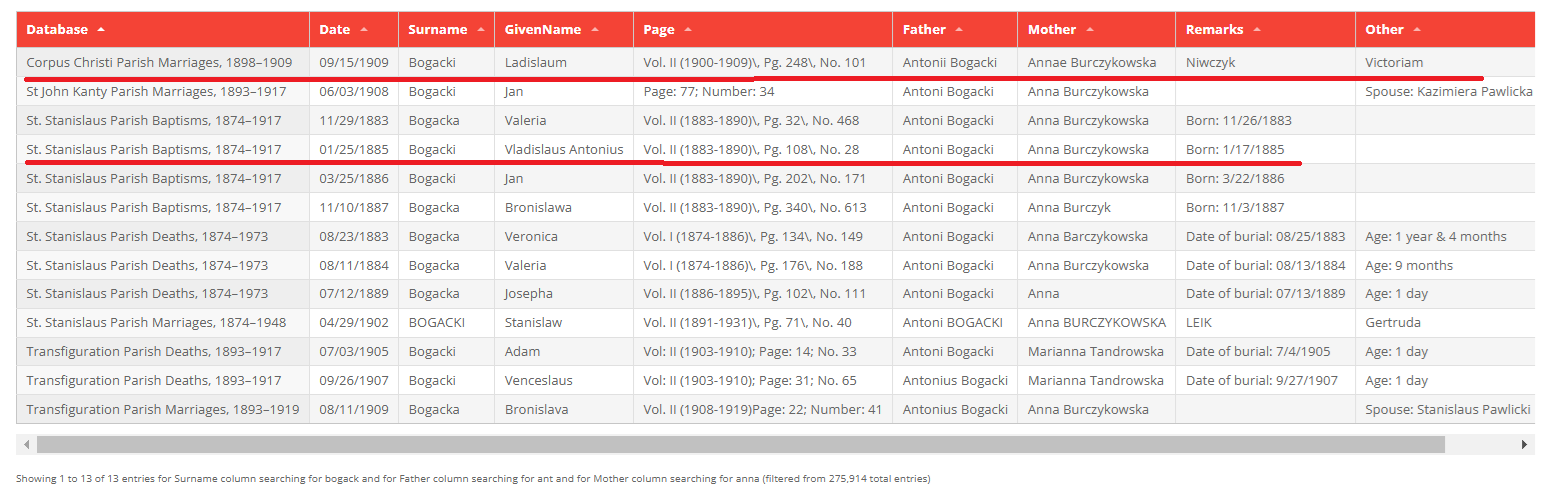
Underlined results include a baptismal record for Vladislaus Antonius Bogacki, who was born 17 January 1885 and baptized at St. Stanislaus, as well as the record of his marriage to Victoria Niwczyk [sic] at Corpus Christi parish. The baptismal record is available online at FamilySearch, and a digital image of the marriage record is available upon request from PGSNYS.[15] They look like a promising match for the Władysław and Wiktoria on the Bogacki monument. We can repeat our strategy of confirming death dates using the SSDI and newspaper death notices, assuming that Władysław probably adopted the name Walter in later years. Lo, and behold, a search for Walter Bogacki at Newspapers produces his death notice, which confirms his date of death and wife’s name, and the SSDI provides additional confirmation of birth and death dates.[16]
As it turns out, there’s no good match for Wiktoria (Niewczyk) Bogacki in the SSDI, which is not unusual for women in this era. Since her marriage record indicated that she was born in Posen, I’ll bet I can find her birth record in BaSIA, which is a vital records database which focuses on the Wielkopolskie province of Poland, where Poznań is located. In the interest of staying focused, however, I’ll defer that question for another day and get back to the problem of untangling the relationships between members of the Bogacki family identified on their grave monument.
There’s a good match for Marcyanna J. Kurpisz in the PGSNYS databases as Marcyanna Bogacka, daughter of Antoni Bogacki and his second wife, Jadwiga Tądrowska. The PGSNYS index points us to her baptismal record from St. Stanislaus, which confirms her date of birth as 10 January 1899.[17] Her death notice confirms that she died 4 May 1971, and identifies her as Marion H. Kurpisz, rather than Marcyanna J.[18] The different middle initials are easily accounted for if we suppose that her middle name might have been Jadwiga, after her mother; the English version of Jadwiga is Hedwig. The name Marcyanna is a variant spelling of Marcjanna or Marciana, which is the female form of Marcjan, which in turn derives from the Latin name Martianus/Martiana.[19] Etymologically, the name is not equivalent to Marianna (Polish), Marian, or Marion (English); “Martina” would have been closer to the original. However, as we saw previously with Kazimiera/Catherine Bogacka, there were no rules which required Polish Americans to adopt names that were etymologically equivalent to their original names. In fact, until the advent of Social Security, no one was even keeping track, so you might see early 20th century Polish Americans trying out a few different names until they settled upon one they liked.
Marion Kurpisz’s death notice also informs us that her husband was Edward J. Kurpisz, who is undoubtedly the Edward Kurpisz on the grave marker. Edward’s death notice provides his date of death, 9 March 1984, but doesn’t tell us how old he was when he died.[20] The record of his marriage to Marion saves the day, however, providing his precise date of birth, 14 March 1899, and parents’ names, Konstanty Kurpisz and Teodora Wdowicka.[21]
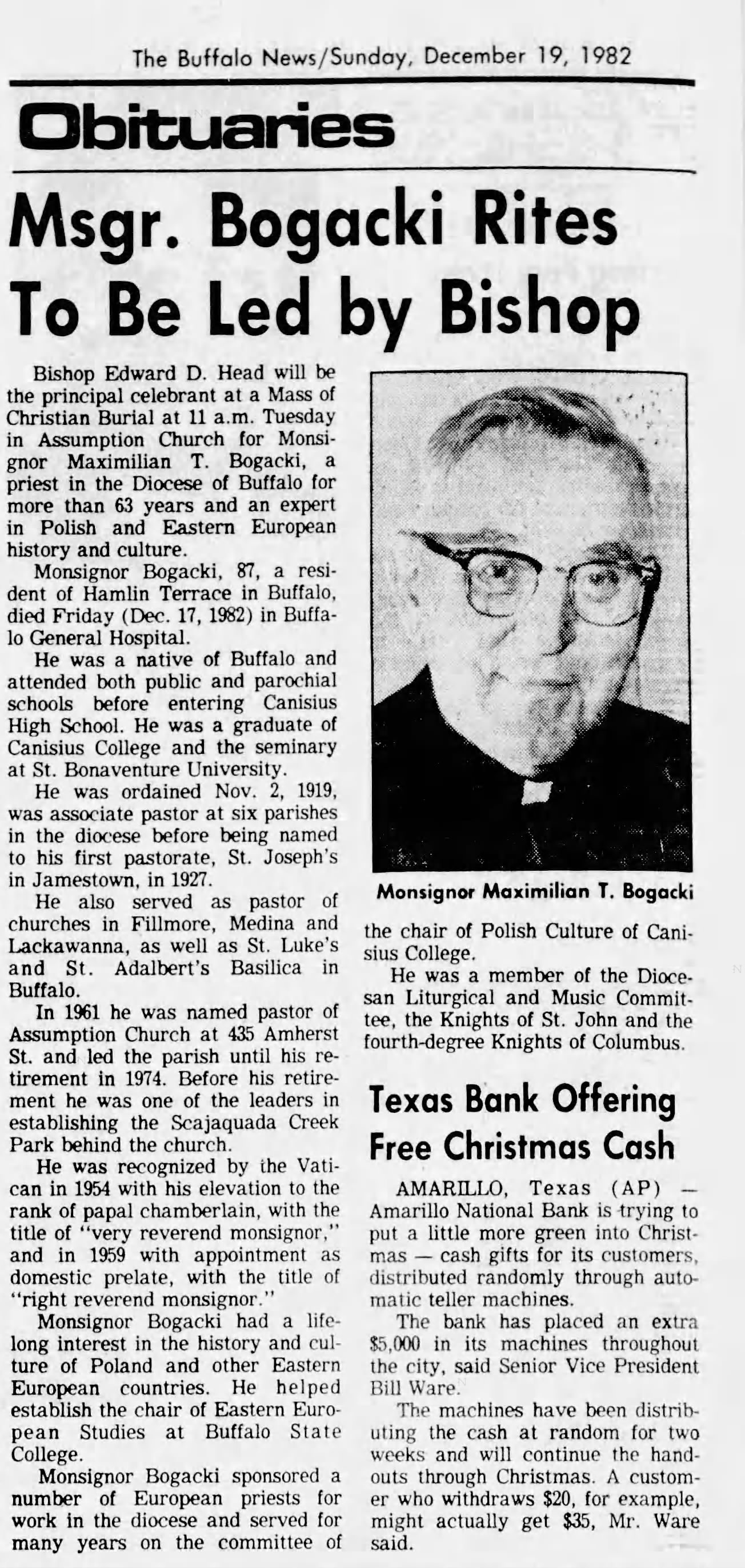
A number of records discovered thus far have mentioned the Right Reverend Monsignor Maksymilian T. Bogacki. He was the priest who performed the marriage for his sister, Marion, and he was also one of the officiants at her funeral Mass. Msgr. Bogacki was born on 6 October 1895 to Antoni Bogacki and his second wife, the former Jadwiga Tądrowska. He was baptized at St. Stanislaus, and a very nice obituary was published in The Buffalo News on 19 December 1982 (Figure 7).[22]
At this point, we’ve established relationships between everyone on the Bogacki family monument except for Adam Bogacki and Elżbieta Siekierecka. Elżbieta will be the subject of a future post, but Adam is a bit of a mystery. The grave marker gives only one date for him, 1907, which is probably his death date. However, there are no good matches in broad searches of indexed historical records for an Adam Bogacki who died in Buffalo in 1907. Rather, I suspect that the grave marker may be in error, and the error may stem from conflating two different children of Antoni Bogacki and his third wife, Maria Tądrowska.
A search in the PGSNYS databases for surname “Bogack,” father’s name “Ant” and mother’s name “Mar” produces the two death records shown in Figure 8, from Transfiguration parish.

This search result reveals that Adam Bogacki was born to Antoni Bogacki and Maria Tądrowska on 2 July 1905, and he and died the next day. His death record is available here.[23] Similarly, Antoni and Maria lost another son, Venceslaus (Wacław in Polish) Bogacki, whose death record states that he was born 26 September 1907 and died one day later.[24] Cemetery records may help determine whether it’s Adam Bogacki who was buried in the family plot, and the grave marker incorrectly identifies his year of death (more likely), or whether it’s Wacław, and the grave marker incorrectly identifies his name. By the way, if you’re wondering where their baptismal records are, it may well be that Adam’s and Venceslaus’s baptisms were recorded at Transfiguration. However, baptismal records are only available for this parish up through 1903.
To sum it all up, then, Figure 9 depicts a partial family tree for the Bogacki family, focusing on those members who are buried in the family plot at St. Stanislaus Cemetery. Stay tuned for the story of Elżbieta Siekierecka: Was she a Bogacka?
Sources:
[1] Roman Catholic Church of St. Stanislaus, Bishop & Martyr (Buffalo, Erie, New York, USA), Marriages, Vol. II (1891–1931), p. 10, no. 33, Bogacki – Tądrowska, 2 February 1892; digital image, FamilySearch (https://www.familysearch.org/ark:/61903/3:1:3Q9M-CS4N-64SR-K?cat=23415&i=1416&lang=en : accessed 18 February 2025); and
Ibid., p. 65, 1901, no. 35, Bogacki-Tondrowska, 4 June 1901; digital image, FamilySearch (https://www.familysearch.org/ark:/61903/3:1:3Q9M-CS4N-64QV-V?lang=en&i=1471 : accessed 18 February 2025).
[2] Roman Catholic Church of the Transfiguration (Buffalo, New York), Deaths, Vol. III (1910–1917), p. 33, no. 16, Antonius Bogacki, 18 February 1915; digital image, FamilySearch (https://www.familysearch.org/ark:/61903/3:1:3Q9M-CS45-1K7V?cat=23193&i=657&lang=en : accessed 18 February 2025).
[3] Dziennik Dla Wszystkich [Everybody’s Daily] (Buffalo, New York),1 May 1954, p. 10, col. 1, death notice for Jan Bogacki; digital image, NYS Historic Newspapers (https://nyshistoricnewspapers.org/?a=d&d=ddw19540501-01&e=——-en-20–1–txt-txIN———- : 18 February 2025); and
Roman Catholic Church of St. John Kanty (Buffalo, Erie, New York, USA), Marriages, 1893–1949, pp. 77-78, 1908, no. 34, Bogacki-Pawlicka, 3 June 1908; digital image, FamilySearch (https://www.familysearch.org/ark:/61903/3:1:3Q9M-CS4V-692K-3?cat=22232&i=435&lang=en : accessed 18 February 2025).
[4] Roman Catholic Church of St. Stanislaus, Bishop & Martyr (Buffalo, Erie, New York, USA), Baptisms, Vol. II (1883-1890), p. 202, no. 171, Jan Bogacki, born 25 March 1886; digital image, FamilySearch (https://www.familysearch.org/ark:/61903/3:1:3Q9M-CS4N-643N-6?cat=23415&i=419&lang=en : accessed 18 February 2025).
[5] Barbara Ruppert, Gravefinder at St. Stan’s, database, (https://gravefinderatststans.com/details/8912 : accessed 18 February 2025), Anna Bogacka, buried 7 December 1891.
[6] Roman Catholic Church of St. Stanislaus, Bishop & Martyr (Buffalo, Erie, New York, USA), Deaths 1886–1893, 1891, no. 418, Anna Bogacka; digital image, FamilySearch (https://www.familysearch.org/ark:/61903/3:1:3Q9M-CS4N-64SC-9?i=1934&cat=2341526 : accessed 18 February 2025).
[7] The Buffalo News (Buffalo, New York), 27 July 1976, p. 14, “Deaths,” Kazmiera R. (nee Pawlicki) Bogacki, 26 July 1976; digital image, Newspapers (https://www.newspapers.com/article/the-buffalo-news-obituary-for-kazimiera/165815855/ : 18 February 2025).
[8] “United States, Social Security Death Index”, database, FamilySearch (https://www.familysearch.org/ark:/61903/1:1:JPW3-X4Q?lang=en. : accessed 18 February 2025), Kasmiera Bogacki, 23 October 1887–Jul 1976.
[9] Wikipedia (EN), “Casimir,” (https://en.wikipedia.org/wiki/Casimir : accessed 18 February 2025; page last edited 31 October 2024, at 04:29 UTC).
[10] The Buffalo News, (Buffalo, New York), 1 May 1954 (Sat), p. 2, “Deaths,” John A. Bogacki,” 30 April 1954; digital image, Newspapers (https://www.newspapers.com/article/the-buffalo-news-obituary-for-john-a-b/166074067/ : accessed 18 February 2025).
[11] Wikipedia (EN), “Carol (given name),” (https://en.wikipedia.org/wiki/Carol_(given_name) : accessed 18 February 2025; page last edited 29 January 2025, at 22:29 UTC).
[12] Cheektowaga Times (Cheektowaga, New York), 6 May 1954 (Thurs), “Former Policeman, John Bogacki, Dies,” obituary for John A. Bogacki, died 30 April 1954; digital image, Newspapers (https://www.newspapers.com/article/cheektowaga-times-obituary-for-john-a-bo/166075646/ : accessed 18 February 2025).
[13] The Buffalo News, (Buffalo, New York), 6 March 1987 (Fri), p. 14, “Deaths,” Henry L. Bogacki, 4 March 1987; digital images, Newspapers (https://www.newspapers.com/article/the-buffalo-news-obituary-for-henry-l/165909368/ : accessed 18 February 2025; and
“United States, Social Security Death Index,” database, FamilySearch (https://www.familysearch.org/ark:/61903/1:1:JPCS-NPP?lang=en. : accessed 18 February 2025), Henry Bogacki, 8 November 1912–March 1987.
[14] The Buffalo News, (Buffalo, New York), 10 March 1999, p. 35, “Obituaries,” Eugenia Bogacki, died 8 March 1999; digital image, Newspapers (https://www.newspapers.com/article/the-buffalo-news-obituary-for-eugenia-mi/165912268/ : accessed 18 February 2025); and
“U.S., Social Security Applications and Claims Index, 1936-2007,” database, Ancestry (https://www.ancestry.com/search/collections/60901/records/21359069 : accessed 18 February 2025), Eugenia Michalski Bogacki, 27 Jun 1917–8 March 1999.
[15] Roman Catholic Church of St. Stanislaus, Bishop & Martyr (Buffalo, Erie, New York, USA), Baptisms, Vol. II (1883–1890), p. 108, 1885, no. 28, Vladislaus Antonius Bogacki; digital image, FamilySearch (https://www.familysearch.org/ark:/61903/3:1:3Q9M-CS4N-64SX-F?cat=23415&i=371&lang=en : accessed 18 February 2025); and
Roman Catholic Church, Corpus Christi parish (Buffalo, Erie, New York), Marriages, Vol. II ( October 2, 1900 – November 3, 1909), p. 248, 1909, no. 101, Bogacki-Niwczyk; Polish Genealogical Society of New York State.
[16] Buffalo Courier-Express, (Buffalo, New York), 27 Nov 1962 (Tues), p. 18, “Deaths,” Walter A. Bogacki, 25 November 1962; digital image, Newspapers (https://www.newspapers.com/article/buffalo-courier-express-walter-a-bogack/165976015/ : 18 February 2025); and
“U.S., Social Security Death Index, 1935-2014,” database, Ancestry (https://www.ancestry.com/search/collections/3693/records/5492373 : accessed 18 February 2025), Walter Bogacki, 17 January 1885–November 1962.
[17] Roman Catholic Church of St. Stanislaus, Bishop & Martyr (Buffalo, Erie, New York, USA), Baptisms, Vol. IV, (1895-1903), p. 310, 1899, no. 18, record for Marcyanna Bogacka, born 10 January 1899; digital image, FamilySearch (https://www.familysearch.org/ark:/61903/3:1:3Q9M-CS4N-643R-Z?cat=23415&i=1132&lang=en; : accessed 18 February 2025).
[18] The Buffalo News (Buffalo, New York), 5 May 1971 (Weds), “Deaths,” Marion H. (nee Bogacki) Kurpisz, 4 May 1971; digital image, Newspapers (https://www.newspapers.com/article/the-buffalo-news-marion-h-bogacki-kur/166068646/ : accessed 18 February 2025).
[19] Wikipedia (PL), “Marcjana,” (https://pl.wikipedia.org/wiki/Marcjana : accessed 18 February 2025; page last edited 28 June 2023, at 03:15); and
Wikipedia (PL), “Marcjan,” (https://pl.wikipedia.org/wiki/Marcjan : accessed 18 February 2025; page last edited 7 November 2024, at 07:47).
[20] The Buffalo News (Buffalo, New York), 11 March 1984 (Sun), p. 52, “Deaths,” Edward J. Kurpisz, 9 March 1984; digital image, Newspapers (https://www.newspapers.com/article/the-buffalo-news-edward-j-kurpisz-death/166069749/ : accessed 18 February 2025).
[21] Chautauqua County Clerk (Chautauqua, New York), Marriage Certificates & Licenses, 1931-1932, license no. 16540, Kurpisz-Bogacka, married 9 February 1932; digital image, FamilySearch (https://www.familysearch.org/ark:/61903/3:1:939J-T5BJ-7?cc=1618491&i=1755&lang=en : accessed 18 February 2025).
[22] Roman Catholic Church of St. Stanislaus, Bishop & Martyr (Buffalo, Erie, New York, USA), Baptisms, Vol. III (1890-1895), p. 634, 1895, no. 699, Max Bogacki, born 6 October 1895; digital image, FamilySearch (https://www.familysearch.org/ark:/61903/3:1:3Q9M-CS4N-647Z-H?cat=23415&i=965&lang=en : accessed 18 February 2025); and
The Buffalo News, (Buffalo, New York), 19 December 1982 (Sunday), p. 70, “Msgr. Bogacki Rites To Be Led by Bishop,” obituary, Msgr. Maximilian T. Bogacki, died 17 December 1982; digital image, Newspapers (https://www.newspapers.com/article/the-buffalo-news-msgr-maximilian-t-bog/166070781/ : accessed 18 February 2025).
[23] Roman Catholic Church of the Transfiguration (Buffalo, New York), Deaths, Vol II (1903-1910), p. 14, 1905, no. 33, Adam Bogacki, died 3 July 1905; digital image, FamilySearch (https://www.familysearch.org/ark:/61903/3:1:3Q9M-CS45-1KN9?cat=23193&i=560&lang=en : accessed 18 February 2025).
[24] Roman Catholic Church, Transfiguration Parish (Buffalo, New York), Deaths, Vol. II (1903-1910), p. 31, 1907, no. 65, Venceslaus Bogacki, died 26 September 1907; digital image, FamilySearch (https://www.familysearch.org/ark:/61903/3:1:3Q9M-CS45-1KCN?cat=23193&i=577&lang=en : accessed 18 February 2025).
© Julie Roberts Szczepankiewicz, 2025


 From Shepherds and Shoemakers