It’s been a long time since I’ve written about my family in this blog, but I’m just going to skip the explanations and excuses and get to the good stuff.
Maria Magdalena (Causin/Cossin) Roberts (1832–1894) was one of my long-time brick-wall ancestors whose family origins I was eventually able to discover. Born 14 August 1832 in Buffalo, New York to Alsatian immigrants, Joseph Antoine and Marie Agathe (Hensÿ) Cossin, she migrated to Detroit, Michigan where she was married on 12 May 1857 to German immigrant, Michael Ruppert/Roberts. Michael worked as a carpenter, and the couple remained in Detroit for the rest of their lives. Maria Magdalena—usually recorded as Mary—kept the house and raised eight children, four of whom outlived her. She died 27 February 1894 in Nankin, Michigan.
Although I was able to definitively identify her parents and their origin in the villages of Pfetterhouse and Seppois-le-Bas in the Haut-Rhin district of Alsace, many questions remain. Those early years between her birth in Buffalo and her marriage in Detroit remain a mystery, along with the fates of her parents. Where did they die? Did they, too, migrate to Detroit, or were they already deceased in Buffalo by the time of Maria Magdalena’s marriage? It’s been difficult to document the family with certainty in historical records from either Buffalo or Detroit, and the many variant spellings of the surname—ranging from the preferred Cossin, to Curzon, to Gosÿ—have added to the challenge.
Recently, I returned to my research on this family, hoping that a newspaper search might produce some new clues. To my delight and astonishment, I found the little article shown here, published in the Detroit Free Press on 7 August 1894—just over five months after Mary Roberts died.
Clearly, I’m not the only one who has sought Maria Magdalena’s whereabouts! I am certain that the woman described in the Personals ad must be “my” Maria Magdalena, who was born in 1832, and was still “Mademoiselle” in 1855, since she did not marry Michael Roberts until 1857. According to the ad, she was already living in Detroit by 22 April 1855, which adds another point to the timeline. Most interesting is the identification of a brother, Anthony, born in 1838, which is brand new information! Where was he born, Buffalo, Detroit, or somewhere else?
A quick search on Ancestry revealed that Y. J. Cicotte of Detroit was probably Y.G. Cicotte, who was enumerated in the 1870 census and was identified as a lawyer. The 1880 Detroit City Directory identified Julius Stoll of 185 Randolph Street as being in the Real Estate and Insurance business. It’s likely, then, that neither of these men was necessarily a friend of Maria Magdalena’s; they were merely professionals whose services had been engaged, first by Maria Magdalena herself in 1855, and then in 1894 by her friends in Alsace who wondered about her whereabouts.
Why did her “friends in Alsace” wait so long to seek her out? Was there some new development back home that led them to break the silence of nearly 40 years? The Detroit Free Press is digitized online at Newspapers for the entire period from 1855 through 1894, and this Personals ad is the only reference to any of these Cossins. If Mary’s friends in Alsace had made attempts to contact her previously through similar Personals ads, those ads should have turned up. Or was it Mary herself who broke off the correspondence, apparently without even informing them of her marriage?
The fact that these friends inquired only after Mary and her brother, but not her parents, suggests that perhaps Joseph Antoine and Marie Agathe were deceased before 1855. Previously, I’d checked the Buffalo, New York Death Index, 1852–1884 for evidence of their deaths, but did not find them. The cemetery where Mary Roberts herself is buried, Mount Elliott in Detroit, offers a database of records from five local cemeteries, and the Cossins are not found. However, the database appears to be incomplete, because I searched the names of five additional relatives known to be buried in that cemetery, and only one of them turned up in the database. So, I emailed the cemetery, and I’m waiting for their reply. Last year, I also checked death records for 1836–1857 from St. Louis parish in Buffalo, where Mary Cossin Roberts was baptized, and did not find them. However, it might be worth another look just in case I missed them the first time. I definitely need to check those baptismal records again for the birth of Anthony Cossin circa 1838.
In my last post, I wrote about my recent confirmation of the parents of Mary Magdalene (Causin/Cossin) Roberts and the discovery of their place of origin in Pfetterhouse, Haut-Rhin, Alsace, France. Although this was a thrilling breakthrough for me, in hindsight, I’m frankly amazed that it took me this long to find them. Let’s unpack the process and see what can be learned from it.
1. Thorough Documentary Research is Always Key
Although this was definitely a stubborn research problem, it’s probably overstating the case to call it a “brick wall” because the documentary research was far from complete. The Genealogical Proof Standard requires “reasonably exhaustive” documentary research, and it’s up to the researcher to identify all collections that are potentially relevant to the research problem and add them to the research plan. Although I’ve been chipping away at research in onsite collections in Detroit as time and money (and the pandemic….) permit, I had not yet examined all of the relevant birth, marriage and death records from the Roberts’ parish in Detroit, Old St. Mary’s, either in person or by proxy. Similarly, my local Family History Center has not been open for quite a while due to the pandemic, making it difficult to research digitized collections with restricted access, such as the church records from St. Louis in Buffalo, where I might have found death records that offered a transcription of “Cossin” that would have been more recognizable. So, it’s entirely possible that this problem could have been solved solely through documentary research, given enough time and focused effort.
2. Don’t Overlook Online Family Trees
Even if I had accepted immediately that the Maria Magdalena Gosÿ who was baptized at St. Louis church in Buffalo, was my Maria Magdalena Causin, I would have had to rely on FAN research for the identification of their ancestral village, since the baptismal record did not mention the parents’ place of origin. So, finding those family trees that mentioned Anna Maria/Maria Anna Hentzi was a critical clue. One of the things I find most surprising is that searches for “Anna Maria Hensy” did not turn up results for Anna Maria/Maria Anna Hentzy Schneider, given the number of family trees in which she appears. Even now, when I repeat those searches to see if I can tease her out of the database, using only the search parameters I knew previously (before the trees from the DNA matches gave me her married surname), she is not readily found. I like to think I’m not a rookie when it comes to database searches, and I certainly tried a variety of search parameters, based on what I knew for a fact, and as well as what I could speculate.
Assuming that the godmother was actually present at the baptism of Maria Magdalena “Gosÿ,” I knew that “Maria Anna Hensy” was living in Buffalo in 1832, was most likely born in France, and was probably between the ages of 16 and 60 when she served as godmother, suggesting a birth between 1772 and 1816, although I suspected that a narrower range from 1800–1816 was more likely. I guessed that she was also probably living in Detroit by 1857 when Maria Magdalena was married, so I set up parallel searches with either Buffalo or Detroit specified as her place of residence. I tired varying the specificity of the search, leaving out some information, such as approximate year of birth, and I also tried making the search more restrictive by specifying “exact search” for some parameters, such as her place of birth in France. I used wild card characters to try to circumvent problems with variant spellings in the surname, and I performed all these same searches at FamilySearch, since they offer a different assortment of indexed databases. Despite all that, no promising candidates emerged for further research until DNA matches permitted me to focus on particular family trees.
Why might this be? Good question. One thing I did not do was try drilling down to the Public Member Trees database, specifically. It’s standard research practice among experienced researchers to drill down to a particular database where the research target is expected to be found, e.g. “1870 United States Federal Census,” or “New York, U.S., Arriving Passenger and Crew Lists (including Castle Garden and Ellis Island), 1820-1957,” especially when the desired results don’t turn up readily in broader searches of all the databases, or within a sub-category of databases, like “Immigration & Emigration” or “Census & Voter Lists.” So, although I searched for “Maria Anna Hensy,” in specific historical records databases (e.g. 1840 census, 1850 census, etc.), my research log indicates that I never drilled down to the Public Member Trees to look for clues. I suspect this reflects some unconscious bias on my part—mea culpa! I’m so accustomed to frustration over all the inaccuracies that I find in so many online trees, that I failed to give these trees the consideration they deserved in generating good leads. When I repeat those searches for Maria Anna Hensy in the Public Member Trees database, the correct Maria Anna/Anna Maria Hentzy Schneider shows up in the first page of search results.
3. Analyze the Surname Hints from DNAGedcom
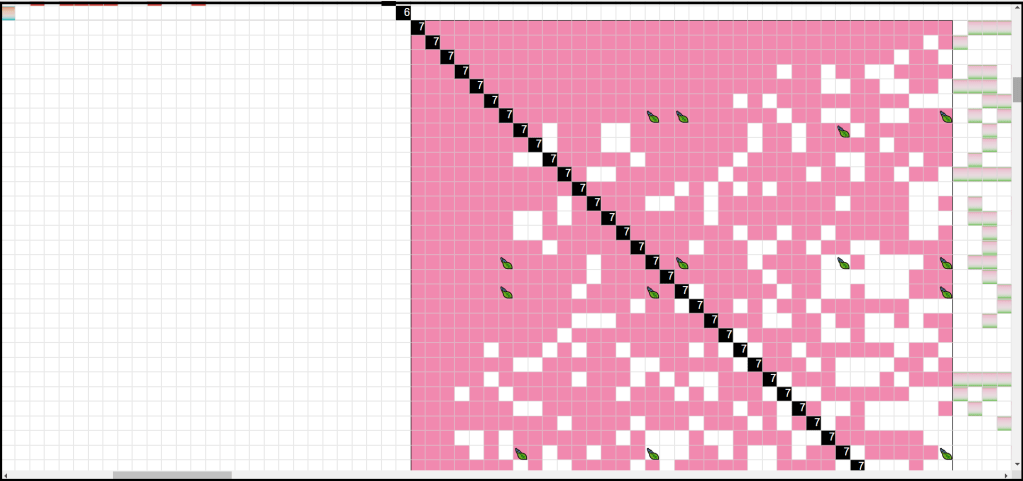
Had I also dug deeper into Aunt Betty’s DNA matches using some of analytical tools out there, I might have found my Cossins sooner. Several weeks ago, I ran a Collins-Leeds analysis at DNAGedcom on all of Aunt Betty’s matches at Ancestry that were within the 20–300 centiMorgan (cM) range, and the results included an enormous cluster with 36 members, whom I realize now are all related through the Hensy line (Figure 1). I’ve written a little previously about DNAGedcom, and more information can be found on their website. However, the purpose of autocluster analysis tools like this is to sort your autosomal DNA match list into clusters of people who are related to each other through a common line of descent.
Figure 1: Detail from Collins-Leeds analysis of Aunt Betty’s Ancestry DNA matches ranging from 20–300 cM showing Cluster 7. The pink/green shaded squares to the right are part of a supercluster between this group and the adjacent Cluster 8 (colored in green, not shown in this image), indicating matches in common between these two clusters, which implies related lines of descent.
The really cool thing about DNAGedcom for these analyses is the amount of information that is provided—assuming you take the time to dig into it, which I had not done previously. For that cluster shown in Figure 1, you’ll notice that some of the pink squares are marked with a green leaf. Those leaves mark the intersections of two DNA testers who have family trees linked to their DNA tests, and hovering the cursor over those squares will reveal the names of individuals found in both trees. You can even go one better and tap on any colored square (marked with a leaf or not) to see the option to “View Cluster,” or “View Chromo[some] Browser,” as shown in Figure 2.
Figure 2: The “View Cluster” and “View Chromo Browser” options that appear for viewing more information about a particular cluster identified via autocluster analysis at DNAGedcom.
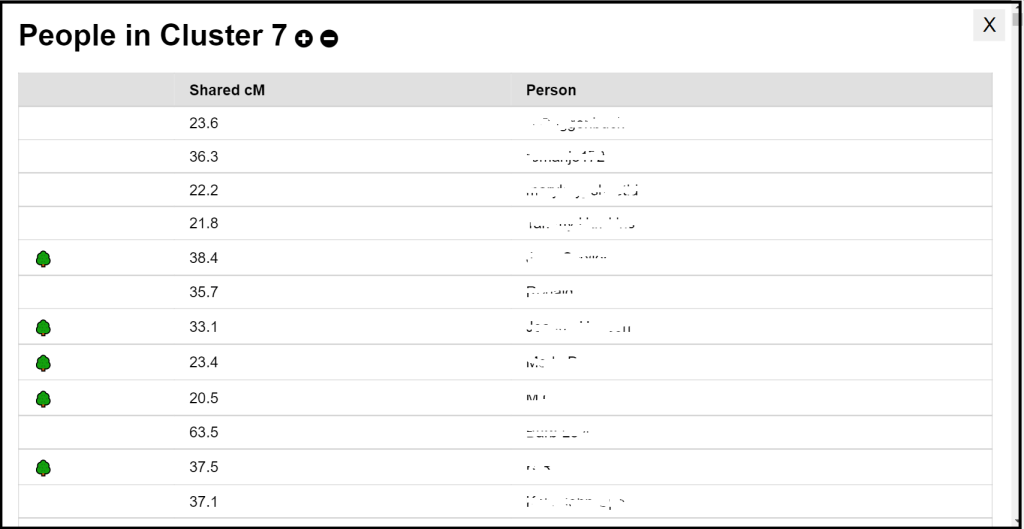
The data used for this autocluster analysis came from Ancestry, and much to the dismay of pretty much everyone interested in genetic genealogy, Ancestry does not offer a chromosome browser or any sort of segment data. So, the “View Chromo Browser” option will not work here, although it would work if these data were gathered from another source like 23&Me. However, clicking on “View Cluster” brings up the chart shown in Figure 3. Names of testers have been redacted for privacy.
Figure 3: Details about Cluster 7, obtained by selecting “View Cluster” option in autocluster matrix generated at DNAGedcom.
Clicking on the name of anyone in that list will take you to the DNA match page for that person at Ancestry. Tree icons on the left indicate those matches with linked family trees. Nice information, but if you keep scrolling down, it gets even better. After identifying the individuals with whom DNA is shared in each cluster, DNAGedcom goes one step further, identifying individual ancestors who appear in the family trees linked to those matches (Figure 4).
Figure 4: Ancestors mentioned in family trees linked to autosomal DNA tests for individuals from Cluster 7, as identified by DNAGedcom.
The names of the DNA matches who own each family tree are listed in the column on the far right, and have been redacted for privacy, but the chart indicates that Nicolaus, Johann Anton, and Servatius Thelen all appear in 4 different family trees of individual members of Cluster 7, as do Anna Maria and Andrew Schneider and Peter Simon. As it happens, the most recent common ancestral couple between Aunt Betty and these matches—Dionisy Hentzy and Agnes Antony— is not mentioned in this top part of the list. However, if we were to scroll down a bit, we would find them (Figure 5).
Figure 5: Dennis (Dionisy) Hanzi in ancestor list generated by DNAGedcom for ancestors identified in family trees of DNA matches in Cluster 7.
Admittedly, this is still a “Some Assembly Required” type of tool. The ancestor list for a given cluster identified by DNAGedcom does not immediately identify the most recent common ancestral couple. However, in conjunction with a list of ancestral FANs, and with guidance from the public member trees, which explain the relationships between individuals mentioned in the list, this is a powerful tool, indeed.
4. Use All the Information in Each Historical Record
The mistake that galls me the most in all of this is that I failed to fully examine the death record for Mary M. Roberts until I sat down to write that first blog post about this discovery. (Actually, had I blogged about my “brick wall” with Maria Magdalena earlier, I might have found my answers faster, since writing about something always forces me to review, organize, and reanalyze my information.) When I looked at my evidence for her date of death, I noticed that I had her probate packet and cemetery records, but I was still citing the index entry for her Michigan death certificate, which I had obtained years ago, and not the original record, which is now readily available online. Duh! One of the cardinal rules of genealogy is to always go to the original source, rather than trusting the information in an index, because so often there is additional information in the original, or there are transcription errors that are caught after viewing the original. Such was the case here, as well. The index entry, shown in Figure 6, only states that Mary M. Roberts was born “abt. 1833.”1
However, the entry from the death register contains more information than was indexed regarding her precise age at the time of death.2 The death register states that she was 61 years, 6 months, and 10 days old when she died, as shown in Figure 7.
Figure 2: Detail of death record for Mary M. Roberts, showing age at time of death as 61 years, 6 months, 10 days (boxed in green).
When I ran this through a date calculator (such as this one), it points to a birth date of 17 August 1832. This is almost an exact match to the birth date of 14 August 1832 that was noted on the baptismal record for Maria Magdalena “Gosÿ” from St. Louis Church in Buffalo.
Facepalm.
Had I made this connection sooner, I would have been much more confident in accepting that baptismal record as the correct one for Mary Magdalene Causin/Casin/Curzon/Couzens. I guess this is why we have Genealogy Do-Overs. All of us start our research by making rookie errors, so at the very least, it’s important to periodically step back and re-evaluate the search to see what is really known, and to make sure that nothing has been overlooked. Better still, consider a full-blown, Thomas MacEntee-style Do Over, which I have never yet had the courage to do.
Not all breakthroughs are the result of elegant or sophisticated methodology. Sometimes, you just keep hacking away at a problem, and you get to the answer in the end, and that’s what happened here. While the origins of the Causin family could possibly have been discovered, in time, using thorough documentary research in church records from Detroit and Buffalo, the process was expedited when the focus switched from the Causin surname to the Hentzy surname of one of their FANs. With the addition of insight gained from examination of DNA matches, the process was expedited still further. The combination of cluster research, autosomal DNA matching, and standard documentary research, is so powerful that it can even overcome a flawed research process. So, while this may not have been a pretty victory, it was a victory nonetheless. I’ll take it.
1 “Michigan, U.S., Deaths and Burials Index, 1869-1995,” database, Ancestry (https://www.ancestry.com/ : 17 November 2021), Mary M. Roberts, died 27 February 1894, citing Family History Library film no. 1377697.
2 “Michigan Deaths and Burials, 1800-1995,” database and image, FamilySearch (https://www.familysearch.org/ark:/61903/1:1:FHH5-3XW : 17 November 2021), Mary M. Roberts, 27 February 1894, citing Wayne, Michigan, Deaths, v. 13-17 1893-1897, no. 3598.





 From Shepherds and Shoemakers