Overview of Vital Records in Poland, Part I: Historical Background

Finding vital records in Poland can be a little confusing to the uninitiated, and sometimes even to more experienced researchers.  I’ve written about obtaining copies of vital records by writing to the archives in a previous post, but today, I wanted to give you a general overview of vital records in Poland.  Understanding how and why they were created can give you some insight into determining where to look for them.  In my next post, I’ll discuss the implications of all of this, and provide some examples for you.

Vital records, by definition, are records of life events — primarily births, marriages, and deaths — and the keeping of vital records began with the Roman Catholic Church.  At the Council of Trent (1545-1563), the Church decreed that, “The parish priest shall have a book in which he shall record the names of the persons united in marriage and of the witnesses, and also the day on which and the place where the marriage was contracted, and this book he shall carefully preserve.”1  Additional rules regarding the sacraments of marriage and baptism were set forth at this time, with instructions to the priests about recording those sacraments.  In 1614, Pope Paul V further defined the rites pertaining to the administration and recording of sacraments in his Rituale Romanum (The Roman Ritual) and introduced a requirement for priests to record deaths in their parishes as well.  At the same time, priests were required to maintain a register of souls (Liber Status Animarum) in their parish, for the purpose of ensuring that all their parishioners were receiving the sacraments as appropriate and were being duly catechized.  These parish census records later came to include additional information about each household in the parish, such as home addresses, and the ages and relationships of household members.

Over time, civil authorities came to recognize the value in these vital records as well, primarily for their use in documenting the local population for taxation and conscription.  Civil vital registration was introduced in different parts of “Poland” at different times, depending on which empire was in power in a given time and place.  During the years of the Polish-Lithuanian Commonwealth, church records were the only vital records in existence.  The very earliest church records are more informative for the nobility than they are for peasants, as surnames for peasants did not come into general use until the middle of the 18th century in some places.  Following a series of three partitions of Poland in 1772, 1793, and 1795, “Poland” disappeared from the map as an independent political entity, and the lands which had formerly been part of the Polish-Lithuanian Commonwealth were divided up by the Russian, Prussian, and Austrian Empires.

Civil Records in Austrian Poland

In 1784, the Holy Roman Emperor Joseph II gave official status to Catholic parish registers, and authorized Catholic priests to act as civil registrars for vital events pertaining to all people in their parish, regardless of faith. At that time he also prescribed the use of the columnar format for parish registers, and the use of individual records books for each village within the parish, replacing the practice of combining vital events from every village within the parish into one parish register. These records were required to be kept in Latin. It wasn’t until the middle of the 19th century that legal authority was granted to Protestants and Jews for the maintenance of their own vital registers, independent of those maintained by the Catholic Church.  A duplicate copy of the parish vital register was created at the end of each year, and was required to be sent to the civil authorities.

Civil Records in Russian Poland

Meanwhile, in another part of “Poland,” Napoleon introduced the practice of maintaining civil vital registers in the Duchy of Warsaw, starting in 1808.  The format of these civil vital records, prescribed by his Napoleonic Code, was quite different from the earlier Latin church records.  They were written in Polish, in a very flowery, legalistic style, and often included quite a bit more information than the Latin church records.  When the Duchy of Warsaw was incorporated into the Kingdom of Poland (“Congress Poland“) in 1815, the Napoleonic format continued to be used.  In 1826, the true Napoleonic format was replaced by a modified form, and at the same time, other religions were granted the authority to maintain their own civil registers distinct from those created by the local Catholic priest. Civil records from this period were written in Polish until about 1868, when Congress Poland, which was a Russian puppet state since its inception, was absorbed entirely into the Russian Empire, erasing any semblance of autonomy that existed previously.  Both church and civil records were required to be kept in Russian from this time, making the two types of vital records virtually indistinguishable.  The use of Russian continued until the emergence of the Second Polish Republic in 1918, when civil records were recorded in Polish once again.

Civil Records in Prussian Poland

In Prussian Poland,  parish vital registers were created in duplicate starting in 1794, based on a proclamation by Emperor Friedrich Wilhelm II, with the original being reserved for the church and the copy being provided to civil authorities. Both Catholic parish priests and Lutheran ministers were required to send these transcripts (Kirchenbuchduplikate) to the local courts.  In 1874, civil registration began in Prussian Poland that was independent of any churches.  People were required to report all births, deaths and marriages to a civil authority (Standesamt), the territory for which might be different from the territory of the local Catholic or Protestant parish.  Records were kept in German.

Civil Records since 1945

Since the end of World War II, civil registration in Poland has been carried out in local civil registry offices.  Each township (gmina) has its own registry office, or Urząd Stanu Cywilnego (USC) which creates and maintains official birth, marriage, and death records, as well as civil divorce records.  Official recognition was also given to civil marriages that take place independently from church ceremonies.  Until recently, any vital records that were less than 100 years old were protected by Polish privacy laws, and only immediate family or direct descendants (with proof of relationship) could request copies.  However, since 2015, a new law was enacted that makes marriage and death records available as archival documents after only 80 years, although births are still protected for 100 years.  Records older than 100 years are supposed to be transferred from the USCs to the appropriate state archives, and stiff penalties are in place to ensure that this happens on schedule.  However, in cases where the births, marriages and deaths are all bound in the same volume, it might happen that the USC retains possession of the volume for 100 years, but provides copies of the marriage and death records after only 80 years, as permitted by law.

In my next post, I’ll discuss some implications of these historical practices and how they influence where to find vital records, and after that, I’ll give some examples of vital records from each partition.

______________________

1Eternal Word Television Network. “Pius IV Council of Trent-24.” (https://www.ewtn.com/library/COUNCILS/TRENT24.HTM  (accessed September 16, 2016).

For further reading:

http://www.halgal.com/vitalrecordsaustria.html

https://familysearch.org/wiki/en/Poland_Civil_Registration

https://familysearch.org/wiki/en/Poland_Church_Records

https://www.archiwa.gov.pl/pl/dla-uzytkownikow/genealogia/typy-%C5%BAr%C3%B3de%C5%82-wykorzystywanych-do-bada%C5%84-genealogicznych

https://pl.wikipedia.org/wiki/Urz%C4%85d_stanu_cywilnego

https://mswia.gov.pl/pl/sprawy-obywatelskie/rejestracja-stanu-cywi/12982,Rejestracja-Stanu-Cywilnego-Wiadomosci-ogolne.html

© Julie Roberts Szczepankiewicz, 2016

Tips for Hiring a Professional Researcher in Poland

If you’re like me, you prefer to do your own research, rather than hiring it out to a professional.  Those moments when you find the long-sought record that finally gives you your great-great-great-grandmother’s maiden name are priceless, right?  And if the records can be found on microfilm, online, or even by writing to one of the archives in Poland, that’s great.  But sometimes it happens that the pastor of your ancestral parish has parish registers from the past 300 years sitting in his office, or the records are at diocesan archive which doesn’t respond to queries, and requires you to find a professional to search in person.

We’ve all heard the horror stories of people who have paid money up front — sometimes quite a bit — and maybe gotten a record or two before their “professional” falls off the face of the earth and stops responding to e-mails and phone calls.   You don’t want to be in that situation, because often there is no recourse — most people in this case just lose whatever money they’ve put up.  But hiring a pro doesn’t have to be a terrifying experience if you work with someone who’s experienced, honest, and fair.  So how do you find the right professional?

1. Get recommendations before you hire.

As an admin for a couple Polish genealogy groups on Facebook, I often get messages from group members asking for recommendations for researchers, and I’m happy to share my experiences with you.  There are also plenty of other group members who have used professional researchers, so ask around, send a message to one of the group admins, or request references from any researchers you’re considering.

2.  Determine the scope and budget for the project.

Personally, I’m happy if my researcher finds the records of interest, uploads the images to a site like DropBox so I can access them, gives me a report on exactly what books and ranges of years were researched, and I’ll take it from there.  But others are looking for a completely documented family tree, including a GEDCOM and a more detailed research report, including full translations of all the records.  Obviously, the more work you need your researcher to do, the greater the cost, so bear that in mind as well.

3. Start with clearly defined research goals.

After you’ve decided what kind of final product you’re looking for, establish clear research goals to begin with. For example, “I would like to find my great-grandmother’s birth record in X parish, circa 1876, her parents’ marriage record, and any other records for her surname in this parish.” Prepare a concise summary for the researcher of what you already know about your family in Poland and your immigrant ancestor (name, approximate date of birth, names of parents and siblings who stayed in Poland, etc.) Stick to facts and keep the family stories and speculation to a minimum.

4. Expect to pay per hour of research, rather than per record.

A good researcher may be able to find two dozen records for your surname of interest in one hour’s time, or maybe only one record. Generally speaking, the earlier you go, the more “spotty” the records become. If the records aren’t indexed, that will also increase the time it takes to find them, because the researcher must skim through every record.

5. Get an estimate before you begin.

Most researchers require some of the money up front, whether in the form of a minimum retainer (e.g. 5 hours’ research time paid in advance), or according to other terms.  Some will allow you to pay after the work is finished.

6.  Understand what’s included, what’s not, and how billing is done.

Travel costs and  donations for the parish or archive are usually billed separately.  Time spent writing the research report and creating the GEDCOM might be billed separately from the research time in the parish or archive as well. A good researcher will break down the invoice for you. Full translations are usually not included, but you could negotiate a price if you’d like them.  Key information extracted from each record, i.e. names, dates, godparents’ and witnesses’ names, etc., is usually included, but I’ve heard of researchers who did not provide this without an additional charge.  Establish in advance what is provided so there are no surprises.

7. Good communication is key.

I personally would not hesitate to work with someone who only speaks Polish if he were highly recommended (there’s always Google Translate!). But if you choose to do that, understand that you might need to work a little harder to be sure both parties clearly understand the expectations.

8. Understand that there are no guarantees.

If a researcher visits a parish in search of your great-grandmother’s baptismal record, but finds nothing because you’ve incorrectly identified the parish, that’s on you.  Or sometimes a researcher may travel to a distant parish to obtain your ancestors’ marriage record and DOES find it, but the record itself indicates that the bride or groom was from another parish, necessitating further research elsewhere. That happens.  A good researcher should at least be able to document his efforts, showing you where he’s looked and how he’s spent his time, even if positive results are scarce.

9. Since travel costs are usually extra, it helps if you can find a researcher who is more or less in the same part of Poland as your ancestral villages.

I’ve heard of researchers who don’t overtly charge extra for travel within the country and travel all over Poland for records, but I suspect that they must be rolling this cost into their research time somehow.

10. Be sure you clearly understand the time frame over which the work will be done.

It might take a few months before the researcher has the opportunity to get to your work, but having to wait a year for results is excessive.  Things can be especially slow if a visit to a parish is required, as some pastors aren’t enthusiastic about having a researcher come in and peruse their parish registers, and may put off granting an appointment.  However, gentle persistence from your researcher will usually (hopefully, fingers crossed) win the day, and your researcher should keep you informed of his phone calls to the parish.

11. Research in Poland may not be as expensive as you think.

Years ago I was reluctant to hire a researcher in Poland because I feared the cost might run into thousands of dollars. Instead, I was pleasantly surprised at how affordable it was. As an example, one researcher searched parish records for me from 1784-1826 (births, marriages and deaths), found 48 records during that time, and the charge was just $150 plus $10 for gas. In another instance, a researcher visited both the parish and the USC, found 56 records for me (between 1826 and 1880), and the cost was $115. Your mileage may vary, and results are not guaranteed, but I have been delighted by how much I have learned about my family from these records.

Hiring a professional researcher doesn’t have to be terrifying or break the bank, but it does take some effort to ensure that you and your researcher are communicating clearly and effectively.  As long as both you and she understand the expectations in terms of research goals, final product, and billing, having a researcher find records for you can be a very satisfying way to further your research into your Polish roots.  It may not be as much fun as a trip to Poland to do the research yourself, but it’s almost certainly much cheaper.

Good luck and happy researching!

© Julie Roberts Szczepankiewicz 2016

Online Translation Aids

Newcomers to the Polish Genealogy group are often intimidated by the prospect of translating records in foreign languages.  Poland’s complicated history has dictated that vital records may be found in Latin, Polish, German, or Russian.  However, fluency in these languages is not required for successful genealogical research.  Vital records tend to be very formulaic, and with practice, one can learn to translate them with relative ease.  The very best translation guides that I’ve found are not online.  They are a series of books written by Jonathan D. Shea and William F. Hoffman, entitled, In Their Words:  A Genealogist’s Translation Guide for Polish, German, Latin and Russian Documents.  Volume I:  Polish, Volume II:  Russian, and Volume III:  Latin have already been published and purchasing information can be found here at the authors’ website.

Less comprehensive assistance can be found online.  Although machine translators (e.g. Google Translate) can be useful from time to time, their use is often best limited to individual words or short phrases, particularly when dealing with old texts which may be written in an old-fashioned, “wordy” or flowery legal format.  There are a variety of websites that can assist, in a pinch, with translating documents.  I made a list of some that I’ve found most helpful for the Polish Genealogy group, grouped by language.

Multi-lingual translation aids (these pages provide assistance with translation of Polish, Russian, German, and/or Latin, to English):

https://sggee.org/research/translation_aids.html

https://familysearch.org/learn/wiki/en/Poland_Civil_Registration-_Vital_Records

The entire article in the above link is very informative, but scroll down about ¼ of the page to get to the translation examples.

Polish:

https://familysearch.org/learn/wiki/en/Poland_Genealogical_Word_List
http://www.rootsweb.ancestry.com/~polwgw/terms.html
http://www.rootsweb.ancestry.com/~polwgw/trans.html
http://en.wiktionary.org/wiki/Appendix:Polish_given_names

A word about given names:  A common problem with “translating” Polish given names into English is that some old Slavic names simply have no exact translation.  By “exact,” I mean that typically, if there is a Christian saint with a particular name, that saint’s name is the basis for translation. So the traditional Slavic name Wojciech is commonly translated as Adalbert because St. Wojciech took the name Adalbert at his confirmation.  Names like Władysław, Stanisław, Bronisław, etc. commonly use the Latin form as the “correct” translation (e.g. Ladislaus, Bronislaus, Stanislaus).   People with those names who immigrated to English-speaking countries often assumed names that were similar visually or phonetically to their original names, but there were no hard-and-fast rules about these things.  So Władysław often became Walter, Stanisława often became Stella,  and Pelagia often becamse Pearl — but other choices were possible, and ultimately it was up to the individual what name he or she decided to use after immigration.  I have two individuals on my husband’s side of the family who were baptized as “Stanisław,” but became “Edward” in America.  So it’s best to keep an open mind about given names when researching.

Russian:

http://zofiafederowicz.com/akta-metrykalne/?setlang=enhttp://www.learn-russia.com/lessons/alphabet.php
http://allbell.tripod.com/cursive/russalph.html
http://masterrussian.com/blalphabet.shtml
http://www.pitt.edu/~armata/cyrillic.jpg
https://familysearch.org/learn/wiki/en/Russian_Genealogical_Word_List
http://files.lib.byu.edu/family-history-library/research-outlines/Europe/Russia.pdf

Latin:

http://apps.nationalarchives.gov.uk/latin/beginners/default.htm

The above link is for a Latin tutorial that might suit those who really want to learn Latin, but may be more comprehensive than necessary for those who only want to know enough to translate church records from Polish parishes.

http://www.newadvent.org/cathen/01022a.htm

The above link is for a helpful list of ecclesiastical abbreviations, which are very common in Catholic church records.

http://genealogy-quest.com/glossary-terms/latin/
https://familysearch.org/learn/wiki/en/Latin_Genealogical_Word_List http://www.genealogy.ro/dictionary/

The preceding three links are all for Latin genealogical word lists, so there’s some overlap among them.

http://archives.nd.edu/latgramm.htm
http://www.worldlingo.com/en/resources/latin_dictionaries.html

This link (above) includes additional Latin links to dictionaries and word lists.

German:

http://c.ancestry.com/cs/media/social-research-german-civil-registration.pdf

https://familysearch.org/learn/wiki/en/German_Word_List
http://www.odessa3.org/collections/articles/link/illness.txt

The above link is specifically for German to English translations of illnesses and causes of death.

http://www.suetterlinschrift.de/Englisch/Sutterlin.htm
https://familysearch.org/learn/wiki/en/Germany_Handwriting

The preceding two links provide assistance with recognizing “old German” Suetterlin script.

http://www.usgennet.org/usa/ne/topic/ethnic/german_terms.html
https://familysearch.org/learn/wiki/en/Prussian_Poland_Civil_Registration


I hope these links are helpful to you in your research. If you know of some great sites that I’ve missed, please let me know!  Happy researching!

© Julie Roberts Szczepankiewicz 2016

Using Facebook for Genealogy

When one thinks of useful tools for genealogy research, social media might not be the first thing that springs to mind.  But social media in general, and Facebook in particular, can be a powerful addition to one’s genealogy “toolbox.”  In this article, I’d like to explain how Facebook genealogy groups can be used effectively in genealogy research, as well as some “do’s and don’t’s” for participating in these groups.

Why Use Facebook for Genealogy?

If you’re not on Facebook, you might not realize that there are over 9,000 genealogy-related groups and pages on Facebook.  And that only counts the ones where the primary language of communication is English!  Genealogist Katherine R. Willson has done for Facebook what Cyndi Ingle (creator of the popular “Cyndi’s List“) has done for genealogy websites, by compiling and indexing a list of all the genealogy groups and pages on Facebook, and making it available in a searchable PDF form on her website.  In addition to groups which focus on research in all fifty states, there are county and regional groups, groups, groups focusing on research in a specific country, and groups which focus on subjects like DNA, adoption, reuniting family Bibles with their families, strategies for getting organized, military history, lineage societies, and everything in between.  If you can think of a special interest that falls under the larger umbrella of genealogy research, chances are good that someone has started a group or page for it on Facebook.  Looking for an easy way to share your own research progress and family photos with interested members of your extended family?  You can create your own Facebook group and invite them to join!

At this point, you may be wondering about the difference between a group and a page.  Per Facebook’s explanation, pages are typically created and managed by an official representative of an organization.  So if you’d like to keep up-to-date with the latest news, events and tips shared by the Polish Genealogical Society of Massachusetts, for example, you can “like” their Facebook page and their posts will appear in your newsfeed.  Typically there’s not as much discussion on a page as there is in a group, which is a place where people can discuss a common interest, share photos, etc.  Groups don’t usually represent an organization that exists outside of Facebook, and therefore they have no official representatives.

To give you an example of the power of these groups, last October, I posted in the German Genealogy group.  I had decided to dust off my research on some of my German lines, so I posted a question about whether the church in Roding, Bavaria would have records for the village of Obertrübenbach, since I had discovered that there was also a church in Obertrübenbach itself.  One of the group members, Klemens (Mente) Pongratz, commented on my thread.  Mente is a local historian and part-time archivist for his hometown in Germany, and many years ago he had created an index for vital records in the parish of Roding.   He happened to have this index on his home computer, and in a matter of minutes, he found the baptismal record for my great-great-grandfather as well as additional records for this family back to 1717, and was able to provide the specific record number and fiche numbers necessary for obtaining scans from the German archives!   What a pleasure to find someone else researching in the same area, who really knows the local history, the archives, the language and the culture, and is so willing to share his expertise!  This is exactly the kind of connection which Facebook groups facilitate, and the kind of magic which I find so satisfying to help create in the Polish Genealogy group.

Polish Genealogy on Facebook

I can’t write an article about using Facebook for genealogy without putting in a plug for the Polish Genealogy group, for which I’m an administrator.  Polish Genealogy was founded in 2008 by Michael Mulholland, a librarian and avid genealogist from Arlington Heights, Illinois. In 2013, recognizing that the group was approaching 1,000 members and was getting to be too much for one person to manage, he added me and some others as additional admins.  Michael is largely emeritus now and not actively involved in the day-to-day maintenance of the group, but the community he envisioned lives on.  We now have close to 9,000 members from around the world, united in our common pursuit of our Polish roots, and active admins include Valerie Warunek, Beth Whitson, Waldemar Chorążewicz and Johanna Maciejczyk-Leck.

Group members in Polish Genealogy range from beginners to professionals, and offer free assistance with research direction, deciphering handwriting or translating records (English, Polish, Latin, Russian, German, Ukrainian, etc.), and locating vital records online or offline, as well as offering camaraderie.  Facebook groups are a little like a genealogy conference or genealogical society meeting that’s taking place 24 hours a day, 7 days a week, where you can celebrate successes, brainstorm, learn new strategies, and vent about frustrations, brick walls, and DNA matches that never reply to your messages.  A dedicated, core group of volunteers is typically on hand to offer assistance, as their personal schedules allow, but everyone is welcome to contribute to the discussion.

It’s not uncommon for a new member to post in the group with just a document or two, and maybe a vague recollection that, “Grandma’s family was supposed to be from somewhere near Warsaw,” and have the group work the problem collaboratively, so that by the end of the discussion, in real time, Grandma’s birth record from Poland has ultimately been produced.  I can’t promise results like this, of course — some problems are more challenging than others.  But at the very least, we can usually suggest next steps to take so that the group member can continue his or her research.

How do I join?

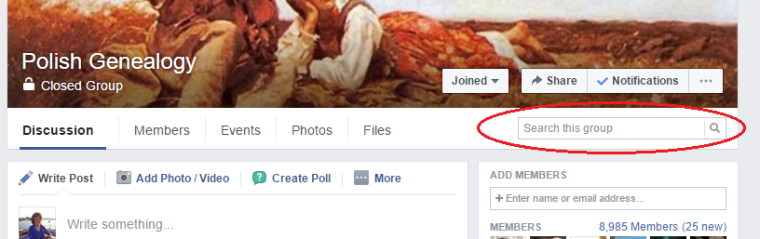
It’s pretty easy.  If you’re not on Facebook, create an account at Facebook.com.  Once you’re logged in, you can find groups by typing keywords in the search box at the top of the page, shown here:

Search Facebook

If you type in “Polish Genealogy,” for example, it will take you to group’s page, where you’ll see a button that says, “Join Group.”  Once you do that, one of the admins will have to approve your request to join.  Polish Genealogy is considered a “Closed Group” on Facebook.  Contrary to what one might think, that does NOT mean that we don’t accept new members.  What it means is that posts and comments made in the group won’t show up in the newsfeed of group members’ Facebook friends who aren’t in the group, as can happen if a group is public.  Here is more information about privacy levels in Facebook groups.

With 1.65 billion active monthly users, Facebook users represent a cross-section of humanity, and not everyone in that community is going to be benevolent.  In our efforts to screen out the bad guys (fake profiles, spammers) we admins carefully review the profiles of new applicants to the group, looking for indications of an interest in genealogy. Sometimes profiles are set up to be very private, and they don’t give us much to go on.  In those cases, I will often write a brief note to applicants individually to inquire further about their research interests. So if you apply to join the group, and it’s been a few days and you still haven’t heard anything, please check your Facebook messages.

Messages?  What messages?

Every Facebook user has three message boxes, all of which can be accessed by clicking on the little speech bubbles icon, shown here:

Message box

Once you click that, you’ll see two of your message boxes:

Message requests

The “Recent” box is where messages end up from people who are already your friends on Facebook.  The “Message Requests” box is (ideally) where you can find messages from people who aren’t already your friends on Facebook.  You have the option to read those messages, and then accept them or delete them.  However, within “Message Requests” there’s another box that even many Facebook-savvy people don’t think about, which is the “filtered requests” inbox.  This is where messages are sent when Facebook algorithms determine that they’re likely to be spam. Unfortunately, that’s often not the case, and it seems as though every time I think to check it, there’s at least one legitimate message in there.

Filtered requests

With so many groups to choose from, how do I decide?

Facebook groups can be a fantastic asset to your research, but it’s impossible for anyone to keep up with a hundred different groups.  So you might want to pick a few to start with and focus only on those.  When choosing which Facebook groups might be most beneficial to your research, be sure to check out the  group’s description, shown here, prior to clicking “Join Group.”

Description.png

Sometimes these descriptions contain special instructions, such as a request to message one of the group admins when you submit your request to join, if your profile has high privacy settings.  Following these instructions will expedite your admission to the group and make the admins’ lives easier.  Trust me on this one, admins spend a lot of time vetting new members and screening out spammers, and I’m thrilled when applicants actually follow those instructions and contact me first, so I don’t have to write to each and every person with a private profile who would like to join one of my groups.

So maybe now you’ve selected a few Facebook genealogy groups and have joined them. What should you do to derive maximum benefit from them?

The “Do’s” and “Don’t’s” of Facebook groups

1.  Do read the pinned post.

The pinned post is found at the top of the group’s page, just under the cover photo, and contains the rules for that particular group.  Most admins have the goal of maintaining a respectful, friendly environment, and keeping posts on topic, but some are more specific than others about how this is to be achieved.  In the Polish Genealogy group, for example, our focus is genealogy, so questions about Polish culture are more appropriate for our sister group, Polish Culture, Food and Traditions.  Similarly, discussions of Polish genetic genealogy are tolerated, but they’re more appropriate for the Polish Autosomal DNA group, or one of the other genetic genealogy groups.

2.  Do check out the group’s files

Files can be found here:files

The files contain lists of valuable websites for Polish research, tutorials on how to use those websites, lists of professional researchers in Poland, online translation aids, the group’s alphabetized surname registry documents (where members can list their surnames of interest and the geographic areas associated with those names),  and more.

3.  Do search the group’s history

files

You might find that your question has already been discussed previously, or you might find others who are working in the same parishes or on the same families.  I can think of several occasions when group members have discovered that they’re related to one another, and it could happen to you!

4.  Do be sure to get your data organized before you post, and give us specifics.

Example of a good post:  “My great-grandfather was Joseph Zielinski, born abt. 1892 in Poland.  His passenger manifest says he was born in Miszczewice but other records say Warsaw or Sochaczew.  He immigrated to North Tonawanda, New York and his marriage record gives parents’ names as Stanley Zielinski and Mary Kalota.  I’m trying to find his birth record and any other records for the family in Poland.”

Example of a poor post:  “My great-grandfather was John Kowalski.  Has anybody heard of him?”

5.  Don’t expect others to do your research for you.

Although group members will often bend over backwards to help people, we are all volunteers.  Everyone has jobs, families, lives outside of Facebook, and his or her own research to attend to.  It’s possible that someone might find you several records for your family in Poland, but it’s also possible that he will give you a link to the appropriate vital records collection online and you’ll have to do the research yourself.  Many group members have learned to translate documents in Latin, Polish, German and Russian, at least well enough to pick out the names of their ancestors.  If you get stuck, you can always post again and ask for further assistance.  But mostly the group is about giving people fishing poles and teaching them to fish, rather than handing them their fish on a silver platter.  Attitudes of entitlement don’t engender much sympathy.

6.  Don’t be thin-skinned.

Online interactions are always fraught with a bit of peril, because they lack the tone of voice and body language that allow us to distinguish between gentle, good-natured teasing and frank hostility.  I always try to read people’s comments in the best possible light, and recognize that in Facebook groups, as in life, there are some people I’d enjoy having a cup of coffee with, and others I’d prefer to avoid.  If someone rubs you the wrong way, let it go and move on.  Also, be aware that some of our group members don’t really speak English — they use Google Translate for all their comments.  Because of that, they try to keep their comments brief and to-the-point, which can sometimes sound harsh.  Be as patient with them as you’d like them to be with you in a foreign-language group.

7.  Do get to know the group’s “regulars.”

If you lurk in the group for a while, even when you don’t have a specific question to post, you’ll get a sense about which members are most knowledgeable and offer sound, reliable advice most consistently.  Occasionally it happens that a relative newbie will offer advice or make a statement that maybe isn’t sound, well thought-out, or factual.  Everyone is entitled to an opinion, but not all opinions are equally well-informed.  You are the ultimate authority on your own family history, so you should take whatever advice you receive and evaluate it critically to see if it makes sense.

8.  Do remember to thank those who helped you.

It sounds like a simple thing, but we’ve all had it happen that we share our time and expertise with someone who never even bothers to say “thank you.”  This is especially irksome when a volunteer has gone so far as to provide scans of records, or translations.  Be gracious and grateful, and you’ll find that people will be more willing to help you again in the future.

Facebook groups really offer something for everyone.  You might break down a brick wall or two, or even meet some cousins.  No matter what your level of proficiency, you’re sure to learn something new, and maybe even make some new friends.  In particular, I welcome you to check out Polish Genealogy, Genealogy Translations, and the Polish Culture, Food and Traditions group, which are three of the groups I admin.  And if you’ve got a success story about how Facebook genealogy groups have helped you, I hope you’ll share it in the comments.  Happy researching!

© Julie Roberts Szczepankiewicz 2016


Search Tips for Beginners in Polish Genealogy

Note: Please see the revised and updated version of these search tips here. However, the original post appears below.

In the Polish Genealogy group on Facebook, we get a lot of people who are brand-new to researching their family history.  To help keep the regular volunteers from getting burned out by saying the same thing over and over again, I wrote up this quick list of search tips and linked it to the pinned post, so that we could refer newcomers to it and help them get started.  Although I wrote it specifically for Polish research, many of the same principles apply no matter what ethnicity your immigrant ancestors were.  The key to continuing research in the Old Country is to find records from the New Country that mention the immigrant’s specific place of birth.  So if you’re reading this blog and you’re new to genealogy, my suggestions to you are:

1. Get a book.  Researching your Polish genealogy is quite a different thing in some ways from researching one’s U.S. ancestry.  To help you familiarize yourself with the history and geography that are essential to your understanding of researching your family in Poland, it’s a good idea to get a beginner’s guide to Polish genealogy.  There are quite a few books on the subject.  You might want to check Amazon (search “Polish Genealogy”) for reviews.

2. Start with yourself and work backwards.  Interview older family members, if any are still around, and ask them questions about everything they remember about their immigrant ancestors.  If all your older family members are deceased, don’t panic – their paper trail is still there, and that’s what we all use to document those family stories anyway.

3. Check out the sites for “one-stop shopping,” like www.familysearch.org, www.ancestry.com, www.fold3.com, etc.  Family Search is free, and the paid sites can probably be accessed free of charge at your local public library.  These sites are good for gathering census records, passenger records, military records, and other types of basic documentation.  Please note that the information available on these sites represents only the tip of the iceberg for what’s out there.  Most of the documents you’ll need are still sitting in churches, courthouses, archives, and libraries, waiting for you to discover them.  In this era of immediate gratification via the internet, people sometimes begin with the unrealistic expectation that somewhere, someone out there has done all the work for them.  While this might be true (to a point) if your ancestors have been living in the U.S. since Colonial times, it’s much less likely to be true if your ancestors arrived here from Poland just a generation or two ago.  Don’t forget that genealogy still requires patience, persistence, time, and good-old fashioned research done with letter-writing, phone calls, and personal visits, if possible.

4. Do your homework in U.S. records before attempting to trace your family in Poland.  It’s a common mistake for people to find one document with a place of birth on it (most likely misspelled) and to try to use that to begin tracing their family in Poland.  Be patient.  In many cases, there are multiple towns and villages in Poland with the same name (think of researching a U.S. place called “Springfield”).  It’s a good idea to obtain several documents with place of birth information so you can compare them before trying to research in Poland.  It’ll save you time (and maybe money) in the long run.

5.  Absolutely make every effort to obtain vital records from the church your immigrant ancestors attended in the U.S.  I cannot state that strongly enough.  Church versions of marriage and death records are much more likely to contain your immigrant ancestor’s precise place of birth in Poland than are the civil equivalents.  Moreover, these places were probably recorded by a Polish priest, so they’re likely to be spelled more or less correctly.  You should also obtain baptismal records for the children of your immigrant ancestors.  These frequently contain an “ex loco” portion that will tell you where the parents came from.  Not every record will contain that information, so be thorough:  if you know that your great-grandmother’s sister also immigrated and lived in that same parish, get her marriage record as well as your great-grandmother’s record.  Get ALL the baptismal records, not just for your own direct line of descent.  Documents from collateral lines can often provide that critical breakthrough you need.

                    5a.  Don’t know what parish your ancestors attended?  Find their address in the census records.  Parishes had defined geographic boundaries (still do!) and people were not likely to “shop around” for a parish they liked, as is often the case today.  People in the group can often assist with identifying the correct parish, so ask if you need help.

                    5b.  Before you write to that parish, check the Family History Library catalog at www.Familysearch.org to see if records for that parish were microfilmed.  If so, it’s often faster to order the microfilm than to wait for the (tired, overworked) parish secretary to get around to replying to your genealogy request.

                    5c.  If you do need to write to the parish, keep in mind that the primary function of the parish staff is to meet the spiritual needs of their congregation, NOT to fulfill genealogy requests.  Make sure to enclose a donation for the parish, and be prepared to wait a while. It’s best to request only a few records (1-3) at a time, keep your letter brief, and be as specific as you can.  If you’re requesting a marriage record, for example, obtain the civil equivalent first – that way, you already know the exact date of the event. Be sure to ask for a clear digital photo or photocopy of the parish register, rather than a typed extract, which Catholic parishes sometimes provide as proof that a sacrament was administered in their parish.  Explain that the original record may contain information that’s vitally important to your search, so you need the full, original record.  If they hesitate due to “privacy concerns” suggest that they cover up the other entries on the page with a sheet of paper, so that only the key entry (and the column headings, if there are any) are showing.  Be polite and respectful — churches are under no obligation to provide copies of their records, so it’s an act of kindness if they choose to do it.  It’s okay to follow up with phone calls, e-mails or letters if a decent interval (4-6 weeks) has gone by and you still have not received a reply.  When you do receive your records, remember to send a thank-you note.

6. Obtain other key records to obtain in order to determine place of birth in Poland:

a.Passenger records.  Family Search, Ancestry have these, and you can find records specifically for the Port of New York from www.ellisisland.org (after 1892) and www.castlegarden.org (before 1892)

b. Naturalization records. Pre-1906, they might not give specific place of birth info, but after 1906 they almost certainly will.  My ancestors are from Buffalo (in Erie County) New York, so I have always been able to obtain these records by visiting/calling/writing to the Erie County Court building.  However, you may need to try the National Archives (http://www.archives.gov/research/naturalization/) or the U.S. Citizenship and Immigration Services (http://www.uscis.gov/genealogy)  Post-1906 records can be goldmines.  They often contain not only the place of birth of the man who was becoming a citizen, but also the place of birth of his wife.   Remember that, prior to the Cable Act of 1922, a woman’s citizenship was a reflection of her husband’s (see http://www.archives.gov/publications/prologue/1998/summer/women-and-naturalization-1.html for more information).  So prior to 1922, you’ll want to look for the naturalization records for the husband of your female ancestors.

c. Military records.  World War I draft registration cards will often provide a specific place of birth.

7. Leave no stone unturned.  As family historians, our job is to document the lives of our family members, so be thorough.  Think beyond the basics, and check out additional sources for information about your family.  As an example, the Polish Genealogical Society of America has a database of insurance claim files from the Polish Roman Catholic Union of America.  The application for life insurance often has fantastic medical and personal information about the applicant (number of brothers and sisters still living, age at which parents died, etc.).  Buffalo’s Polish-language newspaper, the Dziennik Dla Wsystkich, published from 1911-1957, provides a fascinating look into the lives of our ancestors.  Even if you don’t read Polish, you can scan through and find stories and photos of your family, and post them here in the group for translation.  If you have ancestors from New York State, also be sure to check out the newspaper archive at www.fultonhistory.com, which contains keyword-searchable newspapers from all across New York State, from the late 1800s until about the 1980s.

8. Join a Polish genealogical society, either nationally (the Polish Genealogical Society of America, http://www.pgsa.org) in an area where your ancestors lived, or where you live now.  Examples include the Polish Genealogical Society of New York State (www.pgsnys.org), the Polish Genealogical Society of Michigan (www.pgsm.org), the Polish Genealogical Society of Connecticut and the Northeast (www.pgsctne.org), the Polish Genealogical Society of Massachusetts (www.pgsma.org), etc.  Typically their websites have useful databases and resources (i.e. the Polish letter writing guide at the PGSA site) and they have meetings at which you can connect with others researching their Polish heritage in your area.

Hopefully these tips will help you get started in researching your Polish family in U.S. records.  When you’re ready to make the leap into Polish records, the real fun begins. All of us in the Polish Genealogy group on Facebook are looking forward to sharing your joys and frustrations on your genealogical journey, and helping out when we can.  Happy researching, and remember that there’s no such thing as a stupid question – we’re here to help.

© 2016 Julie Roberts Szczepankiewicz

Step-by-Step Guide to Finding Vital Records in Metryki.Genealodzy.pl

As an administrator for the Polish Genealogy group on Facebook, I like to help people get past whatever “brick walls” they’re facing with their genealogy research.  It’s really satisfying when someone comes to the group with maybe one or two documents for an immigrant ancestor, and in real time, the group’s volunteers can determine that immigrant’s place of birth in Poland, and maybe pull up the immigrant’s birth record and his parents’ marriage record while we’re at it.  We’re able to do that so often because of all the fantastic Polish vital records databases that are online now.  However, English-speakers often find these Polish-language websites intimidating.  With that in mind, I hope to occasionally use this blog to post step-by-step guides to using some of these databases, starting with this guide for locating vital records using the site, “Metryki.Genealodzy.pl.”  If you’ve come to this blog from the Polish Genealogy group, you may realize that a very similar guide already exists in the group’s files.  But, hey, I wrote it, so I figure it’s fair game to post a slightly updated version of it here as well.


Metryki.Genealodzy.pl is more than just a repository of scans for parishes indexed in Geneteka.  What many people don’t realize is that the two sites operate independently – that is, there are parishes for which scans are available in Metryki that are not indexed in Geneteka, and there are parishes indexed in Geneteka for which scans are not available in Metryki.  Sometimes a parish may be included in both databases, but for different ranges of years.  Therefore, both sites should be checked when one is seeking records for an ancestral parish.

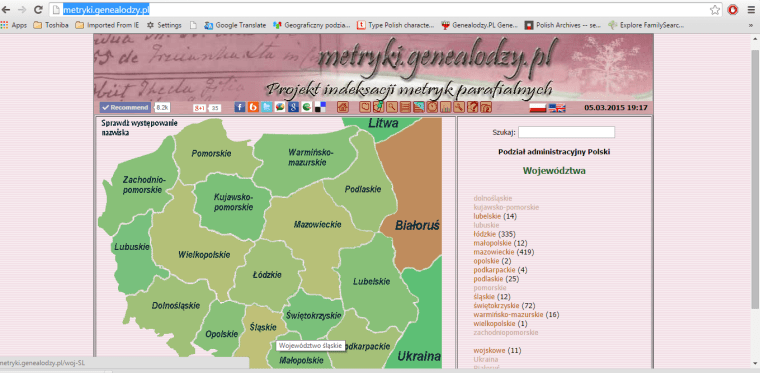
To learn to use Metryki, let’s start here:  http://metryki.genealodzy.pl/

Metryki.genealodzy.pl start page

On the left is an interactive map, so one can begin to explore the resources here by clicking on the name of a province, OR one can select the name of the province from the list at the right.  Alternatively, one can enter the name of a parish of interest in the search box at the top.   Also note that it’s possible to change the language of the site to English by clicking on the British/American flag icon near the top right corner. As an example, if one is interested in records for Gradzanowo Kościelne parish in Żuromin County, Mazowieckie province, one can start typing “Gradzanowo” into the search box at the top.  In this case, by the time there are four letters there, the search engine has found Gradzanowo among the available parishes:

grad screen

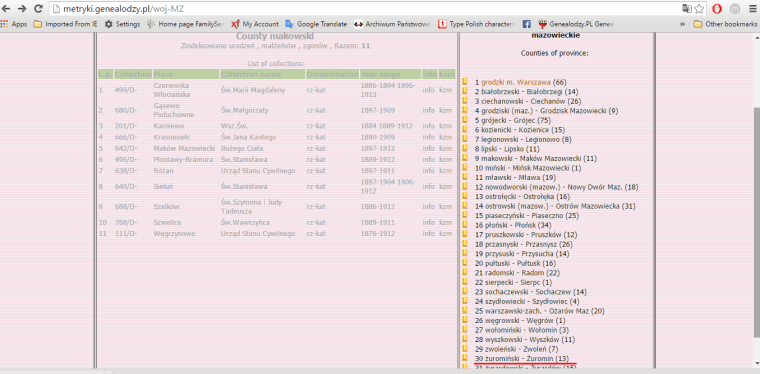
At this point, one could click on that link.  However, sometimes one might want to browse from the map, to see all the resources that are available for a particular county.  To demonstrate locating records for Gradzanowo this way, let’s pretend we click on “Mazowieckie” on the map.  The next screen we come to looks like this:zurominski

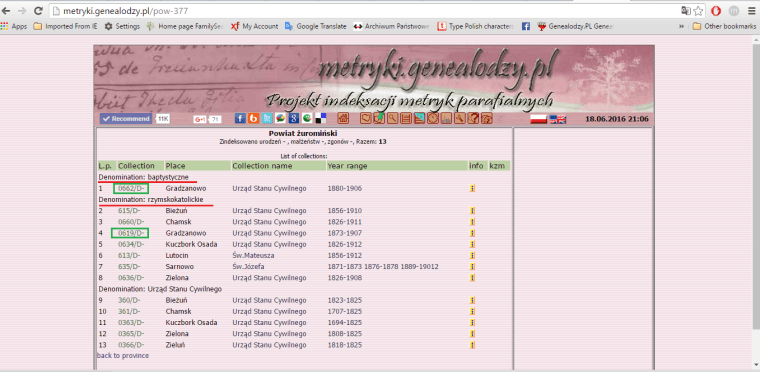
This shows us a list of counties in the province (“Powiaty województwa,” in the default Polish language) and how many parishes or registry offices – the number in parenthesis – are available for each.  If we want to browse to the records for Gradzanowo, we must know that it’s in Żuromin County, and click on item 30 in the list.  If someone doesn’t know the county in which his ancestral village is currently located, a quick search on Google or Google.pl should provide that information.  Once we click the link that reads, “30 żuromiński – Żuromin (13),” we see this page:gradzanowo denominations

This page shows all 13 records collections that are currently available for Żuromin County, grouped according to denomination.  For this particular county, Baptist, Roman Catholic, or civil records(“Urząd Stanu Cywilnego”) are available, although one might also see records from the Lutheran, Jewish, or other faiths.  Within each denomination, we see that a collection name is further specified, which is either the name of a parish ( Św. Mateusza or Św. Józefa in this example, meaning St. Matthew’s or St. Joseph’s, respectively) OR the term, “Urząd Stanu Cywilnego” again.  The use of this term might be confusing to those who are beginners in Polish research, who might be wondering why civil records would be a category under the heading of religious denominations,  and why they might also be mentioned as a collection belonging to a Baptist or a Roman Catholic church.   To understand this, we need to realize that clergy acted as civil registrars in Austrian Poland and in Russian Poland, and in Prussian Poland until 1874.  Żuromin County was located in the Kingdom of Poland (Congress Poland, or Russian Poland), where each faith was permitted to keep their own civil records starting in 1826.  Prior to that time, Catholic priests acted as civil registrars for people of all faiths.  So when we see “Urząd Stanu Cywilnego” under “denomination,” it means that these are records dated before 1826, for which a Catholic priest was acting as civil registrar for people of all faiths living within his jurisdiction.  When we see, “Urząd Stanu Cywilnego” mentioned under “Collection Name,” it means that these are civil records recorded after 1826 by either a Baptist minister or a Catholic priest (in this example), acting as a civil registrar for those Baptists or Catholics, respectively, in his particular parish.  In practice, the format of the church records and civil records may be identical, depending on the parish and time period, but this at least explains the history behind the grouping of records in this database.

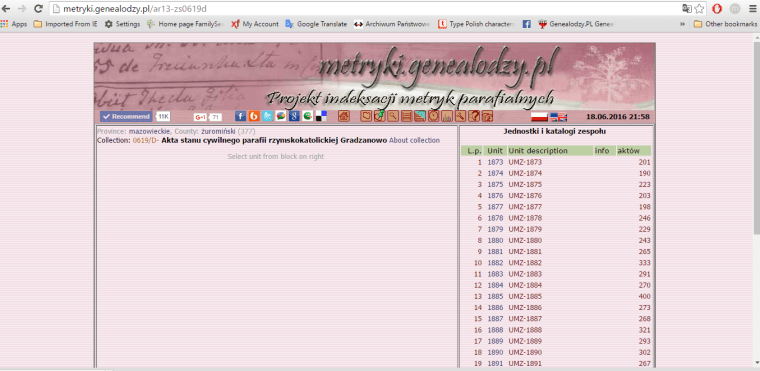
To access the Roman Catholic records for Gradzanowo, click on the code numbers in green (“0619/D-“) in the “Collection” column, shown in the green box in the above image.  That brings us to this page:

Gradzanowo records

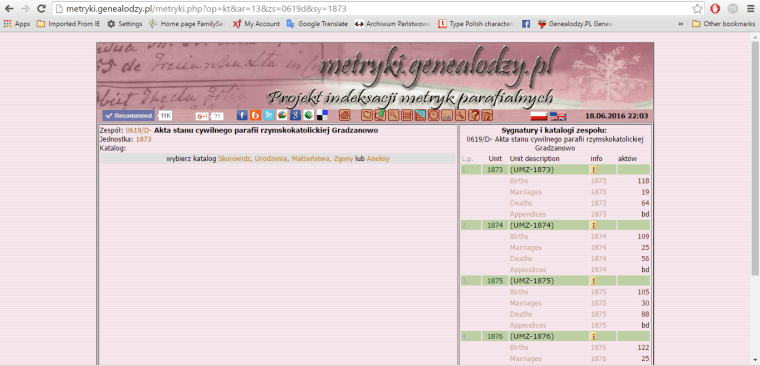
Let’s say we’re looking for a birth from 1873.  We begin by selecting records from 1873 from the list. Now the screen shows this:

Gradzanowo 1873

This gives the option to view births, marriages, deaths, or appendices.  We select “births” and we see:

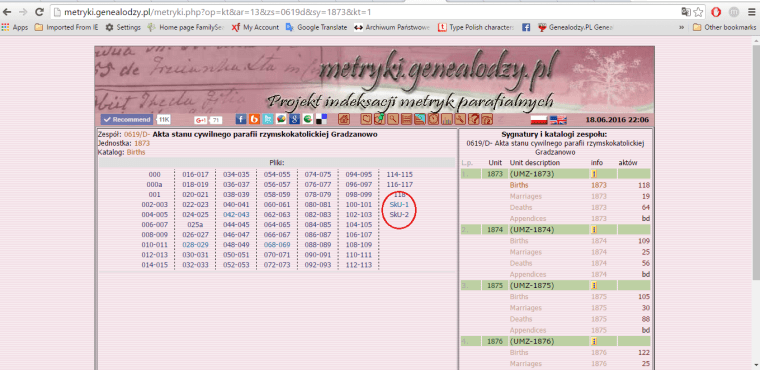
births gradzanowo

In this case, we’re fortunate, because the priest created an end-of-year alphabetical index, indicated by the abbreviation “SkU.”  The Polish word for “index” is “skorowidz,” and “urodzenia” is “births,” so “SkU-1” is the first page of the birth index.  (The marriage and death indexes are labelled SkM and SkZ, respectively.) Our friends at the PTG (Polskie Towarzystwo Genealogiczne, or Polish Genealogical Society) who create the Metryki database have done us a favor by highlighting these index pages for us, so we don’t have to hunt and peck through the pages of images to find them.

A word about these indexes:  In most cases, indexes are only roughly alphabetical – surnames are grouped by first letter of last name, but not alphabetized within each letter category.  Occasionally they’re alphabetized by the first name of the individual, and in some cases, there’s no index at all.  Generally speaking, earlier records (first part of the 19th century) are less likely to be indexed than later records.  After about 1868, when books from Russian Poland are recorded in Russian, the index is usually in Russian, but occasionally in Polish, and usually alphabetized according to the sequence of letters in the Russian alphabet.  However, occasionally one sees indexes written in Russian, but with the names alphabetized according to the Polish alphabet, such that the surname Вишневский (Wiśniewski) is found at the end of the index, rather than the beginning as one would expect.  It’s also good to remember that priests sometimes omitted names from the index when they were creating it, and added them back at the end, following all the other alphabetical entries.  Furthermore, there may be discrepancies in the way a name is recorded in the index versus the actual record, so researchers should always check the individual records when there’s some doubt.

We’re entering the home stretch now.  To find a birth record for Bronisława Krogulska, born in 1873, we check the first index page and see that she is index entry #43 for that year (underlined in red):

Bronislawa Krogulska

Although it’s off-screen in this image, to the far right of Bronisława’s name is the record number that is used to look up the actual document.  In this case, it’s #29.  To get back to the list of pages from the book, click on the icon circled here, in red:

index

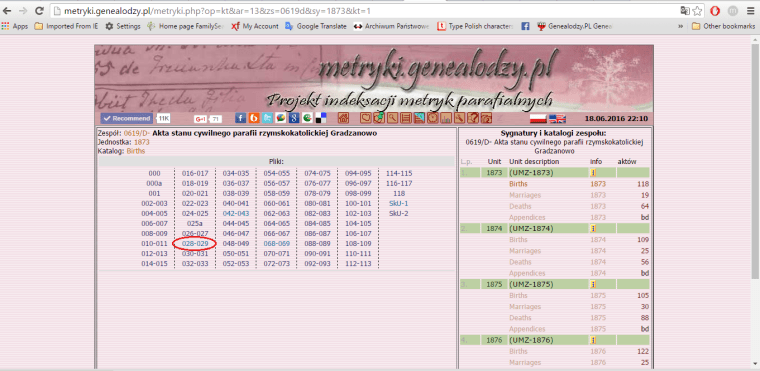
Now we see the selection of pages from the book (below).  The numbers shown refer to the numbers of the records that can be found in that image.  Since Bronisława’s birth record is #29 for that year, we click on the link to the page that includes births 28 and 29:28-29

Researchers who aren’t comfortable with Russian records may gain confidence when they realize that the records themselves frequently contain the names of key participants written in both Russian and Polish, which makes it easier to be certain that one has located the desired record.  In the portion of Bronisława’s birth record shown here, we see the father’s name, Józef Krogulski, written in Polish.  As a bonus, in this particular record, the priest also wrote the name of the village of her birth (Chomęc) in Polish above the Russian, and also extracted her date of birth (16 April 1873).

Bronislawa Krogulska birth

Assistance with translations can be obtained in both the Polish Genealogy group and in the Genealogy Translations group on Facebook, as well as in some other forums.  However, if you have a large number of records needing translations, it’s best to either hire a professional, or learn to do it yourself.  There are a number of great translation resources available, both online and in print form, and a list of these can also be found in the group’s files at Polish Genealogy.  But that’s really all there is to locating vital records in the Metryki.genealodzy.pl database.  Feel free to give me a shout if you have any further questions, and happy researching!

© 2016 Julie Roberts Szczepankiewicz