
The year is drawing to a close. 2017 lies before us, all shiny and new, like a gift waiting to be unwrapped. Like many of us in the genealogical community, I find New Year’s Eve to be a great time to reflect on the research triumphs and frustrations of the past year, and to make research plans for the coming year. When it comes to genealogical New Year’s resolutions, there are so many ancestors I’d like to learn more about, so many families that I’d like to understand better in their cultural and historical context. But one of them in particular is at the top of my research to-do list for 2017: Antonina Naciążek.
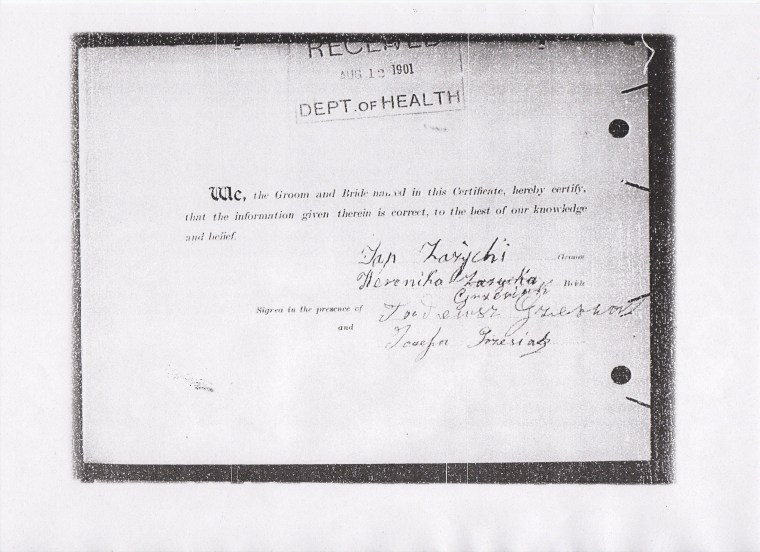
Antonina was my great-great-grandmother, notable because she is my only great-great-grandparent about whom I know little more than her name. My first encounter with her was through the marriage record of her son (my great-grandfather), John Zazycki (Figure 1):
Figure 1: Marriage record for John Zarzycki and Veronica Grzesiak from Buffalo, New York, 5 August 1901.
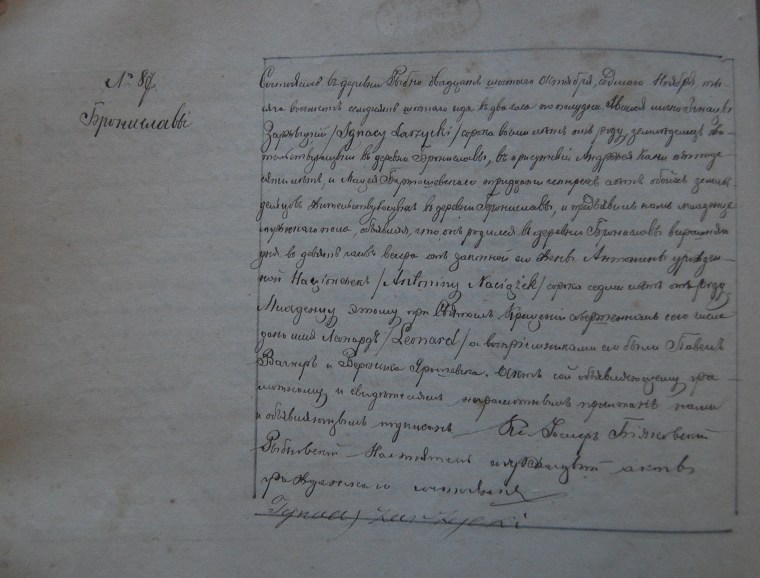
Subsequent research turned up John’s baptismal record in the parish of Rybno, Sochaczew County, Poland, where her name is spelled “Antoniny z Raciążków” (Antonina née Raciążek, Figure 2).
Figure 2: Baptismal record for Jan Zarzycki, Rybno parish, 5 March 1866.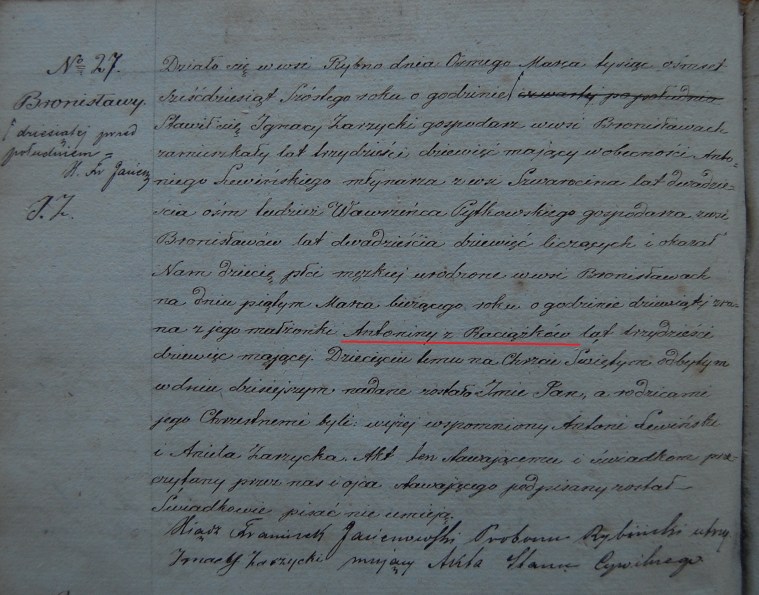
Anyone who’s been doing genealogy for a while is familiar with the inconsistencies in surname spellings that frequently crop up in records prior to the 20th century, and Polish records are no exception. Typically, however, the variations that one sees revolve around a common root with different endings, e.g. Grzesiak can become Grzeszak, Grzeszkiewicz, Grześkiewicz, etc. So I was a little surprised to see Maciążek become Raciążek. In fact, as further evidence accumulated and additional birth, marriage and death records for Antonina’s children were discovered, the most common variant of Antonina’s surname that emerged was Naciążek. Naciążek appeared in the documents a total of 9 times, while Raciążek appeared 7 times, and Maciążek appeared just twice.
Unfortunately, I have yet to obtain any documentation that indicates Antonina’s parents’ names. Based on the birth records for her children, I estimate that Antonina was born circa 1828 and married Ignacy Zarzycki circa 1849. Her children all seem to have been born in the village of Bronisławy and baptized in St. Bartholomew’s church in Rybno. However, she herself must have been from another parish, because neither her birth or marriage record, nor her death record, was found in the records of Rybno at either the parish or the local civil records office (Urząd Stanu Cywilnego, or USC). A search of Geneteka for Naciążek, Raciążek and Maciążek anywhere in Mazowieckie province failed to produce any birth records for an Antonina born circa 1828. So where was Antonina from? Who were her parents? She was last mentioned as a surviving widow in the marriage record of her youngest son, Leonard Zarzycki, in 1904, so she must have died after that time. But where?
Geneteka reveals exactly one record that might give us a clue regarding this family’s origins. Figure 3 shows the results of a search of marriage records in Rybno for the Naciążek surname. Searches for Maciążek and Raciążek produced no results, nor were there any birth or death records for Rybno associated with any of these surnames, apart from records pertaining to known children of Antonina (née Naciążek) Zarzycka.
Figure 3: Geneteka search results for the Naciążek surname in marriage records for Rybno parish.
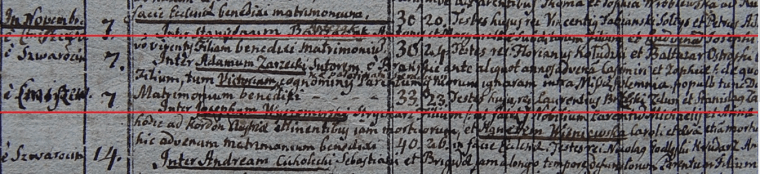
Of the four records shown, numbers 1, 3 and 4 pertain to known children of Antonina (née Naciążek) Zarzycka. However, record #2 (boxed in red) is for the marriage of Roch Kowalski to Anastazja Błaszczak. Further examination of that record (Figure 4) reveals that Roch was “….born and residing in the village of Giżyce, son of the late Aleksander and still-living Marianna née Naciążek, the spouses Kowalski” (text underlined in red), and that he was age 26, suggesting a birth year of about 1877.
Figure 4: Excerpt of marriage record of Roch Kowalski and Anastazja Błaszczak in Rybno parish, 2 February 1903. 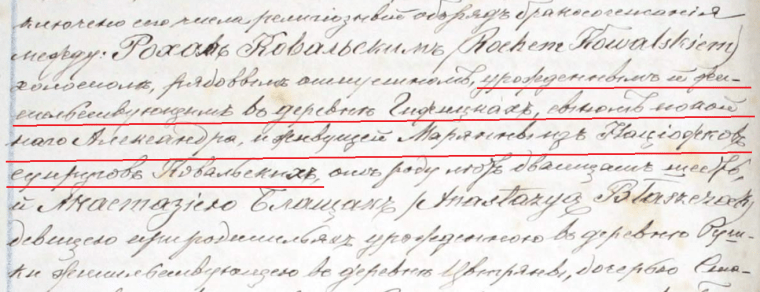
Since Roch Kowalski was a contemporary of Antonina Zarzycka’s children, it stands to reason that Roch’s mother was of the same generation as Antonina herself. Since the parish of Giżyce is located just 8.2 km (about 5 miles) from Bronisławy, and since Naciążek is a relatively rare surname, both in the present-day and historically, it’s not unreasonable to suspect that Antonina and Marianna were related, perhaps even sisters.
Records for the parish in Giżyce are indexed on Geneteka from 1810-1905 with some significant gaps. One such gap exists from 1826-1890 — during the time when Antonina Naciążek is most likely to have been born (1828-1829). However, there is a rather tantalizing birth record in 1824 in Giżyce for a Marianna Naciążek, daughter of Mateusz Naciążek and Petronela Trawińska. Could this be the same Marianna Naciążek who married Aleksander Kowalski?
Frustratingly, a province-wide search using both the Naciążek and Kowalski surnames does not produce a marriage record for Marianna and Aleksander, which would hopefully reveal Marianna’s parents’ names, nor does it produce Marianna’s death record. However, it does produce marriage records for four additional children of that couple (Figure 5):
Figure 5: Geneteka search results for marriage records in Mazowieckie province that contain both the Naciążek and Kowalski surnames.
Hovering the cursor over the “i” in the column after “Naz. matki” indicates that Józefa Kowalska, Ignacy Kowalski, Ludwik Kowalski, and Stanisław Kowalski were all siblings of Roch Kowalski and children of Marianna Naciążek and Aleksander Kowalski. Examination of the three records for which scans are available indicates that Józefa and Ignacy were also born in Giżyce.
Note that the search result for Józefa Kowalska’s marriage notes an alternate spelling of her mother’s maiden name, “Naciąszek.” Geneteka’s search algorithms do not automatically recognize Naciąszek and Naciążek as phonetic equivalents, so Naciąszek must be searched separately. This subsequent search in Geneteka for Naciąszek produces an especially intriguing result: a marriage record in Giżyce for Stanisław Marcinkowski and Marianna Kowalska in 1881 (Figure 6).
Figure 6: Geneteka search result for Naciąszek surname in Mazowieckie province.
The marriage record itself verifies that this is indeed “our” Marianna Kowalska, widow of Aleksander (Figure 7):
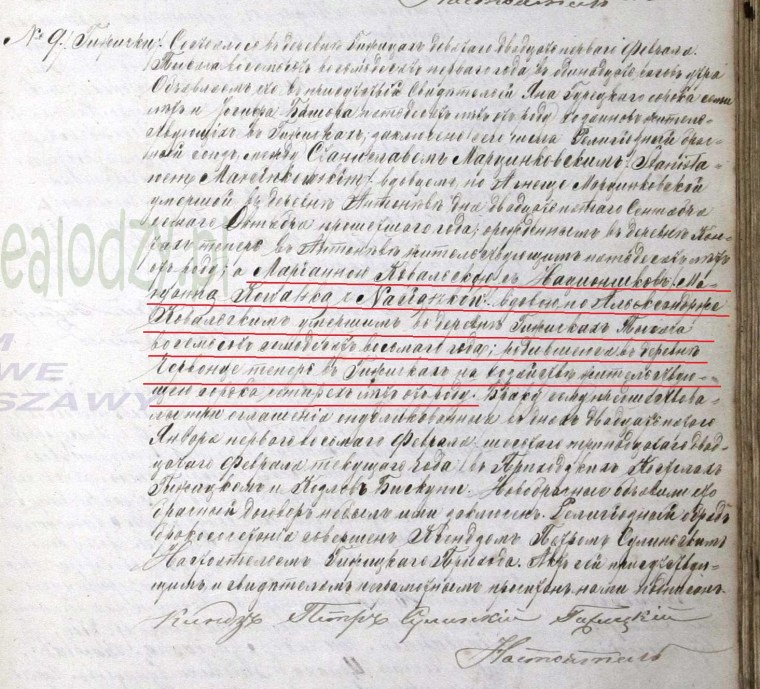
The underlined text in Russian and Polish reads, “…Marianna Kowalska née Naciąszek, widow of Aleksander Kowalski [who] died in the village of Giżyce in the year 1878; born in the village of Czerwonka, now in Giżyce… residing, age 44.”
Pay dirt! Although this record does not tell us the names of Marianna’s parents, it does tell us where and when she was born. Czerwonka is a village that belongs to the parish in Sochaczew, and her age at the time of her second marriage suggests a birth year of 1837. Clearly, this Marianna can’t be the same as the Marianna Naciąszek born in 1824 in Giżyce. Figure 8 shows the location of all these villages in relation to each other in Sochaczew County.
Figure 8: Geographic locations of Giżyce, Bronisławy, Sochaczew and Czerwonka.
Records for Sochaczew are indexed in Geneteka, but unfortunately, there is no perfect match for a Marianna Naciąszek or Naciążek born in 1837 in Czerwonka. However, there is a reasonably close match: the birth of a Florentyna Marianna Naciążek in 1836 in Czerwonka, daughter of…. (dramatic music!)…..Mateusz Naciążek and Petronela Trawińska, the same couple who were the parents of the other Marianna Naciążek who was born in Giżyce in 1824! If the Marianna who was born in 1824 died prior to 1836, it’s possible that her parents would have honored her by naming a sibling Florentyna Marianna but calling her Marianna. So maybe she’s our bride of Aleksander Kowalski? Unfortunately — and frustratingly — there is no marriage record to prove it, nor is there a death record for the Marianna who was born in 1824.
Let’s take a moment to recap what we know so far:
- Only one other Naciążek record exists in Rybno parish, where Antonina (née Naciążek) Zarzycka lived.
- That record is a marriage record for Roch Kowalski, born in Giżyce, son of Marianna Naciążek and Aleksander Kowalski.
- Roch Kowalski is the same generation as Antonina Zarzycka’s children, suggesting that Marianna Naciążek is of the same generation as Antonina, perhaps even her sister.
- Marianna (née Naciążek) Kowalska’s second marriage record reveals her place of birth as Czerwonka (Sochaczew parish) in 1837 and her place of residence as Giżyce.
- The closest match for Marianna’s birth in the records of Sochaczew parish is for a Florentyna Marianna Naciążek, born in Czerwonka in 1836, daughter of Mateusz and Petronela (née Trawińska).
- Mateusz Naciążek and Petronela Trawińska were parents to another daughter named Marianna Naciążek born in Giżyce in 1824. Although the Trawiński surname is fairly common, the relative rarity of the Naciążek surname makes it likely that this is the same couple as the one mentioned in the records in Sochaczew.
So, the focus is definitely on Giżyce and Sochaczew for the births and marriages of both Antonina Naciążek and her putative sister, Marianna Naciążek. Marriages for Sochaczew are indexed on Geneteka from 1826-1835,and 1879-1901, leaving a gap when Antonina and Marianna would have married, which would explain why her marriage record does not show up in the Geneteka index. Geneteka’s indexed birth records for Sochaczew cover 1781-1802, 1826-1841, 1849-1864, 1868-1870, and 1874-1884. So Antonina’s birth in 1828-1829 should be there, if she were born in Sochaczew.
But what if Antonina were born in Giżyce, and not Sochaczew? Geneteka has births indexed for Giżyce for 1810, 1823-1825, and 1891-1905, so there’s a gap for both 1828 when Antonina would have been born, and also for 1849, which is approximately when she would have married. Unfortunately, in reviewing the available ranges of years for available records for both Sochaczew and Giżyce on LDS microfilm and at the Polish State Archives, the hope of identifying Antonina’s and Marianna’s parents definitively seems slim. It appears that Geneteka has indexed all the existing records for these parishes, so the records needed to fill those gaps no longer exist. One of my goals for the new year is to have a researcher in Poland confirm this for me, and verify that there are no additional records available for either of these parishes at the parishes themselves or in a diocesan archive. Even if those early records are gone, and Antonina’s birth and marriage records are lost forever, it should still be possible to track down her death record after 1904, so that’s on my agenda, too.
If you’re like me, you like wringing every last drop of information from a data set, particularly in cases like this where data are limited. So what else can Geneteka tell us about the Naciążeks in Giżyce and Sochaczew? Figure 9 shows Naciążek births in indexed records for all of Mazowieckie province.
Figure 9: Geneteka search result for Naciążek births in Mazowieckie province.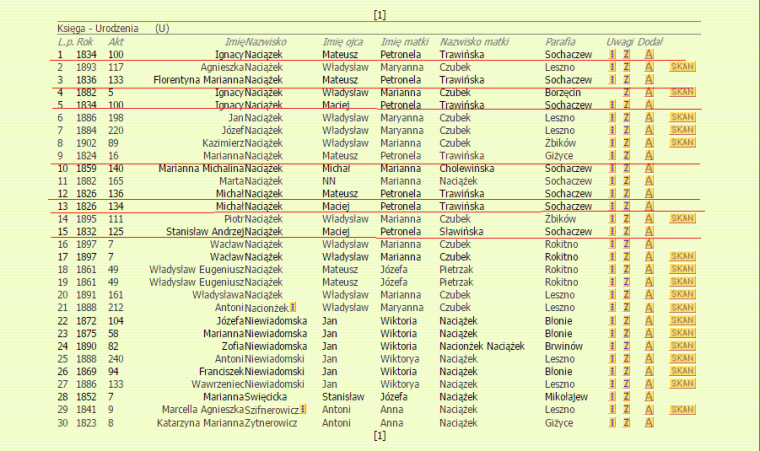
I’ve underlined the ones in red that I believe pertain to the same family. Notice that the father’s name is sometimes recorded as Mateusz and sometimes recorded as Maciej. This might be an artifact of the transcription and translation process. Based on my experience with the records from Sochaczew for this time period, these records are likely to be in Latin, and those names in Latin might be written as Mattheus or Matthias — potentially difficult to differentiate if the handwriting is bad. It’s also possible that the priest used either spelling indiscriminately, especially since he seems to have been a bit careless with Petronela’s name, which is recorded as Trawińska in most of the records, but as Slawińska in one of them. Copies of these records are available from the Diocesan Archive in Łowicz, and I plan to order those in the New Year, so hopefully the originals can shed some light on this.
Based on these data, and data from the death records as well, a clearer image of the Naciążek family’s timeline emerges:
- 1824: Daughter Marianna born in Giżyce.
- 1826: Son Michał born in Sochaczew. (Note that Michał’s birth is recorded twice in the index, as record #134 and record #136. Information contained in the infodot reveals that #134 is the Latin church record while #136 is the Polish-language civil copy.)
- 1832: Son Stanisław Andrzej born in Sochaczew.
- 1834: Son Ignacy born in Sochaczew. (Again, both the Latin church version and the Polish civil copy are available for this record.)
- 1836: Daughter Florentyna Marianna born in Sochaczew.
- 1837: Son Ignacy dies in Sochaczew.
- 1840: Son Jan dies in Sochaczew. Jan is noted to be 6 days old, and birth records for Sochaczew exist for the time of his birth, so it’s unclear whether his birth record is missing due to an omission by the priest or by the indexer.
If great-great-grandma Antonina does, in fact, belong to this family, her birth would fit into that 6-year-gap between Michał’s birth in 1826 and Stanisław Andrzej’s birth in 1832. Since her birth was not captured in the records for Sochaczew, it’s possible that the family returned to Giżyce for that time period.
One final record worth noting that pertains to the Naciążek family in Sochaczew and Giżyce is the marriage record in 1826 of Franciszek Naciążek and Marianna Kowalska. (Figure 10).
Figure 10: Geneteka search results for Naciążek marriages in Mazowieckie province.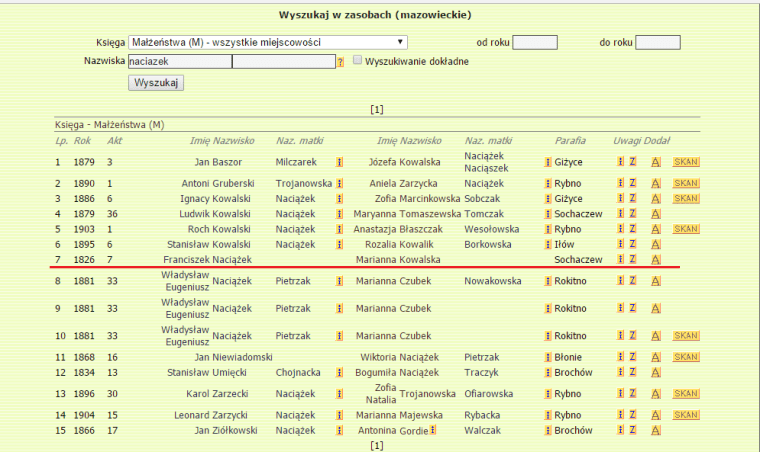
Hovering the cursor over the “i” in the “uwagi” column reveals that the groom, Franciszek Naciążek, was from Giżyce although the wedding took place in the bride’s parish in Sochaczew. Franciszek and Marianna could also be potential parents for Antonina Naciążek, although they seem to disappear from the records. They are not mentioned as parents on any of the indexed birth records in Mazowieckie, and the only other mention of them is in Marianna’s death record in Sochaczew in 1844.
Despite the lack of direct evidence concerning Antonina Naciążek, the indexed records in Geneteka offer a powerful tool for gathering hints about her possible family origins. While it’s disappointing that Antonina’s birth and marriage records may no longer exist, there’s still some hope of finding her death record, and Sochaczew and Giżyce would be logical places to look for it. Maybe 2017 will be my lucky year in terms of locating that document, and maybe I’ll get even luckier and it will include her parents’ names, so I can know for certain whether Antonina Naciążek is the daughter of Mateusz and Petronela (née Trawińska) Naciążek. May 2017 be a lucky year for your genealogical research as well. Here’s to finding our dead ancestors!
© Julie Roberts Szczepankiewicz 2016


 From Shepherds and Shoemakers