Playing “Telephone” Across Generations: Documenting Family Stories

Family stories are always the starting point for genealogy research. Beginners are typically instructed to start with themselves and work backwards, interviewing older family members or generational peers to discover what they remember, or remember hearing, about past generations. Often it feels like a game of “telephone” played out over many decades. You may remember “telephone” as that game in which a number of players stand in a circle, and a complicated phrase is whispered from one person to the next. Repetition is not allowed, so although each person does his best to listen carefully, the phrase becomes distorted, often comically, as it is passed around. Finally the result is whispered to the person who began the game, who announces what the original phrase actually was, and everyone gets a good laugh. As family historians, our job is to sift out the wheat from the chaff, using our ancestors’ paper trail to document what we can from the family stories, but keeping in mind that not everything we were told is going to be verifiable.

I became interested in my family history soon after I was married in 1991. My husband and I were incredibly fortunate to have six living grandparents at that time, as well as plenty of their siblings still living. As I’ve tried to document all the many bits of information I gathered from them, one truth in particular has emerged:  if an older relative remembers a specific name, it’s safe to say that the person is connected to the family in some way, even if it’s not in the way that he or she remembers. Remembered names aren’t just pulled out of thin air.

As one example of this, I interviewed Uncle Mike Stevenson (Szczepankiewicz) about the Szczepankiewicz family history. Uncle Mike was the youngest brother of my husband’s grandfather, Stephen Szczepankiewicz. Although he knew a great deal about his father from his mother’s stories, Uncle Mike had never met him: he died on 14 February 1926,1 and Uncle Mike was born 3 months later, on 23 May 1926.Nonetheless, Uncle Mike proved to be a reliable source. He told me that his father, Michael Szczepankiewicz, had never naturalized. This assertion is validated by the 1925 New York State census, in which Michael Szczepankiewicz is listed as an alien (Figure 1):3

Figure 1:  Extract of 1925 New York State census showing Michael Szczepankiewicz and family.3michael-szczepankiewicz-family-1925

This extract shows that 49-year-old Michael Szczepankiewicz was born in Poland, had been living in the U.S. for 20 years, was an alien (“al”) at the time of the census, and was employed in “building labor.” Since Michael died in 1926, and the naturalization process took longer than a year, it would not have been possible for him to naturalize prior to his death. Uncle Mike also mentioned that his father was a stone mason who helped to build Transfiguration Church in Buffalo. Although I have yet to document this directly (maybe payroll records exist in the archive of the diocese of Buffalo dating back to the construction of Transfiguration Church?), the fact that Michael was a construction laborer is consistent with that claim.

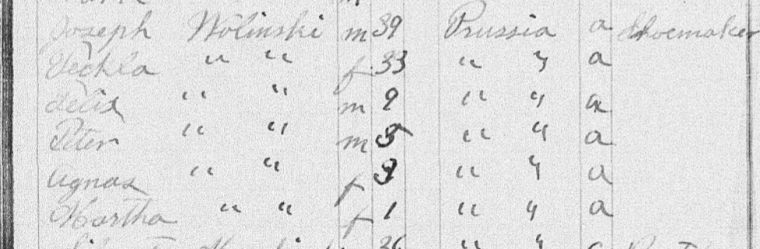
When I asked Uncle Mike about the family of his mother, Agnes (née Wolińska) Szczepankiewicz, he told me that Agnes’s mother was named Apolonia Bogacka. Unfortunately, this didn’t pan out. Records showed that Agnes’s mother’s name was Tekla, as shown by the 1892 census for New York State (Figure 2): 4

Figure 2:  Extract from 1892 census of New York State showing the family of Joseph Wolinski, including wife “Teckla” (sic).4wolinski-family-1892
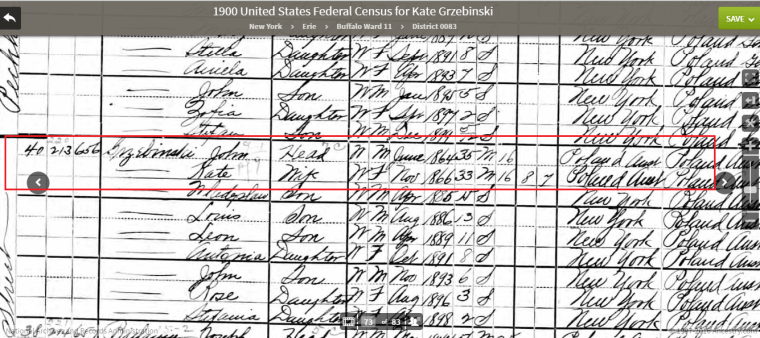
So where did the name “Apolonia Bogacka” come from? The answer was found in the 1900 census (Figure 3).5  Living with Joseph Wolinski’s family is his mother-in-law, “Paline” Bogacka.  The name “Pauline” was commonly used by women named Apolonia in the U.S. as a more American-sounding equivalent.

Figure 3:  Extract from the 1900 U.S. Federal census showing the family of Joseph Wolinski, including mother-in-law “Paline” (sic) Bogacka.5joseph-wolinski-family-1900-census

So it turns out that Uncle Mike’s great-grandmother had also emigrated, and he was confusing her name with the name of his grandmother!

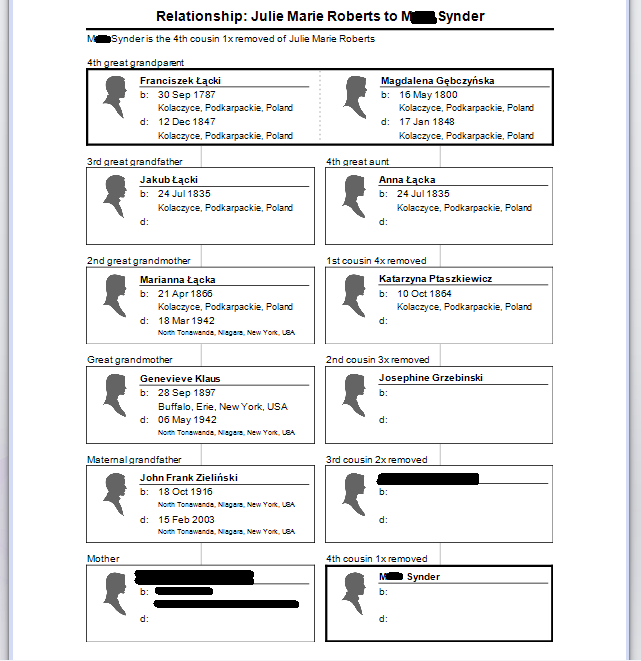
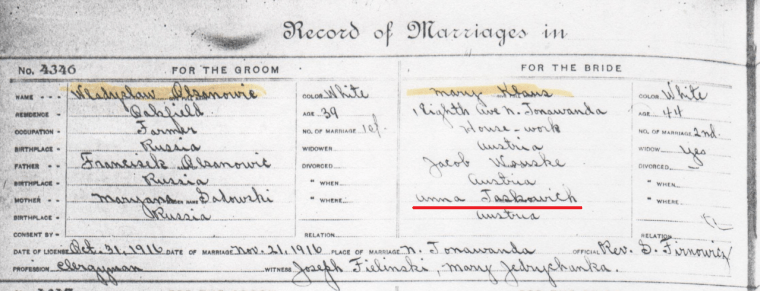
As another example, my grandfather’s first cousin, Jul Ziomek, told me in a 1992 interview that the mother of her grandmother, Mary (née Łącka) Klaus, was named Janina Unicka. Jul was a very reliable source in other matters, but in this case, her memory did not serve her well. The civil record for Mary Klaus’s second marriage, to Władysław Olszanowicz, tells us that her mother’s name was (phonetically) Anna “Taskavich” (Figure 4).6

Figure 4:  Civil marriage record from North Tonawanda, New York, for Mary Klaus and Władysław Olsanowic (sic).6mary-klaus-second-marriage
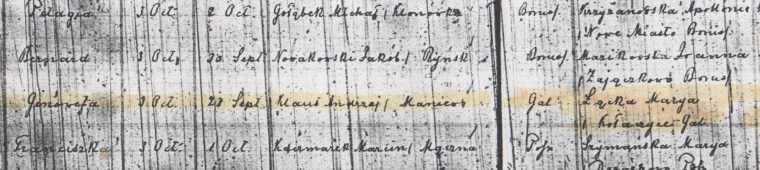
The correct spelling of Mary’s mother’s name in Polish is found on Mary’s baptismal record from her home village of Kołaczyce — she was Anna Ptaszkiewicz (Figure 5).7

Figure 5:  Baptismal record from Kołaczyce, Austrian Poland for Marianna Łącka.7marianna-lacka-birth

The section of the record in the red box pertains to the mother of the child and reads, “Anna filia Francisci Ptaszkiewicz ac Salomea nata Francisco Sasakiewicz.” For those who might be unfamiliar with Latin, this translates as “Anna, daughter of Franciszek Ptaszkiewicz and Salomea, daughter of Franciszek Sasakiewicz.”

Believe it or not, it’s quite reasonable, based on Polish phonetics, that an English speaker might come up with a spelling of “Taskevich”for “Ptaszkiewicz.”  But no matter how you slice it, this is pretty far off from “Janina Unicka.”  So where did Jul come up with that name? The 1910 census gives us a clue (Figure 6):8

Figure 6:  Andrew Klaus family in the 1910 U.S. Federal census.8andrew-klaus-fam-1910
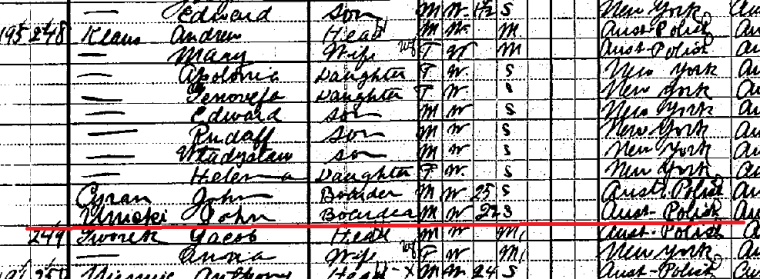
Living with the family of Mary Klaus, there is a boarder named John Unicki.  At this point I have traced Mary Klaus’s family back in Poland for another 3-4 generations, which is as far back as existing vital records go, and I’ve seen no evidence of the Unicki surname anywhere in the extended family tree.  I’ve concluded that cousin Jul’s memory was inaccurate on this point. It must have been dim memories of this boarder, Jan Unicki, living with her grandparents that caused her to associate the name “Janina Unicka” with her grandmother’s family.

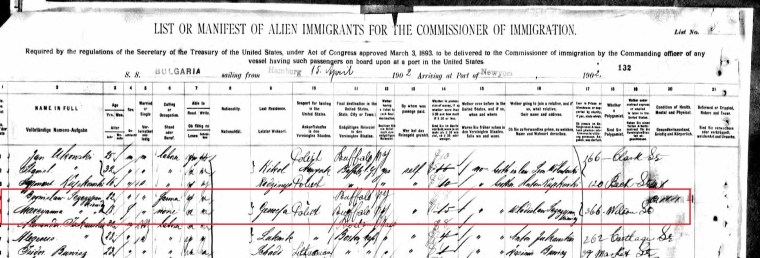
As one final example, my husband’s grandfather, Stephen Szczepankiewicz, told me that his father, Michael Szczepankiewicz, immigrated from Russian Poland to Buffalo, New York, along with four brothers and no sisters. He recalled the names of his father’s brothers as Bernard, Felix, Alexander and Joseph. It turns out that he was partially correct.  Further research indicates that his father did indeed have brothers who also emigrated from Poland to Buffalo who were named Bernard (Anglicized from Bronisław), Alexander, and Joseph.  What Grandpa didn’t know was that there were two more brothers who emigrated, Adam and Walter (also known as “Wadsworth” — both names are Anglicized versions of his Polish name, Władysław), as well as a sister, Marcjanna, who emigrated to Buffalo along with Bronisław and then disappears from records there (Figure 7):9

Figure 7:  Passenger manifest for Marcyanna and Bronisław Szczepankiewicz, arriving in the port of New York on 3 May 1902.9marcjanna-manifest-cropped
 

Try as I might, I could not document a brother named Felix/Feliks Szczepankiewicz, or find one with a name that was even close to that.  Why would Grandpa remember an Uncle Felix if there never was one? Well, it turns out that there was an Uncle Felix, but it was on his mother’s side, not his father’s side. Grandpa Steve’s mother was Agnes/Agnieszka Wolińska.  If we take a closer look at that 1892 census for the Woliński family shown in Figure 2 and the 1900 census shown in Figure 3, the oldest child in the family is Feliks.  So it seems likely that Grandpa was just mixing up which side of the family Uncle Feliks was from.

As is evident from these examples, family stories work best when used as a starting point for genealogy research, but we can’t let our research end there. Time can play tricks with people’s memories, so it’s important to attempt to document everything we’ve been told.  If conflicts exist between the story and the evidence, consider how these might be reconciled.  As you document each story, you’ll begin to get a sense of the reliabilty of each relative’s memory. If you have any particularly wild stories that you’ve been able to document, please let me know in the comments — I’d love to hear about them!

Sources:

Buffalo, Erie, New York, Death Certificates,1926, certificate #1029, record for Michael Sczepankiewicz (sic).

“United States Social Security Death Index,” database, FamilySearch(https://familysearch.org/ark:/61903/1:1:VMDV-RJ7 : 20 May 2014), Michael A Stevenson, 28 Apr 2011; citing U.S. Social Security Administration, Death Master File, database (Alexandria, Virginia: National Technical Information Service, ongoing), accessed on 8 November 2016.

Ancestry.com, New York, State Census, 1925 (Provo, UT, USA, Ancestry.com Operations, Inc., 2012), http://www.ancestry.com, Record for Stepahn Szczepankiewicz, accessed on 8 November 2016.

Ancestry.com, New York, State Census, 1892 (Provo, UT, USA, Ancestry.com Operations, Inc., 2012), http://www.ancestry.com, Record for Joseph Wolinski household, accessed on 8 November 2016.

Ancestry.com, 1900 United States Federal Census (Provo, UT, USA, Ancestry.com Operations Inc, 2004), http://www.ancestry.com, Year: 1900; Census Place: Buffalo Ward 9, Erie, New York; Roll: T623_1026; Page: 6A; Enumeration District: 69, record for Joseph Wolinski household, accessed on 8 November 2016.

6 “New York, County Marriages, 1847-1848; 1908-1936″, database, Church of Jesus Christ of Latter Day Saints, Family Search, (https://familysearch.org), Wladyslaw Olsanowic and Mary Klaus, 21 Nov 1916; citing county clerk’s office, , New York, United States; FHL microfilm 897,558. accessed on 8 November 2016.

Roman Catholic Church, St. Anna’s Parish (Kołaczyce, Jasło, Podkarpackie, Poland), “Urodzenia, 1826-1889”, Stare Kopie, 1866, #20, Record for Marianna Łącka.

Ancestry.com, 1910 United States Federal Census (Provo, UT, USA, Ancestry.com Operations Inc, 2006), http://www.ancestry.com, Year: 1910; Census Place: North Tonawanda Ward 3, Niagara, New York; Roll: T624_1049; Page: 16B; Enumeration District: 0126; FHL microfilm: 1375062, record for Andrew Klaus, accessed on 8 November 2016.

Ancestry.com, New York, Passenger Lists, 1820-1957 (Provo, UT, USA, Ancestry.com Operations, Inc., 2010), http://www.ancestry.com, Year: 1902; Arrival: New York, New York; Microfilm Serial: T715, 1897-1957; Microfilm Roll: Roll 0272; Line: 5; Page Number: 132, record for Marcyanna Sczezyoankiemg, accessed on 8 November 2016.

Overview of Vital Records in Poland: Part III: Additional Examples and Observations

In my previous two posts, I gave some historical background about the evolution of vital records keeping in Poland, and about the implications of those practices for researchers today, seeking records of their ancestors.  Today, I’d like to provide some examples of the kinds of records you might expect to see from the various partitions and from different time periods, to give you an idea of what you might expect to encounter in your own research.

Examples from Prussian Poland

I’ll start off with a couple of examples from the Prussian partition, and a little confession: Although my husband has ancestors from Prussian Poland, and although I have every intention of researching those ancestors at some point, I haven’t done much research in this area yet.  Therefore, I don’t have a huge wealth of examples to offer, but here are a couple.  Figure 1 shows a Catholic baptismal record from 1858 for Stanislaus (Stanisław in Polish) Lewandoski,also known as Edward Levanduski, my husband’s great-great-grandfather, about whom I wrote previously.

Figure 1:  Baptismal record from Gąsawa parish for Stanislaus Lewandoski [sic], born 29 October 1859.1stanislaus-lewandowski-1859-p-1-crop

The record is in columnar form, and column headings, from left to right, tell us the number of the birth record, the year, day and month of the birth, the place of birth, date of baptism and child’s name, the name of the priest who baptized the child,  the parents’ names, father’s occupation, and then additional information on godparents’ names (cut off in this image).  The record is written in Latin.  Unfortunately, no information is given on the parents’ ages.

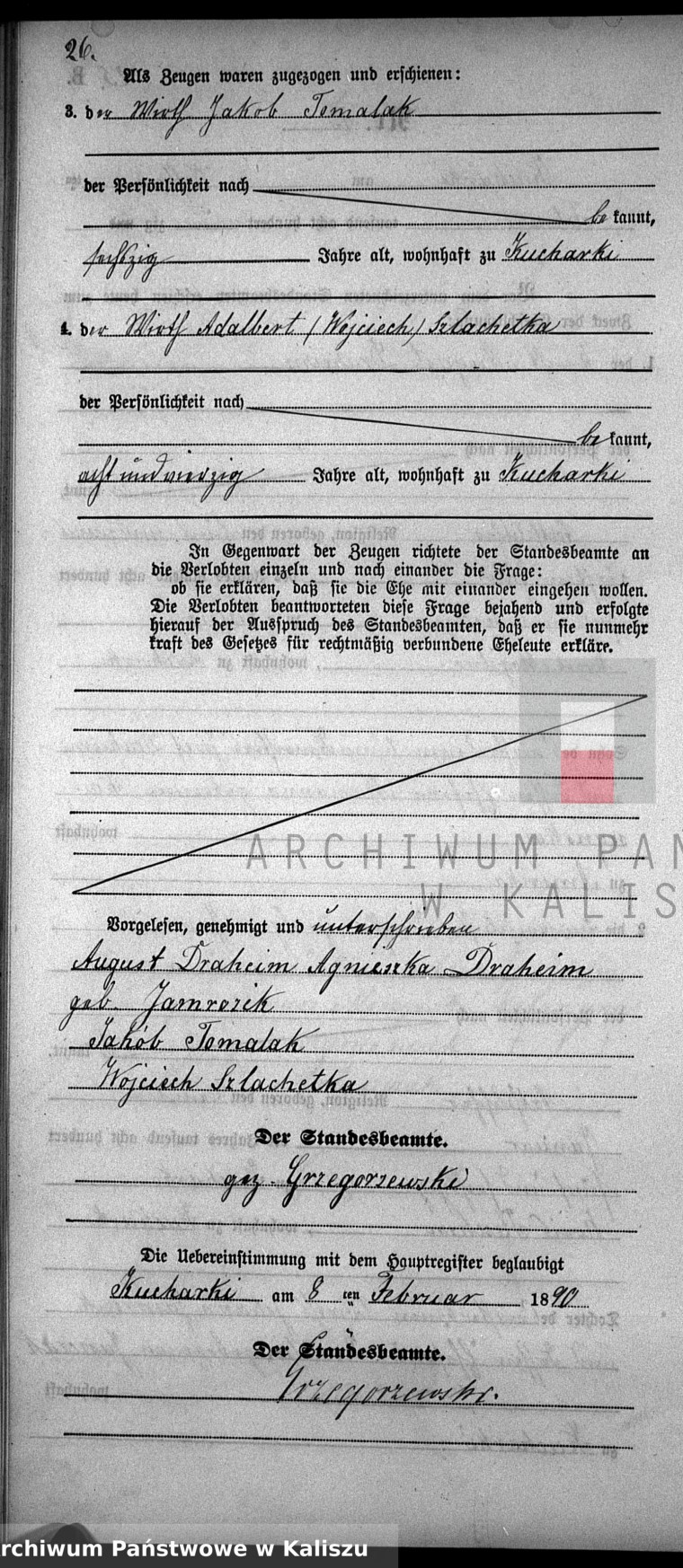
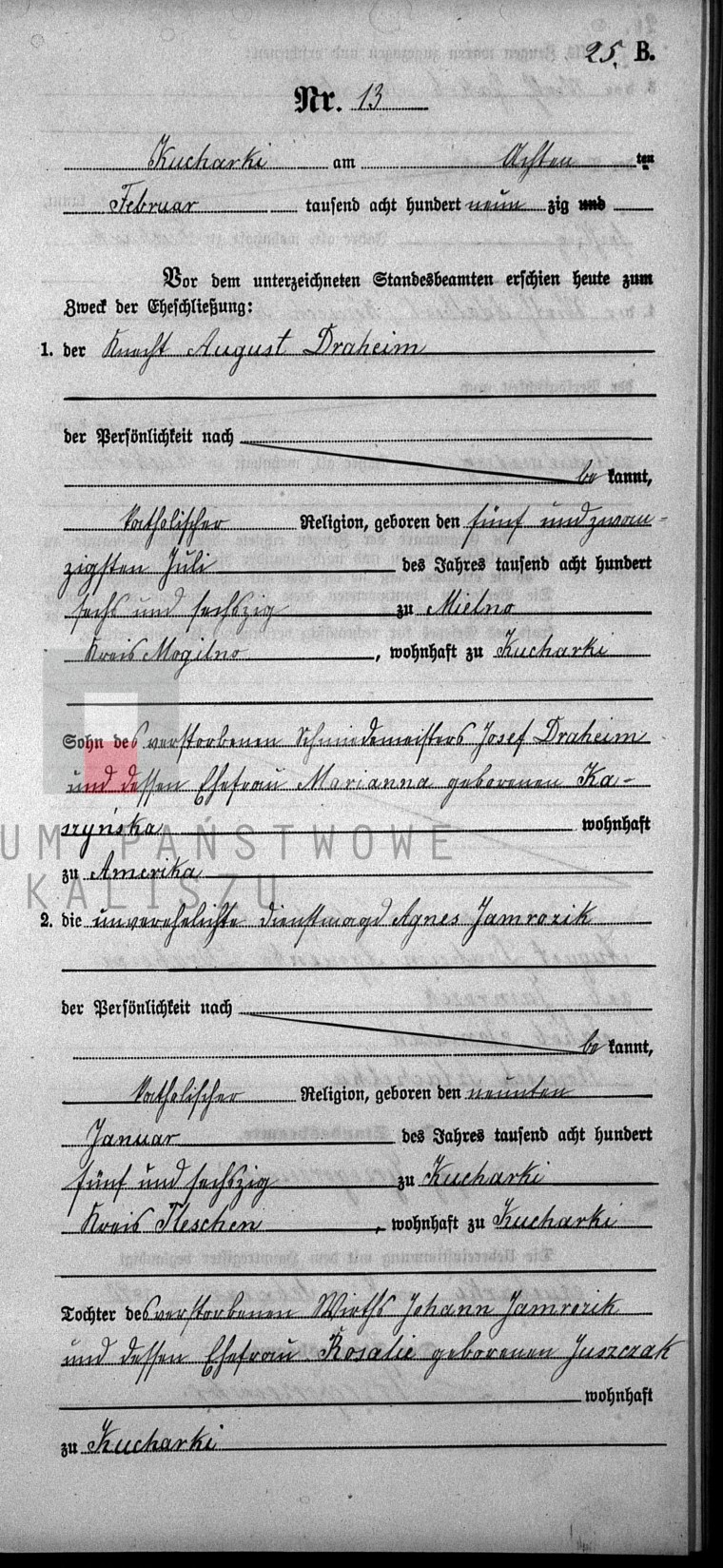
Figures 2a and 2b show a civil marriage record from Kucharki from 1890 for my husband’s great-great-grandparents, Augustyn and Agnieszka Drajem.2

Figure 2a:  Civil marriage record from Kucharki for August Drajem and Agnieszka Jamrozik, 1 February 1890, p. 1.2august-draheim-and-agnieszka-jamrozik-1890-p-1

Figure 2b:  Civil marriage record from Kucharki for August Drajem and Agnieszka Jamrozik, 1 February 1890, p. 2.2augustyn-draheim-and-agnieszka-jamrozik-1890-p-2

As we would expect, the record is in German, and the translation, kindly provided by Johann Kargl in the Facebook group “Genealogy Translations,” is as follows:

“Kucharki 1st February 1890
1. Before the undersigned registrar appeared the farm servant August Draheim, personally known, Catholic, born on 25 July 1866 in Mielno, county Mogilno, living in Kucharki, son of the deceased master tailor Josef Draheim and his wife Marianne, nee Kaszynska, living in America
2. the unmarried maiden Agnes Jamrozik, personally known, Catholic, born on 9 January 1865 in Kucharki, county Kleschen, living in Kucharki, daughter of the innkeeper Johann Jamrozik and his wife Rosalie, nee Juszczak, living in Kucharki.
As witnesses appeared:
3. The innkeeper Jakob Tomalak, personally known, 60 yers old, living in Kucharki
4. the innkeeper Adalbert (Wojciech) Szlachetka, personally known, 48 years old, living in Kucharki

read, approved and signed
August Draheim Agnieszka Draheim, nee Jamrozik
Jakob Tomalak
Wojciech Szlachetka
The registrar
signed Grzegorzewski

Kucharki, 8 February 1890
(signature)”

Notice that the record was created on a fill-in-the-blank form, with all the standard boilerplate text preprinted, so translating these civil records becomes a matter of learning to read a relatively small amount of German script.  In contrast to the brief church book entry, this record contains a lot of wonderful genealogical details, including the precise birthdate and birth place of the bride and groom, occupations and ages of the witnesses, and more.

For those of you who might be panicking and thinking,  “But I can’t read German!” help is on the way.  The very best translation guides that I have found for genealogy are written by Jonathan D. Shea and William F. Hoffman.  Their “In Their Words” series of genealogical translation guides encompasses 3 volumes to date, Volume I:  Polish, Volume II:  Russian, and Volume III:  Latin.  Volume IV:  German is currently in the works and will hopefully be out very soon.  I cannot praise these books highly enough.  These are the books that are constantly lying around the house, never making it back to the bookshelf, because I’m always referring to one or another of them for something.  I can’t wait for their German book to be published so I can learn to read these records for myself.  In the meantime, there’s always the Genealogy Translations group on Facebook, if you (or I) need assistance.

Examples from Russian Poland

In Russian Poland, the standard Napoleonic format existed from 1808-1825, followed by a modified format that was used from 1826 through the 20th century. So a civil death record from 1936 (Figure 3) looks much the same as a civil death record from 1838 (Figure 4).

Figure 3:  Death record from Budy Stare for Marianna Zielińska who died 4 April 1936.3marianna-zielinska-death-1936

Translation:  “Budy Stare.  It happened in Młodzieszyn on the 4th day of April 1936 at 8:00 in the morning.  They appeared, Stanisław Wilanowski, age 40, farmer of Mistrzewice, and Kazimierz Tomczak, farmer of Juliopol, age 26, and stated that, on this day today, at 5:00 in the morning, in Budy Stare, died Marianna née Kalota Zielińska, widow, age 79, born and residing with her sister in Budy Stare, daughter of the late Roch and Agata née Kurowska, farmers.  After visual confirmation of the death of Marianna Zielińska, this document was read aloud to the witnesses but signed only by us.  Pastor of the parish of Młodzieszyn actiing as Civil Registrar.”

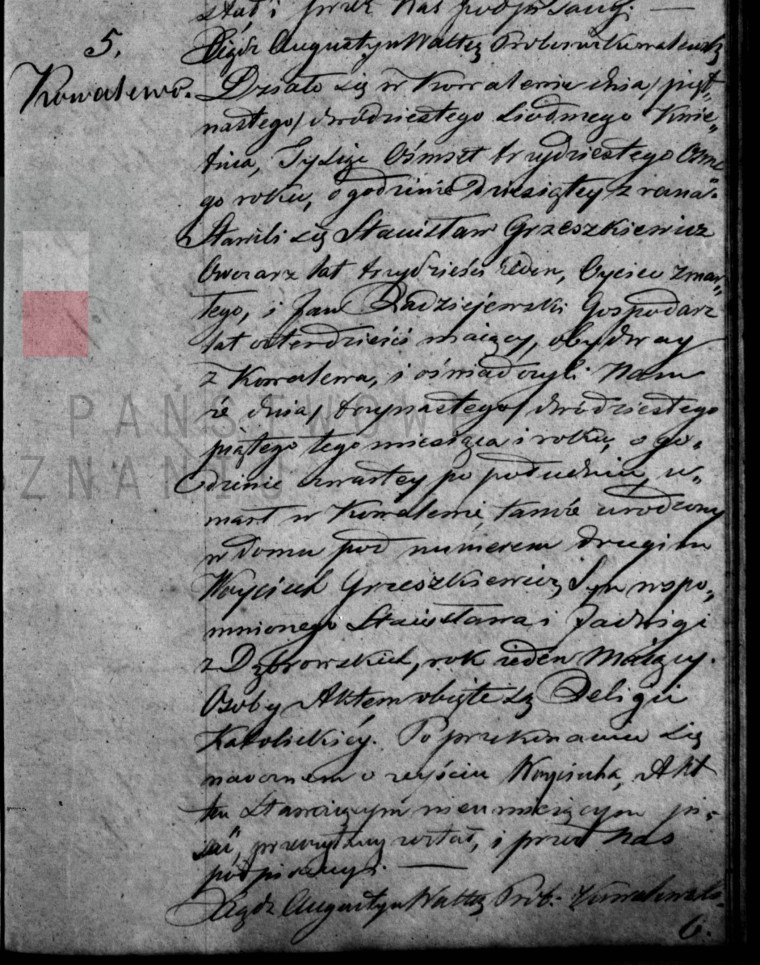
Figure 4:   Death record from Kowalewo-Opactwo for Wojciech Grzeszkiewicz [aka Grzesiak], who died 25 April 1838.4Wojciech Grzeszkiewicz death.jpg

Translation:  “Kowalewo.  It happened in the village of Kowalewo on the 15th/27th day of April 1838 at 10:00 in the morning.  They appeared, Stanisław Grzeszkiewicz, shepherd, age 31, father of the deceased, and Jan Radziejewski, land-owning farmer, age 40, both of Kowalewo, and stated to us that, on the 13th/25th of the current month and year, at 4:00 in the afternoon, died in Kowalewo, likewise born there in house number two, Wojciech Grzeszkiewicz, son of the aforementioned Stanisław and Jadwiga née Dąbrowska, having one year of age.  All persons mentioned in this Act are of the Catholic religion.  After visual confirmation of the death of Wojciech, this document was read aloud to the witnesses and was signed.”

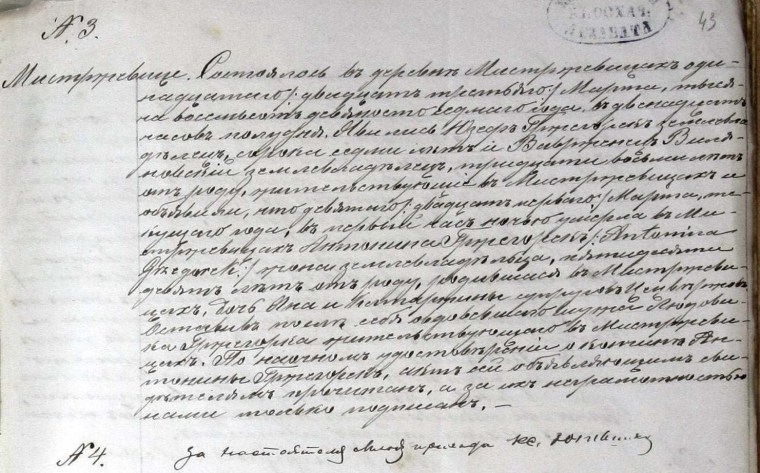
Since records from all villages within a parish were kept in the same book in Russian Poland, we see the name of the village where the event took place inscribed in the margin, next to the record number.  So in Figure 4, the death occurred in Budy Stare, but was recorded by the priest in the Catholic parish in Młodzieszyn.  When you compare the translations of these two records, you see that there’s not much difference in the format.  It’s pretty stable across 102 years and 120 miles in these examples.  That’s even true during the period from about 1868 until 1918, when records from Russian Poland were required to be kept in Russian.  Take a look at this death record from Mistrzewice in 1897, for my 3x-great-grandmother, Antonina (née Ciećwierz) Grzegorek (Figure 5):5

Figure 5:  Death record from Mistrzewice for Antonina Grzegorek, who died 21 March 1897.5antonina-grzegorek-death-1897-crop

Translation:  “Mistrzewice.  It happened in the village of Mistrzewice on the 11th/23rd day of March 1897th year at 12:00 at noon. They appeared, Józef Grzegorek, farmer, age 47, and Wawrzyniec Wilanowski, farmer, age 38, residents of Mistrzewice, and stated that, on the 9th/21st day of March of the present year, at 1:00 am [literally, “in the first hour of the night”], died in the village of Mistrzewice, Antonina Grzegorek, farm wife, age 59, born in Mistrzewice, daughter of Jan and Katarzyna, the spouses Ciećwierz. She leaves after herself her widower husband, Ludwik Grzegorek, residing in the village of Mistrzewice. After visual confirmation of the death of Antonina Grzegorek, this document was read aloud to those present and was signed.”

The style of this record is very much the same as in the previous examples.  This is good news for those who are interested in learning to translate vital records, and it suggests a potential research strategy:  If the prospect of translating Russian records is intimidating,  try to trace back before 1868, and work on the records written in Polish first.  This worked really well for me.  My first foray into vital records from Poland occurred when I began researching the family of my great-grandmother Weronika Grzesiak.  She was born in 1876 in a village within Russian Poland, so her birth record was written in Russian, along with the birth records for most of her siblings. I took one look at the page and thought it was hopeless. However, I knew her parents were married about 1865, back when the records were still written in Polish.  I decided to look for their marriage record first, and then research earlier generations of the family tree.  Starting out with those Polish records gave me a chance to familiarize myself with the grammatical structure of Slavic languages and the format of the vital records, and eventually I gained enough confidence to tackle that Russian cursive.

There are some good translations aids out there, some of which I shared previously.  However, if you’re going to get serious about learning to translate Polish and Russian vital records comfortably, then you really need to get copies of Shea and Hoffman’s translation guides that I mentioned at the beginning of this post. I know quite a few people — native English speakers — who never studied Polish or Russian formally, but have nonetheless taught themselves to read vital records in those languages, and it’s thanks to Shea and Hoffman.

Examples from Austrian Poland

In contrast to the relatively stable format found in records from Russian Poland, Austrian records seem to become progressively more informative throughout the 19th century, to a greater extent than is true for the other partitions.  In this first example (Figure 6) from 1843, we see the typical columnar format that was prescribed for both church and civil records at this time:6

Figure 6:  Marriage record from Kołaczyce for Franciszek  Łącki and Magdalena Bulgewiczowa, 3 August 1834.6franciscus-lacki-marriage2

Column headings, from left to right, tell us the month and date of the wedding, the house numbers of the bride and groom and who is moving in with whom.  In this case, “de 33 ad 84” suggests that after the marriage, the groom will be moving from his house, number 33, to the bride’s house, number 84.  The groom’s name and occupation (“figulus,” i.e. potter) is given, and check marks in the appropriate columns tell us that he was Catholic and a widower.  The “Aetas” column tells us that he was 46 years old.  Similarly, the bride was a 35-year-old Catholic widow named Magdalena Bulgewicz, widow of the late Dominik.  Although the standard nominative form of Magdalena’s married name was Bulgewicz, the form used here, “Bulgewiczowa,” describes a married woman of the Bulgewicz family.  Her maiden name is not provided.  Additional information includes the names and social position of the witnesses, and the name of the priest who performed the marriage.

In contrast, this slightly later record from 18617 in the same parish (Figure 7) includes all the same information as the earlier record, but also includes the names of the parents of the bride and groom (boxed in red) and provides a bit of a description about them (“oppidario,” meaning “townsperson”).

Figure 7:  Marriage record from Kołaczyce for Jakub Łącki and Anna Ptaszkiewicz, 26 November 1861.7jacobus-lacki-marriage2

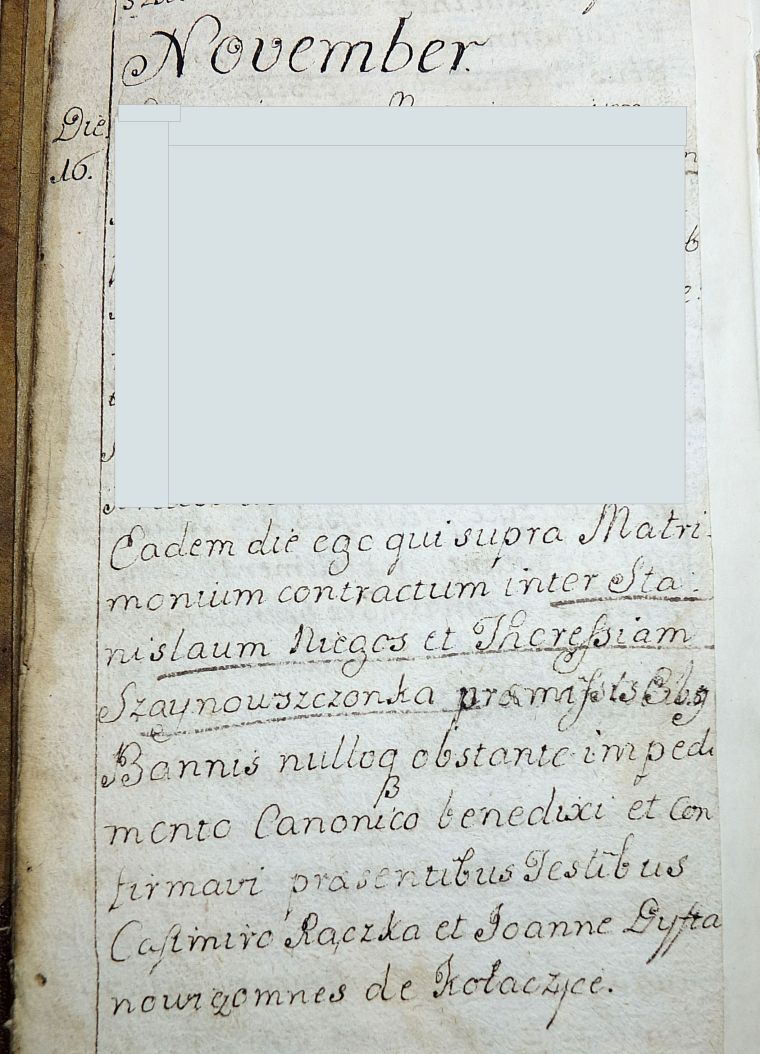
Disappointingly, this early marriage record from Kołaczyce from 17507 (Figure 8) shows relatively little information.

Figure 8:  Marriage record from Kołaczyce for Stanisław Niegos and Teresa Szaynowszczonka.8stanislaw-niegos-and-teresa-szajnowska-1750

In translation, this reads, “On this same day, I who am named above, blessed and confirmed a marriage contract between Stanislaus Niegos and Teresa Szaynowszczonka, having been preceded by three banns and with no canonical impediments standing in the way, in the presence of witnesses Casimir Rączka and Joannes Dystanowicz, all of Kołaczyce.”  The form of the bride’s name used here, “Szaynowszczonka,” indicates an unmarried woman of the Szaynowski family, which would be rendered “Szajnowska” in modern Polish.

It helps to remember that this record predates the requirement for church records to perform double-duty as civil records for the Austrian authorities.  Therefore, the priest’s only purpose in keeping it was to fulfill the obligations imposed upon him by the Roman Ritual.  Since the Church had no interest in the addresses, ages, or occupations of the individuals mentioned in the record, that kind of information does not appear.  In any case, finding a marriage record from 1750 for one’s Polish ancestors is actually pretty respectable, which brings us to my next point.

A Word About Early Records…..

Don’t expect too much from early records, and by “early,” I’m referring to Polish vital records for peasants, late-1600s to about 1750 records.  As is evident from the history, recognition of the importance of vital records developed gradually.  Perhaps this is why I have frequently found church records to be somewhat “spotty” in the late 1600s and early-to-mid 1700s.  By “spotty,” I mean that records that “ought” to be found in a particular parish in a given year just aren’t there.  It’s impossible to say for certain why this is, and in some of these cases, the event may have occurred in Parish B, despite evidence from other documents stating that it occured in Parish A.  But for whatever reason, it seems that priests became more conscientious about over time, as their responsibilities as record-keepers for the civilian authorities increased.  If you’re able to locate those early vital records, that’s a victory, but understand that there’s a chance the record will just not be there.

Poland’s complicated geopolitical history is reflected in her record-keeping practices, which can be confusing to the uninitiated.  The different languages in which the records are kept might be challenging, too.  However, the payoff comes in the satisfaction of being able to locate and read your ancestors’ story for yourself, as preserved by their paper trail.  I hope you’ve enjoyed this look at the history of Polish vital records, with some examples from each partition.  As always, I welcome feedback, including observations and insights based on your own research, so feel free to leave a note in the comments.  Happy researching!

Sources

Roman Catholic Church, Gąsawa parish (Gąsawa, Żnin, Poland), Księgi metrykalne, 1782-1960, Akta urodzeń 1847-1860, 1859, births, #73, record for Stanislaus Lewandoski.; 1191249 Items 1-3.

“Urzad Stanu Cywilnego Kucharki,” Narodowe Archiwum Cyfrowe, Szukajwarchiwach (http://www.szukajwarchiwach.pl/), Akta malzenstw 1874-1909, 1890, #13, marriage record for August Draheim and Agnes Jamrozik, accessed on 1 October 2016.

Urząd stanu cywilnego gminy Młodzieszyn, Sochaczewski, Mazowieckie, Poland, 1936, #16, death certificate for Marianna Zielińska.

 “Akta stanu cywilnego Parafii Rzymskokatolickiej Kowalewo-Opactwo (pow. slupecki),” Narodowego Archiwum Cyfrowego, Naczelnej Dyrekcji Archiwów Panstwowych, Szukajwarchiwach (Szukajwarchiwach.pl), 1838, Zgony, #5, record for Wojciech Grzeszkiewicz, accessed on 1 October 2016.

“Akta stanu cywilnego parafii rzymskokatolickiej w Mlodzieszynie, ” Polskie Towarzystwo Genealogiczne, Metryki.genealodzy.pl:  Projekt Indeksacji Metryk Parafialnych (http://metryki.genealodzy.pl/), 1897, Zgony, #3, record for Antonina Grzegorek.  Accessed on 1 October 2016.

Roman Catholic Church, St. Anna’s Parish (Kołaczyce, Jasło, Podkarpackie, Poland), “Śluby, 1826-1889,” Stare Kopie, 1834, record for Franciscus Łącki and Magdalena Bulgewiczowa, Archiwum Archidecezjalne w Przemyślu, Przemyśl, Poland.

Roman Catholic Church, St. Anna’s Parish (Kołaczyce, Jasło, Podkarpackie, Poland), “Śluby, 1826-1889,” Stare Kopie, 1861, #11, marriage record for Jacobus Łącki and Anna Ptaszkiewicz, Archiwum Archidecezjalne w Przemyślu, Przemyśl, Poland.

Roman Catholic Church, St. Anne’s parish (Kołaczyce, Jasło, Podkarpackie, Poland), “Księga małżeństw parafii Kołaczyce 1748 – 1779,” 1750, marriage record for Stanislaus Niegos and Teresia Szaynoszczonka,  Archiwum Archidecezjalne w Przemyślu, Przemyśl, Poland.

© Julie Roberts Szczepankiewicz 2016

Overview of Vital Records in Poland, Part II: Practical Implications of Historical Practices

In my previous post, I gave an overview of the history of vital records in Poland.  Today I’d like to go into a little more detail about the implications of that history.   Originally I thought I’d offer some examples of vital records from the different partitions as well, but in the interests of keeping these individual blog posts to a reasonable length, I think I’ll break it down a bit further and include those additional examples and observations in a “Part III.”

1.  First, there is no single, centralized repository for vital records in Poland (or in any other country, for that matter).

It sure would be nice if there were, but just as in the U.S., where  you have to go to a town clerk’s office to find a civil marriage record, and a parish to find a church marriage record, the same is true in Poland — more or less. The lines get a bit blurred because of the role that church officials played in acting as civil registrars, so sometimes it’s not immediately apparent whether a given register is the original church register or a civil transcript.  It’s probably safe to say that the state archives have more civil records collections than they do church books, but the state archives do have plenty of original church books nonetheless, as you can see from this collection.  Theoretically, church records more than 100 years old are supposed to be transferred to the appropriate diocesan archive, just as their civil counterparts are supposed to be transferred from the registry office to the appropriate state archive.  However, some parishes choose not to comply with this, so it’s not uncommon to find parish priests with 300 years’ worth of vital records sitting in their office.

Because of this, you may have to get creative in order to get full coverage for your parish of interest, and check a variety of sources.  Some diocesan archives are more forthcoming than others about what their holdings include, and some parishes and diocesan archives aren’t very responsive to requests for records by mail, so I often find it’s most expeditious to hire a local researcher to investigate holdings and obtain records from parishes or archives.  For example, for my ancestral parish of Kołaczyce, records can be found in the parish, in the Archdiocesan Archive in Przemyśl, in the USC (civil registry office), and in the Sanok Branch of the Polish State Archive of Rzeszów (Figure 1):

Figure 1:  Vital Records Coverage Table for Kołaczyce, Podkarpackie province, Poland

Repository Range of Years for Birth Records Range of Years for Marriage Records Range of Years for Death Records
Sanok Branch of the State Archive in Rzeszów

1900-1908

1871-1896

1863-1906

USC in Kołaczyce Presumably, 1916 to present Presumably, 1916 to present Presumably, 1916 to present
Archdiocesan Archive in Przemyśl 1746-1782; 1826-1889 1748-1779; 1826-1889 1762-1779; 1826-1889
St. Anne’s Church in Kołaczyce 1784-present 1784-present 1784-present

As you can see from this table, there’s quite a bit of overlap in the coverage, which is nice, but there are also a few gaps.  The Archdiocesan Archive’s collection only includes births through 1782, which suggests that birth records from 1783 are missing, since the parish collection of birth records begins in 1784.  Similarly, there’s a 4-year gap from 1780-1783 in both marriage records and death records.  It’s not clear why the State Archives have relatively few records and such a disparate range of years for the different vital events, but the fact that there’s so much overlap in coverage means that researchers interested in this parish won’t lack for material.

Coverage differs dramatically in different parts of Poland.  If you’re researching in Galicia, you’re lucky, because coverage there is generally good.  Researchers in Mazovia might have a different experience, however.  Figure 2 shows the coverage table for another one of my ancestral parishes, Młodzieszyn, in Sochaczew County.

Figure 2:  Vital Records Coverage Table for Młodzieszyn, Mazowieckie province, Poland

Repository Range of Years for Birth Records Range of Years for Marriage Records Range of Years for Death Records
Grodzisk Mazowiecki Branch of the State Archive in Warsaw  

1885-1912


1889-1911


1889-1901

USC in Młodzieszyn Presumably, 1916 to present Presumably, 1916 to present Presumably, 1916 to present
Diocesan Archive in Łowicz —- —- —-
Nativity of the Blessed Virgin Mary Church in Młodzieszyn 1945 to present 1945 to present 1945 to present

This area suffered a great deal of damage during the Battle of the Bzura in 1939, and all the vital records from before 1885 were destroyed.  All of them.  Gone.  The point here is that your mileage may vary quite a bit when it comes to the availability of records for your ancestral parish of interest.  Records may exist dating back to the 1600s, or the only existing records may be relatively recent.

2.  The existence of separate record books for each village within a parish in Austrian Poland/Galicia means that you can search for individual village names in sites like Baza PRADZIAD and Szukajwarchiwach, rather than searching only under the parish name.

For example, the village of Nawsie, which belonged to the parish in Kołaczyce, has its own collection of birth records here (births from 1859-1900) at the State Archive Branch in Sanok.  As a corollary to this, since I know that my ancestors were from Kołaczyce, the other villages belonging to that parish would be the very next place I would look for records, if I could not find a record of a particular vital event in Kołaczyce itself.  Note that this is only true for villages and parishes that were within Austrian Poland/Galicia.  If I want to find records for the village of Wierzbno in Słupca County, Wielkopolskie province, which was in Russian Poland, I will not find them by searching under “Wierzbno” in Baza PRADZIAD, Szukajwarchiwach, or any other site which indexes or catalogues  Polish vital records.  Instead, I have to use a gazetteer to determine the parish, which is Kowalewo-Opactwo in this case.  Records from Russian Poland and Prussian Poland typically note the home village(s) of the key participants within each record, but all the records are bound in the same book.

3.  The existence of separate record books for each village within a parish in Austrian Poland means that you need to identify the present parish for the village, when requesting records from the parish itself.

As new parishes are created in Poland to serve the evolving needs of the community, parish borders change.  When a village that belonged previously to one parish is reassigned to a new parish, all the old record books for that village are transferred to the new parish.  As an example, my great-great-grandfather Andrzej Klaus was born in the village of Maniów in gmina Szczucin in the Małopolskie province in 1865.  At that time, Maniów belonged to St. Mary Magdalene parish in Szczucin, so that is the church in which he was baptized.  However, in 1981, a new parish  called Shrine of Our Lady of Fatima and of the Rosary,was founded in the village of Borki,  and the village of Maniów was assigned to this new parish.  So when I visited Poland last summer, and wanted to see the original record book which contained Andrzej Klaus’s baptismal record, that book was in the shiny new parish in Borki rather than in the centuries-old parish in Szczucin.

Of course, in this case the problem is somewhat academic, because these records are also available on microfilm from the LDS.  However, it does frequently happen that the desired parish records that are not available online or on microfilm, and in that case, it is incumbent upon the researcher to determine the correct parish to write to before making an inquiry.

4. The fact that duplicate copies were created in every partition increases the likelihood that at least one copy survived.

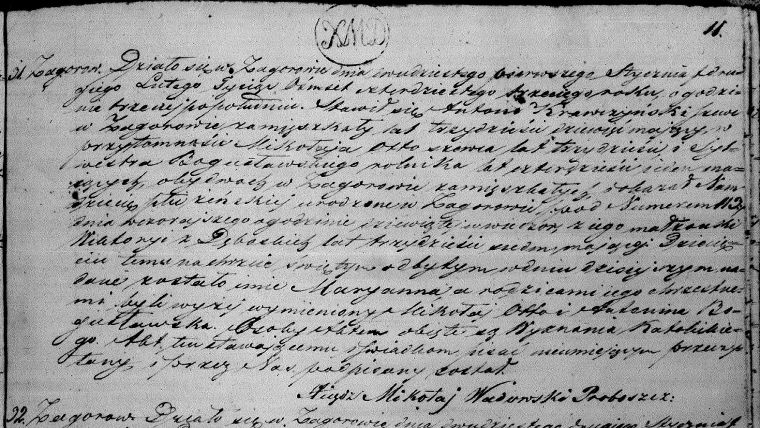
There’s a pervasive myth out there that “all Polish records were destroyed in the wars” that often keeps people from even trying to find those records.  While it’s true that many records were destroyed, there are plenty of records that survived, and in some places, it’s possible to find both the civil and the church record for the same vital event.  As an example, Figure 3 shows the church version of the 1843 baptismal record for my great-great-grandmother, Marianna Krawczyńska,from the parish of Zagórów, in what is now the Wielkopolskie province, but was at the time part of Russian Poland.

Figure 3:  Baptismal record from Zagórów for Marianna Krawczyńska, born 1 February 1843.1film 2162127 item 2 record 31 page 226

The record is in Latin, in paragraph form, and it’s fairly brief.  It’s dated February 2, and in translation, it indicates that the same priest who was named in the preceding record baptized a female child named Marianna, born the previous day at 9:00 in the evening, daughter of Antoni Krawczyński and his lawful wife, Wiktoria Dęboska. (The spelling of Wiktoria’s surname is usually standardized to “Dębowska” in modern Polish.)  Godparents are also named.

In contrast, Marianna’s civil birth record2 includes quite a bit more information (Figure 4).

Figure 4:  Civil birth record from Zagórów for Marianna  Krawczyńska, born 1 February 1843.2 maryanna-krawczynska-1843

The translation is as follows:  “It came to pass in the village of Zagórów on the 21st day of January /2nd day of February, at 3:00 in the afternoon.  He appeared: Antoni Krawczyński, shoemaker, of Zagórów residing, having 39 years of age, in the presence of Mikołaj Otto, shoemaker, age thirty, and Sylwester Bogusławski, farmer, age 41, both residing in Zagórów, and showed us a child of the female sex born in Zagórów in house number 113 (?), born yesterday at 9:00 in the evening of his wife, Wiktorya née Dęboska, age 37. To this child at Holy Baptism performed today, was given the name Maryanna, and her godparents were the aforementioned Mikołaj Otto and Antonina Bogusławska. All parties mentioned in this Act were of the Catholic religion. This act was read aloud to the declarant and witnesses, but signed by us only, because they do not know how to write. [signed] Fr. Mikołaj Wadowski, Pastor.”

Although the key facts are identical between these two records, the civil version includes the names, ages, occupations, and places of residence of two adult, male, legal witnesses in addition to the age, occupation, and place of residence of the father.  This particular record provides the address of the house where the child was born, although this information may be omitted, depending on the parish.  The use of double dates for both the date of baptism and the date of birth was required by the Russian authorities, and reflects the fact that Poland and Western Europe had adopted the Gregorian calendar, while Russia and Eastern Europe persisted in using the old Julian calendar.  The second date (Gregorian) is the one we use today.

This brings us to our next point:

5. Whenever both church and civil records exist for the same vital event, get both.  One may be more informative or accurate than the other.

In Russian Poland and Prussian Poland, the civil transcrips were created in parallel, at the same time as the church record.  So a record from the civil transcript (“Kopie księg metrykalnych”) is likely to be as accurate as one from the parish register, (“Księgi metrykalne”) though it might contain additional information, as shown with Figures 1 and 2.  However, one would predict that discrepancies between the church and civil records might occur somewhat more frequently with civil transcripts (“Kopie księg metrykalnych”) from Galicia, where church records were recopied at the end of the year.  If a discrepancy were found between the civil transcript and the parish register for a vital event from Galicia, I would be inclined to trust the parish register over the transcript.  In many cases, only one set of records (church or civil) is available, so you may not have the luxury of comparing the two.

6. If you’re looking for a relatively recent record, and the state archive does not have it, write to the USC for the township where the village is located.

As an example, my great-great-grandmother had a sister, Barbara Mikołajewska, who died in 1926 in Juliopol, gmina Młodzieszyn, Mazowieckie province.  Since her death occurred more than 80 years ago, it is classified as archival, and therefore anyone may request a copy whether or not they are a direct descendant.  However, If you check the holdings of the state archives (e.g. Baza PRADZIAD, as discussed previously) you see that the the local archive for Młodzieszyn, which is the Grodzisk Branch of the State Archive of Warsaw, only has death records for Młodzieszyn going up to 1901. Records from 1926 have not yet been transferred to the local state archive, so this particular record was still found in the USC for Młodzieszyn.  Tip:  USCs can be rather slow to respond to requests for records, especially if you don’t have an exact date for the event.  You may have better luck with hiring a local researcher to visit the USC in person to obtain records for you.

In the next post, I’ll provide some additional examples of vital records from all three partitions, as well as a few additional tips and observations.  In the meantime, happy researching!

Sources:

1Roman Catholic Church, Zagórów parish (Zagórów (Słupca), Poznań, Poland), Księgi metrykalne, 1592-1964, 1843 #31 birth record for Marianna Krawczyńska, p. 226.; 2161271 Item 5.

2“Akta stanu cywilnego Parafii Rzymskokatolickiej Zagórów (pow. slupecki)”, Narodowe Archiwum Cyfrowe, Szukajwarchiwach (http://www.szukajwarchiwach.pl/), 1843, #31, birth record for Marianna Krawczyńska, accessed on 18 September 2016.

© Julie Roberts Szczepankiewicz 2016

A Case of Mistaken Identity

Have you ever known something about your family for a fact, yet discovered through research that it’s just not true after all?  I’ve had this experience very recently, and it came about as a result of this blog post.  Recently, my mother-in-law’s cousin shared with me this photograph (Figure 1).

Figure 1:  Konczal Fabiszewski family circa 1906 lower resolution 001He wondered if I might have any insight into who the people were.  I was excited to see the photo, and believed I could tell him exactly who these people were because Grandma Barth showed me this same photo before she died, and filled me in. I thought this photo would be a nice subject for a blog post, so I started to gather a bit of background documentation to provide some insight into the lives of the people shown here.  In the process,  I’ve discovered that things aren’t really what they seemed, and maybe — just maybe — Grandma might have been wrong about a thing or two.

I admit that I haven’t done much research with Grandma’s family.  She had accumulated so much information on her own, including where her family had come from in Poland, and preliminary research showed her information to be pretty accurate.  So it was easy to accept all her information as fact, and put this on the back burner while working on lines that seemed more challenging.  By way of background, Grandma Barth’s parents were Albert Drajem and Mary Kantowska, both born in Buffalo, New York, to Polish immigrants.  Mary Drajem, Grandma’s mother, was the fourth of seven children born to John Kantowski and Mary (née Kończal) Kantowska, who came to Buffalo from Łabiszyn, a small town in what is now Żnin County in the  Kujawsko-Pomorskie province of Poland, but what was at that time part of the Prussian Empire.  According to Grandma Barth, her maternal grandmother, Mary Kantowska, had several siblings who also eventually settled in Buffalo:  a brother, John Kończal, and sisters Katherine and Josephine.  Grandma also reported that Katherine married Constantine Fabiszewski and had seven sons, while Josephine married Teofil Mroziński, and had four children.  It is the Fabiszewski family —  Constantine, Katherine, their children, and an old woman, whom we’ll discuss more closely in a moment — who are shown in this photograph.

The Fabiszewski Family of Buffalo, New York

Figure 2 shows the Fabiszewski family in the 1910 U.S. Federal Census:

Figure 2:  Extract of 1910 U.S. Federal Census for Buffalo, New York, showing the Constantine Fabiszewski family:

Fabiszewski family 1910 census

Based on their heights in this photograph, it seems logical to infer that the oldest son, Peter, is standing in the back row, behind his father, with his brother Casimir to the left in the photo, and Leon to the left again, behind the old woman.  The fourth-oldest son, Frank, appears to the be boy holding the candle and prayer book, both of which suggest that this portrait was taken on the occasion of his First Communion.  The very youngest son, Stanislaus, is standing between his parents, with Joseph and Anthony to the left in the photo of the old woman.  So who is the old woman?

The Mysterious Anna (née WoźniakKończal

Grandma Barth told me that this woman was her own great-grandmother, that her name was Anna (née WoźniakKończal, and that she was the mother of Katherine Fabiszewski, John Kończal, Josephine (née Kończal) Mroziński, and Mary (née Kończal) Kantowska (Grandma’s grandma).  Grandma remembered her vividly, even though Grandma was only six years old when Anna died in 1922.  She’s buried in St. Stanislaus Cemetery, whose records indicate that she was 60 when she died,conflicting with Grandma’s assertion that her great-grandmother died at the age of 70.  In 1920, per both Grandma and the 1920 U.S. Federal Census, Anna was living with the family of her daughter Mary Kantowski, in the same house as Grandma Barth’s family (Figure 3):

Figure 3:  Extract of 192o U.S. Federal Census for Buffalo, New York, showing the Kantowski and Drajem families at 221 Clark Street.  Anna Konczal is noted as mother-in-law to head of household, John Kantowski. 1920 Census Kantowski family

Grandma Barth appears in this census as “Jennie,” age 3 years 8 months.  The census indicates that Anna is a 70-year-old widow (Grandma wins on the age question!) and a resident alien who immigrated in 1891.  This immigration year is in contrast to her daughter Mary, who immigrated in 1886 with her husband John.

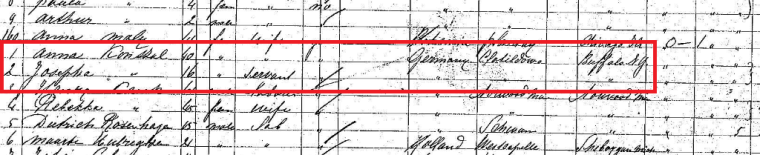
That 1891 immigration year gave me a good lead in finding her passenger manifest,2 which shows Anna and daughter Josepha Konszal (sic) arriving at the Port of New York on 19 November 1892 (Figure 4).

Figure 4:  Passenger manifestfor Anna and Josepha Konszal (sic), 19 November 1892:Konszal passenger manifest 1892


Anna is 40 here and Josepha is 16, which is consistent with their dates of birth from other sources.  They’re from “Clotildowo, Germany,” which fits nicely with the village of Klotyldowo, a village which belonged to the Catholic parish, in Łabiszyn.  They’re headed to Buffalo, New York, which makes sense.  So we know that Anna came over with the then-single Józefa, but was living with her daughter Mary in 1920.  Where was Anna during those intervening years?

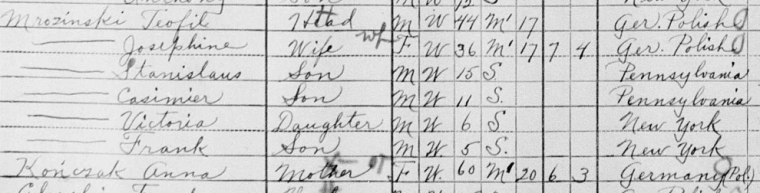
Well, ten years earlier, in the 1910 U.S. Federal Census, Anna Kończal  seems to be found living with her daughter, Józefa Mrozińska, and family (Figure 5):

Figure 5:  Extract from the 1910 U.S. Federal Census for Buffalo, New York, showing the Mroziński family.Teofil Mrozinski family 1910 census

Although we suspect immediately that this is really “our” Anna Kończal and not Teofil’s mother, there are a couple of problems.  Anna’s name is misrendered as “Kończak” instead of “Kończal,” and she is erroneously reported to be Teofil’s mother, and not his mother-in-law.  However, “Kończak” seems pretty close to “Kończal,” and her age and year of immigration match up nicely with the information for “our” Anna that was reported on the 1920 census.  Unfortunately, it can be argued that these latter facts might also be true for Teofil’s mother, so they don’t constitute irrefutable evidence that this Anna is his mother-in-law and not his mother.  Perhaps his mother remarried a man named Kończak after Teofil’s father died, so she was no longer “Mrs. Mrozińska” at the time of the census.  Fair enough.  So how do we resolve this problem?

Next stop, Pennsylvania

Well, Teofil and Josephine’s marriage record should tell us their parents’ names.  Where do well look for that record?  If you’ll notice, the final column on the right in Figure 4 indicates that the oldest two Mroziński children, Stanislaus and Casimir, were born in Pennsylvania, while the younger two were born in New York. Similarly, if you go back to Figure 1, you see that the oldest two Fabiszewski boys, Peter and Casimir, were also born in Pennsylvania.  These data suggest that both the Mrozińskis and the Fabiszewskis might have married in Pennsylvania, prior to the births of their children there.  Sure enough, I found records of marriage for both couples in Shamokin, PA.

The  Mrozińskis’ marriage record  (Figure 6) gave valuable information, but no surprises.

Figure 6:  Marriage certificate for Teofil Mroziński and Józefa Kończal, 1894.Teofil Mrozinski and Jozefa Konczal marriage 1894 crop

Both the bride and groom are from Prussia, consistent with the “German Polish” notation found on census records.  Teofil was living in Shamokin and working as a miner.  His parents were Andreas Mroziński and Rozalia Mrozińska (no maiden name provided).  Josephine was also living in Shamokin, working as a domestic, and her parents’ names are given as Franciszek and Annie Konczal [sic].  Taken together, these facts offer conclusive evidence that the “Anna Kończak” living with the Mroziński family in Buffalo in 1910 really is Teofil’s mother-in-law, and not his mother.

Will the Real Katherine Fabiszewski Please Stand Up?

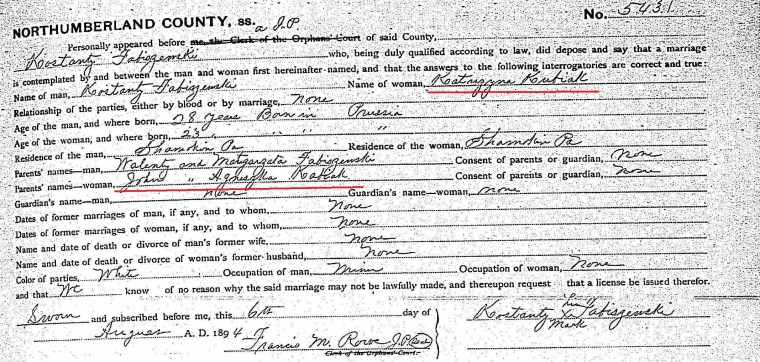
However, the real surprise came with the marriage record for Josephine’s sister, Katherine, to Constantine (Konstanty, in Polish) Fabiszewski (Figure 7):

Figure 7:  Marriage certificate for Konstanty Fabiszewski and Katarzyna Kubiak, 1894.

Konstanty Fabiszewski and Katherine Konczal 1894 crop marked

Katherine’s name is given as Katarzyna Kubiak, not Kończal, and she’s the daughter of John and Agnieszka Kubiak!  What?  How can that be?  Grandma said that Katherine was sister to John, Mary and Josephine Kończal, and she’s been right about everything else so far!  How could Katherine be a Kubiak?  Could there be two Konstanty Fabiszewskis in Shamokin, both about the same age, both married to women named Katherine?  Well, stranger things have happened, but then where is the marriage record for Katherine Kończal? And didn’t Grandma say that her great-grandmother’s name was Anna (née WoźniakKończal, not Anna (née KubiakKończal?

At this point, I don’t have enough data to resolve this problem.  More work needs to be done. Grandma Barth has proven to be a very reliable source in the past, but this could very well be an instance in which she’s wrong.  I looked back to see where Grandma might have gotten the idea that the surname Woźniak was associated with this family, and found it in Mary Kantowska’s birth certificate, an official copy of which Grandma had carefully preserved (Figure 8):

Figure 8:  Official transcript from 1906 of Mary Kantowska’s 1891 baptismal record from St. Stanislaus Church, Buffalo, New York

Maria Kantowski 1891.jpg

This indicates that Mary Kantowska’s parents were, in fact, John Kantowski and Maria Kończal, and that her godparents were John Kończal and Anna Woźniak. John Kończal is likely to be Mary (née Kończal) Kantowska’s brother, whom Grandma mentioned among the known Kończal siblings. So Woźniaks might indeed be connected to the Kończal-Kantowski family, but this does not explain why Katherine, who was purportedly”née Kończal” Fabiszewska, is actually Katherine, née Kubiak, Fabiszewska.

The Poznań Project Weighs In

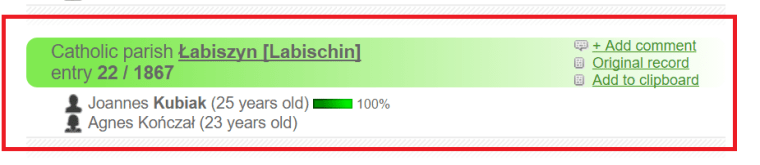
Some interesting insight is gained by search results from the Poznań Project. A search for Franciszek Kończal and Anna, no surname specified — which are the names reported for Josephine’s parents on that marriage record — reveals the following (Figure 9):

Figure 9:  Extract of results from Extended Search in the Poznań Project for marriages between grooms with name Franciscus/Franz/Franciszek Konczal and brides named Anna.Franciscus Konczal and Anna Kubiak Poznan Project hit

Here we see Kubiak again, and in Łabiszyn, the home parish of Grandma’s Kończals.  Anna Kubiak’s age in this record suggests a birth year of 1844 –older than what we would expect based on U.S. records, which point to a birth year of 1850-1852, but within the ballpark.  Moreover, a search for Jan Kubiak and Agnieszka, no surname — the names reported for Katherine Fabiszewski’s parents — produces this hit (Figure 10):

Figure 10:  Extract of results from Extended Search in the Poznań Project for marriages between grooms with name Joannes/Jan/Johann Kubiak and brides named Agnes/Agnieszka.

Jan Kubiak and Agnes Konczal

Curiouser and curiouser!  Same parish, and it would seem that Katherine Fabiszewski’s mother was a Kończal.  Taken together, this might suggest a case of siblings marrying siblings — perhaps Joannes Kubiak and Anna Kubiak were siblings, and they married siblings Agnes Kończal and Franciscus Kończal.  The records from Łabiszyn and Buffalo will tell us for sure.

The Mysterious Anna (née Woźniak) (née Kubiak) Kończal

So where does this leave us?  Who IS the woman in the photo, after all?  Is she Grandma Barth’s great-grandmother, Anna (née Kubiak) Kończal?  If so, why is she in a portrait with the family of her probable niece, and not her daughter?  Was Grandma mistaken, and this photo shows Katherine Fabiszewski and her family with her own mother, Agnes (née Kończal) Kubiak?  It appears that Grandma was misinformed about Katherine Fabiszewski being a sister to her own mother, Mary — present data suggest that they were cousins, or perhaps double cousins, but not siblings.  Yet one wonders if it’s even possible that Grandma would misidentify her own great-grandmother in a family photo.  Like Grandma Barth, I was six when one of my great-grandmothers died, and I can easily pick her out in old family photos.  The very fact that this photograph was handed down in Grandma’s family, and not just in the Fabiszewski family, suggests that it was significant to both families, possibly due to the image of a shared great-grandmother.  Moreover, when Anna Kończal died in 1922, her daughter Mary Kantowska was 54, and her granddaughter Mary Drajem (Grandma Barth’s mother) was 31.  Surely they were the ones to pass this photo down to Grandma Barth, and they would have been able to correctly identify their own mother and grandmother.

There are two final bits of information that we can wring out of that 1910 census listing for Anna Kończal in Figure 4.  The “M1” in the column after age tells us that Anna Kończal was married once, and that she’s been married for twenty years.  The next two numbers tell us that she was the mother of six children, three of whom were still living at the time of the census. Starting with those numbers about Anna’s children, the fact that is says three children still living at the time of the census is significant — not four, Katherine, John, Mary and Josephine — as Grandma Barth recollected.  This would make sense if Grandma was wrong about Katherine Fabiszewska being one of the Kończal siblings.   The next bit, about the “M1/20” only adds to the confusion, however.  Josephine Mrozińska is reported to be 36 years old at the time of this 1910 census — making her 16 at the time of her mother’s wedding, if her mother’s only been married 20 years.  So the census-taker appears to have erred with at least some part of that story.  Either this is a second marriage for Anna, or she’s only been married once, but Josephine was born 16 years out of wedlock.

It’s hard to think of a single hypothetical scenario that would resolve all these conflicts in the data. I considered the fact that perhaps Anna Woźniak was married twice — first to a man named Kubiak, with whom she had Katherine, and then to Franciszek Kończal, with whom she had Josephine, John and Mary.  But if that were the case,then the mother’s name reported on Katherine Fabiszewska’s marriage record should be Anna, and not Agnieszka, and we would expect to see two marriage records for Anna in the Poznań Project.  It’s possible that mistakes were made in recording the census, and also possible (though it seems less likely) that a mistake was made in the marriage record.  Further research should be able to resolve these conflicts and reveal the full story.  In the meantime, we’re left with something of a mystery, and questions today where I thought I had answers yesterday.

Sources:

Note:  Where possible, links are provided to sources online.  Other sources are summarized below.  

1St. Stanislaus Roman Catholic Cemetery (Buffalo, Erie, New York, USA) to Julie Szczepankiewicz, Phone Call, Inquired about a burial for Anna Konczal.  Was informed that she died on April 23, 1922 at age 60 and was buried April 26, 1922  in Sec. K, Lot 79, Grave 7.  Her funeral was at Corpus Christi Church and Urban Funeral Home.

2Anna Konszal, 19 Nov 1892; citing departure port Rotterdam, arrival port New York, ship name Werkendam, NARA microfilm publication T715 and M237 (Washington D.C.: National Archives and Records Administration, n.d.), accessed on 30 August 2016.

© Julie Roberts Szczepankiewicz 2016

Grandma Barth’s Box of Genealogical Treasures

My husband’s grandmother, Joanna “Jean” (née Drajem) Barth was the family historian for her generation, and I loved her for it.  I loved her for other reasons, too, of course, but listening to her stories about Buffalo’s East Side in her childhood and youth gave me such a vivid impression of Buffalo’s pious, hard-working Polish immigrants who brought with them their language, culture, faith, and traditions and created a microcosm of Poland in their new homeland.  Grandma Barth was my Grandma-in-law for seventeen years before she passed away in 2008 at the age of 92, but she was mentally sharp as a tack until she died and an incredible font of family knowledge.  She could tell me names, birth, marriage and death dates from memory for the entire extended family for several generations, with stories about each person, all in her East-Side Polish accent that was somehow comforting to hear.

Grandma Barth’s stories laid the foundation for my research into my mother-in-law’s family.  In the spring of 1999, she traveled from Buffalo to our home in Illinois for our third son’s christening.  I remember spending as much time as possible during that visit, cradling my baby in one arm while typing with my free hand, inputting all the family data from Grandma’s memory into Family Tree Maker.  A few years later, she was back for another christening, this time for my daughter, in 2003.  And this time, she brought with her a plastic shoebox that I came to refer to as, “Grandma Barth’s Box of Genealogical Treasures.”

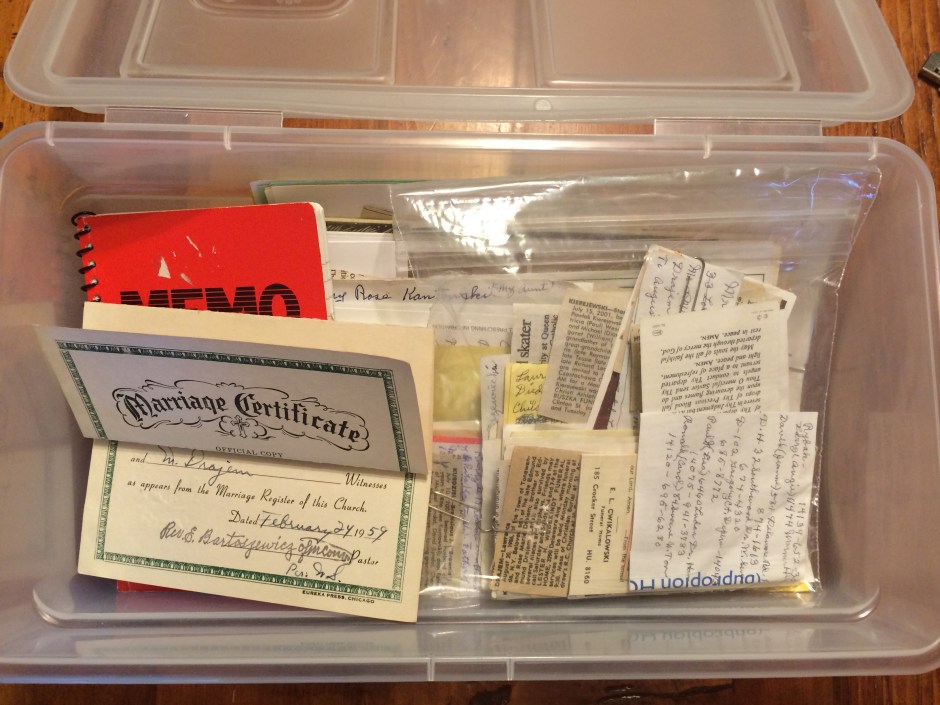
This plastic box contained newspaper clippings, funeral home prayer cards (my family always called them “obrazki,” which means, “pictures” in Polish), and assorted scraps of paper on which Grandma had jotted down bits and pieces of family history.  Never one to waste paper, most of these notes were written in Grandma’s neat, careful penmanship on the backs of junk-mail coupons for pizza and car washes.  What she preserved was amazing.  There were obrazki in there from the 1930s  through the early 2000s. Her parents’ marriage certificate was there, along with other vital records.  There were newspaper articles about her home parish, Corpus Christi, a collection of articles about Fr. Justin Figas (founder of the Father Justin Rosary Hour, a Polish-language radio program) and a series of “Anniversary Books” from Corpus Christi, arranged according to month. Each monthly book covers the years 1898 through 1997, and lists the names of all those who died in the parish during that month in each year.

I tried to photocopy as much of it as I could during her visit, but I recognized that care needed to be taken with this project.  Some of these newspaper death notices had been trimmed into tiny, yellowed bits of paper not more than two inches square.  Moreover, there was clearly an organizational system in place that must be respected. Grandma paper-clipped the scraps of paper together in batches, and put these individual batches into plastic storage bags according to the branch of the family tree to which they belonged. Grandma admitted that in some cases, she didn’t know exactly how some of these people fit into the family, she only knew that they were cousins, which made it all the more important to maintain the associations between the documents which she created through her organizational scheme.

As much as I wanted to photocopy all of it, there was only so much that I could do, given that I had a houseful of out-of-town guests visiting for my fourth child’s christening and only a few days’ time.  Grandma told me there was no rush — she wanted me to have the box when she passed away.  In the meantime, though, she wanted to share it with a cousin.  I thanked Grandma wholeheartedly, congratulated myself on getting as much scanned as I did, and went back to raising my family and researching my family tree.

After Grandma passed away in 2008, we discovered that the box was missing.  The cousin who was supposed to have it didn’t remember anything about it.  My mother-in-law asked around the family, but no one seemed to know what happened to it.  It was presumed to have been thrown out with the trash.  It was an inestimable loss — I was sick at heart over the thought of so much family history, Grandma’s legacy, rotting in a landfill somewhere.

But as you can tell from the photo at the top, the story has a happy ending, and my worst fears never materialized.  One day last spring, my Mom-in-law got a phone call from this cousin, saying he’d found a box of her mother’s things, and he’d like to return it to her.  She called me immediately, and said, “I have some good news for you!  Are you sitting down?  My cousin found the box!”  So this past weekend, several of us got together for breakfast, including Mom, her cousin, Grandma’s youngest sister, and me, and the box found its way back to me at last, looking exactly as I’d remembered it.  Mom’s cousin also kindly shared with me some additional family history treasures from his personal collection.  The poor man was so apologetic — Grandma never mentioned to him about her intentions for the box, and he had no idea what kind of treasure trove he was sitting on.  I’m sure that my discoveries based on the contents of this box will fill quite a number of future blog posts, but it’s going to take some time to process and analyze all of this.  In the meantime, a picture is worth a thousand words, so here are a few of the “goodies” from the box.

Figure 1:  Obrazek from the funeral of Agnieszka (née Jamrozik) Drajem, Grandma Barth’s paternal grandmother, who died 13 February 1946.

Agnieszka Drajem obrazek 1946


Figure 2:  Notes from Grandma’s notebook regarding the family history on her mother’s side (Kantowski and Kończal).

Grandma Barth notebook p 1


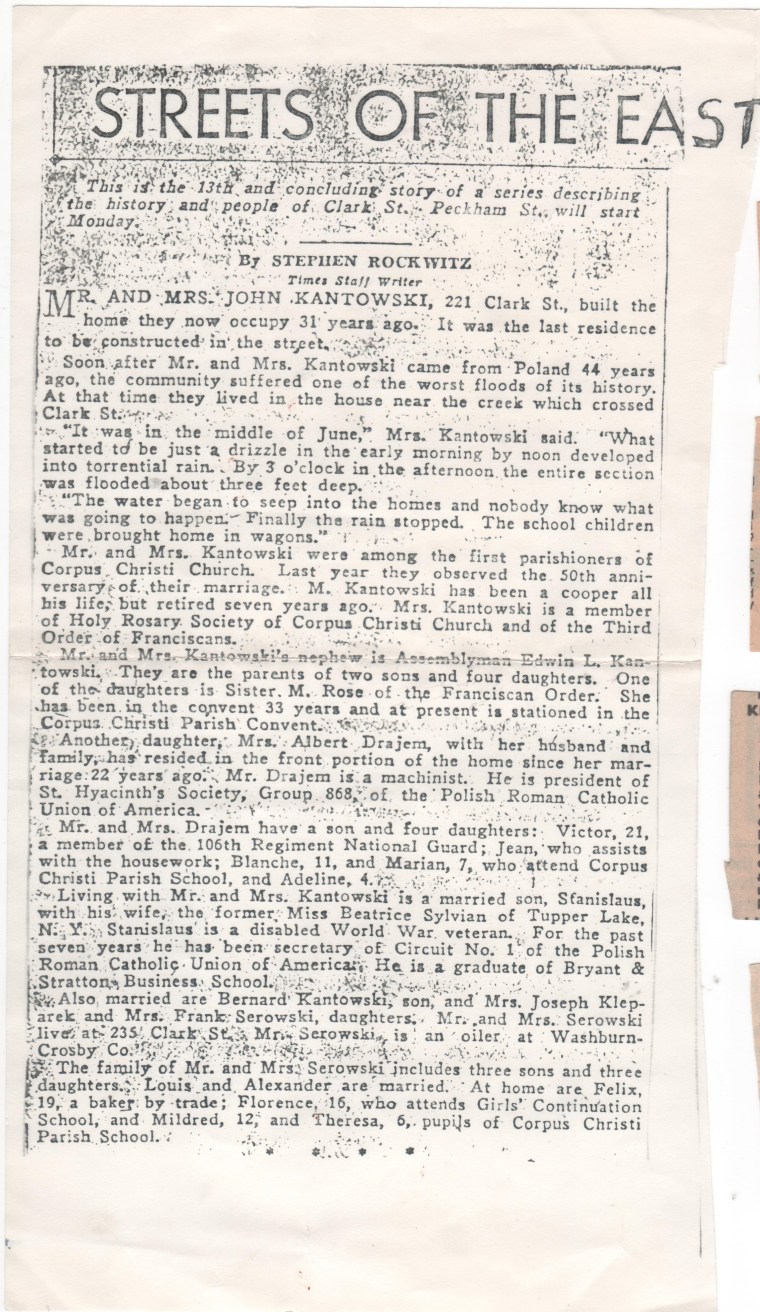
Figure 3:  Photocopy of newspaper interview with John and Mary Kantowski (Grandma Barth’s maternal grandparents), published circa 1934.

Streets of the East John & Mary Kantowski interview

So you can see why I’m pretty excited!  So far I’ve scanned 27 “batches” of clippings, and there’s still more to go.  Here’s to you, Grandma Barth, with love and gratitude for all your love and diligence in preserving the family history for future generations to enjoy.


Walter Wed Where? Wow! A Genealogical Breakthrough

The sweetest victories are the ones that took the longest time in coming.  A couple days ago, I happened upon some documents that fundamentally changed my understanding of my Grzesiak family history, documents I’ve been seeking for many years.  So there is some major happy dancing going on in the Szczepankiewicz house today, albeit limited to just one of its residents.

The Grzesiaks of Kowalewo-Opactwo and Buffalo, New York

In a previous post, I wrote a little about the family of my great-grandmother, Veronica (née Grzesiak) Zazycki.  Veronica immigrated from the little village of Kowalewo-Opactwo in Słupca County to Buffalo, New York, where she was eventually joined by three of her siblings:  Władysław (“Walter”), Tadeusz/Thaddeus, and Józefa/Josephine.  Regarding Veronica’s oldest brother, Grandma told me that Walter had married an actress in Poland, whose name Grandma remembered as “Wanda,” but she didn’t want to leave her career, so he left her and came to the U.S. without her. There were no children from this marriage.

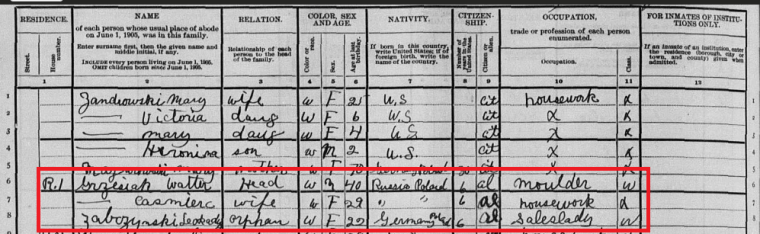
When I began to look for documentation for these family stories, I realized the situation wasn’t exactly as Grandma had portrayed it.  The 1900 census (Figure 1) shows the Grzesiak family all living on Mills Street in Buffalo, consisting of patriarch Joseph, sons Władysław and Thaddeus, daughter Jozefa, and daughter-in-law Casimira — Walter’s wife of two years.  Clearly, Walter’s wife DID come to Buffalo, rather than staying in Poland while he left without her – but her name was Casimira, not Wanda. The census goes on to state that at that time, she was the mother of 0 children, 0 now living, consistent with family reports.

Figure 1:  Extract from the 1900 U.S. Federal Census, showing the Grzesiak family.1900 United States Federal Census - Kazimira Grzesiak

In the 1905 New York State Census (Figure 2), Walter and Casimira were still living in Buffalo, so the marriage lasted at least 7 years.  Subsequent records (e.g. the 1940 Census) do indeed show Walter as divorced or a widower.

Figure 2:  Extract from 1905 New York State Census showing Walter and Casimira Grzesiak.1905 NY State Census for Walter Grzesiak

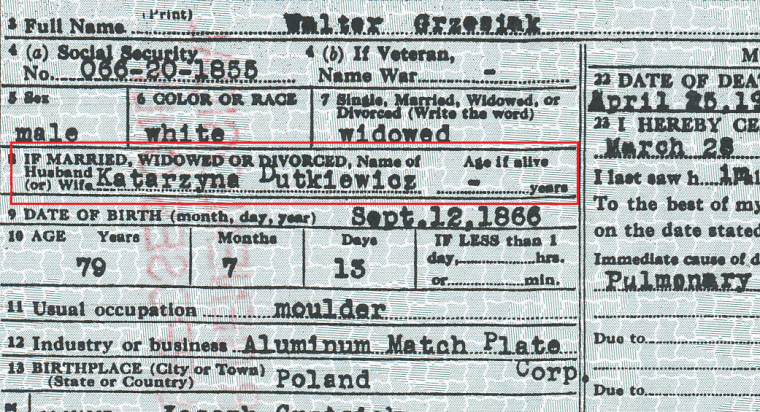
Walter’s death certificatereports his ex-wife’s name as “Katarzyna Dutkiewicz (Figure 3), and the informant was his brother, Thaddeus.

Figure 3:  Extract from Walter Grzesiak’s death certifcate.Katarzyna Dutkiewicz

Clearly, Thaddeus made a mistake with the first name, reporting it as Katarzyna (Katherine) instead of Kazimiera/Casimira.   So how much faith should we put in his version of her maiden name, Dutkiewicz?  Death records are often viewed with some circumspection, since someone other than the deceased is providing the information, and that person might be grieving or in shock.  However, it was all there was to go on, and it seemed like it should have been a good start:  Name, Kazimiera Dutkiewicz (or similar), born about 1880 (based on those census records), married to Władysław Grzesiak in Poland circa 1898.

The Hunt Is On!

Since Walter Grzesiak was born in Kowalewo-Opactwo, it seemed logical that he would have married somewhere in that vicinity, although not necessarily in that parish.  Things get a little tricky with the records for Kowalewo-Opactwo in that time period.  Records are not online, or on microfilm from the LDS, so one must write to the Konin Branch of the State Archive in Poznań to request a search.  Moreover, although Walter was baptized in Kowalewo, that parish was temporarily closed from 1891-1910.  Parish operations were transferred to the church in nearby Ląd, but after 1911, the parishes and their records were separated again.   Unfortunately, the archive reported that there was no marriage record in Ląd for Władysław Grzesiak, or for any of his siblings, during this period.

Initially, this finding didn’t concern me too much.  It’s traditional for a couple to marry in the bride’s parish, so this suggested merely that Kazimiera was from some other parish in the area.  So how does one find a marriage in the Poznań region, when one has no idea what parish the couple married in?  The Poznań Marriage Project, of course.   For those who might be unfamiliar with this resource, the Poznań Project is an indexing effort conceived by Łukasz Bielecki, which is intended to include all existing marriage records for the historic Poznań region from 1800-1899.  Currently, the project is estimated to be at least 75% complete, so there was a good chance I’d be able to find Walter and Casimira’s marriage in there. Frustratingly, there were no good matches, so I assumed that their marriage record must be among the 25% of existing records that remain unindexed.  At this point, finding it would be like searching for the proverbial needle in a haystack.  I put this on the back burner and went back to more productive research on other family lines.

Until two days ago.

My Breakthrough

It seemed like a perfectly ordinary Wednesday afternoon.  I paid bills, ran some errands, took the cat to the vet, and sat down to check e-mail.   But if you’re like me, some small part of your brain is always thinking about genealogy, and suddenly it dawned on me:  the family story was that Casimira was an actress.  How could she have been an actress in a small village with a couple dozen farms?  She must have been from a big city — Warsaw!

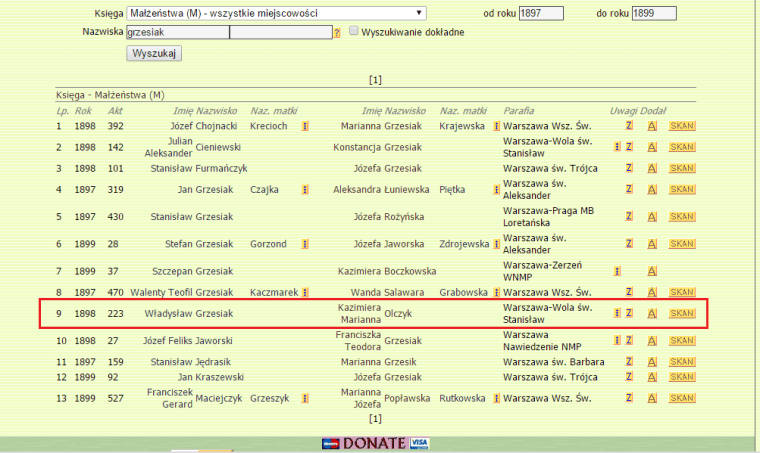
Immediately, I went to Geneteka, my favorite database for indexed vital records from all over Poland.  Normally, I advise people to use documentation from U.S. sources to determine where their ancestors came from before they start randomly searching records in Geneteka, but desperate times call for desperate measures, and I had a pretty specific idea of what I was looking for.  But would the record be there?  Geneteka is not complete — it’s a brilliant, ambitious idea, and new indexes for different parishes and different time periods are constantly being added, but it still represents only a fraction of the vital records available in the tens of thousands of parishes and civil registries across Poland.  In this case, my hunch paid off, and Geneteka came through for me. I was stunned, absolutely stunned, when I saw what had to be their marriage record (Figure 4):

Figure 4:  Geneteka search results for Grzesiak marriages in Warszawa between 1897 and 1899.

Geneteka

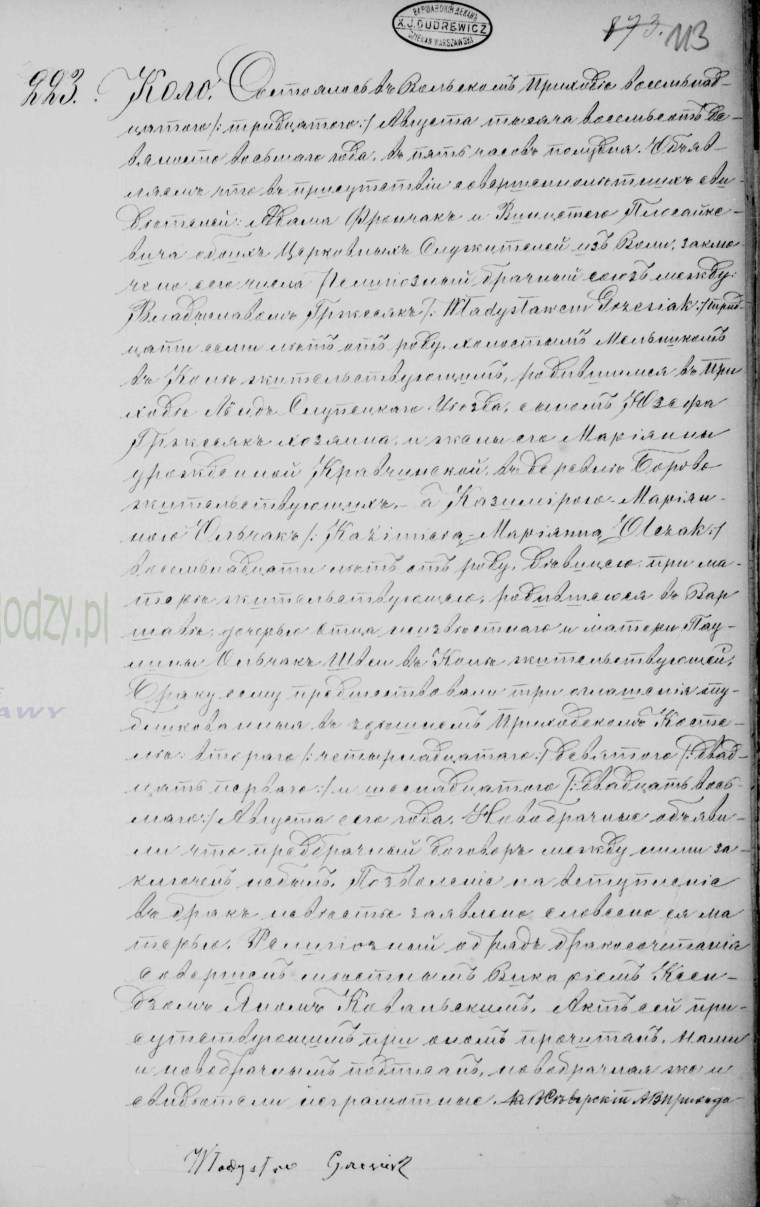
I hit “skan” to get a copy of the record itself (isn’t Geneteka great?!) and here it is, in all its glory:Wladyslaw Grzesiak and Kazimiera Olczyk 1898 crop

The record is in Russian, because Warsaw was in the Russian Empire in 1898 when the event took place, so here’s my translation:

“223. Koło. It happened in Wola parish on the eighteenth/thirtieth day of August in the year one thousand eight hundred ninety-eight at five o’clock in the afternoon. We declare that, in the presence of witnesses Adam Franczak and Wincenty Płocikiewicz, both ecclesiastical servants of Wola, on this day was contracted a religious marriage between Władysław Grzesiak, age thirty-seven, miller of Koło residing, born in Ląd, Słupca district, son of Józef Grzesiak, owner, and his wife Maryanna née Krawczyńska, in the village of Borowo residing, and Kazimiera Marianna Olczak, age eighteen, single, with her mother residing, born in Warsaw, daughter of an unknown father and mother Paulina Olczak, seamstress, in Koło residing.  The marriage was preceded by three readings of the banns on the 2nd/14th, 9th/21st, and 16th/28th days of August of the present year.  The newlyweds stated that they had no prenuptial agreement between them.  Permission was given orally by those present at the ceremony.  The religious ceremony of marriage was performed by the Reverend Jan Kowalski.  This document, after being read aloud, was signed by us and by the groom because the witnesses state that they do not know how to write.”2

Let’s break this down a bit.  First, the double dates are often confusing to those who aren’t familiar with the format of Polish civil records, but they’re a result of the fact that Poland and Western Europe adopted the Gregorian calendar  while Russia and the Eastern Europe continued to use the old Julian calendar.  In order to have these records be clear to everyone, both dates were included on legal documents like this.  The second, later date is the date according to the Gregorian calendar, which we would go by.

Second, Kazimiera’s name isn’t Dutkiewicz, as expected — but we’ll worry about that in a minute.  The date of the marriage (1898) is correct, as is the groom’s name, and parents’ names.  His age is a bit off (he should only be 30, not 37), but it’s not unusual for ages reported in these records to be very much “ballpark estimates.”  Walter was actually born in Kowalewo, not Ląd, but if you recall, the parish functions had been transferred from Kowalewo to Ląd at this time, so perhaps this can be interpretted as a reference to that.

Getting back to Kazimiera, her age (18) matches with what we expected based on U.S. records.  The priest doesn’t mention her budding theatrical career, but perhaps her star had not yet risen very far (if it ever really rose at all).  So this is clearly the right marriage record.  But how did we get from Olczak to Dutkiewicz?

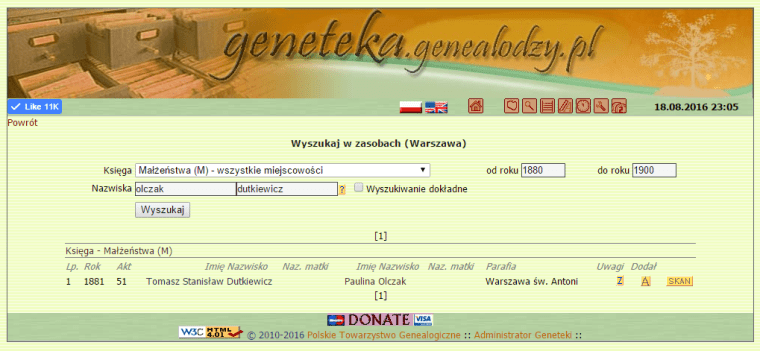
The answer lies again in the indexed records of Geneteka (Figure 5):

Figure 5:  Geneteka search results for marriage records with surnames Olczak and Dutkiewicz between 1880 and 1900:

Olczak

It appears that shortly after Kazimiera’s birth in 1880, her mother Paulina married Tomasz Dutkiewicz.  Whether Tomasz Dutkiewicz ever legally adopted Kazimiera is doubtful, but this certainly explains why she might have at least informally used the name of her step-father as her own.

But Wait, There’s More!

So all this is nice, right?  But why is a marriage record for a great-granduncle really THAT exciting?  As I mentioned, my great-grandmother Veronica emigrated along with three siblings, Walter, Thaddeus and Josephine.  What we didn’t know until I began researching records from Poland, was that there were two additional siblings — Konstancja3 and Pelagia4 — who did not emigrate.  No descendant of the Grzesiak family in the U.S. that I interviewed was aware that these sisters existed.  The Konin Branch of the State Archive in Poznań had no record of marriage for either of them, and I was planning to write again to request a search for their death records, assuming they might have died before reaching a marriageable age.  However, I noticed that there was a marriage record for a Konstancja Grzesiak on the same page of Geneteka search results (Figure 4, result 2) that gave me Walter’s marriage record!  Sure enough, the marriage record5 reveals that Konstancja is the daughter of Józef Grzesiak and his wife, Marianna née Krawczyńska, residing in the village of Ląd.

Unfortunately, I still can’t find a birth record for Pelagia, and it’s still possible that she died before reaching a marriageable age.  But the implications of these new data are tremendous for me.  My great-grandmother arrived in the U.S. in March of 1898,6 and in June and August of that same year, her sister and brother each married in Warsaw, prior to most of her family joining her in Buffalo in 1900, while the one married sister stayed behind in Poland with her family in Warsaw.  Wow!   A little further digging confirmed that Konstancja also had children (Figure 6):

Figure 6:  Geneteka search results for birth records in Warszawa mentioning surnames Cieniewski and Grzesiak:

Cieniewski

So I might have cousins in Poland from this Cieniewski line!  However, it’s interesting that there are only two births.  Birth records for this parish, St. Stanislaus, Bishop and Martyr, and St. Adalbert, in the Wola district of Warsaw, are indexed from 1886 to 1908 without any gaps.  Therefore one might expect to see more than two children born between their marriage in 1898 and 1908 when the records end.  There is no evidence that they immigrated to Buffalo, no good matches in U.S. census records for this family in Buffalo or anywhere else.  So where did they go?

The Grzesiaks of Kowalewo-Opactwo, Warsaw, Buffalo, and Borowo

One clue, in Walter’s marriage record, might point the way.  It stated that he was the son of “Józef Grzesiak, farmer, and his wife Maryanna née Krawczyńska, in the village of Borowo residing”  Borowo is new to me.  This is the first time this place has been mentioned in connection with my family.  And unfortunately, there are at least 20 places in Poland today by that name.  But if Borowo was where her parents were living at the time of Konstancja’s marriage, maybe that’s where she and her young family eventually went to live.  So which Borowo is correct?

Well, Konstancja’s marriage record, from just two months earlier, states that her parents were residing in Ląd.  That, and the fact that there were no good matches for a place called Borowo that’s very close to Warszawa, suggests that this may be the correct place, Borowo in Konin County, about 22 miles east of the Grzesiak’s previous home in Kowalewo-Opactwo:

map

According to the Skorowidz Królestwa Polskiego, a nice period gazetteer of Russian Poland published in 1877, the village of Borowo belongs to the Roman Catholic parish in Krzymów, so that’s where we can look for records.  Records are online and on microfilm, but only from 1808-1884, which doesn’t help us any with finding additional births to Konstancja and Julian Cieniewski after 1900.  However, the Branch Archive in Konin has birth records up to 1911,  so this is an obvious next step to take.

The Old Mill, Revisited

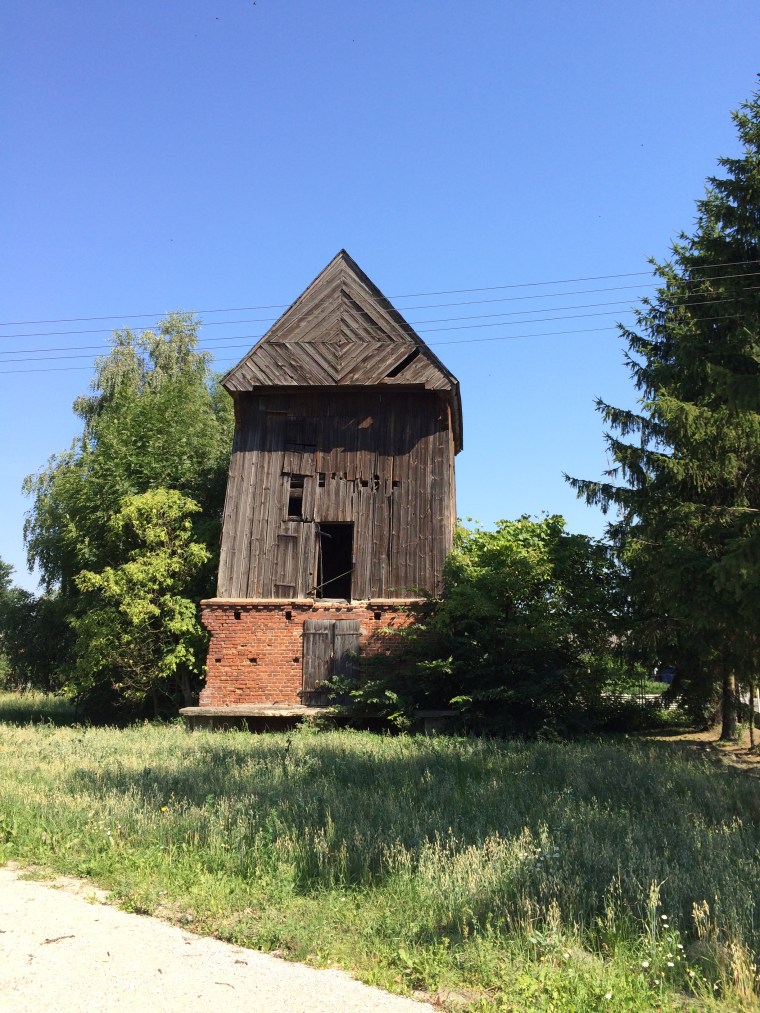
There’s one other really cool connection I’d like to make before I sum things up.  In my previous post about my Grzesiak family, I mentioned my grandmother’s recollection that her mother Veronica’s family owned a grain mill near the parish church.  Try as I might, I couldn’t find any reference to Veronica’s father being a miller.  However, when I visited Veronica’s birthplace of Kowalewo-Opactwo on a trip to Poland last year, I was amazed to see this old windmill, missing its vanes, in close proximity to the church, exactly as Grandma described.  So I found it fascinating that Walter’s marriage record described him clearly as a miller, even though a more general term (“хозяин,” meaning “owner,” but seemingly used as a non-specific synonym for “farmer” or “peasant”) was again used to describe his father, Józef.  This makes me more convinced that the mill in the photo actually was a place associated with Veronica’s family.  Maybe her father didn’t own the mill, maybe he just worked for the miller — but between the existence of this mill where it should be, based on Grandma’s story, and the fact that her uncle Walter was described as a miller, I think there’s good reason to believe that this was the mill that Grandma’s story referred to.  IMG_4542

That’s a Wrap

So what general research insights can be gained from this?

  1.  Once again, my ancestors were more mobile than I expected them to be — and yours might be, too.

When I began my research, I really thought I’d find “the” ancestral village for each surname line and be able to go back for many generations in that same village.  Time and time again, that seems to be the exception, rather than the rule.  I was so blinded by my expectation that Walter would have met his bride some place near to where he was born, that I overlooked obvious resources, like indexed records for Warsaw on Geneteka, because it seemed too improbable.  Logic requires us to search in the obvious places first — those associated with the family.  But when searching in the obvious places doesn’t pan out, it’s time to think outside the box.

2.  Family stories can sometimes hold the key.

If you are among the oldest generation in your family, it’s not too late to write down everything you remember from older relatives, for the next generation.  But if you still have any older relatives remaining, talk to them!  My third cousin and research collaborator, Valerie Baginski, told me that her grandmother always said that the family came from Warsaw, rather than Poznań, which was my family’s version of the story.  Once we figured out that our Grzesiaks’ ancestral village was Kowalewo-Opactwo, closer to Poznań than Warsaw, we dismissed that mention of Warsaw.  Since Warsaw was a bigger city than Poznań, we chalked up this discrepancy to our ancestors’ tendency to paint their place of origin with a broad brush, referencing the closest big city.  Now we realize that it’s quite possible her great-grandmother mentioned Warsaw because she was one of the younger siblings who may have lived there for a time, while my great-grandmother mentioned Poznań because she was the first one to leave Poland, and may never have gone to Warsaw with the others.

3.  Pay your dues.

This last “insight” is a shameless plug for Geneteka, the database for indexed Polish vital records that enabled me to find my Grzesiaks in Warsaw.  For those of you who might be unfamiliar with it, Geneteka is a project sponsored entirely by volunteers from the Polskie Towarzystwo Genealogiczne (PTG, or Polish Genealogical Society), in Poland.  Although all the indexing and photographing of vital records (for Geneteka’s sister site, Metryki, which I wrote about previously) is done by volunteers, funds are still required to pay for servers to host the websites.  If you’ve used Geneteka and found it helpful to you, please consider making a donation to the PTG.  Let’s help them to help us find our ancestors!

Walter’s marriage record was a puzzle piece that’s been missing for a long, long time.  It just goes to show you that you never know when that great idea will hit, or when serendipity will strike, so keep chipping away at those brick walls.  Stay thirsty, my friends.

Sources:

1New York, Department of Health, Division of Vital Statistics, County of Erie, City of Buffalo, Death Certificates, #2600, Death certificate for Walter Grzesiak, 25 April 1946.

2“Akta stanu cywilnego parafii rzymskokatolickiej sw. Stanislawa i Wawrzynca w Warszawie,” Polskie Towarzystwo Genealogiczne, Metryki.genealodzy.pl:  Projekt indeksacji metryk parafialnych (http://metryki.genealodzy.pl/), 1898, Malzenstwa, #223, record for Wladyslaw Grzesiak and Kazimiera Marianna Olczak, accessed on 17 August 2016.

3Roman Catholic Church, Sts. Peter and Paul the Apostles Parish (Kowalewo, Słupca, Wielkopolskie, Poland), Kopie księg metrykalnych, 1808-1879, 1872, births, #5, record for Konstancja Grzesiak.; FHL #1191028 Items 1-4.

4“Akta stanu cywilnego Parafii Rzymskokatolickiej Kowalewo-Opactwo (pow. slupecki)”, Narodowego Archiwum Cyfrowego, Naczelnej Dyrekcji Archiwów Panstwowych, Szukajwarchiwach (Szukajwarchiwach.pl), Ksiega urodzen, malzenstw i zgonów, 1869, births, #48, record for Pelagia Grzesiak, accessed on 21 June 2016.

5“Akta stanu cywilnego parafii rzymskokatolickiej sw. Stanislawa i Wawrzynca w Warszawie “, Polskie Towarzystwo Genealogiczne, Metryki.genealodzy.pl:  Projekt indeksacji metryk parafialnych (http://metryki.genealodzy.pl/), 1898, Malzenstwa, #142, record for Julian Aleksander Cieniewski and Konstancja Grzesiak, accessed on 18 August 2016.

6Ancestry.com, Baltimore, Passenger Lists, 1820-1948 and 1954-1957 (Provo, UT, USA, Ancestry.com Operations Inc, 2006), http://www.ancestry.com, The National Archives at Washington, D.C.; Washington, D.C.; Records of the US Customs Service, RG36; NAI Number: 2655153; Record Group Title: Records of the Immigration and Naturalization Service, 1787-2004; Record Group Number: 85, record for Veronika Gresiak, accessed on 21 July 2016.

Featured Image:

Wodzinowski, Wincenty. Wesele. Digital image.Http://muzeuminstrumentow.pl/. Muzeum Ludowych Instrumentów Muzycznych W Szydłowcu, 18 Sept. 2015. Web. 18 Aug. 2016.  This painting from 1896 seemed very fitting for my cover photo, since it depicts a wedding celebration very close to the time when Walter and Casimira married.

© Julie Roberts Szczepankiewicz 2016


Fun with Genetic Genealogy

A couple days ago, I checked my autosomal DNA matches at Ancestry and discovered a new DNA match with a familiar surname, Ptaszkiewicz, in his family tree.  I wrote to him immediately, and to my pleasant surprise, he wrote back, expressing an interest in collaborating to determine definitively how we’re related.  At this point, I suspect that my new cousin, M. Snyder (name used with permission), and I are double fourth-cousins once removed.  So what does that mean?

One of my great-great-great-grandmothers was Anna Ptaszkiewicz, born 29 April 1834 in Kołaczyce,1 in what is now the Podkarpackie province of Poland, but was the Austrian Empire at that time.  She was the youngest of five children born to Franciszek Wojciech Ptaszkiewicz and Salomea Sasakiewicz.  Anna had an older brother, Franciszek, who was born 23 March 18272 and here’s where the plot thickens:  Franciszek and Anna married twin siblings.  Franciszek Ptaszkiewicz married Anna Łącka on 15 November 1852and Anna Ptaszkiewicz married Jakub Łącki on 26 November 1861.4  Anna and Jakub Łącki were the oldest children of Franciszek Łącki and his second wife, Magdalena Gębczyńska, born 24 July 1835:5

Figure 1: Baptismal record for Jakub and Anna Łącki5Jacobus and Anna lacki birth crop


Franciszek and Anna (née Łącka) Ptaszkiewicz had eight children, including a daughter, Katarzyna, who was born 10 October 1864.6  It is this daughter, Katarzyna, whom I believe might be the same as “Cousin M’s” great-grandmother, Katherine/Catherine (née Ptaszkiewicz) Grzebińska.

Catherine (née Ptaszkiewicz) Grzebińska, was born in November 1866, in Austrian Poland, according to the 1900 U.S. Federal Census7, shown in Figure 2.  Experienced researchers know that our ancestors weren’t always as precise when reporting their birth dates as we are today, so the birth dates for these two Catherines, October 1864 and November 1866, are well within the ballpark range for them to be the same person.

Figure 2:  1900 United States Federal Census for Kate Grzebinski [sic]71900 census Grzebinski


Moreover, “Kate” settled in Buffalo, New York, as did her putative double first cousin, Marianna (née Łącka) Klaus, who was my great-great-grandmother.

Although all of this looks promising, there’s still no “smoking gun” yet — no definitive evidence that would confirm that “Cousin M” and I are related through this particular surname line.  It would be nice to find a marriage record in Kołaczyce or Buffalo for Katarzyna Ptaszkiewicz and Jan Grzebiński.  It would also be nice to find a passenger manifest or church records for “Cousin M’s” Catherine Ptaszkiewicz, indicating that she was from Kołaczyce.  And there’s a good chance that we’ll be able to find those church records.  A search of the records in Kołaczyce for marriages of the children of Franciszek Ptaszkiewicz and Anna Łącka was already on my to-do list.  And it should be easy to determine if Catherine Ptaszkiewicz Grzebińska was from Kołaczyce, since her oldest children were probably baptized at St. Stanislaus Church in Buffalo.  Not only are records from St. Stan’s easily searched on microfilm, but they also reliably indicate the place of birth of the parents of the baptized child, as shown here in this baptismal record8 for my great-grandmother Genowefa Klaus, daughter of Marianna (née Łącka) Klaus (and granddaughter of Anna Ptaszkiewicz).

Figure 3:  Baptismal record for Genowefa Klaus indicating father as Andrzej Klaus from Maniów, Galicia and mother as Marya Łącka from Kołaczyce, Galicia.8Genevieve Klaus baptismal record crop


So we know what we need to find in terms of documentation, and we have a plan to get it. But right now, what we have is DNA evidence.  Both “Cousin M” and I have uploaded our raw DNA data to GEDmatch, which is a free site offering tools for analyzing and understanding one’s autosomal DNA results.  Among the useful tools at GEDmatch is a chromosome browser, which provides a graphic depiction of our match, including the number of SNPs (single nucleotide polymorphisms) included in it.  As is shown in Figure 4, “Cousin M” and I share a 29.3 centimorgan stretch along Chromosome 9:

Figure 4:  Graphic depiction of match from GEDmatch.com.  Red lines indicate base pairs with no match, yellow lines indicate base pairs with half match, green lines indicate base pairs with full match, blue bar indicates a matching segment greater than 7 centimorgans.Chromosome 9


GEDmatch estimates 4.5 generations to our most recent common ancestor (MRCA).  That’s just about right.  It’s actually 5 generations to the MRCA for “Cousin M” and my Mom, as shown in Figure 5. (Since I’m one generation removed from my Mom, I fall on the second page of this chart, not shown here.)

Figure 5:  Relationship Chart for me and Cousin M through Łącki ancestors.Relationship 1 (through Łącki)


And it’s the same relationship through our Ptaszkiewicz ancestors, as shown in Figure 6.  Since Marianna Łącka and Katarzyna Ptaszkiewicz are double first cousins, meaning they share all four of their grandparents in common, they share about as much DNA as half siblings.  If that’s as clear as mud, you might find this explanation to be helpful.

Figure 6:  Relationship Chart for me and Cousin M through Łącki ancestors.Relationship 2 (through Ptaszkiewicz)


So I’m pretty excited about all of this!  This is a beautiful example of how genetic genealogy can complement, extend, and confirm results obtained through traditional documents-based research.  I can’t wait to dive into the records in Kołaczyce and Buffalo to find the documentation that will allow us to stamp this case as “solved.”  In the meantime, please feel free to share your latest DNA mysteries or success stories in the comments.  I’d love to hear how DNA results are helping you with your own research.

Sources:

1Roman Catholic Church, St. Anna’s Parish (Kołaczyce, Jasło, Podkarpackie, Poland), “Urodzenia, 1826-1889”, Stare Kopie, 1834, April 29,  record for Anna Ptaszkiewicz. [date of birth] 29.04.1834, [date of baptism] 29.04.1834, [house number] 56, [child’s name] Anna, [father’s name] Franciscus Ptaszkiewicz sutor, [mother’s name] Salomea Patre Francisco Sasakiewicz nata, [godparents] Nicolaus Sękowski Hava Francisci Wiejoski uxor Civis.

2Roman Catholic Church, St. Anne’s parish (Kołaczyce, Jasło, Małopolskie, Poland), “Księga urodzeń, 1784 – 2015”, 1827, baptismal record for Franciscus Ptaszkiewicz. [Date of birth] Martius 23, 1827, [Date of baptism] Martius 25, 1827, [House number] 53, [Child’s name] Franciscus, Catholica, Puer, Legitimi, [Father] Franciscus Ptaszkiewicz sutor civis, [Mother] Salomea patre Francisco Sasakiewicz nata, [Godparents] Paulus Wiejoski, Francisca Mathai Kowalski uxor, cives.

3Maciej Orzechowski, “Kołaczyce Marriages,” Marriage record for Franciscus Ptaszkiewicz and Anna Łącka, transcribed from the collection, “Roman Catholic Church records, St. Anna’s Parish (Kołaczyce, Jasło, Małopolskie, Poland), Śluby, 1826-1889,” Stare Kopie, record #6 on the spreadsheet. [Number] 20, [Date] 15.11.1852, [House number] — , [sponsus (groom)] Franciscus Ptaszkiewicz sutor filius Francisci Ptaszkiewicz ac Salomea nata Francisco Sasakiewicz oppidariorum, [Aetas (age)] 25, [Viduus] — [House number] — , [sponsa (bride)] Anna Łącka filia def. Francisci Łącki ac Magdalenna nata Joanne Gębczyński ooppidari, [Aetas (age)] 18, [vidua] — , [Testes] Josephus Dutkiewicz pellio Antonius Kołeczek textor.; report to Julie Szczepankiewicz, Hopkinton, Massachusetts, USA, 9 January 2015; Excel Spreadsheet held by Julie Szczepankiewicz, Hopkinton, Massachusetts, USA.

4Roman Catholic Church, St. Anna’s Parish (Kołaczyce, Jasło, Podkarpackie, Poland), “Śluby, 1826-1889,” Stare Kopie, 1861, #11, marriage record for Jacobus Łącki and Anna Ptaszkiewicz. [Record number ]11, [Marriage date] 26.11.1861, [House number] 308, [Groom] Jacobus Łącki filius def. Francisci Łącki ac Magdalenna nata Joanne Gębczyński oppidari, [age] 27, [house number] 77, [Bride] Anna Ptaszkiewicz filia Francisci Ptaszkiewicz ac Salomea nata Francisco Sassakiewicz oppidario, [age] 26, [witnesses] Franciscus Ptaszkiewicz oppidarius Laurentius Kowalski sutor.

5Roman Catholic Church, St. Anna’s Parish (Kołaczyce, Jasło, Podkarpackie, Poland), “Urodzenia, 1826-1889”, Stare Kopie, 1835, Record for Jacobus Łącki and Anna Łącka. [date of birth] 24.07.1835, [date of baptism], 25.07.1835, [house number] 191, [babies’ names] Jacobus et Anna Gemelli, [father’s name] Franciscus Łącki figulus, [mother’s name] Magdalena patre Michaele Gębczyński nata, [godparents] Constantinus Niedzielski Magdalena Michaelis Gałkiewicz uxor Michael Gałkiewicz Catharina Constantini Niedzielski uxor Civis.

6Maciej Orzechowski, “Kolaczyce Births”, Baptismal record for Catharina Ptaszkiewicz, transcribed from the collection, “Roman Catholic Church records, St. Anna’s Parish (Kołaczyce, Jasło, Małopolskie, Poland), ‘Urodzenia, 1826-1889,’ Stare Kopie.”, record number 66 on the spreadsheet. [Record number] 53, [Date of birth] 10.10.1864, [Date of baptism] 11.10.1864, [House number] 308, [Child’s name] Catharina, [Father] Franciscus Ptaszkiewicz sutor, [Mother] Anna filia Francisci Łącki et Magdalenna nata Gębczyńska, [Godparents] Josephus Forys ruricola in Bukowa Catharina uxor Leonhardi Kolbusz ruricola in Bukowa; report to Julie Szczepankiewicz, Hopkinton, Massachusetts, Original report made on 9 January 2015; most recent update on 2 April 2015, all on the same spreadsheet; Original held by Julie Szczepankiewicz, Hopkinton, Massachusetts.

7Ancestry.com, 1900 United States Federal Census (Provo, UT, USA, Ancestry.com Operations Inc, 2004), http://www.ancestry.com, Year: 1900; Census Place: Buffalo Ward 11, Erie, New York; Roll: 1027; Page: 37A; Enumeration District: 0083; FHL microfilm: 1241027. Record for Kate Grzebinski, accessed on 2 July 2016. http://search.ancestry.com/cgi-bin/sse.dll?db=1900usfedcen&h=78760547&indiv=try

8Roman Catholic Church, St. Stanislaus Parish (Buffalo, Erie, New York, USA), Baptisms, 1874-1903, 1897, #620, baptismal record for Genowefa Klaus.; 371 vol. 1.

© 2016 Julie Roberts Szczepankiewicz


Writing to Archives in Poland

A few days ago, I wrote to the Konin branch of the Polish State Archive of Poznań to request a search for death records for Pelagia and Konstancja Grzesiak, who were two sisters of my great-grandmother.  This is pretty routine for me now, but when I first began researching Polish vital records, I was intimidated by the thought of writing to an archive in Poland. I worried that it would be prohibitively expensive, and I worried about translating their correspondence in an era before Facebook groups and Google Translate.  However, writing to the archives is pretty straightforward, and should be a standard research strategy for anyone researching Polish ancestors.  In this post, I’ll walk you through the process of writing to an archive to request records for your family in Poland.

Why Write to an Archive?

Although it’s true that more and more vital records from Poland are coming online every day, thanks to the efforts of both the state archives and the various Polish genealogical societies, there are still plenty of records that are not available online or on microfilm from the LDS.  Some of these records can be found in the diocesan archives, some are in the state archives, and some may still be at the parishes themselves.  You might need to rely on multiple sources to find records in the range of years you need to thoroughly document your family history.

As an example, for my Grzesiak’s ancestral parish in Kowalewo-Opactwo, the LDS has both church and civil records available on microfilm.  However, upon closer examination, we see that the civil records only go from 1808-1865, then there’s a two-year gap, after which coverage extends from 1868-1879.  The church records might be helpful in tracing some of my collateral lines forward in time, since they begin in 1916, but they aren’t useful for finding ancestors.  Those records go all the way up to 1979 (with gaps), which is interesting, given that Polish privacy laws typically restrict access to such recent records.

Microfilm is great, but online access is even better, and in the years since I began researching this family, records for Kowalewo have come online for those same years from 1808-1879, including that same gap from 1866-1867.  One might conclude that the records from 1866-1867 were destroyed, since they don’t appear in either the online collection from the Archiwum Państwowe w Poznaniu Oddział w Koninie (State Archive of Poznań Branch in Konin) or on the LDS microfilm.  However, that’s not the case, those records DO exist. How do we know this?

Baza PRADZIAD:  The Vital Records Database for the Polish State Archives

Baza PRADZIAD can be searched quickly, easily, and in English to see what vital records are held by the various state archives for any given parish or civil registry office.  Note that you must know the parish or civil registry office for your village of interest.  If I search for records for Wola Koszutska, which is a village belonging to the parish in Kowalewo, I won’t get any hits.  But I can find records for ancestors born in Wola Koszutska by knowing that their vital events would have been recorded at the parish in Kowalewo.  Although Polish diacritics aren’t supposed to be important when searching this site, I’ve had it happen on occasion that a search without diacritics comes up empty, but redoing the search with diacritics gives good results.  Maybe that was due to cybergremlins, or maybe there are bugs that only affect certain parishes, but it’s something to consider if nothing turns up the first time you search.  There are ways to set up your keyboard to allow for Polish diacritics, but if you haven’t done that or don’t know how, there’s always this site which works in a pinch so you can copy and paste your proper Polish text into the search box.
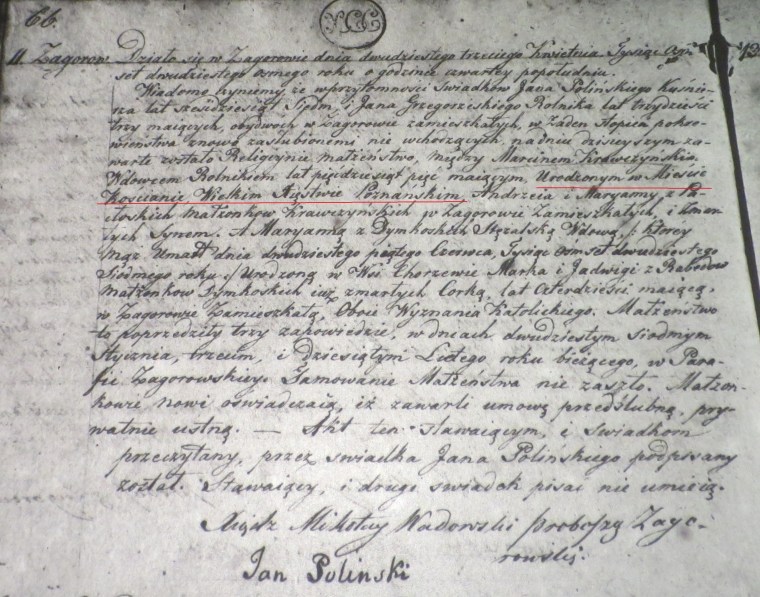
Now, let’s take a look at what comes up in Baza PRADZIAD for Kowalewo (Figure 1):

Figure 1: Baza PRADZIAD Search ScreenPradziad

Figure 1 shows the search screen, and as you’ll see, I got results only by entering the town name.  There are options for restricting the search by entering the “commune” (i.e. gmina), province, religion, or type of event you’re looking for, but you really don’t need all that, and sometimes simple is best.

Figure 2:  Baza PRADZIAD Results from Search for “Kowalewo”:Kowalewo

Figure 2 shows the top part of the search results; if you were to scroll down, there are a few more entries for “Nowe Kowalewo” below this.  Note that there may be multiple parishes or registry offices with the same name that come up in the search results.  However, when you click “more” at the far right, you can see which place is referenced by looking at the province, as shown in Figure 3:

Figure 3:  “More” information on the first entry (“małżeństwa, 1808-1819, 1821-1890, 1911”) of the search results for Kowalewo:Konin

Let’s consider these search results a bit more carefully.  In Figure 2, we see that there are two collections of marriage records (małżeństwa) for Kowalewo.  The first collection, boxed in red, covers marriages from 1808-1819, 1821-1890, and 1911.  This collection belongs to the Archiwum Państwowe w Poznaniu Oddział w Koninie, as we can see from Figure 3 which comes up when we click, “more.”  The second collection, boxed in green (Figure 2), covers marriages from 1828-1866.  If we obtain more information about that collection (Figure 4), we realize that both collections are for the same Kowalewo, and they’re stored in different archives!
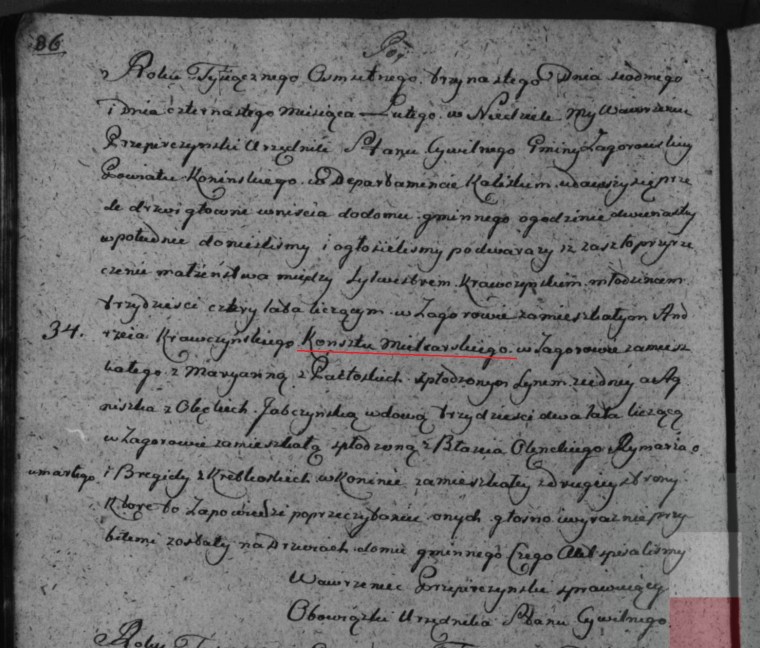
Figure 4:  More” information on the second entry (“małżeństwa, 1828-1866”) of the search results for Kowalewo:Konin 2

These records belong to the Diocesan Archive of Włocławek.  Now, at this point you might be thinking, “Hey, isn’t this site supposed to be for the search engine for the STATE Archives?  What’s a diocesan archive doing in the search results?  And does this mean that I can expect to find all the holdings of the diocesan archives catalogued here?”

Welcome to the murky world of archival holdings in Poland.  It would be great if there were one, central repository for all vital records in Poland, and if those holdings were completely catalogued, and if that catalogue were searchable online at only one website. But as my mother always says, “If wishes were horses, beggars would ride.”  Although you may find that some diocesan archives have their holdings catalogued in Baza PRADZIAD, not all do.  So I generally think of this as a catalogue for the holdings of State Archives, and if any diocesan results come up as well, that’s icing on the cake.

Now let’s go back to Figure 2.  If you compare the boxes in red, blue and yellow, you see that these represent marriages, births (urodzenia) and deaths (zgony) for the same range of years.  This makes sense, because frequently parishes would keep one parish register for each year, divided into three sections.  Looking further at Figure 3, we notice the “dates” and “microfilms” underlined in purple and yellow, respectively, and herein lies the answer to the problem of our two-year gap in microfilmed and online records that exists from 1866-1867.  As you can see from the text underlined in yellow, the archive also has those same microfilms, with the same gap.  But their total collection, underlined in purple, includes years which are not available on microfilm.   Whereas online and microfilmed records end in 1879, the archive also has births, marriages and deaths from 1880-1890, in addition to having births, marriages and deaths to fill that gap from 1866-1867.

How Do I Write to the Archives?

First, you want to make sure that the records aren’t available any other way (e.g microfilm or online), before you write, as archival research is generally slower and more expensive than obtaining records by these other methods.  Popular websites for Polish vital records include Szukajwarchiwach (“Search in the Archives” or SwA), Metryki.GenBaza (or just, “GenBaza”),  Metryki.Genealodzy.pl (or just “Metryki”), Poczekalnia (“Waiting Room,”), Genealogiawarchiwach (“Genealogy in the Archives”, or GwA), the digital collections for Poland available from the LDS, and others (mentioned on this list, starting at the bottom of page 3).  If you’re not familiar with these sites and don’t know how to use them, visit us in Polish Genealogy and we’ll help you out.  To determine whether your parish of interest has been microfilmed by the LDS, check the Family History Library catalog.

If it looks like your records of interest can only be found at one of the archives, you can send an e-mail to the address found in your Baza PRADZIAD search results (see above).  You should write in Polish.  Since this is professional correspondence, this is not a good time to break out Google Translate.  Instead, use one of the letter-writing templates that are available online, either from the LDS or the PGSA.  Alternatively, you can post a translation request in one of the Facebook groups (Polish Genealogy or Genealogy Translations) and a volunteer will probably assist you with a short translation, if you ask nicely.

How Much Will It Cost?

The cost of archival research depends on how many years they have to search, whether or not they find anything, and which archive you’re writing to.  You might think it would be standardized across the country, but that hasn’t been my experience.  I have paid as little as 4 zlotys ($1) to the Archive in Grodzisk for two records found after a search of marriages over a 12-year period, and as much as $30 to the Archive in Konin after a search of marriages over a 9-year period that turned up empty.  (In that case, it’s possible that the girls died before reaching a marriageable age.)  It’s important to have very clear, specific research goals in mind, however.  Sending the archive a request that’s too vague, such as, “please search all your records for Kołaczyce for the surname Kowalski” or too broad, such as, “please search all your death records for Kołaczyce from 1863-1906 for Łącki deaths” is probably not advisable. For that kind of research, it would be better to hire a professional in Poland who can visit the archive for you in person.

What Happens When They Find My Records?

When the archive has completed their research, they will reply to notify you of the results. The letter or e-mail will be in Polish; if you need assistance with translating it, I would again recommend those Facebook groups (Polish Genealogy or Genealogy Translations).  If they found records, they will summarize their findings, but you will not receive copies until you make payment.  If they didn’t find anything, they will still charge you a search fee for the time they had to spend looking.

How Do I Make Payment?

The archives will only accept payment by direct wire transfer to bank account number specified in their correspondence.  They do not accept personal checks, credit cards, cash, or PayPal.   Here’s where it gets tricky:  most U.S. banks charge high fees for international wire transfers.  However, there are alternatives to paying your bank.  You can set up a wire transfer with a company like Western Union or Xoom, where the fees are typically much lower.  If you live in a community with a Polish travel agency, you can often ask them to wire money for you for a small fee.  Or, you can ask a professional researcher in Poland to handle the transaction for you, and you can reimburse him or her via PayPal.  (Be sure to add in a tip if the researcher does not specify a charge for his or her time).

When Will I Get My Records?

Again, your mileage may vary, based on the archive in question, but in general, I’ve gotten results within a week or two after payment has been made.  Be sure to attach your payment receipt to your return e-mail to the archive.  I’ve always received my records in the form of digital images sent via e-mail, but I’ve heard from others who say they’ve always received hard copies.

That’s pretty much all there is to it!  Writing to archives in Poland doesn’t have to be an intimidating process, nor will it necessarily break the bank.  As long as you have clearly defined research goals and a relatively small range of years for them to check, archival research can be quite affordable.  If you’ve been on the fence about writing to an archive, I hope this encourages you to go ahead and give it a try.  And if you do, please let me know how it turns out.  Happy researching!

© 2016 Julie Roberts Szczepankiewicz


The Old Mill

My son Daniel left for Poland yesterday.  I’ve been helping him prepare for his trip, and thinking a lot about my own amazing journey through Poland last summer, which included visits to all my ancestral villages that were known at that time.  And after my recent post about the 1791 purchase of a home in Zagórów by my ancestors, Andrzej and Marianna Krawczyński, I’ve been thinking more about that line in particular.

My most recent ancestor with the Krawczyński surname is my great-great-grandmother, Marianna (née Krawczyńska) Grzesiak.  It was Marianna’s daughter, Veronica, who immigrated to the U.S. as a young girl, married John Zazycki, and eventually gave birth to my grandmother, Helen (née Zazycki) Zielinski.  My grandmother died a year ago, but I vividly remember sitting in Grandma’s immaculate kitchen as a young teenager, asking her about her mother’s life in Poland before she came to this country.  I wrote down Grandma’s comments and kept them in mind as I began to document my family’s history.

Among the tidbits of family history that Grandma shared with me was the fact that her mother’s parents owned a grain mill.  They lived near the church and rectory, and Veronica’s mother sewed all the vestments for the parish priests.  Grandma never knew the names of her mother’s parents — it was up to me to find those, by following the paper trail.  And unfortunately, the paper trail didn’t exactly corroborate the story about owning a grain mill.  Polish vital records typically mention the occupation of the father in child’s baptismal record.  In Veronica’s baptismal record, shown below, her father, Józef Grzesiak, is described as, “‘master of the house,’ of Kowalewo, age thirty-seven.”1  The Russian word used to describe Józef’s occupation, “хозяин,” is unfortunately rather non-specific.  Shea and Hoffman  define it as “master of the house, owner; husband, man”2 although they add that, “сельскій хозяинъ” can be used to mean, “farmer.”  Weronika Grzesiak birth marked


Baptismal records for Veronica’s siblings describe Józef Grzesiak as a “parobek,”3 (farmhand), again with the Russian word “хозяин,”4,7,8 and with the Russian word, “наёмщик,”which Shea and Hoffman define as,”hirer, lessee, tenant, lodger.”6  But nowhere do we see the word for “miller,” in Polish or in Russian.  I had pretty much decided that this was one of those inaccuracies in family stories, something that had gotten slightly distorted in the oral history as it was handed down over four generations.  Until I got to Poland.

On August 3rd, 2015, my husband and I and our tour guide, Łukasz Bielecki, visited the village of Kowalewo-Opactwo, where my great-grandmother Veronica was born.  After stopping by the church of Sts. Peter and Paul the Apostles and the parish cemetery, we stopped at the rectory to see if the pastor was home, and inquire if he knew of any parishioners with the Grzesiak surname.  That was when I saw it, right across the street from the rectory, and just down the street from the church and cemetery (on the left side of the street in this photo):IMG_4542

An old windmill, missing its vanes, long abandoned, from the look of it.  Could it possibly date back to Veronica’s youth in Poland in the 1880s and 1890s?  The location was striking — so close to the church and rectory, exactly as Grandma had described it to me.  And yet Veronica’s father was clearly not a miller, based on the available records, nor were her grandparents described that way.  Veronica’s paternal grandfather, Stanisław Grzesiak, was a shepherd from Cienin Zaborny9 and her maternal grandfather, Antoni Krawczyński, was a shoemaker from Zagórów.10  

So how do we reconcile this?  Perhaps Veronica’s family didn’t own the mill — perhaps she only mentioned that they lived near the mill, and my grandmother misremembered the story?  Or perhaps the records which describe Veronica’s father as a “tenant” or “farmhand” could be construed to mean that he was a hired hand, working for the miller?   The village miller held a position of some stature , so perhaps the priest recording the baptismal records would have been reluctant to describe Józef Grzesiak that way if he was only employed by the miller but did not own the mill.  I have no doubt about the truth of the story that Veronica’s mother, Marianna, sewed vestments for the parish priest.   Veronica supported her family as a seamstress after her husband died, and was known for her strong Catholic faith.  So it’s tempting to believe that somehow, that old mill near the church in Kowalewo might really be the one from Grandma’s stories, and might be connected with my family in some way.  What do you think?

Sources:

1“Akta stanu cywilnego Parafii Rzymskokatolickiej Kowalewo-Opactwo (pow. slupecki)”, Narodowego Archiwum Cyfrowego, Naczelnej Dyrekcji Archiwów Panstwowych, Szukajwarchiwach (Szukajwarchiwach.pl), Ksiega urodzen, malzenstw, zgonów, 1876, # 72, birth record for Weronika Grzesiak, accessed on 21 June 2016. http://www.szukajwarchiwach.pl/54/771/0/6.1/65/skan/full/9J-ASKf3S2mu9O7J_5zYew.

2Shea, Jonathan D., and William F. Hoffman. In Their Words: A Genealogist’s Translation Guide to Polish, German, Latin, and Russian Documents:  Volume II:  Russian. New Britain, CT: Language & Lineage Press, 2002, p. 430.

3″Akta stanu cywilnego Parafii Rzymskokatolickiej Kowalewo-Opactwo (pow. slupecki),” Ksiega urodzen, malzenstw, zgonów, 1867, births, #39, record for Władysław Grzesiak, accessed in person at the archive by Zbigniew Krawczynski.; Archiwum Państwowe w Poznaniu. Oddział w Koninie, 3 Maja 78, Konin, Poland.

4“Akta stanu cywilnego Parafii Rzymskokatolickiej Kowalewo-Opactwo (pow. slupecki)”, Narodowego Archiwum Cyfrowego, Naczelnej Dyrekcji Archiwów Panstwowych, Szukajwarchiwach (Szukajwarchiwach.pl), Ksiega urodzen, malzenstw i zgonów, 1869, births, #48, record for Pelagia Grzesiak, accessed on 21 June 2016 http://www.szukajwarchiwach.pl/54/771/0/6.1/58/skan/full/ntP5qVh00anymNp2qgDJRw

5Roman Catholic Church, Sts. Peter and Paul the Apostles Parish (Kowalewo, Słupca, Wielkopolskie, Poland), Kopie księg metrykalnych, 1808-1879, 1872, births, #5, record for Konstancja Grzesiak.; FHL #1191028 Items 1-4.

6Shea, Jonathan D., and William F. Hoffman. In Their Words: A Genealogist’s Translation Guide to Polish, German, Latin, and Russian Documents:  Volume II:  Russian. New Britain, CT: Language & Lineage Press, 2002, p. 392.

7“Akta stanu cywilnego Parafii Rzymskokatolickiej Kowalewo-Opactwo (pow. slupecki)”, Narodowego Archiwum Cyfrowego, Naczelnej Dyrekcji Archiwów Panstwowych, Szukajwarchiwach (Szukajwarchiwach.pl), Ksiega urodzen, malzenstw, zgonów, 1874, births, #17, record for Tadeusz Grzesiak, accessed on 21 June 2016. http://www.szukajwarchiwach.pl/54/771/0/6.1/63/skan/full/yD_N2CH4hl_7FF3PNvsoAg.

8“Akta stanu cywilnego Parafii Rzymskokatolickiej Kowalewo-Opactwo” (Kowalewo-Opactwo, Słupca, Wielkopolskie, Poland), “Ksiega urodzen, malzenstw, zgonów”, 1881, births, #15, record for Józefa Grzesiak, accessed in person at the archive by Zbigniew Krawczynski.; Archiwum Państwowe w Poznaniu. Oddział w Koninie, 3 Maja 78 Konin, Poland.

9“Akta stanu cywilnego Parafii Rzymskokatolickiej Cienin Koscielny (pow. slupecki)”, Narodowe Archiwum Cyfrowe, Szukajwarchiwach (http://www.szukajwarchiwach.pl/), Ksiega urodzonych, malzenstw i zgonów, 1839, births, #4, record for Józef Grzesiak, accessed on 22 June 2016. http://www.szukajwarchiwach.pl/54/740/0/6.1/30/skan/full/hSeZeC8-TYbTYBA3GioEiA.

10Roman Catholic Church, Zagórów parish (Zagórów (Słupca), Poznań, Poland), Kopie księg metrykalnych, 1808-1947, 1843, Births, #31, record for Marianna Krawczyńska.; 2162128 Item 1.

© 2016 Julie Roberts Szczepankiewicz


The Krawczyńskis’ New Home

This past week was pretty exciting for me in terms of genealogy.  My 6th cousin in Poland, Zbyszek Krawczyński, visited the State Archive in Poznań and found this deed from Zagórów in 1791, when our mutual 5x-great-grandparents, Andrzej and Marianna (nee Paczkowska) Krawczyński purchased their home from the original owners, Grzegorz and Agata Orczykowski1:

OLYMPUS DIGITAL CAMERA
Page 1
OLYMPUS DIGITAL CAMERA
Page 2

My Polish is sufficient to allow a general understanding of the text, but a dear friend (and distant cousin of my husband’s), Anna Smith, provided the following clear translation:

“Having presented themselves in person to the Council Records Office of the town of Zagórów, the spouses Grzegorz and Agatha Orczykowski, residents and citizens of the town of Zagórów together with Izydor and Artoni Orczykowski, their natural heirs, declare voluntarily that, having a house standing in Rynek Nowy on the corner with Wodna Street, [indeed] with [?obonami] and the whole plot which belongs to it, they have agreed on the sum of 900 Polish Złoty in figures 900 with Andrzej and Maryanna Krawczyński, former citizens of Żerków and now residents and citizens of Zagórów, who, after coming to an agreement on the sum promised by themselves, nine hundred Polish Złoty in figures 900, counted this out and handed it to the sellers. Therefore Mr.Orczykowski and the purchaser Mr. Krawczyński confirm this immediately in writing, confirming that by the transaction entered into today, the Orczykowskis and their heirs give the aforementioned house to the Krawczyńskis in perpetuity, they renounce [their rights] and leave no property [whether] of their own or anyone else’s in the house. Indeed the informants freely allow themselves to sign in their own hand (illiterate, led by the hand). [signatures, each ‘with the hand held’]”1

This document places us in medias res regarding the Krawczyńskis and their story.  It’s better to begin at the beginning, but unfortunately, we don’t know where Andrzej and Marianna were born, or where they married.  However, we do know a few details about their lives, thanks to the research carried out by my third cousin, friend, and genealogical collaborator, Valerie Baginski.   Andrzej was born about 1745, based on his age at the time of his death,and Marianna was probably about four years younger than he.3  The first location mentioned in reference to them in the records is the town of Kościan in the Grand Duchy of Poznan (Wielkie Księstwo Poznańskie), where their oldest son, Marcin, was born circa 1773, as indicated by the record for his second marriage to Marianna (née Dymkoska) Stężalska,4 shown here:

film 2162131 item 2 record 11 page 66

We don’t know precisely how long Andrzej and Marianna might have stayed in Kościan, or if they had any additional children there who perhaps died in infancy.  Records for Kościan are available, and are on our research agenda, and perhaps these will give us further insights into Andrzej and Marianna’s earlier years.   But the next time they appear in the records is in the town of Żerków, where their son Sylwester was born on the Feast of St. Sylvester, 31 December 17795:

film 1981505 item 10


The town of Żerków is a little more than 45 miles from Kościan.  These distances always seem to beg the question of why people might have moved.  When I began my genealogical journey, I had visions of pinpointing tiny villages in Europe where people lived in quiet contentment for centuries, until the day when one brave, adventurous, or perhaps foolhardy soul — my immigrant ancestor! — ventured out to the New World.  So it came as something of a shock when I realized just how mobile my ancestors were.  I’m sure they probably moved for many of the same reasons we do today — seeking better economic opportunities, and a better standard of living for their families.  Andrzej’s mobility suggests that he wasn’t tied to the land as a farmer, so what did he do to earn his living?

The only document found to date which provides an answer is the marriage record for this same son, Sylwester, to Agnieszka Olęcka in 1813.  This document describes the groom as, “a bachelor, having thirty-four years of age, residing in Zagórów, begotten son of Andrzej Krawczyński, of the brewing craft, residing in Zagórów…”:6

Sylwester Krawczynski marriage crop

So what makes a brewer from Kościan pack up his family and move to a village 45 miles away?  By 1772, both those locations (Kościan and Żerków) would have been under Prussian control, so political motivations for the move seem unlikely.  We may never know their reasons, but the records of Żerków tell us that Andrzej and Marianna went on to have five more children there before moving once again, this time settling in Zagórów, another 20 miles east of Żerków.

The youngest of their seven children, Teresa, was not quite 7 months old7 when Andrzej and Marianna Krawczyński purchased the house on Rynek Nowy on the corner with Wodna Street on 20 May 1791.  The translation of the record indicates that, after agreeing upon the sum of 900 zlotys, Andrzej and Marianna “counted this out and handed it to the sellers.” One wonders how much money this represented in those times, and how long it would take for a brewer and his wife, with 7 children, to save that money in cash in order to purchase a home.  I can imagine Andrzej’s hands might have trembled a bit as he counted it all out.  Or perhaps he inherited some or all of this money?  In any case, I attempted to determine how much this might represent in modern currency, by comparing it with the price of silver, on the basis of this article, which describes monetary reforms stipulated by King Stanisław August Poniatowski.  The system he instituted, which was in place until 1787, set the value of the zloty relative to value of silver as follows:

1 Cologne mark = 233.855 grams pure silver

1 mark = 10 thaler, so 1 thaler = 23.3855 grams silver

1 thaler = 8 zloty, so 1 zloty = 2.92 grams silver

Therefore 900 zloty = 2,630.87 grams silver

Today’s price per gram = $0.56, meaning they bought their house for $1,473.

Unfortunately, that extrapolation doesn’t work very well.  Another way to go about it might be to determine the price for a pint of beer in a pub in zlotys, and extrapolate based on that, as my friend Mente Pongratz did with success with old German currencies. However, I’m still trying to find some reference that indicates what a pint of beer might have cost in 1791, and if I’m successful, I’ll revisit this issue in another blog post.

Another question which comes to mind is where this house would have been located, and if perhaps any part of it remains.  To answer that, we need to look carefully at the modern map of Zagórów.  The house was described as, “standing in Rynek Nowy on the corner with Wodna Street.”  “Rynek Nowy” means, “New Market,” and a “rynek” in Poland is the market square that one typically finds in or near the center of most towns in Poland.  If one zooms out from this map of present-day Wodna Street, it’s not anywhere close to a market square.  Moreover, there’s no place called “Rynek Nowy,” in Zagórów today, so one must assume that a square which was considered “new” in 1791 has since been renamed.  With that in mind, the present-day “Duży Rynek,” shown here, seems to be a good candidate for that “Rynek Nowy”:Zagorow map

To the west of Duży Rynek, ending at the square, is a street called Kościuszko which merits further consideration.  Kościuszko Street was clearly named after Tadeusz Kościuszko, the military hero honored in both Poland and the U.S. He died in 1817, so in 1791, while he was still alive, it seems unlikely that he would have had any streets named after him.  Therefore, this seems to be a good candidate for the original Wodna Street.  Based on all of this, it would seem that the red brick shop shown here at 1 Duży Rynek, stands more or less on the site of the Krawczyńskis’ home in Zagórów.

It would be nice to confirm that hypothesis with cadastral maps.  A quick check of resources available from the various Polish State Archives doesn’t turn up anything promising here.  However, it should be noted that complete inventories are not available online for the State Archive in Poznań, so perhaps some such maps have survived.  In any case, I like thinking about Andrzej and Marianna Krawczyński, raising their family in that house on the corner of the square.  I hope their years there were happy ones.

Sources:

1Zbygniew Krawczyński, Zagórów, Wielkopolskie, Poland to Julie Szczepankiewicz, e-mail, “Rok 1791,” 15 June 2016, with attached images of the deed of purchase and sale of the house on the corner of Wodna Street and Nowy Rynek, from Grzegorz and Agatha Orczykowski to Andrzej and Marianna Krawczyński, dated 20 May 1791.

2Roman Catholic Church, Sts. Peter and Paul the Apostles Parish (Zagórów, Słupca, Wielkopolskie, Poland), Księgi metrykalne, 1592-1964, 1819, Deaths, p. 206.; 2162126 item 1.  Andrzej was 74 at the time of his death.

3Roman Catholic Church, Sts. Peter and Paul the Apostles Parish (Zagórów, Słupca, Wielkopolskie, Poland), Księgi metrykalne, 1592-1964, 1821, Deaths,  p. 218, #17.; 2162126 item 1. Marianna was 72 at the time of her death.

4Roman Catholic Church, Sts. Peter and Paul the Apostles Parish (Zagórów, Słupca, Wielkopolskie, Poland), Kopie księg metrykalnych, 1808-1947, Akta małżeństw 1826-1833, 1828, #11, record for Marcin Krawczyński and Maryanna Dymkoska Stężalska.; FHL# 2162131 item 2.

5Roman Catholic Church, St. Stanislaus Parish (Żerków, Jarocin, Wielkopolskie, Poland), Księgi metrykalne, 1683-1923, Akta urodzeń 1780-1781, 1780, baptismal record for Sylwester Krawczyński.; FHL# 1981505 item 10.

6“Akta stanu cywilnego Parafii Rzymskokatolickiej Zagórów (pow. slupecki)”, Narodowe Archiwum Cyfrowe, Szukajwarchiwach (http://www.szukajwarchiwach.pl/), Akta malzenstw 1812-1813, 1813, #34, record for Sylwester Krawczyński and Agnieszka nee Olęcka Jabczyńska.

7Roman Catholic Church, St. Stanislaus Parish (Żerków, Jarocin, Wielkopolskie, Poland), Księgi metrykalne, 1683-1923, Akta urodzeń 1778-1830, 1790, record for Teresa Krawczyńska.; FHL# 1981505 item 10.  Teresa was born on 14 October 1790.

© 2016 Julie Roberts Szczepankiewicz