Writing to Archives in Poland

A few days ago, I wrote to the Konin branch of the Polish State Archive of Poznań to request a search for death records for Pelagia and Konstancja Grzesiak, who were two sisters of my great-grandmother.  This is pretty routine for me now, but when I first began researching Polish vital records, I was intimidated by the thought of writing to an archive in Poland. I worried that it would be prohibitively expensive, and I worried about translating their correspondence in an era before Facebook groups and Google Translate.  However, writing to the archives is pretty straightforward, and should be a standard research strategy for anyone researching Polish ancestors.  In this post, I’ll walk you through the process of writing to an archive to request records for your family in Poland.

Why Write to an Archive?

Although it’s true that more and more vital records from Poland are coming online every day, thanks to the efforts of both the state archives and the various Polish genealogical societies, there are still plenty of records that are not available online or on microfilm from the LDS.  Some of these records can be found in the diocesan archives, some are in the state archives, and some may still be at the parishes themselves.  You might need to rely on multiple sources to find records in the range of years you need to thoroughly document your family history.

As an example, for my Grzesiak’s ancestral parish in Kowalewo-Opactwo, the LDS has both church and civil records available on microfilm.  However, upon closer examination, we see that the civil records only go from 1808-1865, then there’s a two-year gap, after which coverage extends from 1868-1879.  The church records might be helpful in tracing some of my collateral lines forward in time, since they begin in 1916, but they aren’t useful for finding ancestors.  Those records go all the way up to 1979 (with gaps), which is interesting, given that Polish privacy laws typically restrict access to such recent records.

Microfilm is great, but online access is even better, and in the years since I began researching this family, records for Kowalewo have come online for those same years from 1808-1879, including that same gap from 1866-1867.  One might conclude that the records from 1866-1867 were destroyed, since they don’t appear in either the online collection from the Archiwum Państwowe w Poznaniu Oddział w Koninie (State Archive of Poznań Branch in Konin) or on the LDS microfilm.  However, that’s not the case, those records DO exist. How do we know this?

Baza PRADZIAD:  The Vital Records Database for the Polish State Archives

Baza PRADZIAD can be searched quickly, easily, and in English to see what vital records are held by the various state archives for any given parish or civil registry office.  Note that you must know the parish or civil registry office for your village of interest.  If I search for records for Wola Koszutska, which is a village belonging to the parish in Kowalewo, I won’t get any hits.  But I can find records for ancestors born in Wola Koszutska by knowing that their vital events would have been recorded at the parish in Kowalewo.  Although Polish diacritics aren’t supposed to be important when searching this site, I’ve had it happen on occasion that a search without diacritics comes up empty, but redoing the search with diacritics gives good results.  Maybe that was due to cybergremlins, or maybe there are bugs that only affect certain parishes, but it’s something to consider if nothing turns up the first time you search.  There are ways to set up your keyboard to allow for Polish diacritics, but if you haven’t done that or don’t know how, there’s always this site which works in a pinch so you can copy and paste your proper Polish text into the search box.

Now, let’s take a look at what comes up in Baza PRADZIAD for Kowalewo (Figure 1):

Figure 1: Baza PRADZIAD Search ScreenPradziad

Figure 1 shows the search screen, and as you’ll see, I got results only by entering the town name.  There are options for restricting the search by entering the “commune” (i.e. gmina), province, religion, or type of event you’re looking for, but you really don’t need all that, and sometimes simple is best.

Figure 2:  Baza PRADZIAD Results from Search for “Kowalewo”:Kowalewo

Figure 2 shows the top part of the search results; if you were to scroll down, there are a few more entries for “Nowe Kowalewo” below this.  Note that there may be multiple parishes or registry offices with the same name that come up in the search results.  However, when you click “more” at the far right, you can see which place is referenced by looking at the province, as shown in Figure 3:

Figure 3:  “More” information on the first entry (“małżeństwa, 1808-1819, 1821-1890, 1911”) of the search results for Kowalewo:Konin
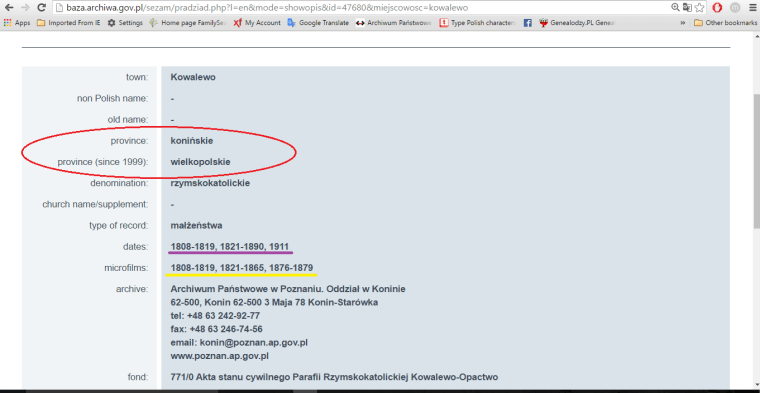
Let’s consider these search results a bit more carefully.  In Figure 2, we see that there are two collections of marriage records (małżeństwa) for Kowalewo.  The first collection, boxed in red, covers marriages from 1808-1819, 1821-1890, and 1911.  This collection belongs to the Archiwum Państwowe w Poznaniu Oddział w Koninie, as we can see from Figure 3 which comes up when we click, “more.”  The second collection, boxed in green (Figure 2), covers marriages from 1828-1866.  If we obtain more information about that collection (Figure 4), we realize that both collections are for the same Kowalewo, and they’re stored in different archives!

Figure 4:  More” information on the second entry (“małżeństwa, 1828-1866”) of the search results for Kowalewo:Konin 2

These records belong to the Diocesan Archive of Włocławek.  Now, at this point you might be thinking, “Hey, isn’t this site supposed to be for the search engine for the STATE Archives?  What’s a diocesan archive doing in the search results?  And does this mean that I can expect to find all the holdings of the diocesan archives catalogued here?”

Welcome to the murky world of archival holdings in Poland.  It would be great if there were one, central repository for all vital records in Poland, and if those holdings were completely catalogued, and if that catalogue were searchable online at only one website. But as my mother always says, “If wishes were horses, beggars would ride.”  Although you may find that some diocesan archives have their holdings catalogued in Baza PRADZIAD, not all do.  So I generally think of this as a catalogue for the holdings of State Archives, and if any diocesan results come up as well, that’s icing on the cake.

Now let’s go back to Figure 2.  If you compare the boxes in red, blue and yellow, you see that these represent marriages, births (urodzenia) and deaths (zgony) for the same range of years.  This makes sense, because frequently parishes would keep one parish register for each year, divided into three sections.  Looking further at Figure 3, we notice the “dates” and “microfilms” underlined in purple and yellow, respectively, and herein lies the answer to the problem of our two-year gap in microfilmed and online records that exists from 1866-1867.  As you can see from the text underlined in yellow, the archive also has those same microfilms, with the same gap.  But their total collection, underlined in purple, includes years which are not available on microfilm.   Whereas online and microfilmed records end in 1879, the archive also has births, marriages and deaths from 1880-1890, in addition to having births, marriages and deaths to fill that gap from 1866-1867.

How Do I Write to the Archives?

First, you want to make sure that the records aren’t available any other way (e.g microfilm or online), before you write, as archival research is generally slower and more expensive than obtaining records by these other methods.  Popular websites for Polish vital records include Szukajwarchiwach (“Search in the Archives” or SwA), Metryki.GenBaza (or just, “GenBaza”),  Metryki.Genealodzy.pl (or just “Metryki”), Poczekalnia (“Waiting Room,”), Genealogiawarchiwach (“Genealogy in the Archives”, or GwA), the digital collections for Poland available from the LDS, and others (mentioned on this list, starting at the bottom of page 3).  If you’re not familiar with these sites and don’t know how to use them, visit us in Polish Genealogy and we’ll help you out.  To determine whether your parish of interest has been microfilmed by the LDS, check the Family History Library catalog.

If it looks like your records of interest can only be found at one of the archives, you can send an e-mail to the address found in your Baza PRADZIAD search results (see above).  You should write in Polish.  Since this is professional correspondence, this is not a good time to break out Google Translate.  Instead, use one of the letter-writing templates that are available online, either from the LDS or the PGSA.  Alternatively, you can post a translation request in one of the Facebook groups (Polish Genealogy or Genealogy Translations) and a volunteer will probably assist you with a short translation, if you ask nicely.

How Much Will It Cost?

The cost of archival research depends on how many years they have to search, whether or not they find anything, and which archive you’re writing to.  You might think it would be standardized across the country, but that hasn’t been my experience.  I have paid as little as 4 zlotys ($1) to the Archive in Grodzisk for two records found after a search of marriages over a 12-year period, and as much as $30 to the Archive in Konin after a search of marriages over a 9-year period that turned up empty.  (In that case, it’s possible that the girls died before reaching a marriageable age.)  It’s important to have very clear, specific research goals in mind, however.  Sending the archive a request that’s too vague, such as, “please search all your records for Kołaczyce for the surname Kowalski” or too broad, such as, “please search all your death records for Kołaczyce from 1863-1906 for Łącki deaths” is probably not advisable. For that kind of research, it would be better to hire a professional in Poland who can visit the archive for you in person.

What Happens When They Find My Records?

When the archive has completed their research, they will reply to notify you of the results. The letter or e-mail will be in Polish; if you need assistance with translating it, I would again recommend those Facebook groups (Polish Genealogy or Genealogy Translations).  If they found records, they will summarize their findings, but you will not receive copies until you make payment.  If they didn’t find anything, they will still charge you a search fee for the time they had to spend looking.

How Do I Make Payment?

The archives will only accept payment by direct wire transfer to bank account number specified in their correspondence.  They do not accept personal checks, credit cards, cash, or PayPal.   Here’s where it gets tricky:  most U.S. banks charge high fees for international wire transfers.  However, there are alternatives to paying your bank.  You can set up a wire transfer with a company like Western Union or Xoom, where the fees are typically much lower.  If you live in a community with a Polish travel agency, you can often ask them to wire money for you for a small fee.  Or, you can ask a professional researcher in Poland to handle the transaction for you, and you can reimburse him or her via PayPal.  (Be sure to add in a tip if the researcher does not specify a charge for his or her time).

When Will I Get My Records?

Again, your mileage may vary, based on the archive in question, but in general, I’ve gotten results within a week or two after payment has been made.  Be sure to attach your payment receipt to your return e-mail to the archive.  I’ve always received my records in the form of digital images sent via e-mail, but I’ve heard from others who say they’ve always received hard copies.

That’s pretty much all there is to it!  Writing to archives in Poland doesn’t have to be an intimidating process, nor will it necessarily break the bank.  As long as you have clearly defined research goals and a relatively small range of years for them to check, archival research can be quite affordable.  If you’ve been on the fence about writing to an archive, I hope this encourages you to go ahead and give it a try.  And if you do, please let me know how it turns out.  Happy researching!

© 2016 Julie Roberts Szczepankiewicz


The Old Mill

My son Daniel left for Poland yesterday.  I’ve been helping him prepare for his trip, and thinking a lot about my own amazing journey through Poland last summer, which included visits to all my ancestral villages that were known at that time.  And after my recent post about the 1791 purchase of a home in Zagórów by my ancestors, Andrzej and Marianna Krawczyński, I’ve been thinking more about that line in particular.

My most recent ancestor with the Krawczyński surname is my great-great-grandmother, Marianna (née Krawczyńska) Grzesiak.  It was Marianna’s daughter, Veronica, who immigrated to the U.S. as a young girl, married John Zazycki, and eventually gave birth to my grandmother, Helen (née Zazycki) Zielinski.  My grandmother died a year ago, but I vividly remember sitting in Grandma’s immaculate kitchen as a young teenager, asking her about her mother’s life in Poland before she came to this country.  I wrote down Grandma’s comments and kept them in mind as I began to document my family’s history.

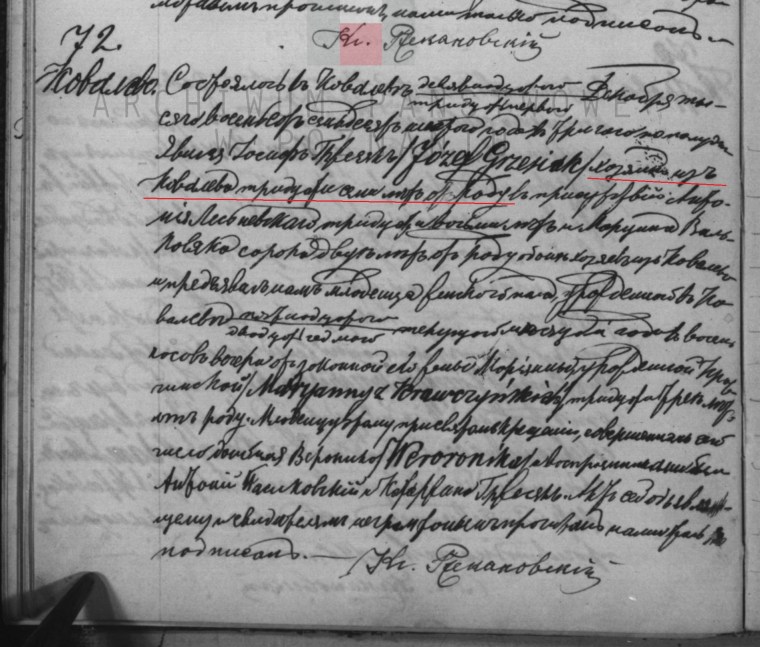
Among the tidbits of family history that Grandma shared with me was the fact that her mother’s parents owned a grain mill.  They lived near the church and rectory, and Veronica’s mother sewed all the vestments for the parish priests.  Grandma never knew the names of her mother’s parents — it was up to me to find those, by following the paper trail.  And unfortunately, the paper trail didn’t exactly corroborate the story about owning a grain mill.  Polish vital records typically mention the occupation of the father in child’s baptismal record.  In Veronica’s baptismal record, shown below, her father, Józef Grzesiak, is described as, “‘master of the house,’ of Kowalewo, age thirty-seven.”1  The Russian word used to describe Józef’s occupation, “хозяин,” is unfortunately rather non-specific.  Shea and Hoffman  define it as “master of the house, owner; husband, man”2 although they add that, “сельскій хозяинъ” can be used to mean, “farmer.”  Weronika Grzesiak birth marked


Baptismal records for Veronica’s siblings describe Józef Grzesiak as a “parobek,”3 (farmhand), again with the Russian word “хозяин,”4,7,8 and with the Russian word, “наёмщик,”which Shea and Hoffman define as,”hirer, lessee, tenant, lodger.”6  But nowhere do we see the word for “miller,” in Polish or in Russian.  I had pretty much decided that this was one of those inaccuracies in family stories, something that had gotten slightly distorted in the oral history as it was handed down over four generations.  Until I got to Poland.

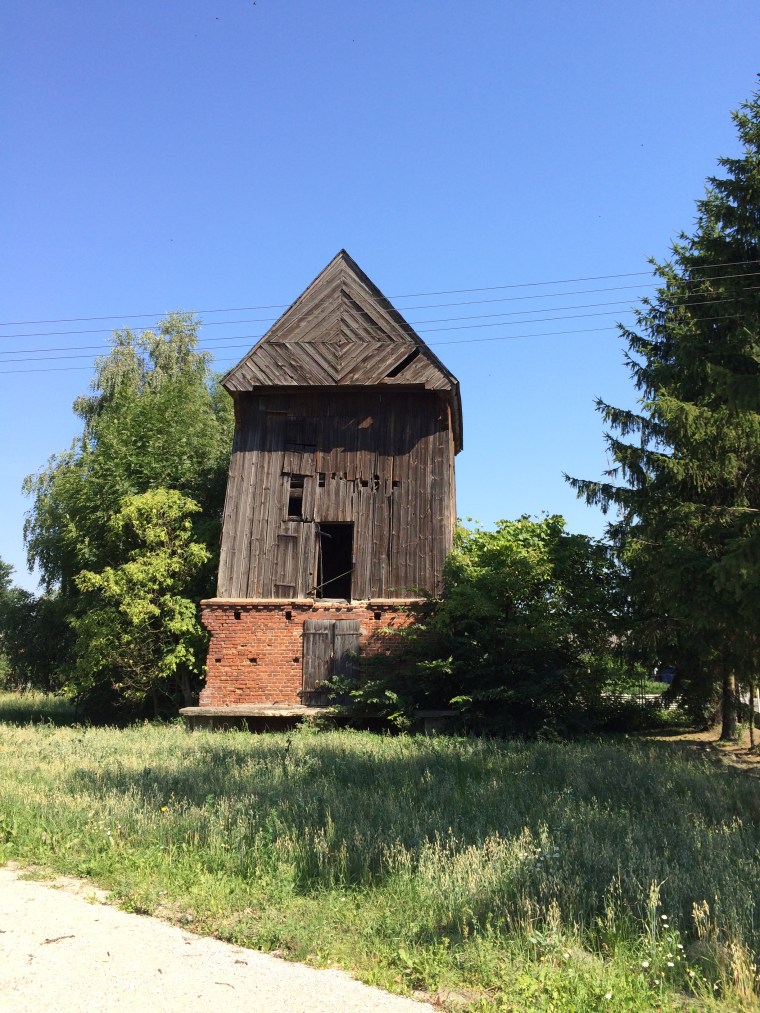
On August 3rd, 2015, my husband and I and our tour guide, Łukasz Bielecki, visited the village of Kowalewo-Opactwo, where my great-grandmother Veronica was born.  After stopping by the church of Sts. Peter and Paul the Apostles and the parish cemetery, we stopped at the rectory to see if the pastor was home, and inquire if he knew of any parishioners with the Grzesiak surname.  That was when I saw it, right across the street from the rectory, and just down the street from the church and cemetery (on the left side of the street in this photo):IMG_4542

An old windmill, missing its vanes, long abandoned, from the look of it.  Could it possibly date back to Veronica’s youth in Poland in the 1880s and 1890s?  The location was striking — so close to the church and rectory, exactly as Grandma had described it to me.  And yet Veronica’s father was clearly not a miller, based on the available records, nor were her grandparents described that way.  Veronica’s paternal grandfather, Stanisław Grzesiak, was a shepherd from Cienin Zaborny9 and her maternal grandfather, Antoni Krawczyński, was a shoemaker from Zagórów.10  

So how do we reconcile this?  Perhaps Veronica’s family didn’t own the mill — perhaps she only mentioned that they lived near the mill, and my grandmother misremembered the story?  Or perhaps the records which describe Veronica’s father as a “tenant” or “farmhand” could be construed to mean that he was a hired hand, working for the miller?   The village miller held a position of some stature , so perhaps the priest recording the baptismal records would have been reluctant to describe Józef Grzesiak that way if he was only employed by the miller but did not own the mill.  I have no doubt about the truth of the story that Veronica’s mother, Marianna, sewed vestments for the parish priest.   Veronica supported her family as a seamstress after her husband died, and was known for her strong Catholic faith.  So it’s tempting to believe that somehow, that old mill near the church in Kowalewo might really be the one from Grandma’s stories, and might be connected with my family in some way.  What do you think?

Sources:

1“Akta stanu cywilnego Parafii Rzymskokatolickiej Kowalewo-Opactwo (pow. slupecki)”, Narodowego Archiwum Cyfrowego, Naczelnej Dyrekcji Archiwów Panstwowych, Szukajwarchiwach (Szukajwarchiwach.pl), Ksiega urodzen, malzenstw, zgonów, 1876, # 72, birth record for Weronika Grzesiak, accessed on 21 June 2016. http://www.szukajwarchiwach.pl/54/771/0/6.1/65/skan/full/9J-ASKf3S2mu9O7J_5zYew.

2Shea, Jonathan D., and William F. Hoffman. In Their Words: A Genealogist’s Translation Guide to Polish, German, Latin, and Russian Documents:  Volume II:  Russian. New Britain, CT: Language & Lineage Press, 2002, p. 430.

3″Akta stanu cywilnego Parafii Rzymskokatolickiej Kowalewo-Opactwo (pow. slupecki),” Ksiega urodzen, malzenstw, zgonów, 1867, births, #39, record for Władysław Grzesiak, accessed in person at the archive by Zbigniew Krawczynski.; Archiwum Państwowe w Poznaniu. Oddział w Koninie, 3 Maja 78, Konin, Poland.

4“Akta stanu cywilnego Parafii Rzymskokatolickiej Kowalewo-Opactwo (pow. slupecki)”, Narodowego Archiwum Cyfrowego, Naczelnej Dyrekcji Archiwów Panstwowych, Szukajwarchiwach (Szukajwarchiwach.pl), Ksiega urodzen, malzenstw i zgonów, 1869, births, #48, record for Pelagia Grzesiak, accessed on 21 June 2016 http://www.szukajwarchiwach.pl/54/771/0/6.1/58/skan/full/ntP5qVh00anymNp2qgDJRw

5Roman Catholic Church, Sts. Peter and Paul the Apostles Parish (Kowalewo, Słupca, Wielkopolskie, Poland), Kopie księg metrykalnych, 1808-1879, 1872, births, #5, record for Konstancja Grzesiak.; FHL #1191028 Items 1-4.

6Shea, Jonathan D., and William F. Hoffman. In Their Words: A Genealogist’s Translation Guide to Polish, German, Latin, and Russian Documents:  Volume II:  Russian. New Britain, CT: Language & Lineage Press, 2002, p. 392.

7“Akta stanu cywilnego Parafii Rzymskokatolickiej Kowalewo-Opactwo (pow. slupecki)”, Narodowego Archiwum Cyfrowego, Naczelnej Dyrekcji Archiwów Panstwowych, Szukajwarchiwach (Szukajwarchiwach.pl), Ksiega urodzen, malzenstw, zgonów, 1874, births, #17, record for Tadeusz Grzesiak, accessed on 21 June 2016. http://www.szukajwarchiwach.pl/54/771/0/6.1/63/skan/full/yD_N2CH4hl_7FF3PNvsoAg.

8“Akta stanu cywilnego Parafii Rzymskokatolickiej Kowalewo-Opactwo” (Kowalewo-Opactwo, Słupca, Wielkopolskie, Poland), “Ksiega urodzen, malzenstw, zgonów”, 1881, births, #15, record for Józefa Grzesiak, accessed in person at the archive by Zbigniew Krawczynski.; Archiwum Państwowe w Poznaniu. Oddział w Koninie, 3 Maja 78 Konin, Poland.

9“Akta stanu cywilnego Parafii Rzymskokatolickiej Cienin Koscielny (pow. slupecki)”, Narodowe Archiwum Cyfrowe, Szukajwarchiwach (http://www.szukajwarchiwach.pl/), Ksiega urodzonych, malzenstw i zgonów, 1839, births, #4, record for Józef Grzesiak, accessed on 22 June 2016. http://www.szukajwarchiwach.pl/54/740/0/6.1/30/skan/full/hSeZeC8-TYbTYBA3GioEiA.

10Roman Catholic Church, Zagórów parish (Zagórów (Słupca), Poznań, Poland), Kopie księg metrykalnych, 1808-1947, 1843, Births, #31, record for Marianna Krawczyńska.; 2162128 Item 1.

© 2016 Julie Roberts Szczepankiewicz


The Krawczyńskis’ New Home

This past week was pretty exciting for me in terms of genealogy.  My 6th cousin in Poland, Zbyszek Krawczyński, visited the State Archive in Poznań and found this deed from Zagórów in 1791, when our mutual 5x-great-grandparents, Andrzej and Marianna (nee Paczkowska) Krawczyński purchased their home from the original owners, Grzegorz and Agata Orczykowski1:

OLYMPUS DIGITAL CAMERA
Page 1
OLYMPUS DIGITAL CAMERA
Page 2

My Polish is sufficient to allow a general understanding of the text, but a dear friend (and distant cousin of my husband’s), Anna Smith, provided the following clear translation:

“Having presented themselves in person to the Council Records Office of the town of Zagórów, the spouses Grzegorz and Agatha Orczykowski, residents and citizens of the town of Zagórów together with Izydor and Artoni Orczykowski, their natural heirs, declare voluntarily that, having a house standing in Rynek Nowy on the corner with Wodna Street, [indeed] with [?obonami] and the whole plot which belongs to it, they have agreed on the sum of 900 Polish Złoty in figures 900 with Andrzej and Maryanna Krawczyński, former citizens of Żerków and now residents and citizens of Zagórów, who, after coming to an agreement on the sum promised by themselves, nine hundred Polish Złoty in figures 900, counted this out and handed it to the sellers. Therefore Mr.Orczykowski and the purchaser Mr. Krawczyński confirm this immediately in writing, confirming that by the transaction entered into today, the Orczykowskis and their heirs give the aforementioned house to the Krawczyńskis in perpetuity, they renounce [their rights] and leave no property [whether] of their own or anyone else’s in the house. Indeed the informants freely allow themselves to sign in their own hand (illiterate, led by the hand). [signatures, each ‘with the hand held’]”1

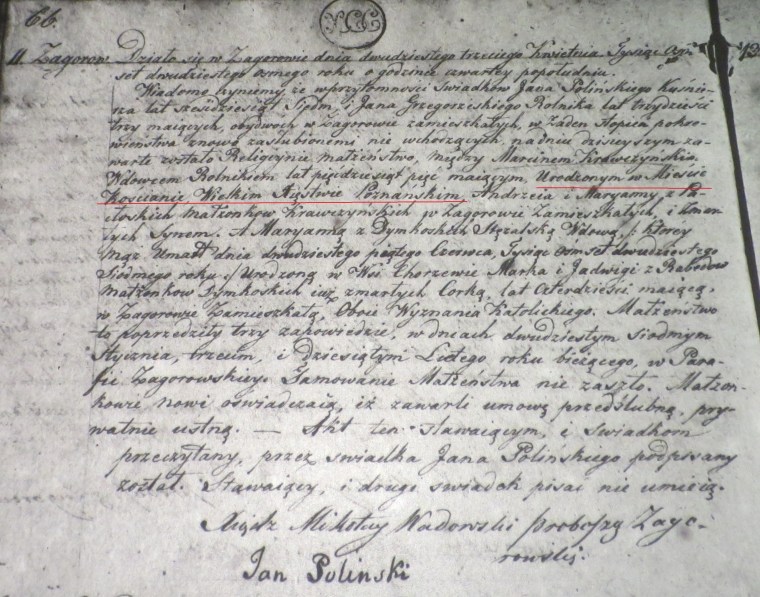
This document places us in medias res regarding the Krawczyńskis and their story.  It’s better to begin at the beginning, but unfortunately, we don’t know where Andrzej and Marianna were born, or where they married.  However, we do know a few details about their lives, thanks to the research carried out by my third cousin, friend, and genealogical collaborator, Valerie Baginski.   Andrzej was born about 1745, based on his age at the time of his death,and Marianna was probably about four years younger than he.3  The first location mentioned in reference to them in the records is the town of Kościan in the Grand Duchy of Poznan (Wielkie Księstwo Poznańskie), where their oldest son, Marcin, was born circa 1773, as indicated by the record for his second marriage to Marianna (née Dymkoska) Stężalska,4 shown here:

film 2162131 item 2 record 11 page 66

We don’t know precisely how long Andrzej and Marianna might have stayed in Kościan, or if they had any additional children there who perhaps died in infancy.  Records for Kościan are available, and are on our research agenda, and perhaps these will give us further insights into Andrzej and Marianna’s earlier years.   But the next time they appear in the records is in the town of Żerków, where their son Sylwester was born on the Feast of St. Sylvester, 31 December 17795:

film 1981505 item 10


The town of Żerków is a little more than 45 miles from Kościan.  These distances always seem to beg the question of why people might have moved.  When I began my genealogical journey, I had visions of pinpointing tiny villages in Europe where people lived in quiet contentment for centuries, until the day when one brave, adventurous, or perhaps foolhardy soul — my immigrant ancestor! — ventured out to the New World.  So it came as something of a shock when I realized just how mobile my ancestors were.  I’m sure they probably moved for many of the same reasons we do today — seeking better economic opportunities, and a better standard of living for their families.  Andrzej’s mobility suggests that he wasn’t tied to the land as a farmer, so what did he do to earn his living?

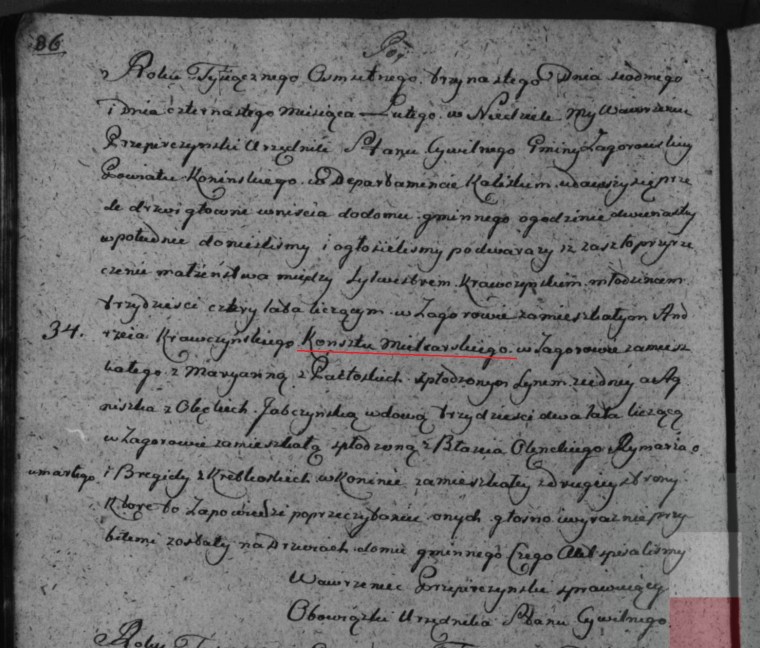
The only document found to date which provides an answer is the marriage record for this same son, Sylwester, to Agnieszka Olęcka in 1813.  This document describes the groom as, “a bachelor, having thirty-four years of age, residing in Zagórów, begotten son of Andrzej Krawczyński, of the brewing craft, residing in Zagórów…”:6

Sylwester Krawczynski marriage crop

So what makes a brewer from Kościan pack up his family and move to a village 45 miles away?  By 1772, both those locations (Kościan and Żerków) would have been under Prussian control, so political motivations for the move seem unlikely.  We may never know their reasons, but the records of Żerków tell us that Andrzej and Marianna went on to have five more children there before moving once again, this time settling in Zagórów, another 20 miles east of Żerków.

The youngest of their seven children, Teresa, was not quite 7 months old7 when Andrzej and Marianna Krawczyński purchased the house on Rynek Nowy on the corner with Wodna Street on 20 May 1791.  The translation of the record indicates that, after agreeing upon the sum of 900 zlotys, Andrzej and Marianna “counted this out and handed it to the sellers.” One wonders how much money this represented in those times, and how long it would take for a brewer and his wife, with 7 children, to save that money in cash in order to purchase a home.  I can imagine Andrzej’s hands might have trembled a bit as he counted it all out.  Or perhaps he inherited some or all of this money?  In any case, I attempted to determine how much this might represent in modern currency, by comparing it with the price of silver, on the basis of this article, which describes monetary reforms stipulated by King Stanisław August Poniatowski.  The system he instituted, which was in place until 1787, set the value of the zloty relative to value of silver as follows:

1 Cologne mark = 233.855 grams pure silver

1 mark = 10 thaler, so 1 thaler = 23.3855 grams silver

1 thaler = 8 zloty, so 1 zloty = 2.92 grams silver

Therefore 900 zloty = 2,630.87 grams silver

Today’s price per gram = $0.56, meaning they bought their house for $1,473.

Unfortunately, that extrapolation doesn’t work very well.  Another way to go about it might be to determine the price for a pint of beer in a pub in zlotys, and extrapolate based on that, as my friend Mente Pongratz did with success with old German currencies. However, I’m still trying to find some reference that indicates what a pint of beer might have cost in 1791, and if I’m successful, I’ll revisit this issue in another blog post.

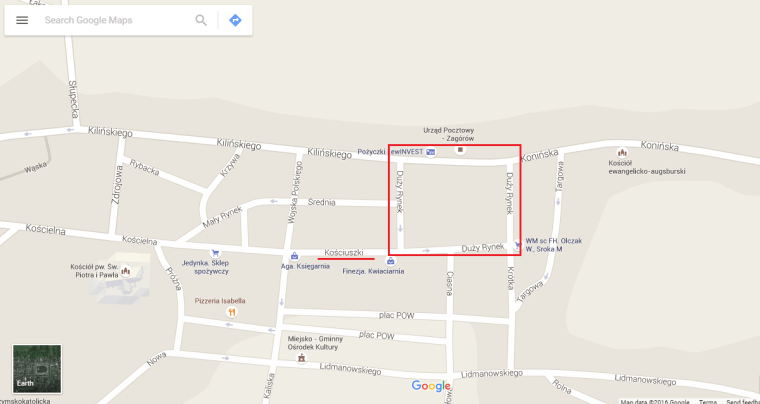
Another question which comes to mind is where this house would have been located, and if perhaps any part of it remains.  To answer that, we need to look carefully at the modern map of Zagórów.  The house was described as, “standing in Rynek Nowy on the corner with Wodna Street.”  “Rynek Nowy” means, “New Market,” and a “rynek” in Poland is the market square that one typically finds in or near the center of most towns in Poland.  If one zooms out from this map of present-day Wodna Street, it’s not anywhere close to a market square.  Moreover, there’s no place called “Rynek Nowy,” in Zagórów today, so one must assume that a square which was considered “new” in 1791 has since been renamed.  With that in mind, the present-day “Duży Rynek,” shown here, seems to be a good candidate for that “Rynek Nowy”:Zagorow map

To the west of Duży Rynek, ending at the square, is a street called Kościuszko which merits further consideration.  Kościuszko Street was clearly named after Tadeusz Kościuszko, the military hero honored in both Poland and the U.S. He died in 1817, so in 1791, while he was still alive, it seems unlikely that he would have had any streets named after him.  Therefore, this seems to be a good candidate for the original Wodna Street.  Based on all of this, it would seem that the red brick shop shown here at 1 Duży Rynek, stands more or less on the site of the Krawczyńskis’ home in Zagórów.

It would be nice to confirm that hypothesis with cadastral maps.  A quick check of resources available from the various Polish State Archives doesn’t turn up anything promising here.  However, it should be noted that complete inventories are not available online for the State Archive in Poznań, so perhaps some such maps have survived.  In any case, I like thinking about Andrzej and Marianna Krawczyński, raising their family in that house on the corner of the square.  I hope their years there were happy ones.

Sources:

1Zbygniew Krawczyński, Zagórów, Wielkopolskie, Poland to Julie Szczepankiewicz, e-mail, “Rok 1791,” 15 June 2016, with attached images of the deed of purchase and sale of the house on the corner of Wodna Street and Nowy Rynek, from Grzegorz and Agatha Orczykowski to Andrzej and Marianna Krawczyński, dated 20 May 1791.

2Roman Catholic Church, Sts. Peter and Paul the Apostles Parish (Zagórów, Słupca, Wielkopolskie, Poland), Księgi metrykalne, 1592-1964, 1819, Deaths, p. 206.; 2162126 item 1.  Andrzej was 74 at the time of his death.

3Roman Catholic Church, Sts. Peter and Paul the Apostles Parish (Zagórów, Słupca, Wielkopolskie, Poland), Księgi metrykalne, 1592-1964, 1821, Deaths,  p. 218, #17.; 2162126 item 1. Marianna was 72 at the time of her death.

4Roman Catholic Church, Sts. Peter and Paul the Apostles Parish (Zagórów, Słupca, Wielkopolskie, Poland), Kopie księg metrykalnych, 1808-1947, Akta małżeństw 1826-1833, 1828, #11, record for Marcin Krawczyński and Maryanna Dymkoska Stężalska.; FHL# 2162131 item 2.

5Roman Catholic Church, St. Stanislaus Parish (Żerków, Jarocin, Wielkopolskie, Poland), Księgi metrykalne, 1683-1923, Akta urodzeń 1780-1781, 1780, baptismal record for Sylwester Krawczyński.; FHL# 1981505 item 10.

6“Akta stanu cywilnego Parafii Rzymskokatolickiej Zagórów (pow. slupecki)”, Narodowe Archiwum Cyfrowe, Szukajwarchiwach (http://www.szukajwarchiwach.pl/), Akta malzenstw 1812-1813, 1813, #34, record for Sylwester Krawczyński and Agnieszka nee Olęcka Jabczyńska.

7Roman Catholic Church, St. Stanislaus Parish (Żerków, Jarocin, Wielkopolskie, Poland), Księgi metrykalne, 1683-1923, Akta urodzeń 1778-1830, 1790, record for Teresa Krawczyńska.; FHL# 1981505 item 10.  Teresa was born on 14 October 1790.

© 2016 Julie Roberts Szczepankiewicz


On Antibiotics And the Brief Life of Wiktoria Zarzycka

Yesterday I had to see my doctor for a possible Lyme disease rash.  He agreed that it looks suspicious and prescribed a course of prophylactic antibiotics.  And oddly enough, that got me thinking about genealogy.  Lyme disease is one of many diseases known to modern-day physicians that is readily treated with antibiotics, and has an excellent prognosis if it’s caught early.  But life was very different for our ancestors, and I often remind myself of this fact when I start romanticizing those by-gone, simpler times.

As I’m sure is true for many of us, I find some ancestors’ stories to be more compelling than others.  For me, one such compelling ancestor is Wiktoria Zarzecka, one of my great-great-great-great-grandmothers.  I first encountered Wiktoria in this 1826 marriage record for her son,  Józef Zarzycki, and his bride, Joanna Krzemińska1:

Jozef Zarzycki and Joanna Krzyminska marriage 1826

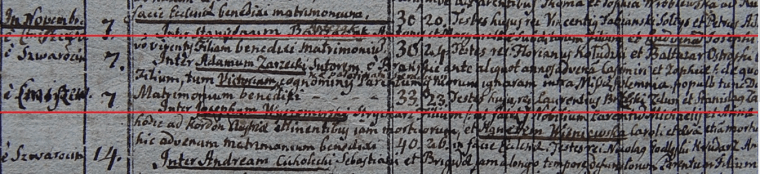
The record describes the groom,  Józef Zarzycki, as a “bachelor, of Szwarocin residing, master of the shoemaking profession, born in the village of Szwarocin of Adam and Wiktoria née Stolarska, the married couple Zarzycki; having twenty-two years of age.”1  Interestingly, this record is the only time we see Wiktoria’s maiden name recorded as Stolarska.  In her own marriage record to Adam Zarzecki in 1802, shown below,2  the priest calls her only, “Victoria, from the voivodeship of Sieradz, the names of whose parents I do not know” and tells us that she was age 23 at the time of her wedding, suggesting a birth year of about 1779.  Bransk


The Sieradz Voivodeship (Palatinatus Siradiensis), where Wiktoria was said to have been born, existed at that time as an administrative division of the Polish-Lithuanian Commonwealth, and encompassed 6 counties and close to 200 Roman Catholic parishes.  Without knowing her parents’ names and an exact place of birth, further research on this line will be difficult at best.  Wiktoria was born into tumultuous times for Poland.  The Polish-Lithuanian Commonwealth had already been diminished in size after the first partition of Poland in 1772, and Poland would be partitioned twice more, in 1793 and 1795, until it no longer existed by the time of Wiktoria’s marriage in 1802.  Both her birthplace, and her new hometown in the parish of Rybno, had become part of the Prussian Empire when she married Adam Zarzecki, gave birth to their only son, and died on 19 May 1807.  This political situation was as brief as Wiktoria’s life, however: just two months after her death, the Duchy of Warsaw was created by the Franco-Prussian treaty signed at Tilsit on 9 July 1807, creating a semi-autonomous Polish state that was in personal union with the Kingdom of Saxony.

One wonders why the priest might have recorded Wiktoria’s surname as Stolarska on her son’s marriage record in 1826, when it was unknown in 1802.  Perhaps her name truly was Stolarska, but the priest in 1802 was careless in his premarital examination, forgot to ask this information or failed to remember it, and then recorded later that he simply did not know her parents’ names?  How could she not have known her at least her father’s surname, if not her parents’ given names?  Was she born to an unwed mother, and perhaps she was orphaned at a young age?  How did a young, unmarried woman come to travel a distance of perhaps 90 miles from her home and settle in a distant village?  Did she travel with other family members, perhaps?  Unfortunately, the records of Rybno remain silent in regard to most of these questions.  The surname Stolarski does not appear in the parish records at all during this time period,3  which suggests that no other family members accompanied Wiktoria to Rybno.   The name “Stolarski” itself, like all Polish surnames with the root “Stolar-,” derives from the word, “stolarz,” meaning “joiner, carpenter,” so it’s also possible that the priest in 1826 created this surname for Wiktoria when he recorded her son’s marriage, perhaps based on someone’s recollection that her father was a carpenter.  As one might expect with such an etymology, the surname is not uncommon in Poland today, and is widely distributed geographically.  However, it does display a moderately increased prevalence in present-day Piotrków Trybunalski County, which was contained within the Sieradz Voivodeship.  It’s tempting to speculate that perhaps this surname really was used by Wiktoria’s family from that area, whose descendants still live there today.

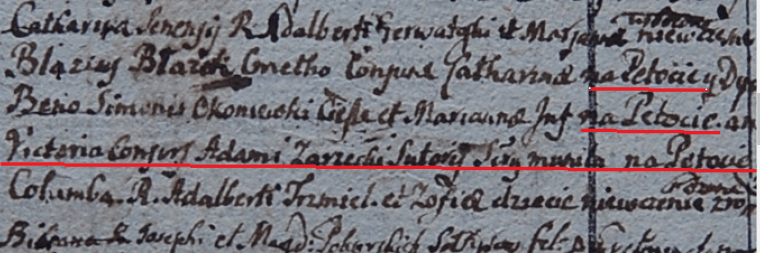
Wiktoria’s life was sadly brief.  Following her marriage in 1802, she became the mother of her only child, Józef Zarzycki, who was born some time between August 1803 and March 1804 in Szwarocin.5   One might expect to see births to a married couple every two years, on average, but this was not the case for Wiktoria and Adam Zarzycki.  Unfortunately, fewer births mean fewer records which might mention Wiktoria and provide us with glimpses into her life.  In 1807, she died at the age of 28.6  This close-up of her death record tells us that she died of “petocie,” which is mentioned here as an old Polish form of the Latin word, “Petechiae.”  Victoria Zarzycka death crop.png

Petechiae are small, red or purple spots on the skin, caused by minor bleeding from a broken capillary, and can have a variety of causes ranging from infectious diseases, to trauma, to leukemia, and a variety of autoimmune or otherwise non-infectious causes.  However, an infectious, contagious disease is suggested here, since at least eight other deaths on this page were attributed to the same cause (two are shown here).  Two serious illnesses that cause a rash and were common during this time are scarlet fever and typhus.  Both of these illnesses are presently treated with antibiotics, and these diseases are no longer life-threatening with timely intervention.

As a 21st-century American, I’m very grateful for the easy access to antibiotics which I enjoy, and which is one reason why rashes and fevers no longer terrify us as they did our ancestors.  We’ll never know what Wiktoria’s life might have included had she lived longer.  Probably she would have lived quietly, just another illiterate peasant woman, raising her family, tending to her home and garden, and supporting her husband’s shoemaking business in whatever ways she was capable. She probably never imagined that one day her descendents would live all over the world.  Although her story is short, it’s one that captivates me.  Rest in peace, Wiktoria.


Sources:

1Roman Catholic Church, St. Bartholomew’s Parish (Rybno, Sochaczew, Mazowieckie, Poland), “Księga ślubów 1826-1828,” 1826, #11, marriage record for Józef Zarzycki and Joanna Krzymińska.

2Roman Catholic Church, St. Bartholomew’s parish (Rybno, Sochaczew, Mazowieckie, Poland), “Księga ślubów 1790-1802,” 1802, #9, marriage record for Adam Zarzecki and Victoria, parents’ names unknown.

3Justyna Krogulska, Warsaw, Poland to Julie Szczepankiewicz, Zarzycki research notes; privately held by Julie Szczepankiewicz, Hopkinton, Massachusetts, USA.

4Hoffman, William F. Polish Surnames: Origins and Meanings. 3rd ed. Vol. 2. (Chicago: Polish Genealogical Society of America, 2012), 729.

Justyna Krogulska, Warsaw, Poland to Julie Szczepankiewicz, Zarzycki research notes; privately held by Julie Szczepankiewicz, Hopkinton, Massachusetts, USA. .”I didn’t find the birth certificate of Józef Zarzycki! There is a gap in the documents in the Aug 1803 – Mar 1804. It follows that Joseph was born at the turn of the year 1803-1804.  In the years 1802-1807 were not born other children of Adam Zarzecki and Wiktoria.”

6Roman Catholic Church, St. Bartholomew’s Parish (Rybno, Sochaczew, Mazowieckie, Poland), “Księga zgonów, 1802-1807,”1807, #39, death record for Victoria Zarzecka.

© 2016 Julie Roberts Szczepankiewicz


What’s in a name? My Zarzycki family of Buffalo, Rybno and Brańsk

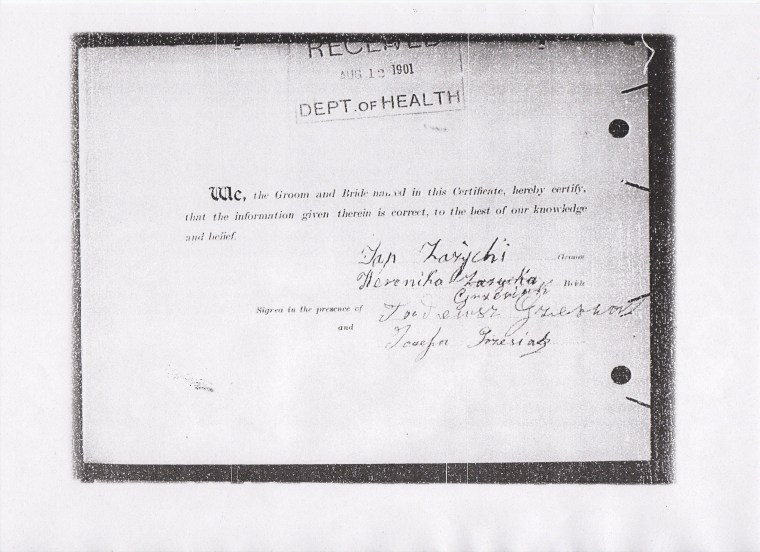
I’ve been very busy with adding new data to my family tree for my Zarzycki family, thanks to my fabulous researcher in Warsaw, Justyna, who visited my ancestral parish in Poland to obtain records that are not available on microfilm, online, or in any archive.   By way of introduction, my maternal grandmother’s father was Jan/John Zażycki, who immigrated to Buffalo, New York in 18951 and eventually settled in North Tonawanda, New York.  My extended Zazycki family always insisted that the surname was spelled “Zażycki,” rather than the phonetically-equivalent “Zarzycki,” and furthermore, I was told by some that anyone with the surname “Zarzycki” was not likely to be related to us.  It may indeed have been the case that my great-grandfather preferred the spelling without the “r.” As you can see from the signature on his civil marriage record, John clearly spelled his name as “Zażycki”2:  Jan & Weronika Zazycki Marriage 2
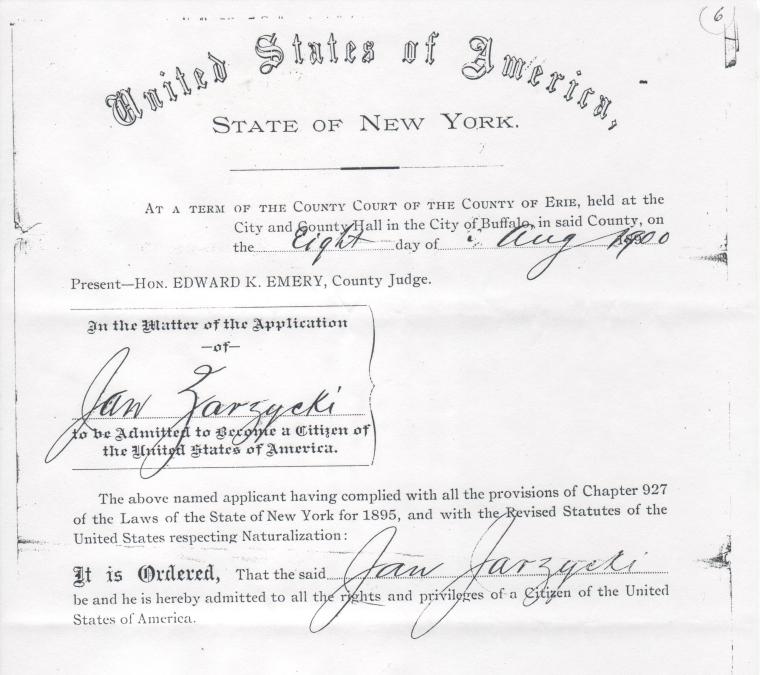
John Zazycki’s naturalization papers contain both spellings, but one could argue that the places in which it was spelled with the “r” were the result of carelessness on the part of the clerk, since there is one place on the naturalization certificate where John’s name not only contains the “r,” but also appears as “Jarzycki”3:

Jan Zazycki naturalization certificate 2

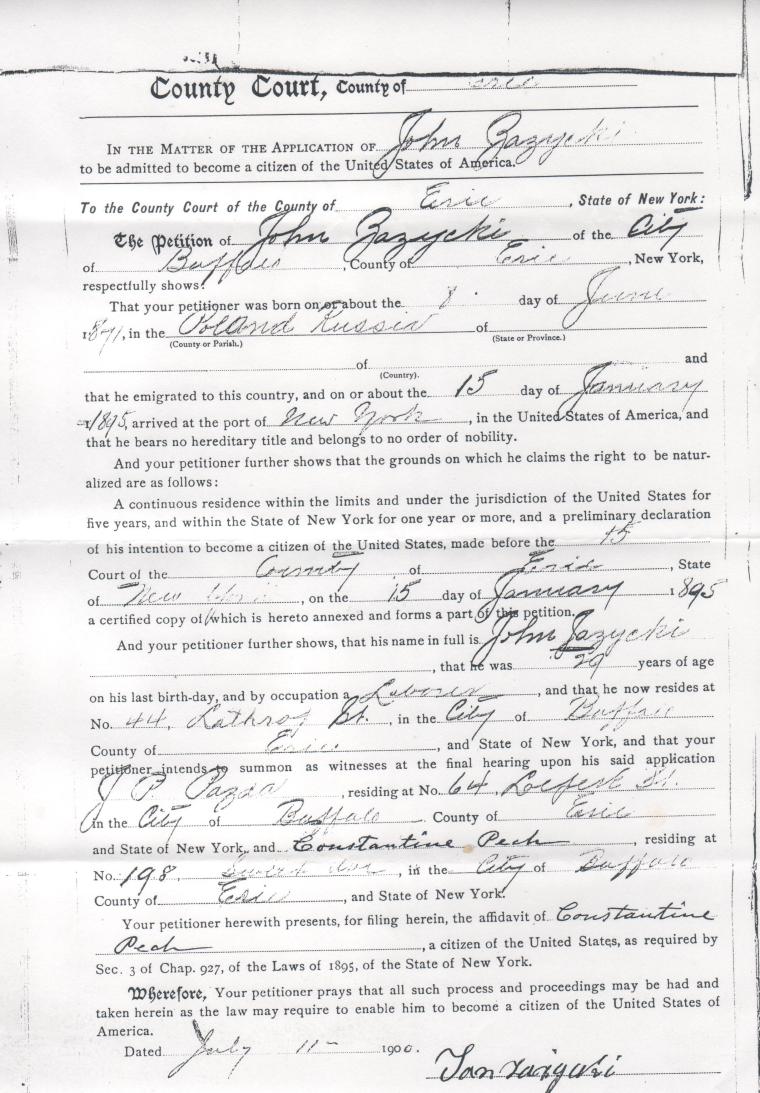
Compare this with the Petition for Naturalization1, which John himself signed at the bottom:

Jan Zazycki Petition for Naturalization

However, any experienced family historian can tell you that one needs to be flexible and keep an open mind regarding variant spellings of surnames, and that is true in this case as well.  In records from Poland, I have only rarely seen the surname spelled as Zażycki.  For example, in records in which Jan’s father, Ignacy, is mentioned, the surname is spelled as “Zarzycki” on 17 occasions and as “Zarzecki” on 3 documents. In documents pertaining to Ignacy’s father, Józef, the surname has been spelled as “Zarzycki” 7 times, and as “Zażycki” only once.  In fact, that’s the only time I have ever seen the name spelled as “Zażycki” on a document from Poland.

My Zarzycki family was from the villages of Szwarocin and Bronisławy, which belong to the Roman Catholic parish of St. Bartholomew in Rybno.  All of these villages are presently in Sochaczew County, Mazowieckie province, but were in the Warsaw province of the Russian Empire at the time of my great-grandfather’s birth in 1866.  Literacy rates were quite low in the Russian Empire in those days — one estimate places the overall literacy rate of the Russian Empire at 24% in 1897, while the rural literacy rate which would include small villages like Bronisławy, was as low as 19.7%.4  Despite this, there is evidence that Ignacy Zarzycki was literate:  his signature appears as distinct from that of the priest, on the birth records of two of his children.  Below is the birth record for Ignacy’s son, Leonard Zarzycki, in 1876.5   Ignacy clearly signed his name as “Zarzycki.”  Leonard Zarzycki birth 1876

The same is true on this birth record for his son, Roman Aleksander Zarzycki in 18726:

Roman Aleksander Zarzycki birth 1872

So although it may have been the case that my great-grandfather preferred the spelling “Zażycki,” it appears that that preference may have begun with him, and has no bearing on the spellings that we see on records from Poland for this family.  In fact, not only does the spelling with the “r” predominate, but John’s own father spelled his name that way.

According to the paper trail for this family, Jan Zażycki was the son of Ignacy Zarzycki and Antonina Maciążek,2 and Ignacy was the son of Józef Zarzycki and Joanna Krzemińska.7 Going back one generation further on the paternal line, Józef Zarzycki was the son of Adam Zarzycki and Wiktora Stolarska.8  In records pertaining to Adam, we see a different trend in spelling.  Out of twelve documents found to date in which he is mentioned, six of them give his name as “Zarzecki,” five of them spell it “Zarzycki,” and only one of them (the marriage record for his son, Józef) shows the spelling, “Zażycki.”  Interestingly, the documents that contain the spelling “Zarzecki,” tend to be older (1802-1812) whereas the spelling “Zarzycki” is found on documents dated between 1812-1828.

The record for Adam’s first marriage to his wife, Wiktoria, states that he was a newcomer to the community in Rybno, having moved there from his original place of birth in Brańsk:9

Bransk

If there were any doubt about which place called Brańsk was meant, it would be cleared up by the record for Adam’s second marriage to Agnieszka Kruczewska in 1810, in which Adam is said to be from Podlachia (Podlasie):10

1810 crop

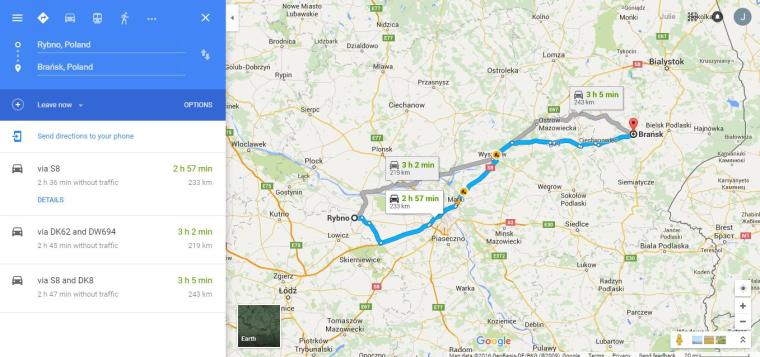
Taken together, these two documents suggest the town of Brańsk, which is currently the seat of gmina Brańsk in Bielsk County, Podlaskie Voivodeship, approximately 143 miles from Rybno:

13246316_10207640187954005_3609992669130168736_o

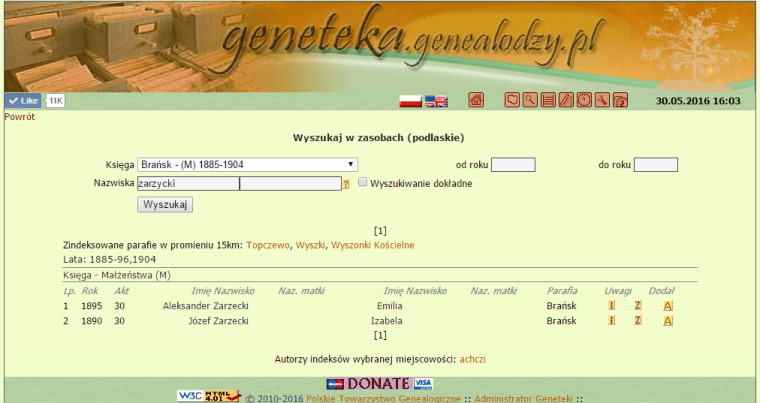
Adam Zarzycki was born about 1769 to Kazimierz Zarzycki and his wife, Zofia,9 but there are no vital records for the parish in Brańsk available for this time period from the Polish State Archives. The LDS Family History Library does have some vital records for Brańsk on microfilm including death records from 1797-1823, but no birth or marriage records from this or any earlier time periods, which suggests they might have been lost or destroyed.  So although it may not be possible to locate a birth record for Adam Zarzycki, it might be possible to locate death records for his parents, and this is an obvious direction for future research. Some of the existing records are indexed on Geneteka, including marriages from 1885-1896, and a search for “Zarzycki” reveals two marriage records with the spelling “Zarzecki”:

Bransk

Taken together, these data suggest that the original spelling of the surname was “Zarzecki,” and that it evolved to “Zarzycki” after Adam Zarzecki migrated to Rybno.  Analysis of the geographic surname distributions for both variants of the name (based on data from 2002) confirms that, although the “Zarzecki” spelling is generally less popular in Poland, it is significantly more common than “Zarzycki” in Bielsk County (124 bearers for Zarzecki/a vs. fewer than 50 for Zarzycki/a).

As this case demonstrates, surnames can evolve significantly over time and place, and the spelling variants that one sees may follow a particular pattern, rather than occurring at random. Tracking these changes can sometimes lead to a better understanding of a family’s geographic origins.  It will be interesting to see whether I can find additional traces of this family in the microfilmed death records from Brańsk — it’s unclear from Adam’s marriage record whether he was from the Brańsk area generally, or from that parish specifically.  But if I am able to find additional records there, you can be sure that I’ll pay close attention to how the Zarzycki/Zarzecki surname is spelled.


Sources:

1Erie, New York, #1892, Petition for Naturalization for Jan Zazycki, 12 July 1900.; Erie County Clerk’s Office, 92 Franklin St. Buffalo, NY 14202.

2Buffalo, Erie County, New York, 1901, #202, marriage record for John Zazycki and Veronica Grzesiak.; Erie County Clerk’s Office, 92 Franklin St., Buffalo, NY 14202.

3Erie, New York, #1892, Certificate of Naturalization for Jan Zazycki, 8 August 1900.; Erie County Clerk’s Office, 92 Franklin St. Buffalo, NY 14202.

4“Likbez.” Wikipedia. Accessed May 29, 2016. https://en.wikipedia.org/wiki/Likbez#CITEREFGrenoble.

5Roman Catholic Church, St. Bartholomew Parish (Rybno, Sochaczew, Mazowieckie, Poland), “Księga urodzeń 1870-1880”, 1876, #87, baptismal record for Leonard Zarzycki.

6Roman Catholic Church, St. Bartholomew Parish (Rybno, Sochaczew, Mazowieckie, Poland), “Księga urodzeń 1870-1880”, 1872, #15, baptismal record for Roman Aleksander Zarzycki.

7Roman Catholic Church, St. Bartholomew’s Parish (Rybno, Sochaczew, Mazowieckie, Poland), “Early birth records (before 1831)”, 1828, #34, baptismal record for Ignacy Zarzycki. 

8Roman Catholic Church, St. Bartholomew’s Parish (Rybno, Sochaczew, Mazowieckie, Poland), “Księga ślubów 1826-1828”, 1826, #11, marriage record for Józef Zażycki and Joanna Krzymińska.

9Roman Catholic Church, St. Bartholomew’s parish (Rybno, Sochaczew, Mazowieckie, Poland), “Księga ślubów 1790-1802”, 1802, #9, marriage record for Adamus Zarzecki and Victoria, parents’ names unknown.

10Roman Catholic Church, St. Bartholomew’s Parish (Rybno, Sochaczew, Mazowieckie, Poland), “Księga ślubów, 1803-1810”, 1810, #8, marriage record for Adamus Zarzecki and Agnes Kruczewska.

© 2016 Julie Roberts Szczepankiewicz