Christiana (_____) Hodgkinson (c. 1788–1865) was my fourth great-grandmother, married to Robert Hodgkinson of Grantham Township on Canada’s Niagara Peninsula.
For decades, her maiden name and parentage have eluded me—and many other Hodgkinson researchers.
When I first discovered my descent from Robert and Christiana after posting on an old RootsWeb message board for Lincoln County, Ontario, back in 2006, another seasoned researcher cautioned me:
“People have been looking for Christiana’s maiden name for over 20 years. So far, no luck. There was speculation that she may have been a Corson as one of her daughters was named Catherine ‘Cor.,’ but all of that is pure speculation. No proof whatsoever.”¹
As I dug deeper, I found another popular theory suggesting Christiana might have been a Larraway. The Larraway family was certainly connected to the Hodgkinsons through the marriage of Robert and Christiana’s daughter, Eleanor Jane, to James Larraway in 1839.² Given the endogamy among settlers in Upper Canada, it wouldn’t have been surprising to find additional ties between the two families.
A distant cousin even mentioned a family Bible record in which Christiana’s maiden name was penciled in as Larraway, then crossed out, as if the writer weren’t certain.³ The theory was appealing: there were plenty of Loyalist Larraways in the Niagara Peninsula, including one Jonas Larraway, himself a Loyalist like Robert Hodgkinson’s father. And in 1829, Robert Hodgkinson placed a newspaper ad for a lost English watch inscribed with the initials “J.L.”⁴ Could that watch have belonged to his father-in-law, Jonas Larraway?
It was just the kind of tantalizing clue that keeps a genealogist awake at night. But despite its appeal, I was never able to find convincing evidence for this theory in the historical record. So, what was the truth of Christiana’s origins?
Christiana in the Records
Because of record loss, Christiana appears in only one census—the 1861 enumeration—which listed her as age 61 and born in Upper Canada.⁵ However, her daughter Elizabeth (Hodgkinson) Walsh stated in the 1900 U.S. census that her mother was born in New York.⁶
Christiana’s death notice, published in the St. Catharines Constitutional on 14 September 1865, reported that she was 77 years old at death, suggesting a birth circa 1788.⁷ Her grave marker at Victoria Lawn Cemetery records her death on 5 September 1864, “Aged 76 Yrs. & 8 M.,” implying a birth in December 1788 or January 1789.⁸ No surviving church records identify her parents or birthplace.
A Breakthrough with Full-Text Search
That was where my research stood—until recently, when I was playing with FamilySearch’s Full-Text Search feature. This AI-driven tool, introduced at RootsTech 2024, has revolutionized genealogical discovery by revealing text buried deep within unindexed images. I’d used it before to glean small clues, but this time, it changed everything.
A simple search for “Christiana Hodgkinson” in Canada, 1790–1866, surfaced a Revolutionary War pension file.⁹
My jaw hit the floor. This was the breakthrough I’d been looking for.
Christiana Hodgkinson was née Griffiths, or Griffis.
Somehow, amid the Loyalist settlement of Grantham, there was a family—my family!—who applied to the U.S. government for a pension they believed was owed to their patriarch for his Revolutionary War service.
The Pension File That Changed Everything
The 48-page file was pure genealogical gold. It revealed that Christiana was the daughter of James and Catherine (Froelich) Griffiths or Griffis and that she had at least six siblings, including Sarah Griffis, who married Francis Hodgkinson—the brother of Christiana’s husband, Robert.¹⁰
Suddenly, the puzzle pieces snapped together: two Hodgkinson brothers had married two Griffis sisters.
James Griffiths was the son of Peter from “Albanii” (Albany), and Catherine was the daughter of Barend Froelich. They were married 13 June 1783 at Zion Evangelical Lutheran Church in Athens, Greene County, New York. It was stated that that “the family originally came from Wales and spelt their name Griffiths until after the Revolution, it was written Griffis, as it was shorter and more like the pronunciation.”
James Griffiths fought on the American side—unlike most of my ancestors of that era, who were Loyalists. A certificate dated 1852 from Archibald Campbell, Deputy Secretary of State in Albany, confirmed that James enlisted 1 March 1777 in Capt. Jacob Wright’s company, Second New York Regiment, commanded by Col. Philip Van Cortlandt. He served three years and was discharged 2 February 1780.
James and Catherine Griffiths migrated to Canada around 1800, settling in Grantham, where Catherine died 17 November 1835 and James died 18 December 1837. They were buried together in the Episcopal Burying Ground at Ten Mile Creek.
A Bureaucratic Saga
All this information appeared within affidavits filed in 1852 by their son Peter Griffis, who believed he and his siblings were entitled to their father’s pension as a Revolutionary War veteran. Among those documents was his sworn declaration describing his father’s service (Figure 1), and identifying his father’s heirs as himself, Mary Larraway, Sarah Hodgkinson, Christiana Hodgkinson, Lydia Courson, and Hannah Oustroudt.
Figure 1. Detail from Peter Griffis’s Revolutionary War pension affidavit. Underlined text highlights his father’s service history, stating, “…his Father was in the service of the United States the greater part of the Revolution, that he resided on the Wall Kill in Orange or Sullivan County during the Revolution and in Green County afterwards until the year 1800 when he removed to the Province of Upper Canada. The Deponent cannot state the dates or periods of the service rendered by his Father but remembers that he stated, that he served three years in a New York Regiment under Capt. Wright, that he enlisted for that period in the year 1776 or 1777, and thinks Colonel Van Courtlandt was the Colonel of the Regiment to which Capt. Wright’s Company belonged…”
Despite the certificate from the Deputy Secretary of State dated 29 September 1852 (Figure 2), the Pension Office equivocated, writing in March 1853 that the claim might be approved if James Griffiths’s identity could be firmly established:
“If his name was formerly Griffith, it can be proved by the production of the Family Record, or a certified Copy.… If the claim is a meritorious one, it is very remarkable that application has been deferred until this late day.”
Figure 2. Certificate by Archibald Campbell, Deputy Secretary of State, Albany, confirming James Griffiths’s Revolutionary War service under Capt. Wright and Col. Van Cortlandt.
Christiana Hodgkinson herself replied in an affidavit—signed in her own hand—attesting to her name, age, parents, and the date of her parents’ marriage, which was recorded in their family Bible brought to Canada around 1800 (Figure 3). Lawrence Corson also testified that he had examined that Bible and believed it to be an original record of James and Catherine’s marriage.
Figure 3. Christiana Hodgkinson’s affidavit featuring her signature at bottom right.
From 1853 to 1859, the family persisted. Their attorney defended the claim, explaining the name change from Griffith to Griffis and the delay caused by their Canadian residence. The pastor of Zion Lutheran Church sent a certified copy of the 1783 marriage record. In September 1859, Sarah Hodgkinson wrote again, still believing children could inherit pensions, and demanded payment for seven years of service at the rate of $8 per month with 6% interest over 77 years, which she calculated to amount to $3,776.46. Her angry letter went so far as to threaten legal action if denied.
You have to love her chutzpah.
Ultimately, the claim was rejected. Some confusion might have been avoided if the Pension Office had clearly stated back in 1852 that Revolutionary War pensions extended only to veterans and widows—not to their heirs. However, they didn’t state that until 1859, in their response to Sarah Hodgkinson. Meanwhile their earlier replies, suggesting that there was insufficient evidence linking James Griffiths the soldier with James Griffis of Grantham, seem puzzling. What are the odds that Peter Griffis could accurately describe the enlistment details of an unrelated James Griffiths?
Connecting the Dots
With the identification of James and Catherine (Froelich) Griffiths as Christiana’s parents, and Lydia (Coursin/Corson) as her sister, two loose ends finally made sense.
The death certificate for James George Welch (Walsh), son of Robert and Elizabeth (Hodgkinson) Walsh, incorrectly reported his mother’s maiden name as Griffith instead of Hodgkinson¹¹ The informant, his wife Jane (Lawder) Walsh, obviously confused her mother-in-law’s maiden name with that of Elizabeth’s mother.
Another clue appears in St. Mark’s Anglican Church Baptisms, Niagara-on-the-Lake, 1792–1856: on 3 January 1816, Barnabas Corson, son of Lawrence and Lydia, was baptized with sponsors Jno. (John) Hodgkinson and Jas. (James) and Catherine Griffiths.¹² It’s clear now that Barnabas’s mother, Lydia (Griffiths) Corson, chose her own parents, and her brother-in-law’s father, as godparents for her son.
Conclusions
The Pension Office’s handling of this case reveals both bureaucratic confusion and subtle bias. Their skepticism may have stemmed from the fact that the claim originated within a known Loyalist settlement in Upper Canada. Indeed, there exists a land petition from a Peter Griffis citing Loyalist service during the Revolution.¹³ That petitioner stated he came to Canada circa 1800, coinciding with Christiana’s family’s arrival. But the Peter Griffis who was Christiana’s brother was born about 1793—too young to have served—so the Loyalist claimant was likely a paternal uncle.
The Griffis family thus embodied the divided loyalties of that era: relatives on both sides of the Revolutionary War. James Griffis was certified to have served honorably on the American side, even if later bureaucrats buried that certification as the final page beneath forty-seven pages of correspondence in his file.
It’s also striking that the old theories weren’t entirely wrong. Christiana’s sisters really did marry into the Corson and Larraway families that researchers long suspected.
Looking back 173 years later, I’m oddly grateful that the Pension Office never clarified in 1852 that a pension claim died with the veteran and his widow. Had they done so, my fourth great-grandmother might never have submitted her affidavit—and her signature, a tangible link to her life, might never have been preserved.
Notes
Name withheld for privacy, author’s research files.
Library and Archives Canada, List of Marriage Licences Issued in Upper Canada (RG 5 B9), LAROWAY, James, and HODGKISON, Eliza [sic] Jane, 24 July 1839.
Name withheld for privacy, author’s research files.
The Farmers’ Journal and Welland Canal Intelligencer (St. Catharines, Ontario), 8 Apr 1829, p. 3, “Watch Lost.”
1861 Census of Canada, Canada West, Lincoln District 22, Grantham Sub-District 6, p. 4, Robert Hodgkinson household; LAC RG31, Microfilm C-1048–1049.
1900 U.S. Census, Erie Co., N.Y., Buffalo Ward 24, ED 212, Sheet 3A, Charles DeVere household; NARA T623, roll 1032.
St. Catharines Constitutional (14 Sept 1865), p. 3, death notice for Christina Hodgkinson.
Victoria Lawn Cemetery (St. Catharines, Ontario), monument inscription for Christiana Hodgkinson.
U.S. Dept. of Veterans Affairs, Revolutionary War Pension File R4321, James Griffis or Griffiths; NARA M804, Roll 1133; digital image, FamilySearch.
Find a Grave memorial #99489809 for Sarah Hidgkinson (1787–1865), North Embro Cemetery, Oxford Co., Ont.; Niagara Peninsula Branch OGS, St. Mark’s Anglican Church Baptisms, Niagara-on-the-Lake, 1792–1856, p. 22.
Ontario Death Certificate 1924 no. 032688, George James Welch, 18 June 1924; FamilySearch database, “Canada, Ontario Deaths, 1869–1937.”
St. Mark’s Anglican Church Baptisms, Niagara-on-the-Lake, 1792–1856, p. 23, entry for 3 Jan 1816, Barnabas Corson.
Upper Canada Land Petitions 1819, Vol. 206, Bundle G12, no. 44, Peter Griffis of Louth; LAC RG1 L3, Microfilm C-2030.
Many of us are familiar with the wonderful information that can be found in Catholic church records. Details such as parents’ names, dates of birth, and place of origin make these records well worth exploring. However, these church records can sometimes introduce mysteries that can only be explained through still deeper research.
One such mystery involves the marriage records I discovered for my great-great-grandfather, Andrzej Klaus, and his brother, Tomasz, which I discussed in a post back in 2017.[1] At that time, I noted that Andrzej’s mother was identified as Anna Słowik in the record of Andrzej’s marriage to Marianna Łącka, which took place at St. Stanislaus Church in Buffalo on 21 January 1891 (Figure 1).[2]
Figure 1: Detail from the marriage record of Andrzej Klaus and Marianna Łącka, showing Andrzej’s parents’ names as” Jakob K. i Anna Słowik,” and his place of birth as “Maniowo, Gal.” The record is in a mixture of Polish and Latin; “Gal.” is an abbreviation for the Galicia province of the Austrian Empire, and Maniowo is a misspelling of Maniów.[2]
Similarly, when Andrzej’s brother, Tomasz Klaus, married Wiktoria Rak at St. Stanislaus on 20 November 1900, the groom’s mother was identified as Franciszka Słowik (Figure 2).[3]
Figure 2: Detail from the marriage record of Tomasz Klaus and Wiktoria Rak, showing Tomasz’s parents’ names as “Jakób K. i Franciszka Słowik,” and his place of birth as “Mielecka Wola, Gal[icia].”[3]
That’s all well and good, except for the fact that I have good evidence that Andrzej and Tomasz were the sons of Jakub Klaus and Franciszka Liguz. Where does the name Słowik come in? Why did both her sons report this as their mother’s maiden name, why did Andrzej report her given name as Anna, and why am I so certain that her name was really Liguz?
The answers lie in church records created at the parish of St. Mary Magdalene in Szczucin, located in Dąbrowa County, in the Galicia province of the Austrian Empire. This was the parish that served the village of Maniów, where the Klaus family lived. Maniów is presently located in gmina Szczucin, Dąbrowa County, in the Małopolskie province of Poland. In 1981, the village was reassigned to a new parish, Our Lady of Fatima & the Rosary, which was established in the village of Borki. According to local custom, when a village is reassigned to a new parish, the church books for that village are transferred from the old parish to the new parish. So, it was in Borki that I first laid eyes on the books containing the baptismal records for my great-grandfather, Andrzej Klaus, and his siblings, even those those baptisms took place in Szczucin.
Church records revealed that Jakub Klaus and Franciszka Liguz were married on 16 September 1860 in Szczucin (Figure 3).[4]
Figure 3: Marriage record from Szczucin for Jakub Klaus and Franciszka Liguz, 16 September 1860.[4]
The Latin marriage record stated that the groom, Jacobus Klaus, was a Catholic, single, 30-year-old servant (famulus), and the son of Laurentius and Anna (née Zolowna) Klaus. Because the records were kept in Latin, Latin forms of given names were used. However, the individuals identified in the records would have been known to their communities by their Polish names, to Laurentius would have been called Wawrzyniec and Jacobus would have been called Jakub. (The name Anna is the same in Latin, Polish, and English.) Note also that the groom’s mother’s maiden name (Zolowna) was given in an old form not used today; the “-ówna” ending signifies an unmarried woman of the Zola family, although her name has also been spelled as Żala and Żola on other records. The bride, 24-year-old Francisca Liguz (Franciszka in Polish), was Catholic, single, and the daughter of Laurentius Liguz and Margaretha (Małgorzata) Warzecha. Witnesses were Adalbertus (Wojciech) Liguz and Joannes (Jan) Mamuśka.
Baptismal records identified eight children born to this couple:
Jan Klaus, born 09 October 1860 in Maniów,[5] died 13 May 1920 in Plymouth, Luzerne, Pennsylvania, USA;[6]
Józef Klaus, born 26 February 1863 in Maniów,[7] died 12 January 1874 in Wola Mielecka;[8]
Andrzej Klaus, born 25 November 1865 in Maniów,[9] died 14 June 1914 in North Tonawanda, Niagara, New York, USA;[10]
Michał Klaus, born 01 September 1867 in Maniów,[11] no death or marriage record yet discovered;
Paweł Klaus, born 28 May 1870 in Maniów,[12] died 14 March 1879 in Wola Mielecka;[13]
Piotr Klaus, born 28 May 1870 in Maniów,[14] died 22 July 1870 in Maniów;[15]
Tomasz Klaus, born 03 September 1872 in Wola Mielecka,[16] died 28 December 1911 in Buffalo, Erie, New York, USA;[17]
Helena Klaus, born 25 September 1875 in Wola Mielecka,[18] died 15 August 1878 in Wola Mielecka.[19]
Baptismal records from Galicia typically identify not only the parents of the child, but also the grandparents, the baptismal records for Andrzej Klaus and each of his siblings identified their mother as Francisca, daughter of Laurentius Liguz and Margaretha Warzecha.
Franciszka Liguz herself was born 6 February 1836 in Maniów, the oldest child of Wawrzyniec and Małgorzata (Warzecha) Liguz (Figure 4) .[20]
Figure 4: Franciszka Liguz’s baptismal record, which states that she was born 6 February 1836 in Maniów, house number 31, and baptized the next day. She was Catholic, female, and legitimate. Her father was Laurentius, a farmer (agricola), son of Joannes (Jan) and Catharina (Katarzyna) Liguz. Her mother was Margaretha, daughter of peasants (cmetho) Andreas and Agnes Warzecha. The midwife was Eva Dudaykowa, and the godparents were Franciscus Rogoza and Catharina Liguszka (Liguz), wife of Adalbert [Liguz] of Borki. The godparents were farmers (agricola). Franciszka was baptized by Fr. Michael Kuziel, Cooperator (assistant pastor).[20]
Her birth record identified her parents as Laurentius, son of Joannes and Catharina Liguz, and Margaretha, daughter of Andreas and Agnes Warzecha. Wawrzyniec/Laurentius Liguz and Małgorzata/Margaretha Warzecha were married on 28 May 1832 in Szczucin (Figure 5).[21] The marriage record identified Wawrzyniec as a 40-year-old widower, while the bride was just 17 years old. Parents’ names were not reported for Wawrzyniec, but Małgorzata’s father was named Andreas/Andrzej, consistent with the information reported on Franciszka Liguz’s birth record.
Figure 5: Marriage record from Szczucin for Laurentius Liguz and Margaretha Warzecha, who were married 28 May 1832.[21]
Wawrzyniec and Małgorzata had six children together:
Franciszka, born 06 February 1836 in Maniów,[22] date of death unknown;
Józefa Zofia Liguz, born 11 January 1838 in Maniów,[23] date of death unknown;
Jan Liguz, born 01 January 1840 in Maniów,[24] died 4 January 1840;[25]
Sebastian Liguz, born 01 Janaury 1840 in Maniów, [26] died 2 January 1840;[27]
Jan Liguz, born 13 June 1841 in Maniów,[28] died 8 September 1841;[29]
Józef Liguz, born 2 March 1844 in Maniów,[30] died 16 May 1846.[31]
The twins, Jan and Sebastian, both died within a few days of birth, and the younger son named Jan, born in 1841, died at the age of 3 months. Wawrzyniec Liguz died at the age of 55 on 6 November 1845, leaving Małgorzata as a 30-year-old widow with three children, ages 9, 7, and 20 months.
How Małgorzata supported her young family during the next three years is unclear. Church records described her late husband, Wawrzyniec, as a “hortulanus,” which was a peasant with a small, garden-sized plot of land.[32] They were residents of house number 31 in Maniów, but she was living at house number 40 at the time of her second marriage to Jan Podkówka, on 1 November 1848 in Szczucin, suggesting that she may have moved in with other family members after her husband’s death.[33]
Jan Podkówka was a 50-year-old father and widower when he married Małgorzata Liguz. The couple had two children together:
Tomasz Podkówka, born 5 November 1849,[34] died 16 November 1873;[35]
Agata Podkówka, born 1 February 1852,[36] died 6 March 1910.[37]
Jan Podkówka must have died before 27 January 1856,[38] because that was when Małgorzata married a third time, to another widower, Antoni Słowik.[39] Here, at last, is the answer to the mystery found in the Buffalo church records regarding the identification of Andrzej and Tomasz Klaus’s mother as Słowik rather than Liguz. Figure 6 shows a simplified version of Małgorzata’s family tree.
Figure 6: Simplified family tree for Małgorzata Warzecha Liguz Podkówka Słowik, which includes her parents, her husbands, and all her children. The chart does not include previous marriages of Jan Podkówka and Antoni Słowik. Her children’s spouses are shown, but the chart does not include all of Małgorzata’s grandchildren. Click image to enlarge.
At the time of her marriage to Antoni Słowik, Małgorzata was a 41-year-old mother of eight children, four of whom were still alive. Franciszka Liguz and Józefa Zofia Liguz were ages 20 and 18, respectively, while Tomasz Podkówka and Agata Podkówka were 7 and nearly 4 years old, respectively. Antoni and Małgorzata had two children together prior to his death on 4 April 1864:[40]
Katarzyna Słowik, born 14 February 1857 in Borki,[41] died 25 April 1902 in Delastowice;[42]
Ignacy Słowik, born 28 July 1859 in Borki,[43] died 5 October 1937 in Maniów.[44]
It’s unclear why Andrzej and Tomasz Klaus would have reported their mother’s maiden name as Słowik rather than Liguz, and why Andrzej would have reported her given name as Anna, rather than Franciszka. It may have been a simple misunderstanding of the question, providing her name at the time of their marriages, rather than her maiden name. It’s also possible that an error was introduced during recopying of the church books from St. Stanislaus in Buffalo; the fact that all the church records from St. Stanislaus appear to be in the same handwriting suggests that these are not original records.
Widowed for the third time at the age of 49, Małgorzata never remarried after Antoni’s death in 1864. Her oldest child, Franciszka, had been married for four years by the time her stepfather, Antoni Słowik, died. Małgorzata’s second child, Józefa Zofia (known as Zofia), had married Wojciech Krupa on 27 July 1862, so she, too, was living independently.[45] Tomasz Podkówka, age 14, was old enough to be a help to his mother, along with his younger sister, Agata Podkówka, age 12. Katarzyna and Ignacy Słowik were only 7 and 5 when their father died, and once again, it’s unclear how Małgorzata managed to support her family following her husband’s death, although it’s probable that she relied on assistance from additional family members.
Małgorzata Warzecha Liguz Podkówka Słowik died at the age of almost 77 on 7 January 1892, having outlived all three husbands, and five of her ten children.[46] Her death record, shown in Figure 7, identified each of her previous husbands. At the time of her death, Małgorzata was living in house number 33 in Borki, and further research may identify the owner of that home.
Figure 7: Death record for Margaretha widow of 1. Laurentius Liguz, 2, Joannes Podkówka, 3. Antonius Słowik, née Warzecha, age 77; causes of death, marasmus.[46]
Researching Małgorzata’s life revealed more than just names and dates—it uncovered a narrative of resilience, adaptation, and change. Her multiple marriages and the resulting blended family echo the complex structures many genealogists discover in their own research. Many questions still remain, but this is the nature of genealogical research; our ancestors left behind breadcrumbs, not roadmaps, and it’s up to us to piece together their stories with patience and persistence.
[1] Julie R. Szczepankiewicz, “And the Walls Came Tumbling Down: New Discoveries in My Klaus Family Research, Part I,” From Shepherds and Shoemakers (https://fromshepherdsandshoemakers.com/), published 8 August 2017, accessed 12 March 2025.
[4] Roman Catholic Church of St. Mary Magdalene (Szczucin, Dąbrowa, Małopolskie, Poland), Maniów, Akta małżeństw [Marriage records], 1860, 16 September, Klaus-Liguz; FamilySearch Library, film no. 1958428 Items 7-8.
[5] Roman Catholic Church, Sanktuarium Matki Bożej Fatimskiej – Różańcowej (Borki, Szczucin, Dąbrowa, Małopolska, Poland), Baptisms, 1860, no. 20, Joannes Klaus; parish archive. Mother was recorded as “Francisca nata Laurentio Liguz et Margaretha Warzecha.”
[6] Pennsylvania, USA, Death Certificates, 1920, no. 60801, John Klaus, died 13 May 1920; imaged as, “Pennsylvania Death Certificates, 1906-1966,” database, Ancestry, (http://ancestry.com : 13 March 2025).
[7] Roman Catholic Church, Sanktuarium Matki Bożej Fatimskiej – Różańcowej (Borki, Szczucin, Dąbrowa, Małopolska, Poland), Baptisms, 1863, unnumbered entries in chronological order, Josephus Klaus, born 26 February 1863. Mother was recorded as “Francisca nata Laurentio Liguz et Margaretha Warzecha.”
[8] Polskie Towarzystwo Genealogiczne [Polish Genealogical Society], Geneteka, database (https://geneteka.genealodzy.pl/ : accessed 15 March 2025), search result for Klaus deaths in Podkarpackie, 1874, no.4, Józef Klaus, son of Jakub Klaus and Franciszka Liguz, parish Książnice-Wola Mielecka, died in Wola Mielecka on 12 January 1874 at the age of 7 years, source: parish archives, indexed by Krzysztof Gruszka.
[9] Roman Catholic Church, Sanktuarium Matki Bożej Fatimskiej – Różańcowej (Borki, Szczucin, Dąbrowa, Małopolska, Poland), Baptisms, 1865, no. 37, Andreas Klaus, born 25 November 1865. Mother was recorded as “Francisca nata Liguz fil: Laurentii et Margarethae natae Warzecha.”
[10] North Tonawanda City Clerk (North Tonawanda, Niagara, New York, USA), Death Certificates, 1914, no. 82, Andro Klaus, 14 June 1914.
[11] Roman Catholic Church, Sanktuarium Matki Bożej Fatimskiej – Różańcowej (Borki, Szczucin, Dąbrowa, Małopolska, Poland), Baptisms, 1867, no. 20, Michael Klaus, born 1 September 1867. Mother was recorded as “Francisca nata Liguz fil. Laurentii et Margarethae natae Warzecha.”
[12] Ibid., 1870, no.18, gemini, Paulus, Petrus Klaus, born 28 May 1870. Mother was recorded as “Francisca filia Laurentii Liguz et Margaritha Warzecha.”
[13] Polskie Towarzystwo Genealogiczne [Polish Genealogical Society], Geneteka, database (https://geneteka.genealodzy.pl/ : accessed 13 March 2025), search result for Klaus deaths in Podkarpackie, 1879, no. 7, Paweł Klaus, son of Jakub Klaus and Franciszka Liguz, parish Książnice-Wola Mielecka, died in Wola Mielecka on 14 March 1879 at the age of 8 years, source: parish archives, indexed by Krzysztof Gruszka.
[15] Ibid.; a cross next to Petrus’ name indicates that he died, and the date “22/7 1870” is recorded under his name.
[16] Polskie Towarzystwo Genealogiczne [Polish Genealogical Society] Geneteka, database (https://geneteka.genealodzy.pl/ : accessed 15 March 2025), search result for Klaus births in Podkarpackie, 1872, no. 23, Tomasz Klaus, son of Jakub Klaus and Franciszka Nygus [sic], parish Książnice-Wola Mielecka, born in Wola Mielecka on 3 September 1872, source: parish archives, indexed by Krzysztof Gruszka, accessed 15 March 2025.
[17] Roman Catholic Church of Corpus Christi (Buffalo, Erie, New York, USA), “Deaths, 1902-1916,” p. 68, 1911, no. 139, Thomas Klaus, 28 December 1911; Polish Genealogical Society of New York State.
[18] Ibid., 1875, #23, Helena Klaus, son of Jakub Klaus and Franciszka Nygus [sic], parish Książnice-Wola Mielecka, born in Wola Mielecka on 25 September 1875, source: parish archives, indexed by Krzysztof Gruszka.
[19] Polskie Towarzystwo Genealogiczne [Polish Genealogical Society], Geneteka, database, (https://geneteka.genealodzy.pl/ : accessed 13 March 2025), search result for Klaus deaths in Podkarpackie, 1878, no. 28, Helena Klaus, daughter of Jakub Klaus and Franciszka Liguz, parish Książnice-Wola Mielecka, died in Wola Mielecka on 15 August 1878 at the age of 3 years, source, parish archives, indexed by Krzysztof Gruszka.
[20] Roman Catholic Church of St. Mary Magdalene (Szczucin, Dąbrowa, Małopolska, Poland), Maniów, Liber Baptizatorum, 1836, unnumbered entries in chronological order, Francisca Liguz, 6 February 1836; FamilySearch Library film no. 1958427, items 12-14.
[21] Ibid., Maniów, Akta małżeństw, 1832, Liguz-Warzechow, 28 May 1832; FSL film no.1958428, items 7-8.
[23] Roman Catholic Church of St. Mary Magdalene, (Szczucin, Dąbrowa, Małopolskie, Poland), Liber Baptizatorum, Maniów, 1838, no. 2, Josepha Sophia Liguz, born 11 January 1838; FamilySearch film no. 1958427, Items 12-14.
[24] Ibid., 1840, no. 2, Joannes Liguz, born 01 January 1840; FamilySearch film 1958427, Items 12-14.
[26] Ibid.,1840, no. 3, Sebastianus Liguz, 01 January 1840; FamilySearch film 1958427, Items 12-14.
[27] Polskie Towarzystwo Genealogiczne [Polish Genealogical Society], Geneteka, database, (http://geneteka.genealodzy.pl/ : accessed 13 March 2025), search result for deaths in Malopolska, 1840, no1, Sebastian Liguz, son of Wawrzyniec and Malgorzata, Parish: Szczucin, Place: Maniów, Remarks: 1 day [old], date of death: 2 January 1840, Source: parish archive, Indexed by Marc68.
[28] Roman Catholic Church, St. Mary Magdalene parish (Szczucin, Dąbrowa, Małopolskie, Poland), Liber Baptizatorum, Maniów, 1841, no. 12, Joannes Liguz, 13 June 1841; FamilySearch film no. 1958427, Items 12-14.
[30] Roman Catholic Church, St. Mary Magdalene parish (Szczucin, Dąbrowa, Małopolskie, Poland), Liber Baptizatorum, Maniów, 1844, unnumbered entries in chronological order, Josephus Liguz, 2 March 1844, FamilySearch film no.1958427, Items 12-14.
[32] William F. Hoffman and Jonathan D. Shea, In Their Words: A Genealogist’s Translation Guide to Polish, German, Lain, and Russian Documents: Volume III: Latin (Language & Lineage Press, 2018), p. 272.
[33] Roman Catholic Church, St. Mary Magdalene parish (Szczucin, Dąbrowa, Małopolskie, Poland), Liber Matrimoniorum [Book of marriages], Maniów, 1848, Joannes Podkówka and Margaretha Ligus, nee Warzecha, 1 November 1848; FamilySearch film no. 1958428, Items 7-8.
[34] Ibid., Liber Baptizatorum, Maniów, 1849, no. 18, Thomas Podkówka, 5 November 1849; FamilySearch film no. 1958427, Items 12-14.
[35] Polskie Towarzystwo Genealogiczne [Polish Genealogical Society], Geneteka, database, Geneteka.genealodzy.pl, (http://geneteka.genealodzy.pl/ : accessed 14 March 2025), search result for Podkówka deaths in Malopolskie, 1873, no. 57, Tomasz Podkówka, son of Jan and Malgorzata Warzecha, Parish: Szczucin, Place: Maniów, Remarks: 25 years [of age], died 16 November 1873, source: parish archive, indexed by Marc68.
[36] Roman Catholic Church, St. Mary Magdalene parish (Szczucin, Dąbrowa, Małopolskie, Poland), Liber Baptizatorum [birth records], Maniów ,1852, no. 5, Agatha Podkówka, 1 February 1852; FamilySearch film no. 1958427 Items 12-14.
[37] Roman Catholic Church, St. Mary Magdalene Parish (Szczucin, Malopolskie, Poland), “Akta stanu cywilnego Parafii Rzymskokatolickiej w Szczucinie,” Ksiega Aktów Zgonów od 1890 – 1913 [Book of Death Certificates from 1890 – 1913], p. 140, Maniów, 1910, no. 6, Agata Liguz, died 6 March 1910; digital image, Szukajwarchiwach (https://www.szukajwarchiwach.gov.pl : accessed 16 March 2025), reference code 33/630/0/-/3, image 74 of 123.
[38] Roman Catholic Church, St. Mary Magdalene parish (Szczucin, Dąbrowa, Małopolskie, Poland), Akta małżeństw [Marriage records] 1786-1866, 1856, Maniów, unnumbered entries in chronological order, Antonius Słowik and Margaretha Podkowka, 27 January 1856; FamilySearch film no. 1958428, Item 3.
[39] There is no clear match in Geneteka for a death record for Jan Podkówka. An online conception date calculator indicates that Agata Podkówka would have been conceived between 20 April 1851 and 27 April 1851. That suggests that Jan Podkówka died between 20 April 1851 and 26 January 1856.
The only death for a Jan Podkówka in Małopolskie that comes close is that of Jan Podkówka, who died in Maniów on 1 December 1851. He was age 52, which suggests a birth circa 1799, consistent with his age at the time of his marriage to Małgorzata (Warzecha) Liguz, but he was reported to be the husband of Katarzyna, not Małgorzata. If this death record is the correct one for Jan Podkówka, husband of Małgorzata, then it’s curious that Agata Podkówka’s baptismal record from February 1852 did not mention that her father was deceased. However, it’s noteworthy that Jan and Małgorzata’s marriage record, and the birth record for their son Tomasz, indicate that he was living in house number 34 in Maniów. Agata’s birth record (presumably made after Jan’s death) indicates that she was born in house number 19 in Maniów, consistent with the prediction that Małgorzata would have had to move in with other family members after Jan’s death.
[40] Polskie Towarzystwo Genealogiczne [Polish Genealogical Society], Geneteka, database, (http://geneteka.genealodzy.pl/ : accessed 17 March 2025), search result for Antoni Slowik in Małopolskie, Deaths, 1864, no. 4, Antoni Slowik, parish: Szczucin, place: Borki, remarks: house no. 33, 58 years, husband of Malgorzata Warzecha, died 4 April 1864; source: parish archive, indexed by Marc68.
[41] Ibid., search result for surnames Slowik and Warzecha in Małopolskie, Births, 1857, no. 5, Katarzyna Slowik, daughter of Antoni and Malgorzata Warzecha, parish: Szczucin, place: Borki, remarks: house number 33, date of birth, 14 February 1857, source: parish archive, indexed by Marc68.
[42] Roman Catholic Church, St. Mary Magdalene Parish (Szczucin, Małopolskie, Poland), “Akta stanu cywilnego Parafii Rzymskokatolickiej w Szczucinie,” Ksiega Aktów Zgonów od 1890 – 1913 [Book of Deaths from 1890 – 1913], p. 184, Delastowice, 1902, no. 2, Catharina Lasak, died 25 April 1902; digital image, Szukaj w Archiwach (https://www.szukajwarchiwach.gov.pl : accessed 17 March 2025), reference code 33/630/0/-/3, scan 96 of 123.
[43] Polskie Towarzystwo Genealogiczne [Polish Genealogical Society], Geneteka, database, (http://geneteka.genealodzy.pl/ : accessed 17 March 2025), search result for surnames Slowik and Warzecha in Małopolskie, Births, 1859, no. 11, Ignacy Slowik, son of Antoni and Malgorzata Warzecha, parish: Szczucin, place: Borki, house no. 33, remarks: house no. 33, date of birth, 28 July 1859, source: parish archive, indexed by Marc68.
[44] Ibid., search result for Ignacy Slowik in Małopolskie, Deaths, 1937, no. 7, Ignacy Slowik, parish: Szczucin, place: Maniów, remarks: age 78, husband of Helena Łaska, date of death, 5 October 1937, source: parish archive, indexed by Marc68.
[45] Ibid., search result for Zofia Liguz in Malopolskie, Marriages, 1862, Wojciech Krupa, son of Walenty and Marianna Krzyzek, and Zofia Liguz, daughter of Wawrzyniec and Malgorzata Warzecha, parish: Szczucin, remarks: groom’s age, 33, bride’s age, 24; place: Borki, date of marriage, 27 July 1862.
[46] Roman Catholic Church, St. Mary Magdalene parish (Szczucin, Dąbrowa, Małopolskie, Poland), Księga Aktów Zgonów [Book of death certificates], 1890-1913, 1892, no. 1, Margaritha Liguz Podkówka Słowik nee Warzecha; imaged as “Akta stanu cywilnego Parafii Rzymskokatolickiej w Szczucinie, 1890-1932,” Szukaj w Archiwach (https://www.szukajwarchiwach.gov.pl/en/jednostka/-/jednostka/19224209 : 5 April 2024), Sygnatura 33/630/0/-/3, scan 5 of 123.
I hope you’re all as excited for RootsTech this week as I am! If you’re new to genealogy and you’ve never heard of RootsTech, it’s simply the world’s largest family discovery event, which is taking place both on-demand and in-person in Salt Lake City, this Thursday through Saturday, March 6–8, 2025.
Unless you’re local to Salt Lake City, it’s probably too late to make plans to attend in person. However, there’s still time to register for the online event, which is free and includes over 200 sessions in more than 26 languages. The full schedule for RootsTech is here, which you can filter by skill level, speaker, and topic to find presentations that will be most helpful to you based on your research needs and interests.
I’m presenting two lectures which will be livestreamed from RootsTech. If you’re unable to attend live, you don’t have to miss out, because the recordings will also be available after the conference in the on-demand library, which currently includes more than 1,500 sessions on 185 topics in over 30 languages.
In my last post, I pieced together the relationships of individuals recorded on the Bogacki family monument in St. Stanislaus Cemetery in Cheektowaga, New York (Figures 1 and 2).
Figure 1: Front of the Bogacki monument in St. Stanislaus Cemetery, Cheektowaga, New York. Photo taken by the author, July 2014.
Figure 2: Back of the Bogacki monument in St. Stanislaus Cemetery, Cheektowaga, New York. Photo taken by the author, July 2014.
The individuals buried here are either descended from the patriarch and matriarch, Józef and Apollonia (Prusiecka) Bogacki, through their son, Antoni Bogacki, and his three wives, Anna Burczykowska (m. 1879), Jadwiga Tądrowska (m. 1892), and Jadwiga’s sister, Maryanna Tądrowska (m. 1901), or else they married into the family. Those who married into the family, in addition to Antoni’s two wives, Jadwiga and Maryanna, were Kazimiera (Pawlicka) Bogacka, who married Jan Bogacki; Wiktoria (Niewczyk) Bogacka, who married Władysław Bogacki; Eugenia (Michalska) Bogacka, who married Henryk Bogacki; and Edward Kurpisz, who married Marcyanna “Marion” (Bogacka) Kurpisz.
That leaves Elżbieta Siekierecka unaccounted for. Her burial in the Bogacki family plot suggests that she was a Bogacka somehow; was her maiden name Bogacka? Or was Siekierecka her maiden name, and she married a Bogacki, as suggested by her Find-a-Grave memorial? [1]
As it turns out, neither is true.
Elżbieta Siekierecka did not leave much trace in U.S. records. Her grave marker informs us that she was born in 1873 and died in 1923, and the New York State Death Index specifies her date and place of death as 1 February 1873 in Cheektowaga, New York.[2] She arrived in the the port of New York on 25 July 1921, so she resided in the U.S. for just 18 months prior to her death.[3]
Elżbieta arrived in the U.S. as a 42-year-old widow with two children, 11-year-old Marya and 9-year-old Antoni. Their ages suggest birth years of 1879, 1910, and 1912, respectively, which makes Elżbieta six years younger than what her grave marker suggests. Her passenger manifest identifies her as a farm laborer whose last permanent residence was “Pozen” (Poznań). Her nearest relative in the country from whence she came was her sister, Marcjanna Szule, who was living in “Staraleka Gub. Pozen.” This suggests the village of Starołęka Wielka, which is currently located in gmina Poznań, Poznań County, in the Wielkopolskie province of Poland. (“Gub.” here is an abbreviation for “gubernia,” which was an administrative division in the Russian Empire comparable to a province. Poznań was never under Russian control, so there was never a “Poznań gubernia.” Moreover, by 1921, Poland had regained its independence, so this village was located in the Poznań voivodeship of the Second Polish Republic.[4] Unfortunately, the clerk who prepared the manifest was apparently unaware of all that.)
Elżbieta was headed to Buffalo, New York, to her sister, “Marya Bogaeta,” living at 76 Rugby Avenue, which is actually Rugby Road on Buffalo’s north side. “Bogaeta” is pretty clearly a mistranscription of Bogacka, in light of present evidence, which would imply that Elżbieta was the sister of Marya (Tądrowska) Bogacka. Marya married Antoni in 1901, and he died in 1915, so she was his widow in 1921 when Elżbieta arrived in the U.S.[5]
Nonetheless, I had been expecting that Elżbieta would have been born a Bogacka, based on her burial in the Bogacki family plot, so my first thought was that the information on the passenger manifest was another example of a Polish immigrant employing a rather expansive definition of family relationships. In my research experience, Polish immigrants sometimes exaggerated the closeness of their relationships to their American contacts, referring to them as “in-laws,” “cousins,” or even “brothers” and “sisters” when there was no evidence for those relationships in historical records. Based on my experience, if Elżbieta were Antoni’s sister, it would not be unusual for her to identify Marya (Tądrowska) Bogacka as her sister, rather than her sister-in-law—especially since Antoni Bogacki was already deceased.
This was my working hypothesis when last I left off with my Bogacki research a few years ago. However, in recent weeks I’ve circled back to it, looking at the data with fresh eyes. That’s when I realized that Elżbieta Siekierecka wasn’t born a Bogacki at all, nor did she marry one: she really was the full sister of Marya (Tądrowska) Bogacka.
What tipped me off was her place of birth, recorded on the second page of her passenger manifest as “Kostrzynie.” Marriage records for Antoni Bogacki and Jadwiga and Marya Tądrowska identify the Tądrowskis’ birthplace as “Kostrzyn, Boruss[ia],” i.e. Kostrzyn, Prussia, as do baptismal records for five of Jadwiga’s children.[6] Jadwiga’s death record similarly identifies her birthplace as “Kostrzyn, Pos[e]n.”[7] The baptismal record for her youngest son, Zygfryd, identifies Jadwiga’s birthplace as “Kościerzyna, Boruss[ia],” which is a different place in Poland, but the body of evidence points to Kostrzyn as being the correct place of origin for the Tądrowski family.[8] The variant spelling recorded on the passenger manifest, “Kostrzynie,” reflects the grammatical declension inherent to the Polish langauge: to say, “I was born in Kostrzyn” in Polish, I would say, “Urodziłam się w Kostrzynie.” A similar conversation probably took place when the passenger manifest was recorded.
In order to prove that Elżbieta Siekierecka was a Tądrowska, I needed to find some evidence of her parentage. Her church burial record or death certificate would likely identify her parents, but a quick search in the PGSNYS databases was negative; she may have been buried from a church which is not indexed. For $11.00, I could request her death certificate from the Town of Cheektowaga (where she died), but why spend money unnecessarily? Her baptismal record or marriage record from Kostrzyn might be easier to find at FamilySearch.
Searching this collection requires a bit of patience and persistence, and sometimes a sense of humor. It seems that many of the volunteer indexers who helped to create this database had little to no familiarity with Polish given names, surnames, and Polish diacritics, or perhaps the entire index was AI-generated. I’ve noticed this same problem with other FamilySearch databases, such as, “Poland, Tarnow, Roman Catholic Diocese Church Books, 1612-1900.” These databases are rife with transcription errors, such as “t” for “ł,” “y” for “ą,” etc. Sometimes, it’s possible to guess what the name should have been based on the transcription. For example, the surname “Koztdwska” makes no sense in Polish, but it’s clearly Kozłowska in the original record. Similarly, “Riotrowski” should be Piotrowski, “Kapusienslia” is Kapuścińska, and the absurd “McHael” is Michael. Unfortunately, FamilySearch doesn’t offer an option to submit a correction to transcriptions in their database like Geneteka does, so these errors are likely to persist. Nonetheless, indexed records with errors are better than no indexed records at all, and wildcards can be used to advantage, even when the surnames were butchered by transcribers or are genuinely difficult to read in the original record.
In this case, we’re in luck, because Jadwiga’s and Marya’s marriage records identify their parents as Wawrzyn Tondrowski/Tądrowski and Salomea Luberska, and this combination of given names is uncommon. And to its credit, FamilySearch‘s search algorithm recognizes that the Polish names Wawrzyn or Wawrzyniec are equivalent to the Latin name Laurentius, so it doesn’t matter which version of the name we use for our search.[9] A search for surname “*drowski” with father’s name Wawrzyn and mother’s name Salomea produces 11 baptismal records for children of this couple—including the three buried in the Bogacki family plot, Hedvigis “Tadrowski,” Elisabeth “Tydrowski,” and Marianna “Igdrowski” (Figure 3). All of them were baptized in Kostrzyn, just as expected, although the dates are off a bit from those reported on the Bogacki monument. Jadwiga/Hedwig Tądrowska was born 11 October 1863 (not 1866), Maria/Marya/Marianna (indexed as Igdrowski) was born 19 November 1865 (not 1867), and Elżbieta/Elisabeth (indexed as Tydrowski) was born 18 November 1872 (not 1873). [10]
Figure 3: Result of search for surname “*drowski,” father’s name “Wawrzyn,” and mother’s name “Salomea” in the FamilySearch database, “Deutschland, Preußen, Posen, Katholische und Lutherisch Kirchenbücher, 1430-1998.” Click image to enlarge.
Geneteka, being a Polish website, usually does a better job with transcribing Polish surnames and given names. As it happens, birth records from Kostrzyn are also indexed there, from 1820–1875, so all eleven of these Tądrowski/Tondrowski birth records should be included. Weirdly, a search for surname “T*” with given names Wawrzyn and Salomea only produced four of them (Figure 4).
Figure 4: Search result for births in Kostrzyn with surname T* and given names Wawrzyn and Salomea. Click image to enlarge.
It’s not clear to me why the other seven birth records aren’t found in this search. Maybe Geneteka is just being glitchy and temperamental, but this underscores the importance of checking more than one database, when available, and always consulting the original records before concluding that a particular event did not happen in a particular location.
We should be able to find Elżbieta’s marriage record to (_____) Siekierecki, and birth records for their children identified on the passenger manifest, Marianna and Antoni, as well as (_____) Siekierecki’s death record, for further confirmation that our conclusions thus far are sound.
A search for surname “Siekierecki” with mother’s name Elisabeth produces the children’s birth records (Figure 5).
Figure 5: Result of search for surname “Siekierecki” and mother’s name “Elisabeth” in the FamilySearch database, “Deutschland, Preußen, Posen, Katholische und Lutherisch Kirchenbücher, 1430-1998.” Click image to enlarge.
These records indicate that Marianna and Antoni Siekierecki were born 26 May 1910 and 30 April 1912, respectively, in “Provinz Posen, Preußen,” and but they don’t tell us where in “Provinz Posen” these births were recorded, nor is it possible to locate a handy coverage table like this one provided for the “Poland, Tarnow Roman Catholic Diocese Church Books” collection. [11] Presumably, this information is available when one views the images at a FamilySearch Center or Affiliate Library. Elżbieta’s husband is also identified as Vincentius (Wincenty) Siekierecki. A little more digging produces a death record for a third child of this couple, an unnamed son who died 10 February 1906. [12]
No amount of digging and creative wildcard searching turn up either a marriage record for Elżbieta and Wincenty Siekierecki, or Wincenty’s death record. This result is explained by the catalog entry for Kostrzyn; the magnifying glass icon next to specific collections indicates that Roman Catholic church marriage records were indexed from 1776–1878 with no apparent gaps, and that death records were indexed from 1776–1915 with no gaps after 1820. Since Elżbieta Tądrowska was born in 1873, her marriage took place well after the end of the indexed records, and Wincenty must have died after 1915. All is not lost, however. The Poznań area has good coverage in indexed databases; in addition to this indexed collection at FamilySearch, we can also try Geneteka, the Poznań Project, and BaSIA.
Geneteka has Kostrzyn marriage records indexed from 1818–1899, and Kostrzyn death records indexed up to 1912, so it’s unlikely that we’ll find Wincenty’s death, although we might possibly find his marriage to Elżbieta. However, a search for Wincenty Siekierecki is negative, even when the search is expanded to include all indexed parishes within 15 km of Kostrzyn, suggesting that the marriage took place in 1900 or later. The stated focus of the Poznań Project is on 19th-century marriages, and in keeping with that, they only have Catholic and civil marriage records for Kostrzyn indexed up to 1899. So, it’s unsurprising that a search here for Wincenty and Elżbieta’s marriage record is negative, confirming the Geneteka search result. We hit pay dirt at BaSIA, however. An “extended search” for Wincenty Siekierecki (as opposed to the basic search, which only allows entry of a surname) produces results in four geographic areas, including Kostrzyn-Poznań-Czerniejewo-Swarzęndz (Figure 6).
Figure 6: Result of search at BaSIA for Wincenty Siekierecki in the Kostrzyn-Poznań-Czerniejewo-Swarzędz geographic cluster. Click image to enlarge.
Results for the Kostrzyn-Poznań-Czerniejewo-Swarzędz cluster include Wincenty’s marriage record and his death record. Consistent with our expectations based on database searches thus far, Wincenty and Elżbieta were married in Kostrzyn on 30 April 1902, and Wincenty died on 12 November 1916 in Poznań. The marriage and death search results are both linked to digital images of those records from the State Archive in Poznań.[13] (Note that the marriage record covers two pages; the second page is here.) The marriage record identifies Wincenty Siekierecki as a butcher, born 14 December 1854 in Kozakowa (?), son of the deceased master saddler Joseph Siekierecki and his deceased wife Franciszka née Witczak, both last living in Kostrzyn. Elżbieta’s parents’ names and birth date agree with those reported in the indexed record of her baptism. Her father was described as a deceased master cooper, while her mother was still alive and residing in Kostrzyn.
So there we have it. Contrary to what burial in the Bogacki family plot might suggest, Elżbieta Siekierecka was not a Bogacka, nor was she married to one. Her connection to the family was tangential, through her sisters, Marya and Jadwiga (Tądrowska) Bogacki, who were two of the wives of Antoni Bogacki. Those researching the Tądrowski family will find ample material in indexed records from Poland. Happy hunting!
Sources:
[1] Find a Grave, database and images (https://www.findagrave.com/memorial/114761395/elzbieta-bogacka : accessed February 20, 2025), memorial page for Elżbieta Siekierecka Bogacka (1873–1923), Find a Grave Memorial ID 114761395, citing Saint Stanislaus Roman Catholic Cemetery, Cheektowaga, Erie County, New York, USA; Maintained by gravefinderStStans (contributor 47637865).
[3] Manifest, SS Potomac, departed Danzig 9 July 1921, arrived New York 25 July 1921, list 5, lines 18-20, Elzbieta, Siekierecka family; imaged as “New York, U.S., Arriving Passenger and Crew Lists (including Castle Garden and Ellis Island), 1820-1957,” Ancestry (https://www.ancestry.com/search/collections/7488/records/4028539363 : accessed 20 February 2025); National Archives Microfilm T715, RG 85, “Records of the Immigration and Naturalization Service, 1787-2004.”
[4] Tadeusz Bystrzycki, Skorowidz miejscowości Rzeczypospolitej Polskiej z oznaczeniem terytorjalnie im właściwych władz i urzędów oraz urządzeń komunikacyjnych [Index of Placenames of the Republic of Poland with corresponding governmental agencies and offices, including communication facilities], (Przemyśl and Warszawa: Wydawnictwo Książnicy Naukowej, 1933?), p. 1610, “Starołęka Wielka, wieś i. folw;” digital image, Wielkopolska Biblioteka Cyfrowa [Wielkopolska Digital Library], (https://www.wbc.poznan.pl/dlibra/publication/7126/edition/12786/content : accessed 20 February 2025).
Roman Catholic Church of St. Stanislaus, Bishop & Martyr (Buffalo, Erie, New York, USA), Marriages, Vol. II (1891-1931), p. 65, 1901, no. 35, Bogacki-Tondrowska, 4 June 1901; digital image, FamilySearch (https://www.familysearch.org/ark:/61903/3:1:3Q9M-CS4N-64QV-V?lang=en&i=1471 : accessed 20 February 2025); and
[10] “Deutschland, Preußen, Posen, Katholische und Lutherisch Kirchenbücher, 1430-1998,” database, FamilySearch (https://www.familysearch.org/ark:/61903/1:1:6FZC-MC5D?lang=en : accessed 21 February 2025), Hedvigis Tadrowski, born 11 October 1863; and
[12] “Deutschland, Preußen, Posen, Katholische und Lutherisch Kirchenbücher, 1430-1998,” database, FamilySearch (https://www.familysearch.org/ark:/61903/1:1:6FC2-KH55?lang=en. : accessed 21 February 2025), (_) Siekierecki, died 10 February 1906.
[13] Urzad Stanu Cywilnego Kostrzyn (pow. sredzki), [Civil registry office of Kostrzyn, Środa County] (Kostrzyn, Środa, Wielkopolskie, Poland), Heiraths-Haupt-Register [Marriage register], 1902, pp. 36-37, no. 18, Siekierecki-Tadrowska; married 15 April 1902; Archiwum Państwowe w Poznaniu [State Archive in Poznań], Sygnatura 53/1875/0/2/172; digital image, Szukaj w Archiwach (https://www.szukajwarchiwach.gov.pl/en/jednostka/-/jednostka/1401374 : accessed 22 February 2025), scans 38 and 39; and
Urząd Stanu Cywilnego Poznań – obwód miejski, Księga miejscowa zgonów tom IV [Rejestr główny zgonów] [Main Death Register, Vol. IV], 1916, no. 2086, Vincent Siekierecki, died 12? November 1916; Archiwum Państwowe w Poznaniu [State Archive in Poznań], Sygnatura 53/1926/0/3/1416; digital image, Szukaj w Archiwach (https://www.szukajwarchiwach.gov.pl/en/jednostka/-/jednostka/23804447 : accessed 22 February 2025), image 217 of 564.
Many thanks to Jody Tzucker, Anne Callanan, Georg Patrzek, and Monika Deimann-Clemens of the Genealogical Translations group on Facebook for their German translation assistance.
Józef Bogacki (c. 1826–1919) and Apolonia (Prusiecka) Bogacka (c. 1822–1906) were some of my husband’s great-great-great-grandparents. They were Polish immigrants from the Prussian partition of Poland who settled in Buffalo, New York, along with some of their children, who were known to include Teka (Bogacka) Wolińska (1860–1906), and Antoni Bogacki (c. 1858–1915).
Although Tekla (Bogacka) Wolińska and her husband, Józef, are buried in a different location in the cemetery, there is a large monument for other members of the Bogacki family in St. Stanislaus Cemetery in Cheektowaga, New York (Figures 1 and 2).
Figure 1: Front of the Bogacki monument in St. Stanislaus Cemetery, Cheektowaga, New York. Photo taken by the author, July 2014.
Figure 2: Back of the Bogacki monument in St. Stanislaus Cemetery, Cheektowaga, New York. Photo taken by the author, July 2014.
Of course, having so many names on a monument just begs their placement into a family tree.
Judging from the dates on the marker alone, Józef Bogacki and Apolonia Bogacka, born in 1826 and 1825, respectively, are the earliest generation shown. Maryanna Bogacka (b. 1867), Antoni Bogacki (b. 1858), Jadwiga Bogacka (b. 1866), and Elżbieta Siekierecka (b. 1873) comprise the next generation of the family, but we need additional evidence to establish their relationships.
Indexed records from the PGSNYS databases provide a quick-and-dirty clarification (Figure 3).
Figure 3: Search results from the PGSNYS databases for surname “Bogack” and given name “Ant” which reveal two marriage records. Click image to enlarge.
These results include two marriage records (marked in red) from St. Stanislaus for Antoni Bogacki, one to Jadwiga Tądrowska in 1892and the other to Marya Tondrowska in 1901.[1] The “Page” column provides the specific volume, page, and record number for locating the results in the the original church books. Since marriage records from St. Stanislaus are imaged at FamilySearch from 1874–1917, both of these records are readily available.
The marriage records identify Antoni’s parents are Josef Bogacki and Apollonia Prusiecka. Although the maiden names of Antoni’s brides are spelled somewhat differently, Tądrowska and Tondrowska are phonetically similar in Polish. The fact that his wives had the same maiden name suggests that they might have been sisters. A second search in the database collection for “Jadwiga Tadrowska” and “Marya Tondrowska,” confirms this suspicion; both were daughters of Wawrzyn (Lawrence) Tądrowski/Tondrowski and Salomea Luberska.
The search shown in Figure 3 for Antoni Bogacki also confirms that he died in 1915 at the age of 57, which suggests a birth in 1858, and these dates match those on the grave marker (Figure 4).
Figure 4: Search results from the PGSNYS database collection for surname “Bogack” and given name “Ant” which reveal his death record. Click image to enlarge.
Antoni Bogacki was buried from Transfiguration parish in Buffalo, and those images, too, are online at FamilySearch.[2] Church records from ethnic Polish parishes like St. Stanislaus and Transfiguration can be a wonderful source for evidence of place of origin, and in this regard, Antoni’s death record and marriage records do not disappoint. His death record reveals that he was born in “Chelmno, Pruss. Zach.,” while both the marriage records state “Chełmno, Boruss.” Borussia is the Latin name for Prussia, and Prusy Zachodnie is the Polish name for West Prussia, so all the documents point to the same location, the town of Chełmno which is presently located in the Kujawsko-Pomorskie province of Poland.
So far we’ve identified the parents, Józef and Apollonia, and three of the four individuals in the Bogacki “children” generation, Antoni and his wives, Jadwiga and Maria (Tądrowska) Bogacki. Elżbieta Siekierecka remains to be placed on the tree, but hers is an interested story, so we’ll come back to her.
Moving on now to the “grandchildren” generation, based on birth years recorded on the monument, we have Jan Bogacki (born 1886), Kazimiera Bogacka (born 1889), Wiktoria Bogacka (born 1887), Władysław Bogacki (born 1885), Marcyanna J. Kurpisz (born 1899) and a priest, Ks. Prałat [ksiądz prałat] Maksymilian T. Bogacki, whose dates of birth and death are specified as Paź. 6 [Październik, October]1895 and Gr. 17 [Grudzień, December] 1982. A search for Jan Bogacki in the PGSNYS databases produces a number of useful records, including his death notice, which was published in the Polish newspaper, Dziennik dla Wszystkich, on 1 May 1954, as well as the record of his marriage at St. John Kanty on 3 June 1908 to Kazimiera Pawlicka.[3] Another piece falls into place; Kazimiera is certainly the Kazimiera Bogacka who was buried in the Bogacki family plot. The databases additionally contain Jan’s baptismal record from St. Stanislaus parish in 1886.[4] The marriage record and the baptismal record both identify Jan’s parents as Antoni Bogacki and Anna Burczykowska and the baptismal record reiterates Antoni’s place of birth as Chełmno, Boruss[ia].
So, Anna Burczykowska was Antoni’s first wife, although she was not buried in the same plot with Antoni and his subsequent wives. A search for her grave at Find-a-Grave is negative, but PGSNYS member, Barbara Ruppert, has Anna Bogacka’s grave indexed at her Grave Finder at St. Stan’s website, which should always be checked when searching for final resting places of Buffalo’s Polonia.[5] Anna’s death record, indexed in the PGSNYS database, reveals that she died 5 December 1891 and was buried 7 December 1891, consistent with the burial date indexed at the Grave Finder website.[6] The death record also states that Anna was born in Chełmno, adding to the growing body of evidence for the Bogacki family’s origins.
Getting back now to the folks whose names were recorded on that monument, we’ve pretty well confirmed the relationship between Kazimiera and Jan Bogacki—she was his wife. However, it would be nice to find some additional evidence of her birth and death dates. Her newspaper death notice is useful here (Figure 5).[7] Not only does it confirm her date of death (which agrees with the date on the grave marker), it also confirms her husband’s name and the names of her children. But wait, there’s more: two of those names match with as-yet-unidentified names on the grave marker, Henryk/Henry and Eugenia Bogacki.
Figure 5: Death notice from The Buffalo News (Buffalo, New York) for Kazimiera (Pawlicka) Bogacka.
A match for Kazimiera Bogacka in the Social Security Death Index (SSDI) with a date of death of July 1976, reports her date of birth as 23 October 1887.[8] This is off a bit from the date reported on her grave marker, 1889, but that kind of discrepancy is not unusual for individuals born in this era. Since Kazimiera’s marriage record indicated that she was born in Poland, we would need to locate her birth record in order to know definitively which birth date is correct, but that’s another question for another day.
Although the English equivalent of the name Kazimiera is Casimira, fellow Bogacki researchers should be aware that Kazimiera also used the name Catherine or Katherine.[9] It was not unusual for early 20th century Polish Americans to adopt an “American” name that differed from the etymological equivalent of that person’s Polish given name. If you compare Kazimiera/Catherine’s death notice shown in Figure 5 with the death notice of her husband, John Bogacki, published in The Buffalo News on 1 May 1954, you see that the names of the children are the same, although the couple’s oldest son, Charles, was recorded as “Carol” in his father’s death notice.[10] This, again, is due to a variant translation of the Polish name Karol (Charles).[11] If any doubt remains about these conclusions, consider John Bogacki’s obituary, published in the Cheektowaga Times, which identifies his wife as Kazimiera (née Pawlicki) rather than Katherine, and their oldest son as Charles J. Bogacki, rather than Carol.[12]
Since this research into Jan and Kazimiera Bogacki provided some preliminary information on Henry and Eugenia Bogacki, we may as well look them up in the SSDI and locate their newspaper death notices to confirm birth and death dates. Henry’s death notice reports his date of death as 4 March 1987, and the SSDI provides his date of birth, 8 November 1912.[13] Henry’s death notice also gives us Eugenia’s maiden name, Michalski, which is confirmed in Eugenia’s obituary, as well as in the Social Security Applications and Claims Index, which goes beyond the SSDI to provide her parents’ names, John Michalski and Victoria Ledzynska, in addition to her dates of birth (27 June 1917) and death (8 March 1999).[14] Since Henry and Eugenia lived so recently, it’s unsurprising that their birth and death dates agree perfectly with those reported on the Bogacki family monument.
After this brief foray into the “great-grandchildren” generation, let’s move back now to placing the remaining “grandchildren” on the tree, Wiktoria Bogacka (born 1887), Władysław Bogacki (born 1885), Marcyanna J. Kurpisz (born 1899) and Rev. Maksymilian T. Bogacki (born 1895). Another search in the PGSNYS databases for surname “Bogack” with father’s name “Ant” and mother’s name “Anna” produces a slew of baptism, marriage, and death records (Figure 6) for children of Antoni Bogacki and Anna Burczykowska, as well as a couple death records for children of Antoni Bogacki and Marianna Tądrowska (Figure 6).
Figure 6: Search results from the PGSNYS databases for surname “Bogack” with father’s name “Ant” and mother’s name “Anna.” Click image to enlarge.
Underlined results include a baptismal record for Vladislaus Antonius Bogacki, who was born 17 January 1885 and baptized at St. Stanislaus, as well as the record of his marriage to Victoria Niwczyk [sic] at Corpus Christi parish. The baptismal record is available online at FamilySearch, and a digital image of the marriage record is available upon request from PGSNYS.[15] They look like a promising match for the Władysław and Wiktoria on the Bogacki monument. We can repeat our strategy of confirming death dates using the SSDI and newspaper death notices, assuming that Władysław probably adopted the name Walter in later years. Lo, and behold, a search for Walter Bogacki at Newspapers produces his death notice, which confirms his date of death and wife’s name, and the SSDI provides additional confirmation of birth and death dates.[16]
As it turns out, there’s no good match for Wiktoria (Niewczyk) Bogacki in the SSDI, which is not unusual for women in this era. Since her marriage record indicated that she was born in Posen, I’ll bet I can find her birth record in BaSIA, which is a vital records database which focuses on the Wielkopolskie province of Poland, where Poznań is located. In the interest of staying focused, however, I’ll defer that question for another day and get back to the problem of untangling the relationships between members of the Bogacki family identified on their grave monument.
There’s a good match for Marcyanna J. Kurpisz in the PGSNYS databases as Marcyanna Bogacka, daughter of Antoni Bogacki and his second wife, Jadwiga Tądrowska. The PGSNYS index points us to her baptismal record from St. Stanislaus, which confirms her date of birth as 10 January 1899.[17] Her death notice confirms that she died 4 May 1971, and identifies her as Marion H. Kurpisz, rather than Marcyanna J.[18] The different middle initials are easily accounted for if we suppose that her middle name might have been Jadwiga, after her mother; the English version of Jadwiga is Hedwig. The name Marcyanna is a variant spelling of Marcjanna or Marciana, which is the female form of Marcjan, which in turn derives from the Latin name Martianus/Martiana.[19] Etymologically, the name is not equivalent to Marianna (Polish), Marian, or Marion (English); “Martina” would have been closer to the original. However, as we saw previously with Kazimiera/Catherine Bogacka, there were no rules which required Polish Americans to adopt names that were etymologically equivalent to their original names. In fact, until the advent of Social Security, no one was even keeping track, so you might see early 20th century Polish Americans trying out a few different names until they settled upon one they liked.
Marion Kurpisz’s death notice also informs us that her husband was Edward J. Kurpisz, who is undoubtedly the Edward Kurpisz on the grave marker. Edward’s death notice provides his date of death, 9 March 1984, but doesn’t tell us how old he was when he died.[20] The record of his marriage to Marion saves the day, however, providing his precise date of birth, 14 March 1899, and parents’ names, Konstanty Kurpisz and Teodora Wdowicka.[21]
A number of records discovered thus far have mentioned the Right Reverend Monsignor Maksymilian T. Bogacki. He was the priest who performed the marriage for his sister, Marion, and he was also one of the officiants at her funeral Mass. Msgr. Bogacki was born on 6 October 1895 to Antoni Bogacki and his second wife, the former Jadwiga Tądrowska. He was baptized at St. Stanislaus, and a very nice obituary was published in The Buffalo News on 19 December 1982 (Figure 7).[22]
Figure 7: Obituary from The Buffalo News for Msgr. Maximilian T. Bogacki. Click image to enlarge.
At this point, we’ve established relationships between everyone on the Bogacki family monument except for Adam Bogacki and Elżbieta Siekierecka. Elżbieta will be the subject of a future post, but Adam is a bit of a mystery. The grave marker gives only one date for him, 1907, which is probably his death date. However, there are no good matches in broad searches of indexed historical records for an Adam Bogacki who died in Buffalo in 1907. Rather, I suspect that the grave marker may be in error, and the error may stem from conflating two different children of Antoni Bogacki and his third wife, Maria Tądrowska.
A search in the PGSNYS databases for surname “Bogack,” father’s name “Ant” and mother’s name “Mar” produces the two death records shown in Figure 8, from Transfiguration parish.
Figure 8: Death records from Transfiguration parish for Adam and Venceslaus Bogacki. Click image to enlarge.
This search result reveals that Adam Bogacki was born to Antoni Bogacki and Maria Tądrowska on 2 July 1905, and he and died the next day. His death record is available here.[23] Similarly, Antoni and Maria lost another son, Venceslaus (Wacław in Polish) Bogacki, whose death record states that he was born 26 September 1907 and died one day later.[24] Cemetery records may help determine whether it’s Adam Bogacki who was buried in the family plot, and the grave marker incorrectly identifies his year of death (more likely), or whether it’s Wacław, and the grave marker incorrectly identifies his name. By the way, if you’re wondering where their baptismal records are, it may well be that Adam’s and Venceslaus’s baptisms were recorded at Transfiguration. However, baptismal records are only available for this parish up through 1903.
To sum it all up, then, Figure 9 depicts a partial family tree for the Bogacki family, focusing on those members who are buried in the family plot at St. Stanislaus Cemetery. Stay tuned for the story of Elżbieta Siekierecka: Was she a Bogacka?
Figure 9: Partial family tree for the Bogacki family of Buffalo, New York, focusing on those members who are buried in the family plot at St. Stanislaus Cemetery (Figures 1 and 2). Click image to enlarge.
Roman Catholic Church, Corpus Christi parish (Buffalo, Erie, New York), Marriages, Vol. II ( October 2, 1900 – November 3, 1909), p. 248, 1909, no. 101, Bogacki-Niwczyk; Polish Genealogical Society of New York State.
[17] Roman Catholic Church of St. Stanislaus, Bishop & Martyr (Buffalo, Erie, New York, USA), Baptisms, Vol. IV, (1895-1903), p. 310, 1899, no. 18, record for Marcyanna Bogacka, born 10 January 1899; digital image, FamilySearch (https://www.familysearch.org/ark:/61903/3:1:3Q9M-CS4N-643R-Z?cat=23415&i=1132&lang=en; : accessed 18 February 2025).
Genealogy research is fundamentally about resolving questions of identity and pedigree, and those questions proliferate when researching ancestors with popular surnames. When there were two or more individuals the same name living in the same area, at the same time, it can be challenging to sort out historical records. However, indirect evidence can often help us fill in the blanks, which was the case for me recently, as I sorted out some newspaper birth and death notices for my Walsh/Welch/Welsh family.
The Thomas Welch Family of St. Catharines, Ontario, and Buffalo, New York
My great-great-great-grandparents, Robert and Elizabeth (Hodgkinson) Walsh, had eight children, the seventh of whom was their son, Thomas John Walsh. Thomas John Walsh was born 10 February 1859 in St. Catharines, Ontario, and was baptized as John Walsh on 13 March 1859 at the cathedral parish of St. Catherine of Alexandria.1 Thomas J. Walsh (or Welsh, or Welch) married Edith M. Dewey, and although no record of their marriage has been discovered, we can surmise that they married circa 1893 based on information found in the 1930 U.S. census (Figure 1).2
Figure 1: 1930 census showing the family of Thomas J. Welch in Buffalo, New York. Click image to enlarge.
Like many of the other Walsh siblings, Thomas was predominantly recorded under the “Welch” surname variant in his later years, and like them, he also migrated from St. Catharines to Buffalo, New York. So, it was not unexpected to find Thomas recorded in the 1930 census in Buffalo under the name Thomas J. Welch. As shown in Figure 1, the small household consisted of Thomas and his wife, Edith, plus one daughter—24-year-old Nellie Welch—and a boarder, Louis Runzer.
The 1930 census is unique in that it asked individuals to state their age at first marriage (Column 15), and Thomas was recorded as having been married at the age of 33, while Edith was recorded as having married at 23. Based on their respective ages in 1930 (70 years for Thomas and 60 for Edith), we can estimate that they married circa 1893. Earlier census records, e.g. in 19013 and 1915,4 similarly make no mention of children other than Nellie. Small families were rare in that time period, which suggests that Thomas and Edith may have had additional children who died in infancy or early childhood.
Three “New” Welches
I found evidence in newspapers for three more children who were previously unknown: Edith Margaret Welch, Mary Verna Welch, and an unnamed Welch son. Figure 2 shows the death notice published in the St. Catharines Standard for Edith M. Welch.5
Figure 2: Death notice for Edith M. Welch, daughter of Thomas J. and Edith Welch. Transcription: “WELCH—In this city, on Wednesday, March 21, 2906, Edith M., daughter of Thomas J. and Edith Welch.”
Note that this death notice is not currently available online at Newspapers.com; this was found through a search in the Local Names Index database of the St. Catharines Public Library, which then provided a copy of the notice for me from microfilm in their collection. (Gems such as that Local Names Index are a great reason to check out the resources of the public library in each town where your ancestors lived.) The death notice specifies that the deceased, Edith M. Welch, was the daughter of Thomas J. Welch and Edith Welch. Since the mother’s name was also stated, it’s probable that Edith M. was a daughter of “my” Thomas Walsh/Welsh/Welch, rather that some other Thomas Welch who might have been living in St. Catharines concurrently.
A corresponding death certificate (Figure 3) further identifies the little girl as Edith Margaret Welch, and informs us that she was 2 years and 4 months old at the time of death, suggesting a date of birth around November 1903.6
Figure 3: Death certificate for Edith Margaret Welch, who died in St. Catharines, Ontario, on 21 March 1906. Click image to enlarge.
Although the death certificate does not state parents’ names, the family’s religion—Roman Catholic— is consistent with existing evidence for the Walsh/Welch family. The family’s residence was noted to be on King Street. Edith Margaret’s baptismal record (Figure 4) confirmed parents’ names as Thomas Welch and Edith Dewey, providing direct evidence that she was, in fact, one of “my” Walsh/Welches.7
Figure 4: Baptismal record from the cathedral parish of St. Catherine of Alexandria in St. Catharines, Ontario, for Edith Margaret Welch, born 25 November 1903. Click image to enlarge.
The baptismal record further states that Edith Margaret was born in Buffalo, New York, on 25 November 1903 and baptized by Rev. Denis Morris on 28 February 1904. Only one godparent, Mrs. Hugh Malloy, was noted.
The Other Thomas Welch
The next two newspaper records I discovered were a little harder to place, since they did not identify the child’s mother in either case. On 14 September 1906, the St. Catharines Standard reported that 3-month-old Mary Verna Welch had died the previous day from cholera infantum (Figure 5).8
Figure 5: Death notice for Mary Verna Welch, 3-month-old infant daughter of Thomas Welch.
Additionally, on 15 July 1908, the St. Catharines Standard reported that a baby boy was born to Mr. and Mrs. Thomas Welch of Lake Street on 14 July 1908 (Figure 6).9
Figure 6: Birth notice for the unnamed son of Mr. and Mrs. Thomas Welch of Lake Street.
I always associate Lake Street with my Walshes, since I had evidence from city directories that my Walsh family was living there in 1874 and 1879, and in 1885, based on parish census records.10 So, my first thought was that this Thomas Welch family might be “mine.” However, a search of the 1911 census for Thomas Welch revealed a different Thomas Welch family, living at 63 Queen Street (which intersects Lake Street) in St. Catharines at that time, with wife Anna and five children (Figure 7).11
Figure 7: 1911 census showing the family of Thomas and Anna Welch of St. Catharines. Click image to enlarge.
The youngest of Thomas and Anna Welch’s five children was a son named Michael, born in July 1908. This corresponds well with the date of the newspaper birth announcement, implying that the child whose birth was announced was Michael Welch, son of Thomas and Anna. Moreover, census data indicate that the family of Thomas and Edith Welch migrated to the U.S. circa 1906–1907, prior to the birth of this child in 1908.12 All these data combine to suggest that the Welch baby in the newspaper birth announcement is not the son of Thomas and Edith, and therefore is not relevant to my research.
But what about Mary Verna? Her age suggests that she was born about June 1906, just three months after Edith Margaret died. Was she actually Edith Margaret’s sister, or could this have been another child of the other Thomas Welch? A birth in 1906 would place her neatly between the births of Thomas and Anna Welch’s daughter, Marguerite, in 1904, and Michael in 1908. Granted, they already had a daughter named Mary, but if they intended to call this daughter “Verna,” it may have been that the name “Mary” was tacked on at baptism. (Catholic tradition prefers that a child is named for a saint, so it sometimes happened that the priest would add on a saint’s name at baptism—often Mary or Joseph—in cases where the parents preferred another name for the child.)
A burial record for Mary Verna might identify her parents. The death noticed mentioned “Rev. Dean Morris” who conducted Mary Verna’s burial service, and it was this same priest, the Reverend Dean Denis Morris, pastor of the parish of St. Catherine of Alexandria, who baptized Edith Margaret Welch.13 Unfortunately, church burial records for this parish are not available online, so it’s not possible to use those to quickly confirm the names of Mary Verna’s parents. Moreover, although baptismal records from St. Catherine of Alexandria are online, no baptismal record was found for her. The information needed to assign Mary Verna to one of the Thomas Welch families was found in her death certificate, however (Figure 8).14
Figure 8: Death certificate for Mary Verna Welch, 13 September 1906.
Although the death certificate did not identify Mary Verna’s parents, it stated that her residence at the time of death was on King Street. You may recall from Figure 3 that King Street was noted to be the residence of the Thomas and Edith Welch family in 1906, when Edith Margaret Welch died. Based on this information, I believe that Mary Verna Welch was the daughter of Thomas and Edith (Dewey) Welch, and not Thomas and Anna Welch.
Indirect evidence can help us to fill in the blanks, and permit at least a tentative placement of an individual within a family tree. However, it’s important to keep an open mind, and be willing to revise conclusions as necessary if new evidence is eventually discovered. Further research in church records from Buffalo may turn up baptismal records for Mary Verna Welch and Nellie Welch—whose baptismal record is also absent from the records of St. Catherine’s—which would likely offer direct evidence for Mary Verna’s parents. Obviously, I would expect such evidence to be consistent with my present hypothesis, that Mary Verna was the daughter of Thomas and Edith (Dewey) Welch. But if I’m wrong, it would not be the first time I’ve had to go back to the drawing board and revise a hypothesis. To quote my former undergraduate research mentor, “Keep gathering data, and truth will emerge!”
Sources:
1Roman Catholic Church, Cathedral of St. Catherine of Alexandria (St. Catharines, Ontario, Canada), “Parish Registers, 1852-1910,” 1859, baptismal record for John Walsh, accessed as “Ontario, Roman Catholic Church Records, 1760-1923,” browsable images, FamilySearch (https://familysearch.org: 12 October 2022), path: Lincoln County > St Catharines > Cathedral of St Catherine of Alexandria > Baptisms, Marriages 1852-1860, image 88 of 104. “
21930 United States Federal Census, Erie County population schedule, Buffalo Ward 26, Enumeration District 333, Sheet 18B, family no. 314, Thomas J. Welch household; digital image, Ancestry (https://www.ancestry.com/ : 12 October 2022), citing United States of America, Bureau of the Census. Fifteenth Census of the United States, 1930. Washington, D.C., National Archives and Records Administration, 1930. T626, 2,667 rolls, no specific roll cited; FHL microfilm no. 2341168.
31901 Census of Canada, Ontario population schedule, Lincoln and Niagara District no. 85, St. Catharines City Sub-district K, Division no. 2, Sheet no. 4, family no. 35, Thos. Welsh household; digital image, Library and Archives Canada (https://www.bac-lac.gc.ca : 12 October 2022), citing microfilm T-6480, RG31 – Statistics Canada, Item no. 3598169, Image no. z000079736.
41915 New York State Census, Erie County population schedule, Buffalo Ward 23, Assembly District 02, Election District 01, page 19, lines 12-35, Thos. J. Welch household; digital image, Ancestry (https://www.ancestry.com : 12 October 2022); citing state population census schedules, 1915, New York State Archives, Albany, New York.
5 St. Catharines Standard (St. Catharines, Ontario), 22 March 1906, p 3, death notice for Edith M. Welch; image from microfilm, St. Catharines Public Library, Special Collections, 54 Church Street, St. Catharines, Ontario, Canada.
6“Ontario, Canada, Deaths and Deaths Overseas, 1869-1948,” database with images, FamilySearch (https://www.familysearch.org : 12 October 2022), Edith Margaret Welch, died 21 March 1906, citing St. Catharines, Lincoln, Ontario, yr 1906 certificate no. 017490, Registrar General; Archives of Ontario, Toronto; FHL microfilm 1,854,401.
7Roman Catholic Church, Cathedral of St. Catherine of Alexandria (St. Catharines, Ontario, Canada), Parish Registers, 1852-1910, Baptisms, 1860-1906, p 169, unnumbered entries in chronological order, Edith Margaret Welch, born 25 November 1903; digital image, FamilySearch (https://www.familysearch.org : 12 October 2022), FHL film no. 1309899/DGS no. 5107195, image 171 of 177.
8St. Catharines Standard (St. Catharines, Ontario),14 September 1906 (Friday), p 4, col. 3, death notice for Mary Verna Welch; digital image, Newspapers (https://www.newspapers.com : 12 October 2022).
9 Ibid.,15 July 1908 (Friday), p 3, col. 5, birth notice for unnamed son of Thomas Welch; digital image, Newspapers (https://www.newspapers.com : 12 October 2022).
William W. Evans, Gazetteer and business directory of Lincoln and Welland counties for 1879 (Brantford, Ontario, Canada: William W. Evans, 1878), entries for Welch, Henry; Welch, Welch, J.G.; Welch, Robert; Welch, Robert Jr.; and Welch, Thos. J,, accessed as browsable images, “Canadian Directories Collection,” Library and Archives Canada (https://www.bac-lac.gc.ca : 12 October 2022), path: Southwestern Ontario Counties > Gazetteer and business directory of Lincoln and Welland counties for 1879 > e010780629_p3.pdf, page 23 of 28; and
Roman Catholic Church, Cathedral of St. Catherine of Alexandria (St. Catharines, Niagara, Ontario, Canada), Parish Census 1885-86 (Liber Status Animarum), p. 18, Mrs. Walsh household on Lake Street; digital image, FamilySearch (https://www.familysearch.org/ : 12 October 2022), path: “Canada, Ontario Roman Catholic Church Records, 1760-1923,” > Lincoln > St. Catherines > Cathedral of St. Catherine of Alexandria > Censuses 1885–1886 > image 19 of 116.
111911 Census of Canada, Ontario population schedule, Lincoln District no. 93, St. Catharines City Sub-district no. 39 (St. Andrews Ward), Sheet no. 5, family no. 58, Thomas Welch household; digital image, Library and Archives Canada (https://www.bac-lac.gc.ca : 12 October 2022), citing microfilm T-20383, RG31—Statistics Canada, item no. 6330696, image no. e002000645.
12 1915 New York State census; 1930 United States Federal Census. See footnotes 4 and 2.
13“History of the Knights and Council 1394,” Knights of Columbus Council 1394, 235 Church Street, St. Catharines, Ontario, K of C Council 1394 (http://www.kofccouncil1394.org/history.htm : 12 October 2022).
14 “Canada, Ontario Deaths, 1869-1937 and Overseas Deaths, 1939-1947,” database with images, FamilySearch (https://familysearch.org/ : 12 October 2022), Mary Verna Welch, 13 Sep 1906; citing St Catharines, Lincoln, Ontario, yr 1906, certificate no. 17594, Registrar General, Archives of Ontario, Toronto; FHL microfilm 1,854,401.
I’ve been on a roll lately with research into my Bavarian Murri ancestors, who settled in Buffalo, New York. Recently, I was able to confirm a hypothesis, generated through genetic genealogy and cluster research (also known as FAN research), that they originated in the town of Waldmünchen. I was also able to find an answer to the question of what happened to Mary Murri, Joseph and Walburga (Maurer) Murri’s oldest daughter, which is my topic for today.
Mary Murri of Waldmünchen, Bavaria, and Buffalo, New York
Mary Murri was born on 16 September 1863 in Waldmünchen in the Kingdom of Bavaria to Joseph and Walburga (Maurer or Mauerer) Murri.1 At the age of five, she immigrated to Buffalo, New York, with her parents, arriving in the port of New York on 3 April 1869.2 The 1880 census shows her living with her family (Figure 1).3
Figure 1: Mary Murry (sic) in the family of Joseph and Walburga Murry, living at 309 North Street in Buffalo, New York, in 1880. Click image to enlarge.
In 1880, the Murri family was living at 309 North Street in Buffalo. Joseph, age 53 years, was supporting the family as a laborer, while Walburga was keeping the home, and the children were at school. Mary was reported to be 16 years of age, and her occupation appears to be “At: Servace,” which might suggest that she was employed in servitude, e.g. as a housekeeper. On 21 January 1884, she married Christian Leonard, a discovery made by my Aunt Carol when she obtained Christian and Mary’s civil marriage record.4 However, after the marriage, the Leonard family seemed to disappear. They were not found in the 1900 U.S. census, nor were there any promising matches for them in the 1892 census for New York State, living anywhere in Western New York. Leonard is a common surname, and it was easy to drop this pursuit in favor of easier targets—until now.
DNA Lights the Way, Yet Again
As I reported previously, in recent weeks, I’ve been examining clusters of autosomal DNA matches, looking for leads that would help me connect to earlier generations of my Murri/Maurer family. Figure 2 shows a portion of my dad’s autocluster matrix, generated by DNAGedcom, based on Ancestry DNA matches who share between 9 and 400 centimorgans (cM, a unit of genetic distance) with him. The supercluster outlined in yellow, containing the dark green cluster (334), the red cluster (335) and related matches, is the same one previously assigned to documented Maurer descendants. The boxes that are colored gray, with greenish tops and pinkish bottoms, located in the column above the green arrow, represent comparisons between one particular DNA match, whom I’ll call Donna (not her real name) with two other matches in that cluster. It was Donna’s tree that led me to discover what happened to Mary (Murri) Leonard.
Figure 2: Portion of Dad’s autosomal DNA autocluster matrix, generated by DNAGedom based on Ancestry DNA matches who share between 9 cM and 400 cM DNA with Dad. The supercluster outlined in yellow has been found to include documented Maurer/Mauerer descendants. The colored boxes above the green arrow represent comparisons between a particular DNA match, J.P., and two other matches in that cluster.
Donna’s public tree, linked to her DNA results, indicated that she was a granddaughter of William Jack Lenhardt, who was born and died in Canada. William’s wife was also Canadian, and in fact, every non-privatized individual in the limited tree was from Canada. That threw me at first. Examining this match outside the context of shared matches, I assumed that we must be related through one of Dad’s Canadian ancestral lines, such as Walsh, Dodds, Hodgkinson, etc. So how could Donna be part of a supercluster of DNA matches who share common Maurer ancestry?
That’s when it hit me. Lenhardt = Leonard! Christian and Mary Leonard must have moved to Canada!
Filling in the Blanks
My focus turned to the connection between William Jack Lenhardt and Mary Murri Leonard. Although Donna’s tree lacked evidence for William Jack Lenhardt’s parents or grandparents, a search on Ancestry pointed me to a different family tree—one among many—which identified William John “Jack” Lenhardt as the son of Michael Lawrence Lenhardt and Henrietta Agnes Henderson.5 Further searches for Michael put all the pieces into place. His marriage record identified his parents as Christian Lenhardt and Mary Murray (Figure 3), a deceptive spelling which turned a Bavarian surname into something decidedly Irish-sounding.6
Figure 3: Marriage record for Michael Lawrence Lenhardt and Henrietta Agnes Henderson, who were married in Toronto, Ontario, Canada on 25 October 1919. The names of the groom’s parents are boxed in red. Click image to enlarge.
The groom’s age, 27, suggests a birth year circa 1892 rather than 1894, but he may have fudged that a bit. His religion was reported as Methodist, rather than Roman Catholic, but despite these minor discrepancies, the evidence from this marriage record supports the DNA evidence tying the Christian Lenhardt family of Toronto to Mary Murri Leonard of Buffalo, New York.
Although a number of family trees cite Michael’s date of birth as 8 June 1894, his baptismal record, shown in Figure 4, confirms that he was baptized in the Roman Catholic faith at St. Basil’s in Toronto on 24 June 1894, and that he was born in Toronto on 26 May 1894.7
Figure 4: Baptismal record from St. Basil’s Roman Catholic church, Toronto, Ontario, for Michael Lenhardt, born 26 May 1894. Click image to enlarge.
According to this record, Michael’s parents were Christopher (sic) Lenhardt and Mary Muri, both born in Germany. Only one godparent was identified, whose name looks like M. J. Crotter.
Mary Lenhardt’s own death record adds to the growing body of evidence that she is the same as Mary Murri Leonard of Buffalo, New York (Figure 5).8
Figure 5: Death certificate for Mary Lenhardt, 13 July 1929. Click image to enlarge.
According to this document, Mary was living at 70 Shaftesbury Avenue in Toronto, where she died at the age of 66 years on 13 July 1929. The informant was her husband, Christian Lenhardt, who was living with her. Mary was born in Germany circa 1863, and was the daughter of Joseph Murray, consistent with existing evidence. She was buried on 16 July 1929 in Mount Hope Cemetery. Her grave marker may have been placed some time after her death, because the inscription states incorrectly that she died at the age of 62 years.9
Coming Full Circle
Thanks to documentary evidence from the U.S. and Canada, a more complete picture of Mary’s life has now emerged. After her marriage on 21 January 1884, Mary and Christian Lenhardt remained in Buffalo for eight more years. Parish records from St. Boniface Church reveal that four sons were born to them during this time: Nicholas John, on 28 November 1886; Robert John, on 3 June 1888; Joseph John Baptist on 28 June 1890, and Frederick Christian on 7 December 1891.10 Nicholas John died some time before 1892, since his death was indexed in the Buffalo, New York, Death Index, 1885–1891.11Further research in burial records from St. Boniface church should be sufficient to establish a precise date of death. (This is on my to-do list for the next time I’m at the Family History Center.) The Lenhardt family must have moved to Toronto early in 1892, since they are not found in the 1892 New York State census, for which the official enumeration date was 16 February 1892.
Having settled in Toronto, the couple had four more children: a stillborn daughter, Marie, who was born on 28 May 1893;12 the aforementioned son, Michael Lawrence Lenhardt, born 26 May 1894; a stillborn infant son, unnamed, who was born on 17 June 1897;13 and another daughter, Mary, born 6 March 1904.14 The family appears in the 1901 census in Figure 6.15
Figure 6: 1901 census of Canada, showing the family of Christian and Mary Lenhardt living in Toronto. Click image to enlarge.
The census confirms that the Lenhardt family arrived in Canada in 1892. Christian Lenhardt was reported to have been born 8 November 1861 in Germany; he was Roman Catholic, and employed as a basket maker. Mary (Murri) Lenhardt was reported to have been born 15 August 1863 in Germany, which is reasonably close to her actual birthdate of 16 September 1863. Mary was employed as a charwoman. Birth dates reported for Robert and Joseph correspond exactly with dates found in the baptismal records from St. Boniface. Frederick’s reported date of birth was exactly one year off—7 December 1892, rather than 7 December 1891, which was reported on his baptismal record. Michael Lawrence—recorded here as just Lawrence—was reported to have been born on 8 June 1894, which explains why so many family trees contain this error in his birth date.
The next census in which we might expect to find the Lenhardt family is the 1911 census of Canada. However, they are not found. Why might that be? The Toronto city directory for that year identifies Christian, Robert J., and Frederick Lenhardt as residents at 42 Hillsboro Avenue.16 Library and Archives Canada offers a street index to facilitate the determination of census districts and sub-districts for major cities, and according to this index, Hillsboro Avenue was in District 126, Sub-district 2. A search of the 1911 census database, omitting any surnames and specifying only the province of Ontario, District 126, Sub-district 2, returned no results, which suggests that this sub-district must be one for which the census returns have not survived. However, Library and Archives Canada’s index to districts and sub-districts for the 1911 census states that District 126 (Toronto North), Sub-district 2 (Ward 3), is found on Microfilm T-20401. It’s unclear to me whether this suggests that the scans from that microfilm are somehow absent from the database, or if the index information is incorrect, and the census returns from that location truly did not survive. I wrote to the archive this morning and am awaiting their reply.
Mary Lenhardt appears in the census in 1921 for the last time before her death in 1929 (Figure 7).17
Figure 7: 1921 census of Canada, showing the family of Christian and Mary Lenhardt living at 70 Shaftesbury Street in Toronto. Click image to enlarge.
By 1921, Mary Lenhardt was 57 years old, and living in her final home, at 70 Shaftesbury Street, in a multigenerational household with her husband, two of her adult sons, a daughter-in-law, and several grandchildren. The adult children who were living with Mary and Christian were 31-year-old Joseph Lenhardt, working as a chauffeur, and 28-year-old Michael, employed as an elevator operator, along with Michael’s wife, recorded here as Agnes Etta. The household also included two grandsons, 7-year-old Harold and 5-year-old William. They were the children of Mary’s son, Frederick, and his wife, the former Dora May Redman, whom he married on 29 June 1910.18 The influenza pandemic of 1918 took Dora’s life on 11 October of that year, and Frederick followed her to the grave five days later, on 16 October 1918, leaving their two little boys as orphans.19 Mary’s husband, Christian, was still supporting the family as a basket weaver, although this census described him as a “willow worker.”
Verna or Mary?
The final member of the household enumerated in 1921 was 19-year-old Verna, who was recorded as a daughter of the head-of-household, Christian Lenhardt. I believe this is meant to be Verna Lenhardt, the oldest daughter of Michael and Agnes Etta, who are listed immediately above her in in the census. However, it’s curious—but certainly not unprecedented—that the census-taker was so far off in recording her age. Since Verna was born 4 May 1920, she would have celebrated her first birthday just prior to the census enumeration date of 1 June 1921, so the census-taker missed the mark by 18 years.20 Moreover, the fact that she was recorded as “daughter” of the head of household, rather than “granddaughter,” and the fact that her age suggests a birth circa 1902, led me to speculate whether “Verna” might instead be Christian and Mary’s daughter, Mary Lenhardt, who was born in 1904, and is notably absent from this census. Again, it’s not unprecedented for a person to use a name that’s not recorded on a birth record, so it’s possible that Mary’s full name was Mary Verna, and she was known as Verna among family members.
Nonetheless, I’m inclined to think that the Verna recorded here really was meant to be one-year-old Verna Lenhardt, oldest daughter of Michael and Agnes Etta, since she is otherwise unaccounted for. Furthermore, if Mary Lenhardt, born in 1904, survived to adulthood, it’s likely that she would have been mentioned in one of the dozen or more online trees that document this family. It’s probable, then, that little Mary died in infancy or early childhood, since broad searches in indexed records at Ancestry and FamilySearch failed to produce promising matches. Unfortunately, it’s not easy to confirm this hypothesis that Mary died young. Scanned burial records from St. Basil’s parish in Toronto, where her brother Michael was baptized, are not available before 1906, and Mary is not found in the database, “Canada, Ontario Deaths, 1869-1937 and Overseas Deaths, 1939-1947.” So, the question remains, was Mary Lenhardt still alive at the time of this census? Could it be that both she and one-year-old Verna were living with Christian and Mary Lenhardt in 1921, and the census-taker conflated their identities? The missing 1911 census might shed some light on the situation, in addition to cemetery records, but for now, the fate of Mary Lenhardt, youngest child of Christian and Mary (Murri), will have to remain a mystery.
And so, we’ve now got a pretty good idea of the story arc for Mary (Murri) Lenhardt, thanks to hints obtained from DNA matches. The family tree has been extended by another branch, and a disconnect in the data has been resolved. As a genealogist, I think that’s a pretty good thing.
Sources:
1 Roman Catholic Church, Waldmünchen parish (Waldmünchen, Cham, Bayern, Germany), Bd. 4, “Taufen 1831-1867,” 1863, p. 383, no. 154, Anna Maria Murri, Bischöfliches Zentralarchiv Regensburg, St. Petersweg 11 – 13, 93047 Regensburg, Germany.
2 Manifest, SS Hansa, arriving 3 April 1869, lines 38-42, Muri family; imaged as “New York, U.S., Arriving Passenger and Crew Lists (including Castle Garden and Ellis Island), 1820-1957,” database with images, Ancestry(https://www.ancestry.com/ : 07 August 2022); citing Microfilm Serial M237, 1820-1897; Line 42; List no. 292.
3 1880 United States Federal Census, Erie County, New York, population schedule, Buffalo city, Enumeration District 147, sheet 12D, family no. 120, Joseph Murry household; digital image, Ancestry (https://www.ancestry.com : 07 August 2022), citing NARA microfilm publication T9, roll 830 of 1,454 rolls, Records of the Bureau of the Census, Record Group 29, National Archives, Washington, D.C., Family History microfilm no.1254830.
4 Carol Roberts Fischer (Ancestry user cfish1063), “Boehringer Family Tree,” Ancestry Public Member Trees, database, Ancestry (https://www.ancestry.com : 5 August 2022).
5Ancestry user “angt10,” “Tompkins Family Tree,” Ancestry Public Member Trees, database, Ancestry (https://www.ancestry.com : 07 August 2022).
6“Canada, Ontario Marriages, 1869-1927,” database with images, FamilySearch (https://www.familysearch.org/ : 07 August 2022), Michael Lawrence Lenhardt and Henrietta Agnes Henderson, 25 October 1919; citing registration no. 006061, Toronto, York, Ontario, Canada, Archives of Ontario, Toronto; FHL microfilm 2,210,696.
7 Roman Catholic Church, St. Basil’s Parish (Toronto, Ontario, Canada), Parish registers, 1858–1910, Baptisms 1858–1910, p 81, unnumbered entries in chronological order, Michael Lenhardt, born 28 May 1894; digital image, FamilySearch (https://www.familysearch.org : 07 August 2022), Family History Library film no. 1305640, DGS no. 5106877, image 83 of 138.
8“Canada, Ontario Deaths, 1869-1937 and Overseas Deaths, 1939-1947,” database with images, FamilySearch (https://www.familysearch.org/ : 07 August 2022), Mary Lenhardt, 13 July 1929, citing registration no. 05647, Registrar General. Archives of Ontario, Toronto; FHL microfilm 2,210,916, image 93 of 1598.
9Find a Grave, database and images (https://www.findagrave.com/memorial/148960636/mary-lenhardt: accessed 07 August 2022), memorial page for Mary Murray Lenhardt (1867–13 Jul 1929), Find a Grave Memorial ID 148960636, citing Mount Hope Catholic Cemetery, Toronto, Toronto Municipality, Ontario, Canada; Maintained by Pete C. (contributor 47614007).
10 “New York Births and Christenings, 1640-1962”, database, FamilySearch (https://www.familysearch.org/ : 07 August 2022), Nicolaum Johannem Lenhard, born 28 November 1886; citing Roman Catholic Church, St. Boniface Parish (Buffalo, New York), Baptisms 1849-1899, FHL microfilm no. 928704/DGS no. 7585930.
11Buffalo City Clerk’s Office, Buffalo, New York, Death Index, 1885-1891, p. 456, Nicholas J. Lenhardt, Vol. 10, p 345; digital image, Internet Archive (https://archive.org/: 7 August 2022), image 511 of 990.
12 “Canada, Ontario Births, 1869-1912,” database with images, FamilySearch (https://www.familysearch.org/ : 5 August 2022), Marie Lenhardt, 28 May 1893, citing birth registration no. 014831, Toronto, York, Ontario, Canada, citing Archives of Ontario, Toronto; FHL microfilm 1,846,239; and
“Canada, Ontario Deaths, 1869-1937 and Overseas Deaths, 1939-1947,” database with images, FamilySearch (https://www.familysearch.org/ : 6 August 20220), Marie Lenhardt, stillborn, 28 May 1893; citing Registrar General, death registration no. 02226, Toronto, York, Ontario; Archives of Ontario, Toronto; FHL microfilm 1,853,581.
13 “Canada, Ontario Births, 1869-1912”, database, FamilySearch, (https://www.familysearch.org/), digital images, unnamed male infant Lenhardt, 17 June 1897, citing birth registration no. 003207, Toronto, York, Ontario, Canada, citing Archives of Ontario, Toronto; FHL microfilm 1,846,239; and
“Ontario, Canada, Deaths and Deaths Overseas, 1869-1948,” database, Ancestry (https://www.ancestry.com/ : 6 August 2022), male infant Lenhardt, stillborn, 17 June 1897; citing Registrar General, death registration no. 002554, Toronto, York, Ontario; Archives of Ontario, Toronto; FHL microfilm 1,853,835.
14 “Canada, Ontario Births, 1869-1912,” database with images, FamilySearch, (https://www.familysearch.org/ : 5 August 2022), Mary Lenhardt, 6 March 1904; citing birth registration no. 003553, Toronto, York, Ontario, Canada, citing Archives of Ontario, Toronto; FHL microfilm 2,210,619.
151901 Census of Canada, Ontario population schedule, District no. 131, West York, Subdistrict E, Toronto City, Ward 4, Division no. 4, page no. 12, family no. 108, Christi Lenhardt household; digital image, Library and Archives Canada (https://www.bac-lac.gc.ca/eng/census/1901/Pages/item.aspx?itemid=2633998 : 07 August 2022), citing RG31 – Statistics Canada, microfilm T-6508, item no. 2633998, image no. z000119179.
17 1921 Census of Canada, Ontario population schedule, District no. 132, Toronto North, Subdistrict no. 8, Toronto, Ward 2, page 24, family no. 262, Christian Lenhardt household; digital image, Library and Archives Canada (https://www.bac-lac.gc.ca/ : 07 August 2022), citing RG31, Statistics Canada, Item no. 3427899, image no. e003039918.
18“Ontario, Canada, Marriages, 1826-1938,” database with images, FamilySearch (https://www.familysearch.org : 07 August 2022), Frederick C. Lenhardt and Dora May Redman, 29 June 1910; citing registration no. 003013, Toronto, York, Ontario, Canada, Archives of Ontario, Toronto; FHL microfilm 1,872,068.
19 “Canada, Ontario Deaths, 1869-1937 and Overseas Deaths, 1939-1947,” database with images, FamilySearch (https://www.familysearch.org : 07 August 2022), Dora May Lenhardt, 11 October 1918; citing registration no. 005962, Toronto, York, Ontario, Canada, Archives of Ontario, Toronto; FHL microfilm 1,862,693; and
Ibid., Frederick Lenhardt, 16 October 1918; citing registration no. 006632, Toronto, York, Ontario, Canada.
20 Find a Grave, database and images (https://www.findagrave.com/memorial/138941522/verna-stauffer: accessed 08 August 2022), memorial page for Verna Lenhardt Stauffer (4 May 1920–23 Sep 2014), Find a Grave Memorial ID 138941522, citing Huxley Cemetery, Hillsburgh, Wellington County, Ontario, Canada; Maintained by Anonymous (contributor 48340051).
The longer I research, the more I am convinced of the unstoppable power of cluster research, combined with autosomal DNA testing, when it comes to breaking through genealogical brick walls. Cluster research is also known as FAN research—genealogical research into an ancestor’s friends, associates and neighbors—and this method has proven to be very successful when the paper trail dries up, and historical records cannot be found which offer direct evidence for parentage or place of origin.
Last autumn, this combination helped me break through a long-standing brick wall, and discover the place of origin of my Causin/Cossin ancestors from Pfetterhouse, Alsace, France. Bolstered by that success, I’ve been attempting to utilize that same magic combination of FAN plus DNA research to discover the origins of my Murre/Muri ancestors, who immigrated to Buffalo, New York in 1869 from somewhere in Bavaria.
From Bavaria to Buffalo: The Joseph Murre Family
Let me start with a brief introduction to my 3x-great-grandparents, Joseph and Walburga (Maurer) Murre. Joseph Murre (or Murrÿ, Muri, Murri, Murrie, etc.) was born circa 1825 in Bavaria, Germany.1 Around 1862, he married Walburga Maurer, who was born circa 1835.2 They had at least three children while in Germany: Maria/Mary Murre, born circa 1863; Anna Murre (my great-great-grandmother), born 27 September 1865; and Johann/John F. Murre, born circa April 1867.3 The Murre family emigrated from the port of Bremen, arriving in New York on 3 April 1869 aboard the SS Hansa.4 Their passenger manifest is shown in Figure 1.
Figure 1: Manifest from the SS Hansa showing the family of Joseph, Walburga, Maria, Anna, and Johann Muri (sic). Click image to enlarge.
Unfortunately, the manifest does not specify a place of origin beyond simply “Bavaria,” and neither have any other records discovered to date been informative in that regard—including naturalization records and church records, which are so often helpful in identifying an immigrant’s place of origin.
Three more children were born to Joseph and Walburga Murre in Buffalo: Josephine, born in 1869, Alois/Aloysius Joseph, born in 1872, and Frances Walburga, born in 1876.5 Walburga Murre—who became known as Barbara in the U.S.—died on 18 September 1886 and is buried in the United German & French Cemetery in Cheektowaga, New York.6 Her husband, Joseph, was living in the Erie County Almshouse at the time of the 1900 census, and he died in 1905.7 He, too, is buried in the United German & French Cemetery in Cheektowaga, albeit in a different plot from the one where Walburga is buried.
While it would oversimplify the situation considerably to state that this summary is “all” that was known about the Murre/Maurer family, the fact remains that thus far, I have not identified any siblings or parents for either Joseph Murre or Walburga Maurer, nor have I been able to identify their place of origin in Bavaria.
Step 1: Use DNA to Light the Way
When faced with a similar research question for my Causin/Cossin line, I believe I missed an opportunity by failing to exploit genetic genealogy methodology early on in the research. Now that I’m older and wiser, I decided to tackle my Murre/Maurer origins question using genetic genealogy methods right from the start. Specifically, I began by examining the Collins-Leeds Method autoclusters of my Dad’s autosomal DNA matches, gathered from all his Ancestry DNA matches who share between 20 cM (centimorgans, a unit of genetic distance) and 400 cM of DNA with him. These autoclusters are created by the DNAGedcom Client, an app available with a subscription to DNAGedcom. The clusters are displayed in a matrix that resembles the one shown in Figure 2.
Figure 2: A portion of the Collins-Leeds Method autosomal cluster matrix generated by the DNAGedcom client for Ancestry DNA matches who share between 20 cM and 400 cM DNA with my dad.
At the time I ran this autocluster analysis, Dad had 385 Ancestry DNA matches who met the specified requirements of sharing between 20 and 400 cM DNA with him. So, Figure 2 shows only a portion of the matrix, which is set up as a grid with those 385 names along the top and also along the left side. Those 385 people are organized into clusters based on common ancestry, and Cluster 57, indicated by the red arrow, is the cluster to focus on to start. Clicking the popup box, “View Cluster,” brings up the image shown in Figure 3.
Figure 3: Details about Cluster 57, obtained by selecting “View Cluster” option in autocluster matrix generated by the DNAGedcom Client.
The green tree icon (circled in red) indicates a DNA match with a family tree linked to his or her test results; names of matches (in the “Person” column) have been redacted for privacy. By scrolling down through the list of Ancestors in Cluster, or by examining the trees (when available), I was able to determine that two of these DNA matches are descendants of Josephine (Murre) Hummel—the sister of my great-great-grandmother, Anna (Murre) Boehringer. The third match lacks a family tree, so it’s not immediately clear how we are related; however, these initial findings imply that we must be related through DNA passed down from ancestors of either Joseph Murre or Walburga Maurer.
The fourth member of that Cluster 57, whom I’ll call L.O., is even more interesting, because her family tree indicates that she is the great-granddaughter of German immigrants Frank and Matilda Maurer of Buffalo, New York. L.O. is the DNA match who shares 41.5 cM DNA with my dad, in the list of people in Cluster 57 shown in Figure 3. At this point, I did not have any information on Frank Maurer’s ancestry. But the fact that he shared a surname with Walburga Maurer, combined with the fact that one of his descendants shares DNA with three documented descendants of hers, strongly suggested that (a) Cluster 57 is a Maurer DNA cluster and not a Murre DNA cluster, and (b) Frank must somehow be related to Walburga.
Hoping to gather more data, I examined the Collins-Leeds Method autoclusters that were generated from gathering Dad’s DNA matches who shared between 9 cM and 400 cM DNA with him. By dropping the minimum threshold for inclusion in the analysis all the way down to 9 cM, I picked up DNA matches who are related more distantly, and the total number of individuals included in the analysis jumped from 385 to 1,651. The cluster that contains the same individuals found in Cluster 57 of the previous analysis, is now numbered as Cluster 334, shown in Figure 4.
Figure 4: A portion of the Collins-Leeds Method autosomal cluster matrix generated by the DNAGedcom client for Ancestry DNA matches who share between 9 cM and 400 cM DNA with my Dad.
Examination of the new and improved version of that “Maurer Cluster” (Cluster 334) revealed that there’s some overlap with the adjacent Cluster 335, as well as some other DNA matches (336–342) that are more loosely related, creating a supercluster. That supercluster includes all the greyed-out boxes around Clusters 334 and 335.
Inspection of available family trees for people in the 334–342 supercluster produced the following data (Figure 5):
Match ID
Shared cM with Dad
Pedigree notes
L.O.
41.5 cM
Granddaughter of Eleanor Maurer, daughter of Franz Maurer & Matilda Grenz
M.L.
11.1 cM
Great-granddaughter of John J. Maurer, son of Franz Maurer & Matilda Grenz
C.M.
11.0 cM
Grandson of Joseph J. Maurer, son of Franz Maurer & Matilda Grenz
R.H.
10.8 cM
Grandson of John J. Maurer, son of Franz Maurer & Matilda Grenz
D.U.
9.2 cM
Grandson of Eleanor Maurer, daughter of Franz Maurer & Matilda Grenz
T.M.
10 cM
Grandson of John J. Maurer, son of Franz Maurer & Matilda Grenz
Figure 5: Summary of DNA and family tree data for DNA matches from supercluster 334–342 whose precise relationship to my Dad has yet to be determined.
The DNA matches summarized in Figure 5 were in addition to other DNA matches from that cluster who were already known to me as descendants of Joseph and Walburga (Maurer) Murre.
Most of these matches are in the 10 cM range, with the outlier being L.O., who shares roughly 42 cM with my dad, and this variability may be due simply to the randomness of DNA inheritance through recombination. However, other possibilities exist, such as the possibility that L.O. shares more than the expected amount of DNA with Dad because she’s also related to him in some other way, besides just the Maurer connection. That’s a question for another day, but in any case, there’s ample DNA evidence here to suggest that the genetic link between my family and all these DNA cousins lies in that Maurer DNA. Nonetheless, the precise relationship between Franz Maurer and my 3x-great-grandmother, Walburga (Maurer) Murre, remains unclear. Were they siblings, or perhaps first cousins? If we hypothesize that Franz and Walburga were siblings, then that would mean that Dad and all these great-grandchildren of Franz Maurer would be third cousins once removed (3C1R). While it’s within the realm of statistical possibility for 3C1R to share only 10 cM DNA, according to data from the Shared cM Project, a more distant relationship between Franz and Walburga is more probable.
Step 2: Research Franz Maurer’s Family in Historical Records
Now that we’ve identified a family of interest, who was Franz Maurer, and what evidence can be found in historical records that might offer some clues for our research question? Preliminary research indicated that Franz/Frank Maurer was born circa 1839 in Bavaria, and was married to Franziska/Frances Geigand in Germany. Figure 6 shows the family in the 1880 census.8
Figure 6: 1880 U.S. Census showing the family of Franz Maurer living at 240 Locust Street in Buffalo, New York.
Franz was a carpenter, born in Bavaria, and the couple had two children while in Germany: a son, Alois, born circa 1861, and a daughter, Anna, born about 1865. They immigrated in 1867,9 and settled in Buffalo, New York, in the same parish where my Murre family would settle two years later—St. Boniface, formerly located at 145 Mulberry Street. Church records show that another son, Joseph, was born to Franz and Franziska on 18 August 1867, followed by Michael on 21 July 1869.10 Twin boys, Joannes Aloisius and Franciscus (as they were identified in their Latin baptismal records), were born on 2 February 1872,11 but they both died of smallpox that summer, which also took the life of four-year-old Joseph.12 Another son, Frank, was born on 26 June 1873, followed by Henry on 14 July 1876.13 A daughter, Francisca, born 18 August 1880,14 must also have died in infancy, because she disappears from the records. She is not, however, buried in the same cemetery plot as many of the other Maurer children who died in childhood.
On 15 April 1881, Franziska/Frances Maurer died,15 leaving behind her husband and five living children, ranging in age from about 5 years to 20 years old. Four months later, on 22 August 1881,16 Franz remarried a fellow German immigrant, 33-year-old Franziska (Eppler or Ebler) Schabel, a widow whose previous husband, Frank Schabel, died in April 1880.17 At the time of her remarriage, Frances was the mother of two children, Frank Schabel, Jr. (about age 4), and Rose Schabel, who was barely two years old.18 Although Frank Jr. retained his biological father’s surname, Rose was subsequently known as Rose Maurer, and she identified her father as Francis Maurer—not Schabel—on her marriage record.19 Although Frances was still within her childbearing years when she married Frank Maurer, no children from this marriage have been discovered thus far.
The second Frances Maurer must have died before 1888, because Franz Maurer remarried for the third time on 24 January of that year.20 Oddly, there is no evidence for Frances’ death in the Buffalo, New York, death index 1885–1891. However, there may have been a miscommunication with the civil clerks when the certificate was recorded, because there is a death certificate for a Frank Marer (sic) in that time period, which might be that of Frances, despite the masculine version of the given name.21 (Research is ongoing.)
Franz Maurer’s new bride was 34-year-old Matilda Grenz, another German immigrant, and four children were born to this couple: Joseph, on 15 January 1889; Matilda, on 30 April 1891, John, on 21 December 1892, and Eleanor, on 22 January 1897.22 Franz/Frank Maurer, Sr., died in 1910 and is buried in the United German & French Cemetery.23 In 1924, his wife, Matilda, passed away, and she is buried by his side.24
Step 3: Confirm FAN Club Membership
As expected, evidence from Joseph and Walburga Murre’s FAN club confirms the importance of the Franz Maurer family to my quest for the origins of my Maurer/Murre ancestors. Joseph and Walburga Murre named Franz and Franziska Maurer as godparents to their youngest child, Frances Walburga Murre, whose baptismal record from St. Boniface church is shown in Figure 7.25
Figure 7: Baptismal record from St. Boniface Church in Buffalo, New York, for Francisca Walburga Murre. Click image to enlarge. The record states, “Die 22 Octobris baptizavi Franciscam Walburgam, nat[am] 20 h[ujus] m[ensis] fil[ia] Josephi Murrÿ et Walburgae Maurer. Patrini fuere Franciscus Maurer et Francisca Maurer.” In translation, “On the 22nd day of October, I baptized Francisca Walburga, born on the 20th of this month, daughter of Joseph Murrÿ and Walburga Maurer. Godparents were Franciscus Maurer and Francisca Maurer.”
Interestingly, for both of their other Buffalo-born children, Josephine and Alois Joseph, they named as godparents Alois Geigand and his wife, Josephine. Josephine Murre’s baptismal record is shown in Figure 8.26
Figure 8: Baptismal record from St. Boniface Church in Buffalo, New York, for Josephine Murre. Click image to enlarge. The record states, “No. 542, Josephina Muri Oct 31. Baptizavi Josephinam, natam 28 hujus ex Joseph Muri & Walburga Maurer, conjugibus. Sponsores fuere Aloisius & Josephina Geigand.” In translation, “I baptized Josephine, born on the 28th of this [month] of Joseph Muri & Walburga Maurer, spouses. Sponsors were Aloisius & Josephine Geigand.”
Cemetery data from United German and French Cemetery, where Walburga and Joseph were buried, confirm the close relationship between the Maurer and Geigand families. The lot where Walburga was laid to rest was a large one, with at least 20 burials in it, owned by Alois Geigand and Frank Maurer.27 Of the twenty burials, all but four of them have been identified as descendants of Maurer or Geigand families. (Those remaining four burials may also be related, but currently their connection to these families is unclear.) The 1880 census, shown previously in Figure 6, also illustrates the strong links between the families, since they were living in the same house at 240 Locust Street at that time. A detail from this census is shown in Figure 9.
Figure 9: Detail from 1880 census showing Alois and Josephine Geigand living with the family of Frank Maurer in Buffalo, New York. Click image to enlarge.
According to this census, Alois and Josephine Geigand were both 68 years old, which implies that they were born circa 1812. These ages suggest that perhaps they might be the parents of Frances (Geigand) Maurer, and I’m hoping that her burial record from St. Boniface might shed some light on that.
This brings us to the Hamburg emigration manifest for these folks, the document that gives me a glimmer of hope that I might be able to discover the origins of my Maurer/Murre family (Figure 10).28
Figure 10: Hamburg emigration manifest for the Geigand and Maurer families, who departed for New York on 1 May 1867 on the SS Victoria. Click image to enlarge.
This manifest is irrefutably the correct one for these families. The names and ages of all passengers line up perfectly with data from U.S. records, confirming that 55-year-old laborer, Alois Geigand (indexed as Geigant), and his 54-year-old wife, Josephine, traveled to the U.S. with their two children, 24-year-old Georg and 17-year-old Walbur (sic), aboard the SS Victoria, departing from Hamburg on 1 May 1867. Traveling with them were the family of Franz (indexed as “Fraz”) Maurer, a 23-year-old carpenter; his wife, Franziska, and two children, Alois and Anna. Their place of origin was indexed by Ancestry as Waldmünchen, Bayern—a town in Bavaria, Germany, that’s barely two miles from the Czech border (Figure 11).
Figure 11: Location of Waldmünchen. Click image for interactive Google Map.
It’s always good to get more than one piece of evidence for place of origin before attempting to dive into records from Europe, and in this case, the emigration register from Mainz, Germany, provided that additional evidence (Figures 12a and b).29
Figure 12a: First page of the emigration register from Mainz, Germany, identifying the families of Aloys Geigand and Franz Maurer. 17-year-old Walbur Geigand, who was identified as Alois’s daughter on the passenger manifest, appears two rows down. Figure 12b: Second page of the emigration register from Mainz, Germany, identifying the families of Alois Geigand and Franz Maurer. 17-year-old Walbur Geigand, who was identified as Alois’s daughter on the passenger manifest, appears two rows down.
Professional researcher, Marcel Elias, provided the following translation of these entries:
“Nr. 394, 24 April 1867, agent’s name Humann, Schiffsvertrag (a confirmation about booked ticket) from 24 April 1867, Names of emigrants:
Geigant Aloys, 55yo
his wife Josepha, 54 yo,
their son Georg, 24 yo
all from Waldmünchen, Bayern, Auswanderungszeugniss (approval for emigration) from Waldmünchen from 27 March 1867, heading to New York, port of departure Hamburg on April 26
Nr. 395, 24 April 1867, agent’s name Humann, Schiffsvertrag (a confirmation about booked ticket) from 24 April 1867, Names of emigrants:
Maurer, Franz, 28yo
his wife Franziska, 26 (or 28 yo)
children: Alois, 4 ¼
Anna 1 ¼
all from Waldmünchen, Bayern, Auswanderungszeugniss (approval for emigration) from Waldmünchen from 27 March 1867, heading to New York, port of departure Hamburg on April 26″
Observant readers may have noticed that there were other emigrants from Waldmünchen recorded on both the passenger manifest, as well as the emigration register. These other emigrants included group 393, consisting of 30-year-old Maria Maurer and her children, Anna and Johann, as well as 42-year-old Georg Macht. They, too, belong to the Maurer-Geigand FAN Club, and I was not surprised to discover that Maria and Georg were married at St. Boniface on 18 June 1867, less than two months after they arrived in Buffalo.30 Ship-board romance or marriage of convenience? Who knows?
Step 4: Seek Evidence for Murre/Maurer Family in Records from Waldmünchen
Unfortunately, my own ancestors, Joseph and Walburga Murre, were not found in the database of Mainz, Germany, emigration registers, which suggests that they registered in another administrative center. (They also departed from Bremen, rather than Hamburg.) So, these two pieces of evidence—the passenger manifest and the emigration register—are my best hope for tracking down my Murre family. You may also note that Ancestry indexed the last place of residence of the emigrant Maurer-Geigand clan as “Waldmühlen,” rather than “Waldmünchen,” based on the “Wohnort” column. However, the place was clearly recorded as Waldmünchen in the “Legitimationen” column in Figure 12b. This discrepancy might be concerning, apart from the fact that I also happened to find a Buffalo Evening News article from 1933 about the 60th wedding anniversary of Joseph and Anna (Pongratz) Geigand, which states that Joseph Geigand was born in Waldmünchen, Bavaria, Germany, and came to the U.S. in 1871.31 Do I know how Joseph Geigand is related to my family at this point? Heck no. Nonetheless, FAN principles would suggest that he’s got to be a part of the Maurer-Geigand FAN Club, and at this point, that’s good enough for me.
Finding my Murre family in records from Waldmünchen sounds pretty straightforward, but it’s not a slam-dunk. It may be that the Maurers were approximating their place of origin to Waldmünchen, when in fact they were from some smaller village in the vicinity. We won’t know until we try. However, trying is not something I can do on my own. FamilySearch has no scans online for Roman Catholic records from Waldmünchen, nor am I sufficiently proficient in my ability to read German. Church records from Waldmünchen are at the Bischöfliche Zentralarchiv Regensburg (diocesan archive in Regensburg), which is an archive that’s quite familiar to Marcel Elias, the professional researcher I mentioned previously. So, I handed the ball off to Marcel, and I’m awaiting his results with bated breath. Stay tuned.
Sources:
1 1900 U.S. Census, Erie County, New York, population schedule, Buffalo Ward 25, Enumeration District 222, Sheet 2A, Erie County Almshouse, line 16, Joseph Murri; digital image, Ancestry (https://www.ancestry.com/ : 12 July 2022), citing Family History Library microfilm no. 1241033, original data from National Archives and Records Administration publication T623, 1854 rolls.
2 1870 United States Federal Census, Erie County, New York, population schedule, Buffalo Ward 7, page 73, family no. 603, Joseph Murri household; digital image, Ancestry (https://www.ancestry.com/ : 12 July 2022), citing NARA microfilm publication M593, roll 934 of 1,761 rolls. Washington, D.C.: National Archives and Records Administration, n.d; Family History Library Film no. 552433.
3 1880 United States Federal Census, Erie County, New York, population schedule, Buffalo city, Enumeration District 147, sheet 12D, family no. 120, Joseph Murry household; digital image, Ancestry (https://www.ancestry.com : 12 July 2022), citing NARA microfilm publication T9, roll 830 of 1,454 rolls, Records of the Bureau of the Census, Record Group 29, National Archives, Washington, D.C., Family History microfilm no.1254830; and
New York State Department of Health, Division of Vital Statistics, Death Certificates, no. 2064, Anna Mertz, 29 March 1936; Buffalo, New York, City Clerk, 1302 City Hall, 65 Niagara Square, Buffalo, New York; and
1900 U.S. Census, Erie County, New York, population schedule, West Seneca, Enumeration District 264, Sheet 28A, line 10, John Murra in Alois Klug household; digital image, Ancestry (http://search.ancestry.com : 12 July 2022), citing National Archives and Records Administration, 1900. T623, roll 1034 of 1854 rolls, FHL microfilm no. 1241034.
4Manifest, SS Hansa, arriving 3 April 1869, lines 38-42, Muri family; imaged as “New York, U.S., Arriving Passenger and Crew Lists (including Castle Garden and Ellis Island), 1820-1957,” database with images, Ancestry (https://www.ancestry.com/ : 12 July 2022); citing Microfilm Serial M237, 1820-1897; Line 42; List no. 292.
5 St. Boniface Roman Catholic Parish Records,142 Locust St. Buffalo, New York, microfilm publication, 2 rolls (Buffalo & Erie County Public Library : Western New York Genealogical Society, 1982), Roll 1: Baptisms (1849-1912), 1869, no. 542, baptismal record for Josephina Muri; and
Ibid., 1872, no. 977, baptismal record for Aloisius Joseph Muri; and
Ibid., 1876, no. 90, baptismal record for Francisca Walburga Murrÿ.
6 Ibid., 1886, baptisms, no. 124, record for Walburga Barbara Murry. Although it was recorded among the baptisms, the text makes it clear that this is a death record. “Walburga Barb. Murry. no. 124. Die 18a Sept. Walburga Barbara Murri quinqueqinta duos annos nata animam Deo reddidit confesso atque Viatico refecta die 20a b.m. rite sepultum est ejus corpus. Ferdinand Kolb.”; and
United German and French Cemetery Roman Catholic Cemetery, Mount Calvary Cemetery Group (500 Pine Ridge Heritage Boulevard, Cheektowaga, New York) to Julie Szczepankiewicz, Murre/Maurer/Geigand burial data, including record of lot owners for Lot 66, Section S; diagram of plot, and record of burials on lot; burial records for Walburga Barb Murri (1886) and Joseph Murre (1905).
7 Ibid., and
1900 U.S. Census, record for Joseph Murri.
81880 United States Federal Census, Erie County, New York, population schedule, Buffalo city, Enumeration District 147, page 31C, family no. 305, Frank Maurer household; digital image, Ancestry (https://www.ancestry.com/discoveryui-content/view/1716337:6742 : 12 July 2022), citing NARA microfilm publication T9, roll 830 of 1,454 rolls, Records of the Bureau of the Census, Record Group 29. National Archives, Washington, D.C.
9 Manifest, SS Victoria, departing 1 May 1867 Hamburg to New York, p328, nos. 46-49, Franz Maurer family (indexed as Fraz); imaged as “Hamburg Passenger Lists, 1850-1934,” Ancestry (https://www.ancestry.com : 12 July 2022), citing Staatsarchiv Hamburg; Hamburg, Deutschland; Hamburger Passagierlisten; Volume: 373-7 I, VIII A 1 Band 021 A; Page: 327; Microfilm No.: K_1712.
15 Find a Grave, database and images (https://www.findagrave.com/memorial/79956024/franziska-mauerer : accessed 12 July 2022), memorial page for Franziska Mauerer (28 Feb 1838–15 Apr 1881), Find a Grave Memorial ID 79956024, citing United German and French Cemetery, Cheektowaga, Erie County, New York, USA ; Maintained by Phyllis Meyer (contributor 47083260).
171880 U.S. Census, Erie County, New York, mortality schedule, Buffalo city, Enumeration District 141, sheet 1, line 19, Frank Schabel, died April 1880; imaged as “U.S., Federal Census Mortality Schedules, 1850-1885,” Ancestry (https://www.ancestry.com/ : 12 July 2022), citing New York State Education Department, Office of Cultural Education, Albany, New York; Archive Roll No. M10.
181880 United States Federal Census, Erie County, New York population schedule, Buffalo city, Enumeration District 141, Sheet 93A, household no. 249, Francis (sic) Schabel household; digital image, Ancestry (https://www.ancestry.com/ : 12 July 2022), citing NARA microfilm publication T9, roll 829 of1,454 rolls.
19Roman Catholic Church, Our Lady of Lourdes parish (Buffalo, Erie, New York, USA), Marriages, 1883-1907,1903, no. 22, Joannes C. Bauer et Rosa K. Maurer, 17 June 1903; digital image, FamilySearch (https://www.familysearch.org/ark:/61903/3:1:3QSQ-G928-9NHL : 12 July 2022), “Church records, 1850-1924,” Family History Library film no. 1292741/DGS no. 4023115, image 1048 of 1740.
21 City of Buffalo, Buffalo, NY, Death Index, 1885-1891, p. 486, Marer, Frank, unknown date (bet. 1885-1891), Vol. 10, p 62; digital image, Internet Archive (https://archive.org/ : 12 July 2022), image 549 of 990.
22 “New York Births and Christenings, 1640-1962”, database, Joseph Maurer, born 15 January 1889; and
“U.S., Social Security Applications and Claims Index, 1936-2007,” database, Ancestry (https://www.ancestry.com/ : 12 July 2022), Matilda Catherine Maurer, born 30 April 1891, SSN 058342914; and “New York Births and Christenings, 1640-1962”, database, Martinam Maurer, born 30 April 1891. Matilda’s baptismal record identifies her as Martina, with the same date of birth, but I believe they are the same individual.
“New York Births and Christenings, 1640-1962,” database, Johannem Maurer, born 21 December 1892; and
“New York Births and Christenings, 1640-1962”, database, Elleonoram Maurer, born 22 January 1897.
23Find a Grave, database and images (https://www.findagrave.com/memorial/79897696/frank-x-maurer : accessed 12 July 2022), memorial page for Frank X. Maurer (1839–1910), Find a Grave Memorial ID 79897696, citing United German and French Cemetery, Cheektowaga, Erie County, New York, USA ; Maintained by DPotzler (contributor 47357059).
24Find a Grave, database and images (https://www.findagrave.com/memorial/79896453/matilda-r-maurer : accessed 12 July 2022), memorial page for Matilda R. Grenz Maurer (1853–19 Mar 1924), Find a Grave Memorial ID 79896453, citing United German and French Cemetery, Cheektowaga, Erie County, New York, USA ; Maintained by DPotzler (contributor 47357059).
25 St. Boniface Roman Catholic Parish Records,142 Locust St. Buffalo, New York, 1876, no. 90, baptismal record for Francisca Walburga Murrÿ.
26 Ibid., 1869, no. 542, baptismal record for Josephina Muri.
27 United German and French Cemetery Roman Catholic Cemetery, record of lot owners and record of burials on Lot 66, Section S.
28 Manifest, SS Victoria, families of Franz Maurer and Alois Geigant.
29“Mainz, Germany, Emigration Register, 1856-1877,” database and images, Ancestry (https://www.ancestry.com/ : 12 July 2022), Franz Mauer family (Ordnungs no. 395), Aloys Geigand family (Ordnungs no. 394), and Walbur Geigand (Ordnungs no. 397), Auswanderungszeugniss [approval for emigration] from Waldmünchen from 27 March 1867, schiffsverträge [shipping contract] 24 April 1867, citing Auswanderungsregister 1856-1877, Stadtarchiv Mainz, Germany, Serial no. 395, Identification no. 1632, reference no. 70 / 1358.
31Buffalo Evening News (Buffalo, New York), 21 April 1933 (Friday), p 21, col 2, “Married 60 Years,” anniversary announcement for Joseph and Anna (Pongratz) Geigand,” digital image, Newspapers (https://www.newspapers.com/ : 12 July 2022).
Last week, I wrote about my attempts to nail down a place of birth for my husband’s great-great-great-grandfather, Antoni Nowicki, whose marriage record from Gradzanowo Kościelne stated that he was born in the village of Kroczewo. There’s only one village in Poland today called Kroczewo, but Antoni Nowicki was definitely not born there. So, I identified a couple alternative locations that were phonetically similar to Kroczewo, including a constellation of villages whose names start with Kraszewo (Figure 1).
Figure 1: Map showing locations of Gradzanowo Kościelne with inset showing locations of Kraszewo-Czubaki, Kraszewo Podborne, Kraszewo-Rory, Kraszewo-Fałki, Kraszewo Sławęcin, and Kraszewo-Gaczułty. Click image for interactive Google Map.
All of these “Kraszewos” belong to the parish in Raciąż, and although birth records from the time of Antoni’s birth are digitized at FamilySearch, access is restricted, so I figured the research would have to wait until my next opportunity to visit my local Family History Center (FHC).
After writing that post, I took a look at my calendar, and realized that it might be a while before I had a chance to make it to the FHC. So, I opted for a quick remote research request from the Family History Library, in the hopes that they could at least give me a “yes” or “no” about whether Antoni Nowicki was baptized in Raciąż. This past Wednesday, that answer turned out to be “yes,” and they replied with a copy of Antoni’s birth record (Figure 2).1
Figure 2: Birth record from Raciąż parish for Antoni Nowicki, born 23 July 1844. Click image to enlarge.
The record is in Polish, and is transcribed as follows:
“95. Kroczewo.
Działo się w mieście Raciążu dnia czternastego/dwudziestego szóstego Lipca, Tysiąc ośmset czterdziestego czwartego roku o godzinie dziesiątej przed południem. Stawił się Maciej Nowicki, Rolnik, zamieszkały w Kroczewie, lat dwadzieścia cztery mający, w obecności Albina Krolewskiego, lat dwadzieścia dwa, Pawła Bułakowskiego, lat czterdzieści mających, na Budach Kraszewskich zamieszkałych, rolników, i okazał Nam dziecię płci męskiej urodzone w Kroczewie dnia siedemnastego/dwudziestego trzeciego Lipca roku bieżącego o godzinie trzeciej rano z jego małżonki Joanny z Ługowskich, lat dwadzieścia mającej. Dziecięciu temu na Chrzcie Świętym odbytym w dniu dzisiejszym nadane zostało imię Antoni, a rodzicami jego Chrzestnymi byli Albin Królewski i Jadwiga Ostrowska (?). Akt ten przeczytany stawającemu i świadkom przez Nas podpisany został. Stawający i świadkowie pisać nie umieją. [Signed] X. Strzałkowski, proboszcz Raciążki”
In English, this translates as,
“95. Kroczewo.
This happened in the town of Raciąż on the fourteenth/twenty-sixth day of July, in the year one thousand eight hundred and forty-four, at ten o’clock in the morning. Maciej Nowicki appeared, a farmer, residing in Kroczewo, having twenty-four years of age, in the presence of Albin Krolewski, aged twenty-two, Pawel Bułakowski, aged forty, residents in Budy Kraszewskie, farmers, and presented to us a male child born in Kroczewo on the seventeenth/twenty-third day of July of the current year at three o’clock in the morning from his spouse Joanna, née Ługowska, aged twenty. At Holy Baptism, performed today, the child was given the name Antoni, and his godparents were Albin Królewski and Jadwiga Ostrowska (?). This document was read to the declarant and to the witnesses and was signed by Us. The declarant and the witnesses are unable to write. [Signed] Fr. Strzałkowski, pastor of Raciąż.”
This document adds to the growing body of evidence for the Nowicki family by providing a precise birth date for Antoni, who was born 23 July 1844. His parents’ ages suggest birth years circa 1820 for Maciej, and 1824 for Joanna, which makes Joanna a bit older, potentially, than what was supposed previously. Only one other document has thus far been discovered which offers evidence for her year of birth, and that document—the birth record for her son, Franciszek— suggested that she was born circa 1826. Most importantly, this document resolves the practical question of where to look for additional records for this family: Raciąż.
What it does not resolve is the question about where Antoni’s birthplace was located. He was definitely born in Kroczewo; the spelling is identical to the spelling of his birthplace as it was recorded in his marriage record, apart from the fact that this priest had an interesting habit of using the Polish ż in words where a z is typically used, e.g. cżternastego. So although Antoni’s place of birth was recorded as Krocżewo, I think we can safely interpret that as a simple Kroczewo. But where the heck was it? Other records on that same page refer to Kraszewo Gaczułty and Kraszewo Falki, yet the priest distinguished this place name from those in his spelling, which suggests that this was not merely another name for one of the assorted Kraszewos identified thus far. The Słownik Geograficzne Królestwa Polskiego i innych krajów słowiańskich, which typically mentions alternate spellings for place names when they were known to exist, does not mention any places called Kroczewo other than the one in Płońsk County, which is the wrong Kroczewo (not the one in Raciąż parish). Neither do the entries for the assorted Kraszewo villages mention any alternate spellings that might identify the precise location of “Kroczewo.”
It might be possible to locate a map which includes Kroczewo, assuming a map could be found for the correct time period, and at a sufficient scale to include very small villages. This 1:200,000-scale map from 1913 shows Kraszewo, and “Kraszewo Budy,” which appears to be the village known as Budy Kraszewskie today, given its position relative to “Pulka-Raciążska” which is Pólka-Raciąż today, but no Kroczewo (Figure 3).2
Figure 3: Detail from 1913 map showing locations of Kraszewo Budy, Kraszewo, and Gradzanowo. Click image to enlarge.
I tried again with a map from the David Rumsey collection, originally published in 1856 (Figure 4).3 Unfortunately, at only 1:370,000 scale, the map only shows the larger villages. Raciąż is called Racionz on this map, but it’s unclear to me whether the “Radzanowo” mentioned here is actually Gradzanowo Kościelne, or if it refers instead to the village of Radzanów, located a little over 5 km north of Gradzanowo.
Figure 4: Detail from 1856 map showing locations of Radzanowo [sic] and Raciąż (Racionz). Click image to enlarge.
Next up was a map by Juliusz Kolberg, published in 1827 at a map scale ranging from 1:477,000 to about 1:525,000 (Figure 5).4
Figure 5: Detail from 1827 map showing locations of Radzanowo, Gradzanowo Kośc[ielne], and three of the Kraszewos (Czubaki, Podborne, and Gaczułki). Click image to enlarge.
This map clearly differentiates between Radzanowo and Gradzanowo, and shows three of the Kraszewo villages—Kraszewo Czubaki, Kraszewo Podborze [sic] and Kraszewo Gaczołki [sic]—to the northwest of Raciąż. Note that Kraszewo Podborze is called Kraszewo Podborne today, and Kraszewo Gaczołki is Kraszewo Gaczułty. Scanning all the other place names on the map within a reasonable distance of the parish in Raciąż, I don’t see any places called Kroczewo.
I finally pulled out the big guns and located a Russian-language 1931 map published at a 1:25,000 scale from the Wojskowy Instytut Geograficzny (Military Geographic Institute). This map scale is such that an entire map quadrant is dedicated to the town of Raciąż and its environs (Figure 6).
Figure 6: 1931 Russian-language map of Raciąż and its environs. Click image to enlarge. From top to bottom, places underlined in blue are -Чубаки [Kraszewo-Czubaki], -Роры [Kraszewo-Rory], Подборне [Kraszewo Podborne], Ф Крашево [F. Kraszewo?], -Фальки [Kraszewo Falki], -Гачулти [Kraszewo Gaczułti], -Славенцинъ [Kraszewo-Sławęcin], and Ф. Крашево Дезерта [Kraszewo Dezerta].
This map shows the Raciąż area in incredible detail, and permits identification of not only the six Kraszewos shown in Google Maps, but Kraszewo Dezerta, which was mentioned in the Skorowidz Królestwa Polskiego published in 1877. Additionally, there’s a “Ф. Крашево” located south of -Podborne. Maybe that Ф stands for Фольварк, the Russian transliteration of folwark, which is a Polish word for a manor or estate? That’s my current hypothesis, at least.
As interesting as all of this may be, it’s unfortunately not getting me any closer to identifying Kroczewo, since Kroczewo [Крочево] does not appear to be anywhere on this map. At this point, I’m inclined to throw in the towel, and declare this village to be lost to the mists of time, an odd historical artifact preserved in the church books of Raciąż. Maybe Fr. Franciszek Strzałkowski had a clear idea of where this place was when he recorded the birth of Antoni Nowicki way back in 1844, but I sure wish he would have let the cartographers in on the secret.
1 Roman Catholic Church (Raciaz, Plonsk, Mazowieckie, Poland), “Akta stanu cywilnego, 1808-1865,” 1844, Akta urodzeń, no. 95, Antoni Nowicki, born 23 July 1844; digital image, FamilySearch (https://www.familysearch.org/ : 23 March 2022), Family History Library film no. 730110/DGS no. 8024747, image 28 of 785.
2 Offiz. A. Spaczek, Offiz. K. Ginzkey, “Mława,” 1913, 1:200,000 scale topographic map from 3rd Military Mapping Survey of Austria-Hungary; digital image, Térképtudományi és Geoinformatikai Intézet (Institute of Cartography and Geoinformatics)(http://lazarus.elte.hu/hun/digkonyv/topo/3felmeres.htm : 28 March 2022), map 38-53.
3 Carl Ferdinand Weiland, Karte von den Konigl: Preussischen Provinzen Preussen und Posen, nebst dem Kaiserlich Russischen Konigreiche Polen. (with) Umgebung von Warshau. (with) Umgebung von Konigsberg. (with) Umgebung von Danzig. Entworfen und gezeichnet von C.F. Weiland. Gestochen von J. Madel III [Map of the Royal Prussian Provinces of Prussia and Posen, together with the Imperial Russian Kingdom of Poland. (with) Surroundings of Warshau. (with) Surroundings of Konigsberg. (with) Surroundings of Danzig. Designed and drawn by C.F. Weiland. Engraved by J. Madel III], (Weimar: Geographisches Institut Weimar, 1856); digital image, David Rumsey Map Collection (https://www.davidrumsey.com/luna/servlet/s/f89w04 : 28 March 2022).
4 Juliusz Kolberg, Atlas Królestwa Polskiego, “Mappa jeneralna województwa płockiego / podług Sotzmana ze względem na zaszłe odmiany przez Juliusza Colberg” [General map of Płock voivodship / according to Sotzman with regard to variations by Juliusz Colberg], (Warsaw: Instytut Litograficzny Szkolny, 1827); digital image, Polona (https://polona.pl/item/atlas-krolestwa-polskiego-atlas-du-royaume-de-pologne,NDcwMDgwNjE/11/#info:metadata : 28 March 2022).
5 Wojskowy Instytut Geograficzny, 11799189 @ WIG – Mapa Szczegółowa Polski [Detailed Map of Poland] 1:25 000 /1929–1939/, “P37 S30 H (alt. 3730 H) RACIĄŻ (RAZIONSCH), 1931;” digital image, Archiwum Map Wojskowego Instytutu Geograficznego 1919–1939 (http://maps.mapywig.org/m/WIG_maps/series/025K/P37-S30-H_1931_LoC_G6520_s25_.P6.jpg : 28 March 2022).
As genealogists, we’re taught to follow the paper trail, gathering evidence from historical documents that tell the story of our ancestors’ lives. Even when our ancestors moved around, we can often find clues in the historical records that point to their previous place of residence. So, don’t you just hate it when you find a document that clearly states a person’s place of origin, but it’s not the right place?
Born in Kroczewo? Not So Fast….
I ran into this problem recently while researching my husband’s Nowicki ancestors. His great-grandmother, Helen (Majczyk) Skolimowski, was the daughter of Stanisław and Aniela (Nowicka) Majczyk. Aniela Nowicka was the daughter of Antoni and Jadwiga (Krogulska) Nowicki, so this story begins with Antoni and Jadwiga’s marriage record, which I recently obtained from the Archiwum Diecezjalne w Płocku (diocesan archive in Płock). (I’d like to add that the archive is really a pleasure to work with, and requests can be made quite simply by filling out this form on their website.) A copy of the marriage record is shown in Figure 1.1
Figure 1: Marriage record from Gradzanowo Kościelne for Antoni Nowicki and Jadwiga Agnieszka Krogulska, 13 February 1865.
The full text of the marriage record is transcribed and translated in the footnotes, for those who are interested, but the portion relevant to this discussion is the passage shown in Figure 2, which describes the groom.
Figure 2: Passage from marriage record of Antoni Nowicki and Jadwiga Krogulska which describes the groom. Underlined text reads, “urodzonym w Kroczewie,” or “born in Kroczewo.” Click image to enlarge.
The marriage record describes Antoni as a young man, urodzonym w Kroczewie (born in Kroczewo), son of Maciej and Joanna née Ługowska, the spouses Nowicki, residing with his parents in Bojanowo, age 20. This suggests a birth circa 1845 in Kroczewo, a village with its own church. Both Bojanowo and Kroczewo were located in the Płock gubernia, but the villages are 67 km apart (Figure 3).
Figure 3: Map showing locations of Bojanowo and Kroczewo. Google Maps. Click image for interactive map.
So far, so good, right? However, births for Kroczewo are indexed in Geneteka for the entire period from 1817 to 1903 with no gaps, and there is no birth record for Antoni Nowicki. Moreover, Kroczewo is not especially close to Gradzanowo, and generally, when a marriage or death record references a birthplace that was not nearby, the priest made an effort to mention the parish, county, or country in which the birthplace was located. Conversely, a lack of further identifying information suggests that the place in question must be sufficiently nearby that the priest felt no further description was necessary.
This suggests two possibilities: one, that Antoni Nowicki was baptized in Kroczewo, but his birth was recorded or indexed in such a way that I did not locate it in my initial search, and two, that he was baptized elsewhere. A broader search in Geneteka might address both possibilities, so I expanded the parameters to include all indexed birth records in the Mazowieckie province. The result? No promising hits. I played around with search parameters still further, using his parents’ names and the “Wyszukaj jako para/Relationship Search” option, to see if I could find records for any of Antoni’s siblings, and used wildcards under the assumption that their names might have been misrecorded, or that his mother’s maiden name might have been omitted from the record. Even that search, for birth records to surname Nowicki, given names M* and J*, between 1840 and 1850, anywhere in Mazowieckie province, produced no clues, nor did it help to use a wildcard in the surname and search for Now*. As of this writing, he’s just not in Geneteka.
So, what other place might “Kroczewo” be? Antoni married in Gradzanowo Kościelne, and he was living in Bojanowo at the time of his marriage, so I pulled out the map to see what villages are located nearby that resemble “Kroczewo” phonetically. I found a village called Kocewo near Bieżuń, 20 km from Gradzanowo. There’s also a geographic cluster of six “Kraszewo” villages, Kraszewo-Czubaki, Kraszewo Podborne, Kraszewo Rory, Kraszewo-Falki, Kraszewo-Sławęcin, and Kraszewo Gaczułty, all located within 20 km of Gradzanowo. While other candidates exist that are a bit further away, these are my top candidates at the moment.
Down a Rabbit Hole In Search of Kocewo
The next question is, to what parishes did those villages belong? Kocewo’s proximity to Bieżuń suggests that this would be the parish to which it was assigned. However, I was unable to confirm that, using the Skorowidz Królewstwa Polskiego (a gazetteer published in 1877 which includes locations in the Królestwo Polskie, or Kingdom of Poland). In fact, the Skorowidz does not even mention the village of Kocewo (Figure 4); the closest option is Kocewia, which is not the same place.2
Figure 4: Detail from the Skorowidz Królestwa Polskiego showing page on which Kocewo should appear.
Undaunted, I checked the Skorowidz miejscowości Rzeczypospolitej Polskiej, published in 1933. Still no Kocewo; the closest entries were Kocewe and Kocewko, but again, neither refers to the same place. What the heck? Mapa.szukacz.pl confirmed my findings from Google Maps: the village of Kocewo is located in gmina Bieżuń, Żuromiń County, Mazowieckie, and has a population of 46. Wikipedia repeats that information, so the village is clearly found in modern sources. However, the only mention of Kocewo in the Słownik Geograficzne Królestwa Polskiego i innych krajów słowiańskich was a reference to mudflats (błota) of the river Pełta. The Pełta river runs roughly north-south, but well to the east of the Gradzanowo area. Kocewo was proving to be surprisingly elusive in historical sources.
A search of the Polish version of Wikipedia gave me the clue I needed: “dawn. Myślin-Kocewo,” where “dawn.” is an abbreviation for dawniej, formerly. Apparently, Kocewo is so small even today that it was formerly united with the nearby village of Myślin, which likely accounts for its absence from historical sources. Repeating my gazetteer searches in the M’s rather than the K’s permitted identification of the parish for Myślin-Kocewo as Chamsk circa 1877 and Bieżuń circa 1933 (Figure 2).3
Figure 5: Entry for Myślin Kocewo in the Skorowidz Królestwa Polskiego.
A search for the parish of Chamsk in Geneteka reveals a gap in indexed birth records from 1842 until 1889. Since Antoni Nowicki was born circa 1845, this could explain the absence of his birth record in Geneteka. (On the other hand, the fact that the village of Kocewo did not exists as an independent municipality at the time of Antoni’s marriage, casts doubt on the hypothesis that the priest would have mentioned it as Antoni’s place of birth.) Records for Chamsk from 1826–1911 are online at Metryki, which means I’ll be able to find an answer to the question of whether or not Antoni Nowicki was baptized there. However, a quick peek revealed that no end-of-year index was created in the book that contains the births from 1845, so all 115 of them will have to be browsed individually to find Antoni’s birth, if in fact he was baptized in this parish. It’s research for another day.
Thankfully, identification of the parishes for the assorted Kraszewos (if that’s a word) was more straightforward. Figure 6 shows the Kraszewo entries in the Skorowidz.4
Figure 6: Entries in the Skorowidz Królestwa Polskiego for Kraszewo. Column headings are shown at the bottom of the image; click image to enlarge.
The first Kraszewo, in Ciechanów County, is 53 km from Bojanowo, so I excluded it from the first round of candidates to consider. The last Kraszewo, Kraszewo Czarne, was not even in the Płock province, so it, too, seems less likely. The remaining eight Kraszewos include the six found on the contemporary map, as well as two additional places, Kraszewo Dezerta and Kraszewo Budy, which may have been absorbed by one of the other villages. Kraszewo Bory may have been an older name for Kraszewo Rory, found on the modern map, but from the perspective of finding vital records, it’s irrelevant whether they were two distinct villages or one village under two names, since all the Kraszewos in this cluster belonged to the parish in Raciąż.
Although birth records from Raciąz are indexed in Geneteka, there’s a gap from 1808 through 1875, which might also explain why Antoni Nowicki’s birth is not found. Neither are scans of birth records from Raciąż for the appropriate time period available online at Szukajwarchiwach or another convenient source. They are digitized at FamilySearch, but access is restricted, so this research will have to wait for another day when my local Family History Center is open.
Further Clues
Additional clues regarding the Nowicki family’s migrations can be found in Geneteka. My search for children of Maciej Nowicki and Joanna Ługowska produced a birth record for Antoni Nowicki’s brother, Franciszek Nowicki, who was born in Gołuszyn (Radzanów parish) in 1858 (Figure 7).
Figure 7: Geneteka search result for Nowicki birth records in all indexed parishes in Mazowieckie province, searching for given names starting with “Ma-” and given name Joanna as a pair.
Clicking over to the scan reveals that Franciszek was born 22 September 1858, and that his father, Maciej, was a 38-year-old farmer and resident of Gołuszyn, while his mother was 32 years old.5 Similarly, a search of the marriage records produced a marriage record for another son of Maciej and Joanna, Andrzej Nowicki, who married Józefa Maciejewska in Dąbrowa in 1875 (Figure 8).
Figure 8: Geneteka search result for Nowicki marriage records in all indexed parishes in Mazowieckie province, searching for given names starting with “Ma-” and given name Joanna as a pair.
According to that marriage record, Andrzej Nowicki was twenty-four years old and born in Gołuszyn.6
From this information, a timeline begins to emerge for Maciej and Joanna. Maciej was born circa 1820, and Joanna was born circa 1826, but we don’t know where either of them was born. We don’t know where they married, either; all that searching in Geneteka did not turn up their marriage record. Based on Joanna’s age, we can guess that they were married circa 1844, so Antoni was likely their oldest child. Accurate identification of Antoni’s birthplace may be the key to finding their marriage record as well. By 1851, they were living in Gołuszyn, where Andrzej was born, and they were still living there in 1858 when Franciszek was born. Andrzej’s marriage record also stated that his father, Maciej, was already deceased while his mother, Joanna, was still living, which helps narrow down the time frame for searching for death records for Maciej and Joanna. Joanna’s death record might state her place of of birth, if it was known, and that, too, could point to her place of marriage and birth.
Although this research has gone off the road for the moment, at least the records still offer a compass! Stay tuned!
Sources:
1 Roman Catholic Church (Gradzanowo, Żuromin, Mazowieckie, Poland), “Akta stanu cywilnego Parafii Rzymskokatolickiej w Gradzanowie,” 1865, Małżeństwa, no. 14, Antoni Nowicki and Jadwiga Agnieszka Krogulska, 13 February 1865, privately held by Archiwum Diecezjalne w Płocku, 09-400 Płock, Poland. Proofreading and editing of the following transcription and translation were kindly provided by Dr. Roman Kałużniacki.
Transcription:
“No. 14 Chomąc.
Działo się w Gradzanowie dnia trzynastego Lutego, tysiąc ośmset sześćdziesiątego piątego roku o godzinie trzeciej po południu. Wiadomo czynimy, iż w przytomności świadków Damazego Uzdowskiego, właściciela częściowego z Bojanowa, i Leona Kocięda, gospodarza z Chomącu po lat trzydzieści ośm mających—na dniu dzisiejszym zawarte zostało religijne małżeństwo między Antonim Nowickim, młodzianem, urodzonym w Kroczewie, synem Macieja i Joanny z Ługowskich małżonków Nowickich, w Bojanowie przy rodzicach zamieszkałym, lat dwadzieścia mającym, a Jadwigą Agnieszką Krogulską panną, urodzoną w Łaczewie, córką Marcina i Katarzyny z Pawełkiewiczów, małżonków Krogulskich, w Chomącu przy rodzicach zamieszkałą, lat dziewiętnaście mającą. Małżeństwo to poprzedziły trzy zapowiedzie w dniach dwudziestym drugim, dwudziestym dziewiątym Stycznia i piątym Lutego roku bieżącego w Kościele Parafialnym Gradzanowskim ogłoszone. Małżonkowie nowi oświadczają, iż umowy przedślubnej nie zawarli. Zezwolenie rodziców obojga nowozaślubionych, obecnych Aktowi małżeństwa ustnie oświadczone było. Obrząd ten religijny dopełwiony został przez miejscowego Kommendarza. Akt ten po odczytaniu przez nas został podpisany, Nowożeńcy i świadkowie pisać nie umieją. Xiądz Piotr Pawłowski Komm. Gradzanowski Utrzymający Akta Metryczne-Cywilne.”
Translation:
14. Chomęc. It happened in Gradzanowo on the thirteenth day of February, in the year one thousand eighteen hundred and sixty-five, at three o’clock in the afternoon. We hereby declare that in the presence of witnesses Damazy Uzdowski, a part land owner from Bojanowo, and Leon Kocięda, a farmer from Chomęc, both thirty-eight years old, on this day was celebrated a religious wedding between Antoni Nowicki, a young man born in Kroczewo, son of Maciej and Joanna, nee Ługowska, the spouses Nowicki, residing in Bojanówo with his parents, aged twenty years, and Jadwiga Agnieszka Krogulska, single, born in Łaczewo, daughter of Marcin and Katarzyna, nee Pawełkiewicz, the spouses Krogulski, residing in Chomęc with her parents, aged nineteen years. This marriage was preceded by three announcements made at the Gradzanowo parish church on the twenty-second and twenty-ninth days of January and the fifth day of February of this year. The new spouses declare that they have not entered into any prenuptial agreement. The consent of the parents of both newlyweds who were present at the ceremony was verbally declared. This religious rite was performed by the local magistrate. This document having been read was signed by us, since the Newlyweds and the witnesses, do not know how to write.
Rev. Piotr Pawłowski Komm. Gradzanowo Keeping Civil Metrical Files.
2I. Zinberg, Skorowidz Królestwa Polskiego czyli Spis alfabetyczny miast, wsi, folwarków, kolonii i wszystkich nomenklatur w guberniach Królestwa Polskiego, z wykazaniem: gubernii, powiatu, gminy, parafii, sądu pokoju lub gminnego, oraz najbliższej stacyi pocztowej, wraz z oddzielnym spisem gmin podług najświeższej ich liczby i nazwy ułożony, wykazujący: odległość każdej danej gminy od miasta powiatowego i sądu swojego gminnego; czy i jakie znajdują się w gminie zakłady fabryczne lub przemysłowe, szkoły itp. oraz ludność każdej gminy, obejmujący także podział sądownictwa krajowego świeżo urządzonego, Tom 1 (Warsaw: W. Drukarni, I.J. Ałapina 1877), p. 272; digital image, Śląska Biblioteka Cyfrowa (https://www.sbc.org.pl/ : 19 March 2022).
3 Ibid., p. 405, “Myślin-Kocewo.”
4 Ibid., p. 299, “Kraszewo.”
5Roman Catholic Church (Radzanów, Mlawa, Mazowieckie, Poland), “Akta stanu cywilnego Parafii Rzymskokatolickiej w Radzanowie, 1826-1909,” Akta Urodzonych w roku 1858, no. 100, Franciszek Nowicki; digital image, Metryki.GenBaza (https://metryki.genbaza.pl : 20 March 2022), image _M_1967.jpg, citing Archiwum Państwowe w Warszawie Oddział w Mławie.
6Roman Catholic Church (Dabrowa, Mlawa, Mazowieckie, Poland), “Akta stanu cywilnego parafii rzymsko-katolickiej Dabrowa k. Mlawy, 1826-1912,” 1875, marriages, no. 9, Andrzej Nowicki and Józef Maciejewska; digital image, Metryki.genealodzy.pl (https://metryki.genealodzy.pl/ : 20 March 2022), Zespól: 0632/D- , image 008-009.jpg.

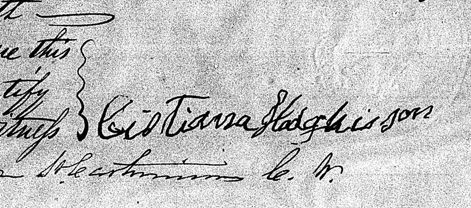
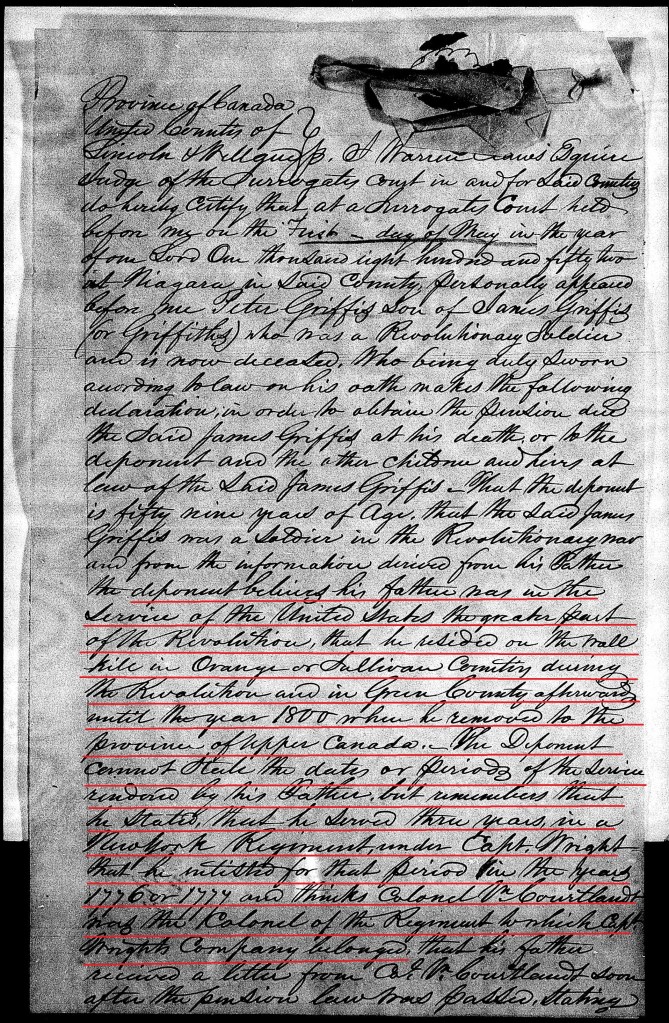
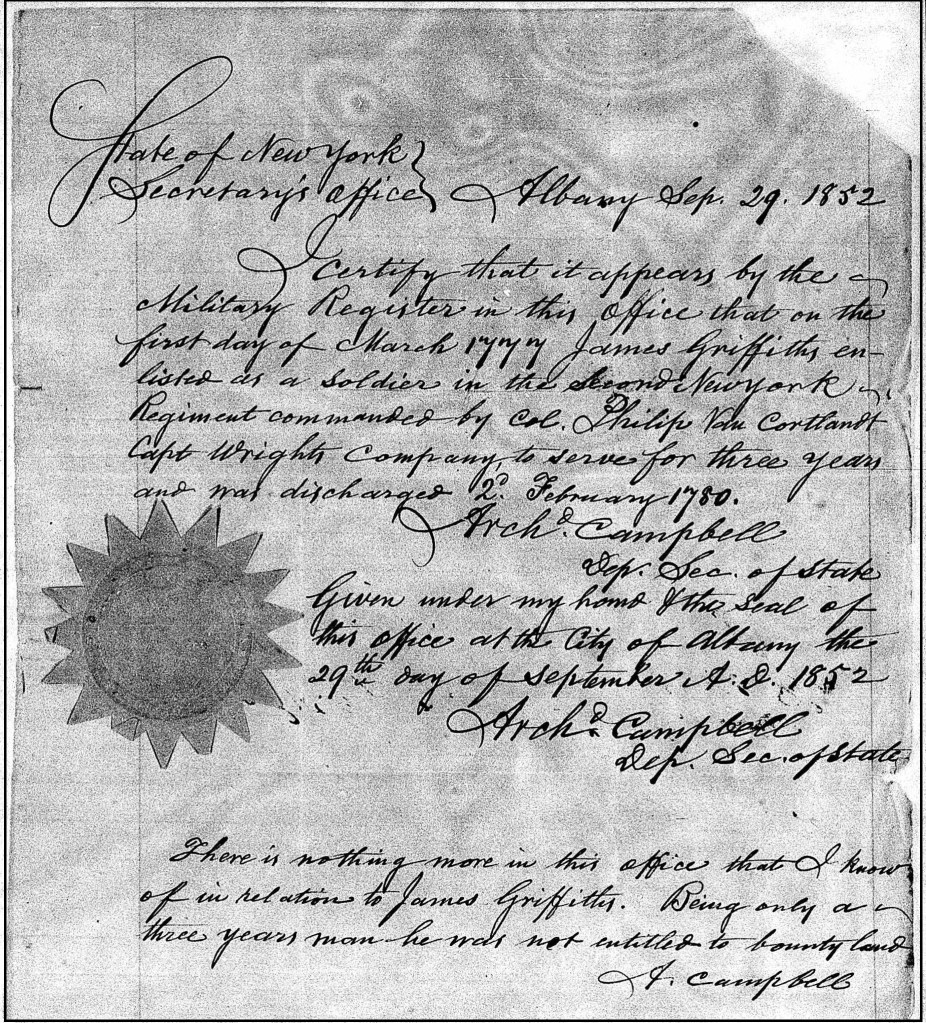
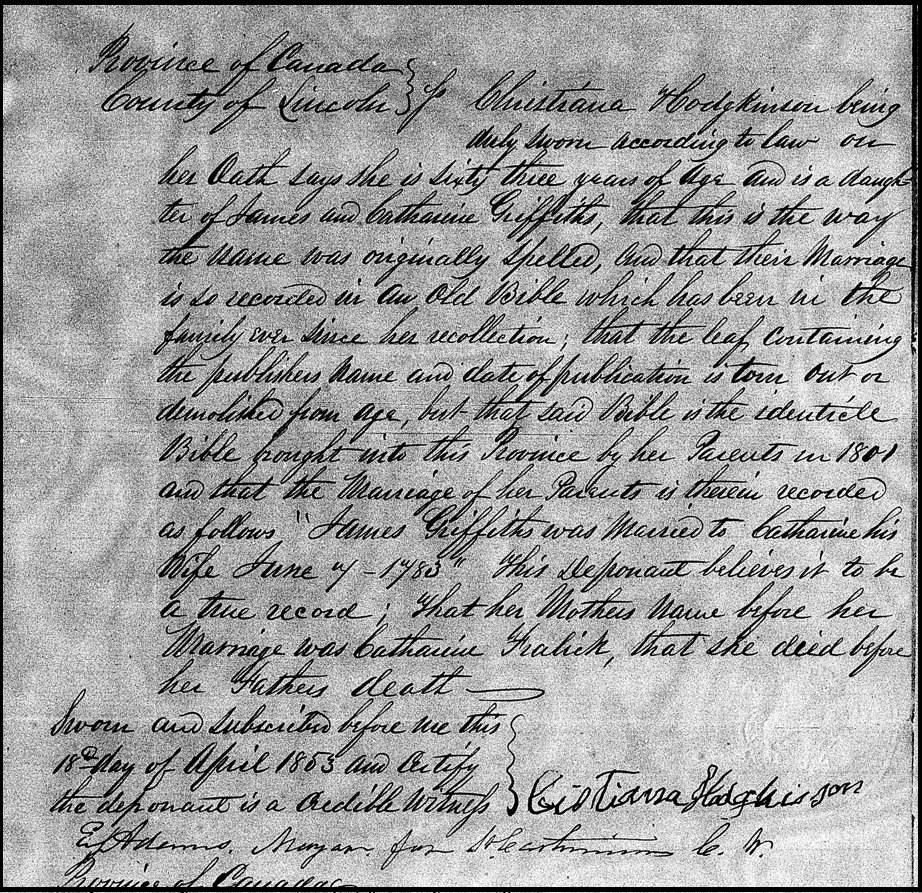
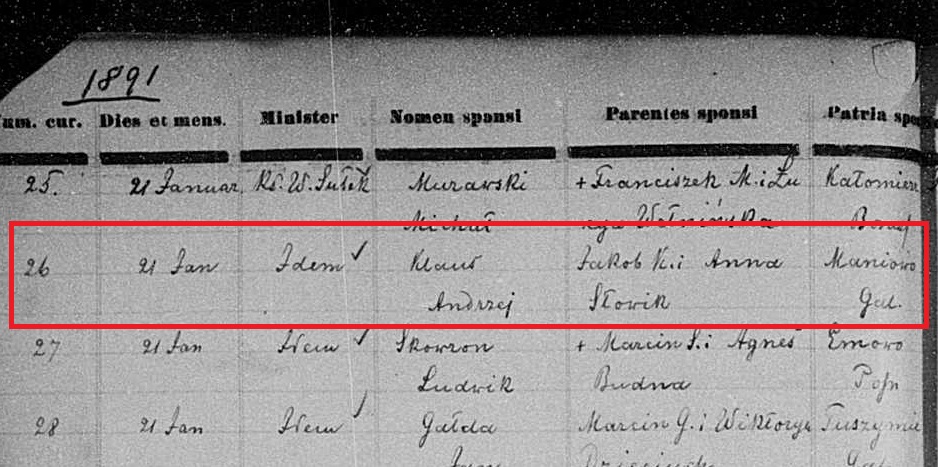

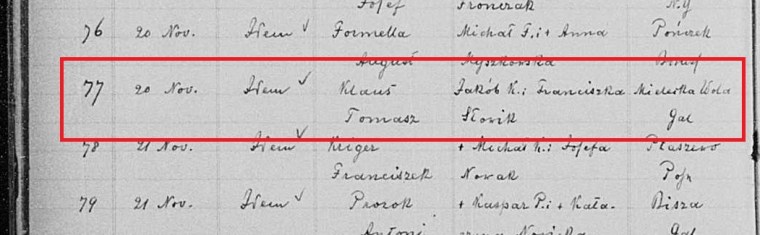

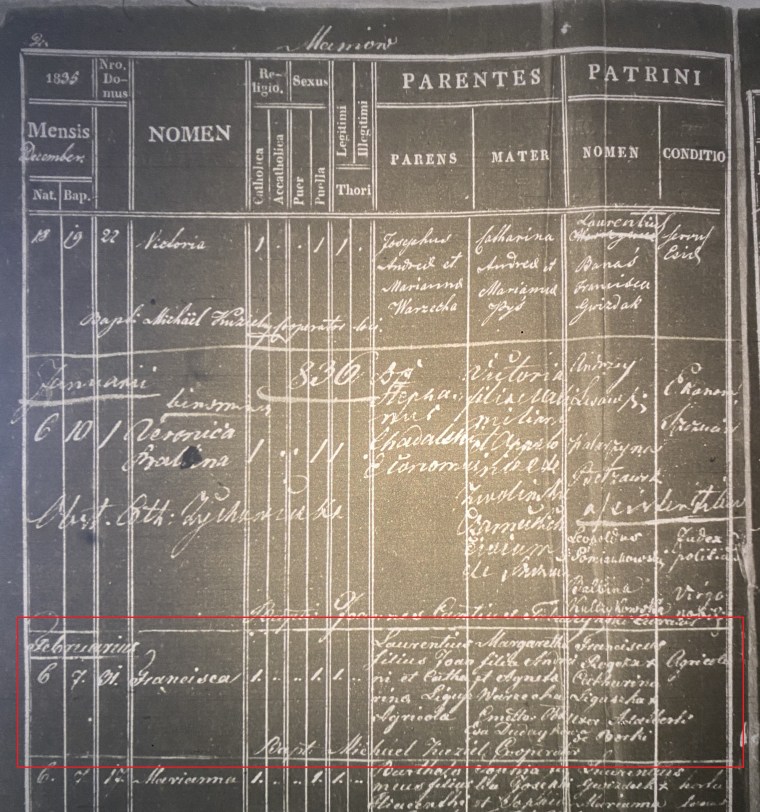
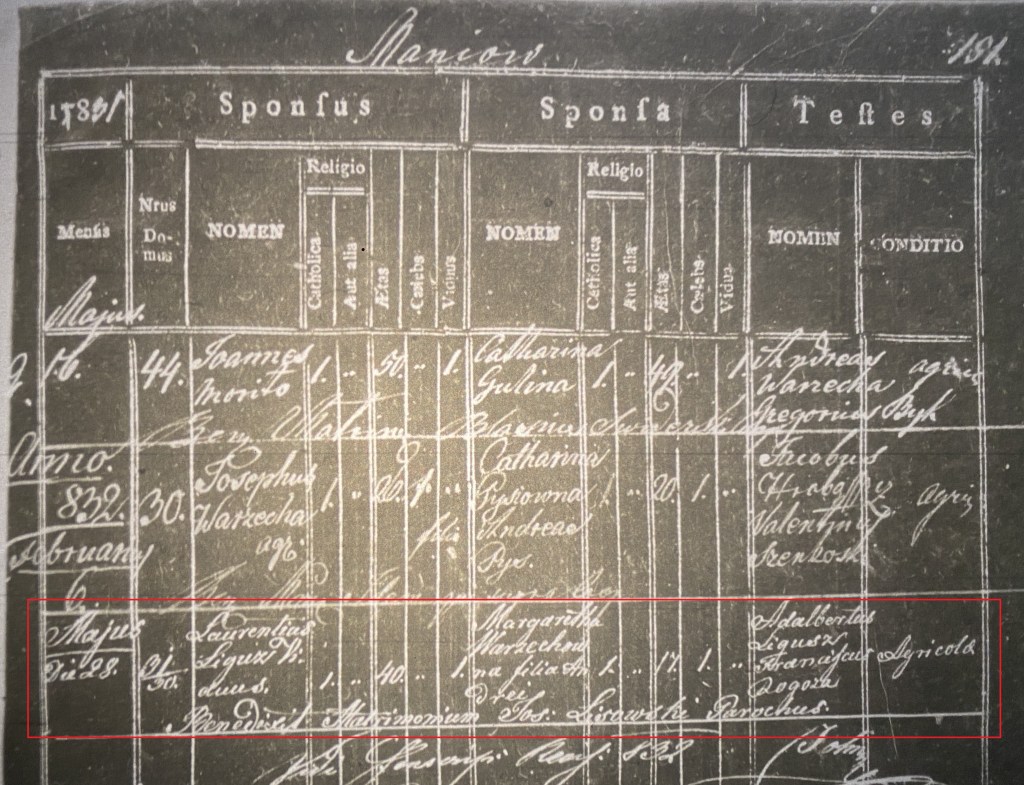
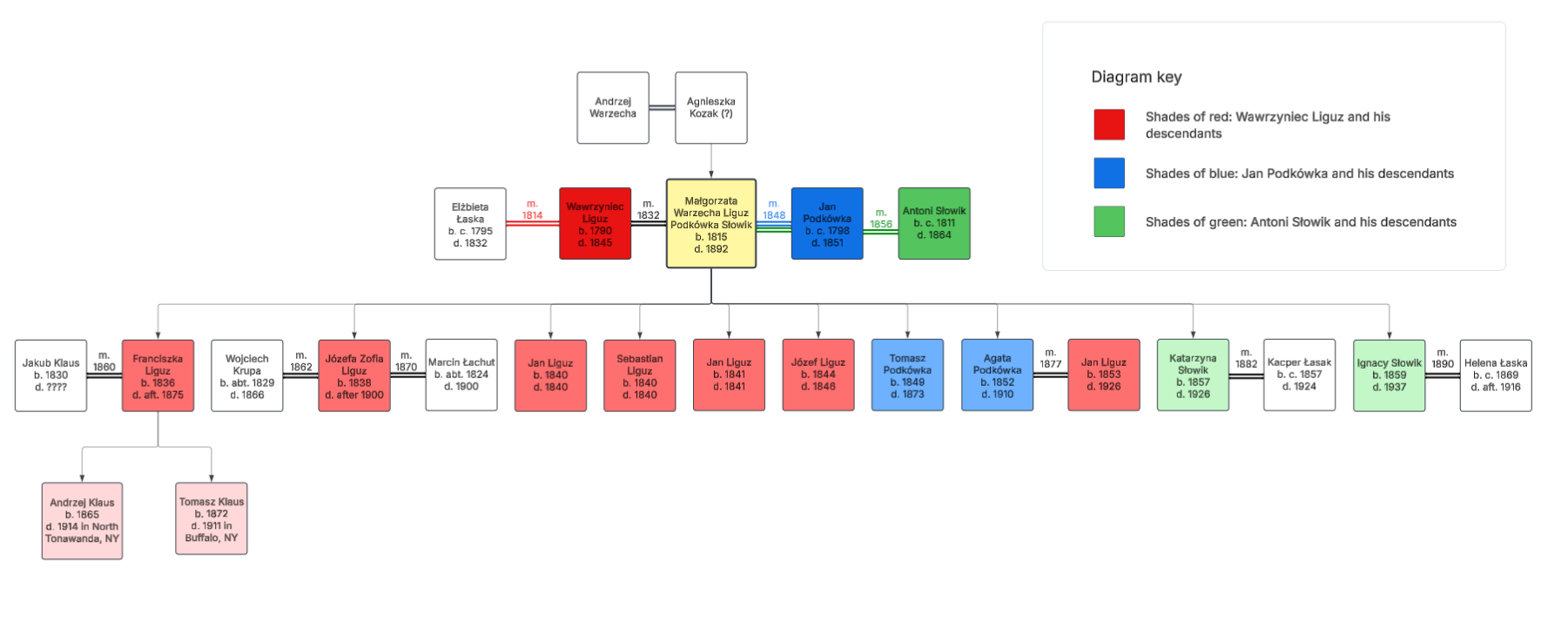

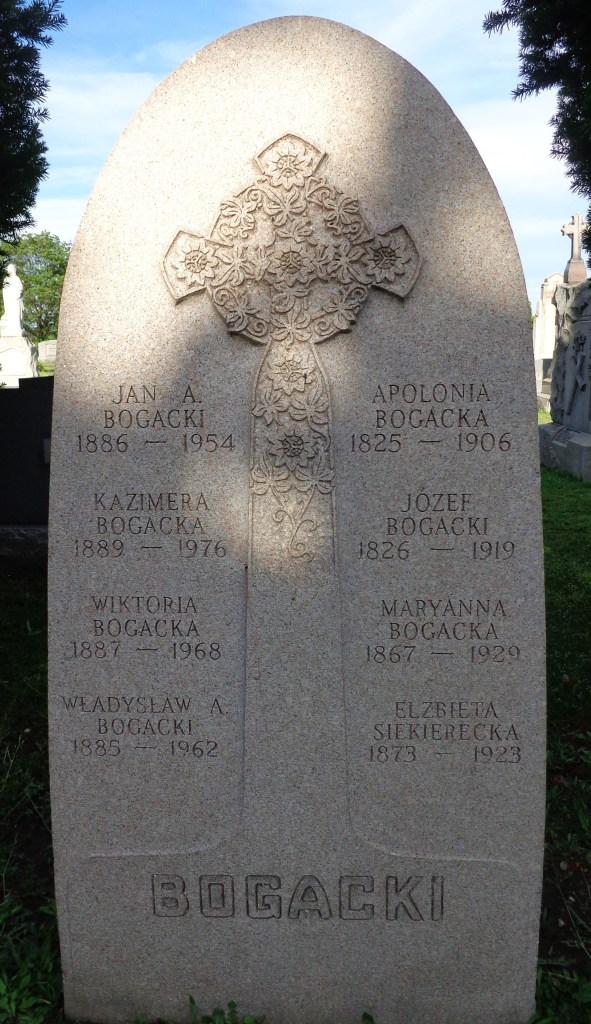
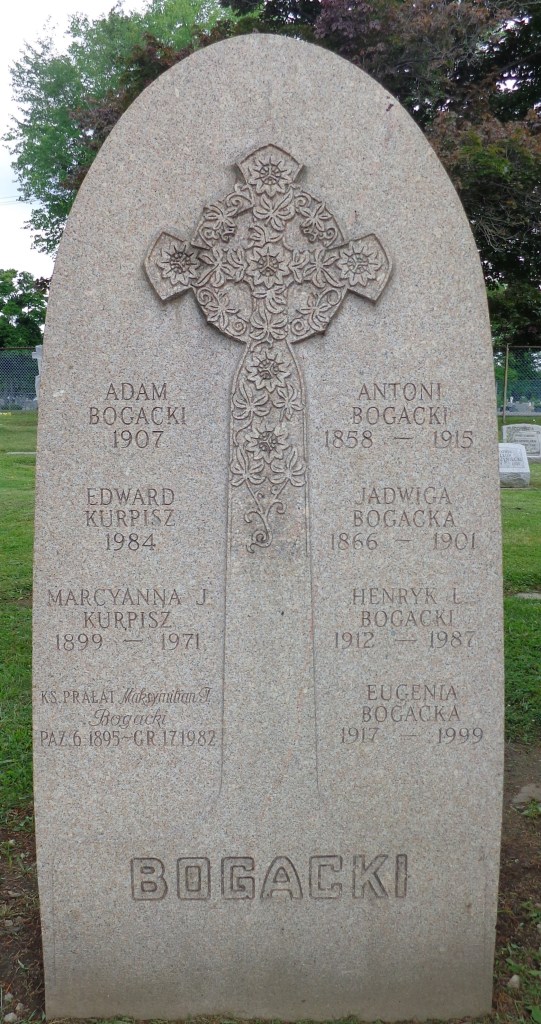


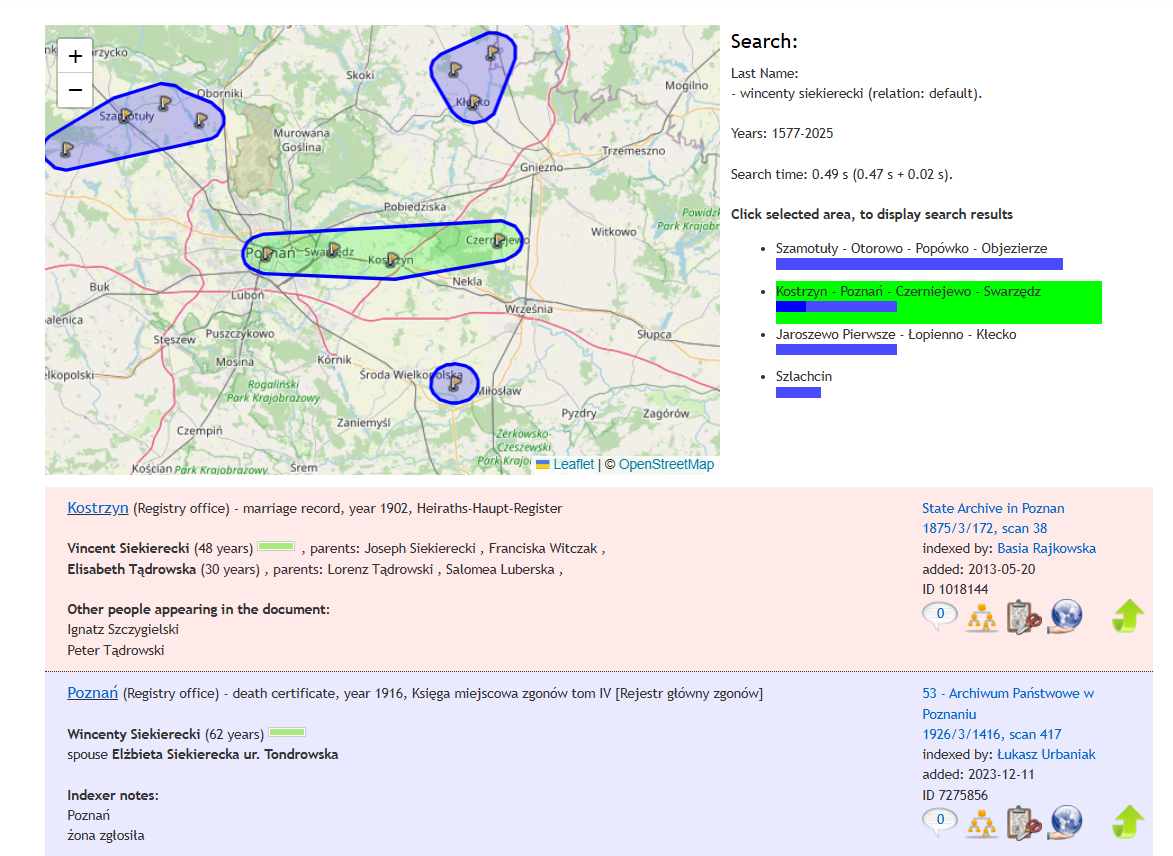



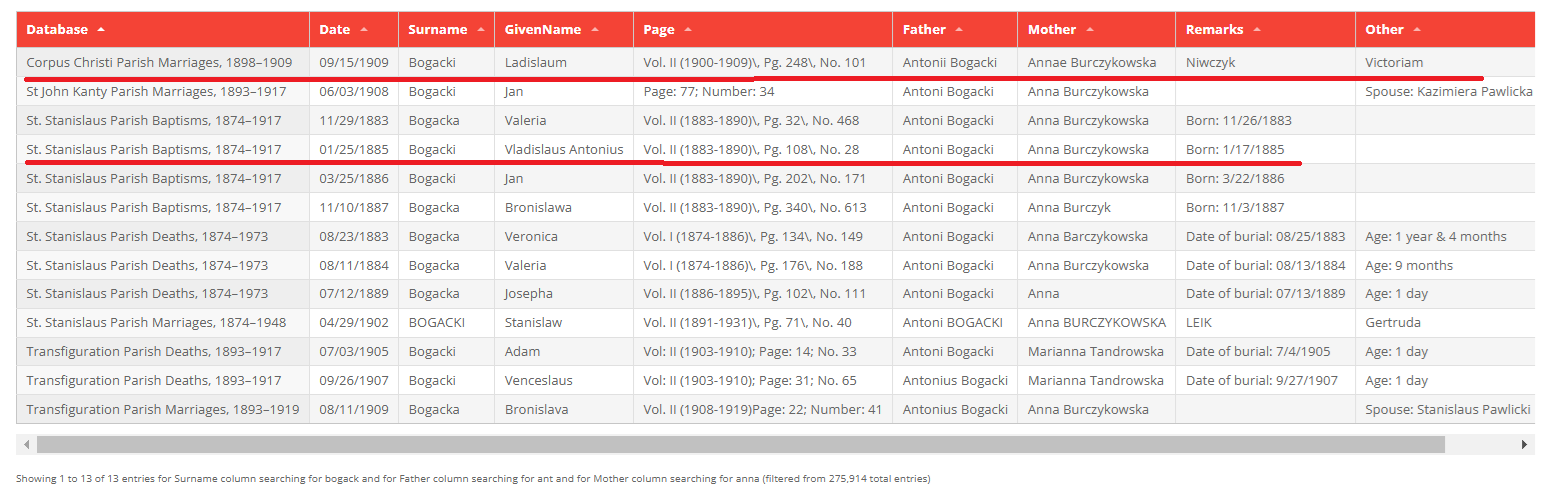
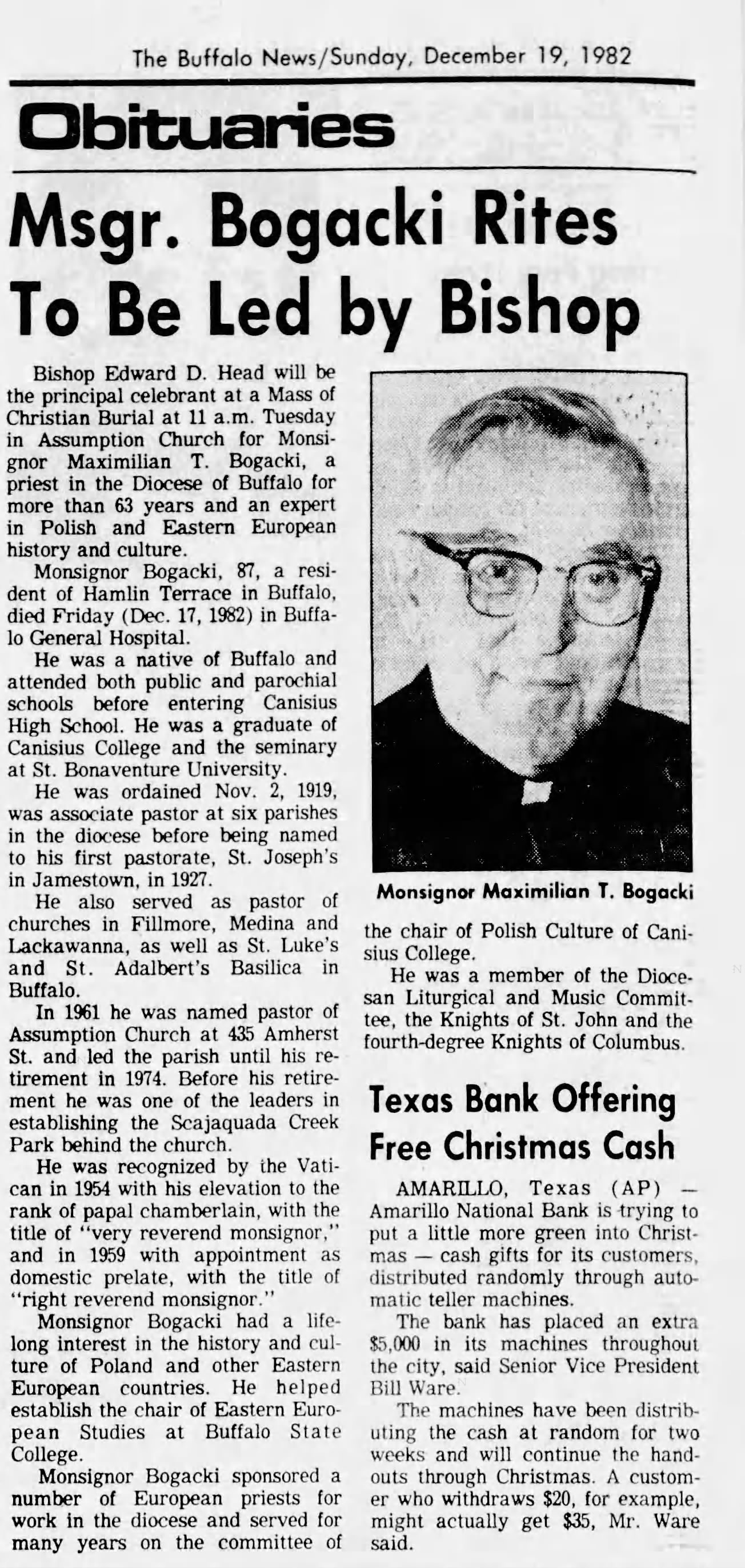

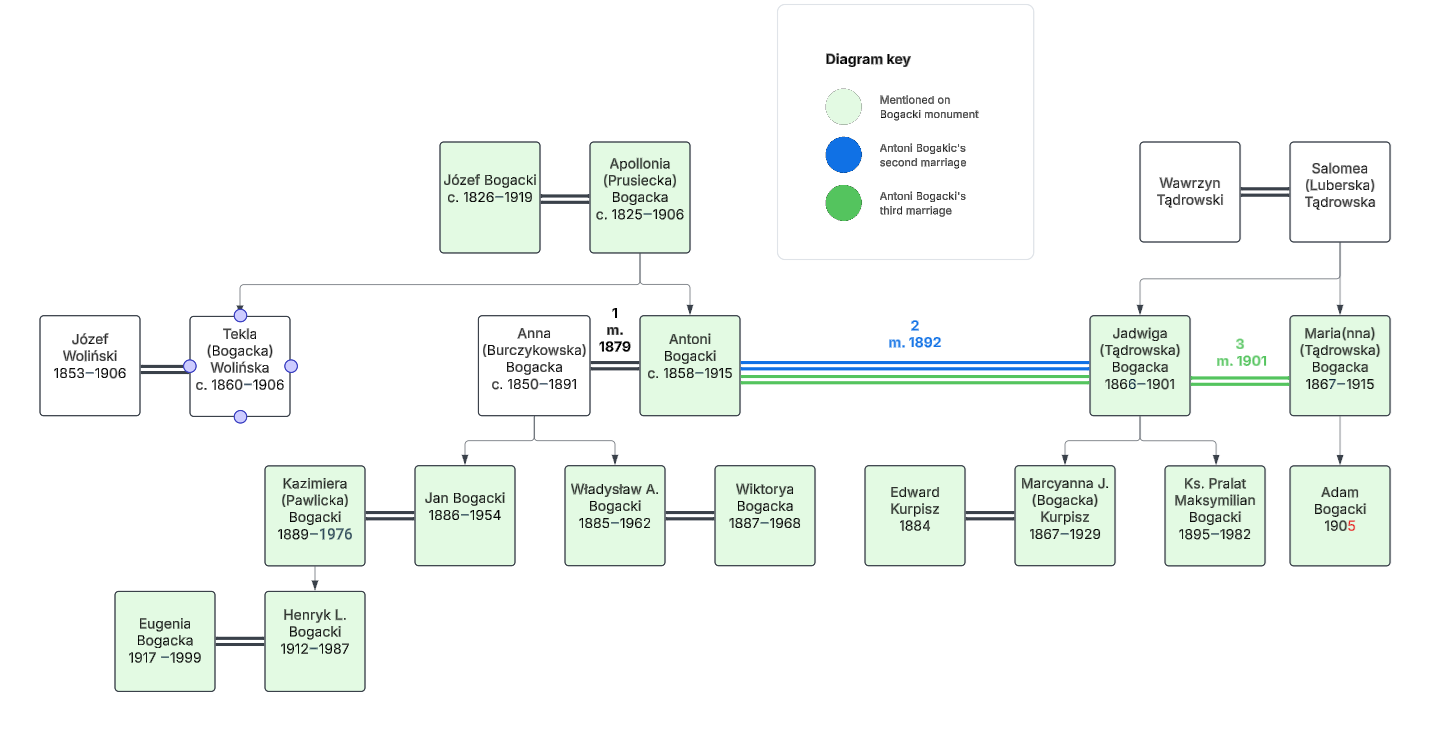


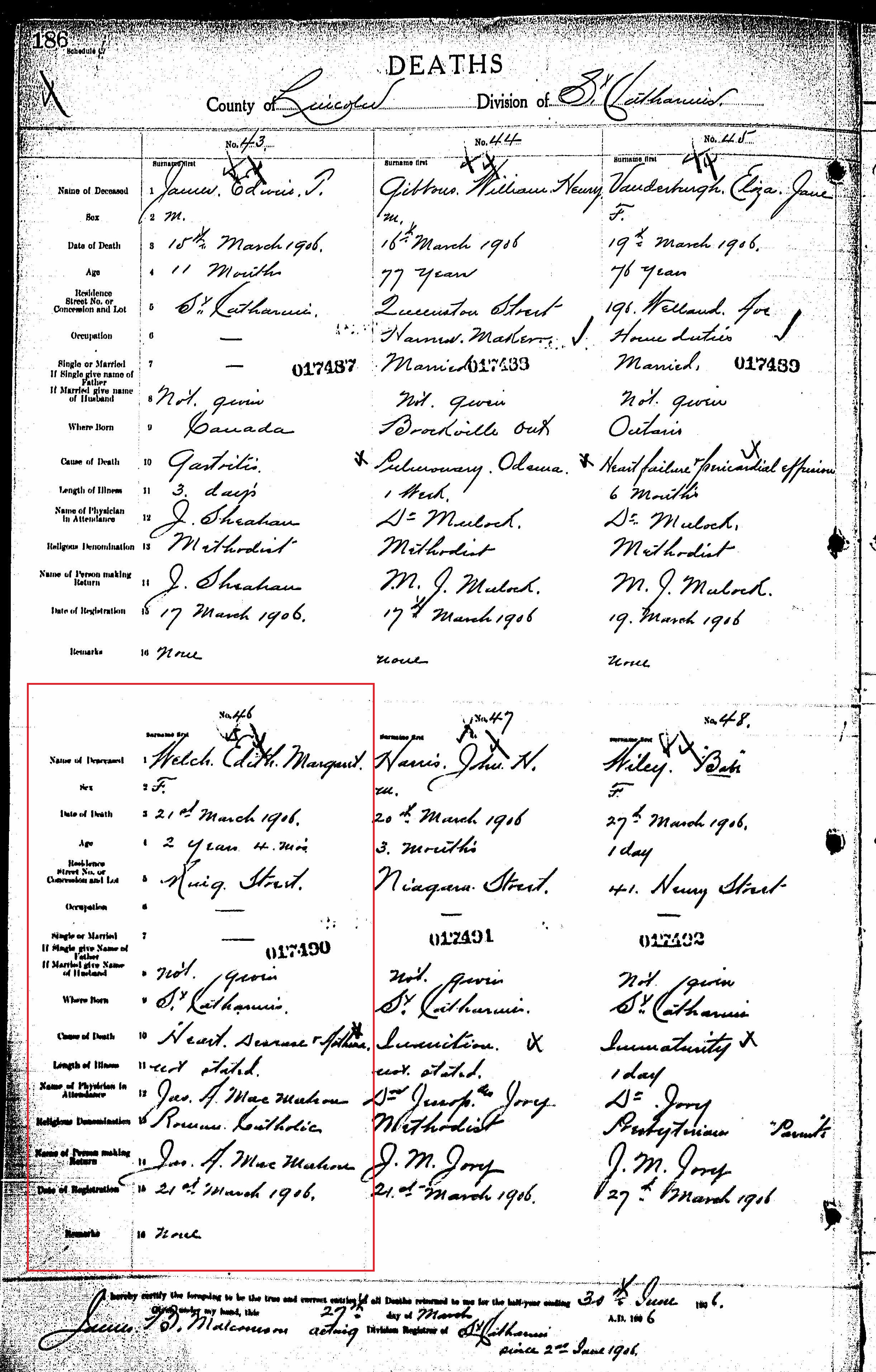

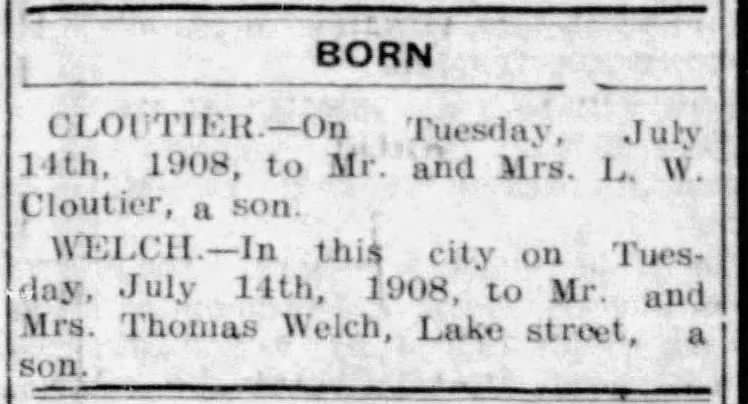
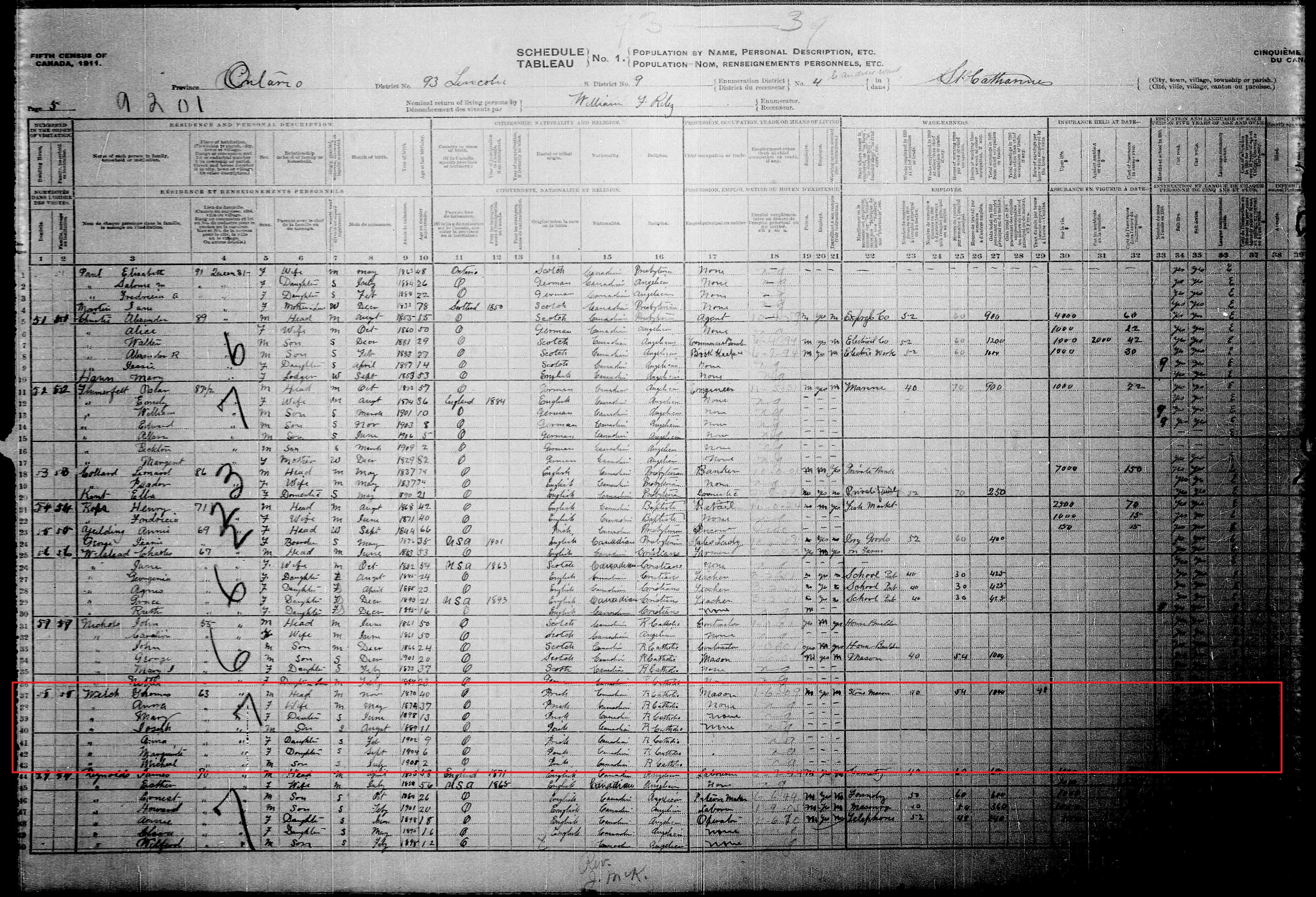
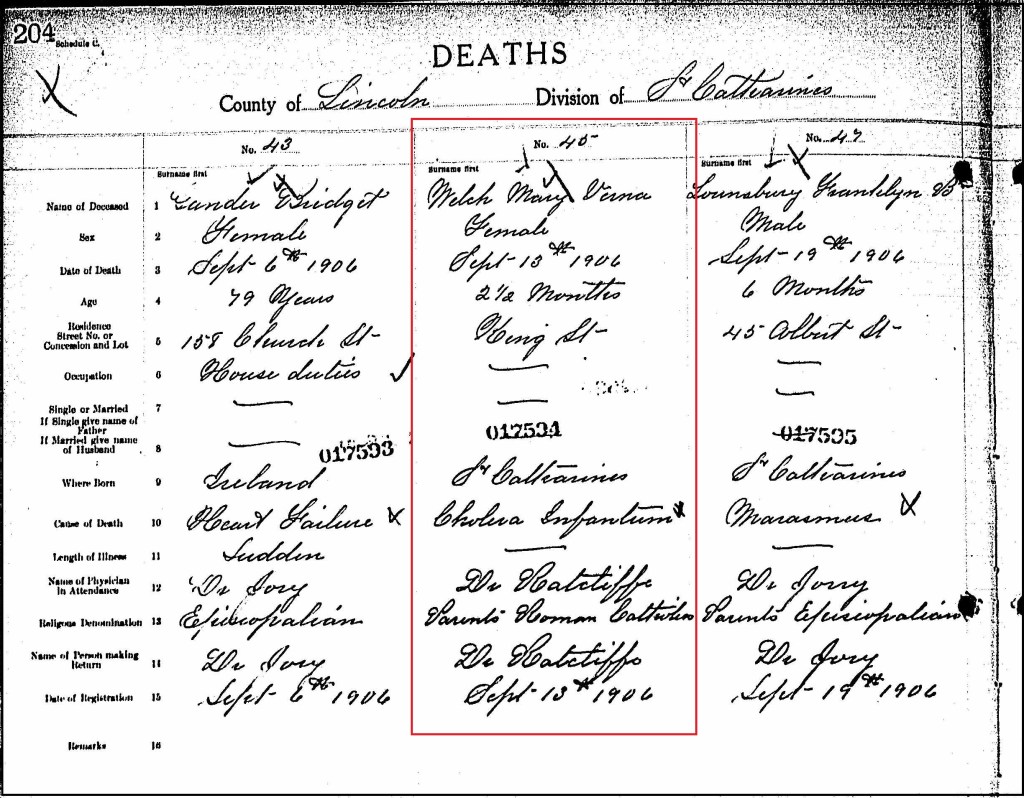

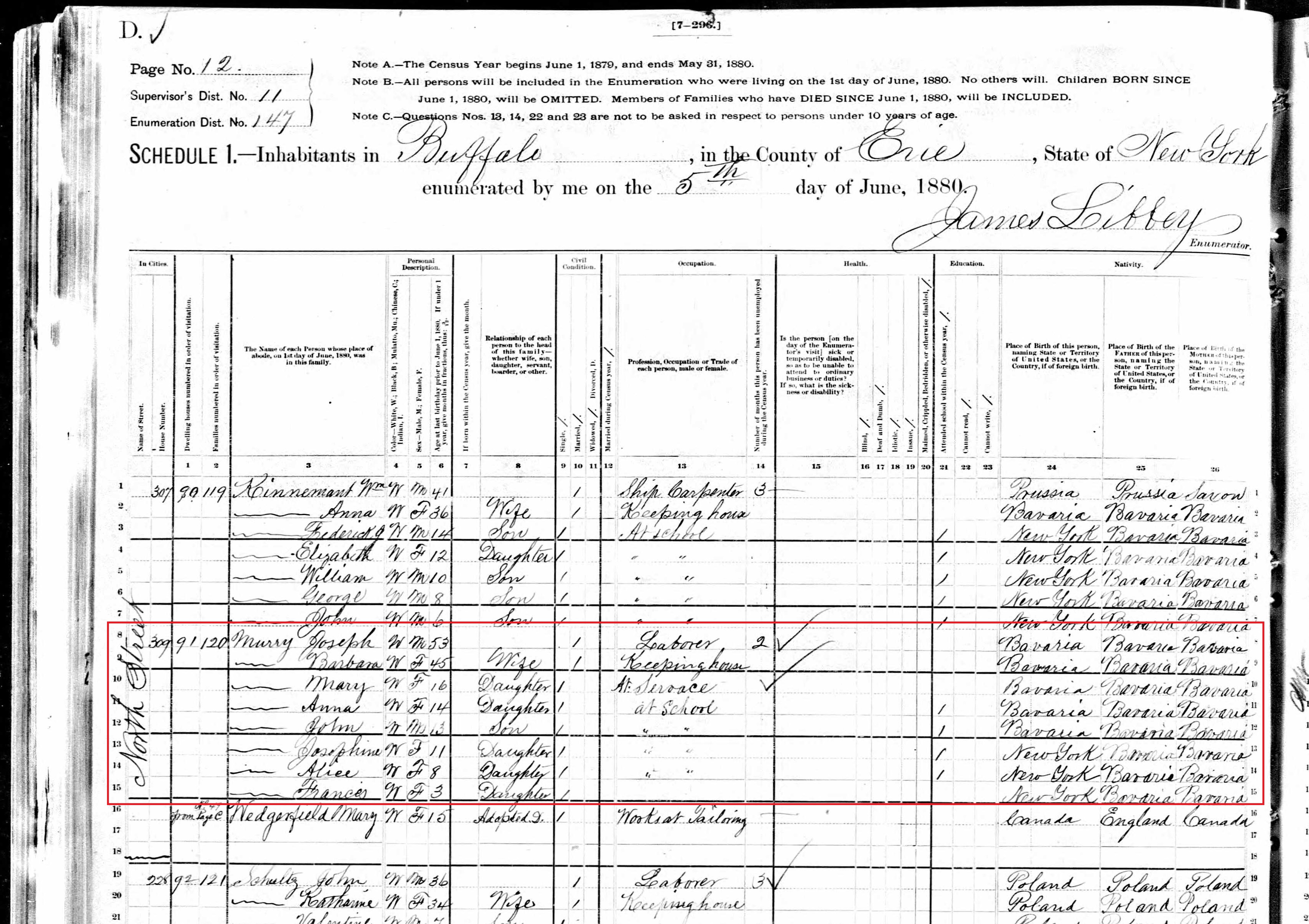
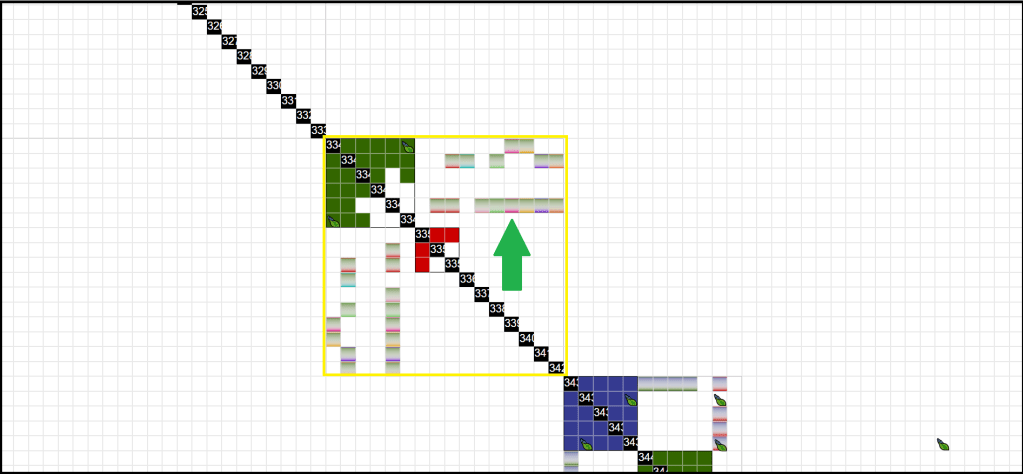

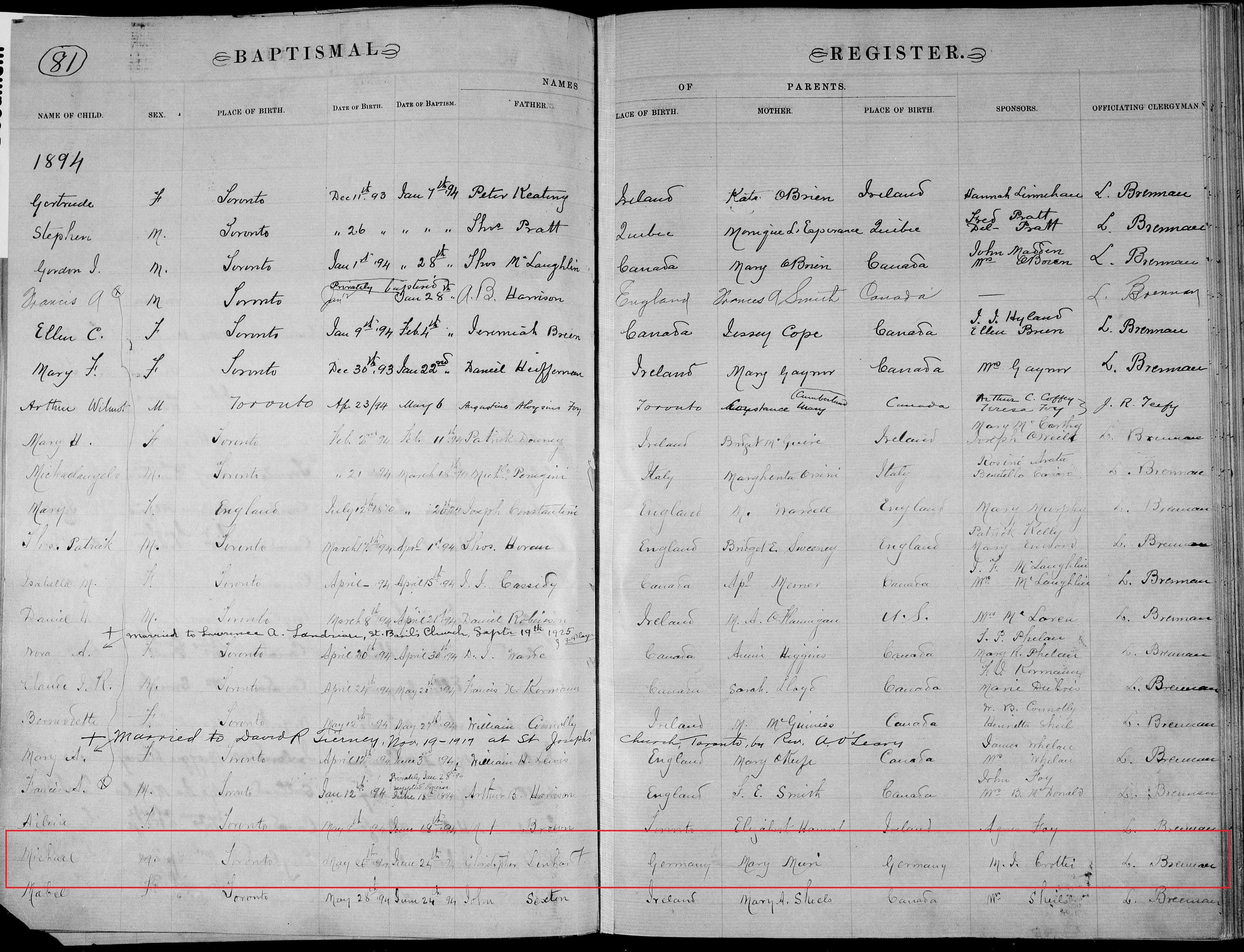




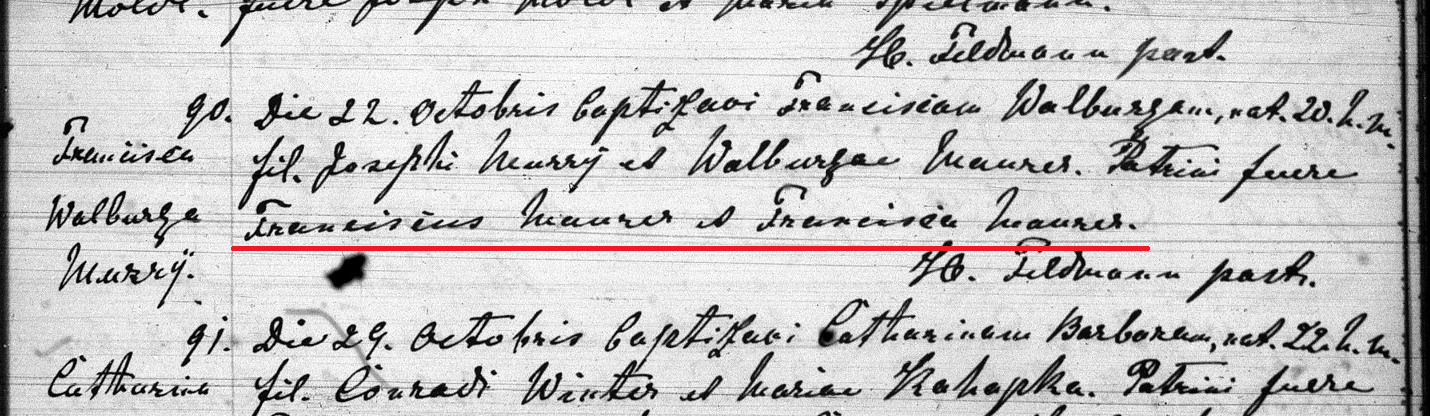
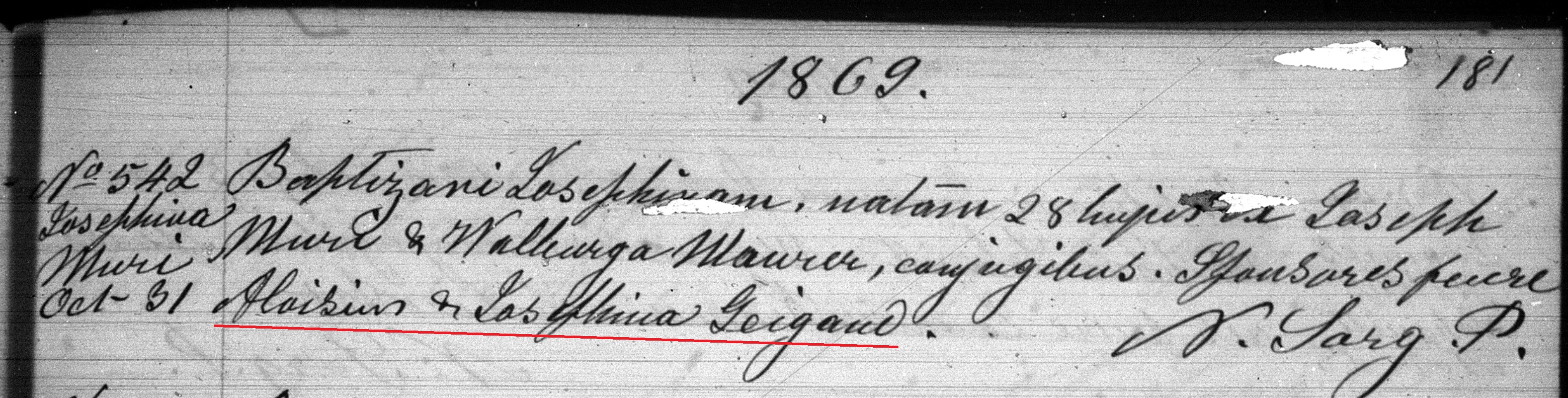

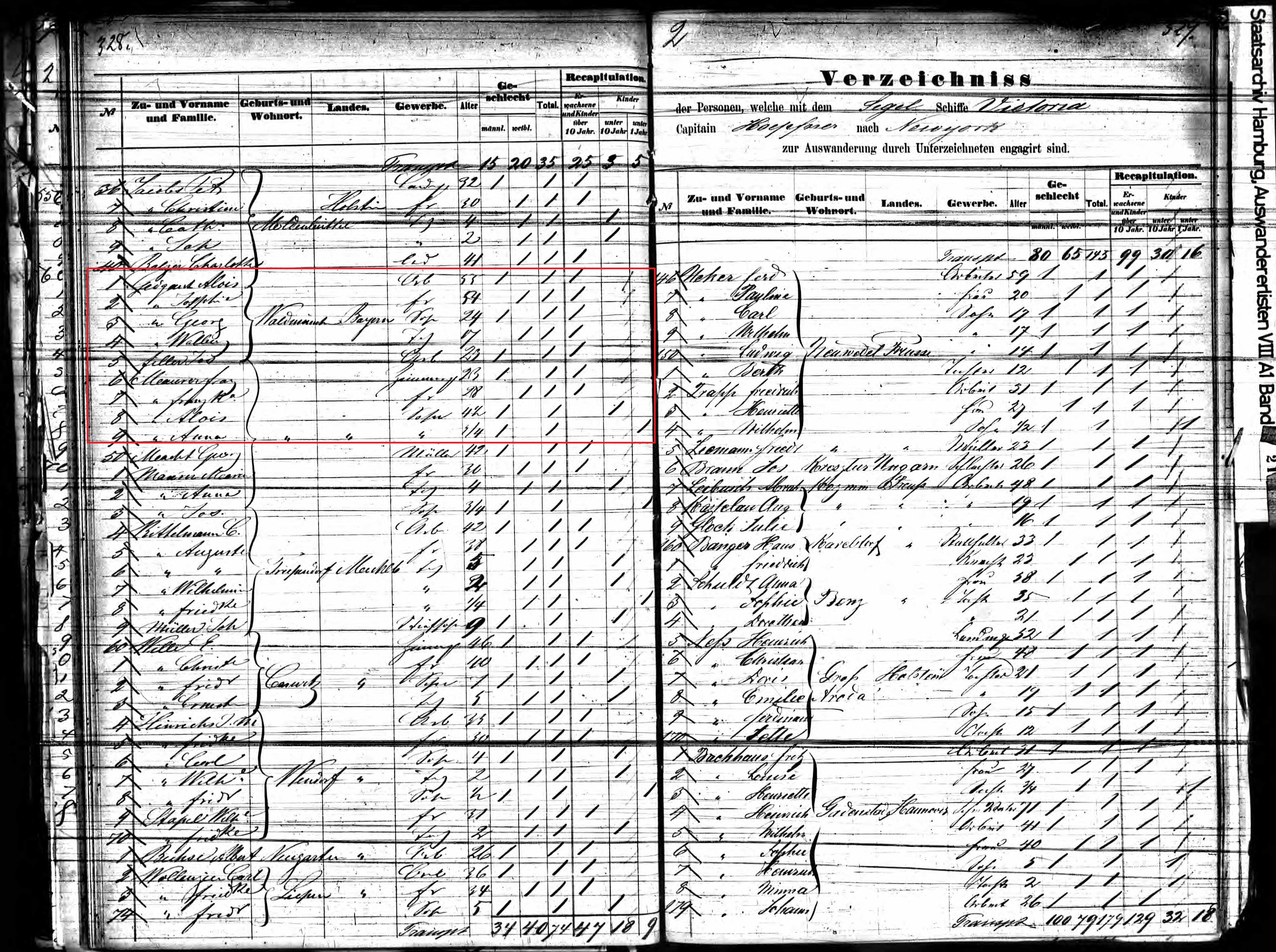







 From Shepherds and Shoemakers