Magdalena Gębczyńska’s Story

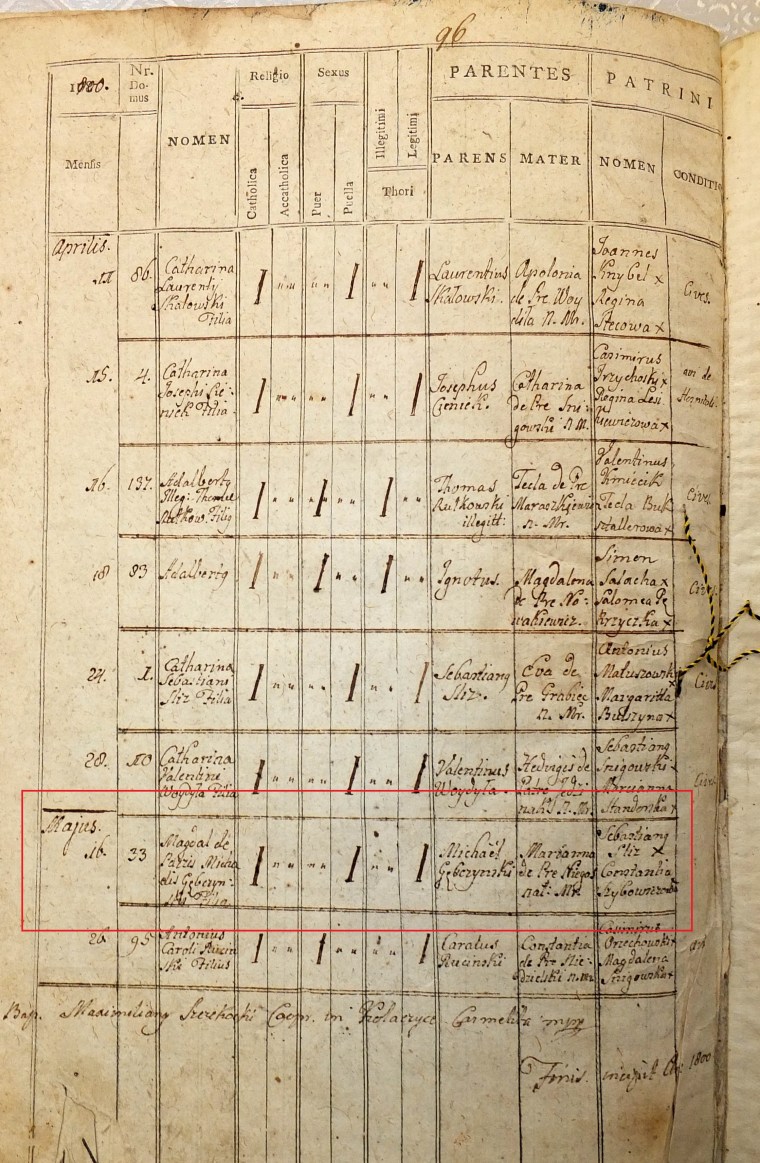
Have you ever discovered an ancestor whose story seem especially compelling to you? For me, it’s my great-great-great-great-grandmother, Magdalena Gębczyńska. To describe the relationship another way, Magdalena was the great-great-grandmother of my maternal grandfather, John Zielinski. She was baptized in the village of Kołaczyce on 16 May 1800, probably within a few days of her birth, in keeping with Catholic customs of the time (Figure 1).1

Figure 1: Baptismal record from St. Anne’s parish in Kołaczyce for Magdalena Gębczyńska. Translation: 16 May 1800, house number 33, Magdal., daughter of father Michał Gębczyński, Catholic, female, legitimate. Father: Michał Gębczyński, Mother: Marianna née Niegos. Godparents: Sebastian Sliz, Konstancja Trzybowiczowa (?), townspeople. s

Although evidence suggests that Magdalena’s family were ethnic Poles, and the village of Kołaczyce lies within the Podkarpackie province of Poland today, an independent Poland did not exist at the time of her birth. The vast Polish-Lithuanian Commonwealth which existed for centuries was erased from the map in a series of three partitions in 1772, 1793 and 1795. Land that belonged to Poland historically was divided up among Austria, Russia and Prussia until Poland was no more. The village of Kołaczyce was absorbed into the Austrian crownlands after the first partition, which took place when Magdalena’s parents were still children. Five years after the final partition, Magdalena Gębczyńska was born. She was the sixth child and only daughter of Michał Gębczyński and Marianna Niegos or Niegosz.2 At the age of 15, she was married for the first time to Józef Sopalski, who worked as a potter, and together they had two daughters, Katarzyna Barbara and Teodosia Petronella.3 When Magdalena was 3 months pregnant with Teodosia, her husband died on 22 November 1818 of “haectica” (Figure 2).4

Figure 2: Death record from St. Anne’s parish in Kołaczyce for Josephus Sopalski. Translation: 22 November 1818, house number 23, Józef Sopalski, potter, Catholic, male, age 24. Cause of death: “haectica.” The word under “haectica” is “provisus,” which literally means “provided for.” The implication is that Józef  received the three sacraments of the Anointing of the Sick, Confession, and Communion–collectively known as Last Rites–prior to his death.

Józef Sopalski death 1818 marked

“Haectica” is the Latin word for “hectic fever,” an archaic medical term for a fever that goes up at night and down during the day, which could result from causes as various as tuberculosis or septicemia. On 10 February 1819, Magdalena married Dominik Bulgewicz, three months before the birth of Teodosia on 26 May 1819.Magdalena and Dominik had five children together: Melchior Gaspar (born 1 January 1821), Magdalena (born 14 May 1823), Anna Marianna (born 30 May 1825), Marcianna Agnieszka (born 28 December 1826), and Zofia (born 8 April 1829).Three of these babies, Magdalena, Marcianna and Zofia, died before the age of five, and then Magdalena was widowed a second time, when Dominik died between 1829 and 1834.At the age of 34, and as a mother of four living children, ages 17, 14, 13 and 9, Magdalena was married a third time (Figure 3).8

Figure 3: Marriage record from St. Anne’s parish in Kołaczyce for Magdalena Bulgewicz and Franciszek Łącki. Translation: 3 August 1834, from house numbers 33 (Magdalena) and 84 (Franciszek). Groom: Franciszek Łącki, potter, Catholic, age 46, widower. Bride: Magdalena Bulgewiczowa, widow after the death of Dominik, Catholic, age 35. (The “-owa” suffix on Magdalena’s surname is a Polish grammatical ending which indicates a married woman for that particular family.) Witnesses: Konstanty Niedzielski and Piotr Lechowski, townsmen.8Franciscus Lacki marriage2 marked

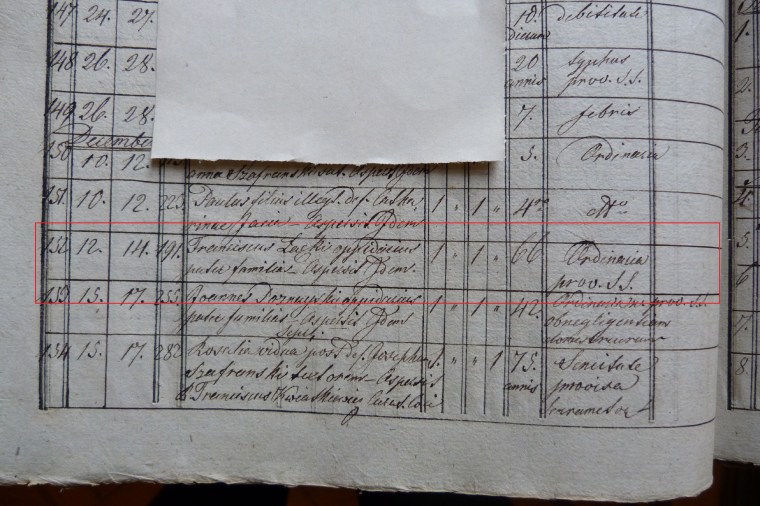
Her husband was Franciszek Łącki, a 46-year-old widower and father of five children with his first wife, Tekla Stadnik or Stachnik.9 Like Magdalena and most of our ancestors in that time period, Franciszek was no stranger to deep personal loss, since only two of his children were living at the time of his marriage to Magdalena.10 With Franciszek, Magdalena had five more children: twins, Jakub and Anna (born 24 July 1835), Józef (born 7 February 1838), Katarzyna (born 16 April 1841), and Wojciech (born 22 April 1843).11 Anna and Jakub survived to adulthood and married siblings, Franciszek Ptaszkiewicz and Anna Ptaszkiewicz.12 However, the twins were Magdalena’s only children from this marriage who survived to adulthood. Her youngest three children with Franciszek Łącki all died in infancy.13 On 12 December 1847, Magdalena was widowed a third time when Franciszek died of “ordinary causes” at the age of 66 (Figure 4).14

Figure 4: Death record from St. Anne’s parish in Kołaczyce for Franciszek Łącki. Translation: “#152. Date of death: 12 December 1847. Date of burial: 14 December 1847. House number: 191. Deceased: Franciszek Łącki, townsman, father of a family, “Aspersit idem.” This phrase is literally, “sprinkled by the same,” and simply means that the priest who presided over Franciszek’s funeral was the same priest mentioned in the other records on the page. (During a Roman Catholic funeral, the casket is sprinkled with holy water as a remembrance of the baptism of the deceased.) The slashes in the columns following the information on the deceased indicate the Franciszek was a Catholic male, age 66 when he died, and his cause of death was noted to be “ordinary.” The notation below that, “prov. SS.” indicates that Franciszek received the Sacraments prior to his death.Franciszek Lacki death 1847 image 1 marked

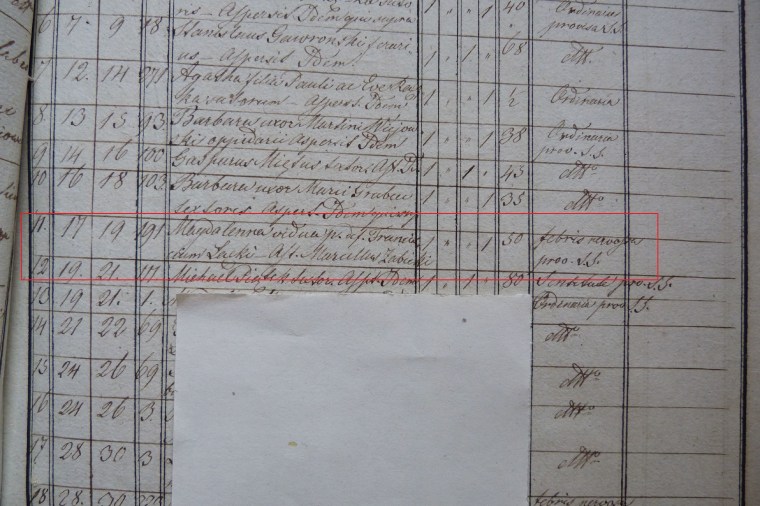
Magdalena Łącka herself passed away a year later, on 17 January 1848, a few months shy of her 48th birthday (Figure 5).15 

Figure 5: Death record from St. Anne’s parish in Kołaczyce for Magdalena Łącka. Translation: “#11. Date of death: 17 January 1848. Date of burial:  19 January 1848. House number: 191. Deceased: Magdalenna [sic], widow of the late Franciszek Łącki, sprinkled (another reference to the Catholic burial rite) by Marcelli Zabicki. Catholic, female, age 50. Cause of death: febris nervosa. Magdalena received the Sacraments prior to her death.15Magdalena Gebczynska death 1848 image 1 marked

Her cause of death was noted to be “februs nervosa,” or “nervous fever,” which may have been typhus. Poor Magdalena died so young, and yet she outlived three husbands, bore 12 children, and outlived half of them. She is almost certainly buried in the parish cemetery in Kołaczyce, along with all of her husbands and all (?) her children, except for her son, Jakub Łącki– my great-great-great-grandfather — who emigrated to the U.S. in 1884.16 May she rest in peace.

Sources:

Roman Catholic Church, St. Anne’s parish (Kołaczyce, Jasło, Podkarpackie, Poland), “Urodzenia, 1784-2015,” 1800, baptismal record for Magdal Gębczyńska, 16 May 1800.

2 Ibid., 1786, baptismal record for Josephus Gębczyński, 7 March 1786; and

Ibid., 1789, baptismal record for Josephus Gębczyński, 15 March 1789; and

Ibid., 1791, baptismal record for Augustinus Joannes Gębczyński, 26 August 1791; and

Lucjan Gabriel Cichocki, “Kołaczyce Births,” baptismal record for Benedictus Gębczyński, baptized 16 March 1794, transcribed from the parish records of St. Anne’s Roman Catholic Church, Kołaczyce, Jasło, Podkarpackie, Poland, report to Julie Szczepankiewicz, Hopkinton, Massachusetts, 6 May 2015; Excel spreadsheet held by Julie Szczepankiewicz, Hopkinton, Massachusetts; and

Roman Catholic Church, St. Anne’s parish (Kołaczyce, Jasło, Podkarpackie, Poland), “Urodzenia, 1784-2015,” 1797, baptismal record for Andreas Gębczyński, 26 November 1797; and

Ibid., 1803, baptismal record for Joannes Paulus Gębczyński, 20 June 1803.

Roman Catholic Church, St. Anne’s parish (Kołaczyce, Jasło, Podkarpackie, Poland), “Śluby, 1784-2015,” 1815, marriage record for Josephus Sopalski and Magdalena Gębczeńszczonka, 14 November 1815; and

Roman Catholic Church, St. Anne’s parish (Kołaczyce, Jasło, Podkarpackie, Poland), “Urodzenia, 1784-2015,” 1816, baptismal record for Catharina Barbara Sopalska, born 21 November 1816; and

Ibid., 1819, baptismal record for Theodosia Petronella Sopalska, born 26 May 1819.

Roman Catholic Church, St. Anne’s parish (Kołaczyce, Jasło, Małopolskie, Poland), “Księga zgonów, 1784 – 2015,” 1818, death record for Josephus Sopalski, 22 November 1818.

Roman Catholic Church, St. Anne’s parish (Kołaczyce, Jasło, Podkarpackie, Poland), “Sluby, 1784-2015,” 1819, marriage record for Dominicus Bulgewicz and Magdalena Sopalska, 10 February 1819.

Roman Catholic Church, St. Anne’s parish (Kołaczyce, Jasło, Podkarpackie, Poland), “Urodzenia, 1784-2015,” 1821, baptismal record for Melchior Gasparus Bulgewicz, 1 January 1821; and

Ibid., 1823, baptismal record for Magdalena Bulgewicz, born 14 May 1823; and

Ibid,. 1825, baptismal record for Anna Marianna Bulgewicz. born 30 May 1825; and

Maciej Orzechowski, “Kolaczyce Births,” baptismal record for Marcianna Agnes Bulgewicz, born 28 December 1826, transcribed from the collection, “Roman Catholic Church records, St. Anna’s Parish (Kołaczyce, Jasło, Małopolskie, Poland), “Urodzenia, 1826-1889″, Stary Kopie,” report to Julie Szczepankiewicz, Hopkinton, Massachusetts, on 9 January 2015; Excel spreadsheet held by Julie Szczepankiewicz, Hopkinton, Massachusetts; and

Ibid., baptismal record for Sophia Bulgewicz, born 8 April 1829.

7 Roman Catholic Church, St. Anna’s parish (Kołaczyce, Jasło, Podkarpackie, Poland), “Zgony, 1826-1889,” Stary Kopie, 1828, death record for Magdalena Bulgewicz, 26 June 1828; and

Ibid., death record for Marcianna Bulgewicz, died 17 July 1828; and

Ibid., death record for Sophia Bulgewicz, 29 September 1829.

Roman Catholic Church, St. Anna’s Parish (Kołaczyce, Jasło, Podkarpackie, Poland), “Śluby, 1826-1889,” Stare Kopie, 1834, marriage record for Franciscus Łącki and Magdalena Bulgewiczowa, 3 August 1834.

Roman Catholic Church, St. Anne’s parish (Kołaczyce, Jasło, Podkarpackie, Poland), “Urodzenia, 1784-2015,” 1818, baptismal record for Simon Łącki, born 26 October 1818; and

Ibid., 1821, baptismal record for Marianna Łącki, born 1 February 1821; and

Ibid., 1823, baptismal record for Clara Marianna Łącka, born 9 August 1823; and

Maciej Orzechowski, “Kolaczyce Births,” baptismal record for Valentinus Casimirus Łącki, born 8 February 1826, transcribed from the collection, “Roman Catholic Church records, St. Anna’s Parish (Kołaczyce, Jasło, Małopolskie, Poland), “Urodzenia, 1826-1889″, Stary Kopie,” report to Julie Szczepankiewicz, Hopkinton, Massachusetts on 9 January 2015, Excel spreadsheet held by Julie Szczepankiewicz, Hopkinton, Massachusetts; and

Ibid., baptismal record for Stanislaus Łącki, born 22 March 1829.

10 Roman Catholic Church, St. Anne’s parish (Kołaczyce, Jasło, Małopolskie, Poland), “Księga zgonów, 1784 – 2015,” 1820, death record for Simon Łącki, 6 January 1820; and

Ibid., 1826, death record for Valentinus Łącki, 23 June 1826; and

Ibid., 1829, death record for Stanislaus Łącki 24 June 1829.

11 Roman Catholic Church, St. Anna’s Parish (Kołaczyce, Jasło, Podkarpackie, Poland), “Urodzenia, 1826-1889,” Stare Kopie, 1835, baptismal record for Jacobus Łącki and Anna Łącka, born 24 July 1835; and

Maciej Orzechowski, “Kolaczyce Births,” baptismal record for Josephus Łącki, born 7 February 1838, transcribed from the collection, “Roman Catholic Church records, St. Anna’s Parish (Kołaczyce, Jasło, Małopolskie, Poland), “Urodzenia, 1826-1889,” Stary Kopie,” report to Julie Szczepankiewicz, Hopkinton, Massachusetts on 9 January 2015, Excel spreadsheet held by Julie Szczepankiewicz, Hopkinton, Massachusetts; and

Ibid., baptismal record for Catharina Łącka, born 16 April 1841; and

Ibid., baptismal record for Adalbertus Łącki, born 22 April 1843.

12 Roman Catholic Church, St. Anna’s Parish (Kołaczyce, Jasło, Podkarpackie, Poland), “Śluby, 1826-1889,” Stare Kopie, 1861, #11, marriage record for Jacobus Łącki and Anna Ptaszkiewicz, 26 November 1861; and

Maciej Orzechowski, “Kołaczyce Marriages,” marriage record for Franciscus Ptaszkiewicz and Anna Łącka, married 15 November 1852,  transcribed from the collection, “Roman Catholic Church records, St. Anna’s Parish (Kołaczyce, Jasło, Małopolskie, Poland), Śluby, 1826-1889,” Stare Kopie, report to Julie Szczepankiewicz, Hopkinton, Massachusetts on 9 January 2015, Excel spreadsheet held by Julie Szczepankiewicz, Hopkinton, Massachusetts.

13 Roman Catholic Church, St. Anna’s parish (Kołaczyce, Jasło, Podkarpackie, Poland), “Zgony, 1826-1889,” Stary Kopie, 1839, death record for Josephus Łącki, died 2 October 1839; and

Ibid., 1842, #20, death record for Catharina Łącka, died 9 March 1842; and

Ibid., 1843, #28, death record for Adalbertus Łącki, died 1 June 1843.

14 Ibid., 1847, #152, death record for Franciscus Łącki, died 12 December 1847.

15 Ibid., 1848, #11, death record for Magdalena Łącka, died 17 January 1848.

16 New York, Passenger Lists, 1820-1957, record for Jacob Lacki, arrived aboard S.S. Moravia on 6 May 1884, microfilm serial: M237, 1820-1897; microfilm roll: roll 475; line: 46; list number: 506, accessed via https://ancestry.com (Provo, UT, USA, Ancestry.com Operations, Inc., 2010), 27 May 2018.

© Julie Roberts Szczepankiewicz 2018

The Many Wives of Józef Grzesiak

Veritatem Temporis filiam esse dixit.” (Truth is the daughter of time.) — Aulus Gellius

Conflicts in documentary evidence happen all the time. The logical resolution of such conflicts is one of the hallmarks of sound genealogical research that separates the professionals and experienced family history researchers from the novices. A perfect illustration of this is the story of my great-great-grandfather, Józef Grzesiak, and his many (?) wives.

Growing up, I used to ask my maternal grandmother to tell me about her mother’s family in Poland, and my desire to document those stories inspired my early family history efforts. Grandma’s mother was Veronica (née Grzesiak) Zazycki, but Grandma never knew the names of her grandparents, because “people didn’t talk about those things back then,” as she told me time and again. Nevertheless, Grandma knew a few details, such as the fact that her mother’s parents owned the grain mill that I wrote about previously. She told the story of how “Veronica’s mother died when Josephine was born, so at age 18, Veronica came to America. She found employment working in the kitchen of a restaurant.  She spoke no English, so her employers called her Mary and they communicated through signs and gestures.  She saved her money and sent it to her two brothers, Władysław (“Walter”) and Tadeusz, (Thaddeus), and her sister Józefa (Josephine), so they could come to America.”1 Grandma also told the story, shared previously, of how Walter married an actress in Poland who didn’t want to leave her career, which ultimately ended their marriage.

When I started my research, I didn’t know whether or not I’d ever be able to document some of these details, but I figured that it should be easy to answer the question, “Who were Veronica Grzesiak’s parents?” And in fact, it was pretty easy. On her marriage record to John Zazycki in 1901, Veronica reported her parents’ names as Joseph Grzesiak and Marianna Krawczynska (Figure 1).2

Figure 1: Marriage record for John Zazycki and Veronica Grzesiak, 5 August 1901.2Jan & Weronika Zazyki Marriage 1 marked

This document also told me which partition of Poland Grandma’s parents were from (Russian), and Veronica’s age reported here, 22, allowed me to estimate that she was born circa 1879. So far, so good.  However, when Veronica’s brother Thaddeus was married to Mary Gorski, he reported his parents’ names as Joseph Grzesiak and Mary Cebulska (Figure 2).3

Figure 2: Extract from marriage record for Thaddeus Grzesiak and Mayme (Mary) Gorski, 20 April 1910.3

Tadeusz Gresiak & Marya Gorska marriage record 1 marked

Now this was interesting, and it seemed like just the kind of detail that those family stories were likely to gloss over, since “people never talked about these things back then.” Okay, I concluded, no big deal, apparently Veronica and Thaddeus were half-siblings, sharing a father, but different mothers.

However, their sister Josephine named yet a different mother on her marriage record. When she married Joseph Cymerman in 1902, she stated that her parents were Joseph Grzesiak and Anna Nowacka (Figure 3).4

Figure 3: Extract from marriage record for Joseph Cymerman and Josepha Grzesiak, 5 August 1902.4

Jozefa Grzesiak & Jozef Cymermann marriage record 1 marked

Well, okay, maybe Joseph Grzesiak was very unlucky and lost two of his wives, so he married for a third time. It happened. But then there is yet another wife’s name reported on the death record for the oldest Grzesiak sibling, Walter (Figure 4).5

Figure 4: Extract from death record for Walter Grzesiak.5

Walter_Grzesiak_-_death

On this document, Walter was reported to be the son of Joseph Grzesiak and Maryanna Szafron. Now, most genealogists consider death records to be less accurate sources for information about an individual than some other types of records (e.g. marriage records) since the informant is probably grieving, possibly in shock, and may not be well-informed about the early life of the decedent, including parents’ names.  However, in this case, the informant was none other than Thaddeus (signing himself here as Theodore) Grzesiak — Walter’s brother.

So what do we make of this?  We have four siblings, all children of Joseph Grzesiak, but four different mother’s names reported on four different documents by three of the siblings.  Were they all half-siblings, each with the same father but a different mother?  I ran this theory past Grandma while she was still alive, and she didn’t buy it.  She had never heard of Walter, Thaddeus and Josephine being half-siblings to her mother, but she had no explanation for the discrepancies on the documents.  The maiden names reported for the mothers — Marianna Krawczyńska, Marianna Szafron, Marya Cebulska, and Anna Nowacka — weren’t even phonetically similar, apart from the fact that the siblings more or less agreed on a first name of Marianna. And was it grief that caused Thaddeus to change his story, reporting on his own marriage record that his mother was Maria Cebulska but then deciding 36 years later that her name was Marianna Szafron? Was it possible that the Grzesiak siblings did not even know their own mother’s name?  Perhaps there was an explanation:  Grandma said that Veronica’s mother had died (shortly?) after the birth of the youngest sibling, Josephine. Since Thaddeus and Veronica were only 7 and 5 when Josephine was born, maybe none of the children knew her well?

The only way to answer this question was to examine evidence from Polish records. The birth records for Walter, Veronica, Thaddeus and Josephine should tell us who their mothers were. If Joseph had several wives who died in succession, there would be death records for those wives and marriage records to tell the tale.

Polish Records to the Rescue

A very robust paper trail consisting of naturalization records (Figure 5),6 passenger manifests,7,8 and draft registrations,9 in addition to a personal recollection shared with me by Tadeusz Grzesiak’s son, Arthur Gray,10 all pointed to the Grzesiaks’ place of origin as the village of Kowalewo-Opactwo in Słupca County, which was at that time located in the Kalisz gubernia (province) of Russian Poland.

Figure 5: Władysław Grzesiak’s petition for naturalization, 23 January 1917, showing place of birth “Kowalewo, Poland, Russia” on 17 September 1867.Walter Grzesiak Petition

In the church records of Kowalewo, birth records were discovered for each of the immigrant Grzesiak children. Władysław Grzesiak was born 20 September 1867, fairly consistent with the birth date he reported for himself on his naturalization petition (Figure 6).11 

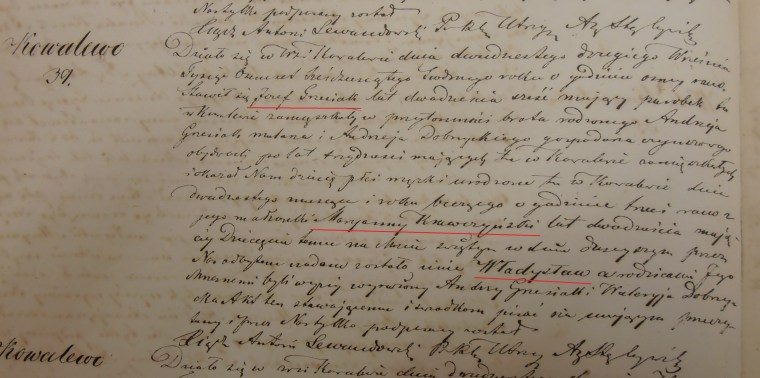
Figure 6: Polish-language birth record for Władysław Grzesiak, born 20 September 1867, with names of parents and child underlined in red.11OLYMPUS DIGITAL CAMERA

In this document, Władysław’s parents are reported to be Józef Grzesiak, age 26, a farmhand (parobek) residing in Kowalewo, and his wife, Maryanna née Krawczyńska, age 20. Similarly, the birth record for Tadeusz Grzesiak was discovered, and his parents, too, were reported to be Józef Grzesiak and Marianna née Krawczyńska (Figure 7).12

Figure 7: Russian-language Birth record for Tadeusz Grzesiak, born 27 March 1874, with names of parents and child underlined in red.12Tadeusz Grzesiak birth record marked

It’s evident that there’s a language change between these two records. Władysław’s birth record was written in Polish, while Tadeusz’s birth record was written in Russian. This was one of the punitive measures imposed by the Russian Government on Polish territories as a result of the failure of the January Uprising of 1863. Prior to 1867, the use of the Polish language was permitted in official record-keeping, but starting in 1868 (earlier in some areas) official records and even church records were required to be kept only in Russian. Tadeusz’s birth date, 27 March 1874, is a few years off from his date of birth as he reported it on his World War II draft registration — 24 March 1878. However, it was not unusual for people to report their dates of birth inaccurately in an era when there was no reason to know this information precisely, as there is today. In this document, Józef Grzesiak was reported to be a 33-year-old “master of the house” (хозяин), while his wife, Marianna, was age 31. The age difference between Józef and Marianna, which was 6 years in the first record, has magically diminished to 2 years, but again, such discrepancies are very common in these records.

Next, we have the birth record for my great-grandmother, Weronika Grzesiak, who was born 27 December 1876 (Figure 8).13 

Figure 8: Russian-language birth record for Weronika Grzesiak, born 27 December 1876, with names of parents and child underlined in red.13Weronika Grzesiak birth marked

Once again, parents were recorded as Józef Grzesiak, “master of the house,” of Kowalewo, age 37, and his wife, Maryanna née Krawczyńska, age 33.

Finally, the birth record of Józefa Grzesiak was discovered.14 Józefa was born 6 March 1881, and yes, her parents were none other than Józef Grzesiak and Marianna née Krawczyńska (Figure 9).

Figure 9: Russian-language birth record for Józefa Grzesiak, born 6 March 1881, with names of parents and child underlined in red.14Jozefa Grzesiak birth record

This time, Józef Grzesiak was recorded as “master of the house,” age 40, while his wife, Marianna, was age 37. Ultimately, Józef’s and Marianna’s dates of birth can only be known accurately when their birth records are discovered — and I discovered those a long time ago, but that’s another story for another day.

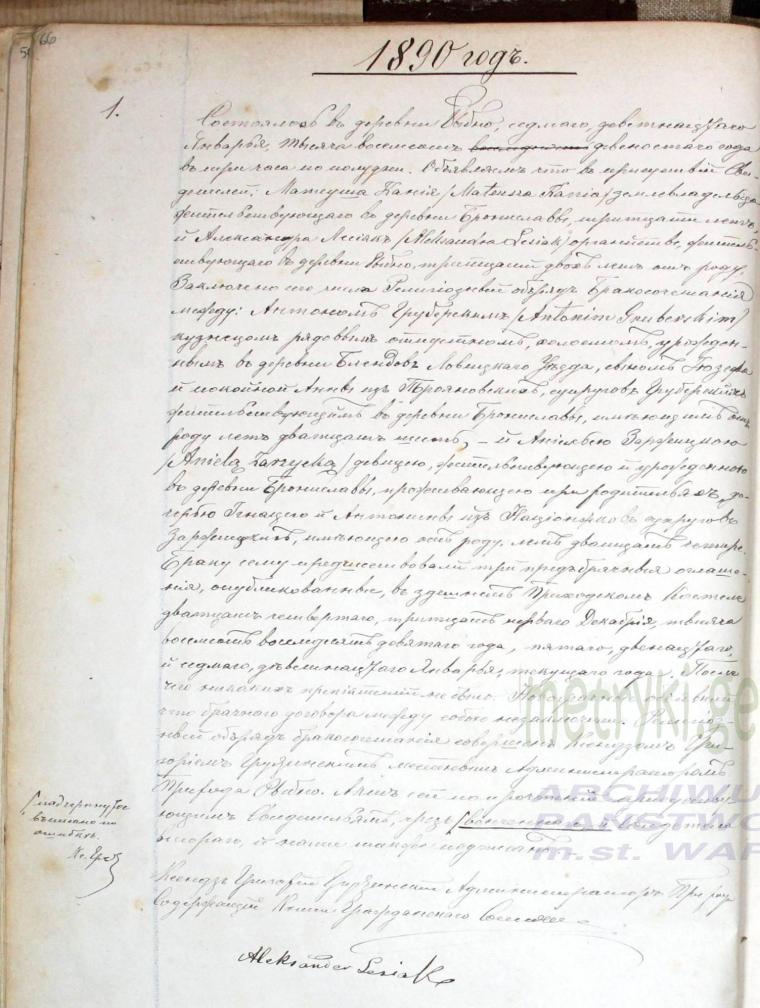
As if this weren’t sufficient evidence to put to rest the notion that the immigrant Grzesiak siblings were half-siblings, the icing on the cake was the search in marriage records and death records for any marriages for Józef Grzesiak or death records for previous wives. The only marriage record discovered was his marriage in Kowalewo in 1865 to Marianna Kawczyńska (sic) (Figure 10).15

Figure 10: Polish-language marriage record from Kowalewo for Józef Grzesiak and Maryanna Kawczyńska (sic), 31 October 1865 with names of the groom and bride underlined in red.15Jozef Grzesiak and Marianna Krawczynska marriage

The fact that this is the only marriage record found for Józef Grzesiak in Kowalewo is unsurprising, given that all of his children’s birth records name the same mother, Marianna Krawczyńska. The date of the record makes sense — they were married about 2 years before Władysław’s birth in 1867, not an unusually long period of time to be married prior to the birth of an eldest child. Józef was described as a 25-year-old bachelor, born in Cienin Zaborny but residing in Kowalewo with his parents, Stanisław and Jadwiga, at the time of his marriage. Marianna was noted to be age 22, born in Zagórów and residing in Kowalewo, daughter of Antoni and Wiktoria.

So at the end of the day, there is absolutely no evidence in Polish records for any wives of Józef Grzesiak other than Marianna Krawczyńska, whom he married in 1865 and with whom he had 6 children: the four immigrant Grzesiak siblings, as well as two daughters, Konstancja and Pelagia, who remained in Poland, and whose story I touched on a bit previously. There was no Maria Cebulska, no Anna Nowacka, no Marianna Szafron. They didn’t exist. Grandma Veronica was the only one of her siblings who accurately reported her mother’s name on a document in the U.S. So where did Tadeusz and Józefa come up with those names? Maybe Grandma was right all along — “people just didn’t talk about those things back then.” Maybe Tadeusz and Józefa really had no idea what their mother’s name was. One thing is certain, though: Marianna Grzesiak did not die when Józefa was born, or even shortly thereafter. No, Marianna Grzesiak died in Russian Poland in 1904, when her youngest daughter Józefa was 23 years old and married.16 So isn’t it a little odd that at least two of her children didn’t appear to know her name, and that the story was handed down that she died before Veronica and her siblings left Poland for America? I have some speculations about that, but it’s another story for another day.

Genealogists usually find that the best strategy for handling conflicting evidence is to keep gathering data until the truth emerges. Sometimes some analytical skill is required to interpret the data, but at other times, it’s just a question of perseverance to find the right records to settle the question. In this case, one could look at the data from U.S. records and conclude that Józef Grzesiak had three or four wives, or one could dig deeper, find the Grzesiak children’s birth records and Józef and Marianna’s marriage record from Poland, and know the truth.

Sources

1 Helen Zielinski, interviews by Julie Szczepankiewicz, circa 1986-1998; Notes from interviews privately held by Julie Szczepankiewicz, Hopkinton, Massachusetts, 2018.

2 City of Buffalo, Bureau of Vital Statistics, marriage record for John Zazycki and Veronica Grzesiak, 5 August 1901, certificate no. 202, Buffalo, Erie, New York, Erie County Clerk’s Office, 92 Franklin Street, Buffalo, New York.

3 New York State Department of Health, Bureau of Vital Statistics, marriage record for Thaddeus Grzesiak and Mayme (Mary) Gorski, 20 April 1910, certificate no. 9051, Buffalo, Erie, New York, Erie County Clerk’s Office, 92 Franklin Street, Buffalo, New York.

City of Buffalo, Bureau of Vital Statistics, marriage record for Joseph Cymerman and Josephine Grzesiak, 5 August 1902, certificate no.198, Buffalo, Erie, New York, Erie County Clerk’s Office, 92 Franklin Street, Buffalo, New York.

New York, Department of Health, Division of Vital Statistics, death certificate for Walter Grzesiak, 25 April 1946, no. 2600, Buffalo, Erie, New York.

Wladyslaw Grzesiak, Petition for Naturalization, No. 4950, 23 January 1917, Supreme Court of New York, Buffalo, Erie, New York.

7 Maryland, Baltimore Passenger Lists, 1820-1948 (image), Veronika Grzesiak, S.S. Willehad, April 1898, https://www.familysearch.org, accessed 25 February 2018.

Maryland, Baltimore Passenger Lists, 1820-1948 (image), Jozef, Kazimira and Jozefa Grzesiak, S.S. Rhein, May 1900, https://www.familysearch.org, accessed 25 February 2018.

World War II Draft Registration Cards, 1942, Draft Registration Cards for Fourth Registration for New York State, 04/27/1942 – 04/27/1942; NAI Number: 2555973; record Group Title: Records of the Selective Service System; Record Group Number: 147, record for Tadeusz George Grzesiak, http://ancestry.com, subscription database, accessed 25 February 2018.

10Arthur Gray, interview by Julie Szczepankiewicz, circa 1998; Notes from interview privately held by Julie Szczepankiewicz, Hopkinton, Massachusetts, 2018.

11 Akta stanu cywilnego Parafii Rzymskokatolickiej Kowalewo-Opactwo (Kowalewo-Opactwo, Słupca, Wielkopolskie, Poland), Księga urodzeń, małżeństw, i zgonów, 1867, births, #39, record for Władysław Grzesiak, accessed in person at the archive by Zbigniew Krawczyński, Archiwum Państwowe w Poznaniu. Oddział w Koninie, 3 Maja 78 Konin, Poland.

12 Akta stanu cywilnego Parafii Rzymskokatolickiej Kowalewo-Opactwo (pow. slupecki), Księga urodzeń, małżeństw, i zgonów, 1874, births, #17, record for Tadeusz Grzesiak, Narodowego Archiwum Cyfrowego, Naczelnej Dyrekcji Archiwów Panstwowych, Szukajwarchiwach, http://www.szukajwarchiwach.pl, accessed on 25 February 2018.

13Akta stanu cywilnego Parafii Rzymskokatolickiej Kowalewo-Opactwo (pow. slupecki),  Księga urodzeń, małżeństw, i zgonów, 1876, births # 72, record for Weronika Grzesiak, accessed on 25 February 2018.

14 Akta stanu cywilnego Parafii Rzymskokatolickiej Kowalewo-Opactwo (pow. slupecki) (Kowalewo-Opactwo, Słupca, Wielkopolskie, Poland), Księga urodzeń, małżeństw, i zgonów, 1881, births, #15, record for Józefa Grzesiak, Narodowego Archiwum Cyfrowego, Naczelnej Dyrekcji Archiwów Panstwowych, Szukajwarchiwach, http://www.szukajwarchiwach.pl, accessed on 25 February 2018.

15Akta stanu cywilnego Parafii Rzymskokatolickiej Kowalewo-Opactwo (pow. slupecki), Księga urodzeń, małżeństw, i zgonów, 1865, marriages, #10, record for Józef Grzesiak and Maryanna Kawczynska, 31 October 1865, Narodowego Archiwum Cyfrowego, Naczelnej Dyrekcji Archiwów Panstwowych, Szukajwarchiwach, http://www.szukajwarchiwach.pl , image 20.jpg, accessed on 25 February 2018.

16 Roman Catholic church, Zagórów parish (Zagórów, Słupca, Wielkopolskie, Poland), Kopie księg metrykalnych, 1808-1947, Akta zgonów 1891-1906, 1904, #52, death record for Marianna Grzesiak, DGS 8018016, Image 383, accessed on 25 February 2018.

© Julie Roberts Szczepankiewicz 2018

Where Were Your Ancestors in 1857?

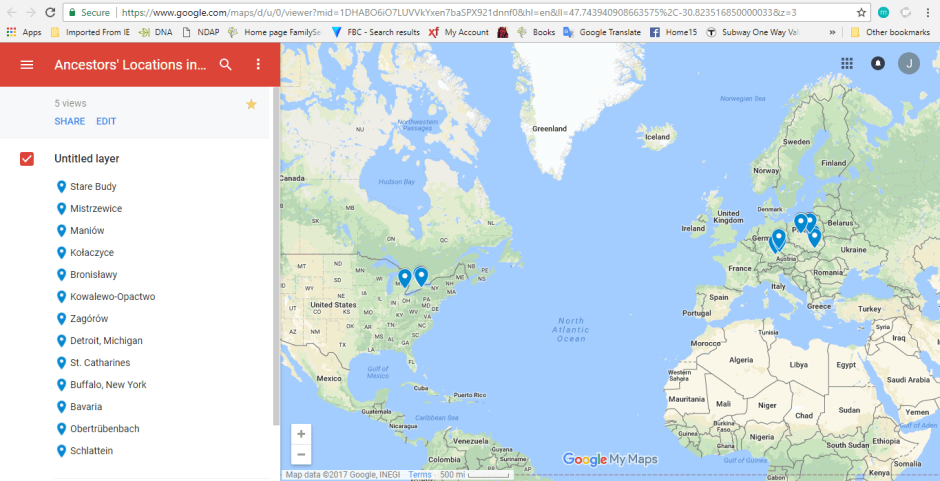
Genealogists often think in terms of family timelines, tracing one particular family line through many generations. However, it occurred to me that it might be interesting to examine my family tree in cross section. That is, what was happening in each of my family lines in the year 1857? I chose that year because I wrote recently about my 3x-great-grandparents’s marriage in Roding, Bavaria in 1857, and that got me wondering what my other ancestors were doing in that same year, and where they were living around the world. It turns out this is a pretty useful (and fun!) exercise. I gained new insights into each family group, and it also served to point out deficiencies in my research, and families that I’ve neglected, that I should perhaps plan to spend more time on in 2018. Here, then, is a summary of my ancestral couples who were alive at that time. Although the map in the featured image is not “clickable,” you can use this link to explore that map in greater depth, if you’d like.

Maternal grandfather’s line

In 1857, my 3x-great-grandparents, Michał Zieliński and Antonia (née Ciećwierz) Zielińska, were living in the village of Mistrzewice in Sochaczew County in what was at that time the Królestwo Polskie or Kingdom of Poland, which officially had some autonomy, but was in reality a puppet state of the Russian Empire. They’d been married about four years, although I don’t know the precise date of their marriage because 19th century records for Mistrzewice prior to 1859 were largely destroyed. Michał and Antonina had one daughter, Zofia, who was about 2, and Michał supported his family as a gospodarz, a farmer who owned his own land.1

Meanwhile, in the nearby village of Budy Stare, Sochaczew County, my 3x-great-grandparents Roch Kalota and Agata (née Kurowska) Kalota welcomed their (probably) oldest daughter, my great-great-grandmother, Marianna Kalota, who was born circa 1857. Again, the destruction of records has been a problem for researching this line, but available records tell us that Roch Kalota, too, was a farmer.2

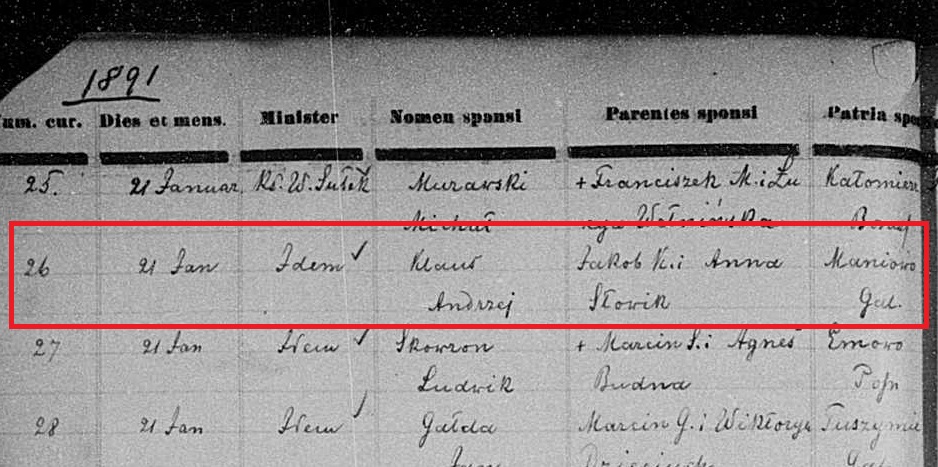
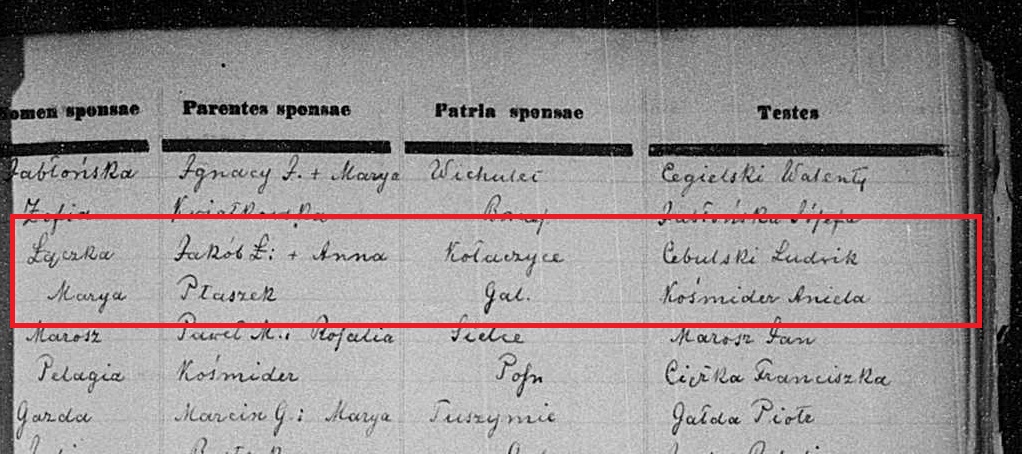
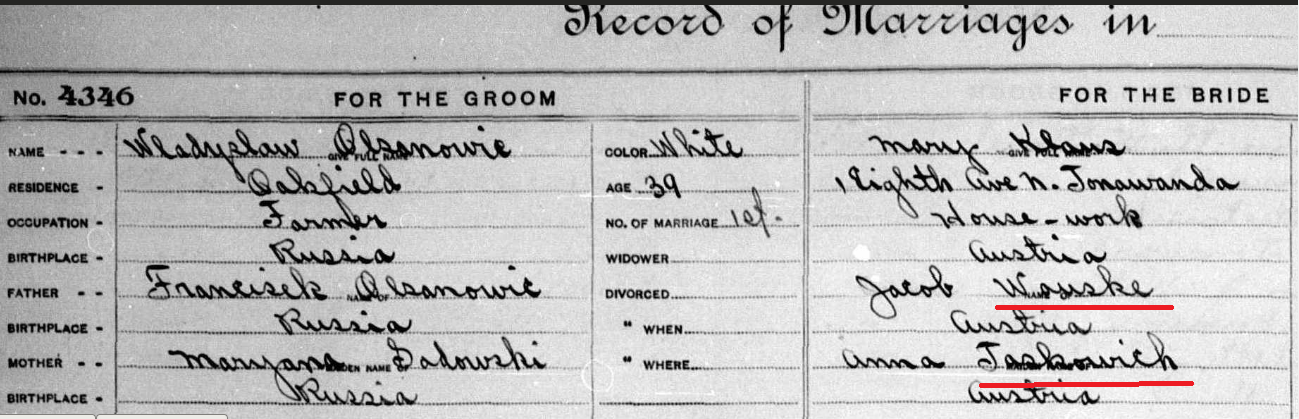
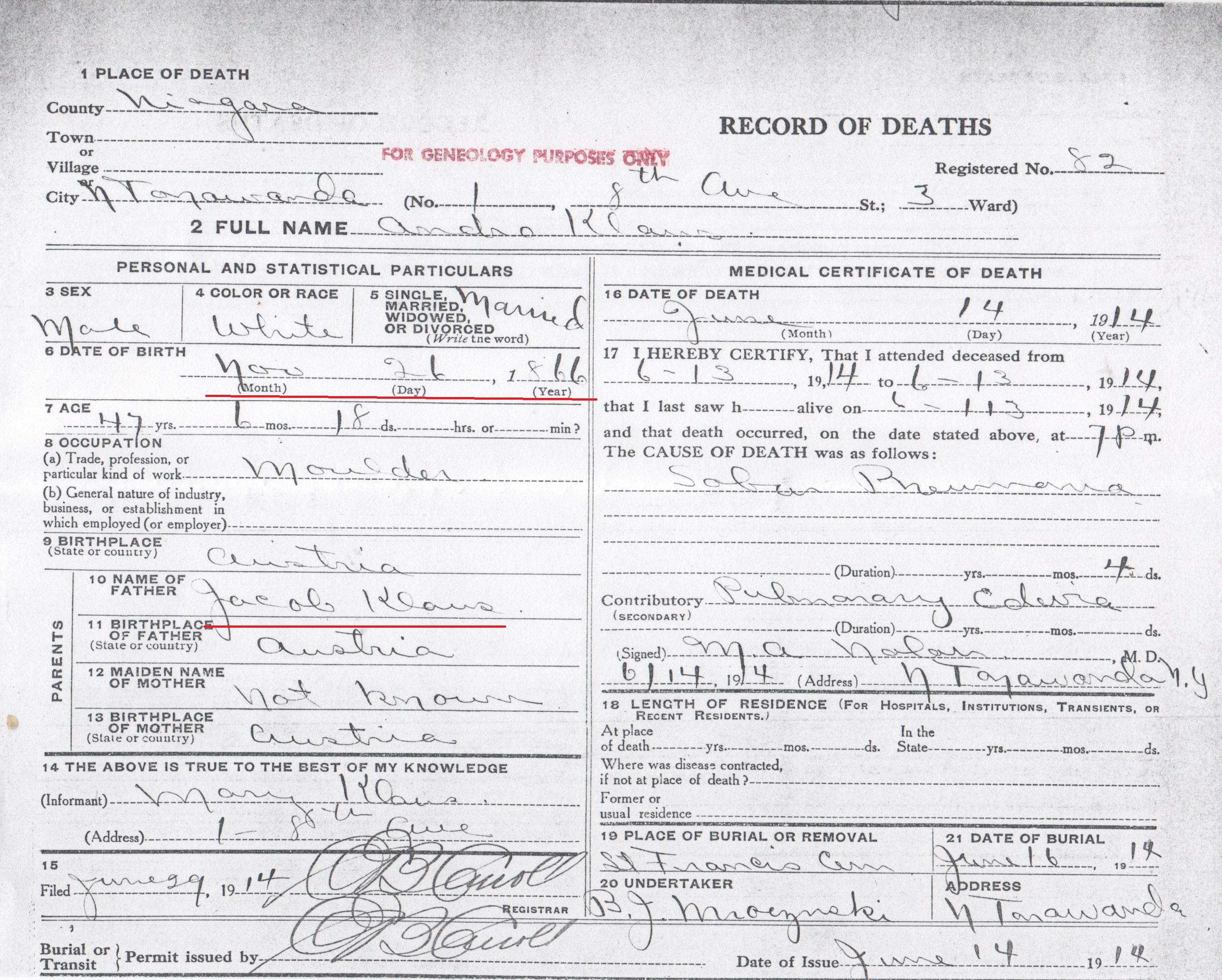
In the south of Poland in 1857, my 3x-great-grandparents on my Klaus line had not yet married. Jakub Klaus was the son of Wawrzyniec (Lawrence) Klaus and Anna Żala or Żola. He was a young man already 27 years of age, but he did not marry his wife, Franciszka, until 1860.Franciszka Liguz was the daughter of Wawrzyniec Liguz and Małgorzata Warzecha, age 21 in 1857. Both Franciszka and her husband-to-be, Jakub, lived in the village of Maniów in Dąbrowa County in the Galicia region of the Austrian Empire, and Jakub was described as a famulus, or servant.

Still further south in what is now Poland, my 3x-great-grandparents Jakub Łącki and Anna Ptaszkiewicz were 4 years away from their eventual wedding date.4 In 1857, Jakub was a 22-year-old shoemaker from the village of Kołaczyce in Jasło County in the Austrian Empire, and Anna was the 23-year-old daughter of a shoemaker from the same village.

Maternal grandmother’s line

Heading further north again in Poland, back into Sochaczew County in Russian Poland, my 2x-great-grandparents Ignacy and Antonina (née Naciążek) Zarzycki were about 8 years into their marriage, raising their family in the village of Bronisławy. By 1857, they had three children for whom birth records have been discovered, Marianna,5 Paulina,and Tomasz.7 Ignacy was a land-owning farmer who was born in the nearby village of Szwarocin,8 but his wife Antonina’s place of birth remains a mystery.

Moving west now, in 1857 my 3x-great-grandparents Stanisław and Jadwiga (née Dąbrowska) Grzesiak were living in Kowalewo Opactwo, a village that was located in Słupca County at the far western edge of the Russian Empire, within walking distance of the border with Prussia. Ages 51 and 41, respectively, they were already parents to 12 of their 13 children. Stanisław was usually described as a shepherd or a tenant farmer.9

In the nearby town of Zagórów, my 3x-great-grandmother, Wiktoria (née Dębowska) Krawczyńska was living as a 53-year-old widow, having lost her husband Antoni Krawczyński 10 years earlier.10 Antoni had been a shoemaker, and he and Wiktoria were the parents of 8 children, of whom 4 died in infancy. By 1857, the surviving children ranged in age from 27 to 14 — the youngest being my great-great-grandmother, Marianna Krawczyńska.

Paternal grandfather’s line

Meanwhile, in Detroit, Michigan, my 3x-great-grandparents Michael Ruppert and Maria Magdalena Causin were newlyweds in 1857, having married on 12 May of that year.11 Michael had immigrated to the U.S. just four years earlier, at the age of 19, with his parents and siblings.12 The Rupperts were from the village of Heßloch in the Grand Duchy of Hesse-Darmstadt, or what is now Alzey-Worms district in Rhineland-Palatinate, Germany.13 Michael was a carpenter, and he and his family had already begun to use the surname Roberts.14 His wife Maria Magdalena Causin/Casin/Curzon is a bit of a mystery, and will likely be the subject of future blog post, because she doesn’t show up in the records until her marriage in 1857, and her parents’ names are not on her marriage or death records.

In 1857, my 3x-great-grandparents Henry and Catherine (née Grentzinger) Wagner and were also living in Detroit, had been married for 2 years and were parents to their first child, John Wagner.15 Henry was a teamster who had arrived in Detroit about 3 years previously along with his parents and siblings, all immigrants from the village of Roßdorf in the Electorate of Hesse, a state within the German Confederation.16  This was a first marriage for Henry, but a second marriage for Catherine, since she was a young widow after the death of her first husband, Victor Dellinger or Dalmgher.17 In addition to burying her husband some time between 1850-1855, it appears that both of Catherine’s children from that first marriage 18 also died young, since they were not mentioned in the 1860 census in the household of Henry and Catherine Wagner. Catherine herself was an immigrant from Steinsoultz, Haut-Rhin, Alsace, who came to Detroit with her parents and siblings some time between 1830 and 1834.

Across the border and some 225 miles to the east, my 3x-great-grandparents Robert and Elizabeth (née Hodgkinson) Walsh made their home in St. Catharines, Ontario, Canada. In 1857, Elizabeth Walsh was a 39-year-old mother of 5, pregnant with her 6th child, Ellen, who was born in December of that year.19 Elizabeth was the granddaughter and great-granddaughter of United Empire Loyalists, so her family were among the first settlers in St. Catharines. Her husband, Robert Walsh, was a 49-year-old tailor from Ireland whose family origins have proven to be more elusive than his wife’s.

Also living in St. Catharines were my 3x-great-grandparents, Robert and Catherine Dodds. In 1857, Robert was a 40-year-old immigrant from England, usually described as a laborer or farm laborer. Nothing is known about Robert’s family of origin. He married his wife, Catherine, circa 1840, and by 1857 they were the parents of three daughters and three sons.20 Catherine’s origins, and even her maiden name, are unclear. There is evidence that she was born circa 1818 in Martintown, Glengarry, Ontario to parents who were Scottish immigrants or of Scottish extraction, but no birth record or marriage record has yet been discovered for her.

Paternal grandmother’s line

Jacob and Catherine (née Rogg or Rock) Böhringer, my 3x-great-grandparents, were German immigrants from the Black Forest, having lived in the village of Gündelwangen in the Grand Duchy of Baden21 prior to their migration to Buffalo, New York in 1848.22 By 1857, Catherine and Jacob had already buried three of their seven children, including oldest daughter Maria Bertha, who was born in Germany and apparently died on the voyage to America. Jacob was a joiner or a cabinet maker.23

In 1857, my 3x-great-grandparents Joseph Murre and Walburga Maurer were still about 5 years away from their eventual wedding date. They were born and married in Bavaria, Germany, although I have yet to discover their specific place of origin. I don’t know the names of the parents of either Joseph or Walburga. Joseph was a woodworker who was employed in a planing mill in Buffalo, New York in 1870 24 and was later listed as a carpenter in the Buffalo city directory in 1890. He and Walburga arrived in New York on 3 April 1869 with their children Maria, Anna and Johann.25

In October 1857, my 3x-great-grandparents Johann Meier and Anna Maria Urban were married in the parish church in Roding, Bavaria.26 Their first child, Johann Evangelista Meier, was born out of wedlock two years previously although the father was named on the baptismal record with a note that the child was subsequently legitimized. Johann and Anna Maria would go on to have a total of 10 children, 3 of whom migrated to Buffalo, New York.

In 1857, my 4x-great-grandparents, Ulrich Götz or Goetz and Josephine Zinger, were living somewhere in Bavaria and raising their 4-year-old son, Carl Götz, who was my 3x-great-grandfather. Almost nothing is known of this family, including where they lived in Bavaria or the names of Carl’s siblings. Carl grew up to be the second husband of a much older wife, Julia Anna Bäumler, who was already 19 in 1857. Julia had at least one child from a previous relationship, a son, John George Bäumler, who was born in 1858. Julia and Carl married in Bavaria circa 1875, a development which may or may not have influenced John Bäumler’s decision to emigrate from Bavaria to Buffalo, New York in 1876.28 Julia gave birth to her only child with Carl, Anna Götz (my great-great-grandmother), in 1877, and the Götz family eventually followed John Bäumler to Buffalo in 1883. Julia Götz’s death record states that she was born in “Schlattine, Bavaria,” which suggests the village of Schlattein in Neustadt an der Waldnaab, Bavaria, but further research is needed to confirm this location.

So there you have it: a summary of where my ancestors were in the world, and in their lives, in the year 1857. But what about your ancestors? Where were they living, and what were they doing? Is there a more interesting year for your family than 1857? Choose a different year, and tell me your ancestors’ stories!

Selected Sources:

Akta stanu cywilnego parafii rzymskokatolickiej w Mistrzewicach, Polskie Towarzystwo Genealogiczne, Metryki.genealodzy.pl, 1875, Małżeństwa, #2, record for Zofia Zielińska and Piotr Malinowski, accessed on 10 November 2017.

2 Akta stanu cywilnego parafii rzymskokatolickiej w Mlodzieszynie, Polskie Towarzystwo Genealogiczne, Metryki.genealodzy.pl, Księga zgonów 1889-1901, 1895, #59, death record for Wojciech Kalota, accessed on 10 November 2017.

Roman Catholic Church, St. Mary Magdalene parish (Szczucin, Dąbrowa, Małopolskie, Poland), Księgi metrykalne, 1786-1988, Akta małżeństw 1786-1988, Maniów, 1860, 16 September, marriage record for Jacobus Klaus and Francisca Liguz, Family History Library film # 1958428 Items 7-8.

Roman Catholic Church, St. Anne’s Parish (Kołaczyce, Jasło, Podkarpackie, Poland), Śluby, 1826-1889, Stare Kopie, 1861, #11, marriage record for Jacobus Łącki and Anna Ptaszkiewicz.

Roman Catholic Church, St. Bartholomew’s parish (Rybno, Sochaczew, Mazowieckie, Poland), Księga urodzeń 1845-1854, 1850, #48, baptismal record for Maryanna Zarzycka.

Roman Catholic Church, St. Bartholomew’s parish (Rybno, Sochaczew, Mazowieckie, Poland), Księga urodzeń 1845-1854, 1853, #60, baptismal record for Paulina Zarzycka.

Roman Catholic Church, St. Bartholomew’s Parish (Rybno, Sochaczew, Mazowieckie, Poland), Księga urodzeń, 1855-1862, 1856, #48, baptismal record for Tomasz Zarzecki.

Roman Catholic Church, St. Bartholomew’s Parish (Rybno, Sochaczew, Mazowieckie, Poland), 1828, #34, baptismal record for Ignacy Zarzycki.

Akta stanu cywilnego Parafii Rzymskokatolickiej Kowalewo-Opactwo (pow. słupecki), 1832, marriages, #14, record for Stanisław Grzesiak and Jadwiga Dąbrowska, Szukajwarchiwach, http://www.szukajwarchiwach.pl/, accessed 17 November 2017.

10 Roman Catholic Church, Zagórów parish (Zagórów (Słupca), Poznań, Poland), Kopie księg metrykalnych, 1808-1947, 1843, #137, death record for Antoni Krawczyński.; FHL film #2162134, Item 1, Akta zgonów 1844-1849.

11 Roman Catholic Church, St. Joseph’s parish (Detroit, Wayne, Michigan, USA), “Marriages”, 1857, #15, marriage record for Michael Ruppert and Magdalena Causin.

12 New York, Passenger Lists, 1820-1957 (index and image), record for Franz, Catherine, Michael, Arnold, and Catherine Rupard, S.S. William Tell, arrived 4 March 1853, http://ancestry.com, subscription database, Microfilm Serial: M237, 1820-1897; Microfilm Roll: Roll 123; Line: 51; List Number: 146, accessed 17 November 2017.

13 Roman Catholic Church (Heßloch (Kr. Worms), Hesse, Germany), Kirchenbuch, 1715-1876, 1834, baptismal record for Michael Ruppert, FHL film #948719.

14 1860 U.S. Census (population schedule), Detroit, Wayne, Michigan, p. 142, Michael Roberts and Frank Roberts households, http://ancestry.com, subscription database, accessed 17 November 2017.

15 Michigan, County Marriages, 1820-1940, database, Church of Jesus Christ of Latter-Day Saints, FamilySearch, (https://familysearch.org), database with images, 1855, #11, record for Henry Wagner and Catherine Dellinger, accessed 17 November 2017.

16 New York, Passenger Lists, 1820-1957 (image and transcription), record for Henry, Cath., August, Johnny, Gertrude, and Marianne WagnerS.S. Erbpring Luidrich August, arrived 29 September 1853 in New York,  Microfilm Serial: M237, 1820-1897; Microfilm Roll: Roll 132; Line: 12; List Number: 1010,  http://ancestry.com/, subscription database, accessed 17 November 2017.

17 Michigan, County Marriages, 1820-1940,  (images and transcriptions), Wayne County, marriage certificates, 1842-1848, v. B, #1733, marriage record for Victor Dellinger and Catherine Grenzinger, 3 February 1846,  FamilySearch, https://familysearch.org, accessed 17 November 2017.

18 1850 U.S. Federal Census (population schedule), Detroit, Wayne, Michigan, page 156B and 157, Victor Dalmgher household, http://ancestry.com, subscription database, accessed 17 November 2017.  

19 Census of 1861, database, Library and Archives Canada, St. Catharines, Lincoln, Canada West (Ontario), Robert Walsh household, item number 2721097, accessed 17 November 2017.

 20 Census of 1861, database, Library and Archives Canada, Grantham, Lincoln, Canada West (Ontario), Library and Archives Canada, Robert Dodds household, Item number 1884852, accessed 17 November 2017.

21 Roman Catholic Church, Gündelwangen parish (Gündelwangen, Waldshut, Freiburg, Baden-Württemberg, Germany), Kirchenbuchduplikat, 1810-1869, 1847, baptisms, #4, record for Maria Bertha Rogg, p. 165, with addendum on page 171, Family History Library film #1055226.

22 Passenger and Immigration Lists, 1820-1850,  record for Jacob Behringer, Catherine, and Marie Behringer, S.S. Admiral, arrived 4 November 1848 in New York, http://ancestry.com/, subscription database, accessed 17 November 2017.

23 1860 United States Federal Census (population schedule), 7th Ward Buffalo, Erie, New York, p. 77, Jacob Barringer household, http://familysearch.org, accessed 17 November 2017.

24 1860 United States Federal Census (population schedule), 7th Ward Buffalo, Erie, New York, p. 73, Joseph Murri household, http://familysearch.org, accessed 17 November 2017.

25 Passenger Lists, 1820-1957 (image and transcription), record for Joseph, Walburga, Anna, Marie, and Johann Muri, S.S. Hansa, arrived 3 April 1869 in New York,  Microfilm Serial: M237, 1820-1897; Microfilm Roll: Roll 308; Line: 38; List Number: 292. http://ancestry.com/, subscription database, accessed 17 November 2017.

26 BZAR, Roman Catholic Church, St. Pancrus parish (Roding, Cham, Oberpfalz, Germany), Marriage record for Johann Maier and Anna M. Urban, 27 October 1857, Vol. 27, page 3 MF 573.

271900 United States Federal Census (population schedule), Buffalo, Erie, New York, E.D. 107, Sheet 16B, Charles Goetz household, https://.ancestry.com, subscription database, accessed 17 November 2017.

28 1900 United States Federal Census (population schedule), Gainesville, Wyoming, New York, E.D. 122, Sheet 9A, John Baumler household, https://.ancestry.com, subscription database, accessed 17 November 2017.

© Julie Roberts Szczepankiewicz 2017

Frank Zielinski and the Board of Special Inquiry

“Keep, ancient lands, your storied pomp!” cries she
With silent lips. “Give me your tired, your poor,
Your huddled masses yearning to breathe free,
The wretched refuse of your teeming shore.
Send these, the homeless, tempest-tost to me,
I lift my lamp beside the golden door!”

— Emma Lazarus, The New Colossus, 1883.

Despite Lazarus’ idealized portrayal of America’s welcome toward immigrants, there has always been a fair amount of suspicion toward the most recent wave of newcomers, and concern that they would take away jobs from American citizens or require public assistance. Any family historian who has ever studied a passenger manifest from the early 20th century has seen the columns in which immigrants were required to verify that they were in good mental and physical health, that they were not deformed or crippled, that they were not anarchists or polygamists. Immigrants could be sent back home for any number of reasons, and although only about 2% of Ellis Island immigrants were actually turned away, many of our ancestors were subjected to a more detailed physical exam or a special hearing prior to admittance.

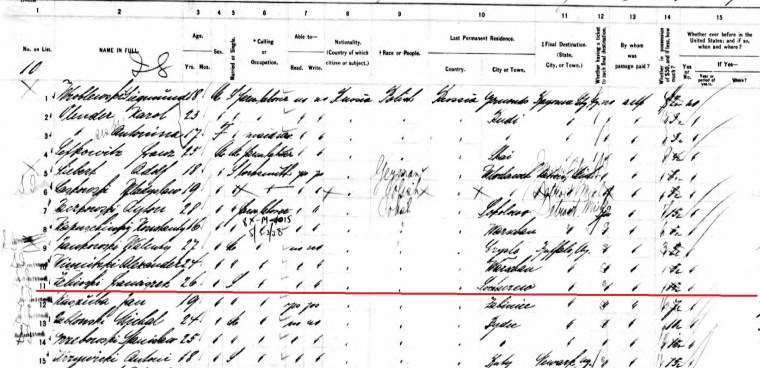
Consequently, many of us have discovered evidence in our own family trees of  immigrants who were detained for a hearing with the Board of Special Inquiry. In my family, my great-grandfather’s brother, Franciszek (Frank) Zieliński, was one such example. Franciszek arrived at Ellis Island on 7 April 1907, and his passenger manifest is shown here on the Ellis Island site (free) or via Ancestry, here (Figure 1).

Figure 1:  Extract from passenger manifest of Franciszek Zelinski (sic) from the S.S. Breslau, 7 April 1907.1Frank Zielinski marked manifest left crop

Franciszek appears on line 11, a single, male farm laborer, age 26, not able to read or write, which was not unusual for men living in Russian Poland at that time. His last permanent residence was noted to be Sochaczew, Russian Poland. Franciszek did not have a ticket to his final destination and he had only one dollar to his name, but he was reported to have paid for his ticket himself. Franciszek and a traveling companion, Aleksander Winnicki, were both going to join the brother-in-law of a third companion, Walenty Jankowski, who reported that he was from the village of Czyste, which is near Sochaczew. Walenty’s brother-in-law, Antoni Bejger (?), was living in Buffalo, New York. Although this manifest page is genealogical gold, it tells only half the story. As evidenced by the “SI” notations and subsequent “Admitted” stamps, all three of these men, along with four others on this page, were flagged for detainment and a hearing with the Board of Special Inquiry (SI).

These Records of Aliens Held for Special Inquiry appear as separate documents that usually constitute the final pages of the ship’s manifest, or possibly the first few pages of the manifest, as some manifests were microfilmed in reverse order. It’s common for a search on Ancestry to reveal one of the manifest pages for a particular immigrant (the main manifest page or the Record of Aliens Held for Special Inquiry page), but not both. However, you can always browse manually to find the additional page if there is reason to suspect that it should exist. Figure 2 shows the page from the Record of Aliens Held for Special Inquiry where Franciszek Zieliński was mentioned.

Figure 2: Record of Aliens Held for Special Inquiry, Franceszek Zelinski (sic), S.S. Breslau, 7 April 1907.2

Board of Special Inquiry manifest Frank Zielinski crop

The left-most columns on this manifest confirm the data found in the original manifest entry for Franciszek, indicating “26m” for a 26-year-old male, followed by his name. The next columns report group number and page number on the manifest where he was originally recorded. There is a column for number of persons held, which was only one, in Franciszek’s case. However, other entries note larger traveling parties, such as the group of 8 recorded further down on the page — a mother traveling with 7 children, who was detained as a Likely Public Charge (L.P.C.). The next column reveals the reason for Frank’s detainment, “C.L.” This notation stands for “Contract Labor,” and Franciszek’s traveling companions, Aleksander Winnicki and Walenty Jankowski, were detained for this same reason.

Apparently, Franciszek and the others were suspected of immigrating in violation of the Alien Contract Labor Law of 1885. This law was intended to discourage the practice among American companies of promising jobs to immigrants upon arrival, bringing them in under contract, or prepaying their passage. In addition,

The law aimed at reducing immigration to the country and supplying the workforce with better skilled trained craftsmen. The act prohibited all companies and individuals from bringing immigrants into the United States under contract or through indentured servitude. A less overt purpose of the law was to raise the quality of new immigrants by excluding people who could not pay their own way to reach the United States. Immigrants who could afford to travel to the United States on their own income were most welcome.3

The next columns on the manifest report the name of the immigration inspector, Leonard, and the actions of the Boards of Special Inquiry. In the case of Franciszek and his friends, the hearings took place on that same day, 7 April (reported in the “Date” column), and a transcript of the proceedings was recorded by the secretary “Lov” on page 10 of the stenographer’s notebook. One such transcript can be found here, although the transcript from Franciszek’s hearing would not have been preserved because he was ultimately admitted to the United States. The only records that were not destroyed were for cases in which the BSI judged in favor of exclusion an immigrant, and the immigrant appealed the decision. The documents surrounding those appeals are housed at the National Archives in Washington, D.C., and additional information about obtaining them can be found here.

The final columns on the far right side of the page are also interesting, in that they provide a tally for the number of breakfasts, lunches and dinners the detained person or party received while in detainment. The cost of these meals was billed to the steamship company. Unfortunately, the top corner of the original page was torn prior to microfilming, so this information is not available in Frank’s case.

Ultimately, Frank was admitted to the U.S., possibly because he was able to persuade the BSI that he did, in fact, pay for his own ticket as he reported on the manifest. Nevertheless, these Records of Aliens Held for Special Inquiry provide fascinating details to add to our understanding of our immigrant ancestors’ stories. So the next time you see an “admitted” stamp on a manifest next to the name of an immigrant ancestor, be sure to dig a little deeper in the manifest to uncover the rest of the story.


For further reading:

Grounds for Exclusion noted on BSI lists:  http://www.jewishgen.org/infofiles/manifests/bsi/causes.html, and

http://www.dvhh.org/dta/usa/general-research/alien_detentions.htm

Interesting story about an immigrant whose admittance was denied by the BSI, but who gained entry upon appeal:

http://www.jewishgen.org/InfoFiles/Manifests/bsi/

Sources:

1 New York, Passenger Lists, 1820-1957 (image), Ancestry.com, (Provo, UT, USA, Ancestry.com Operations Inc, 2003), Record for Franciszek Zelinski, S.S. Breslau, 7 April 1907, list 10, line 11, accessed 8 October 2017.

New York, Passenger Lists, 1820-1957 (image), Ancestry.com, (Provo, UT, USA, Ancestry.com Operations Inc, 2003), Franceszek Zelinski (sic) in Record of Aliens Held for Special Inquiry, S.S. Breslau, 7 April 1907, page 121, accessed 8 October 2017.

Bell, Keith J. “Alien Contract Labor Law of 1885,”  Immigration to the United States, http://immigrationtounitedstates.org, accessed 8 October 2017.

© Julie Roberts Szczepankiewicz 2017


The Leonard Zarzycki Family of Warsaw

Genealogists are often too familiar with the frustration of painstakingly gathering documentation to identify an ancestral village, only to discover that the family didn’t stay there for long, nor did they leave any hint about where they went. Sometimes, it’s just a branch or two that disappears from the records, but in such cases, it can be really difficult to find people in the absence of indexed records. I have quite a few family lines that dead-end this way, but the good news is that indexing efforts in Poland are bringing more and more of these missing relatives to light. Just yesterday, in fact, I managed to discover evidence for a previously unknown Zarzycki cousin who went to Warsaw.

I’ve written about my Zarzycki/Zażycki family in the past. This is the family of my great-grandfather, Jan Zażycki, who was born in the village of Bronisławy in Sochaczew County in 1866, and immigrated to Buffalo, New York. The village of Bronisławy belongs to the parish of Rybno, and it’s challenging to obtain records from this parish since so few of the parish books were ever transferred to the state or diocesan archive. Most of them are still onsite at the parish itself, but thanks to the diligence of my onsite researcher, Justyna Krogulska, and the generous pastor who was willing to permit access to the records, I’ve been able to gather baptismal records for Jan and his siblings, trace the family’s roots a bit further back, and also trace some of Jan’s siblings forward, to identify their spouses and at least some of their children. However, some of Jan’s siblings disappeared from the records in Rybno. Did they die in infancy, and their deaths were somehow not recorded? Did they move and perhaps marry elsewhere in Poland? So far I haven’t found evidence of emigration (I’ve looked), but maybe a surname was dramatically altered?

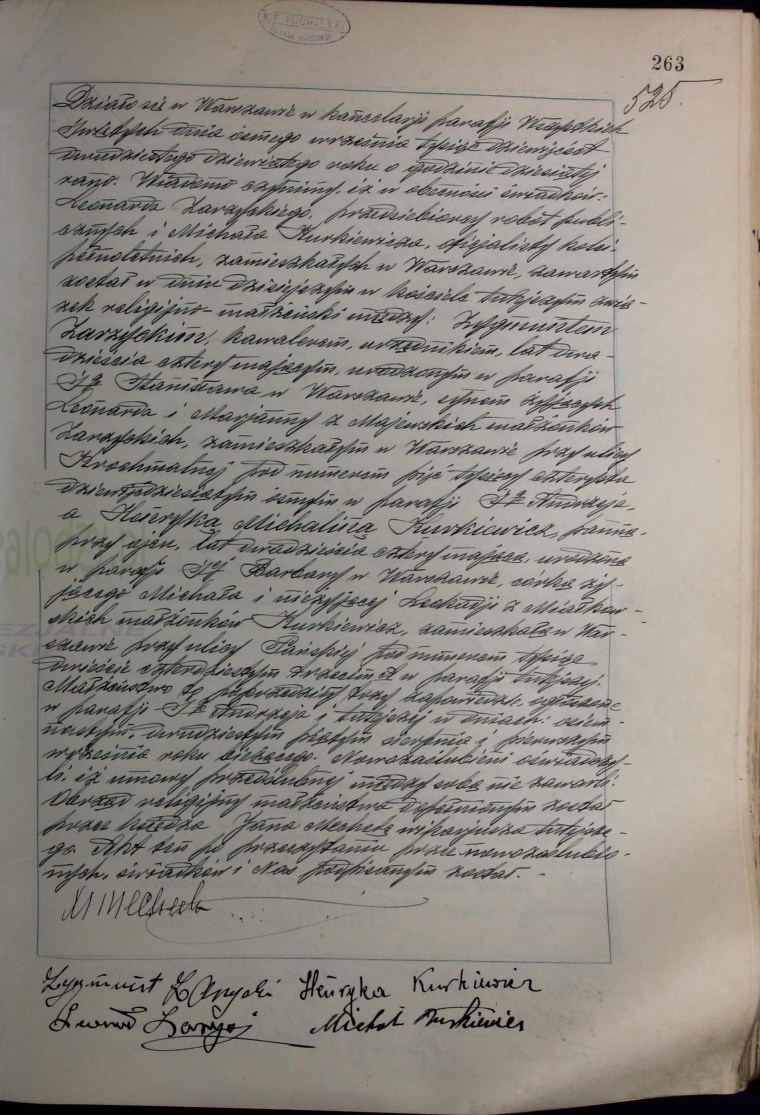
Today, one of those missing siblings emerged, in the indexed records for Warsaw in the vital records database, Geneteka. Leonard Zarzycki was the youngest brother of my great-grandfather Jan. Leonard was born 6 November 1876,and his marriage to Marianna Majewska was recorded in Rybno parish on 14 February 1904.2 After that marriage, however, the couple disappeared from the records. No birth records for their children were discovered in Rybno, and I had no idea where they went until today, when I discovered the following marriage record for Leonard and Marianna’s son, Zygmunt, at All Saints Church in Warsaw in 1929.3

Zygmunt Zarzycki and Henryka Kurkiewicz 1929 crop

The translation of the record is as follows:

“#525. This happened in Warsaw in the office of All Saints parish on the eighth day of September in the year one thousand nine hundred twenty-nine at ten o’clock in the morning. We declare that — in the presence of witnesses, Leonard Zarzycki, public works entrepreneur, and Michał Kurkiewicz, railroad official, adult residents of Warsaw — that on this day, in this church, was contracted a religous marriage between Zygmunt Zarzycki, bachelor, office worker, having twenty-four years of age, born in the parish of St. Stanisław, son of the living Leonard and Marianna née Majewska, the spouses Zarzycki, residing in Warsaw on Krochmalna Street in house number five thousand four hundred ninety eight in St. Andrew’s parish, and Henryka Michalina Kurkiewicz, single, [residing] with her father, having twenty-four years of age, born in the parish of St. Barbara in Warsaw, daughter of the living Michał and the late Leokadia née Miałkowska, residing in Warsaw on Pańska Street in house number one thousand two hundred forty-three in the parish here. The marriage was preceded by three announcements, proclaimed in the parish of St. Andrew’s and here, on the eighteenth and twenty-fifth days of August and the first day of September. The newlyweds stated that they had no prenuptial agreement between them. The religious ceremony of marriage was performed by Fr. Jan Mecheta, local vicar. This document was read aloud to the newlyweds and witnesses, and we signed. [Signed] Fr. Mecheta, Zygmunt Zarzycki, Henryka Kurkiewicz, Michał Kurkiewicz.”


The ages reported here suggest that both Zygmunt and his bride, Henryka, were born circa 1905 in Warsaw. The parish in which Zygmunt was baptized, St. Stanisław, Bishop and Martyr, was founded in 1611 in the Wola district of Warsaw, and Zygmunt’s birth record was subsequently located in the records from that parish. The address at which Leonard Zarzycki’s family was living at the time of Zygmunt’s marriage, 5498 Krochmalna Street, appears not to correspond to any present address there, but this is hardly surprising, given that 90% of Warsaw was destroyed during World War II. Krochmalna Street itself was a very poor neighborhood, largely Jewish, and the eastern part of the street was within the area walled off by the Nazis in November 1940 to form the Warsaw Ghetto, just 11 years after the date of Zygmunt and Henryka’s wedding.

I have to wonder what happened to the Zarzyckis during the war. Did they leave the city and go back to family in Bronisławy? Were they forcibly relocated? Might they have participated in the Warsaw Uprising? One resource to check for answers to these questions is the “Loss” database. In 2006, The Polish Instytut Pamięci Narodowej (Institute of National Memory) and the Ministerstwo Kultury i Dziedzictwa Narodowego (Ministry of Culture and National Heritage) developed this database to assist families in discovering the fates of individuals who suffered the loss of life or property as a result of Nazi oppression. A broad search for Zarzycki/Zarzycka, with father’s name Leonard (to locate Zygmunt) or Ignacy (to locate Zygmunt’s father, Leonard) did not produce any likely matches, suggesting that the family might, indeed, have left Warsaw before the war.

Another broad search in the indexed records at Geneteka for St. Stanisław Church in Warszawa-Wola reveals a large number of births to Zarzyckis between 1904, when Leonard and Marianna were married, and 1908, when indexed records end for this parish. I hoped that some of these might be for additional children of this couple, so I examined each record individually, since the index is of the “bare bones” variety which lacks key identifying information such as mother’s maiden name. Unfortunately, none were for children of Leonard and Marianna. Zygmunt’s marriage record stated that the family was living in Warsaw in St. Andrew’s parish at that time, so perhaps they moved there soon after he was born, and additional siblings can be found in those records. Birth records for St. Andrew’s are not indexed in Geneteka for the period from 1904-1912, but they’re available (unindexed) at Geneteka‘s sister site, Metryki. So perhaps I’ll be able to discover a few more children of Leonard and Marianna Zarzycki in due time. Stay tuned!

Sources:

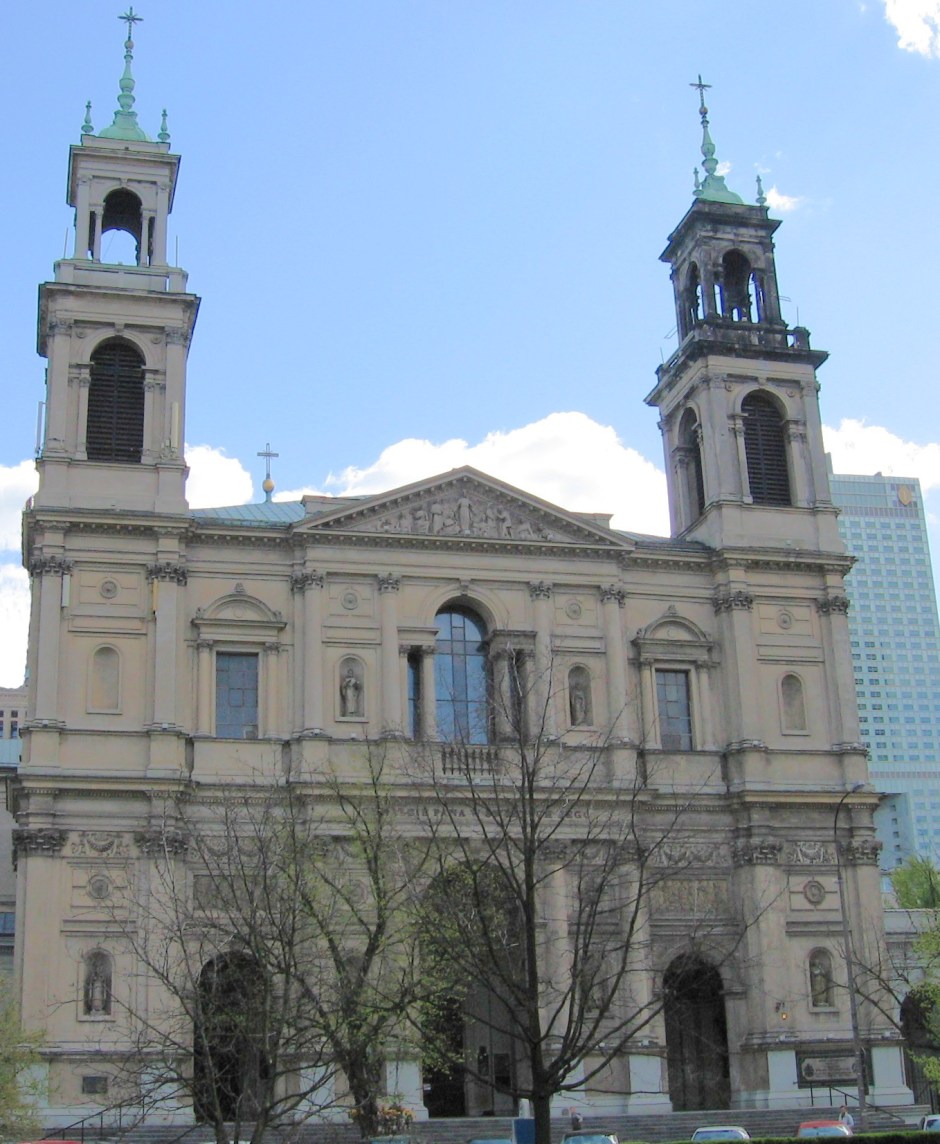
Featured Image: All Saints Church in Warsaw, Poland, image courtesy of Wikipedia user Masti, licensed under CC-BY-SA 2.5.

Roman Catholic Church, St. Bartholomew Parish (Rybno, Sochaczew, Mazowieckie, Poland), Księga urodzeń 1870-1880, 1876, #87, baptismal record for Leonard Zarzycki.

Akta stanu cywilnego parafii rzymskokatolickiej w Rybnie, Polskie Towarzystwo Genealogiczne, Metryki.Genealodzy.pl, 1904, #15, marriage record for Leonard Zarzycki and Maryanna Majewska, accessed on 28 September 2017.

Ksiegi metrykalne parafii rzymskokatolickiej Wszystkich Swietych w Warszawie, Polskie Towarzystwo Genealogiczne, Metryki.genealodzy.pl (http://metryki.genealodzy.pl), Ksiega zaslubionych 1929 r., #525, marriage record for Zygmunt Zarzycki and Henryka Michalina Kurkiewicz, accessed on 28 September 2017.

© Julie Roberts Szczepankiewicz 2017

The Mysterious Wanda Gruberska: The Next Chapter

In my last post, I shared an article I wrote for the Polish Genealogical Society of America’s journal, Rodziny, about finding a new DNA match to a cousin who knew only his grandmother’s birth name, Wanda Gruberska, but little else about her, since she was adopted as a child and had her name changed. Today I’d like to provide a few updates to the story, based on new research findings since its publication.

To briefly recap, when I was contacted by this DNA match, I recognized the Gruberski surname because my maternal grandmother’s Zazycki family had multiple ties to the Gruberski family in Poland through marriage. However, Wanda Gruberska herself was not in my family tree, and at that point, I did not know who her parents might be. By process of elimination I was able to identify Wanda’s parents as Jan/John Gruberski and Marianna/Mary (née Pindur) Gruberska, demonstrate that they immigrated to Minnesota, prove that Mary died in 1918, and discover that one of the Gruberskis’ children was living in an orphanage in St. Paul in 1920. However, I still had no direct evidence of Wanda’s birth to these parents or of her own placement in that orphanage. I suspected that Wanda might have been baptized at St. Adalbert’s church in St. Paul, Minnesota, based on her family’s address in city directories.

The Smoking Gun, and a New Sister

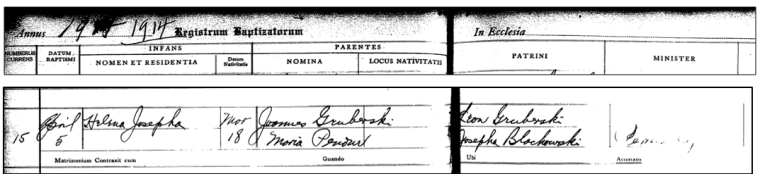
What I did not realize at that time was that baptisms and marriages from this parish, as well as other Polish parishes in Minnesota, were indexed by John Rys and compiled into searchable databases which can be accessed via the website of the Polish Genealogical Society of Minnesota. John kindly provided me with a copy of Wanda’s baptismal record (Figure 1),1 as well as a copy of the baptismal record for another sister, Helena Josepha (Figure 2).2

Figure 1: Baptismal record from St. Adalbert’s church, St. Paul, Minnesota, for Wanda Grubarska, born 7 May 1916.1Wanda Gruberska baptism 1916

Figure 2: Baptismal record from St. Adalbert’s church, St. Paul, Minnesota, for Helen Josepha, born 18 March 1914.2Helena Gruberska baptism 1914

Wanda’s surname is spelled “Grubarska” in the first record, and her year of birth, 1916, makes her a full three years younger than her family suspected. However, this birth record is nonetheless a “smoking gun” —  the direct evidence which irrefutably identifies Wanda as a child of the parents whom I predicted for her, based on all prior evidence. Although I was previously unaware of another sister, Helena, it makes sense that John and Mary might have had another child born in the U.S. if Wanda was born as late as 1916. John and Mary’s oldest children, Stanisław and Genowefa, were born in Poland in 1908 and 1910, respectively, and arrived in the U.S. in April 1913 with their mother Mary and uncle Bolesław (Bill) Gruberski. Helena had to have been the first of John and Mary’s children born in the U.S., since her March 1914 birth date suggests that she was conceived in June 1913.

The Godfather

Helena’s godfather, Leon Gruberski, was another surprise, since I don’t have him in my family tree. However, my data on the children of Marianna Zarzycka and Józef Gruberski are still incomplete. As mentioned previously, the family lived in Bronisławy, a village belonging to the parish in Rybno. The majority of the 19th-century records for Rybno have not been microfilmed, nor are they available from the Polish State Archives (apart from a narrow range of years starting in 1886). Instead, the records are still in possession of the local Catholic parish. Thanks to a gracious pastor and a diligent researcher (Justyna Krogulska), I have been able to obtain records for my family from this parish, but it looks like another round of research is in order, focusing specifically on the Gruberski family.

Although Leon’s birth record is currently unavailable, a quick check on Ancestry produced his passenger manifest (Figures 3a and b, which can also be viewed free via Ellis Island):

Figure 3a:  Extract from first page of passenger manifest for Leon Gruberski.4Leon Gruberski passenger manifest page 1

Figure 3b: Extract from second page of passenger manifest for Leon Gruberski.4Leon Gruberski passenger manifest page 2

The manifest informs us that Leon arrived in New York on 5 May 1909, that he was single, and that he was born about 1885 in “Bronislawa.” His nearest relative in that place was his father, Józef Gruberski, who was living in “Bronislawa, Warschau,” and Leon was a citizen of Russia. All of this is consistent with the village of Bronisławy, which was located in the Warsaw gubernia (province) of the Russian Empire. On page 2, we see that he was headed to his “step brother,” Piotr Przanowski, living at 153 Box (?) Street in St. Paul, Minnesota. Leon may have used the term “step brother” in a rather broad sense. The Przanowski family was clearly associated with the Gruberski family because Leon’s brother, Roman Gruberski, was married to Julianna Przanowska, who was the daughter of Stanisław Przanowski and Franciszka Dobińska. A quick check in Geneteka reveals that Julianna did indeed have a brother named Piotr Przanowski, who married Łucja Gajowniczek in Iłów in 1897, and this is probably the Piotr Przanowski mentioned in Leon’s passenger manifest. Assuming that further research does not turn up evidence of a closer relationship, Piotr can’t properly be called a “step brother” to Leon. However, our ancestors typically employed a very expansive concept of family when reporting their relationships to contacts in the U.S., and this fact, compounded with the language barrier, probably explains the notation on the manifest.

In any case, Leon seems to disappear from U.S. records subsequent to that 1909 passenger manifest. We know he must have remained in the U.S. through 1914 at least, since he was godfather to his niece, Helena Józefa, in April of that year. This, in turn, implies that he should be found in the 1910 census. Very often, Polish immigrants can be tough to locate in U.S. census records because their names were misspelled by the census-taker on the original form, or mistranscribed during the indexing process. One of my favorite tricks for getting around this is to omit the surname entirely and search using other known data. However, a search of the 1910 census for men named Leon, no surname specified, born 1880-1890 in Russia, living in St. Paul, Minnesota, produced no promising hits. I also checked for his contact in the U.S., Piotr Przanowski, since occasionally one might see a boarder mistakenly recorded on a census record under the surname of the head of household. I successfully located the household of Peter Przanowski — misindexed as Peter Pozanowski — living in South St. Paul in 1910. I’m sure it’s the right family, because his wife’s name was Lucy and he and his wife reported that they’d been married for 13 years, suggesting a marriage date of 1897. Both of these facts match the marriage record in Geneteka precisely. However, there was no Leon living with them, so for now I’ll put Leon on the back burner and move on.

Crowdsourcing at its Best

Since publishing that article, I also obtained Mary Gruberski’s death certificate (Figure 4).4

Figure 4: Death certificate for Mrs. John (Mary) Gruberski, 11 December 1918.Mary Gruberski death 1918.jpg

At the time of her death, the Gruberskis were living at 844 Gaulthier (sic) Street in St. Paul. Mary’s date of birth was reported to be 25 March 1880, but based on her age reported on her marriage record, 1890 would be a more probable birth year for her. Mary died of epidemic influenza on 14 December 1918 and was buried two days later in Calvary Cemetery. She was reported to be the wife of John Gruberski, but the document is worded in such a way that it makes no distinction between a wife, a widow, and a divorcée, so we cannot tell from this information whether or not John Gruberski is already deceased. However, the fact that John himself was not the informant is potentially significant. The name of the person who was the informant is unclear, but he did not know Mary’s parents’ names, or her precise place of birth, which suggests that he may not have known her well.

I was really bothered by the fact that I couldn’t read the informant’s name on this document. The disjointed appearance of the signature made it look almost like a short name, e.g. Geo. (George) Doun or Dorn, followed by a phrase, which I thought might contain some clue about the relationship of the informant to the deceased. Moreover, the 1910 census did indeed show a man by the name of George Dorn who lived at 1058 Rice Street in St. Paul in 1910, less than a mile from the Gruberskis’ address on the death certificate. However, this theory was blown out of the water last night by the amazing Kasia Dane in the Polish Genealogy group on Facebook.

One of my favorite strategies when I need another pair of eyes or a fresh perspective, is to crowdsource the problem by posting in a Facebook group. I posted this record in Polish Genealogy recently, and after some discussion, Kasia produced irrefutable evidence that the informant was a Belgian immigrant named Georges Dommels-Huizen. Kasia’s most compelling piece of evidence was this World War I draft card, which informs us that Georges was employed as a records clerk at the City and County Hospital in St. Paul, Minnesota. As a hospital records clerk, Georges would have had access to the basic information contained in Mary’s medical chart when she was admitted to the hospital.

Bill Gruberski’s Day in Court

Rather than resting on her laurels, Kasia dug a little deeper and turned up a spectacular find in Internet Archive. It’s often surprising what information one can find by a simple internet search using the name of a research subject combined with an identifying fact or two. In this case, a search for “Mary Gruberski 1918” produced a book entitled Minnesota Reports, which is a summary of cases argued and determined in the Supreme Court of Minnesota, published in 1922.5 The case summary tells us that Mary took out a life insurance policy on herself in 1918, shortly before her death, naming her brother-in-law, Bolesław “Bill” Gruberski, as the beneficiary. The insurer was the Brotherhood of American Yeomen, which was a fraternal beneficiary organization. The policy was issued in September of 1918, but prior to issuance of the life insurance certificate, the insurer required Mary to undergo a physical examination and to answer questions about her own health history, family health history, and her physical condition. The medical examination took place on 18 August 1918, and one of the questions asked was, “Are you pregnant?” At the time of the exam, Mary was 5 1/2 months pregnant, and she delivered a full-term baby on 15 November 1918, one month before her death.

Since the death claim was made so soon after the policy issued, it seems that the insurer balked at making the payout on the policy. They argued that the policy was void if any of the statements made during the medical exam regarding Mary’s physical condition were untrue, and they claimed that Mary stated that she was not pregnant. Never mind that her death was completely unrelated to her pregnancy, the whole case came down to the question of whether or not the statements made during the exam were warranties that could invalidate the insurance certificate if proven to be false. The plaintiff, on the other hand, charged that the medical examiner erroneously inserted Mary’s answers into the medical report, and that Mary did, in fact, admit to being pregnant. Mary was known to be illiterate, with limited English-speaking skills. Both sides offered conflicting testimony regarding Mary’s actual oral statement, and whether or not an interpreter was used, and it was noted to be strange that the medical examiner recorded her waist measurement, yet did not realize that she was 5 1/2 months pregnant. When the case was first tried in the Ramsey County District Court, it was judged in favor of the plaintiff — that is, the insurer was required to pay a death benefit of $1,000 to Bill Gruberski for his sister-in-law’s death. The defendant appealed that verdict, but it was upheld by the State Supreme Court.

So what are the genealogical implications of this new evidence? First, we now know that John and Mary Gruberski had at least 5 children prior to Mary’s death in 1918: Stanisław, Genowefa, Helena, Wanda, and this new baby born in November 1918, just a month before Mary’s death. Second, these data support my suspicion that John Gruberski might have preceded Mary in death. It’s a little odd that she would have named her brother-in-law as her beneficiary if her husband were still alive. Perhaps her intention was to have Bill use the money for the care of her children. In any case, the question remains as to when John Gruberski died, and the probable timeframe for this event is pretty narrow. If John and Mary’s youngest child was born in November 1918, the baby would have been conceived in February of that year. Therefore John must have died some time after the baby’s conception, but before Mary applied for the life insurance policy in August 1918, and named her brother-in-law, and not her husband, as beneficiary. It’s also theoretically possible that John did not die in 1918, but rather abandoned his family and moved back to Poland, and I hope to address this question with further research.

The Seven Siblings

There’s one final new development that I want to share in this next chapter of the story. As mentioned previously, John and Mary’s oldest son, Stanisław, was reported in the 1920 census to be an inmate at St. Joseph’s German Catholic Orphan Society Home in St. Paul, Minnesota. I contacted the Archdiocesan Archives for St. Paul to inquire about records from the orphanage, and was delighted to learn that they do have records for Wanda and all her siblings, which I can request from their archive 100 years after the date of the record.  The earliest records will be available in January 2019 and the latest in September 2025.  It seems a long time to wait, but I’m in this for the long haul. The surprise came when the archivist wrote that they have records for seven Gruberski children, not just five.  Based on the dates of birth of the children previously discovered, the remaining two children must have been born in 1915 and 1917.  Given how large this family was, it seems odd that Stanisław was the only one of the siblings who was reported to be living in the orphanage in 1920. Prior to my correspondence with the Archdiocesan Archive, I assumed that the younger children might already have been adopted by 1920, leaving only Stanisław there. However, assuming that the release dates on the orphanage case files correspond to the dates when each child was legally adopted, there should have been three additional Gruberski children reported on the census, based on the census date of January 1920. Why they were not reported on the census is another mystery for another day.

There’s also the mystery of where these children would have been baptized, since the only baptismal records found at St. Adalbert’s were for Wanda and Helena. The obvious answer is that they must have been baptized in a different parish, so I took a look at the family’s addresses in city directories to determine what other parish they might have lived in. Unfortunately, this approach didn’t help much. In the 19147 city directory for St. Paul, John Gruberski was reported to be living at 720 S. Concord Street, which isn’t especially close to any of the ethnic Polish Roman Catholic churches in St. Paul. In 1915,8 he was listed in several places in the directory.  He appears first in the alphabetical listing of residents, which confirmed the previous home address of 720 S. Concord Street, and was also mentioned in the business directory under both “blacksmiths” and “horseshoers” where it was noted that his blacksmithing business was located at 161 Milford. In 1916,the only Gruberski listing is for “Jochim,” although it’s clearly the same as our John, since he’s a blacksmith working at 161 Milford. This time his residence is reported to be 865 Rice Street, but that’s still only a mile away from St. Adalbert’s.

In 1917,10 I found John’s brother, Bill Gruberski, living and working at his brother’s former address, 161 Milford. Moreover, the 1917 directory shows “Joachim Gruberski,” also a blacksmith, living at 887 Albemarle. Google Maps informs me that 887 Albemarle is about 26 feet away from 161 Milford, so right next door. By 1918,11 there’s no longer any mention of any John, Jochim, or Joachim Gruberski, but William Grubarski is mentioned as a “helper” living at 844 Galtier, which is again, quite close to St. Adalbert’s. 844 Galtier is an address we’ve seen before:  it’s where Mary Gruberski was living at the time of her death in December 1918. Moreover, both of these facts are consistent with our present hypothesis, that John Gruberski died (or perhaps abandoned his family) between February 1918 and November 1918. It seems quite plausible that Mary and her children might have moved in with her brother-in-law and his family if her husband died suddenly while she was pregnant with her seventh child.

Although this analysis of the city directories has helped us to understand some aspects of the story, it did not suggest any other parishes where the Gruberski children might have been baptized, since all the addresses associated with the family point to St. Adalbert’s. At this point, I don’t have any answers, merely speculation. Maybe, for some reason, some of the children were baptized at nearby St. Stanislaus parish, even though it was an ethnic Czech parish and therefore probably not the first choice for Polish immigrants? They were most likely not baptized at the ethnic Polish St. Casimir church in St. Paul, because their baptisms would have been captured in John Rys’s database. So this, too, remains another mystery for another day.

To Be Continued….

To sum it up, this next chapter in the saga of the Gruberski family in St. Paul has been pretty interesting, and the pieces of the story are starting to come together. We now have Wanda’s baptismal record, which provides direct evidence for her parentage, and we have a baptismal record for one additional sibling, Helena. We’ve learned of the existence of three more siblings, previously unknown, and we know the dates on which we can request adoption records for each of the seven siblings from the Archdiocesan Archive. We’ve discovered Leon Gruberski, John’s brother, and have a plan in place for further research in Polish records to obtain his birth record, and the birth records for all additional children of Józef Gruberski and Marianna Zarzycka. The report of a successful lawsuit, brought by Bill Gruberski against the Brotherhood of American Yeomen after their refusal to pay the death claim on Mary Gruberski’s life insurance policy, provided key genealogical details including the date of birth of Mary’s youngest child, and the fact that Mary named her Bill, rather than her husband, as her beneficiary. This, in combination with data from Mary’s death record and city directories, contributed evidence to our developing hypothesis that John Gruberski died between February 1918 and August 1918. Some questions still remain, of which the most important are those regarding the fate of John Gruberski, but hopefully further research can resolve those. Stay tuned!

Sources:

Roman Catholic Church, St. Adalbert’s Parish (St. Paul, Ramsey, Minnesota), Baptisms, 1911-1923, 1916, #61, baptismal record for Wanda Gruberska.

Roman Catholic Church, St. Adalbert’s Parish (St. Paul, Ramsey, Minnesota), Baptisms, 1911-1923, 1914, #15, baptismal record for Helena Josepha Gruberski.

New York, Passenger Lists, 1820-1957  (images and transcription)Year: 1909; Arrival: New York, New York; Microfilm Serial: T715, 1897-1957; Microfilm Roll: Roll 1257; Line: 14; Page Number: 149, record for Leon Gruberski, accessed 31 August 2017

Minnesota, Division of Vital Statistics, Death Certificates, 1918, #8746, record for Mrs. John (Mary) Gruberski, died 14 December 1918 in St. Paul, Ramsey, Minnesota.

Minnesota Reports, Supreme Court of the State of Minnesota (1922), Bill Gruberski v. Brotherhood of American Yeomen, a Fraternal Beneficiary Organization, May 6, 1921, Case number 22,197, pp. 49-53.; book digitized by Google from the library of Harvard University and uploaded to the Internet Archive by user tpb., Internet Archive (https://archive.org/), accessed 31 August 2017.

6 1920 United States Federal Census (image and transcription), Year: 1920; Census Place: St Paul Ward 11, Ramsey, Minnesota; Roll: T625_855; Page: 4A; Enumeration District: 140; Image: 1041, https://www.ancestry.com, Record for Stanislaus Gruberski, accessed 31 August 2017.

7U.S. City Directories, 1821-1989 (image and transcription), R.L. Polk and Co.’s St. Paul City Directory, 1914, (St. Paul, Minnesota: R.L. Polk & Co.), record for John Gruberski, p. 734, https://www.ancestry.com, accessed 31 August 2017.

U.S. City Directories, 1821-1989 (image and transcription), R.L. Polk and Co.’s St. Paul City Directory, 1915, (St. Paul, Minnesota: R.L. Polk & Co.), record for John Gruberski, pp. 698 and 1757, https://www.ancestry.com, accessed 31 August 2017.

U.S. City Directories, 1821-1989 (image and transcription), R.L. Polk and Co.’s St. Paul City Directory, 1916, (St. Paul, Minnesota: R.L. Polk & Co.), record for Jochim Gruberski, p. 712, https://www.ancestry.com, accessed 31 August 2017.

10 U.S. City Directories, 1821-1989 (image and transcription), R.L. Polk and Co.’s St. Paul City Directory, 1917, (St. Paul, Minnesota: R.L. Polk & Co.), record for Bill and Joachim Gruberski, p. 708, https://www.ancestry.com, accessed 31 August 2017.

11 U.S. City Directories, 1821-1989 (image and transcription), R.L. Polk and Co.’s St. Paul City Directory, 1918, (St. Paul, Minnesota: R.L. Polk & Co.), record for Wm. Grubarski, p. 501, https://www.ancestry.com, accessed 31 August 2017.

© Julie Roberts Szczepankiewicz 2017

The Mysterious Wanda Gruberska: A Genetic Genealogy Success Story

Note: This story was originally published in the Spring 2017 issue of Rodziny, the journal of the Polish Genealogical Society of America. With their permission, I’m publishing it again here, with the intention of following it up with some new data that I’ve obtained since it was published.

Recently I got some exciting new autosomal DNA test results for my “Uncle” (mother’s maternal first cousin), Fred Zazycki.  Uncle Fred generously consented to provide a saliva sample for autosomal DNA testing through Ancestry, which is really an incredible gift.  Why is it better for me to have his DNA tested in addition to my own?  Let’s quickly review some basic concepts in genetic genealogy.

The ABCs of DNA

Each of us has 23 pairs of chromosomes located in the nucleus of almost every cell in the body.  These chromosomes contain the genetic material (DNA) that makes us unique individuals.  Of these 23 pairs of chromosomes, 22 pairs are called autosomes, and the final pair are the sex chromosomes.  For men, the sex chromosomes are an X inherited from the mother and a Y inherited from the father.  Women inherit two X chromosomes, one from the mother and one from the father.

One copy of each of the 22 paired autosomes comes from the mother, and one from the father, so roughly half our genetic material comes from each parent. Each parent’s genetic contribution gets cut in half with each successive generation, so although I inherit half my DNA from my mother, I only inherit a quarter of my DNA (on average) from each of my maternal grandparents, and only 1/8 of my DNA (on average) from each of my maternal great-grandparents. If we extend this further, each of us has 64 great-great-great-great-grandparents, and each of them will only contribute 1/64 of our genetic makeup, or about 1.563%, on average. However, due to a process called recombination that affects the way bits of DNA are inherited, these are only statistical averages.  In practice,  one might inherit a bit more or a bit less from any given ancestor, and all of us have many ancestors from whom we’ve inherited no DNA at all.

For this reason, it’s important to try to test the oldest generations in a family first.  Since Uncle Fred is one generation closer than I am to our immigrant ancestor, John Zazycki, Uncle Fred will have inherited an average of twice as much DNA from John Zazycki as I did. This means that his DNA “looks back” into the family tree a generation further than mine is able to.

The Zarzycki and Gruberski families of Bronisławy and Błędów

Almost as soon as Uncle Fred’s DNA test results posted, and before I’d even had a chance to look at them, I already had a message in my Ancestry inbox from a DNA match who wanted to investigate the connection. The DNA match,”Cousin Jon,” has a family tree on Ancestry which included a surname I recognized:  Gruberski.  My great-grandfather John Zazycki had an oldest sister, Marianna Zarzycka, who married Józef Gruberski in 1874 in Rybno (Figure 1).

Figure 1:  Marriage record from the parish in Rybno, Sochaczew County, for Marianna Zarzycka and  Józef Gruberski, 25 October 1874.1

marianna-zarzycka-and-jozef-gruberski-1874

A full translation of this record is provided in the footnotes, if you’re really interested in reading the whole thing.

From this record and from the parish records in Łowicz, we know that Józef Gruberski was a 40-year-old widower when he married 24-year-old Marianna Zarzycka. His first wife, Anna Trojanowska, had died four years earlier, and he came into this second marriage with four children. The records of Rybno also reveal that the paths of the Zarzycki and Gruberski families crossed in other ways besides just this marriage.  In 1890, Józef Gruberski and Anna Trojanowska’s third son, Antoni Gruberski, married Aniela Zarzycka.  Aniela was the younger sister of Antoni’s step-mother, Marianna (née Zarzycka) Gruberska. (Figure 2).

Figure 2:  Marriage record from the parish in Rybno, Sochaczew County, for Aniela Zarzycka and Antoni Gruberski, 19 January 1890.2aniela-zarzycka-and-antoni-gruberski-1890

For my great-grandfather Jan Zarzycki, Józef Gruberski was not only husband to his sister Marianna and father-in-law to his sister Aniela, he was also the boss.  Józef Gruberski was the master blacksmith under whom Jan had apprenticed.  We know this because one of the documents which Jan brought with him from Poland, which was handed down in our family, was an identification booklet that included basic biographical information written in Russian and Polish. (Figure 3).

Figure 3:  Identification booklet from Russian Poland for Jan Zażycki.3jan-zazycki-working-papers-p3

In our family, my grandmother’s brother, Joseph, fondly known as Uncle J, was the one who inherited the book from his father, Jan Zażycki.  He, in turn, passed it down to my cousin, John, who is Jan Zażycki’s namesake.  Consequently, I don’t have the actual book in my possession, but my cousin kindly made a photocopy of some of the pages for me, which included notes from a translator. Some of these aren’t especially accurate, but I don’t have a copy without the notes, so we’ll overlook that part.  The interesting thing to note in this context is the part highlighted in red, that states, “Pracuje u Józefa Gruberskiego/Majstra tegoż kunsztu kowalskiego.”  This tells us that Jan Zażycki was a blacksmith who was working for Józef Gruberski, master of the blacksmithing craft. The word “czeladnik” in the corner next to Jan’s name means “journeyman,” which would suggest that Jan had completed his training and was now fully qualified to be employed as a blacksmith.

Matchmaker, Matchmaker….

Given all the ways in which the Zarzycki family and the Gruberski family had intertwined, it seemed very likely that this must be how Uncle Fred’s new DNA match was connected to our family.  So what do we know about the match itself? Well, GEDmatch reports that it consists of substantial matches on Chromosome 12 (32.8 cM), Chromosome 17 (28.4 cM) and Chromosome 21 (30.4 cM), for a total of a whopping 91.5 cM, which is fantastic, given that this is to a cousin previously unknown to the family (Figures 4a and 4b).

Figure 4a:  GEDmatch Autosomal Comparison Between Uncle Fred and Cousin Jon. Green = base pairs with full match, yellow = base pairs with half match, red = base pairs with no match, and blue = matching segments > 7 cM (centiMorgans, a measure of genetic distance).gedmatch-1

Figure 4b:  gedmatch-2

GEDmatch estimates 3.6 generations to the MRCA (Most Recent Common Ancestor) between Uncle Fred and Cousin Jon.  Interestingly, when I checked my own matches, I also match Cousin Jon, although the match is much smaller.  I ran a GEDmatch Segment Triangulation, which verified that all three of us do share a common segment consisting of 12.2 cM on Chromosome 17 (Figure 5):

Figure 5:  GEDmatch Segment Triangulation graphic showing start and stop points for the matching segment shared by Uncle Fred, Cousin Jon and me.Figure 4

In my case, GEDmatch estimates 5.1 generations to MRCA, even though I’m only one generation away from Uncle Fred, which nicely illustrates the inequalities of DNA inheritance.

The Sad Tale of Wanda Gruberska

So who was the mystery Gruberska cousin? Unfortunately, Cousin Jon’s family didn’t know much about the Gruberski family at all.  According to family recollection, Jon’s grandmother was born Wanda Evangeline Gruberska.  The family believed that she was Polish.  Wanda was born circa 1913, and was left at an orphanage, either in Minnesota or Michigan, shortly after arriving in America.  She was adopted out of the orphanage and her name was changed to Katherine Burke.  By the time the 1930 census was enumerated, she was living with her adoptive family.  Cousin Jon’s family suspected that she was not actually an orphan, but that her biological mother was unable to care for her. Armed with that information, I set out to see how Wanda fit into my family tree.

Since two of the Zarzycki women (Marianna and Aniela) had married Gruberski men (Józef and Antoni), I took a look at both of those lineages to identify the most likely candidates to be Wanda’s father.  Józef and Marianna Gruberski had four children that I’d been able to discover through Polish vital records:  Roman (b. 1876), Jan (b. 1877), Bolesław Leopold (b.1880), and Julia Antonina (b. 1887).  Any one of the boys could have been Wanda’s father, or Julia might have been Wanda’s unwed mother.

Antoni and Aniela Gruberski had two sons, both named Bronisław, the second one (b. 1903) named after the first son Bronisław who died at the age of three. Aniela Gruberska was born in 1863, so she would have been 50 by 1913 when Wanda was born — too old to be Wanda’s mother.  Similarly, her son Bronisław, and any unknown sons born after him, would be too young to be Wanda’s father.  That ruled out that lineage, so the focus must be on the children of Józef and Marianna Gruberski.  What was known about their descendants?

Parish records from Ilów show that Roman Gruberski married Julianna Przanowska on 21 February 1906.4  Although birth records for this parish are online and indexed at Geneteka through 1909, there are no births to this couple during that time, nor are there any births to this couple recorded in any of the indexed records on Geneteka. Parish records from Szymanów reveal that Jan Gruberski married Marianna Pindor on 23 July 1907.5  In addition to the marriage record, indexed records in Geneteka contain one birth for a child from this marriage, that of Stanisław Alfons Gruberski, who was born in Ilów on 1 May 1908.Finally, parish records from Rybno indicate that Bolesław Gruberski married Helena Zarzycka on 6 March 1902.7  Yes, it’s another connection between the Zarzycki and Gruberski families.  Helena was Bolesław’s first cousin once removed, the youngest of the ten children of Wojciech Zarzycki and his wife, Aniela (née Tempińska). Therefore she was first cousin to Bolesław’s mother, Marianna Gruberska, even though there was 31 years’ difference in the ages of the two women.  Bolesław and Helena had at least four children that I’ve been able to discover, Wacław (b. 1902), Marianna (b. 1903), Genowefa (b. 1905) and Stanisław (b. 1906), all of whom married in Nowy Dwór Mazowiecki parish between 1926-1930.

So at this point, we have some individuals who might be good candidates to be the parent(s) of Wanda Gruberska.  Was there any evidence that any of them had emigrated?Yep!  A little digging on Ancestry turned up a passenger manifest from 1910, which showed both Jan and Roman Gruberski coming to the U.S. in 1910 (Figure 6).

Figure 6: First page of the passenger manifest for Jan and Roman Gruberski, arriving 4 May 1910.8new-york-passenger-lists-1820-1957-jan-gruberski

On closer inspection, we see that Jan and Roman Gruberski are reported to be 31 and 34, respectively, suggesting birth years of 1879 and 1876, which is reasonably consistent with what we’d expect for our Gruberski brothers. Younger brother Jan is noted to be a laborer, while Roman was recorded as a blacksmith, consistent with the tradition of blacksmithing in the Gruberski family. Jan is reported to be from “Blędowo,” while Roman is from “Bronisławow,” which correspond to the locations of Błędów and Bronisławy, where the family is know to have lived.  Jan’s nearest relative in the old country is his wife, Marya Gruberska, and Roman’s is his wife, Julia Gruberska — names that fit exactly with what is known about our Gruberski brothers.  They were headed to Buffalo, New York, which is where my great-grandfather Jan Zazycki first settled when he immigrated in 1895.  The manifest contains a second page which I won’t discuss in detail, since we already have more than enough information to verify that these are our Gruberski brothers and since it doesn’t add anything significant or contradict anything already supposed.

So far, so good.  Two of our potential candidates for Wanda’s Gruberska’s father have made it to Buffalo.  But how do we get from Buffalo to an orphanage in Michigan or Minnesota, and which one is the father? Further digging produces a second passenger manifest, this one from 1913, which shows the third brother, Bolesław Gruberski, accompanying his sister-in-law, Marianna Gruberska, to the United States, along with her two children, Stanisław and Genowefa (Figure 7).

Figure 7:  First page of the passenger manifest for the Gruberski family, arriving 22 April 1913.9new-york-passenger-lists-1820-1957-boleslaw-leopold-gruberski

Again, the ages match with what we would expect for our three known Gruberski family members, and there is a new addition to the family:  little Genowefa Gruberska, age 2 years 6 months, who is the daughter of Marianna Gruberska.  Genowefa’s age indicates a birth date of October 1910.  All of them are reported to be from “Jeziorka,” which suggests the village of Jeziorko, about halfway in between Błędów and Bronisławy.  Marianna reported her nearest relative in the old country to be her mother, Florentyna Gonsewska.  The surname Gonsewska is new, perhaps indicating a second marriage, but her mother’s given name was definitely Florentyna.  Marianna’s brother-in-law, Bolesław Gruberski, reports his nearest relative as his wife, Helena Gruberska. The final column gives us a critical bit of information:  they were headed to St. Paul, Minnesota!

The second page of the manifest confirms that their relative in St. Paul is, in fact, Marianna’s husband, Jan Gruberski, who is also reported as the father of Stanisław and Genowefa and the brother of Bolesław (Figure 8).

Figure 8:  Detail of second page of passenger manifest for Gruberski family, arriving 22 April 1913.9detail-of-manifest

The pieces are starting to fall into place, and we’re getting closer now to the orphanage in “Michigan or Minnesota” where Wanda Gruberska was adopted.  The 1915 St. Paul City Directory confirms that our John Gruberski is still living there, two years after the arrival of his wife and children, and that he’s still working as a blacksmith (Figure 9).

Figure 9:  Detail of R.L. Polk and Co.’s St. Paul City Directory 1915, showing John Gruberski.10john-gruberski-1915-city-directory-marked

Since John’s wife Marianna arrived in April of 1913, it’s entirely possible that another daughter, Wanda, could have been born to them by January of 1914, which is reasonably consistent with Wanda’s approximate birth year of 1913. Minnesota did not conduct a state census in 1915, so the next opportunity for catching a glimpse of the whole family in documents would be the 1920 U.S. Census.  However, the only member of the family who is readily found in the 1920 census is the young son, Stanisław — living in an orphanage (Figure 10).

Figure 10:  Detail of the 1920 census for St. Paul (Ward 11), Minnesota, showing Stanislaus Gruberski.111920-united-states-federal-census-stanislaw-alfons-gruberski

Interestingly, Stanisław is the only Gruberski child found in the census listings for that orphanage. His sister Genowefa is not there, nor is there any sign of a sister Wanda. Moreover, I have not yet been able to locate the parents, Jan and Marianna, in the 1920 census.  So what happened?

The Minnesota Deaths and Burials database gives us a clue (Figure 11), although the year of birth is significantly off from what we’ve seen in other records.

Figure 11:  Entry for Mary Gruberski in the Minnesota Deaths and Burials database.12mary-gruberski-death

Marianna’s year of birth suggested by records from Poland (her marriage record and Stanisław’s birth record) was 1890-1891.  However, it was 1886 based on her passenger manifest, and the fact that her husband was the only Gruberski noted in the 1915 St. Paul City Directory suggests that Gruberski wasn’t a popular surname in the city at that time.  Morever, the death date of 1918 is consistent with her son being placed in an orphanage by 1920.  Without a family support system to help care for his children after his wife’s death, John Gruberski may have felt that he had few options.

Epilogue

Of course, this still leaves many unanswered questions, which can hopefully be resolved with more data.  Although the evidence points to Wanda Gruberska being the daughter of Jan and Marianna (née Pindor) Gruberski, it should be possible to confirm that by locating a birth/baptismal record for Wanda.  It would also be nice to obtain death and burial records for her mother and possibly her sister, Genowefa. St. Adalbert’s parish was an ethnic Polish parish located just one mile from the Milford Street address noted for John Gruberski in the 1915 city directory, so that would be a reasonable place to search for such records.  And what became of the father, John Gruberski?  He and his brother Roman seem to disappear from indexed records. However, the paper trail for his brother Bolesław suggests that he adopted the name William in the U.S. (a common choice for men named Bolesław), was still married to Helena (“Ellen”) when he registered for the draft in 1917, was a widower by 1940, and died in Chicago in 1943. Helen is not mentioned in any indexed records in the U.S. discovered to date, apart from her husband’s World War I draft registration. So her stay in the U.S. may have been brief, especially considering that all her children married in Poland.

The story had a happy ending for young Wanda, who became Katherine Burke.  Cousin Jon’s family reports that she married, raised her family, loved to cook, and was beloved by her children and grandchildren until her death in 1991.  But what of her brother, Stanisław Gruberski, last seen as an 11-year-old boy in the orphanage in 1920?  He, too, disappears from the records, but like his sister Wanda, his name might have been changed upon adoption.  We may never know if there are any cousins stemming from his line — unless, of course, they wonder about their origins and turn to DNA testing for answers.

Sources:

Roman Catholic Church, St. Bartholomew Parish (Rybno, Sochaczew, Mazowieckie, Poland), Księga ślubów 1868-1886, 1874, #15, marriage record for Józef Gruberski and Maryanna Zarzycka. “#15, Bronisławy.  It happened in the village of Rybno on the thirteenth/twenty-fifth day of October in the year one thousand eight hundred seventy-four at four o’clock in the afternoon.  We declare that, in the presence of witnesses Maciej Bartoszewski, age thirty-eight, and Wawrzyniec Pytkowski, age forty, both farmers residing in the village of Bronisławy, that on this day was contracted a religious marital union between Józef Gruberski, widower after the death on the tenth/twenty-second day of October in the year one thousand eight hundred seventy in the village of Błędów of his wife, Anna née Trojanowska; blacksmith residing in the village of Błędów, born in the village of Ożarów, age forty, son of the late Mateusz and Nepomucena née Banowska, the spouses Gruberski; and Maryanna Zarzycka, single, born in the village of Bronisławy, age twenty-four, daughter of Ignacy and Antonina née Naciążek, the spouses Zarzycki, farmers residing in the village of Bronisławy; in that same village of Bronisławy residing with her parents.  The marriage was preceded by three announcements on the twenty-second day of September/fourth day of October, the twenty-ninth day of September/eleventh day of October, and the sixth/eighteenth day of October of the current year in Rybno and in the parish church in Łowicz.  The newlyweds stated that they had no prenuptial agreement between them.  The marriage ceremony was performed by Fr. Józef Bijakowski (?).  This Act to the declarant and witnesses was read aloud but signed only by us because they are unable to write.   [Signed] Fr. Józef Bijakowski, pastor of Rybno performing the duties of Civil Registrar.”

Akta stanu cywilnego parafii rzymskokatolickiej w Rybnie, Polskie Towarzystwo Genealogiczne, Metryki.genealodzy.pl:  Projekt indeksacjia metryk parafialnych (http://metryki.genealodzy.pl/), 1890, Marriages, #1, accessed on 26 January 2017. “#1. This happened in the village of Rybno on the seventh/nineteenth day of January in the year one thousand eight hundred ninety at three o’clock in the afternoon.  We declare that, in the presence of witnesses Mateusz Kania, farmer residing in the village of Bronislawy, age thirty-seven (?), and Aleksander Lesiak, organist residing in the village of Rybno, age thirty-two; on this day was contracted a religious marriage between Antoni Gruberski, blacksmith, soldier on leave, single, born in the village of Bledów, in the district of Lowicz, son of Józef and the late Anna née Trojanowska, the spouses Gruberski, residing in the village of Bronislawy, having twenty-six years of age; and Aniela Zarzycka, single, residing and born in the village of Bronislawy, living with her parents, daughter of Ignacy and Antonina née Naciazek, the spouses Zarzycki, having twenty-four years of age.  The marriage was preceded by three readings of the banns in the local parish church on the twenty-fourth and thirty-first days of December in the year one thousand eight hundred eighty nine [corresponding to the fifth and twelvth days of January and the] seventh/nineteenth days of January of the current year, after which no impediments were found.  The newlyweds stated that they had no premarital agreement between them.  The religious ceremony of marriage was performed by Fr. Grigori Gruzinski (?), local administrator of the parish of Rybno.  This document was read aloud to the declarants and witnesses and was signed by Us and by the second witness due to the illiteracy of the other witnesses. [Signed] Fr. Grigori Gruzinski, Administrator of the parish and keeper of vital records [signed] Aleksander Lesiak”

Książka Rzemieślnicza Czeladnika Kunsztu Kowalskiego Jana Zarzyckiego, Worker’s identification book for Jan Zarzycki, 29 August 1886, privately held by John D. Zazycki, Milford, Ohio, 2000.

4  Akta stanu cywilnego parafii rzymskokatolickiej w Ilowie, Polskie Towarzystwo Genealogiczne, Metryki.genealodzy.pl:  Projekt indeksacji metryk parafialnych (http://metryki.genealodzy.pl/), 1906, Marriages, #15, record for Roman Gruberski and Julianna Przanowska, accessed on 26 January 2017.

Akta stanu cywilnego parafii rzymskokatolickiej w Szymanowie, Polskie Towarzystwo Genealogiczne, Metryki.genealodzy.pl:  Projekt indeksacji metryk parafialnych (http://metryki.genealodzy.pl/), 1907, marriages, #25, record for Jan Gruberski and Maryanna Pindor, accessed on 26 January 2017.

Akta stanu cywilnego parafii rzymskokatolickiej w Ilowie, Polskie Towarzystwo Genealogiczne, Metryki.genealodzy.pl:  Projekt indeksacji metryk parafialnych (http://metryki.genealodzy.pl/), 1908, births, #52, record for Stanislaw Alfons Gruberski, accessed on 26 January 2017.

7 Akta stanu cywilnego parafii rzymskokatolickiej w Rybnie, Polskie Towarzystwo Genealogiczne, Metryki.genealodzy.pl:  Projekt indeksacjia metryk parafialnych (http://metryki.genealodzy.pl/), Ksiega slubów 1888-1908, 1902, #6, marriage record for Boleslaw Leopold Gruberski and Helena Zarzycka, accessed on 26 January 2017.

New York, Passenger Lists, 1820-1957 (image), Jan Gruberski and Roman Gruberski, S.S. Bremen, 4 May 1910, http://ancestry.com, subscription database, accessed January 2017.

New York, Passenger Lists, 1820-1957 (image), Marianna, Stanisław, Genowefa, and Bolesław Gruberski, S.S. President Lincoln, 22 April 1913, http://ancestry.com, subscription database, accessed January 2017.

10 U.S. City Directories, 1822-1995 (images), John Gruberski, St. Paul, Minnesota, 1915, http://ancestry.com, subscription database, accessed January 2017.

11 1920 U.S. Census (population schedule), St. Paul, Ramsey, Minnesota, ED 140, sheet 4A, Stanislaus Gruberski, St. Joseph’s German Catholic Orphan Society (institution), http://familysearch.org, accessed January 2017.

12 Minnesota Deaths and Burials, 1835-1990, index-only database, https://familysearch.org, record for Mary Gruberski, 14 Dec 1918; citing St. Paul, Ramsey, Minnesota, reference 1407; FHL microfilm 2,218,025, accessed on 27 January 2017.

© Julie Roberts Szczepankiewicz 2017


And the Walls Came Tumbling Down: New Discoveries in my Klaus Family Research, Part I

This morning I feel like a genealogical Joshua at the battle of Jericho, because there are brick walls crumbling all over the place. It’s amazing how one discovery can lead to seven more. So many pieces are falling into place that I’m positively giddy, but each answer leads to another question. Today I’d like to tell you about some new discoveries that came about over the past few days as a direct result of the marriage record I found last week for my great-great-grandparents, Andrzej/Andrew Klaus and Marianna/Mary Łącka, in Buffalo, New York. Previously, I wrote about my erroneous assumption that they’d married in Texas, based on the family story (still unproven) that their oldest sons, Joseph and John, were born there. It turns out that their marriage record is already available online, thanks to a recent efforts to digitize all the microfilms from the Family History Library. So without further ado, here is the record for Andrew and Mary Klaus’s marriage (Figures 1a-b).1

Figure 1a: Marriage record from St. Stanislaus parish, Buffalo, New York, for Andrzej Klaus and Marya Łączka (sic), 21 January 1891, page 1.1Andrzej Klaus and Marya Lacka 1891 left crop

Starting with the information on the left side of the register, the record states that the bride and groom were married on 21 January 1891 by Fr. W. Sułek. The groom’s name was recorded as Andrzej Klaus, and he was reported to be the son of Jakób Klaus and Anna Słowik of “Maniowo, Gal.” The page on the right (Figure 1 b) reports that the bride was Marya Łączka (sic), daughter of Jakób Łączki and Anna Ptaszek of Kołaczyce, Galicia. Witnesses were Ludwik Cebulski and Aniela Kośmider.

Figure 1b: Marriage record from St. Stanislaus parish, Buffalo, New York, for Andrzej Klaus and Marya Łączka (sic), 21 January 1891, page 2.1

Andrzej Klaus and Marya Lacka 1891 right crop

Most of this information is nicely consistent with other evidence for this couple. Although the maiden name of the bride’s mother is more often reported as Ptaszkiewicz in records from Poland, the variant form Ptaszek is a close second, used almost as freqently, so it’s not surprising that Mary Klaus might not have been too particular about which form she reported. In fact, she reported her mother’s maiden name as Ptaszkiewicz, rather than Ptaszek, on her second marriage record when she married Władysław Olszanowicz in 1916 after Andrew Klaus’s death in 1914.2,3 In this case, the civil clerk recorded it with an approximately phonetic spelling as “Taskovich” (Figure 2), just as he or she recorded Mary’s maiden name as “Wauske” rather than Łącka.

Figure 2: Extract from marriage record for Władysław Olsanowic (sic) and Mary Klaus, North Tonawanda, New York, 21 November 1916.Wladyslaw Olszanowicz and Mary Klaus

A minor source of concern for me in discovering the marriage record for Andrew and Mary Klaus was the fact that his mother’s name was recorded as Anna Słowik, rather than Franciszka Liguz. Needless to say, those names aren’t even close. However, I’m still confident that I’m tracking the right Klaus family in Polish records. For one thing, Andrew’s date of birth was reported on his death record as 26 November 1866 (Figure 3), which was an important clue.3

Figure 3: Death certificate for Andro (sic) Klaus, 14 June 1914, with date of birth and father’s name highlighted.3Andrew Klaus death certificate marked

Additionally, I’m confident in my identification of Andrew’s birth location as the village of Maniów that’s presently located in Dąbrowa County, Małopolska.  All the records for his children who were baptized at St. Stanislaus parish mentioned some variant of “Maniów,” and there were only 2 places by that name in Galicia, according to Jan Bigo’s 1918 index,.4 However, there were also places called Maniowy and Maniawa, which could arguably have been intended. When faced with a problem like this, the best way to get around it is to keep digging for documentation that references place of birth. In this case, Fr. Kasprzak at St. Stan’s did me a huge favor by recording a slightly different reference to Andrew’s birthplace on the baptismal record for his son, Edward (Figure 4).5

Figure 4: Extract from baptismal record from St. Stanislaus parish, Buffalo, New York, for Edward Klaus, born 11 September 1899, with father’s place of birth underlined in red.5Edward Klaus birth marked

On this record, Andrzej Klaus is noted to be from Szczeciny, and in context with the previous references to Maniów, this can be understood to be a reference to Szczucin, the parish which served the village of Maniów.

Records for this parish, and other parishes in the Diocese of Tarnów, are indexed at Family Search. Granted, this index is far from perfect; in my experience, it contains many inaccuracies and also seems to miss some records. However, a search for Andrew or Andreas (the Latin form of the name) Klaus, born between 1863 and 1867 — not even specifying the father’s name or the precise place of birth — returns only one result that is not only close, it’s nearly perfect: the birth of the Andrzej Klaus whose baptismal record I referenced in my last post (Figure 5):

Figure 5: Search result for Andreas Klaus in index to Tarnów Roman Catholic Diocese Church Books, 1612-1900 at FamilySearch.

Family Search index for Andrew Klaus

The actual record shows a date of birth of 25 November 1865, with baptism one day later, which is a very close match with the birth date that Mary Klaus reported on Andrew’s death certificate, 26 November 1866. The father’s name, Jacobus or Jakub, also matches. So the only problem is that the mother’s name, Franciszka Liguz, doesn’t match the mother’s name, Anna Słowik, that Andrew reported on his marriage record. This brings me to the first new discovery I made after finding this marriage record.

Discovery #1: The marriage record of Tomasz Klaus and Wiktoria Rak

Our ancestors didn’t migrate alone — typically they followed other family members, friends, or neighbors, who had successfully settled in a new place, in a phenomenon known as chain migration. However, until recently I had not found any evidence of other members of the Klaus family living near Andrew and Mary. Since the discovery of this marriage record, I took a closer look at the marriage records for St. Stan’s in Buffalo and discovered the record for Andrew’s brother, Tomasz Klaus, to Wiktoria Rak (Figures 6a and b):6

Figure 6a: Marriage record from St. Stanislaus parish, Buffalo, New York, for Tomasz Klaus and Wiktorya Rak, 20 November 1900, page 1.Tomasz Klaus and Wiktoria Rak 1900 marked

In this record, the groom is reported to have been born in “Mielecka Wola,” consistent with his known place of birth in Wola Mielecka in present-day Mielec County, Podkarpackie province.

Figure 6b: Marriage record from St. Stanislaus parish, Buffalo, New York, for Tomasz Klaus and Wiktorya Rak, 20 November 1900, page 2.Tomasz Klaus and Wiktoria Rak 1900 crop left.jpg

The bride, Wiktoria Rak, was born in Jasło, which is the seat of Jasło County in Podkarpackie province. Perhaps not coincidentally, Jasło is very close to her sister-in-law Mary Klaus’s place of birth in Kołaczyce. Tomasz’s parents were recorded as Jakób Klaus and Franciszka Słowik, which is especially interesting in light of the fact that the same maiden name, Słowik, was recorded on Andrew Klaus’s marriage record in 1891. However, in this case, Tomasz reported her given name as Franciszka, consistent with the actual name of Andrew Klaus’s mother, Franciszka Liguz.

Will the Real Franciszka Klaus Please Stand Up?

So why does the name Słowik keep cropping up? Is it possible that Andrew and Tomasz were step-brothers? What do the records in Poland say about Tomasz’s mother? Well, the answer to that is a little complicated. Wola Mielecka, where Tomasz was born, originally belonged to the parish of Książnice, although a new parish, Divine Providence, was recently founded in Wola Mielecka itself. Records from Wola Mielecka, originally created in Książnice, but which currently belong to the new parish, are indexed in Geneteka under the parish name Książnice-Wola Mielecka. A search of birth records for children of Jakub and Franciszka Klaus produces the birth record for Tomasz Klaus in 1872 — but his mother’s name was reported to be Franciszka Nygus (Figure 7). So now how do we reconcile that surname with the surnames of Liguz and Słowik already discovered?

Figure 7: Geneteka search result for birth records mentioning names Jakub Klaus and Franciszka in Książnice-Wola Mielecka between 1786-1915.Geneteka screenshot

A check of the death records which mention the same couple is very enlightening (Figure 8):

Figure 8: Geneteka search result for death records mentioning names Jakub Klaus and Franciszka in Książnice-Wola Mielecka between 1787-1970.

Geneteka screenshot 2

Hovering the cursor over the “i” in the “Uwagi” (Remarks) column reveals that the Helena Klaus who died on 15 August 1878 was born in 1875, suggesting that this is the same Helena Klaus whose mother was reported to be Franciszka Nygus. We can therefore conclude that it was merely an error on the part of the priest when he recorded Franciszka’s name as “Nygus” rather than “Liguz” on Helena’s birth record. It’s clear that Józef, Helena, Paweł, and Tomasz must all be siblings to Andrew Klaus.

It’s still possible that Anna Słowik was Jakub Klaus’s second wife, and stepmother to the Klaus children, which would explain why both Andrew and Tomasz reported that surname on their marriage records in Buffalo. Marriage and death records from Poland will be very helpful here, but I haven’t had a chance to discover any yet. Available evidence suggests that Jakub and Franciszka probably married in Szczucin, rather than Książnice-Wola Mielecka, and unfortunately, records for Szczucin are not yet indexed in Geneteka. Despite its name, FamilySearch’s index to Tarnów Roman Catholic Diocese Church Books, 1612-1900 seems to contain only baptismal records, rather than any marriages or deaths, so Jakub Klaus’s marriage record(s) cannot be discovered there, either. I recently ordered the microfilms for Maniów/Szczucin, but have not had a chance to view them yet because of the limited summer hours of operation of my local Family History Center. So, this question remains on the back burner for now.

I’m still seeking evidence for Tomasz/Thomas and Wiktoria/Victoria Klaus in U.S. records. A probable match for Thomas is buried at St. Stanislaus Cemetery. His Find-A-Grave memorial lacked his years of birth and death, but a quick phone call to the cemetery informed me that he died on 28 December 1911 at the age of 33 years, 5 months, 23 days, and that he was buried from Corpus Christi Church. His age at death suggests a birth date of 5 July 1878. The 1878 birth is a bit off from the 1872 date of birth for Tomasz Klaus in the Geneteka index, but a widow grieving the loss of her husband at a young age might have remembered him to be even younger still by a few years. Thomas and Victoria also show up in the 1910 census, but one would never find them with too restrictive a search, because Thomas’s reported age (and date of birth calculated from that) is wildly inaccurate (Figure 9):

Figure 9: Extract from 1910 U.S. census showing Thomas and Victoria Klaus in the household of John Skowronski (previous page).7Thomas and Victoria Klaus census crop

Thomas and Victoria were reported to be living at or near 49 Beck Street in Buffalo, in the household of John and Stella Skowronski and their children. John was reported to be an immigrant from German Poland, while his wife Stella was a Russian Pole. Living with them were several boarders — Stanley Pietrykowski, Walter Ciesielski, Andrew Lisica, and Anthony Skowronski, and Joseph Wypych — whose relationships to the family are unclear. Although Anthony’s surname suggests a relationship to head-of-household John Skowronski, Anthony is marked as a Russian Pole, suggesting that something is amiss in the recording. Things become even more bizarre on the second page. Thomas and Victoria Klaus are correctly noted to be Austrian Poles, yet they are marked as brother and sister to head of household John Skowronski. It’s possible that some relationship might nonetheless exist (e.g. Victoria and Stella Skowronski might be sisters) but the fact that they’re purportedly from different partitions of Poland is odd. Also living in this household were the family of Albert and Alice Rak and their children. Albert and Alice are also marked as brother and sister to head of household John Skowronski, and again, any actual relationship is unclear. Albert Rak was marked as an Austrian Pole, and from his surname, it’s almost certain that he’s a relative of Victoria (née Rak) Klaus, possibly a brother.

Getting back to the entry for Thomas and Victoria, they were reported to be ages 22 and 18, respectively, yet it was noted that they’d been married for 10 years. The suggested marriage year of 1900 fits with their 1900 marriage record from St. Stan’s, but they were unlikely to have been 12 and 8 at the time of their marriage. At this point, there are so many problems with this census record that one cannot help but wonder if the census taker had been hitting the bars prior to his visit to Beck Street. Thomas was reported to have arrived in 1882. However, he would have been just 10 years old at that time, so if this date is accurate (and there is good reason to doubt that) he would have to have traveled with some family member other than his brother Andrew, who didn’t arrive until 1889. He was naturalized, and working as a laborer at street work. Victoria was reported to have arrived in 1897, and was employed in 1910 as a washerwoman for a private family. There were no children from this marriage.

So, there are quite a few avenues for further research to document Thomas Klaus’s story. However, in my next post, I’ll write about a new discovery that sheds light on Andrew and Mary’s Klaus’s story, and also some negative evidence that offers insight into their family history. Stay tuned!

Sources:

Roman Catholic Church, St. Stanislaus parish (Buffalo, Erie, New York, USA), Church records, 1873-1917, Marriages, 1891, #26, record for Andrzej Klaus and Marya Łączka, accessed 7 August 2017.

2New York, County Marriages, 1847-1848; 1908-1936, Wladyslaw Olsanowic and Mary Klaus, 21 Nov 1916; citing county clerk’s office, Niagara, New York, United States; FHL microfilm 897,558. accessed on 7 August 2017.

North Tonawanda, Niagara, New York, city clerk’s office, 1914, #82, death certificate for Andro Klaus, 14 June 1914.

4 Jan Bigo, Najnowszy Skorowidz Wszystkich Miejscowości z Przysiółkami
w Królestwie Galicyi, Wielkiem Księstwie Krakowskiem i Księstwie Bukowińskiem

z uwzględnieniem wszystkich dotąd zaszłych zmian terytoryalnych kraju
z oznaczeniem, (Lwów, 1918), p. 100, http://www.mtg-malopolska.org.pl/, accessed 7 August 2017.

Roman Catholic Church, St. Stanislaus Parish (Buffalo, Erie, New York, USA), Church records, 1873-1917, Baptisms, 1899, #396, record for Edward Klaus, accessed 7 August 2017.

6 Ibid., Marriages, 1900, #77, Tomasz Klaus and Wiktoria Rak, 20 November 1900; FamilySearch, accessed 8 August 2017.

7 1910 U.S. census, population schedule, (images and transcription), Buffalo, Erie, New York, E.D. 76, Sheet 3A, citing Thomas and Victoria Klaus in John Skowronski household, FamilySearch, https://familysearch.org, accessed 8 August 2017.

© Julie Roberts Szczepankiewicz 2017

Missing the Forest for the Trees: Discovering the Marriage Place of Andrzej Klaus and Marianna Łącka

Yesterday was one of those days when I couldn’t decide whether I should kick myself for being stupid, or rejoice at finding the answer to a question that’s been bothering me for years. I finally figured out where my great-great-grandparents, Marianna/Mary Łącka and Andrzej/Andrew Klaus, were married, and it wasn’t where I expected.  I don’t think I’ve blogged about them previously, so let me introduce you, and explain the problem.

The Łącki family of Kołaczyce

My great-great-grandmother was Marianna Łącka, who was born on 21 April 1866 in the village of Kołaczyce, which was at that time located in the Galicia region of the Austrian Empire and is now in the Podkarpackie province of Poland (Figure 1).1  She was the third child, and only daughter, of Jakub Łącki and Anna Ptaszkiewicz. Jakub and Anna’s second-born son, Jan, died in infancy2,3, but another son Jan was born in 1872,4 in addition to oldest son Józef, who was born in 1863.5

Figure 1: Baptismal record of Marianna Łącka, born 21 April 1866 in Kołaczyce.1Marianna Lacki birth cropped
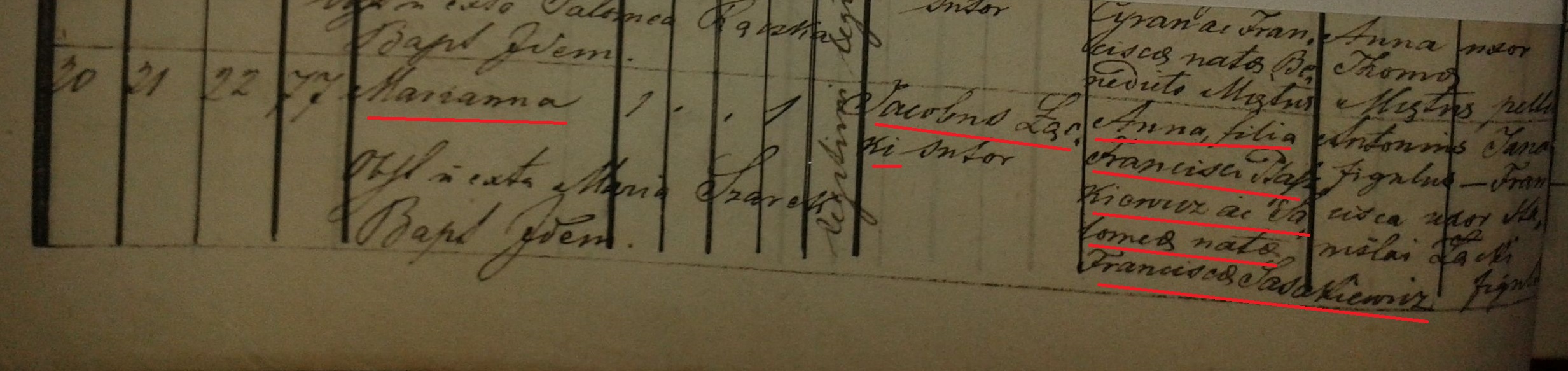
Marianna Łącka’s baptismal record tells us that her father, Jakub/Jacob, was a shoemaker, and that her mother, Anna Ptaszkiewicz, was the daughter of Franciszek Ptaszkiewicz and Salomea Sasakiewicz, who was the daughter of Franciszek Sasakiewicz. Anna (née Ptaszkiewicz) Łącka died in 1879 at the relatively young age of 45,and perhaps her death was a factor in the family’s decision to emigrate. In 1884, the remaining members of the Łącki family left Kołaczyce, and traveled from Hamburg to the port of New York on board the Moravia, arriving on May 6th (Figure 3).7,8

Figure 3:  Hamburg Emigration List showing Jakob Lacki, age 50, Marie Lacki, age 17, Joh. (Jan) Lacki, age 9, and Jos. Lacki, age 24, with previous residence noted as Kołaczyce.7
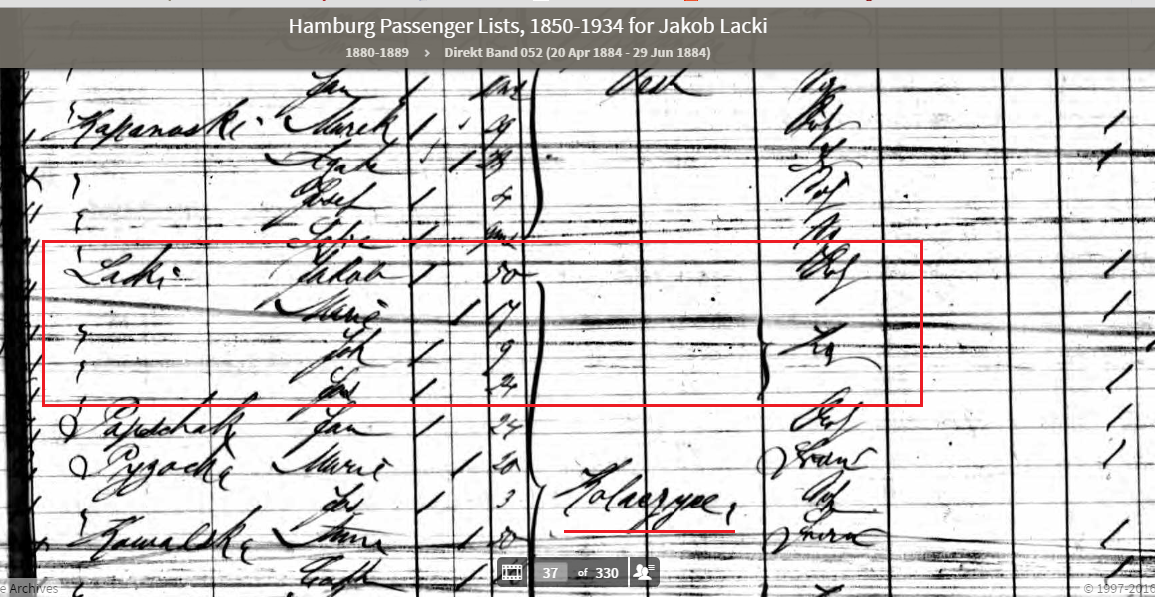
Closeup of Hamburg Emigration record for Lacki family

The Klaus Family of Maniów and Wola Mielecka

Meanwhile, Marianna Łącka’s future husband, Andrzej/Andrew Klaus, migrated to America independently, in 1889.9 Andrzej was born on 25 November 1865 in Maniów, Galicia, Austrian Poland,10 son of Jakub Klaus and Franciszka Liguz. At that time, the village of Maniów belonged to the parish of St. Mary Magdalene in Szczucin, which is where Andrzej was baptized.

Figure 4:  Church of St. Mary Magdalene in Szczucin, Malopolska, Poland, July 2015.IMG_3611
However, in 1981, a new parish was founded in Borki, the Sanctuary of Our Lady of Fatima and the Rosary, and the village of Maniów was reassigned to this parish. All the old records for Maniów were transferred to this new parish, so it was in Borki that I was able to see Andrzej Klaus’s baptismal record10 with my own eyes, when I visited the parish in 2015 (Figure 5). (Note that these records are also available on microfilm until 1 September 2017 from the Family History Library.)

Figure 5: Baptismal record for Andreas Klaus, born 25 November 1865 in Maniów, Dąbrowa County, Galicia, Austria. Godfather’s place of residence, Wola Mielecka, is underlined in red.Andrzej Klaus baptismal record marked

Although Andrzej was born in Maniów, the Klaus family was originally from Wola Mielecka, about 15 miles away, where Andrzej’s father, Jakub, was born, and where his uncle and godfather, Mattheus (Maciej) Klaus was still living at the time of Andrzej’s baptism.11 Andrzej himself also lived in Wola Mielecka just prior to his emigration, as evident from his passenger manifest (Figure 6).12

Figure 6:  Hamburg emigration manifest for Andrzey (sic) Klaus, departing 26 March 1889.12Andrzej Klaus manifest marked

This manifest seems like a good match for “my” Andrzej Klaus — he was reported to be 24 years of age in 1889, suggesting a birth year of 1865, which is consistent with data from other sources, and his year of immigration is consistent with the time frame (1888-1890) which he reported in later census records. The place of residence fits, and although his destination — Plymouth, Pennsylvania — was previously unknown to our family, it’s not unreasonable to believe he might have gone there to work for a while before moving on. However, the problem has been that both Andrzej Klaus and the Łącki family drop out of the records for a time after their respective arrivals in the U.S. Until yesterday, I hadn’t been able to find any trace of Andrzej and Marianna until 1892, when their third child was born. Jakub and Józef Łącki seem to disappear completely, and I don’t find Jan Łącki in a record that I’m certain pertains to him until 1903, when he was naturalized in Pittsburgh, Pennsylvania.

But yesterday, I finally discovered Andrzej and Marianna’s 1891 marriage record, in Buffalo, New York — a place where it was completely unexpected, and yet, makes perfect sense, since the family did eventually settle in Western New York. So why on earth did it take so long for me to find it there? I guess sometimes what we see depends on what we look for, and where we look. I was so focused on documenting the family story of where they were supposed to be, that I didn’t think to check someplace that, in hindsight, seems pretty obvious. Here’s the story.

The Klaus and Łącki families of….Texas? (And St. Louis, and Buffalo, and North Tonawanda)

Back in 1992, I interviewed my grandfather’s cousin, Julia Ziomek, to see what information she could provide about the Klaus family history. Cousin Jul had clearly been the kind of child who sat at the knee of her grandmother, Mary (née Łącka) Klaus, listening to family stories, and I’ve spent the past 25 years trying to document everything she told me. In some cases, she was absolutely accurate. In other cases, she was partially correct — for example, remembering that a particular name was associated with the family, but incorrectly recalling the exact relationship. In still other instances, she was just plain wrong. So it’s difficult to know how much stock to put in her story of the Klaus family origins, but as she told it, Mary Łącka and Andrew Klaus married back in Poland, and lived in Texas when they first arrived in the U.S. It was during this time in Texas that their oldest sons, Joseph and John, were born, but by 1892, the family had moved to St. Louis, Missouri, where their oldest two daughters Anna and Apolonia/Pauline, were born in 1892 and 1894, respectively. Circa 1895, the family moved again to Buffalo, New York, where my great-grandmother, Genowefa/Genevieve, was born in 1897. Two more sons, Edward and Władysław/Walter, were born in Buffalo, before the family finally settled in North Tonawanda, New York, where their youngest children, Rudolf and Helen, were born.

Unfortunately, the timeline is problematic. Even before I found this marriage record in Buffalo, there was pretty good evidence that Cousin Jul was wrong about her grandparents’ place of marriage. Andrew and Mary could not have married in Galicia, since their passenger manifests make it clear that they emigrated separately. Could those be the wrong manifests, after all? It seems unlikely. I spent years looking for a manifest that supported the scenario of Andrzej and Marianna Klaus migrating into a southern port such as Galveston or New Orleans, that would be consistent with a first home in Texas, but never found one, nor have I found any evidence for Marianna Klaus traveling under her married name through any port, nor is there a marriage record for them in her home parish of Kołaczyce. In contrast, both the manifest for Andrzej Klaus and the manifest for the family of Jakub Łącki match existing evidence very nicely.

In hindsight, the fact that both Andrew and Mary entered the U.S. through the port of New York should have been more of a clue to look for their marriage record somewhere in New York — for example, in Buffalo, where they were known to have lived later in life. However, a search in city directories for Buffalo between 1889 and 1892 revealed no trace of Andrew Klaus, so until yesterday, I didn’t see much point in checking Buffalo church records for their marriage. Moreover, if I were going to suspect that they’d married somewhere other than Texas, where their first two children were purportedly born, existing evidence would point to Pennsylvania, rather than Buffalo, since Andrew’s manifest mentioned a destination of Plymouth, Pennsylvania, and since Mary’s brother John was naturalized in Pittsburgh in 1903. However, rather than trying to guess where they might have married in Pennsylvania circa 1890, I assumed that Cousin Jul was correct about the family’s general migration pattern from Texas to St. Louis to Buffalo to North Tonawanda, and I reasoned that Andrew and Mary most likely married in Texas prior to Joseph’s birth circa 1890.

Although she was mistaken about Andrew and Mary’s place of marriage, Cousin Jul was spot-on about the Klaus family’s residence in St. Louis. Anna Klaus’s baptismal record from St. Stanislaus Kostka parish in St. Louis (Figure 7) is unmistakeably correct, as is that of her sister, Apolonia/Pauline.13,14 Since Jul correctly identified which Klaus children were born in St. Louis, Buffalo, and North Tonawanda, I had reason to believe her claim that Joseph and John were born in Texas, and it seemed more logical to predict that Andrew and Mary would have married there as well, rather than marrying in Buffalo, and then moving to Texas and St. Louis before returning to Buffalo.

Figure 7: Baptismal record for Anna Klaus from St. Stanislaus Kostka parish, St. Louis, Missouri.13Anna Klaus baptismal record

Don’t Mess with Texas, or Mary Klaus

Another reason why I’ve been inclined to believe Cousin Jul’s claim that the family lived in Texas, despite the difficulties in the timeline, is that she recalled one very specific event from their time there. Jul told me that Texas was a pretty rough place back in the early 1890s, and the locals weren’t always delighted to have Polish immigrant neighbors. A day came when someone was trying to break into the Klaus family’s home by climbing in through a window. Mary Klaus grabbed an axe and cut off the man’s hands. (You go, Grandma Klaus!) It may have been this incident that precipitated the family’s move to St. Louis. I’ve often pondered this story over these many years, because on the one hand, it seems pretty far-fetched. And yet, if ever such a story would be true, it seems more plausible in the Wild West than in any of the other places associated with this family.

Part of the difficulty with tracing my Klaus family in Texas is the fact that there were more than a dozen Polish parishes that existed there by the early 1890s. Rather than searching through the records for all of them, I hoped to find some clue first as to where in Texas they might have lived. Theoretically, this should have been easy, since both Joseph and John were (supposedly!) born there, and one might expect their places of birth to be recorded on their marriage and death records. But as we all know, theory doesn’t always line up with reality.

Evidence for Joseph Klaus

Joseph Klaus (or Claus, a spelling he seemed to prefer) married Mary Brzuszkiewicz (Brooks) in St. Hedwig’s Church in Dunkirk, New York on 16 August 1910.15 According to their marriage record, Joseph was born in Buffalo, New York, circa 1887. His World War I draft registration states that he was born 19 February 1886.16 The 1915 New York State Census (in which his name appears as “Cloos”) also suggests a birth year of 1887, and only states that he was born in the U.S. 17 The 1910 census suggests that he was born circa 1885 in New York.18 In the 1905 New York state census, he was not listed with his family, and it’s unclear whether he was living independently at that point, or if he was merely omitted from the census due to error or miscommunication.19 Joseph Klaus died of influenza on 7 October 1918, and his death certificate states that he was born 25 February 1886 in Buffalo, New York (Figure 8).20

Figure 8: Death certificate for Joseph Claus (sic), indicating birth on 25 February 1886 in Buffalo, New York.20Joseph Klaus death certificate
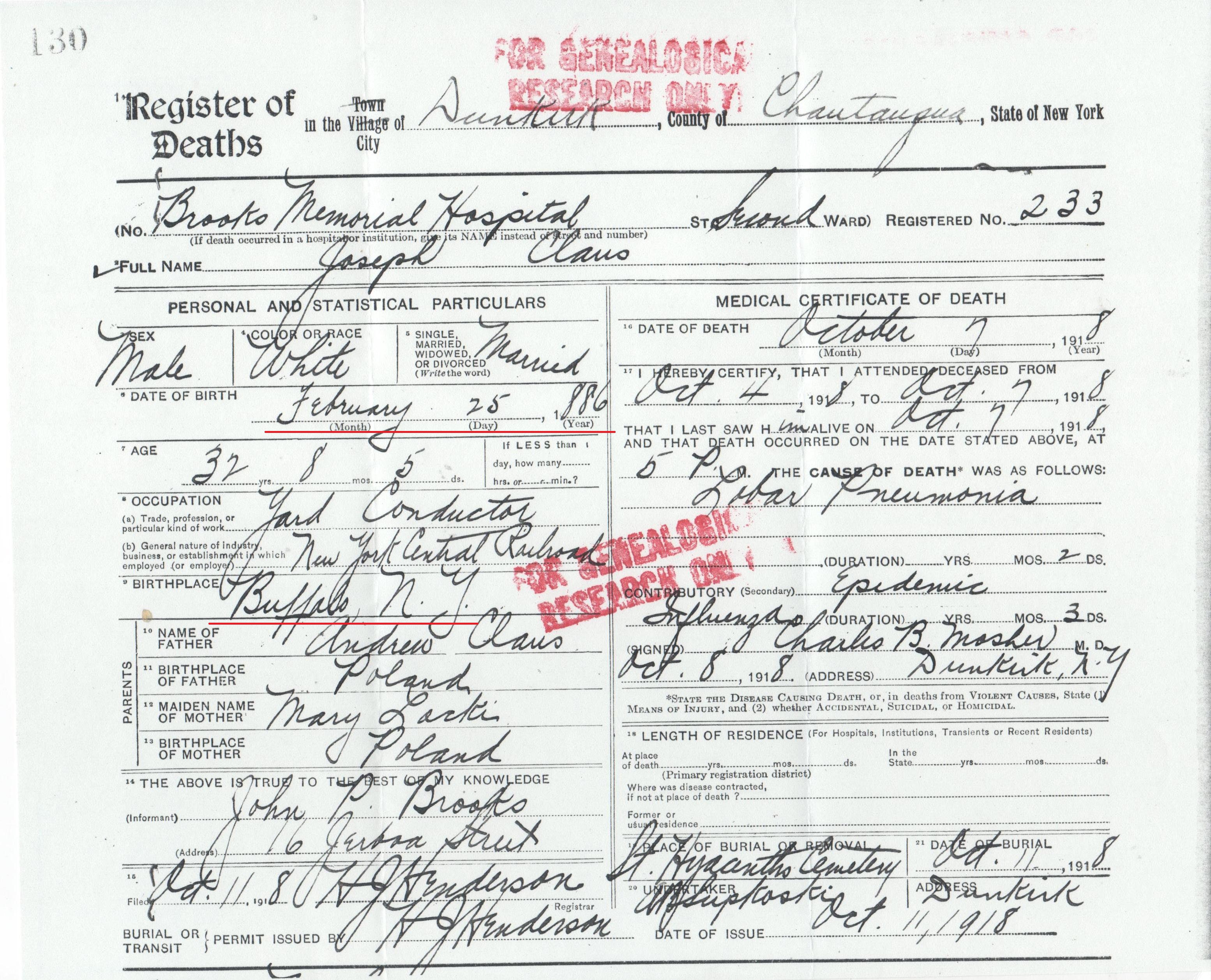
In all these documents, the details such as address, occupation, and parents’ names confirm that they relate to the same individual, despite the misspellings or variant spellings of the surname. Moreover, all these documents point to a date of birth betwen 1885-1887, probably in February of that year, and they all consistently claim that he was born in New York State, probably Buffalo. In light of the new evidence that his parents were married in Buffalo after all, maybe I should finally believe all this documentation and look for his baptismal record in Buffalo?  I’m definitely more inclined to do that now, but I’m still not 100% convinced that the Texas story is completely false. For one thing, these dates of birth are clearly impossible, given that his father didn’t arrive in the U.S. until 1889, so who’s to say that Joseph was not similarly ill-informed about his place of birth? And what about John Klaus? What do the records tell us about his place of birth?

Evidence for John Klaus

John Klaus’s story was even briefer than his brother’s. My grandfather was not even aware of his existence — it was Cousin Jul who first mentioned him, and I’ve since been able to verify his existence. (Score another point for Jul.) Like Joseph, he is not mentioned in the 1905 census with the rest of the family.19 John’s life was documented in only three records that I have discovered to date: his death record, dated 18 June 1905; a newspaper article from the North Tonawanda Evening News, dated 27 January 1905 (Figure 9); and the 1900 census.

Figure 9: North Tonawanda Evening News article mentioning John Klaus.21

John Klaus coal theft

Although this article does not mention his parents’ names, my Klauses were the only family by that name living in North Tonawanda at the time. John Klaus was reported to be 15 years of age in January 1905, suggesting a birth year of 1889-1890. This is consistent with his death certificate, which reports his age as 15 years, 8 months, 3 days when he died on 18 June 1905, from which we can calculate a date of birth of 15 October 1889.22 The death certificate further states that he was employed as a “meter carrier,” that he was born in New York, and was the son of Andrew Klaus and Mary Lenke (sic), both Austrian-born. John died of tubercular meningitis.

Again, we have a problem with the timeline. How is it possible for John Klaus to have been born in New York in 1889? Do we believe the body of evidence gathered for Joseph and John, or do we believe those passenger manifests?

1900 Census to the Rescue!

For me, the 1900 census goes a long way toward resolving this conflict (Figure 10).23

Figure 10: Extract from the 1900 census for Buffalo, New York, showing the family of Andro (sic) Klaus.1900 United States Federal Census - Andrzej Klaus
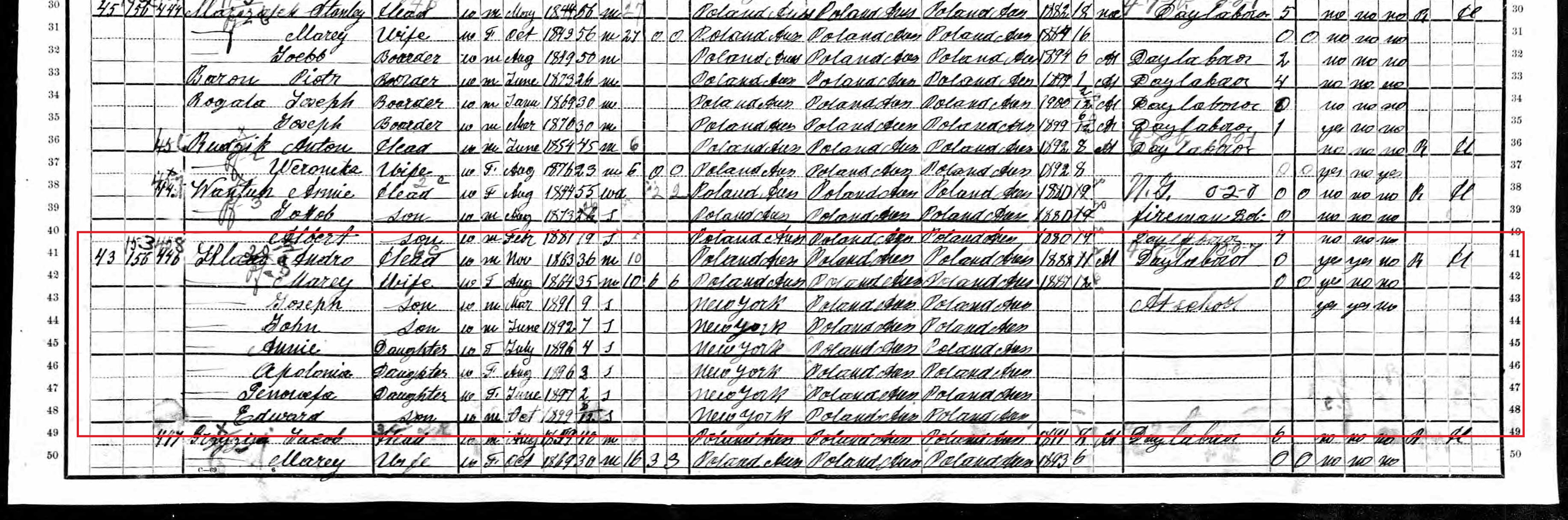
Even though both Ancestry and FamilySearch indexed the family as “Klano,” rather than Klaus, there’s no doubt that this is the correct family. In 1900, the family was living at 43 Clark Street in Buffalo, New York. Andrew reported his date of birth as November 1863, reasonably close to his actual birthdate of November 1865. Similarly, his year of immigration (1888) and place of birth (“Poland-Aus”) were pretty consistent with other evidence. Mary reported that she was born August 1864 in Austrian Poland — a little bit off from her actual date of birth of April 1866, but we can live with it. She reported that she arrived 1887, which is also a little off from her actual arrival date of 1884, but is at least consistent insofar as she confirmed that she arrived in the U.S. before her husband. Andrew and Mary reported that they’d been married for 10 years, suggesting a marriage year of 1890, which fits nicely with the date on the marriage record I just discovered for them, in January 1891 (more on that in a minute).

Turning now to the children’s places of birth, we note with some dismay that all of them were reported to have been born in New York — no reference to Texas here. However, the fact that all the children were reported to have been born in New York — including the two for whom there is documented evidence of birth in St. Louis, Missouri — implies that it’s still quite possible that the oldest two might have been born somewhere other than New York — Texas, for example. All evidence suggests that the Klaus family was anything but affluent — barely making ends meet, even stealing coal to heat their home in January. Perhaps the effort of putting food on the table was sufficiently overwhelming that an accurate accounting of the children’s places of birth was simply not important to them. Who cares where the children were born? Let’s just say they were all born in New York.

Andrew and Mary were equally imprecise when reporting their children’s dates of birth. In this document, we see that 9-year-old Joseph was reported to have been born in March 1891, 7-year-old John was reported to have been born in June 1892, and 4-year-old Annie was reported to have been born in July 1896. Andrew and Mary’s system for estimating their children’s ages seems to have broken down completely by the time they reached Apolonia, since her reported date of birth was August 1896, implying that she was exactly one month younger than her sister Anna. They did somewhat better with the younger children: Genowefa’s date of birth was reported as June 1897, whereas she was actually born 28 September 1897,24 and Edward’s date of birth was reported as October 1899, while his actual date of birth was 11 September 1899.25

Clearly, these dates are off:  We know that Anna was born November 1892, and we know now that Andrew and Mary were married in January 1891. If we assume that children aren’t typically spaced closer than 11 months, that would suggest that John Klaus was born no later than December 1891. This, in turn, suggests that Joseph was either conceived out of wedlock prior to his parents’ marriage in January 1891, or that he and John were twins.  Although twins were common in both the Klaus and Łącki families (Mary’s father, Jacob, was a twin, and Andrew had two younger brothers who were twins), it seems unlikely that such was the case here, since one might expect Andrew and Mary to report on census records that the boys were the same age, even if they couldn’t remember exactly how old they were.

In any case, it’s unlikely that Joseph Klaus was born as early as 1885-1887, as he reported in documents later in life, because there’s a big difference between a child of 9, and a teenager of 13-15. Even if the parents couldn’t remember his exact date of birth, they’d be unlikely to be so far off in reporting his age. On the other hand, according to the proposed timeline, Joseph would have been born in 1890, and John would have been born in 1891, which seems pretty plausible, given their ages reported here.

So what about that marriage record for Andrew and Mary Klaus, and where does this leave us with knowing where Joseph and John might have been born, as well as finding their birth records?

The Rest of the Story

I discovered Andrew and Mary’s marriage record in a wonderful online index to church records from St. Stanislaus parish in Buffalo, created by Kasia Dane. Her index isn’t new, it’s been online for some time now, and I use it frequently. In fact, it’s such a great resource that my Polish friend, Waldemar Chorążewicz, recently reformatted it and added it to the Polish vital records database Geneteka (under “Pozostałe,” at the bottom of the list of provinces on the main search page) to aid Poles seeking their family members who might have immigrated to Buffalo. However, I just hadn’t thought to search for the Klauses in that index until yesterday, for all the reasons mentioned here. It was only in the spirit of leaving no stone unturned that I decided to check the index, never really expecting them to be there. You could have knocked me over with a feather when they actually were.

Figure 10: Entry for the marriage of Andrzej Klaus and Marya Łączka (sic) from Kasia Dane’s index of marriages from St. Stanislaus parish in Buffalo, New York, 1889-1894:

Klaus entry.png

I’m looking forward to getting a copy of the original record on my next trip to Buffalo. (St. Stan’s church records are available on microfilm at the Buffalo and Erie County Public Library.) I’ll also analyze the marriage record more fully in my next blog post, because this one record has prompted some interesting further discoveries. For now, I’ll just conclude by mentioning that I did, of course, check Kasia’s index to baptismal records at St. Stan’s for the baptisms of Joseph and John, and they were not there. In fact, the only Klaus children that were mentioned there were children of Andrew and Mary, all of whom I had documented previously — Genowefa/Genevieve, Edward, Władysław/Walter, and a son, Bolesław, who was born in 1895 and died in infancy.26 This doesn’t necessarily imply that Joseph and John Klaus weren’t born in Buffalo, it only means that they weren’t baptized at St. Stanislaus. Other Polish parishes that were in existence in Buffalo circa 1890-1891 were St. Adalbert’s, founded in 1886, and Assumption in Black Rock, founded in 1888. Records from both these parishes are on microfilm from at the Buffalo and Erie County Public Library, so I’ll be excited to check them out on my next trip to the library.

All in all, I’m thrilled to have finally found Andrew and Mary’s marriage record, even if’s slightly humiliating that it was under my nose all this time. One more piece in the family history jigsaw puzzle has now fallen into place, and my understanding of my ancestors’ journey is a little bit clearer. Whether their migration path took them through Texas for a brief window of two years, or whether that was all a bizarre tall tale, remains to be seen. I’m looking forward to discovering the truth!

Sources:

Featured Image: Wedding photo of Mary Łącka Klaus and her second husband, Władysław/Walter Olszanowicz, 21 November 1916, North Tonawanda, New York. Back Row, left to right: Apolonia/Pauline Klaus Sobuś (Mary’s daughter), holding her son, Edward Sobuś; Stanisław/Stanley Sobuś(Pauline’s husband); Anna Klaus Gworek (Mary’s daughter); Jacob Gworek (Anna’s husband); Genowefa/Genevieve Klaus Zielinska (Mary’s daughter, my great-grandmother).
Front Row, left to right: Julia Sobuś Ziomek (Cousin Jul, daughter of Pauline Klaus Sobuś); Unknown (most probably the groom’s marriage witness, Mary Jedrychanka); Walter Olszanowicz ; Mary Łącka Klaus; Joseph Zieliński (Genevieve’s husband, my great-grandfather); Marie Gworek Glitta (crouching on floor, Anna’s daughter); Helen Klaus (Mary’s daughter)

Roman Catholic Church, St. Anna’s Parish (Kołaczyce, Jasło, Podkarpackie, Poland), “Urodzenia, 1826-1889,” Stare Kopie, 1866, #20, baptismal record for Marianna Łącka.

Maciej Orzechowski, “Kolaczyce Births”, Baptismal record for Joannes Łącki, transcribed from the collection, “Roman Catholic Church records, St. Anna’s Parish (Kołaczyce, Jasło, Małopolskie, Poland), “Urodzenia, 1826-1889,” Stare Kopie, 1864, #36; report to Julie Szczepankiewicz, Hopkinton, Massachusetts.

Roman Catholic Church, St. Anna’s Parish (Kołaczyce, Jasło, Podkarpackie, Poland), “Zgony, 1826-1889,” Stare Kopie, 1864, #55, record for Joannes Łącki.

Roman Catholic Church, St. Anna’s Parish (Kołaczyce, Jasło, Podkarpackie, Poland), “Urodzenia, 1826-1889,” Stare Kopie, 1872, #25, Record for Joannes Łącki.

Roman Catholic Church, St. Anna’s Parish (Kołaczyce, Jasło, Podkarpackie, Poland), “Urodzenia, 1826-1889,” Stare Kopie, 1863, #3, record for Josephus Łącki.

Roman Catholic Church, St. Anna’s Parish (Kołaczyce, Jasło, Podkarpackie, Poland), “Zgony, 1826-1889”, Stare Kopie, 1879, #45, record for Anna Łącka.

Staatsarchiv Hamburg, Hamburg Passenger Lists, 1850-1934 (Provo, UT, USA, Ancestry.com Operations Inc, 2008), http://www.ancestry.com, Staatsarchiv Hamburg; Hamburg, Deutschland; Hamburger Passagierlisten; Microfilm No.: K_1731, record for Jakob Lacki, accessed on 3 August 2017.

New York, Passenger Lists, 1820-1957 (Provo, UT, USA, Ancestry.com Operations, Inc., 2010), http://www.ancestry.com, Year: 1884; Arrival: New York, New York; Microfilm Serial: M237, 1820-1897; Microfilm Roll: Roll 475; Line: 46; List Number: 506, record for Jacob Lacki, accessed on 3 August 2017.

Staatsarchiv Hamburg, Hamburg Passenger Lists, 1850-1934 (Provo, UT, USA, Ancestry.com Operations Inc, 2008), http://www.ancestry.com, record for Andrzey Klaus, accessed on 3 August 2017.

10 Roman Catholic Church, Sanctuary of Our Lady of Fatima and the Rosary (Borki, Szczucin, Dąbrowa, Małopolska, Poland), “Ksiąg Metrykalnych,” 1865, births, #37, record for Andreas Klaus.

11Roman Catholic Church, St. John the Baptist Parish (Książnice, Mielec, Podkparpackie, Poland), Księgi metrykalne, 1615-1919, 1830, #16, baptismal record for Jakub Klaus, FHL film #939982.

12 Staatsarchiv Hamburg, Hamburg Passenger Lists, 1850-1934 (Provo, UT, USA, Ancestry.com Operations Inc, 2008), http://www.ancestry.com, record for Andrzey Klaus, accessed on 3 August 2017.

13 Roman Catholic Church, St. Stanislaus Kostka Parish (St. Louis, Missouri, USA), Church records, 1880-1993, Baptisms, 1880-1923, 1892, #127, record for Anna Klaus, FHL film #1872178.

14 Roman Catholic Church, St. Stanislaus Kostka Parish (St. Louis, Missouri, USA), Church records, 1880-1993, Baptisms, 1880-1923, 1894, #2, record for Apolonia Klaus, FHL film #1872178.

15 New York, Chautauqua, Dunkirk, Office of the City Clerk, Marriage Certificates, 1910, #431, marriage certificate for Joseph Klaus and Mary Brzuszkiewicz, 16 August 1910.

16 U.S., World War I Draft Registration Cards, 1917-1918, (Provo, UT, USA: Ancestry.com Operations Inc, 2005), www.ancestry.com, Chautauqua, New York, Roll: 1712292; Draft Board: 1, record for Joseph J. Claus, accessed 4 August 2017.

17 New York, State Census, 1915 (population schedule), Dunkirk, Chautauqua, New York, Election District 03, Assembly District 02, page 38, Joseph Cloos household, https://www.ancestry.com/, subscription database, accessed 4 August 2017.

18 1910 U.S. Federal census (population schedule), Dunkirk, Chautauqua, New York, E.D. 115, sheet 14B, Joseph Cloos in Elizabeth Couhig household, https://familysearch.org, accessed 4 August 2017.


19 New York, State Census, 1905 (population schedule), North Tonawanda, Niagara, New York, Election District 01, page 60, Anderes Kraus (sic) household, https://www.ancestry.com/, subscription database, accessed 4 August 2017.

20 New York, Chautauqua, Dunkirk, Office of the City Clerk, Death Certificates, 1918, #130, death certificate for Joseph Claus, 7 October 1918.

21 “Coal Thieves Were Fined,” The Evening News (North Tonawanda, New York), 27 January 1905, p. 1, https://fultonhistory.com.com, accessed 4 August 2017.

22 New York, Niagara, City of North Tonawanda, Office of the City Clerk, Death Certificates, 1905, #2016, death certificate for John Klaus, 18 June 1905.

23 1900 U.S. Federal census (population schedule), Buffalo, Erie, New York, E.D. 84, sheet 28A, Andro Klano (sic) household, https://familysearch.org, accessed 4 August 2017.

24 Roman Catholic Church, St. Stanislaus Parish (Buffalo, Erie, New York, USA), Baptisms, 1874-1903, 1897, #620, baptismal record for Genowefa Klaus.

25Roman Catholic Church, St. Stanislaus Parish (Buffalo, Erie, New York, USA), Baptisms, 1874-1903, 1899, #396, baptismal record for Edward Klaus.

26 Roman Catholic Church, St. Stanislaus Parish (Buffalo, Erie, New York, USA), Baptisms, 1874-1903, 1895, #757, record for Bolesław Klaus.


© Julie Roberts Szczepankiewicz 2017

The Sad Tale of the Zieliński Family of Mistrzewice

“Happy families are all alike; every unhappy family is unhappy in its own way.” — Leo Tolstoy, Anna Karenina

Stanisław Zieliński was born on 6 April 1863, the third child and oldest son of the known children of Michał Zieliński and Antonina Ciećwierz. He married Marianna Kalota, daughter of Roch Kalota and Agata Kurowska, circa 1885, probably in Marianna’s home parish of Młodzieszyn. Unfortunately, most vital records for Młodzieszyn were destroyed, including all marriage records prior to 1889, which likely explains why their marriage record has not been found.  The Zieliński family were ethnic Poles living in historically Polish lands that were at that time part of the Russian Empire. Like his father, Michał, Stanisław Zieliński was a gospodarz, which Shea and Hoffman define as a “farmer (one fairly well off, owning his own land), landlord.”Stanisław and Marianna made their home in Mistrzewice, where his parents were living, rather than in the nearby village of Budy Stare, where Marianna was born.

On 16 September 1886, Stanisław and Marianna welcomed their first child:  a son, Franciszek.  A second son, Antoni, was born on 6 May 1889. However, he only lived for a year and 5 months before passing away on 5 October 1890.  Families were all too accustomed to high infant mortality in those days, so perhaps it was some consolation to Marianna and Stanisław that she was already pregnant with their third child as they buried little Antoni.  Their third son, Piotr, was born on 4 May 1891, but his death was recorded in the parish books of Mistrzewice only one week later.

Little Franciszek had already turned six years old when his brother Józef was born on 10 October 1892. Two years later, on Christmas Eve, another brother, Szczepan, joined the family. Stanisław and Marianna welcomed two more sons, Władysław and Jan, on 20 March 1897 and 20 March 1899, respectively, and then three daughters were born:  Władysława, on 25 June 1901, Marianna, on 14 September 1903, and Zofia, on 25 November 1907.  Sadly, little Marianna lived for just two and a half months2 before she joined her brothers Antoni and Piotr in the parish cemetery.

In March of 1907, Franciszek decided to head out into the world and seek employment opportunities in America.  A young man, 21 years of age, he had already completed three years of compulsory military service in the Russian infantry, which was a distasteful obligation for most Poles. It’s not clear what factors influenced him in his decision to leave his homeland, but at the end of March in 1907, Franciszek departed from the Port of Bremen, arriving at Ellis Island on 7 April 1907. He was bound for Buffalo, New York.

There is some evidence to suggest that Frank’s younger brother, Joseph, joined him in the U.S. circa 1909 and then returned to Poland prior to his “official” arrival in the U.S. in 1912. The best match for Frank Zielinski in the 1910 U.S. census was to a man who was boarding with Anthony and Mary Lapinski in Buffalo, New York, along with another boarder, Joseph “Rzolek,” — and one Joseph Zielinski, all immigrants from Russian Poland. In this document, Frank and Joseph Zielinski are reported to be ages 26 and 20, respectively, suggesting birth years of 1884 and 1890, making them both exactly two years older than expected for my relatives. Frank reported arriving in the U.S. in 1906, while Joseph reported arriving in 1909. (No good match for his passenger manifest circa 1909 has been located as of yet.) Both men were working in a foundry (possibly Lackawanna Steel Company), Frank as a molder and Joseph as a core maker.  These occupations are interesting in light of the fact that Joseph reported his occupation as molder on the record of his 1915 marriage to Genevieve Klaus. Nonetheless, Zielinski is a very common Polish surname — so much so that the 1925 New York State Census shows a 35-year-old boarder named Joseph Zielinski living with the family of my great-grandparents Joseph and Genevieve Zielinski in North Tonawanda. When I asked my grandfather, John Zielinski, about that boarder, he remembered the man and insisted he was not a relative, it was just a crazy coincidence.

There is no evidence to suggest that Frank returned to Poland after his arrival in the U.S. in 1907. However, if the Joseph in the 1910 census is my great-grandfather, then he must have gone back to Poland some time after April 27, 1910 and then returned to the U.S. on 3 September 1912 on the S.S. Grosser Kurfürst, which is the date which corresponds to his arrival per his naturalization papers. The passenger described on this manifest is an incontrovertible match to my great-grandfather. On line 3, “Josef Zelinski” is reported to be a 20-year-old Pole from Russia whose last residence was “Mestanice,” and whose father, Stanisław Zelinski, was living in “Mistrzewice, Warsaw.” Joseph was headed to North Tonawanda, New York, and the second page reveals that he was specifically headed to his brother, Franciszek Zielinski at 7 Sawyer Avenue. His place of birth was recorded as something vaguely akin to “Mistrzewice.” Interestingly, Joseph’s answers to the questions about any previous travel to the U.S, support the idea that he was not in the U.S. previously, and it’s difficult to state with certainty that the Joseph Zielinski in the 1910 census is indeed the same man.

By 1915, Frank was boarding with the family of Joseph and Mary Brodowski at 65 7th Avenue in North Tonawanda and working as a laborer in the steel mill.  His brother Joseph was similarly working in the steel mill while boarding down the street with the family of Peter and Bronisława Kwiatkowski at 44 7th Avenue in North Tonawanda — but not for long.  On 5 October of that year, Joseph married 18-year-old Genowefa (Genevieve) Klaus.

Figure 1:  Józef Zieliński and Genowefa Klaus, 5 October 1915, North Tonawanda, New York.Genowefa Klaus and Jozef Zielinski wedding.jpg

Joseph’s brother, Frank, seated on the bride’s left, was his best man (Figure 2).

Figure 2:  Wedding party of Józef Zieliński and Genowefa Klaus, 5 October 1915. Genevieve Klaus & Joseph Zielinski wedding party

Genevieve was born in North Tonawanda to Andrzej and Marianna (née Łącka) Klaus, Polish immigrants from the Galicia region of the Austrian Empire. As Józek and Genia (Joe and Jenny, as they were called in English) settled into married life, however, his family in Poland was experiencing dark days. World War I was raging in Europe, and Mistrzewice, situated in the path of the advancing German army on its way to Warsaw, found itself in the midst of battle. The period from December 1914 through July 1915 witnessed the harshest devastation at the hands of both the Germans and the Russians.  German soldiers stripped homes and farms in Mistrzewice, Młodzieszyn, and the surrounding villages of whatever materials they could repurpose for the building of fortifications and trenches. As the Germany army advanced, many Polish peasants became refugees, fleeing eastward in the hope of survival.  However, as the Russian army retreated, they were ordered to “expel the ‘enemy’ nations within,” killing Poles, Jews, and other ethnic groups in keeping with the Tsarist policy of ethnic homogenization. It is estimated that 70,000 soldiers were killed on both sides during this battle of the Rawka-Bzura, some of whom were buried in the cemeteries in Mistrzewice and Młodzieszyn, and there are no good estimates for the number of civilian peasants from this area who were casualities of the war.

It was on August 13 of that year that Frank and Joseph’s youngest sister, 7-year-old Zofia, died. Her death certificate does not reveal her cause of death. Did she die of some childhood illness like her siblings?  Was her death a direct cause of the war — being in the wrong place at the wrong time, a victim of a stray bullet? Or did her family try to flee the village, and she perished as a result of the typhus, choleratyphoid, malaria, or dysentery that were prevalent among both soldiers and refugees? What is clear from her death record is that her death was not reported until 31 December 1915 because of the war (Figure 3).

Figure 3:  Death record from Młodzieszyn for Zofia Zielińska, 1915.Zofia Zielinska death 1915 cropIn translation, this document states,

“#102. Mistrzewice. This happened in the village of Młodzieszyn on the thirty-first day of December in the year one thousand nine hundred fifteen at five o’clock in the afternoon. They appeared, Piotr Szewczyk, age fifty, and Ludwik Grzegorek, age sixty-eight, farmers residing in the village of Mistrzewice, and stated that, on the thirteenth day of August in the year one thousand nine hundred fifteen, at six o’clock in the afternoon, died in the village of Mistrzewice, Zofia Zielińska, a girl having seven years of age, daughter of Stanisław Zieliński and Marianna nee Kalota, the spouses Zieliński, land-owning farmers residing in the village of Mistrzewice; born and residing with her parents in the village of Mistrzewice. The delay in the registration of this act happened due to the war. After confirmation of the death of Zofia Zielińska, this document was read aloud to the witnesses but was signed only by Us. [Signed] Fr. K. Kopański, administrator of Młodzieszyn parish performing the duties of civil registrar.”

Just four months after Zofia’s death and two months after his son Joseph’s wedding in North Tonawanda, Stanisław Zieliński passed away on 23 December 1915.3  At the time of his death, his sons Szczepan, Władysław and Jan were 21, 18 and 16, respectively, and daughter Władysława was 14 years old. It’s not clear how, or if, the boys managed to avoid conscription into the Russian Army. Szczepan’s death record in June of 1916 mentions only that he was born in the village of Mistrzewice and was residing there with his mother (Figure 4).

Figure 4:  Death record from Młodzieszyn for Szczepan Zieliński, 1916.4Szczepan Zielinski death 1916 cropTranslation:

“#78. Mistrzewice. This happened in the village of Młodzieszyn on the sixteenth day of June in the year one thousand nine hundred sixteen at six o’clock in the morning. They appeared, Piotr Szewczyk, age sixty, and Ludwik Grzegorek, age sixty-two, farmers residing in the village of Mistrzewice, and stated that, on the fourteenth day of June in the current year, at six o’clock in the morning, died in the village of Mistrzewice, Szczepan Zieliński, bachelor, aged twenty, son of Stanisław and Maryanna nee Kalota, the spouses Zieliński, landowning farmers; born in the village of Mistrzewice and residing there with his mother. After eyewitness confirmation of the death of Szczepan Zieliński, this document was read to the illiterate witnesses and was signed only by us.[signed] Administrator of the parish of Młodzieszyn acting as civil registrar, Fr. Kaj. Kopański.”

Although no mention is made of military service, it is nonetheless possible that the Szczepan was fighting in the war.  A genealogist friend in Poland explained that death records would sometimes state that the deceased was a soldier, and indicate what country he was killed in, but that it depended on the priest.  Many priests were afraid to disclose such information. In the parish of Baranowo, he explained, a priest was killed by a Russian officer for singing the song, “Boże, coś Polskę” Many people lived in fear.

Meanwhile, in North Tonawanda, Joe and Jenny welcomed their first child, John Frank Zielinski (my grandfather), on 18 October 1916 (Figure 5).

Figure 5:  John Frank Zielinski, circa early 1917.John Zielinski circa 1916

But while the family in North Tonawanda thrived and grew, the family in Mistrzewice continued to suffer, and on 13 April 1917, Joe Zielinski’s brother Jan died at the age of 18 (Figure 6).5 

Figure 6:  Death record from Młodzieszyn for Jan Zieliński, 1917.Jan Zielinski death 1917 crop

Again, no mention was made of the cause of death, and whether it was a direct or indirect result of the war. The record only states that he was born in the village of Mistrzewice in the local parish and was living there with his mother.

On 6 April 1917, the U.S. declared war on the German Empire, and in June of that year, Joseph and Frank were required to register for the draft. As resident aliens, they were supposed to be placed in Draft Class V:  Exempt and Ineligible. However, local draft boards had the authority to assign draft classes on a case-by-case basis, and Frank Zielinski’s status as a single man with prior military experience and no dependents made him a desirable candidate for the draft, regardless of the fact that he was a Russian citizen. The particulars of Frank’s military story are an interesting tale in themselves (and a topic on which I’ve lectured previously), and deserve to be told in depth at another time. But as his service record indicates, Frank was inducted on 24 February 1918, and sent overseas on 7 April 1918 as a member of the 307th Infantry Regiment, Company C. Frank Zielinski was killed in action on 25 October 1918, shot through the head by a sniper’s bullet.6 The oldest son of Stanisław and Marianna Zieliński is buried in the Meuse-Argonne American Cemetery in Romagne-sous-Montfaucon, France, although available evidence suggests that he was never naturalized, and there is no evidence to suggest that he ever wished to be an American citizen (Figure 7).

Figure 7: Gravesite of Frank Zielinski.MA-Zielinski, Frank, C-14-10

Joe and Jenny Zielinski’s second child, Frank Walter, was born  on 2 September 1918, named after his uncle who was serving in the war.  The following spring, Joseph Zielinski filed his Declaration of Intent to Naturalize on 18 March 1919. 7 His family in North Tonawanda was growing, and he must have felt that life in the U.S. was good.  As further evidence of Joe’s intentions to remain in the U.S., correspondence with the U.S. Quartermaster General’s office, dated 13 March 1919, indicates that Joe wished to have his brother’s remains returned home for burial in North Tonawanda (Figures 8a and 8b), although he was concerned about the expense of shipping the body.8 

Figure 8a:  First page of letter from Joseph Zielinski to the Quartermaster General’s Office, dated 13 March 1919.Page 23 March 13 1919 Letter from Joseph Zielinski cropped

Figure 8b:  Second page of letter from Joseph Zielinski to Quartermaster General’s Office.Page 24 Letter from Joseph Zielinski p 2

As the family flourished in the U.S., it continued to diminish in Poland. That autumn, on 30 September 1919, Joe’s 17-year-old sister, Władysława, died in Mistrzewice.7 Her death left only 22-year-old Władysław to manage the family farm and care for his aging mother, Marianna. However, eighteen months later, tragedy struck the Zieliński family in Poland once more, as Władysław Zieliński died on 23 March 1921, a few days after his 24th birthday.10  It’s difficult to imagine what a great loss this must have been for Marianna.  She had borne 10 children, and 9 of them preceded her in death, including 8 children who died before the age of 30. Her only surviving son was living in the U.S., leaving her alone in Poland to manage the farm as a 64-year-old widow.

Władysław’s death was almost certainly the impetus for Joe Zielinski’s decision to move his family back to Poland. Although his uncle’s death was not mentioned by my grandfather, Grandpa clearly remembered traveling to Poland as a young boy, and living there for a period of time that he remembered as about 6 months. Their exact departure date is not known, but they were definitely gone by 28 April 1921.  Additional correspondence from Frank Zielinski’s burial records file indicates that a letter sent to Joe Zielinski was returned on that date, marked “undelieverable” by the Post Office in North Tonawanda with the additional note, “Old Country” (Figure 9):

Figure 9:  Copy of envelope returned to the Quartermaster General’s Office by the North Tonawanda, New York post office.Page 31 Apr 28 1921 Envelope to Jos Zielinski marked undeliverable.jpg

When they departed for Poland in the spring of 1921, Joe and Jenny’s family included 4 1/2 year old John, almost-3-year-old Frank, and baby Helen, born 2 August 1920.  Jenny was also newly pregnant with their fourth child, Stanley Joseph (named after his paternal grandfather Stanisław and his father), who would be born on 11 November 1921. The family traveled on board the R.M.S. Olympic — sister ship to the Titanic (Figures 10a and 10b).

Figure 10a: Original postcard from the Zielinskis’ voyage to Poland, showing the Olympic.R.M.S. Olympic postcard

Figure 10b:  Reverse of the postcard.Reverse of postcard from RMS Olympic

Although he was very young, my Grandpa vividly remembered certain experiences from the trip:  tasting bananas for the first time on board the ship, chasing oranges that the sailors would roll across the ship’s deck for the children, and staring at all the soldiers’ helmets still lying in the creek behind his grandmother’s farm, a grim reminder of the recent war. He recalled riding in a horse-drawn wagon to the markets in Sochaczew and Warsaw. And he remembered his grandmother, Marianna, as a rather unkind woman.  This impression was confirmed by Grandpa’s maternal cousin Julia Ziomek, who was three years older than he, and who shared with me her memories of conversations with her Aunt Jenny about that trip to Poland.  Julia’s stories suggest that Joe and Jenny may have considered this as a permanent relocation.  She recalled that Aunt Jenny had shipped packages of household supplies to Poland in advance of their journey, with the expectation that her mother-in-law would keep these things and have them ready for Jenny to set up housekeeping upon their arrival.  Instead, Marianna deemed the items unnecessary, and donated them to the parish priest, which caused some consternation upon Jenny and Joe’s arrival. Cousin Julia also recalled Jenny’s comments about the unkindness of her mother-in-law to her children, scolding them harshly and calling them “dim-witted.” After only a few months, Jenny was ready to go back home to North Tonawanda, and apparently, Joe was persuaded. On 10 August 1921, my American-born grandfather entered Ellis Island with his family to resume the life they’d left behind.

Marianna Zielińska’s remembered harshness seems much more understandable in light of these new death records that tell the whole story of her suffering and loss.  One can easily forgive a lack of patience with the children, given that she had just buried her ninth child when my grandfather and his family arrived in Poland.  Perhaps she was embittered by so much loss and heartbreak, leaving her fearful of becoming emotionally close to her grandchildren. Perhaps Joe and Jenny tried to persuade her to sell the farm and return with them to North Tonawanda, and Marianna’s ill-temper arose from the stress of having to choose between her surviving son and her homeland.  Although those details are lost, it is known that Marianna remained in Poland, moving in with her sister in Budy Stare. She died on 4 April 1936 (Figure 11).11 

Figure 11:  Death record from Młodzieszyn for Marianna Zielińska, 1936.Marianna Zielinska death 1936Translation:

“No. 16, Budy Stare. It happened in Młodzieszyn on 4th April 1936 at 8:00 in the morning. They appeared, Stanisław Wilanowski, age 40, farmer of Mistrzewice, and Kazimierz Tomczak, farmer of Juliopol, age 26, and stated that, on this day today, at 5:00 in the morning, in Budy Stare, died Marianna née Kalota Zielińska, widow, age 79, born and residing with her sister in Budy Stare, daughter of the late Roch and Agata née Kurowska, farmers. After eyewitness testimony to the death of Marianna Zielińska, this document was read aloud to the witnesses but signed only by us. Pastor of the Parish of Młodzieszyn acting as Civil Registrar.”

Rest in peace now, Marianna.  Your story has been told.

Sources:

Where possible, sources are linked directly within the text. Citations for sources not available online appear below.

1 Jonathan D. Shea and William F. Hoffman, In Their Words:  A Genealogist’s Translation Guide to Polish, German, Latin and Russian Documents:  Volume I:  Polish, (New Britain, CT: Language & Lineage Press, 2000), p. 305.

Akta stanu cywilnego parafii rzymskokatolickiej w Młodzieszynie, 1903, #102, death record for Marianna Zielińska.

Akta stanu cywilnego parafii rzymskokatolickiej w Młodzieszynie, 1915, #101, death record for Stanisław Zieliński.

Akta stanu cywilnego parafii rzymskokatolickiej w Młodzieszynie, 1916, #78, death record for Szczepan Zieliński.

Akta stanu cywilnego parafii rzymskokatolickiej w Młodzieszynie, 1917, #20, death record for Jan Zieliński.

Report from Private Henry Davies regarding Frank Zielinski’s cause of death, Records of the Quartermaster General’s Office, 1915-1939, Burial Case File for Private Frank Zerlintski, serial number 1680271, Record Group 92, National Archives Identifier 595318, National Personnel Records Center, St. Louis, Missouri.

Niagara, New York, Naturalization Records, Declarations of Intent to Naturalize, #4244, record for Joseph Zielinski, 18 March 1919.

8 Letter from Joseph Zielinski to the Quartermaster General’s office regarding disposition of remains of Private Frank Zielinski, dated 13 March 1919, Records of the Quartermaster General’s Office, 1915-1939, Burial Case File for Private Frank Zerlintski, serial number 1680271, Record Group 92, National Archives Identifier 595318, National Personnel Records Center, St. Louis, Missouri.

Akta stanu cywilnego parafii rzymskokatolickiej w Młodzieszynie, 1919, #75, death record for Władysława Zielińska.

10 Akta stanu cywilnego parafii rzymskokatolickiej w Młodzieszynie, 1921, #24, death record for Władysław Zieliński.

11 Akta stanu cywilnego parafii rzymskokatolickiej w Młodzieszynie, 1936, #16, death record for Marianna Zielińska.

© Julie Roberts Szczepankiewicz 2017