“Grandma said she was from Poznań”: Decoding Stories About Ancestors from Poland

Most of us use family stories as the starting point for our genealogy research. However, the truth can sometimes get distorted, and it’s our job as family historians to sort out the historical fact from the fiction.  With that in mind, I’d like to offer some suggestions based on common misinterpretations, to help you decode those family stories and understand what Grandma really meant.

Story:  “Grandma said she was from Poznań.”

Analysis:  Most of our ancestors were from small villages, not big cities, so in all likelihood, Grandma didn’t mean she was from the city of Poznań proper.  Often an immigrant would generalize her place of birth to the closest big city under the assumption that her listener wouldn’t recognize the name of whatever small village she was actually born in.  We still do this today:  if I’m talking with someone who’s not familiar with Western New York, I might say, “I’m originally from Buffalo,” although it would be more accurate to say that I used to live in Williamsville, a village about 12 miles east of the city of Buffalo itself.  When I’m talking with another Western New Yorker, I can be more specific. In my family history, the Great-Grandma who said she was from Poznań was from the village of Kowalewo-Opactwo, about 48 miles east. Looking for her in records from the city of Poznań itself would be an exercise in frustration and a waste of time.

Story:  “On Great-Grandpa’s World War I draft registration, he stated that he was from Płock, but on his passenger manifest he said that he was from Bieżuń.  Which one do I trust?”

Analysis:  Both.  Sometimes our ancestors referenced a larger administrative division rather than the smallest one, just as I might sometimes say I was born in New York, rather than Buffalo.  Gather all the bits of evidence for your ancestor’s place of origin, then check a gazetteer to see if they can be reconciled.  In this example, the village of Bieżuń was the seat of gmina Bieżuń within the Sierpc powiat and the Płock gubernia of Russian Poland.  (A gmina is an administrative division similar to a township, serving multiple small villages, but smaller than a powiat, which is comparable to a county.  A gubernia is like a province.)  Consequently, any reference to Bieżuń, Sierpc, or Płock on documents pertaining to Great-Grandpa’s place of birth might be consistent with the same location.  Not sure which gazetteer to use?  Check out the section entitled “Maps, Phonetic Gazetteers, and Period Gazetteers” in this previous post.

Story:  “Grandpa was Polish, and he was born somewhere near the Russian border.”

Analysis:  As discussed in a recent post, Poland didn’t exist as an independent nation from 1795 until 1918.  So statements like this one, which presuppose that Grandma was born in Poland near the border with Russia, are immediately suspect.  In most cases, “near the Russian border” means somewhere in Russian Poland – either the Kingdom of Poland or the Kresy (the eastern borderlands that were part of Poland between the world wars). Similarly, “near the German border” suggests Prussian Poland, and “near the Austrian border” suggests Galicia.

In my experience, these “border” stories were an attempt to reconcile the apparent conflict between the fact of someone’s Polish ethnicity and his documented Prussian (for example) nationality.  Grandpa may have come from someplace solidly within Prussian Poland, not particularly close to the actual border with Russia, but nonetheless the “border” stories persist.  Since ethnicity has more to do with language, culture, and religion than with citizenship, even if Grandpa was a citizen of Prussia, we should not infer that he was ethnically German, for the same reason that I would not suddenly become an ethnic Mexican if Mexico were to invade the U.S. tomorrow.

Story:  “Great-Grandma’s passenger manifest from 1900 says she was 20, but the 1930 census says she was only 45. Therefore she must have lied about her age on the census.”

Analysis:  I always cringe when I hear accusations that ancestors lied about their age. Unless it’s something really egregious, I like to give Grandma the benefit of the doubt and assume that any discrepancy was an innocent mistake, rather than assuming an intent to deceive. In rural, agrarian society it just wasn’t necessary to know one’s birthdate precisely, and many of our ancestors didn’t know their exact birthdate, or they might remember the day, but not the year.  When evaluating records for your Polish ancestor, it’s not uncommon for someone’s reported age to be off by a few years in either direction.  This is as true in records from Poland as it is in U.S. records.  For example, many parish priests had a tendency to round the ages of declarants and witnesses, which is evident when all the key participants just happen to be 30, 40 or 50 with nary an odd-numbered age in the bunch.

Story: “Great-Grandpa Albert must have lied about his birthdate.  He said it was in April, but I found his baptismal record from Poland and he was actually born in September.”

Analysis:  This is a corollary to the situation described above, but with a twist.  Many Americans don’t realize that in Polish culture, name days were traditionally more important than birthdays.  Name days (imieniny) are the designated feast days dedicated to canonized saints within the Roman Catholic church.  For example, the feast of St. Adalbert is celebrated on April 23, so men named Albert/Adalbert or Wojciech (the equivalent of this name in Polish) would be celebrated on that day, regardless of when their actual birthdays were.  In practice, the feast day calendar sometimes influenced the choice of names given to a child, with parents naming their child after a saint whose feast day was on or close to the child’s actual date of birth.  However, your mileage may vary with this.  In some cases, multiple saints bore the same name throughout history, e.g. St. John the Evangelist, St. John the Baptist, St. John Kanty, St. John of God, St. John Nepomucene, etc., so the same name might have multiple feast days associated with it throughout the year.  In this case, there’s really no way of knowing just which Saint John was your ancestor’s patron unless it is specified in his baptismal record.

Story:  “I’d love to find Grandma’s birth record in Poland, but I’ve heard it’s no use, because all the records were destroyed in the wars.”

Analysis:  This misconception has prevented many a family historian from trying to explore his roots in Poland.  I’ll be honest — at one point, I fell for it, too.  Back in the earlier days of my research, I determined that my great-grandfather, Józef Zieliński, was born in the village of Mistrzewice, in Młodzieszyn township.  Thanks to the old Rootsweb genealogy mailing lists, I found another researcher who was also interested in the Zieliński surname in Młodzieszyn.  He’d been to Poland, visited the parish, and assured me that all records prior to 1945 were destroyed.  This was about 12 years ago, before it was easy to check online for availability of records in the Polish State Archives, and back before anything much was online, so I don’t blame that researcher at all.  He was going on the best information that he had, but it’s up to each of us to do our own due diligence.  At that point, I assumed that I would never learn anything more about my Zieliński family in Poland, and with a heavy heart, I moved on to other lines of research.

It wasn’t until 2012 that I discovered that some records for Mistrzewice and Młodzieszyn did survive the war, and were indexed on Geneteka. (If you’re interested, that story is told here).  Admittedly, the range of years covered by the surviving records is limited, but between these documents and some letter-writing to the local civil registry office (Urząd Stanu Cywilnego, or USC) in Młodzieszyn, I was able to add another 1-3 generations of ancestors (depending on the line) to my Zieliński family tree.  If I’d believed the story that all the records were destroyed and had stopped looking, I’d have missed out.

These are a few examples of common misunderstandings that I’ve heard from people as they begin to research their Polish ancestry.  What about you?  What are some misunderstandings that you had when you began your research?  What are the stories in your family that you’ve discovered weren’t quite accurate, once you dug a little deeper?  I’d love to hear from you in the comments!  In the meantime, happy researching.

Featured photo credit:  Detail of map, “Posen 1905”, courtesy of Wikimedia Commons, is in the public domain.

© Julie Roberts Szczepankiewicz 2017

Godparents: Ideal Candidates for Analysis Via the FAN Principle

Who were your ancestors’ FANS?  Genealogist Elizabeth Shown Mills first suggested this handy acronym for Family, Associates, and Neighbors and explained, “To prove identity, origin and parentage, study individuals in the context of their FAN club.”1 When it comes to researching my Catholic ancestors, some of my favorite FANS include the godparents that are named on their children’s baptismal records.

Why Godparents?

According to Catholic Canon Law, godparents must be baptized and confirmed members of the Catholic Church who have received the Eucharist.  They must also be at least 16 years of age, although exceptions can be granted, and they may not be the same as the parents.  Typically there is one godfather and one godmother, although sometimes additional godparents were named, especially for the baptism of a noble child.  Godparents were often relatives of the child, as is still the practice today, although there is no requirement for this, and it’s not uncommon for parents to ask close friends to serve as godparents.  Depending on the family culture, godparents might be a married couple, or one might come from the father’s side of the family and one from the mother’s side.  The role of godparents is to provide spiritual support to the parents as they raise their child in the Catholic faith, and some families have an understanding that the godparents will assume financial responsibility for the child in the event of the parents’ death.  Since this is such an important role, godparents are clearly worthy of some of our attention as genealogists.

Godparents are also especially noteworthy as FANs because one of them is usually a woman, which can provide clues about women’s married names in the era before women were commonly named as legal witnesses. Let’s examine some of the ways in which godparents can shed some light on questions of identity in genealogical problems.

The Naciążek Family, Revisited

In my last post, I wrote about my great-great-grandmother, Antonina (née Naciążek) Zarzycka, the frustrating lack of birth, marriage or death records for her, and why it’s possible that her birth and marriage records might no longer exist, based on where those events were likely to have taken place.  I also examined evidence regarding a contemporary of hers named Marianna (née Naciążek) Kowalska, who is likely to be a relative based on the rarity of the surname and the geographic proximity of her village of residence to that of Antonina.  However, one piece of evidence I did not examine in that post was the issue of godparents:  If Antonina Zarzycka and Marianna Kowalska were cousins or even sisters, as I suspect, then one would expect each of them to be named as a godmother to a child or children of the other.  So what do the records say?

Unfortunately, there are no baptismal records available for the five known children of Marianna (née Naciążek) Kowalska.  That leaves the baptismal records for the eleven children of Antonina (née Naciążek) Zarzycka, which are summarized in Figure 1.

Figure 1: Summary of Godparents of Children of Ignacy Zarzycki and Antonina (née Naciążek) Zarzycka.figure-1

And there we have it — the “smoking gun” is the godmother of Florentyna Zarzycka — Marianna Kowalska.  Kowalski (in combination with the feminine form of the name, Kowalska) is a very popular surname, and if we were to consider only the names of the godparents in absence of other data, it would not be obvious which Marianna Kowalska was meant here.  However, in light of the other evidence that Antonina had a cousin or sister with this name who lived nearby, it seems likely that these Marianna Kowalskas are one and the same.

So who are these other godparents?  There is documentary evidence that Ignacy Zarzycki had just three siblings:  a brother Wincenty, and twin siblings Wojciech and Wiktoria.  Wiktoria’s first husband was Ludwik Karol Pszenicki, and Wojciech’s wife was Aniela Tempińska,. so it’s reasonable to conclude that those four godparents — Aniela Zarzycka, Wojciech Zarzycki, Wincenty Zarzycki, and Wiktoria Pszenicka — were siblings to Ignacy Zarzycki by blood or marriage.

Unfortunately, for the rest of the list, there are no obvious matches to known members of the Zarzycki family, and certainly not to the Naciążek family, about whom we know so little.  At first glance, Marianna Marcinkowska’s name stood out as a possible clue. As discussed in my previous post, Marianna (née Naciążek) Kowalska was remarried to Stanisław Marcinkowski in Giżyce in 1881. However, it’s obvious that the timing does not work for this to be the same person as Tomasz’s godmother, since he was born in 1856, 25 years earlier.  Given the propensity for families to intermarry in those days, the fact that the Marcinkowski family was associated with the Naciążek family may still be significant. None of the other surnames mentioned were associated with the Naciążek family (0r any variant of that surname) in any of the indexed records in Geneteka, anywhere in Mazowieckie province.

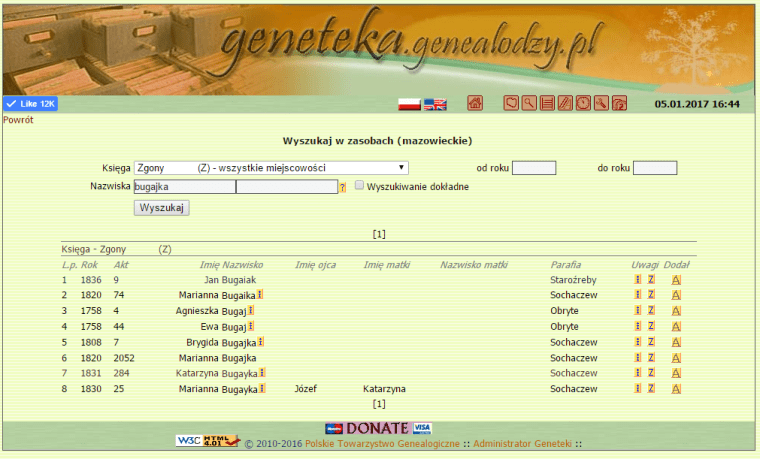
It’s still possible that these other godparents might be related to the Zarzycki/Naciążek family, and that the proof of the relationships lies in records that simply have not yet been indexed, or in records that no longer exist.  However, it’s also possible that some of these godparents were merely good friends of Ignacy and Antonina, which is the clear drawback of godparent analysis.  Some of the godparents’ surnames (e.g. Zieliński) are so common that, in absence of any direct evidence, it will be difficult to tie them to the Zarzycki/Naciążek family with any degree of certainty.  Some of them, like Bugajka, are tantalizingly rare, and it’s fascinating to note that one of the only parishes in which this surname is found in Geneteka is Sochaczew, which is one of the two parishes that seems to be associated with my Naciążek family (Figure 2).

Figure 2:  Geneteka search results for death records with the Bugajka surname in Mazowieckie province.figure-1

Could it be that Antonina Naciążek had a sister named Jadwiga who married a Bugajka, and it is she who was named as godmother to Józef Zarzycki in 1859?  Might she even be a daughter-in-law to one of the widows whose deaths are reported here?  It’s possible, maybe even probable, but at present, there’s not enough evidence to draw any conclusions.  My family should have no reason to wonder why I have insomnia some nights.

Speaking of insomnia-provoking questions, who the heck was Weronika Jaroszewska, and why was she named as godmother to three of Antonina’s children?  Another question for another sleepless night.

To sum up, in this example, we hypothesized that two women were siblings, predicted that they should be named as godmothers to each other’s children if that hypothesis were true, and then examined the evidence, which supported the hypothesis.  In my next post, I’ll offer an example of how this sort of analysis can also be used in reverse, to suggest a mother’s maiden name in absence of direct evidence for that.  In the meantime, happy researching!

Sources:

Mills, Elizabeth Shown. QuickSheet: The Historical Biographer’s Guide to the Research Process. Baltimore: Genealogical Publishing Co., 2012, p. 1.

Roman Catholic Church, St. Bartholomew’s parish (Rybno, Sochaczew, Mazowieckie, Poland), “Księga urodzeń 1845-1854,” 1850, #48, baptismal record for Maryanna Zarzycka.

3 Roman Catholic Church, St. Bartholomew’s parish (Rybno, Sochaczew, Mazowieckie, Poland), “Księga urodzeń 1845-1854,” 1853, #60, baptismal record for Paulina Zarzycka.

Roman Catholic Church, St. Bartholomew’s Parish (Rybno, Sochaczew, Mazowieckie, Poland), “Księga urodzeń, 1855-1862,”1856, #48, baptismal record for Tomasz Zarzecki.

Roman Catholic Church, St. Bartholomew Parish (Rybno, Sochaczew, Mazowieckie, Poland), “Księga urodzeń 1855-1862,” 1859, #15, baptismal record for Józef Zarzycki.

Roman Catholic Church, St. Bartholomew’s Parish (Rybno, Sochaczew, Mazowieckie, Poland), “Księga urodzeń 1863-1869,” 1861, #36, baptismal record for Florentyna Zarzecka.

Roman Catholic Church, St. Bartholomew’s Parish (Rybno, Sochaczew, Mazowieckie, Poland), “Księga urodzeń 1863-1869,” 1863, # 72, baptismal record for Aniela Zarzecka.

Roman Catholic Church, St. Bartholomew’s Parish (Rybno, Sochaczew, Mazowieckie, Poland), “Księga urodzeń 1863-1869,” 1866, #27, baptismal record for Jan Zarzycki.

Roman Catholic Church, St. Bartholomew’s Parish (Rybno, Sochaczew, Mazowieckie, Poland), “Księga urodzeń 1863-1869,” 1868, #67, baptismal record for Joanna Walentyna Zarzycka.

10 Roman Catholic Church, St. Bartholomew’s Parish (Rybno, Sochaczew, Mazowieckie, Poland), “Księga urodzeń 1863-1869,”1869, #93, baptismal record for Karol Zarzycki.

11 Roman Catholic Church, St. Bartholomew Parish (Rybno, Sochaczew, Mazowieckie, Poland), “Księga urodzeń 1870-1880,” 1872, #15, baptismal record for Roman Aleksander Zarzycki.

12 Roman Catholic Church, St. Bartholomew Parish (Rybno, Sochaczew, Mazowieckie, Poland), “Księga urodzeń 1870-1880,”1876, #87, baptismal record for Leonard Zarzycki.

© Julie Roberts Szczepankiewicz 2017

In search of Antonina Naciążek: Mining Geneteka for Clues in Absence of Direct Evidence

The year is drawing to a close. 2017 lies before us, all shiny and new, like a gift waiting to be unwrapped.  Like many of us in the genealogical community, I find New Year’s Eve to be a great time to reflect on the research triumphs and frustrations of the past year, and to make research plans for the coming year. When it comes to genealogical New Year’s resolutions, there are so many ancestors I’d like to learn more about, so many families that I’d like to understand better in their cultural and historical context.  But one of them in particular is at the top of my research to-do list for 2017:  Antonina Naciążek.

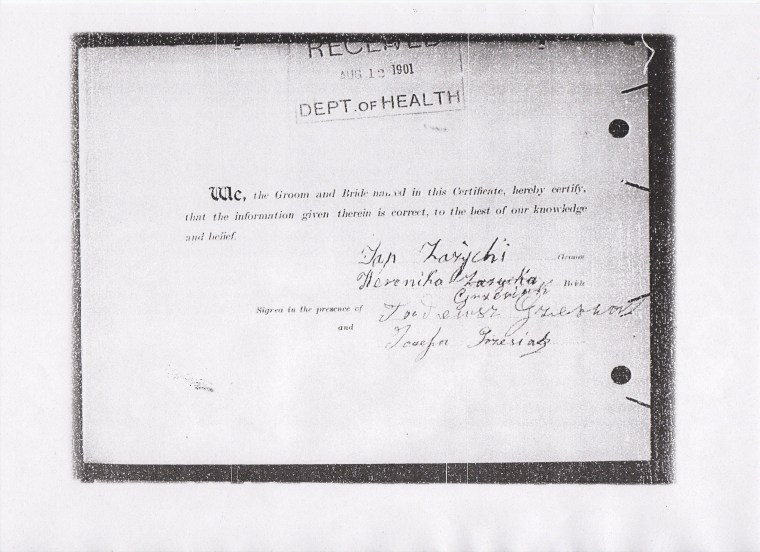
Antonina was my great-great-grandmother, notable because she is my only great-great-grandparent about whom I know little more than her name.  My first encounter with her was through the marriage record of her son (my great-grandfather), John Zazycki (Figure 1):

Figure 1:  Marriage record for John Zarzycki and Veronica Grzesiak from Buffalo, New York, 5 August 1901.jan-weronika-zazyki-marriage-1

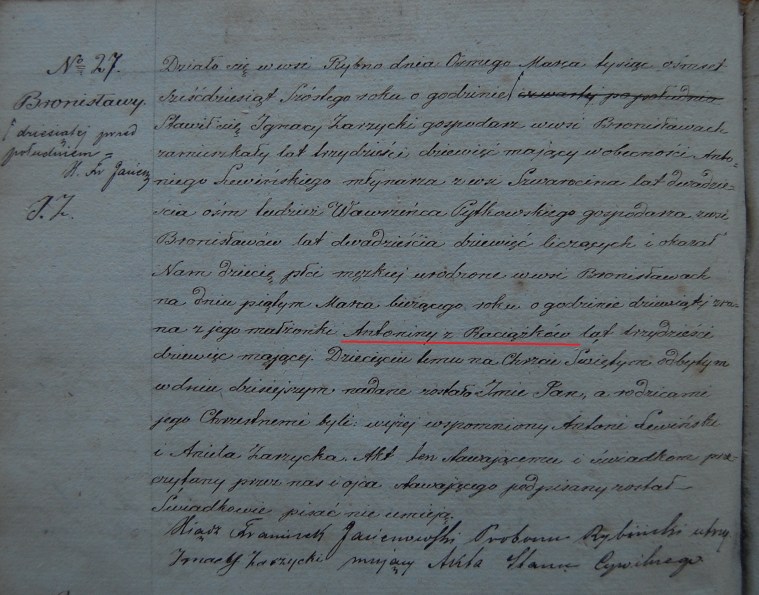
Subsequent research turned up John’s baptismal record in the parish of Rybno, Sochaczew County, Poland, where her name is spelled “Antoniny z Raciążków” (Antonina née Raciążek, Figure 2).

Figure 2:  Baptismal record for Jan Zarzycki, Rybno parish, 5 March 1866.jan-zarzycki-birth-1866

Anyone who’s been doing genealogy for a while is familiar with the inconsistencies in surname spellings that frequently crop up in records prior to the 20th century, and Polish records are no exception.  Typically, however, the variations that one sees revolve around a common root with different endings, e.g. Grzesiak can become Grzeszak, Grzeszkiewicz, Grześkiewicz, etc.  So I was a little surprised to see Maciążek become Raciążek.  In fact, as further evidence accumulated and additional birth, marriage and death records for Antonina’s children were discovered, the most common variant of Antonina’s surname that emerged was Naciążek.  Naciążek appeared in the documents a total of 9 times, while Raciążek appeared 7 times, and Maciążek appeared just twice.

Unfortunately, I have yet to obtain any documentation that indicates Antonina’s parents’ names.  Based on the birth records for her children, I estimate that Antonina was born circa 1828 and married Ignacy Zarzycki circa 1849.  Her children all seem to have been born in the village of Bronisławy and baptized in St. Bartholomew’s church in Rybno.  However, she herself must have been from another parish, because neither her birth or marriage record, nor her death record, was found in the records of Rybno at either the parish or the local civil records office (Urząd Stanu Cywilnego, or USC).  A search of Geneteka for Naciążek, Raciążek and Maciążek anywhere in Mazowieckie province failed to produce any birth records for an Antonina born circa 1828.  So where was Antonina from?  Who were her parents?  She was last mentioned as a surviving widow in the marriage record of her youngest son, Leonard Zarzycki, in 1904, so she must have died after that time.  But where?

Geneteka reveals exactly one record that might give us a clue regarding this family’s origins. Figure 3 shows the results of a search of marriage records in Rybno for the Naciążek surname.  Searches for Maciążek and Raciążek produced no results, nor were there any birth or death records for Rybno associated with any of these surnames, apart from records pertaining to known children of Antonina (née Naciążek) Zarzycka.

Figure 3:  Geneteka search results for the Naciążek surname in marriage records for Rybno parish.roch-kowalski-marriage

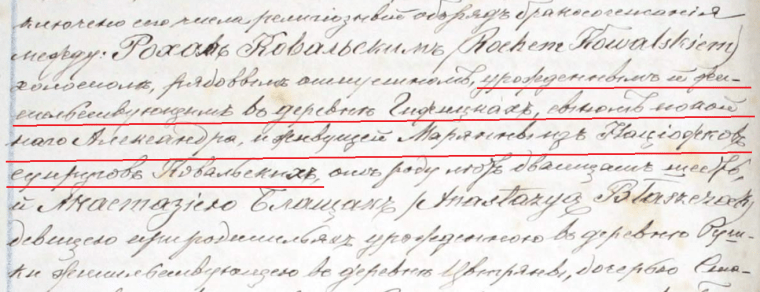
Of the four records shown, numbers 1, 3 and 4 pertain to known children of Antonina (née Naciążek) Zarzycka.  However, record #2 (boxed in red) is for the marriage of Roch Kowalski to Anastazja Błaszczak.  Further examination of that record (Figure 4) reveals that Roch was “….born and residing in the village of Giżyce, son of the late Aleksander and still-living Marianna née Naciążek, the spouses Kowalski” (text underlined in red), and that he was age 26, suggesting a birth year of about 1877.

Figure 4:  Excerpt of marriage record of Roch Kowalski and Anastazja Błaszczak in Rybno parish, 2 February 1903.  roch-kowalski-marriage-excerpt

Since Roch Kowalski was a contemporary of Antonina Zarzycka’s children, it stands to reason that Roch’s mother was of the same generation as Antonina herself.  Since the parish of Giżyce is located just 8.2 km (about 5 miles) from Bronisławy, and since Naciążek is a relatively rare surname, both in the present-day and historically, it’s not unreasonable to suspect that Antonina and Marianna were related, perhaps even sisters.

Records for the parish in Giżyce are indexed on Geneteka from 1810-1905 with some significant gaps.  One such gap exists from 1826-1890 — during the time when Antonina Naciążek is most likely to have been born (1828-1829).  However, there is a rather tantalizing birth record in 1824 in Giżyce for a Marianna Naciążek, daughter of Mateusz Naciążek and Petronela Trawińska.  Could this be the same Marianna Naciążek who married Aleksander Kowalski?

Frustratingly, a province-wide search using both the Naciążek and Kowalski surnames does not produce a marriage record for Marianna and Aleksander, which would hopefully reveal Marianna’s parents’ names, nor does it produce Marianna’s death record.  However, it does produce marriage records for four additional children of that couple (Figure 5):

Figure 5:  Geneteka search results for marriage records in Mazowieckie province that contain both the Naciążek and Kowalski surnames.naciazek-kowalski-marriages

Hovering the cursor over the “i” in the column after “Naz. matki” indicates that Józefa Kowalska, Ignacy Kowalski, Ludwik Kowalski, and Stanisław Kowalski were all siblings of Roch Kowalski and children of Marianna Naciążek and Aleksander Kowalski.  Examination of the three records for which scans are available indicates that Józefa and Ignacy were also born in Giżyce.

Note that the search result for Józefa Kowalska’s marriage notes an alternate spelling of her mother’s maiden name, “Naciąszek.” Geneteka’s search algorithms do not automatically recognize Naciąszek and Naciążek as phonetic equivalents, so Naciąszek must be searched separately.  This subsequent search in Geneteka for Naciąszek produces an  especially intriguing result: a marriage record in Giżyce for Stanisław Marcinkowski and Marianna Kowalska in 1881 (Figure 6).

Figure 6:  Geneteka search result for Naciąszek surname in Mazowieckie province.marcinkowski-kowalska-marriage

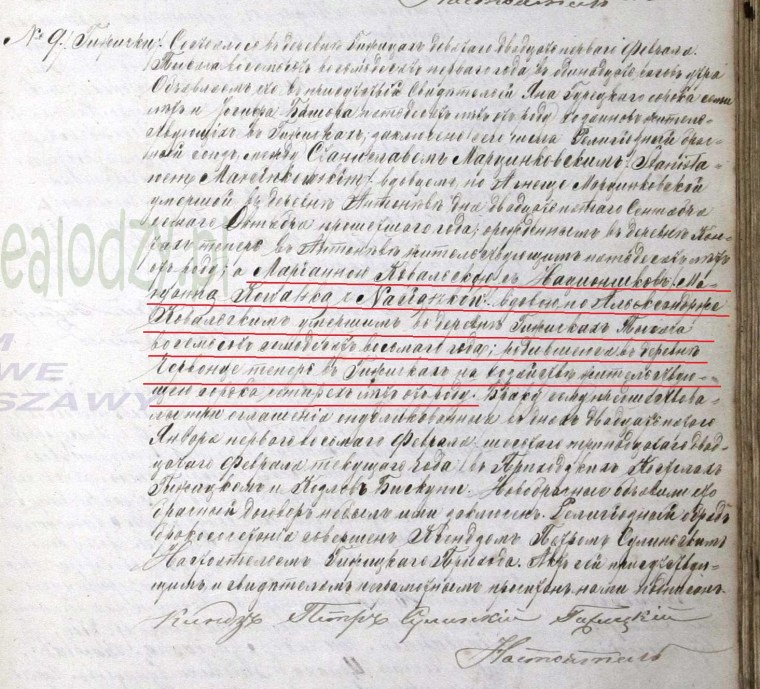
The marriage record itself verifies that this is indeed “our” Marianna Kowalska, widow of Aleksander (Figure 7):

marcinkowski-kowalski-marriage-1856

The underlined text in Russian and Polish reads, “…Marianna Kowalska née Naciąszek, widow of Aleksander Kowalski [who] died in the village of Giżyce in the year 1878; born in the village of Czerwonka, now in Giżyce… residing, age 44.”

Pay dirt!  Although this record does not tell us the names of Marianna’s parents, it does tell us where and when she was born.  Czerwonka is a village that belongs to the parish in Sochaczew, and her age at the time of her second marriage suggests a birth year of 1837.  Clearly, this Marianna can’t be the same as the Marianna Naciąszek born in 1824 in Giżyce. Figure 8 shows the location of all these villages in relation to each other in Sochaczew County.

Figure 8:  Geographic  locations of Giżyce, Bronisławy, Sochaczew and Czerwonka.map-of-czerwonka

Records for Sochaczew are indexed in Geneteka, but unfortunately, there is no perfect match for a Marianna Naciąszek or Naciążek born in 1837 in Czerwonka.  However, there is a reasonably close match:  the birth of a Florentyna Marianna Naciążek in 1836 in Czerwonka, daughter of…. (dramatic music!)…..Mateusz Naciążek and Petronela Trawińska, the same couple who were the parents of the other Marianna Naciążek who was born in Giżyce in 1824! If the Marianna who was born in 1824 died prior to 1836, it’s possible that her parents would have honored her by naming a sibling Florentyna Marianna but calling her Marianna.  So maybe she’s our bride of Aleksander Kowalski?  Unfortunately — and frustratingly — there is no marriage record to prove it, nor is there a death record for the Marianna who was born in 1824.


Let’s take a moment to recap what we know so far:

  • Only one other Naciążek record exists in Rybno parish, where Antonina (née Naciążek) Zarzycka lived.
  • That record is a marriage record for Roch Kowalski, born in Giżyce, son of Marianna Naciążek and Aleksander Kowalski.
  • Roch Kowalski is the same generation as Antonina Zarzycka’s children, suggesting that Marianna Naciążek is of the same generation as Antonina, perhaps even her sister.
  • Marianna (née Naciążek) Kowalska’s second marriage record reveals her place of birth as Czerwonka (Sochaczew parish) in 1837 and her place of residence as Giżyce.
  • The closest match for Marianna’s birth in the records of Sochaczew parish is for a Florentyna Marianna Naciążek, born in Czerwonka in 1836, daughter of Mateusz and Petronela (née Trawińska).
  • Mateusz Naciążek and Petronela Trawińska were parents to another daughter named Marianna Naciążek born in Giżyce in 1824.  Although the Trawiński surname is fairly common, the relative rarity of the Naciążek surname makes it likely that this is the same couple as the one mentioned in the records in Sochaczew.

So, the focus is definitely on Giżyce and Sochaczew for the births and marriages of both Antonina Naciążek and her putative sister, Marianna Naciążek. Marriages for Sochaczew are indexed on Geneteka from 1826-1835,and 1879-1901, leaving a gap when Antonina and Marianna would have married, which would explain why her marriage record does not show up in the Geneteka index. Geneteka’s indexed birth records for Sochaczew cover 1781-1802, 1826-1841, 1849-1864, 1868-1870, and 1874-1884. So Antonina’s birth in 1828-1829 should be there, if she were born in Sochaczew.

But what if Antonina were born in Giżyce, and not Sochaczew?  Geneteka has births indexed for Giżyce for 1810, 1823-1825, and 1891-1905, so there’s a gap for both 1828  when Antonina would have been born, and also for 1849, which is approximately when she would have married. Unfortunately, in reviewing the available ranges of years for available records for both Sochaczew and Giżyce on LDS microfilm and at the Polish State Archives, the hope of identifying Antonina’s and Marianna’s parents definitively seems slim. It appears that Geneteka has indexed all the existing records for these parishes, so the records needed to fill those gaps no longer exist.  One of my goals for the new year is to have a researcher in Poland confirm this for me, and verify that there are no additional records available for either of these parishes at the parishes themselves or in a diocesan archive. Even if those early records are gone, and Antonina’s birth and marriage records are lost forever, it should still be possible to track down her death record after 1904, so that’s on my agenda, too.

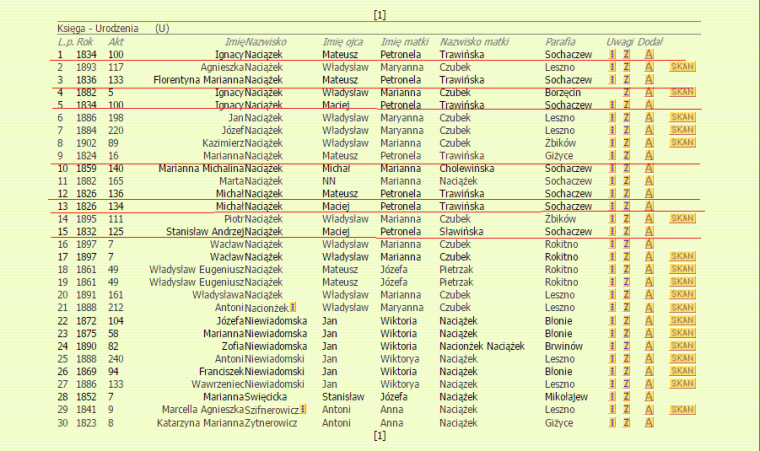
If you’re like me, you like wringing every last drop of information from a data set, particularly in cases like this where data are limited.  So what else can Geneteka tell us about the Naciążeks in Giżyce and Sochaczew? Figure 9 shows Naciążek births in indexed records for all of Mazowieckie province.

Figure 9:  Geneteka search result for Naciążek births in Mazowieckie province.naciazek-births-in-mazowieckie

I’ve underlined the ones in red that I believe pertain to the same family.  Notice that the father’s name is sometimes recorded as Mateusz and sometimes recorded as Maciej.  This might be an artifact of the transcription and translation process.  Based on my experience with the records from Sochaczew for this time period, these records are likely to be in Latin, and those names in Latin might be written as Mattheus or Matthias — potentially difficult to differentiate if the handwriting is bad.  It’s also possible that the priest used either spelling indiscriminately, especially since he seems to have been a bit careless with Petronela’s name, which is recorded as Trawińska in most of the records, but as Slawińska in one of them.  Copies of these records are available from the Diocesan Archive in Łowicz, and I plan to order those in the New Year, so hopefully the originals can shed some light on this.

Based on these data, and data from the death records as well, a clearer image of the Naciążek family’s timeline emerges:

  • 1824:  Daughter Marianna born in Giżyce.
  • 1826:  Son Michał born in Sochaczew. (Note that Michał’s birth is recorded twice in the index, as record #134 and record #136.  Information contained in the infodot reveals that #134 is the Latin church record while #136 is the Polish-language civil copy.)
  • 1832:  Son Stanisław Andrzej born in Sochaczew.
  • 1834:  Son Ignacy born in Sochaczew.  (Again, both the Latin church version and the Polish civil copy are available for this record.)
  • 1836:  Daughter Florentyna Marianna born in Sochaczew.
  • 1837:  Son Ignacy dies in Sochaczew.
  • 1840:  Son Jan dies in Sochaczew.  Jan is noted to be 6 days old, and birth records for Sochaczew exist for the time of his birth, so it’s unclear whether his birth record is missing due to an omission by the priest or by the indexer.

If great-great-grandma Antonina does, in fact, belong to this family, her birth would fit into that 6-year-gap between Michał’s birth in 1826 and Stanisław Andrzej’s birth in 1832. Since her birth was not captured in the records for Sochaczew, it’s possible that the family returned to Giżyce for that time period.

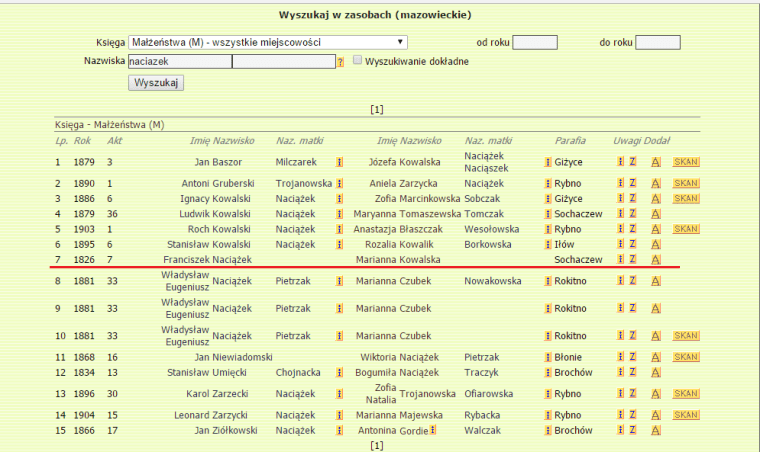
One final record worth noting that pertains to the Naciążek family in Sochaczew and Giżyce is the marriage record in 1826 of Franciszek Naciążek and Marianna Kowalska.  (Figure 10).

Figure 10:  Geneteka search results for Naciążek marriages in Mazowieckie province.franciszek-and-marianna-naciazek

Hovering the cursor over the “i” in the “uwagi” column reveals that the groom, Franciszek Naciążek, was from Giżyce although the wedding took place in the bride’s parish in Sochaczew. Franciszek and Marianna could also be potential parents for Antonina Naciążek, although they seem to disappear from the records.  They are not mentioned as parents on any of the indexed birth records in Mazowieckie, and the only other mention of them is in Marianna’s death record in Sochaczew in 1844.

Despite the lack of direct evidence concerning Antonina Naciążek, the indexed records in Geneteka offer a powerful tool for gathering hints about her possible family origins.  While it’s disappointing that Antonina’s birth and marriage records may no longer exist, there’s still some hope of finding her death record, and Sochaczew and Giżyce would be logical places to look for it.  Maybe 2017 will be my lucky year in terms of locating that document, and maybe I’ll get even luckier and it will include her parents’ names, so I can know for certain whether Antonina Naciążek is the daughter of Mateusz and Petronela (née Trawińska) Naciążek. May 2017 be a lucky year for your genealogical research as well. Here’s to finding our dead ancestors!

© Julie Roberts Szczepankiewicz 2016


50+ Useful Websites for Polish Genealogy

“Raindrops on roses, and whiskers on kittens, bright copper kettles, and warm woolen mittens….”  Like Maria in The Sound of Music, we all have lists of our favorite things.  For me, there are quite a few Polish genealogy websites that are on my list of favorite things.  With that in mind, and with Christmas right around the corner, here are some of my favorite online resources for Polish genealogy.  Some of these bear further mention in future blog posts, and I’ll probably get around to discussing them in greater detail at some point.  For now, give it a look, maybe you’ll find something new that will help with your research. (And in case you were wondering, I’m calling it “50+” because some of the links are to related sites, so number them as you wish.) Happy hunting!

Maps, Phonetic Gazetteers, and Period Gazetteers:                            

Jewish Gen Gazetteer (www.jewishgen.org/communities/loctown.asp):

  • An indispensable Soundex-type (phonetic) gazetteer for identifying villages for which the name is spelled incorrectly on a U.S. document. For more hits, try using the Daitch-Mokotoff Soundex, rather than Beider-Morse Phonetic Matching.

Kresy Gazetteer (http://www.kami.net.pl/kresy/):

  • This is a fantastic site for determining parish for villages in the eastern border regions (Kresy) that formerly belonged to Poland (Second Polish Republic) but are now located in western Ukraine, western Belarus, and southeastern Lithuania.
  • Soundex-style allows you to search without knowing the exact spelling of the place name, if you select “similar” (Daitch-Mokotoff Soundex) or “rough” as your search method.

Mapa.szukacz.pl (http://mapa.szukacz.pl/):

  • Does not show parish for a village, but does show current administrative divisions including the gmina (useful if you want to write to the USC for a record less than 100 years old).
  • Only shows villages within current borders of Poland.
  • Polish diacritics don’t matter (i.e. a search for “lodz” will give you “Łódź”.)
  • Advanced search allows you to search within a specific Voivodeship; useful when searching for places like “Nowa Wieś.”

Słownik geograficzny Królestwa Polskiego i innych krajów słowiańskich (http://dir.icm.edu.pl/Slownik_geograficzny/):

  • Coverage includes all localities in the former Polish provinces of Russia, most localities in the former Austrian province of Galicia (now divided between Poland and the Ukraine), Belorussian provinces of the Russian Empire (now in the Republic of Belarus), and also contains significant localities in other Slavic and eastern European nations; Russia, Slovakia, the Czech Republic, Hungary, Slovenia, Croatia, Serbia, Bulgaria and Romania. While the information is a bit less comprehensive, localities from the provinces of Poznan, West Prussia, East Prussia, Silesia, and Pomerania are also covered.
  • Published between 1880-1902 in 15 volumes.
  • Contains information on parishes, history, population, etc.
  • Abbreviations are common; assistance can be found at PGSA website (below)
  • Must use proper Polish diacritics (i.e. a search for “lodz” will yield no result, but a search for “Łódź” will give multiple hits)

PGSA Translated Słownik geograficzny entries (https://pgsa.org/research-slownik-translations/) and related pages, (https://pgsa.org/research-slownik-terminology/, https://pgsa.org/research-slownik-interpretation/, 

  • Defines abbreviations and explains historical context for Słownik entries; also offers English translations for a limited number of villages. Translated entries are currently a benefit available to members only.

Polish Roots Translated SGKP entries (https://www.polishroots.com/GeographyMaps/SlownikGeograficzny?PageId=61):

  • Similar to the above site, but different coverage. To access translated entries, hover cursor over “Geography & Maps” option in menu bar at the top of the page, then select a letter of the alphabet to view translated entries for places in the Słownik beginning with that letter.

Skorowidz Królestwa Polskiego (https://www.sbc.org.pl/dlibra/publication/11404/edition/10794/content?ref=desc for Volume 1 and https://www.sbc.org.pl/dlibra/show-content/publication/edition/10795?id=10795 for Volume 2):

  • Will need to install a Deja Vu reader onto your computer to read these files. Follow instructions at website for downloading (the site will prompt you) or you can download it here.  Running the most current version of Java is also important. Easy-to-read, tabular format shows name of village, gubernia/governate, powiat/county, gmina/township, parafia/parish, as well as sąd pokoju/courthouse, and poczta/post office.
  • Published in 1877.
  • Includes only the Kingdom of Poland (Congress Poland, or “Russian Poland”) – not Galicia or Prussian Poland.

Tabella of the Kingdom of Poland (Tabella miast, wsi, osad Królestwa Polskiego z wyrażeniem ich położenia i ludności alfabetycznie ułożona w Biórze Kommissyi Rządowey Spraw Wewnętrznych i Policyi; Volume 1:  http://bc.wbp.lublin.pl/dlibra/docmetadata?id=7612&from=pubstats and Volume 2: http://www.wbc.poznan.pl/dlibra/doccontent?id=110117)

  • The Tabella is similar to the Skorowidz Królestwa Polskiego in that it covers the same territory (Russian Poland). However, it was published 50 years earlier, in 1827, so may be of value if you need to focus on that earlier time period.

Kartenmeister (http://www.kartenmeister.com/preview/databaseuwe.asp):

  • Includes Eastprussia, Westprussia, Brandenburg, Posen, Pomerania, and Silesia.
  • Flexible search parameters; can search by German or Polish name of village, or use other methods.
  • Catholic or Evangelical parish for the village is usually included in search results.

Gesher Galicia Town Locator (http://www.geshergalicia.org/galician-town-locator/):

  • If you’ve got the correct spelling of a town, this is a great resource because it includes places of worship for people from all towns and villages in Galicia as of 1900.

Genealogische Orts-Verzeichnis (GOV), The Historic Gazetteer (http://gov.genealogy.net/search/index):

  • This German-language database includes locations around the world. It searches for the character string typed in the search box (truncate by leaving off as many letters as desired). The results list includes the type of location, the higher level jurisdictions, and the current postal code, and includes links to additional articles about this place for further reading.

Meyers gazetteer (https://www.meyersgaz.org/):

  • This is an online, searchable version of the popular Meyers Orts- und Verkehrs-lexikon des deutschen Reichs The goal of the Meyer’s compilers was to list every place name in the German Empire (1871-1918). It gives the location, i.e. the state and other jurisdictions, where the civil registry office was and parishes if that town had them. It also gives lots of other information about each place. Click the “Ecclesiastical” link in the menu bar at the top to see the distance in miles from the target location to the nearest Catholic, Protestant and Jewish places of worship.

Brian Lenius’s Genealogical Gazetteer of Galicia (http://www.lenius.ca/gazetteerorder/gazetteerorderform.htm ):

  • Not an online resource, but this gazetteer is available in print from the author, and is considered to be a superlative resource for those with ancestors from Galicia.

Bigo’s Skorowidz of Galicia, 1914 (Najnowszy skorowidz wszystkich miejscowości z przysiółkami w Królestwie Galicyi, Wielkiem Księstwie Krakowskiem i Księstwie Bukowińskiem z uwzględnieniem wszystkich dotąd zaszłych zmian terytoryalnych kraju) (https://www.pbc.rzeszow.pl/dlibra/publication/5332/edition/4909/content?ref=desc):

  • Like the Skorowidz of 1877, you need a Deja Vu reader to view these files.
  • Tabular format includes columns for village name, the county and district council, district court and tax office, parish office, population, post office, klm distance (from the post office), telegraph office, klm distance (from the telegraph office), and the owner of the “Major estate” in a village, as opposed to the owners of the “minor estates” (commoners).
  • Roman Catholic parishes are distinguished from Greek Catholic by the use of “ł” (abbreviation for “łaciński,”) or “gr” (abbreviation for “grecki”) next to the name of the parish that served that locality. The word “loco” means that there was a parish within that location.

Index of Place Names in the Republic of Poland (Skorowidz miejscowości Rzeczypospolitej Polskiej) (http://www.wbc.poznan.pl/dlibra/docmetadata?id=12786&from=publication ):

  • Like the Skorowidz of 1877, you need a Deja Vu reader to view these files.
  • Published circa 1933, it covers locations that were within the borders of the Second Polish Republic (1918-1939).
  • Tabular format again, includes villages in the eastern border regions (Kresy) that formerly belonged to Poland but are now located in western Ukraine, western Belarus, and southeastern Lithuania.

3rd Military Mapping Survey of Austria-Hungary (http://lazarus.elte.hu/hun/digkonyv/topo/3felmeres.htm):

  • Contrary to what the name suggests, maps include places that were in Russian Poland and Prussian Poland.
  • Individual maps can be downloaded by right-clicking on them.
  • 1:200,000 scale resolution shows most small villages.
  • Place names may be in Polish or German.
  • Does not cover the northern third (approximately) of modern Poland.

Map Archive of Wojskowy Instytut Geograficzny 1919 – 1939 (http://www.mapywig.org/):

  • Mapywig is a treasure-trove of maps in a variety of different scales, time periods, and resolutions.
  • Maps might be in Polish, German or Russian.
  • An overview (in English) can be found here.
  • Clicking on a map quadrant in the index will take you to a page showing all the maps available for that quadrant, which vary in resolution and date of map.
  • Offers full coverage of northern Poland, unlike the maps at the Lazarus site (above).

Mapire:  Historical Maps of the Hapsburg Empire (http://mapire.eu/en/):

  • This is a really fun site if you have ancestors from Galicia.  It includes maps from the first, second and third military surveys of the Austrian Empire and allows you to overlay these maps with modern maps and vary the transparency between the two.

Sources for locating vital records in Poland:

Note:  Sites marked with * are primary sources, at which actual images of the records can be obtained.  Sites marked with § are indexes for records; copies of the records themselves must be obtained from another source.

*LDS FHL microfilms (https://familysearch.org/catalog-search):

  • Not an online source for records, but all researchers should be aware of this option nonetheless. Check back regularly — the FHL has been digitizing more and more of their microfilms and changes are NOT reflected on their “Poland Research” page (below). You may be pleasantly surprised to discover that some of your favorite microfilms are now online.

*§Family Search digitized or indexed collections for Poland: (https://familysearch.org/search/collection/location/1927187):

  • Collections exist for Roman Catholic dioceses of Lublin, Radom, Częstochowa, and Gliwice, with images; index-only records exist for the Diocese of Tarnów.  There’s also a collection of curiously-named “Evangelical” Church records. 1700-2005, that not only includes Baptist and Lutheran records but also Greek Catholic records from Sulmice in the Lublin province.

*Szukajwarchiwach, “Search the Archives” (http://www.szukajwarchiwach.pl/):

  • Use proper Polish diacritics for best results.  Often you’ll get results without them, and it may be an old bug that has since been fixed, but if you get no results without diacritics, repeat the search with them.
  • For best results, search according to parish or gmina name rather than village name. The exception for this is for records from Galicia/Austrian Poland, where separate books were kept for each village within a parish, so you may find villages indexed individually.
  • Check box for “Vital records and civil registers” to limit search results.
  • Detailed instructions for using (with screen shots!) can be found at https://familysearch.org/learn/wiki/en/images/a/af/Polish_State_Archives.pdf

*Metryki.GenBaza (http://metryki.genbaza.pl/):

  • Must create an account at http://genpol.com/ first in order to access records, and must log in each time.
  • Some overlap with Metryki.Genealodzy.pl in terms of records collections, but contains many parishes not found elsewhere online.
  • Use of site in Polish is recommended; portions of site are not usable in English (am error message will result — although again, this might be an old bug that has since been fixed, as I haven’t had this happen in a while).

*§Genealodzy.pl websites:  Geneszukacz, Geneteka, Metryki, Poczekalnia (http://genealodzy.pl/):

Geneteka: http://geneteka.genealodzy.pl/

  • Surname-indexed records searchable by individual parish or entire province.
  • Can input a second surname to find all children of a given couple; can also limit range of years.
  • Polish diacritics not important, and searches for the masculine version of a surname will return results for both genders (i.e. “Zielinski” à Zieliński and Zielińska).
  • Can be helpful if only some information about an ancestors’ birthplace (e.g. county) is known, but not the precise location; however, only a small fraction of Polish parishes are indexed to date, so there is a risk of chasing down the wrong ancestors if Geneteka is used in an attempt to side-step preliminary research in U.S. documents.
  • Some indexed records are linked to scans of documents within the Metryki.Genealodzy.pl collection or at Szukajwarchiwach.

*Metryki.Genealodzy.pl: http://metryki.genealodzy.pl/

  • More than just a repository of scans for records indexed at Geneteka, Metryki often contains different parishes or different ranges of years for parishes indexed on Geneteka.  See this post for more information.

*Poczekalnia (“Waiting Room”): http://poczekalnia.genealodzy.pl/

  • Scans waiting to be checked and added to Metryki. Click on “Lista” or “Galeria” to get to the directory of parish records, grouped according to the archive from which they were obtained.

*AGAD (Archiwum Główne Akt Dawnych w Warszawie, Central Archives of Historical Records in Warsaw): http://www.agad.gov.pl/inwentarze/testy.html

  • Roman Catholic, Greek Catholic, Jewish, and Protestant records from parts of Eastern Poland which are now located in Ukraine.

*Archiwum Państwowe w Przemyślu:  http://www.przemysl.ap.gov.pl/skany/

  • Has Roman Catholic and Greek Catholic records from parishes in the Przemyśl area. Most of these records are also available from Szukajwarchiwarch, but there are a few parishes for which records are only online here, and NOT at that site as well.

*State Archive in Olsztyn: http://www.olsztyn.ap.gov.pl/apnet/wybierz.php

  • Has vital records from some villages in this area formerly located in East Prussia; click “Skan Digitalizacja,” and then use the drop-down menu under “Nazwa zespołu” (name of the collection) to find a town based on current Polish names, or use “Nazwa oryginala” to look up record sets based on former German names.

*State Archive in Szczecin: http://www.szczecin.ap.gov.pl/iCmsModuleArchPublic/showDocuments/nrap/65

  • Has vital records from some villages in this area formerly located in the Prussian province of Pomerania. Scroll down the page to see the available locations, listed in the column on the left.

*Civil Registry Office in Wrocław/Standesamt Breslau:  http://ahnenforscher.pl/?page_id=120

  • Has vital records for Wrocław (Breslau in German) from 1889-1911
  • Viewing records requires the installation of the DjVu plug-in, so the site works best with Internet Explorer and appears to be incompatible with some versions of Google Chrome (like mine).

*Archion: https://www.archion.de/de/browse/?no_cache=1

  • Has Lutheran church records from parishes located in the former German provinces of Posen, West Prussia, East Prussia and Silesia, with over 20 million scans online.
  • Searching is free, but a subscription is required to access scans.

*Matricula: http://data.matricula-online.eu/en/polen/breslau/

  • Has Lutheran church records for four places in Lower Silesian Voivodeship (województwo dolnośląskie), Siedlęcin/Boberröhrsdorf in Jelenia Góra County, 1748-1914; Sobieszów/Hermsdorf in Jelenia Góra County, 1742-1916; St. Elizabeth’s Church in Wrocław, 1750-1945; and St. Bernhard’s Church in Wrocław, 1812-1906.

*Epaveldas:  http://www.epaveldas.lt/vbspi/lang.do?language=lt

  • Has vital records for locations that are in present-day Lithuania.

*Genealogy in the Archive:  https://www.genealogiawarchiwach.pl/

  • Has vital records for locations in the Kujawsko-Pomorskie, Pomorskie, Wielkopolskie, and Warmińsko-Mazurskie provinces.  A relative newcomer to the Polish vital records scene, this site is somewhat infamous for its awkward and slow user interface.  However, attempts are being made to resolve some of these issues, so there’s hope.

*Górnośląskie Towarszystwo Genealogiczne (Upper Silesian Genealogical Society):   http://siliusradicum.pl/ksiegi-metrykalne/

  • Has some Roman Catholic, Protestant, and Jewish vital records for some locations in Upper Silesia; original records are held by the State Archive in Katowice.
  • Records can be browsed online via Dropbox.

BaSIA (Baza Systemu Indeksacji Archiwalnej, Database of Archival Indexing System): http://www.basia.famula.pl/en/

  • Has indexed vital records (births, marriages and deaths) from the Poznan area, some linked directly to scans from the Polish State Archives
  • Extended search allows you to restrict search to a give range of years, type of document, distance from a specified location.
  • Polish diacritics not important.
  • One can create an account, register surnames of interest, and they will e-mail you when new records for those surnames are added.
  • To view scans, go to archive information in the results column on the right, and click on the line below the archive name that has code numbers and the word “scan.”

*§Lubgens:  http://lubgens.eu/portal.php

  • Has indexed vital records for Lublin area, many with scans attached.
  • Polish diacritics don’t matter (i.e. “Zielinski” yields same result as “Zieliński”) BUT masculine or feminine version of surname DOES matter (i.e. “Zielinski” yields different results from “Zielinska”).

*§Słupca Genealogy:  http://slupcagenealogy.com/

  • Indexed records from parishes in Słupca and Kalisz counties; Jewish records recently added for Słupca.
  • Many results linked to scans from the Polish State Archives.

§Pomeranian Genealogical Society database: http://www.ptg.gda.pl/

  • Indexed civil and church vital records from Pomerania.
  • Go to “PomGenBase” in menu bar at the top of the page and then select “Search PomGenBase” followed by the type of records you wish to search. Alternatively, select “Metrical Book Indexes” followed by “Parish and Registry Offices” to see the full list of parishes and years currently indexed.
  • Polish diacritics DO matter IF you choose “search directly” (i.e. “Wolinski” yields different results than “Woliński”). Can use wildcard characters (“?” replaces one letter, “*” replaces more than one) if you’re not certain of the spelling.

§Poznan Marriage Project: http://poznan-project.psnc.pl/

  • Indexed marriage records from the Poznan region, 1800-1899, currently about 80% complete.
  • One may request a copy of a single record by clicking “original record” and requesting it from the archive, OR it may be requested from the site’s creator, Lukasz Bielecki, with a donation to the project. However, clicking the parish name in which the record was found will yield a list of LDS microfilms for that parish, and by searching these one is likely to find not only that marriage, but also many other vital records for one’s family.

§Katalog Szlachty: http://www.katalogszlachty.com/

  • Click on “indeksy” in menu at left, and then on “indeksy” again to reach the list of indexed parishes.
  • Records for Szlachta (noblemen), primarily from northeastern Poland.

§Szpejankowski and Szpejankowski Family Website: http://szpejankowski.eu/

  • Has indexed vital records for the Dobrzyń region of Poland.

§SGGEE Databases: https://www.sggee.org/research/PublicDatabases.html

  • Society for German Genealogy in Eastern Europe; public database includes indexed Lutheran vital records for select parishes in Volhynia, Kiev and Podolia, and Lublin.

*§Metryki Wołyń: http://wolyn-metryki.pl/joomla/index.php

  • Has indexed church and civil vital records from 19th century Wołyń/Volhynia (eastern Poland/Belarus/Ukraine).  English-language search portal yields results that are linked to scans at the AGAD site.  Polish diacritics are not required to search this site.

*§Indexed records from Zieluń parish: 

http://www.zielun.pl/metryki.php?parafia=zielun&metryki=b&year=1900

  • Has indexed birth, marriage and death records from Zieluń parish in gmina Lubowidz, Mazowieckie province, from 1822-1912, linked to scans in Metryki. Note that the range of indexed years is broader at this site than what’s available on Geneteka. To navigate between births, marriages and deaths, click on the icons of the star (births), wedding rings (marriages), and cross (deaths) located between the column with the years and the column with the names.

§Jamiński Zespół Indeksacyjny (Jaminy Indexing Team): http://jzi.org.pl/

  • This group is indexing records for the parishes of Jaminy, Krasnybór, Sztabin, Bargłów Kościelny, and others in Augustów county, Podlaskie. The search form for their indexes is found here: http://search.jzi.org.pl/geneo/.

§Databases of the State Archive in Płock: http://plock.ap.gov.pl/p,136,geneaa

  • Has indexed vital records for several Lutheran and Roman Catholic parishes in the Płock area (under “Genea”).

§Częstochowa Genealogical Society database: http://www.genealodzy.czestochowa.pl/index.php

  • Has indexed vital records from a number of parishes in the Częstochowa area.
  • Must create an account in order to search records.

§Strony o Wołyniu Przed Wojennym (Volhynia Before the War): http://wolyn.ovh.org/

  • Pre-WWII era genealogical data for individuals living in the Volhynia region (which straddles eastern Poland, Belarus and Ukraine), grouped by village name.
  • Click on “Alfabetyczny spis miejscowości” at the top of the page for an alphabetical list of villages covered; each listing provides contact information to connect with others researching those families.

§Poland GenWeb Archives: http://www.rootsweb.ancestry.com/~polwgw/polandarchives.html

  • Assorted records transcriptions from parishes across Poland.

§Church Registers of Tyniec Mały/Klein Tinz: http://frontiernet.net/~michael6/tinz/

  • Data from Catholic parish registers; village is in Wrocław County, Lower Silesian Voivodeship.

Polish State Archives’ PRADZIAD database search portal:  http://baza.archiwa.gov.pl/sezam/pradziad.php?l=en

  • Enter a parish or gmina/township name for a complete list of the vital records holdings of the Polish State Archives for that location. If records are found, you can write or e-mail the archive to request a search of records for a particular record or records.  See this post on writing to archives in Poland.

Catalog of Metrics in Russia, Ukraine and Belarus:  http://metrics.tilda.ws/  

  • This site is a great finding aid for vital records in Russia, Ukraine and Belarus, organized by geographic region within each country, with links to archives, gazetteers (in Russian) and other resources.

FBPGG site: https://sites.google.com/view/polishgenealogygroup/polish-archives-in-a-nutshell?authuser=0

  • The “Internet Tools” list at this site includes a comprehensive collection of web links for Polish genealogy. There is also a helpful collection of addresses for civil and church archives in Poland.

Cyndi’s List, Poland: https://www.cyndislist.com/poland/ 

  • An additional collection of web links for Polish genealogy.

© Julie Roberts Szczepankiewicz 2016, updated January 2021.

A Geneteka Christmas

The Advent season, with its preparations for Christmas, is always nostalgic for me.  I was very close to my grandparents, John and Helen Zielinski, and Grandpa told me stories of how his mother, Genevieve (née Klaus) Zielinski, loved Christmas, too.  He was the oldest of the five children in his family, and at some point before Christmas, she would draw him aside and show him the gifts that she had gathered to give to his younger siblings, sharing with him her anticipation of the joy that those gifts would bring.  Of course, she didn’t show him the gifts that he himself would receive, but the honor of being co-conspirator in creating Christmas joy for his siblings was clearly a source of pride for Grandpa.  Grandpa’s family also had a tradition of giving the children one gift before Christmas.  Whether this custom had its origins in the Polish tradition of gift-giving at the feast of St. Nicholas (Święty Mikołaj) on December 6 is unclear, but Grandpa and Grandma strongly felt that children should not have to wait throughout the whole of Advent without some small gift.  As a child, I certainly had no objections to this practice.

Grandpa passed away in the pre-dawn darkness of a February night in 2003.  He had been suffering from prostate cancer for some time, and we knew the end was near. At the time, I was pregnant with my fourth child, Catherine, and when I spoke with him on the phone for the last time, a few days before he died, Grandpa told me that he was holding out to know that Catherine had arrived into this world safely.  Catherine was born a few minutes after dawn, just hours after Grandpa died.  He never got to meet her, but I know in my heart that he knew all about her.  I’ve tried to share my memories of my grandparents with all my children, especially at Christmas when those memories are so dear and Grandma and Grandpa feel so close.

So what does this have to do with Geneteka?  Fast-forward to October of 2012. I was still plugging away at my research on Grandpa’s Zieliński’s family, but I hadn’t obtained any information prior to the emigration of Grandpa’s father, Joseph Zielinski, and Joseph’s brother, Frank Zielinski. I had progressed to the point where I had identified the Zielinskis’ ancestral village of Mistrzewice, Mazowieckie province, and I had determined that some records for this parish were held at the Archiwum Państwowe w Warszawie Oddział w Grodzisku Mazowieckim (the Grodzisk Mazowiecki Branch of the Polish State Archive of Warsaw).  In October 2012 I wrote a snail-mail letter to the archive to request a copy of my great-grandfather’s birth record, hoping that at last I might have some documentation from Poland for this family.  Most of my research in Polish records at this point had been done in LDS microfilms, and I was as yet unaware of the growing treasure-trove of Polish vital records coming online in greater numbers each day.

It was while I was waiting for my reply from that archive, that Grandpa gave me my best Christmas gift that year, on December 16 — a little early, because no one should have to wait all the way until Christmas without some small gift.  That was the day I discovered Geneteka, and found the birth records for his father, Joseph Zielinski, as well as for Joseph’s brother, Frank Zielinski, and eight other siblings who were previously unknown to our family (Figure 1).

Figure 1:  Geneteka search results for children of Stanisław Zieliński and Marianna Kalota.zielinskis-in-geneteka

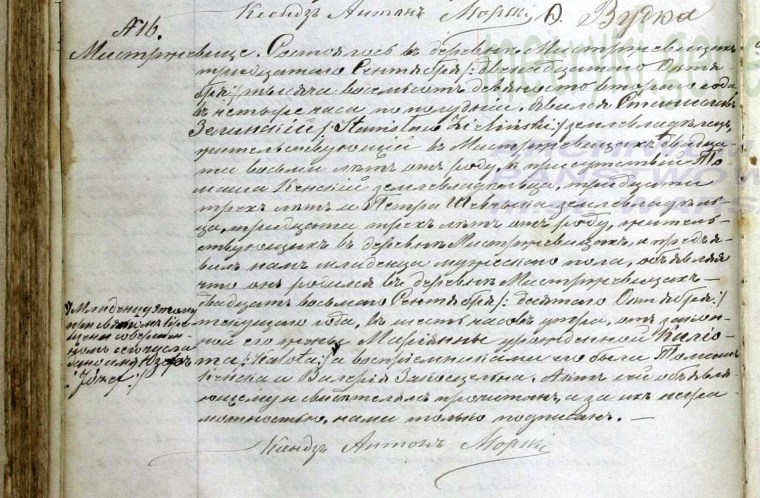
For me, finally reading great-grandpa’s baptismal record, after so many years of seeking it, was such a thrill (Figure 2).

Figure 2:  Baptismal record for Józef Zieliński, son of Stanisław Zieliński and Marianna Kalota.joseph-zielinski

As you may notice, the record is in Russian, which was the required language for all legal documents from this part of Poland at that time. Having this fantastic data set that I couldn’t read because all the records were in Russian, was also a gift in its own way.  Although I’d dabbled in Russian translations with a few records before this, it was these records that forced me to finally get serious about learning to read Russian vital records.  During the week between Christmas and New Year’s, while we were in Buffalo visiting with our extended family, I sat down and immersed myself in these records and in Shea and Hoffman’s game-changing translation guide until they finally started making sense and I could read them with relative ease.  The fact that my family indulged me in that, and gave me the time and space for genealogy research in the midst of holiday cheer, was yet another Christmas gift.

(If you’re curious about what that baptismal record says, here’s the translation.)

“This happened in the village of Mistrzewice on the 30th day of September/12th day of October 1892 at 4:00 in the afternoon. He appeared, Stanisław Zieliński, farmer residing in Mistrzewice, 28 years from birth, in the presence of Tomasz Kęska, farmer, age 33, and Piotr Szewczyk, farmer, age 33, residents of the village of Mistrzewice, and showed us a child of the male sex, stating that it was born in the village of Mistrzewice on the 28th day of September/10th day of October of the current year at 6:00 in the morning of his lawful wife Marianna, née Kalota. (Marginal note, whose text should be inserted here, reads, “To this child at Holy Baptism was given the name Józef.) and godparents were Tomasz Kęska and Waleria Zakościelna. This document to the declarant and to the illiterate witnesses was read, and signed only by us.”

Unfortunately, Mistrzewice and Młodzieszyn, the two parishes which held records for my Zieliński family, were in the path of the Nazis in 1939.  Many records were destroyed, as was the parish cemetery in Mistrzewice, so my knowledge of the family is incomplete.  I do know that my 5x-great-grandparents were Wojciech and Katarzyna (maiden name unknown) Ciećwierz, probably born in the 1790s.  Their son, Jan Ciećwierz, married Katarzyna Grzelak about 1836.  Jan and Katarzyna’s daughter, Antonina Ciećwierz, married Michał Zieliński circa 1853, and together they had 7 children, including my great-great-grandfather, Stanisław Zieliński, who married Marianna Kalota.  Michał Zieliński died in February 1872, a fact which I know only because it was mentioned in the marriage record when his widow Antonina remarried Ludwik Grzegorek. Surviving marriage records for Mistrzewice only go back to 1855, and death records only go back to 1890, so I will never be able to determine Michał’s parents’ names from either his marriage or his death record.

On the Kalota side, I can trace back as far as my 4x-great-grandparents, Antoni Kalota and Marianna Wilczek, whose son Roch Kalota married Agata Kurowska, daughter of Andrzej and Katarzyna (maiden name unknown) Kurowski, circa 1855.  Had they married in Mistrzewice, their marriage record might have been captured in the surviving records, but unfortuately the Kalota family was from Młodzieszyn, where all the records prior to 1885 were destroyed.  Roch and Agata Kalota had six children that I have been able to discover, including my great-great-grandmother, Marianna (née Kalota) Zielińska.

Geneteka’s interface has changed considerably since I began my research that Christmas, and it offers more powerful and flexible search options than it did four years ago.  Moreover, records are being added to Geneteka regularly, so it’s well worth your time to revisit your research periodically, even if you think you’ve been thorough.  For example, a new feature that has been added since I first began researching my Zieliński family is the ability to conduct a province-wide search using both a surname and a maiden name.  So I can now search all of Mazowieckie province for records which mention both the names Ciećwierz and Grzelak — which I just did, while writing this blog post, with exciting results (Figure 3)!

Figure 3:  Search results for Ciećwierz and Grzelak in Mazowieckie province.ciecwierz-and-grzelak

If you’ll notice, there are three marriages that occurred in Mistrzewice, and I knew about those already.  However, there are two births for children of Jan Ciećwierz and Katarzyna Grzelak in the parish of Mikołajew — Feliks in 1838 and Marcjanna in 1840.  The dates are right on the money to make them siblings of my 3x-great-grandmother, Antonina (née Ciećwierz) Zielińska.  Moreover, there is an 1830 marriage record for a Marianna Ciećwierz to a Karol Grzelak, also in Mikołajew, as well the death record for this same woman five years later. If you hover your cursor over the “i” in that indexed entry for the death record, you see that Marianna was age 25 when she died and her maiden name was indeed Ciećwierz. The death index specifies that the parents of Marianna (née Ciećwierz) Grzelak were Wojciech and Katarzyna, which means that Marianna was most likely a sister to my 4x-great-grandfather Jan Ciećwierz. Jan’s death record from 1897 states that he was age 82 when he died, suggesting a birth year of 1815, and if Marianna was 25 when she died in 1835, then she was born in 1810 — just 5 years older than Jan.

The fact that these records are from Mikołajew is also fascinating to me.  My great-grandfather, Joseph Zielinski, emigrated in 1912 with his cousin, Stanley Mikołajewski. Although he initially settled in North Tonawanda, New York, where my family lived, Stanley eventually moved on to Cleveland where he changed the family surname to Michaels. The families remained close and would often travel back and forth between North Tonawanda and Cleveland for visits.  Etymologically, “Mikołajewski” is a topographic surname, deriving from the names of towns such as Mikołajew.1 So essentially, the surname “Mikołajewski” means, “that guy from Mikołajew,” and I have long suspected that the Mikołajewskis who settled in Młodzieszyn and married into my Kalota family, must have been from the nearby village of Mikołajew originally (Figure 4).

Figure 4:  Map showing proximity of Mikołajew to Młodzieszyn and Mistrzewice.map

Surnames were often surprisingly changeable in the first half of the 19th century in Poland, and as I consider these new data, I wonder if perhaps it was Stanley Mikołajewski’s grandfather or great-grandfather who might have used a different surname previously, but migrated to Młodzieszyn, perhaps at the same time as my Ciećwierz ancestors, and became known as “Mikołajewski.”  Further pondering and research are required to fully understand all this, but at the moment, I’m thrilled with this wonderful new discovery!

Somehow, it seems like another Christmas gift from Grandpa in heaven.

Sources:

1 William F. Hoffman, Polish Surnames:  Origins and Meanings (Third Edition), (Chicago: Polish Genealogical Society of America, 2012), p. 450

© Julie Roberts Szczepankiewicz 2016

“Why Can’t I Find Census Records for My Ancestors in Poland?”

Those researching their Polish ancestry often wonder wonder how they can find census records for their ancestors in Poland.  Most of us American researchers have come to rely on the census as a first step in researching our ancestors, and there are good reasons why we love it.  Census records provide a “snapshot” of our families at different points in time, revealing names, ages and relationships of family members, as well as other important details such as year of immigration, year of naturalization, how many children a woman had, and more.  Most importantly, the census has been digitized and indexed, which allows us to find our ancestors with relative ease, even when they migrate around the country.  It seems natural, then, that people would want to find similar records for their ancestors in Poland.  So where are these records?

The answer is a bit complicated, and depends on our understanding of the history of census-taking.  Censuses have been conducted since ancient times.  Remember the Census of Quirinius mentioned in the Bible, in which Joseph and Mary had to travel to Bethlehem to be counted?  Perhaps in recognition of the logistical problems of “no room at the inn” created by having an entire population move around, more contemporary emperors have conducted censuses by having enumerators go door to door, counting people where they lived.  The purpose of any census was usually to provide information for taxation and military conscription as well as statistical information about the population, which might include ethnic minorities living in a given area, languages spoken, religious affiliation, etc.  Here in the U.S., the census was mandated by the Constitution, and has been conducted every ten years since 1790.  However, since Poland did not exist as an independent nation from 1795 until 1918, there could be no “national census of Poland” during this time.  Rather, censuses were conducted at different times and in different places by the Russian, Prussian, and Austro-Hungarian Empires which occupied Polish lands.

In the Russian Empire, a large census was conducted in 1897, although it’s worth noting that this census was criticized for undercounting Poles and overestimating those with Russian ethnicity.  Similarly, the German Empire conducted a census in 1895, which was criticized for lowering the number of Catholics and ethnic Poles in German-occupied lands.  Many additional censuses were conducted (a nice summary of which can be found here), but in many cases, original returns have not survived, and only statistical summaries remain.  In addition to these governmental census records, some religious census census records survive for Poland.  Each Catholic parish priest conducted an annual census of his parishioners, which was called “Status Animarum” in Latin, or “Spis Parafialny” in Polish, an example of which can be seen here.  The original intent of these censuses was to allow the priest to verify that his parishioners were receiving the sacraments as appropriate, but these censuses eventually grew to include addresses and ages of household members.

The result of all this history is a patchwork of records that includes parish censuses, tax lists, population registers, conscription lists, etc.  Some of these are available online (more about where to find those in my next blog post), and more are coming online every day. But the backbone of research in Polish records is vital records.  The Polish archives and genealogical societies have been going to great lengths to get more and more of these vital records—both the original church records, and the civil copies—digitized, indexed, and online.  In fact, one might wonder why we here in the U.S. chose to prioritize the digitization of census records over vital records.

Once again, the answer lies in the history.  Civil vital registration in America began slowly, and regional practices varied widely.  Town vital records exist for Massachusetts that date back to the 1600s, but vital registration didn’t begin in most parts of the U.S. until the mid-to-late 1800s.  Moreover, it wasn’t until about 1920 that vital registration requirements were reliably enforced.  Prior to that, researchers must turn to church records to obtain births, marriages and deaths for their ancestors.  A national effort to digitize church records would be problematic in the U.S. because church records are not public documents, and churches are not required to hand them over to the state or make them public for any reason.  (Of course, churches will sometimes make records available to individuals if asked nicely and if a donation is offered.)

While we in America tend to think in terms of this separation of church and state, the same is not true in Poland, or elsewhere in Europe.  As I wrote previously, church officials frequently served as civil registrars throughout Poland, and parish record books were recognized as legal documents. The practice of making duplicate copies of church books for civil authorities dates back to the late 18th century across much of modern-day Poland, and these duplicate copies serve as our foundation for Polish genealogical research.  The greater availability of vital records relative to census records does require a bit of a shift in mindset for American researchers.  Instead of having a decennial snapshot of your ancestral family groups indicating the names of all the family members, researchers will have to discover those names through careful analysis of parish records.  Although more time-consuming, the result is ultimately more complete, as a survey of U.S. census records will omit any children who died in infancy between census years.

In many cases, Polish vital records themselves will provide guideposts to migrations of the family.  Marriage records will usually state where the bride and groom were born, and where their parents are living at the time of the marriage.   But what happens if a couple moves around during their childbearing years?  One might suspect such an occurrence if there is an unusually large gap (more than about 3 years) between births to a married couple in the records for a particular parish.  It’s times like this that indexed records can be very, very helpful.  In their absence, a researcher is often faced with the task of searching parishes in the surrounding area more or less at random, unless other clues are available which suggest where the family might have gone (e.g. a child’s godparent with the same surname as one of the parents is living in another local parish).  Still, what about those researchers who have no clue where in Poland their family originated?  Indexed vital records would certainly make life a lot easier for them, too.

At present there are a number of popular indexing sites available for vital records in Poland.  The most comprehensive and ambitious of these is Geneteka, which aims to cover every province within Poland today as well as offering limited coverage in areas that were once part of Poland but are no longer.  Other indexing efforts, such as Lubgens for the Lublin area, BaSIA and the Poznań Project for the Wielkopolskie province/Poznań area, the Pomeranian Genealogical Society database for the Pomerania region, and other, smaller efforts, are strictly regional and don’t aim to include full coverage of Poland.  The situation is very reminiscent of the way things were here in the U.S. in the late 1990s and early 2000s, when numerous small indexing projects existed for census records, prior to the completion of indexing efforts by Ancestry.com, FamilySearch, and others.  Although all these Polish indexing efforts are presently free and not behind a paywall, the sponsoring genealogical societies rely on donations to pay for servers and keep the records online.

At some point in the future, tracking your ancestors’ migrations through indexed records in Geneteka might be as easy as finding them in indexed census records in the U.S. Geneteka’s search engine is powerful enough to allow for some pretty great searching already, especially now that it’s possible to search using two different surnames (e.g. father’s surname and mother’s maiden name). New indexes (i.e. new parishes, registry offices, or new ranges of years for parishes or registry offices for which coverage already exists) are being added all the time, but the vast scope of this project — indexing over 300 years’ worth of records from every parish, synagogue, other place of worship, or civil registry office in an area of about 121,000 square miles —  means that it will take some time before coverage is even close to complete. So for now, the best approach is still to accurately determine one’s ancestors’ place of origin in Poland, using U.S. records, before attempting research in Poland, rather than hoping to get lucky with indexed vital records.

In my next post, I’ll review some options for those intrepid and hardy souls who still hope to find actual “census records” of one type or another for your ancestors in Poland.  Until then, happy researching!

© Julie Roberts Szczepankiewicz 2016


Walter Wed Where? Wow! A Genealogical Breakthrough

The sweetest victories are the ones that took the longest time in coming.  A couple days ago, I happened upon some documents that fundamentally changed my understanding of my Grzesiak family history, documents I’ve been seeking for many years.  So there is some major happy dancing going on in the Szczepankiewicz house today, albeit limited to just one of its residents.

The Grzesiaks of Kowalewo-Opactwo and Buffalo, New York

In a previous post, I wrote a little about the family of my great-grandmother, Veronica (née Grzesiak) Zazycki.  Veronica immigrated from the little village of Kowalewo-Opactwo in Słupca County to Buffalo, New York, where she was eventually joined by three of her siblings:  Władysław (“Walter”), Tadeusz/Thaddeus, and Józefa/Josephine.  Regarding Veronica’s oldest brother, Grandma told me that Walter had married an actress in Poland, whose name Grandma remembered as “Wanda,” but she didn’t want to leave her career, so he left her and came to the U.S. without her. There were no children from this marriage.

When I began to look for documentation for these family stories, I realized the situation wasn’t exactly as Grandma had portrayed it.  The 1900 census (Figure 1) shows the Grzesiak family all living on Mills Street in Buffalo, consisting of patriarch Joseph, sons Władysław and Thaddeus, daughter Jozefa, and daughter-in-law Casimira — Walter’s wife of two years.  Clearly, Walter’s wife DID come to Buffalo, rather than staying in Poland while he left without her – but her name was Casimira, not Wanda. The census goes on to state that at that time, she was the mother of 0 children, 0 now living, consistent with family reports.

Figure 1:  Extract from the 1900 U.S. Federal Census, showing the Grzesiak family.1900 United States Federal Census - Kazimira Grzesiak

In the 1905 New York State Census (Figure 2), Walter and Casimira were still living in Buffalo, so the marriage lasted at least 7 years.  Subsequent records (e.g. the 1940 Census) do indeed show Walter as divorced or a widower.

Figure 2:  Extract from 1905 New York State Census showing Walter and Casimira Grzesiak.1905 NY State Census for Walter Grzesiak
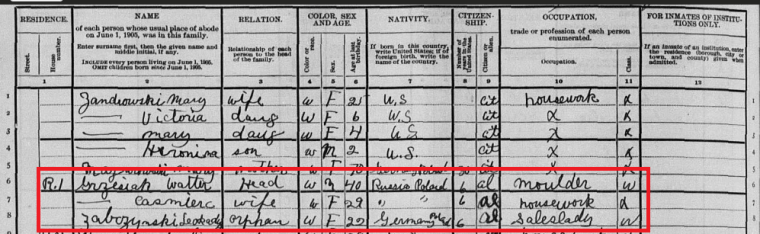
Walter’s death certificatereports his ex-wife’s name as “Katarzyna Dutkiewicz (Figure 3), and the informant was his brother, Thaddeus.

Figure 3:  Extract from Walter Grzesiak’s death certifcate.Katarzyna Dutkiewicz
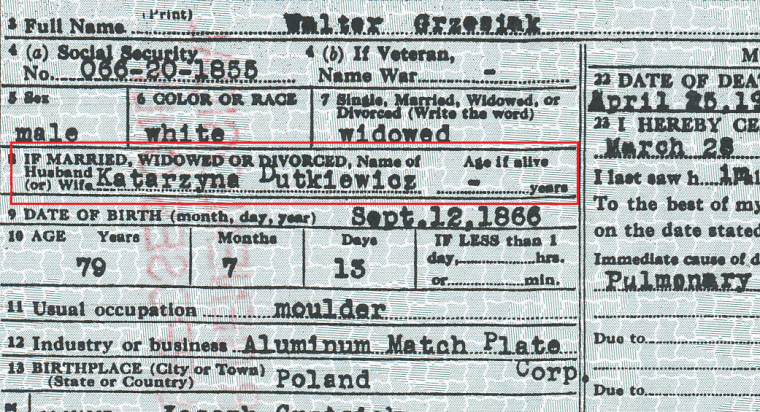
Clearly, Thaddeus made a mistake with the first name, reporting it as Katarzyna (Katherine) instead of Kazimiera/Casimira.   So how much faith should we put in his version of her maiden name, Dutkiewicz?  Death records are often viewed with some circumspection, since someone other than the deceased is providing the information, and that person might be grieving or in shock.  However, it was all there was to go on, and it seemed like it should have been a good start:  Name, Kazimiera Dutkiewicz (or similar), born about 1880 (based on those census records), married to Władysław Grzesiak in Poland circa 1898.

The Hunt Is On!

Since Walter Grzesiak was born in Kowalewo-Opactwo, it seemed logical that he would have married somewhere in that vicinity, although not necessarily in that parish.  Things get a little tricky with the records for Kowalewo-Opactwo in that time period.  Records are not online, or on microfilm from the LDS, so one must write to the Konin Branch of the State Archive in Poznań to request a search.  Moreover, although Walter was baptized in Kowalewo, that parish was temporarily closed from 1891-1910.  Parish operations were transferred to the church in nearby Ląd, but after 1911, the parishes and their records were separated again.   Unfortunately, the archive reported that there was no marriage record in Ląd for Władysław Grzesiak, or for any of his siblings, during this period.

Initially, this finding didn’t concern me too much.  It’s traditional for a couple to marry in the bride’s parish, so this suggested merely that Kazimiera was from some other parish in the area.  So how does one find a marriage in the Poznań region, when one has no idea what parish the couple married in?  The Poznań Marriage Project, of course.   For those who might be unfamiliar with this resource, the Poznań Project is an indexing effort conceived by Łukasz Bielecki, which is intended to include all existing marriage records for the historic Poznań region from 1800-1899.  Currently, the project is estimated to be at least 75% complete, so there was a good chance I’d be able to find Walter and Casimira’s marriage in there. Frustratingly, there were no good matches, so I assumed that their marriage record must be among the 25% of existing records that remain unindexed.  At this point, finding it would be like searching for the proverbial needle in a haystack.  I put this on the back burner and went back to more productive research on other family lines.

Until two days ago.

My Breakthrough

It seemed like a perfectly ordinary Wednesday afternoon.  I paid bills, ran some errands, took the cat to the vet, and sat down to check e-mail.   But if you’re like me, some small part of your brain is always thinking about genealogy, and suddenly it dawned on me:  the family story was that Casimira was an actress.  How could she have been an actress in a small village with a couple dozen farms?  She must have been from a big city — Warsaw!

Immediately, I went to Geneteka, my favorite database for indexed vital records from all over Poland.  Normally, I advise people to use documentation from U.S. sources to determine where their ancestors came from before they start randomly searching records in Geneteka, but desperate times call for desperate measures, and I had a pretty specific idea of what I was looking for.  But would the record be there?  Geneteka is not complete — it’s a brilliant, ambitious idea, and new indexes for different parishes and different time periods are constantly being added, but it still represents only a fraction of the vital records available in the tens of thousands of parishes and civil registries across Poland.  In this case, my hunch paid off, and Geneteka came through for me. I was stunned, absolutely stunned, when I saw what had to be their marriage record (Figure 4):

Figure 4:  Geneteka search results for Grzesiak marriages in Warszawa between 1897 and 1899.
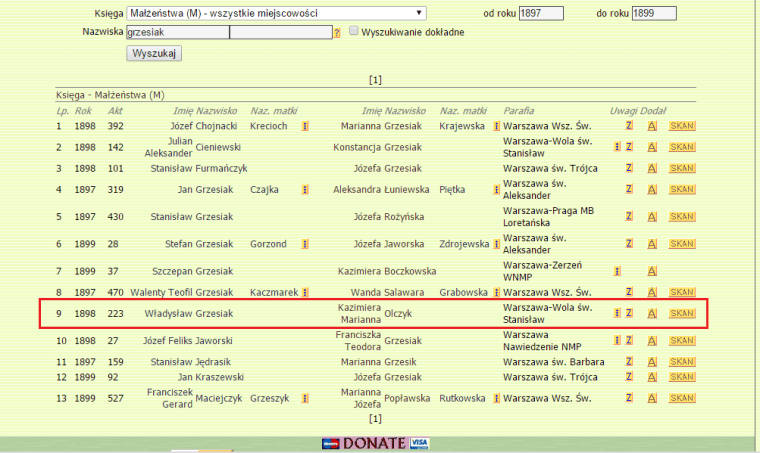
Geneteka

I hit “skan” to get a copy of the record itself (isn’t Geneteka great?!) and here it is, in all its glory:Wladyslaw Grzesiak and Kazimiera Olczyk 1898 crop
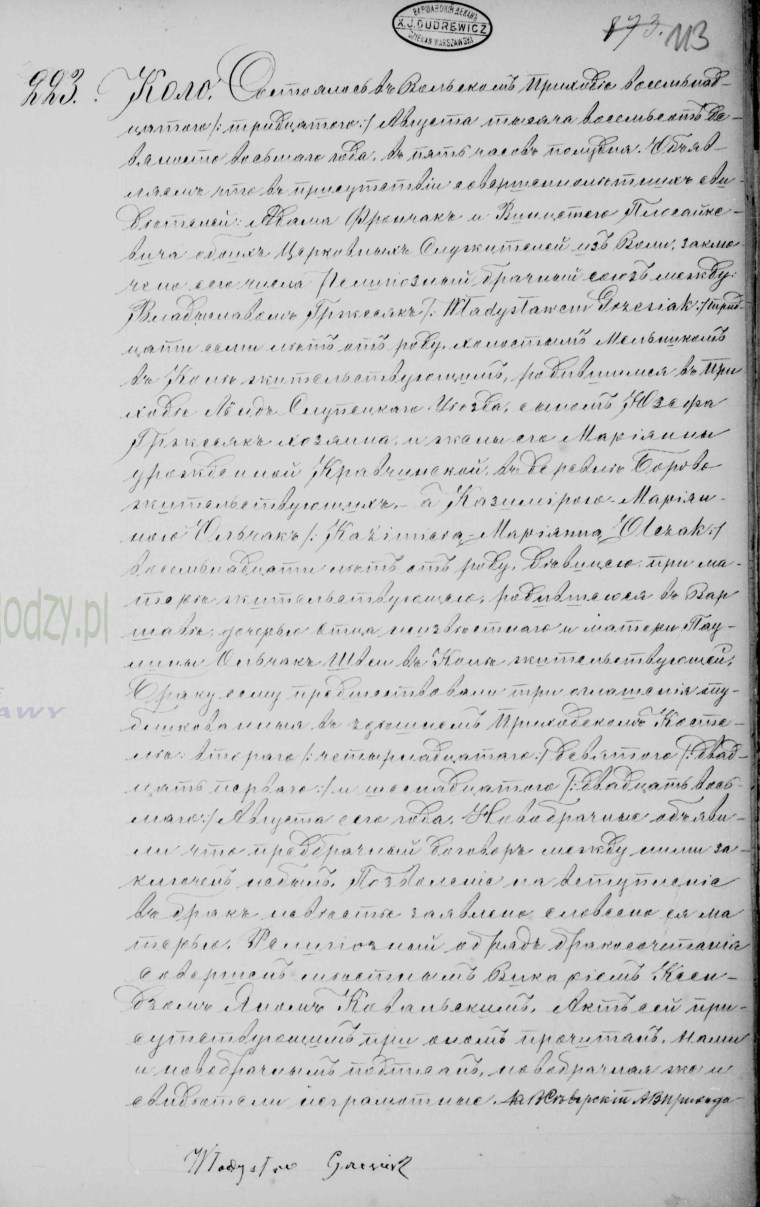
The record is in Russian, because Warsaw was in the Russian Empire in 1898 when the event took place, so here’s my translation:

“223. Koło. It happened in Wola parish on the eighteenth/thirtieth day of August in the year one thousand eight hundred ninety-eight at five o’clock in the afternoon. We declare that, in the presence of witnesses Adam Franczak and Wincenty Płocikiewicz, both ecclesiastical servants of Wola, on this day was contracted a religious marriage between Władysław Grzesiak, age thirty-seven, miller of Koło residing, born in Ląd, Słupca district, son of Józef Grzesiak, owner, and his wife Maryanna née Krawczyńska, in the village of Borowo residing, and Kazimiera Marianna Olczak, age eighteen, single, with her mother residing, born in Warsaw, daughter of an unknown father and mother Paulina Olczak, seamstress, in Koło residing.  The marriage was preceded by three readings of the banns on the 2nd/14th, 9th/21st, and 16th/28th days of August of the present year.  The newlyweds stated that they had no prenuptial agreement between them.  Permission was given orally by those present at the ceremony.  The religious ceremony of marriage was performed by the Reverend Jan Kowalski.  This document, after being read aloud, was signed by us and by the groom because the witnesses state that they do not know how to write.”2

Let’s break this down a bit.  First, the double dates are often confusing to those who aren’t familiar with the format of Polish civil records, but they’re a result of the fact that Poland and Western Europe adopted the Gregorian calendar  while Russia and the Eastern Europe continued to use the old Julian calendar.  In order to have these records be clear to everyone, both dates were included on legal documents like this.  The second, later date is the date according to the Gregorian calendar, which we would go by.

Second, Kazimiera’s name isn’t Dutkiewicz, as expected — but we’ll worry about that in a minute.  The date of the marriage (1898) is correct, as is the groom’s name, and parents’ names.  His age is a bit off (he should only be 30, not 37), but it’s not unusual for ages reported in these records to be very much “ballpark estimates.”  Walter was actually born in Kowalewo, not Ląd, but if you recall, the parish functions had been transferred from Kowalewo to Ląd at this time, so perhaps this can be interpretted as a reference to that.

Getting back to Kazimiera, her age (18) matches with what we expected based on U.S. records.  The priest doesn’t mention her budding theatrical career, but perhaps her star had not yet risen very far (if it ever really rose at all).  So this is clearly the right marriage record.  But how did we get from Olczak to Dutkiewicz?

The answer lies again in the indexed records of Geneteka (Figure 5):

Figure 5:  Geneteka search results for marriage records with surnames Olczak and Dutkiewicz between 1880 and 1900:
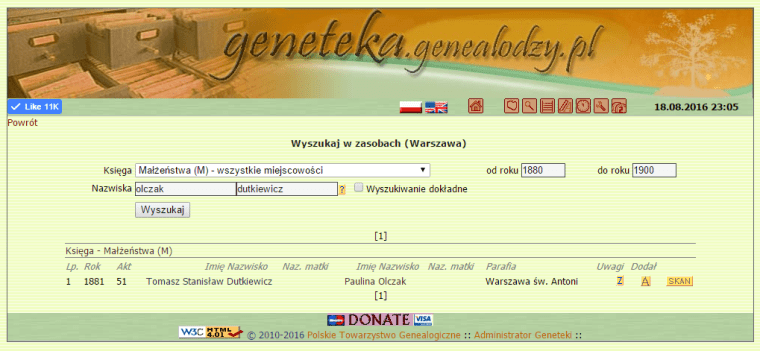
Olczak

It appears that shortly after Kazimiera’s birth in 1880, her mother Paulina married Tomasz Dutkiewicz.  Whether Tomasz Dutkiewicz ever legally adopted Kazimiera is doubtful, but this certainly explains why she might have at least informally used the name of her step-father as her own.

But Wait, There’s More!

So all this is nice, right?  But why is a marriage record for a great-granduncle really THAT exciting?  As I mentioned, my great-grandmother Veronica emigrated along with three siblings, Walter, Thaddeus and Josephine.  What we didn’t know until I began researching records from Poland, was that there were two additional siblings — Konstancja3 and Pelagia4 — who did not emigrate.  No descendant of the Grzesiak family in the U.S. that I interviewed was aware that these sisters existed.  The Konin Branch of the State Archive in Poznań had no record of marriage for either of them, and I was planning to write again to request a search for their death records, assuming they might have died before reaching a marriageable age.  However, I noticed that there was a marriage record for a Konstancja Grzesiak on the same page of Geneteka search results (Figure 4, result 2) that gave me Walter’s marriage record!  Sure enough, the marriage record5 reveals that Konstancja is the daughter of Józef Grzesiak and his wife, Marianna née Krawczyńska, residing in the village of Ląd.

Unfortunately, I still can’t find a birth record for Pelagia, and it’s still possible that she died before reaching a marriageable age.  But the implications of these new data are tremendous for me.  My great-grandmother arrived in the U.S. in March of 1898,6 and in June and August of that same year, her sister and brother each married in Warsaw, prior to most of her family joining her in Buffalo in 1900, while the one married sister stayed behind in Poland with her family in Warsaw.  Wow!   A little further digging confirmed that Konstancja also had children (Figure 6):

Figure 6:  Geneteka search results for birth records in Warszawa mentioning surnames Cieniewski and Grzesiak:

Cieniewski

So I might have cousins in Poland from this Cieniewski line!  However, it’s interesting that there are only two births.  Birth records for this parish, St. Stanislaus, Bishop and Martyr, and St. Adalbert, in the Wola district of Warsaw, are indexed from 1886 to 1908 without any gaps.  Therefore one might expect to see more than two children born between their marriage in 1898 and 1908 when the records end.  There is no evidence that they immigrated to Buffalo, no good matches in U.S. census records for this family in Buffalo or anywhere else.  So where did they go?

The Grzesiaks of Kowalewo-Opactwo, Warsaw, Buffalo, and Borowo

One clue, in Walter’s marriage record, might point the way.  It stated that he was the son of “Józef Grzesiak, farmer, and his wife Maryanna née Krawczyńska, in the village of Borowo residing”  Borowo is new to me.  This is the first time this place has been mentioned in connection with my family.  And unfortunately, there are at least 20 places in Poland today by that name.  But if Borowo was where her parents were living at the time of Konstancja’s marriage, maybe that’s where she and her young family eventually went to live.  So which Borowo is correct?

Well, Konstancja’s marriage record, from just two months earlier, states that her parents were residing in Ląd.  That, and the fact that there were no good matches for a place called Borowo that’s very close to Warszawa, suggests that this may be the correct place, Borowo in Konin County, about 22 miles east of the Grzesiak’s previous home in Kowalewo-Opactwo:

map

According to the Skorowidz Królestwa Polskiego, a nice period gazetteer of Russian Poland published in 1877, the village of Borowo belongs to the Roman Catholic parish in Krzymów, so that’s where we can look for records.  Records are online and on microfilm, but only from 1808-1884, which doesn’t help us any with finding additional births to Konstancja and Julian Cieniewski after 1900.  However, the Branch Archive in Konin has birth records up to 1911,  so this is an obvious next step to take.

The Old Mill, Revisited

There’s one other really cool connection I’d like to make before I sum things up.  In my previous post about my Grzesiak family, I mentioned my grandmother’s recollection that her mother Veronica’s family owned a grain mill near the parish church.  Try as I might, I couldn’t find any reference to Veronica’s father being a miller.  However, when I visited Veronica’s birthplace of Kowalewo-Opactwo on a trip to Poland last year, I was amazed to see this old windmill, missing its vanes, in close proximity to the church, exactly as Grandma described.  So I found it fascinating that Walter’s marriage record described him clearly as a miller, even though a more general term (“хозяин,” meaning “owner,” but seemingly used as a non-specific synonym for “farmer” or “peasant”) was again used to describe his father, Józef.  This makes me more convinced that the mill in the photo actually was a place associated with Veronica’s family.  Maybe her father didn’t own the mill, maybe he just worked for the miller — but between the existence of this mill where it should be, based on Grandma’s story, and the fact that her uncle Walter was described as a miller, I think there’s good reason to believe that this was the mill that Grandma’s story referred to.  IMG_4542
That’s a Wrap

So what general research insights can be gained from this?

  1.  Once again, my ancestors were more mobile than I expected them to be — and yours might be, too.

When I began my research, I really thought I’d find “the” ancestral village for each surname line and be able to go back for many generations in that same village.  Time and time again, that seems to be the exception, rather than the rule.  I was so blinded by my expectation that Walter would have met his bride some place near to where he was born, that I overlooked obvious resources, like indexed records for Warsaw on Geneteka, because it seemed too improbable.  Logic requires us to search in the obvious places first — those associated with the family.  But when searching in the obvious places doesn’t pan out, it’s time to think outside the box.

2.  Family stories can sometimes hold the key.

If you are among the oldest generation in your family, it’s not too late to write down everything you remember from older relatives, for the next generation.  But if you still have any older relatives remaining, talk to them!  My third cousin and research collaborator, Valerie Baginski, told me that her grandmother always said that the family came from Warsaw, rather than Poznań, which was my family’s version of the story.  Once we figured out that our Grzesiaks’ ancestral village was Kowalewo-Opactwo, closer to Poznań than Warsaw, we dismissed that mention of Warsaw.  Since Warsaw was a bigger city than Poznań, we chalked up this discrepancy to our ancestors’ tendency to paint their place of origin with a broad brush, referencing the closest big city.  Now we realize that it’s quite possible her great-grandmother mentioned Warsaw because she was one of the younger siblings who may have lived there for a time, while my great-grandmother mentioned Poznań because she was the first one to leave Poland, and may never have gone to Warsaw with the others.

3.  Pay your dues.

This last “insight” is a shameless plug for Geneteka, the database for indexed Polish vital records that enabled me to find my Grzesiaks in Warsaw.  For those of you who might be unfamiliar with it, Geneteka is a project sponsored entirely by volunteers from the Polskie Towarzystwo Genealogiczne (PTG, or Polish Genealogical Society), in Poland.  Although all the indexing and photographing of vital records (for Geneteka’s sister site, Metryki, which I wrote about previously) is done by volunteers, funds are still required to pay for servers to host the websites.  If you’ve used Geneteka and found it helpful to you, please consider making a donation to the PTG.  Let’s help them to help us find our ancestors!

Walter’s marriage record was a puzzle piece that’s been missing for a long, long time.  It just goes to show you that you never know when that great idea will hit, or when serendipity will strike, so keep chipping away at those brick walls.  Stay thirsty, my friends.

Sources:

1New York, Department of Health, Division of Vital Statistics, County of Erie, City of Buffalo, Death Certificates, #2600, Death certificate for Walter Grzesiak, 25 April 1946.

2“Akta stanu cywilnego parafii rzymskokatolickiej sw. Stanislawa i Wawrzynca w Warszawie,” Polskie Towarzystwo Genealogiczne, Metryki.genealodzy.pl:  Projekt indeksacji metryk parafialnych (http://metryki.genealodzy.pl/), 1898, Malzenstwa, #223, record for Wladyslaw Grzesiak and Kazimiera Marianna Olczak, accessed on 17 August 2016.

3Roman Catholic Church, Sts. Peter and Paul the Apostles Parish (Kowalewo, Słupca, Wielkopolskie, Poland), Kopie księg metrykalnych, 1808-1879, 1872, births, #5, record for Konstancja Grzesiak.; FHL #1191028 Items 1-4.

4“Akta stanu cywilnego Parafii Rzymskokatolickiej Kowalewo-Opactwo (pow. slupecki)”, Narodowego Archiwum Cyfrowego, Naczelnej Dyrekcji Archiwów Panstwowych, Szukajwarchiwach (Szukajwarchiwach.pl), Ksiega urodzen, malzenstw i zgonów, 1869, births, #48, record for Pelagia Grzesiak, accessed on 21 June 2016.

5“Akta stanu cywilnego parafii rzymskokatolickiej sw. Stanislawa i Wawrzynca w Warszawie “, Polskie Towarzystwo Genealogiczne, Metryki.genealodzy.pl:  Projekt indeksacji metryk parafialnych (http://metryki.genealodzy.pl/), 1898, Malzenstwa, #142, record for Julian Aleksander Cieniewski and Konstancja Grzesiak, accessed on 18 August 2016.

6Ancestry.com, Baltimore, Passenger Lists, 1820-1948 and 1954-1957 (Provo, UT, USA, Ancestry.com Operations Inc, 2006), http://www.ancestry.com, The National Archives at Washington, D.C.; Washington, D.C.; Records of the US Customs Service, RG36; NAI Number: 2655153; Record Group Title: Records of the Immigration and Naturalization Service, 1787-2004; Record Group Number: 85, record for Veronika Gresiak, accessed on 21 July 2016.

Featured Image:

Wodzinowski, Wincenty. Wesele. Digital image.Http://muzeuminstrumentow.pl/. Muzeum Ludowych Instrumentów Muzycznych W Szydłowcu, 18 Sept. 2015. Web. 18 Aug. 2016.  This painting from 1896 seemed very fitting for my cover photo, since it depicts a wedding celebration very close to the time when Walter and Casimira married.

© Julie Roberts Szczepankiewicz 2016


What’s in a name? My Zarzycki family of Buffalo, Rybno and Brańsk

I’ve been very busy with adding new data to my family tree for my Zarzycki family, thanks to my fabulous researcher in Warsaw, Justyna, who visited my ancestral parish in Poland to obtain records that are not available on microfilm, online, or in any archive.   By way of introduction, my maternal grandmother’s father was Jan/John Zażycki, who immigrated to Buffalo, New York in 18951 and eventually settled in North Tonawanda, New York.  My extended Zazycki family always insisted that the surname was spelled “Zażycki,” rather than the phonetically-equivalent “Zarzycki,” and furthermore, I was told by some that anyone with the surname “Zarzycki” was not likely to be related to us.  It may indeed have been the case that my great-grandfather preferred the spelling without the “r.” As you can see from the signature on his civil marriage record, John clearly spelled his name as “Zażycki”2:  Jan & Weronika Zazycki Marriage 2
John Zazycki’s naturalization papers contain both spellings, but one could argue that the places in which it was spelled with the “r” were the result of carelessness on the part of the clerk, since there is one place on the naturalization certificate where John’s name not only contains the “r,” but also appears as “Jarzycki”3:

Jan Zazycki naturalization certificate 2

Compare this with the Petition for Naturalization1, which John himself signed at the bottom:

Jan Zazycki Petition for Naturalization

However, any experienced family historian can tell you that one needs to be flexible and keep an open mind regarding variant spellings of surnames, and that is true in this case as well.  In records from Poland, I have only rarely seen the surname spelled as Zażycki.  For example, in records in which Jan’s father, Ignacy, is mentioned, the surname is spelled as “Zarzycki” on 17 occasions and as “Zarzecki” on 3 documents. In documents pertaining to Ignacy’s father, Józef, the surname has been spelled as “Zarzycki” 7 times, and as “Zażycki” only once.  In fact, that’s the only time I have ever seen the name spelled as “Zażycki” on a document from Poland.

My Zarzycki family was from the villages of Szwarocin and Bronisławy, which belong to the Roman Catholic parish of St. Bartholomew in Rybno.  All of these villages are presently in Sochaczew County, Mazowieckie province, but were in the Warsaw province of the Russian Empire at the time of my great-grandfather’s birth in 1866.  Literacy rates were quite low in the Russian Empire in those days — one estimate places the overall literacy rate of the Russian Empire at 24% in 1897, while the rural literacy rate which would include small villages like Bronisławy, was as low as 19.7%.4  Despite this, there is evidence that Ignacy Zarzycki was literate:  his signature appears as distinct from that of the priest, on the birth records of two of his children.  Below is the birth record for Ignacy’s son, Leonard Zarzycki, in 1876.5   Ignacy clearly signed his name as “Zarzycki.”  Leonard Zarzycki birth 1876

The same is true on this birth record for his son, Roman Aleksander Zarzycki in 18726:

Roman Aleksander Zarzycki birth 1872

So although it may have been the case that my great-grandfather preferred the spelling “Zażycki,” it appears that that preference may have begun with him, and has no bearing on the spellings that we see on records from Poland for this family.  In fact, not only does the spelling with the “r” predominate, but John’s own father spelled his name that way.

According to the paper trail for this family, Jan Zażycki was the son of Ignacy Zarzycki and Antonina Maciążek,2 and Ignacy was the son of Józef Zarzycki and Joanna Krzemińska.7 Going back one generation further on the paternal line, Józef Zarzycki was the son of Adam Zarzycki and Wiktora Stolarska.8  In records pertaining to Adam, we see a different trend in spelling.  Out of twelve documents found to date in which he is mentioned, six of them give his name as “Zarzecki,” five of them spell it “Zarzycki,” and only one of them (the marriage record for his son, Józef) shows the spelling, “Zażycki.”  Interestingly, the documents that contain the spelling “Zarzecki,” tend to be older (1802-1812) whereas the spelling “Zarzycki” is found on documents dated between 1812-1828.

The record for Adam’s first marriage to his wife, Wiktoria, states that he was a newcomer to the community in Rybno, having moved there from his original place of birth in Brańsk:9

Bransk

If there were any doubt about which place called Brańsk was meant, it would be cleared up by the record for Adam’s second marriage to Agnieszka Kruczewska in 1810, in which Adam is said to be from Podlachia (Podlasie):10

1810 crop

Taken together, these two documents suggest the town of Brańsk, which is currently the seat of gmina Brańsk in Bielsk County, Podlaskie Voivodeship, approximately 143 miles from Rybno:

13246316_10207640187954005_3609992669130168736_o

Adam Zarzycki was born about 1769 to Kazimierz Zarzycki and his wife, Zofia,9 but there are no vital records for the parish in Brańsk available for this time period from the Polish State Archives. The LDS Family History Library does have some vital records for Brańsk on microfilm including death records from 1797-1823, but no birth or marriage records from this or any earlier time periods, which suggests they might have been lost or destroyed.  So although it may not be possible to locate a birth record for Adam Zarzycki, it might be possible to locate death records for his parents, and this is an obvious direction for future research. Some of the existing records are indexed on Geneteka, including marriages from 1885-1896, and a search for “Zarzycki” reveals two marriage records with the spelling “Zarzecki”:

Bransk

Taken together, these data suggest that the original spelling of the surname was “Zarzecki,” and that it evolved to “Zarzycki” after Adam Zarzecki migrated to Rybno.  Analysis of the geographic surname distributions for both variants of the name (based on data from 2002) confirms that, although the “Zarzecki” spelling is generally less popular in Poland, it is significantly more common than “Zarzycki” in Bielsk County (124 bearers for Zarzecki/a vs. fewer than 50 for Zarzycki/a).

As this case demonstrates, surnames can evolve significantly over time and place, and the spelling variants that one sees may follow a particular pattern, rather than occurring at random. Tracking these changes can sometimes lead to a better understanding of a family’s geographic origins.  It will be interesting to see whether I can find additional traces of this family in the microfilmed death records from Brańsk — it’s unclear from Adam’s marriage record whether he was from the Brańsk area generally, or from that parish specifically.  But if I am able to find additional records there, you can be sure that I’ll pay close attention to how the Zarzycki/Zarzecki surname is spelled.


Sources:

1Erie, New York, #1892, Petition for Naturalization for Jan Zazycki, 12 July 1900.; Erie County Clerk’s Office, 92 Franklin St. Buffalo, NY 14202.

2Buffalo, Erie County, New York, 1901, #202, marriage record for John Zazycki and Veronica Grzesiak.; Erie County Clerk’s Office, 92 Franklin St., Buffalo, NY 14202.

3Erie, New York, #1892, Certificate of Naturalization for Jan Zazycki, 8 August 1900.; Erie County Clerk’s Office, 92 Franklin St. Buffalo, NY 14202.

4“Likbez.” Wikipedia. Accessed May 29, 2016. https://en.wikipedia.org/wiki/Likbez#CITEREFGrenoble.

5Roman Catholic Church, St. Bartholomew Parish (Rybno, Sochaczew, Mazowieckie, Poland), “Księga urodzeń 1870-1880”, 1876, #87, baptismal record for Leonard Zarzycki.

6Roman Catholic Church, St. Bartholomew Parish (Rybno, Sochaczew, Mazowieckie, Poland), “Księga urodzeń 1870-1880”, 1872, #15, baptismal record for Roman Aleksander Zarzycki.

7Roman Catholic Church, St. Bartholomew’s Parish (Rybno, Sochaczew, Mazowieckie, Poland), “Early birth records (before 1831)”, 1828, #34, baptismal record for Ignacy Zarzycki. 

8Roman Catholic Church, St. Bartholomew’s Parish (Rybno, Sochaczew, Mazowieckie, Poland), “Księga ślubów 1826-1828”, 1826, #11, marriage record for Józef Zażycki and Joanna Krzymińska.

9Roman Catholic Church, St. Bartholomew’s parish (Rybno, Sochaczew, Mazowieckie, Poland), “Księga ślubów 1790-1802”, 1802, #9, marriage record for Adamus Zarzecki and Victoria, parents’ names unknown.

10Roman Catholic Church, St. Bartholomew’s Parish (Rybno, Sochaczew, Mazowieckie, Poland), “Księga ślubów, 1803-1810”, 1810, #8, marriage record for Adamus Zarzecki and Agnes Kruczewska.

© 2016 Julie Roberts Szczepankiewicz