In my last post, I described my quest to determine the place of origin in Bavaria of my immigrant Murre/Murri/Murie/Murrÿ ancestors, including my great-great-grandmother, Anna (Murre) Boehringer and her parents, Joseph and Walburga (Maurer) Murre. Using Collins-Leeds Method autoclusters of Ancestry autosomal DNA matches to my dad, I was able to identify a cluster of matches that includes documented descendants of Joseph and Walburga Murre, as well as descendants of a Franz/Frank Maurer. Zeroing in on this particular Maurer family, I was able to confirm through documentary research that Franz Maurer was, in fact, strongly connected to the Murre family—part of their FAN club. Although I’d been unable to find evidence for Joseph and Walburga’s specific place of origin in Bavaria, I found evidence that Franz Maurer and his first wife, Franziska Geigand, emigrated from the town of Waldmünchen, along with the family of a Maria Maurer and her two children. The group of travelers from Waldmünchen also included the family of Alois and Josephine Geigand, who were additional members of the Murre family’s FAN club. Logic would suggest, then, that Joseph and Walburga Murre’s family should also be from Waldmünchen, so I arranged to have a professional researcher, Marcel Elias, visit the Regensburg Bischöfliches Zentralarchiv (Regensburg Diocesan Central Archive) for me, in order to find evidence for my Murre/Maurer families in church records from Waldmünchen.
The Emigrants from Waldmünchen
Marcel nailed it! During the course of a one-day trip to the archive, he located documentation to create a tree which included 71 individuals, including the five members of my Murre family who were known to have been born in Bavaria. Thanks to Marcel’s research, so many questions have been answered, and the story of the Murri family has been fleshed out considerably. We now know that Joseph Murri was born 27 August 1827 in Waldmünchen—a date which is reasonably consistent with the date of birth of August 1825 which was stated in the 1900 census.1 His parents—whose identities were previously unknown—were Joseph Murri and Joseph’s third wife, Magdalena Schmaderer. Joseph married Walburga Maurer (or Mauerer, as the name was more frequently spelled in German records) on 5 November 1862. Their marriage record is shown in Figures 1a and 1b.2
Figure 1a: First page of marriage record from Waldmünchen for Joseph Murri and Walburga Mauerer, 5 November 1862. Click image to enlarge.Figure 1b: Second page of marriage record from Waldmünchen for Joseph Murri and Walburga Mauerer, 5 November 1862. Click image to enlarge.
In translation, the record describes the groom as Joseph Murri, an unmarried, Catholic, day laborer and a resident of Waldmünchen, born in Waldmünchen on 22 August 1827 to Joseph Murri, a cottager from Waldmünchen, and Magdalena Schmaderer from Grosenkirchen. The bride was Walburga Mauerer, an unmarried, Catholic, carpenter’s daughter, born on 28 April 1834 to Andreas Mauerer and Catharina Weidner, both from Waldmünchen. Joseph and Walburga were married in the church by an officiant whose surname was Beck on 5 November 1862, in front of witnesses Martin Haller, a cloth maker and Johann Baptist Hausladen, a master mason, both from Waldmünchen. The couple’s civil marriage took place before a magistrate on 22 October 1862.
Joseph and Walburga’s three oldest children were known to have been born in Bavaria, and birth records from Waldmünchen indicate that the oldest, Mary Murre, was baptized as Anna Maria Murri, born 16 September 1863.3 Their second child, my great-great-grandmother Anna Murre, was baptized as Anna Francisca Murri, and her date of birth was 27 September 1865, exactly as it was reported on her death record.4 Finally, their son, John Murre, was baptized as Johann Murri, born on 23 April 1867.5
Revealing the Mysteries of the Past
Beyond documenting the German-born members of the Murri family itself, Marcel was able to discover evidence to elucidate the relationships among the Maurers and Geigands who emigrated together on 1 May 1867. His findings confirm that Walburga (Maurer or Mauerer) Murri and Franz Maurer were, in fact, related, as suggested by DNA evidence. They were siblings: two of the eight children born to Andreas and Katharina (Weidner) Mauerer. Moreover, Alois and Josephine Geigand were the parents of Franziska (Geigand) Mauerer, as I hypothesized in my last post. Franz and Franziska’s marriage record is shown in Figures 2a and b.6
Figure 2a: First page of marriage record from Waldmünchen for Franz Georg Mauerer and Franziska Geigant, 17 October 1864. Click image to enlarge.Figure 2b: Second page of marriage record from Waldmünchen for Franz Georg Mauerer and Franziska Geigant, 17 October 1864. Click image to enlarge.
Translated, the record states that, on 17 October 1864, an officiant named Sichert married Franz Mauerer and Francisca Geigant (sic) in the parish of Waldmünchen. The groom was an unmarried, Catholic carpenter, who was born on 14 July 1839 in Waldmünchen to Andreas Mauerer, a carpenter, and Catharina Weidner. The bride was unmarried and Catholic, born in Waldmünchen on 25 February 1838. Her parents were Alois Geigant, a mason, and Josepha Lechner. Witnesses were Xaver Mauerer, a carpenter, and Johann Alt, a cottager. The bride and groom, their parents, and both witnesses, were all residents of Waldmünchen. The civil marriage took place at the city office on 27 September 1864.
The fact that Josepha Geigand’s maiden name was Lechner clears up another mystery found in U.S. records. While most of the baptismal records for Franz and Franziska Maurer’s Buffalo-born children reported Franziska’s maiden name as Geigand or Geichand, the baptismal record for their son, Michael Maurer, reported the mother’s maiden name as Lechner.7 Since the Maurers and the Geigands all settled in St. Boniface parish, it’s probable that the priest there was well-acquainted with the whole family, making it plausible that he mixed up Franziska (Geigand) Maurer’s maiden name with that of her mother, Josepha (Lechner) Geigand. It’s also worth noting that Marcel’s research did not turn up any evidence that the Geigands were blood relatives of the Murri family. Previously, I’d wondered about that, since Alois and Josephine Geigand were named as godparents to two of Joseph and Walburga Murri’s children. However, thus far, it appears that Alois and Josephine were only related to by marriage to the Murri family, since their daughter Franziska (Geigand) Maurer was sister-in-law to Joseph and Walburga (Maurer) Murri.
There’s more. Maria Maurer who emigrated with her two children, Anna and Johann, was also the sister of Walburga and Franz.8 Georg Macht, who was traveling with them, was the children’s father.9 Restrictive marriage laws in 19th century-Bavaria resulted in a high rate of illegitimate births,10 and it was not uncommon for a couple to have one or more children together prior to marriage. That may explain their speedy marriage, less than two months after arriving in Buffalo.11
As for that relatively small amount of DNA shared between my dad and five of the great-grandchildren of Franz/Frank Maurer—just 10 cM—I’m inclined to chalk it up to the randomness of DNA inheritance through recombination. As I mentioned in my previous post, 10 cM shared DNA would be more typical of a relationship that was more distant than third cousins once removed (3C1R), according to data from the Shared cM Project. However, since Walburga and Franz were, indeed, siblings, Dad and Franz’s great-grandchildren are 3C1R nonetheless.
Deeper Roots of the Murri and Mauerer Families
Although the Murri surname had already disappeared from Bavaria by 1890,12 the surname was readily found in earlier records. Marcel was able to trace the Murri line back five more generations from my 3x-great-grandfather, Joseph Murri, who was born in 1827. In the time allotted for the research, Marcel got back as far as the marriage of Peter Muri and Eva Braun, who were married in Waldmünchen on 4 June 1703.13 Although the mothers of the bride and groom were not identified, Peter was noted to be the son of Blasius Muri, while Eva was the daughter of Martin Braun. This makes Blasius and Martin two of my 8x-great-grandfathers.
The Mauerer family, however, proved to be more difficult to trace. Although Marcel located a baptismal record for Andreas Mauerer, Walburga (Maurer) Murri’s father, the birth record stated that Andreas was illegitimate. Andreas’s baptismal record is shown in Figure 3.
Figure 3: Baptismal record from Waldmünchen for Andreas Mauerer, born 25 October 1793. Click image to enlarge.
The Latin transcription is as follows, with credit to both Marcel Elias, and to Mente Pongratz (researcher and frequent contributor to the German Genealogy Facebook group, as well as the Genealogical Translations Facebook group) for their assistance and insights:
“Waldmünchen. 25. Nat[us] et a R[everendus] D[ominus] Joanne Nepomuc[ene] Gresser, Supern[umerarius] baptizatus est Andreas, Christinae Lineburgerin, Michaelis Linneburger textoris tibialium filiae, adhuc solutae hic, et ut mater ascerit Conradi Mauerer militis ex legione principis de Taxis hic, fil[ius] illeg[itimus]. Levante Andreas Meixlsperger soluto textore in Hochabrun ejus vices Franciseno Reischl adstans hic.”
In translation, it states,
“Waldmünchen. On the 25th [day of October 1793; the month and date were recorded on a previous page], is born, and by Reverend Lord Joannes Nepomucene Gresser, Supernumerary, is baptized, Andreas, of Christina Lineburger, as yet unmarried daughter of Michael Linneburger, stocking weaver herein, and as the mother asserts, illegitimate son of Conrad Mauerer, soldier in the legion of the Prince of Taxis here. Lifted by Andreas Meixlsperger, unmarried weaver in Hochabrun by his proxy, Francis Reischl, standing here.”
This sounds rather awkward in English, but it helps to know that a Supernumerary was more or less an associate pastor, so Andreas was baptized by Fr. Johann Nepomucene Gresser. The mother was Christina Lineburger/Linneburger/Lüneburger, who stated that the baby’s father was Conrad Mauerer, a soldier. The term “levante,” or lifted, refers to the person who lifted the child out of the waters of the baptismal font—the godparent. In this case, the godfather, Andreas Meixlsperger of Hochabrun was not present, so Franz Reischl stood in as proxy. The “legion of the Prince of Taxis” seems to refer to the Königlich Bayerisches 2. Chevaulegers-Regiment „Taxis“ (2nd Royal Bavarian Chevaulers Regiment “Taxis,”) which was a cavalry unit of the Bavarian Army, belonging to the Prince of Thurn und Taxis. I’m hoping we might be able to get a further glimpse of Conrad Mauerer in military records from the Bayerisches Armeemuseum (Military History Museum of Bavaria), located in Ingolstadt, as it would be nice to know who his parents were, and where he was born. Marcel found no evidence of additional children born to Christina and Conrad in the baptismal records from Waldmünchen, and neither was there any evidence that they ever married each other.
All in all, I’m absolutely thrilled with the results of this latest round of research. Thanks to Marcel, I was finally able to establish definitively that Waldmünchen was the place of origin of my Murri and Maurer ancestors, and identify at least a portion of Joseph and Walburga’s ancestors, going back five more generations. Although each answer has led to to two more questions, for now, I’m content to savor the victory.
Sources:
1 1900 U.S. Census, Erie County, New York, population schedule, Buffalo Ward 25, Enumeration District 222, Sheet 2A, Erie County Almshoouse, line 16, Joseph Murri; digital image, Ancestry (https://www.ancestry.com/ : 27 July 2022), citing Family History Library microfilm no. 1241033, original data from National Archives and Records Administration publication T623, 1854 rolls; and
Roman Catholic Church, Waldmünchen parish (Waldmünchen, Cham, Bayern, Germany), Bd. 3, “Taufen, 1788-1830,” p 395, birth record for Joseph Murri, 22 August 1827; Bischöfliches Zentralarchiv Regensburg, St. Petersweg 11 – 13, 93047 Regensburg, Germany.
2 Ibid., Bd. 4, “Trauungen, 1831-1867,” unnumbered pages, 1862, no. 6, Joseph Murri and Walburga Mauerer.
3 Ibid., Bd. 4, “Taufen 1831-1867,” p. 383, no. 154, Anna Maria Murri, 16 September 1863.
4 Ibid., Bd. 4, “Taufen, 1831-1867,” p. 413, no. 183, Anna Francisca Murri, 27 September 1865; and
New York State Department of Health, Division of Vital Statistics, Death Certificates, no. 2064, Anna Mertz, 29 March 1936; Buffalo, New York, City Clerk, 1302 City Hall, 65 Niagara Square, Buffalo, New York.
5 Roman Catholic Church, Waldmünchen parish (Waldmünchen, Cham, Bayern, Germany), Bd. 4, “Taufen, 1831-1867,” p. 442, no. 71, Johann Murri, 23 April 1867; Bischöfliches Zentralarchiv Regensburg, St. Petersweg 11 – 13, 93047 Regensburg, Germany.
6 Ibid., Bd. 4, “Trauungen, 1831-1867,” unnumbered pages in chronological order, 1864, No. 6, Franz Georg Mauerer and Franziska Geigant, 17 October 1864.
8 Roman Catholic Church, Waldmünchen parish (Waldmünchen, Cham, Bayern, Germany), Bd. 4, “Taufen 1831-1867,” p. 50, unnumbered entries in chronological order, Anna Maria Mauerer, 2 July 1836; Bischöfliches Zentralarchiv Regensburg, Regensburg, St. Petersweg 11 – 13, 93047 Regensburg, Germany.
9 Ibid., p. 355, no. 129, “Anna, illeg.”daughter of Georg Macht and A. Maria Mauerer, born 9 August 1861; and
Ibid., p. 430, no. 169, “Joh. Baptist, illeg.” son of Georg Macht and A. Maria Mauerer, born 12 August 1866.
10 Knodel, John, “Law, Marriage and Illegitimacy in Nineteenth-Century Germany,” Population Studies, vol. 20, no. 3, 1967, pp. 279–94, JSTOR (https://doi.org/10.2307/2172673 : 27 July 2022).
13 Roman Catholic Church, Waldmünchen parish (Waldmünchen, Cham, Bayern, Germany), Bd. 5, “Ehen 1628-1735,” p. 636, unnumbered entries in chronological order, Peter Muri and Eva Braun, 4 June 1703; Bischöfliches Zentralarchiv Regensburg, St. Petersweg 11 – 13, 93047 Regensburg, Germany.
The longer I research, the more I am convinced of the unstoppable power of cluster research, combined with autosomal DNA testing, when it comes to breaking through genealogical brick walls. Cluster research is also known as FAN research—genealogical research into an ancestor’s friends, associates and neighbors—and this method has proven to be very successful when the paper trail dries up, and historical records cannot be found which offer direct evidence for parentage or place of origin.
Last autumn, this combination helped me break through a long-standing brick wall, and discover the place of origin of my Causin/Cossin ancestors from Pfetterhouse, Alsace, France. Bolstered by that success, I’ve been attempting to utilize that same magic combination of FAN plus DNA research to discover the origins of my Murre/Muri ancestors, who immigrated to Buffalo, New York in 1869 from somewhere in Bavaria.
From Bavaria to Buffalo: The Joseph Murre Family
Let me start with a brief introduction to my 3x-great-grandparents, Joseph and Walburga (Maurer) Murre. Joseph Murre (or Murrÿ, Muri, Murri, Murrie, etc.) was born circa 1825 in Bavaria, Germany.1 Around 1862, he married Walburga Maurer, who was born circa 1835.2 They had at least three children while in Germany: Maria/Mary Murre, born circa 1863; Anna Murre (my great-great-grandmother), born 27 September 1865; and Johann/John F. Murre, born circa April 1867.3 The Murre family emigrated from the port of Bremen, arriving in New York on 3 April 1869 aboard the SS Hansa.4 Their passenger manifest is shown in Figure 1.
Figure 1: Manifest from the SS Hansa showing the family of Joseph, Walburga, Maria, Anna, and Johann Muri (sic). Click image to enlarge.
Unfortunately, the manifest does not specify a place of origin beyond simply “Bavaria,” and neither have any other records discovered to date been informative in that regard—including naturalization records and church records, which are so often helpful in identifying an immigrant’s place of origin.
Three more children were born to Joseph and Walburga Murre in Buffalo: Josephine, born in 1869, Alois/Aloysius Joseph, born in 1872, and Frances Walburga, born in 1876.5 Walburga Murre—who became known as Barbara in the U.S.—died on 18 September 1886 and is buried in the United German & French Cemetery in Cheektowaga, New York.6 Her husband, Joseph, was living in the Erie County Almshouse at the time of the 1900 census, and he died in 1905.7 He, too, is buried in the United German & French Cemetery in Cheektowaga, albeit in a different plot from the one where Walburga is buried.
While it would oversimplify the situation considerably to state that this summary is “all” that was known about the Murre/Maurer family, the fact remains that thus far, I have not identified any siblings or parents for either Joseph Murre or Walburga Maurer, nor have I been able to identify their place of origin in Bavaria.
Step 1: Use DNA to Light the Way
When faced with a similar research question for my Causin/Cossin line, I believe I missed an opportunity by failing to exploit genetic genealogy methodology early on in the research. Now that I’m older and wiser, I decided to tackle my Murre/Maurer origins question using genetic genealogy methods right from the start. Specifically, I began by examining the Collins-Leeds Method autoclusters of my Dad’s autosomal DNA matches, gathered from all his Ancestry DNA matches who share between 20 cM (centimorgans, a unit of genetic distance) and 400 cM of DNA with him. These autoclusters are created by the DNAGedcom Client, an app available with a subscription to DNAGedcom. The clusters are displayed in a matrix that resembles the one shown in Figure 2.
Figure 2: A portion of the Collins-Leeds Method autosomal cluster matrix generated by the DNAGedcom client for Ancestry DNA matches who share between 20 cM and 400 cM DNA with my dad.
At the time I ran this autocluster analysis, Dad had 385 Ancestry DNA matches who met the specified requirements of sharing between 20 and 400 cM DNA with him. So, Figure 2 shows only a portion of the matrix, which is set up as a grid with those 385 names along the top and also along the left side. Those 385 people are organized into clusters based on common ancestry, and Cluster 57, indicated by the red arrow, is the cluster to focus on to start. Clicking the popup box, “View Cluster,” brings up the image shown in Figure 3.
Figure 3: Details about Cluster 57, obtained by selecting “View Cluster” option in autocluster matrix generated by the DNAGedcom Client.
The green tree icon (circled in red) indicates a DNA match with a family tree linked to his or her test results; names of matches (in the “Person” column) have been redacted for privacy. By scrolling down through the list of Ancestors in Cluster, or by examining the trees (when available), I was able to determine that two of these DNA matches are descendants of Josephine (Murre) Hummel—the sister of my great-great-grandmother, Anna (Murre) Boehringer. The third match lacks a family tree, so it’s not immediately clear how we are related; however, these initial findings imply that we must be related through DNA passed down from ancestors of either Joseph Murre or Walburga Maurer.
The fourth member of that Cluster 57, whom I’ll call L.O., is even more interesting, because her family tree indicates that she is the great-granddaughter of German immigrants Frank and Matilda Maurer of Buffalo, New York. L.O. is the DNA match who shares 41.5 cM DNA with my dad, in the list of people in Cluster 57 shown in Figure 3. At this point, I did not have any information on Frank Maurer’s ancestry. But the fact that he shared a surname with Walburga Maurer, combined with the fact that one of his descendants shares DNA with three documented descendants of hers, strongly suggested that (a) Cluster 57 is a Maurer DNA cluster and not a Murre DNA cluster, and (b) Frank must somehow be related to Walburga.
Hoping to gather more data, I examined the Collins-Leeds Method autoclusters that were generated from gathering Dad’s DNA matches who shared between 9 cM and 400 cM DNA with him. By dropping the minimum threshold for inclusion in the analysis all the way down to 9 cM, I picked up DNA matches who are related more distantly, and the total number of individuals included in the analysis jumped from 385 to 1,651. The cluster that contains the same individuals found in Cluster 57 of the previous analysis, is now numbered as Cluster 334, shown in Figure 4.
Figure 4: A portion of the Collins-Leeds Method autosomal cluster matrix generated by the DNAGedcom client for Ancestry DNA matches who share between 9 cM and 400 cM DNA with my Dad.
Examination of the new and improved version of that “Maurer Cluster” (Cluster 334) revealed that there’s some overlap with the adjacent Cluster 335, as well as some other DNA matches (336–342) that are more loosely related, creating a supercluster. That supercluster includes all the greyed-out boxes around Clusters 334 and 335.
Inspection of available family trees for people in the 334–342 supercluster produced the following data (Figure 5):
Match ID
Shared cM with Dad
Pedigree notes
L.O.
41.5 cM
Granddaughter of Eleanor Maurer, daughter of Franz Maurer & Matilda Grenz
M.L.
11.1 cM
Great-granddaughter of John J. Maurer, son of Franz Maurer & Matilda Grenz
C.M.
11.0 cM
Grandson of Joseph J. Maurer, son of Franz Maurer & Matilda Grenz
R.H.
10.8 cM
Grandson of John J. Maurer, son of Franz Maurer & Matilda Grenz
D.U.
9.2 cM
Grandson of Eleanor Maurer, daughter of Franz Maurer & Matilda Grenz
T.M.
10 cM
Grandson of John J. Maurer, son of Franz Maurer & Matilda Grenz
Figure 5: Summary of DNA and family tree data for DNA matches from supercluster 334–342 whose precise relationship to my Dad has yet to be determined.
The DNA matches summarized in Figure 5 were in addition to other DNA matches from that cluster who were already known to me as descendants of Joseph and Walburga (Maurer) Murre.
Most of these matches are in the 10 cM range, with the outlier being L.O., who shares roughly 42 cM with my dad, and this variability may be due simply to the randomness of DNA inheritance through recombination. However, other possibilities exist, such as the possibility that L.O. shares more than the expected amount of DNA with Dad because she’s also related to him in some other way, besides just the Maurer connection. That’s a question for another day, but in any case, there’s ample DNA evidence here to suggest that the genetic link between my family and all these DNA cousins lies in that Maurer DNA. Nonetheless, the precise relationship between Franz Maurer and my 3x-great-grandmother, Walburga (Maurer) Murre, remains unclear. Were they siblings, or perhaps first cousins? If we hypothesize that Franz and Walburga were siblings, then that would mean that Dad and all these great-grandchildren of Franz Maurer would be third cousins once removed (3C1R). While it’s within the realm of statistical possibility for 3C1R to share only 10 cM DNA, according to data from the Shared cM Project, a more distant relationship between Franz and Walburga is more probable.
Step 2: Research Franz Maurer’s Family in Historical Records
Now that we’ve identified a family of interest, who was Franz Maurer, and what evidence can be found in historical records that might offer some clues for our research question? Preliminary research indicated that Franz/Frank Maurer was born circa 1839 in Bavaria, and was married to Franziska/Frances Geigand in Germany. Figure 6 shows the family in the 1880 census.8
Figure 6: 1880 U.S. Census showing the family of Franz Maurer living at 240 Locust Street in Buffalo, New York.
Franz was a carpenter, born in Bavaria, and the couple had two children while in Germany: a son, Alois, born circa 1861, and a daughter, Anna, born about 1865. They immigrated in 1867,9 and settled in Buffalo, New York, in the same parish where my Murre family would settle two years later—St. Boniface, formerly located at 145 Mulberry Street. Church records show that another son, Joseph, was born to Franz and Franziska on 18 August 1867, followed by Michael on 21 July 1869.10 Twin boys, Joannes Aloisius and Franciscus (as they were identified in their Latin baptismal records), were born on 2 February 1872,11 but they both died of smallpox that summer, which also took the life of four-year-old Joseph.12 Another son, Frank, was born on 26 June 1873, followed by Henry on 14 July 1876.13 A daughter, Francisca, born 18 August 1880,14 must also have died in infancy, because she disappears from the records. She is not, however, buried in the same cemetery plot as many of the other Maurer children who died in childhood.
On 15 April 1881, Franziska/Frances Maurer died,15 leaving behind her husband and five living children, ranging in age from about 5 years to 20 years old. Four months later, on 22 August 1881,16 Franz remarried a fellow German immigrant, 33-year-old Franziska (Eppler or Ebler) Schabel, a widow whose previous husband, Frank Schabel, died in April 1880.17 At the time of her remarriage, Frances was the mother of two children, Frank Schabel, Jr. (about age 4), and Rose Schabel, who was barely two years old.18 Although Frank Jr. retained his biological father’s surname, Rose was subsequently known as Rose Maurer, and she identified her father as Francis Maurer—not Schabel—on her marriage record.19 Although Frances was still within her childbearing years when she married Frank Maurer, no children from this marriage have been discovered thus far.
The second Frances Maurer must have died before 1888, because Franz Maurer remarried for the third time on 24 January of that year.20 Oddly, there is no evidence for Frances’ death in the Buffalo, New York, death index 1885–1891. However, there may have been a miscommunication with the civil clerks when the certificate was recorded, because there is a death certificate for a Frank Marer (sic) in that time period, which might be that of Frances, despite the masculine version of the given name.21 (Research is ongoing.)
Franz Maurer’s new bride was 34-year-old Matilda Grenz, another German immigrant, and four children were born to this couple: Joseph, on 15 January 1889; Matilda, on 30 April 1891, John, on 21 December 1892, and Eleanor, on 22 January 1897.22 Franz/Frank Maurer, Sr., died in 1910 and is buried in the United German & French Cemetery.23 In 1924, his wife, Matilda, passed away, and she is buried by his side.24
Step 3: Confirm FAN Club Membership
As expected, evidence from Joseph and Walburga Murre’s FAN club confirms the importance of the Franz Maurer family to my quest for the origins of my Maurer/Murre ancestors. Joseph and Walburga Murre named Franz and Franziska Maurer as godparents to their youngest child, Frances Walburga Murre, whose baptismal record from St. Boniface church is shown in Figure 7.25
Figure 7: Baptismal record from St. Boniface Church in Buffalo, New York, for Francisca Walburga Murre. Click image to enlarge. The record states, “Die 22 Octobris baptizavi Franciscam Walburgam, nat[am] 20 h[ujus] m[ensis] fil[ia] Josephi Murrÿ et Walburgae Maurer. Patrini fuere Franciscus Maurer et Francisca Maurer.” In translation, “On the 22nd day of October, I baptized Francisca Walburga, born on the 20th of this month, daughter of Joseph Murrÿ and Walburga Maurer. Godparents were Franciscus Maurer and Francisca Maurer.”
Interestingly, for both of their other Buffalo-born children, Josephine and Alois Joseph, they named as godparents Alois Geigand and his wife, Josephine. Josephine Murre’s baptismal record is shown in Figure 8.26
Figure 8: Baptismal record from St. Boniface Church in Buffalo, New York, for Josephine Murre. Click image to enlarge. The record states, “No. 542, Josephina Muri Oct 31. Baptizavi Josephinam, natam 28 hujus ex Joseph Muri & Walburga Maurer, conjugibus. Sponsores fuere Aloisius & Josephina Geigand.” In translation, “I baptized Josephine, born on the 28th of this [month] of Joseph Muri & Walburga Maurer, spouses. Sponsors were Aloisius & Josephine Geigand.”
Cemetery data from United German and French Cemetery, where Walburga and Joseph were buried, confirm the close relationship between the Maurer and Geigand families. The lot where Walburga was laid to rest was a large one, with at least 20 burials in it, owned by Alois Geigand and Frank Maurer.27 Of the twenty burials, all but four of them have been identified as descendants of Maurer or Geigand families. (Those remaining four burials may also be related, but currently their connection to these families is unclear.) The 1880 census, shown previously in Figure 6, also illustrates the strong links between the families, since they were living in the same house at 240 Locust Street at that time. A detail from this census is shown in Figure 9.
Figure 9: Detail from 1880 census showing Alois and Josephine Geigand living with the family of Frank Maurer in Buffalo, New York. Click image to enlarge.
According to this census, Alois and Josephine Geigand were both 68 years old, which implies that they were born circa 1812. These ages suggest that perhaps they might be the parents of Frances (Geigand) Maurer, and I’m hoping that her burial record from St. Boniface might shed some light on that.
This brings us to the Hamburg emigration manifest for these folks, the document that gives me a glimmer of hope that I might be able to discover the origins of my Maurer/Murre family (Figure 10).28
Figure 10: Hamburg emigration manifest for the Geigand and Maurer families, who departed for New York on 1 May 1867 on the SS Victoria. Click image to enlarge.
This manifest is irrefutably the correct one for these families. The names and ages of all passengers line up perfectly with data from U.S. records, confirming that 55-year-old laborer, Alois Geigand (indexed as Geigant), and his 54-year-old wife, Josephine, traveled to the U.S. with their two children, 24-year-old Georg and 17-year-old Walbur (sic), aboard the SS Victoria, departing from Hamburg on 1 May 1867. Traveling with them were the family of Franz (indexed as “Fraz”) Maurer, a 23-year-old carpenter; his wife, Franziska, and two children, Alois and Anna. Their place of origin was indexed by Ancestry as Waldmünchen, Bayern—a town in Bavaria, Germany, that’s barely two miles from the Czech border (Figure 11).
Figure 11: Location of Waldmünchen. Click image for interactive Google Map.
It’s always good to get more than one piece of evidence for place of origin before attempting to dive into records from Europe, and in this case, the emigration register from Mainz, Germany, provided that additional evidence (Figures 12a and b).29
Figure 12a: First page of the emigration register from Mainz, Germany, identifying the families of Aloys Geigand and Franz Maurer. 17-year-old Walbur Geigand, who was identified as Alois’s daughter on the passenger manifest, appears two rows down. Figure 12b: Second page of the emigration register from Mainz, Germany, identifying the families of Alois Geigand and Franz Maurer. 17-year-old Walbur Geigand, who was identified as Alois’s daughter on the passenger manifest, appears two rows down.
Professional researcher, Marcel Elias, provided the following translation of these entries:
“Nr. 394, 24 April 1867, agent’s name Humann, Schiffsvertrag (a confirmation about booked ticket) from 24 April 1867, Names of emigrants:
Geigant Aloys, 55yo
his wife Josepha, 54 yo,
their son Georg, 24 yo
all from Waldmünchen, Bayern, Auswanderungszeugniss (approval for emigration) from Waldmünchen from 27 March 1867, heading to New York, port of departure Hamburg on April 26
Nr. 395, 24 April 1867, agent’s name Humann, Schiffsvertrag (a confirmation about booked ticket) from 24 April 1867, Names of emigrants:
Maurer, Franz, 28yo
his wife Franziska, 26 (or 28 yo)
children: Alois, 4 ¼
Anna 1 ¼
all from Waldmünchen, Bayern, Auswanderungszeugniss (approval for emigration) from Waldmünchen from 27 March 1867, heading to New York, port of departure Hamburg on April 26″
Observant readers may have noticed that there were other emigrants from Waldmünchen recorded on both the passenger manifest, as well as the emigration register. These other emigrants included group 393, consisting of 30-year-old Maria Maurer and her children, Anna and Johann, as well as 42-year-old Georg Macht. They, too, belong to the Maurer-Geigand FAN Club, and I was not surprised to discover that Maria and Georg were married at St. Boniface on 18 June 1867, less than two months after they arrived in Buffalo.30 Ship-board romance or marriage of convenience? Who knows?
Step 4: Seek Evidence for Murre/Maurer Family in Records from Waldmünchen
Unfortunately, my own ancestors, Joseph and Walburga Murre, were not found in the database of Mainz, Germany, emigration registers, which suggests that they registered in another administrative center. (They also departed from Bremen, rather than Hamburg.) So, these two pieces of evidence—the passenger manifest and the emigration register—are my best hope for tracking down my Murre family. You may also note that Ancestry indexed the last place of residence of the emigrant Maurer-Geigand clan as “Waldmühlen,” rather than “Waldmünchen,” based on the “Wohnort” column. However, the place was clearly recorded as Waldmünchen in the “Legitimationen” column in Figure 12b. This discrepancy might be concerning, apart from the fact that I also happened to find a Buffalo Evening News article from 1933 about the 60th wedding anniversary of Joseph and Anna (Pongratz) Geigand, which states that Joseph Geigand was born in Waldmünchen, Bavaria, Germany, and came to the U.S. in 1871.31 Do I know how Joseph Geigand is related to my family at this point? Heck no. Nonetheless, FAN principles would suggest that he’s got to be a part of the Maurer-Geigand FAN Club, and at this point, that’s good enough for me.
Finding my Murre family in records from Waldmünchen sounds pretty straightforward, but it’s not a slam-dunk. It may be that the Maurers were approximating their place of origin to Waldmünchen, when in fact they were from some smaller village in the vicinity. We won’t know until we try. However, trying is not something I can do on my own. FamilySearch has no scans online for Roman Catholic records from Waldmünchen, nor am I sufficiently proficient in my ability to read German. Church records from Waldmünchen are at the Bischöfliche Zentralarchiv Regensburg (diocesan archive in Regensburg), which is an archive that’s quite familiar to Marcel Elias, the professional researcher I mentioned previously. So, I handed the ball off to Marcel, and I’m awaiting his results with bated breath. Stay tuned.
Sources:
1 1900 U.S. Census, Erie County, New York, population schedule, Buffalo Ward 25, Enumeration District 222, Sheet 2A, Erie County Almshouse, line 16, Joseph Murri; digital image, Ancestry (https://www.ancestry.com/ : 12 July 2022), citing Family History Library microfilm no. 1241033, original data from National Archives and Records Administration publication T623, 1854 rolls.
2 1870 United States Federal Census, Erie County, New York, population schedule, Buffalo Ward 7, page 73, family no. 603, Joseph Murri household; digital image, Ancestry (https://www.ancestry.com/ : 12 July 2022), citing NARA microfilm publication M593, roll 934 of 1,761 rolls. Washington, D.C.: National Archives and Records Administration, n.d; Family History Library Film no. 552433.
3 1880 United States Federal Census, Erie County, New York, population schedule, Buffalo city, Enumeration District 147, sheet 12D, family no. 120, Joseph Murry household; digital image, Ancestry (https://www.ancestry.com : 12 July 2022), citing NARA microfilm publication T9, roll 830 of 1,454 rolls, Records of the Bureau of the Census, Record Group 29, National Archives, Washington, D.C., Family History microfilm no.1254830; and
New York State Department of Health, Division of Vital Statistics, Death Certificates, no. 2064, Anna Mertz, 29 March 1936; Buffalo, New York, City Clerk, 1302 City Hall, 65 Niagara Square, Buffalo, New York; and
1900 U.S. Census, Erie County, New York, population schedule, West Seneca, Enumeration District 264, Sheet 28A, line 10, John Murra in Alois Klug household; digital image, Ancestry (http://search.ancestry.com : 12 July 2022), citing National Archives and Records Administration, 1900. T623, roll 1034 of 1854 rolls, FHL microfilm no. 1241034.
4Manifest, SS Hansa, arriving 3 April 1869, lines 38-42, Muri family; imaged as “New York, U.S., Arriving Passenger and Crew Lists (including Castle Garden and Ellis Island), 1820-1957,” database with images, Ancestry (https://www.ancestry.com/ : 12 July 2022); citing Microfilm Serial M237, 1820-1897; Line 42; List no. 292.
5 St. Boniface Roman Catholic Parish Records,142 Locust St. Buffalo, New York, microfilm publication, 2 rolls (Buffalo & Erie County Public Library : Western New York Genealogical Society, 1982), Roll 1: Baptisms (1849-1912), 1869, no. 542, baptismal record for Josephina Muri; and
Ibid., 1872, no. 977, baptismal record for Aloisius Joseph Muri; and
Ibid., 1876, no. 90, baptismal record for Francisca Walburga Murrÿ.
6 Ibid., 1886, baptisms, no. 124, record for Walburga Barbara Murry. Although it was recorded among the baptisms, the text makes it clear that this is a death record. “Walburga Barb. Murry. no. 124. Die 18a Sept. Walburga Barbara Murri quinqueqinta duos annos nata animam Deo reddidit confesso atque Viatico refecta die 20a b.m. rite sepultum est ejus corpus. Ferdinand Kolb.”; and
United German and French Cemetery Roman Catholic Cemetery, Mount Calvary Cemetery Group (500 Pine Ridge Heritage Boulevard, Cheektowaga, New York) to Julie Szczepankiewicz, Murre/Maurer/Geigand burial data, including record of lot owners for Lot 66, Section S; diagram of plot, and record of burials on lot; burial records for Walburga Barb Murri (1886) and Joseph Murre (1905).
7 Ibid., and
1900 U.S. Census, record for Joseph Murri.
81880 United States Federal Census, Erie County, New York, population schedule, Buffalo city, Enumeration District 147, page 31C, family no. 305, Frank Maurer household; digital image, Ancestry (https://www.ancestry.com/discoveryui-content/view/1716337:6742 : 12 July 2022), citing NARA microfilm publication T9, roll 830 of 1,454 rolls, Records of the Bureau of the Census, Record Group 29. National Archives, Washington, D.C.
9 Manifest, SS Victoria, departing 1 May 1867 Hamburg to New York, p328, nos. 46-49, Franz Maurer family (indexed as Fraz); imaged as “Hamburg Passenger Lists, 1850-1934,” Ancestry (https://www.ancestry.com : 12 July 2022), citing Staatsarchiv Hamburg; Hamburg, Deutschland; Hamburger Passagierlisten; Volume: 373-7 I, VIII A 1 Band 021 A; Page: 327; Microfilm No.: K_1712.
15 Find a Grave, database and images (https://www.findagrave.com/memorial/79956024/franziska-mauerer : accessed 12 July 2022), memorial page for Franziska Mauerer (28 Feb 1838–15 Apr 1881), Find a Grave Memorial ID 79956024, citing United German and French Cemetery, Cheektowaga, Erie County, New York, USA ; Maintained by Phyllis Meyer (contributor 47083260).
171880 U.S. Census, Erie County, New York, mortality schedule, Buffalo city, Enumeration District 141, sheet 1, line 19, Frank Schabel, died April 1880; imaged as “U.S., Federal Census Mortality Schedules, 1850-1885,” Ancestry (https://www.ancestry.com/ : 12 July 2022), citing New York State Education Department, Office of Cultural Education, Albany, New York; Archive Roll No. M10.
181880 United States Federal Census, Erie County, New York population schedule, Buffalo city, Enumeration District 141, Sheet 93A, household no. 249, Francis (sic) Schabel household; digital image, Ancestry (https://www.ancestry.com/ : 12 July 2022), citing NARA microfilm publication T9, roll 829 of1,454 rolls.
19Roman Catholic Church, Our Lady of Lourdes parish (Buffalo, Erie, New York, USA), Marriages, 1883-1907,1903, no. 22, Joannes C. Bauer et Rosa K. Maurer, 17 June 1903; digital image, FamilySearch (https://www.familysearch.org/ark:/61903/3:1:3QSQ-G928-9NHL : 12 July 2022), “Church records, 1850-1924,” Family History Library film no. 1292741/DGS no. 4023115, image 1048 of 1740.
21 City of Buffalo, Buffalo, NY, Death Index, 1885-1891, p. 486, Marer, Frank, unknown date (bet. 1885-1891), Vol. 10, p 62; digital image, Internet Archive (https://archive.org/ : 12 July 2022), image 549 of 990.
22 “New York Births and Christenings, 1640-1962”, database, Joseph Maurer, born 15 January 1889; and
“U.S., Social Security Applications and Claims Index, 1936-2007,” database, Ancestry (https://www.ancestry.com/ : 12 July 2022), Matilda Catherine Maurer, born 30 April 1891, SSN 058342914; and “New York Births and Christenings, 1640-1962”, database, Martinam Maurer, born 30 April 1891. Matilda’s baptismal record identifies her as Martina, with the same date of birth, but I believe they are the same individual.
“New York Births and Christenings, 1640-1962,” database, Johannem Maurer, born 21 December 1892; and
“New York Births and Christenings, 1640-1962”, database, Elleonoram Maurer, born 22 January 1897.
23Find a Grave, database and images (https://www.findagrave.com/memorial/79897696/frank-x-maurer : accessed 12 July 2022), memorial page for Frank X. Maurer (1839–1910), Find a Grave Memorial ID 79897696, citing United German and French Cemetery, Cheektowaga, Erie County, New York, USA ; Maintained by DPotzler (contributor 47357059).
24Find a Grave, database and images (https://www.findagrave.com/memorial/79896453/matilda-r-maurer : accessed 12 July 2022), memorial page for Matilda R. Grenz Maurer (1853–19 Mar 1924), Find a Grave Memorial ID 79896453, citing United German and French Cemetery, Cheektowaga, Erie County, New York, USA ; Maintained by DPotzler (contributor 47357059).
25 St. Boniface Roman Catholic Parish Records,142 Locust St. Buffalo, New York, 1876, no. 90, baptismal record for Francisca Walburga Murrÿ.
26 Ibid., 1869, no. 542, baptismal record for Josephina Muri.
27 United German and French Cemetery Roman Catholic Cemetery, record of lot owners and record of burials on Lot 66, Section S.
28 Manifest, SS Victoria, families of Franz Maurer and Alois Geigant.
29“Mainz, Germany, Emigration Register, 1856-1877,” database and images, Ancestry (https://www.ancestry.com/ : 12 July 2022), Franz Mauer family (Ordnungs no. 395), Aloys Geigand family (Ordnungs no. 394), and Walbur Geigand (Ordnungs no. 397), Auswanderungszeugniss [approval for emigration] from Waldmünchen from 27 March 1867, schiffsverträge [shipping contract] 24 April 1867, citing Auswanderungsregister 1856-1877, Stadtarchiv Mainz, Germany, Serial no. 395, Identification no. 1632, reference no. 70 / 1358.
31Buffalo Evening News (Buffalo, New York), 21 April 1933 (Friday), p 21, col 2, “Married 60 Years,” anniversary announcement for Joseph and Anna (Pongratz) Geigand,” digital image, Newspapers (https://www.newspapers.com/ : 12 July 2022).
Recently, I provided a table of gazetteers that are useful for Polish genealogy. Maps are similarly useful tools for locating places where our ancestors lived, and it’s nice to incorporate them into any written family history to provide geographic context. As a bonus, some old maps can be quite beautiful as well. Additionally, thanks to utilities such as Google Maps, it’s possible to create and share unique custom maps that can provide insight into genealogical research questions. Some of the custom maps I’ve created for my own research include a map of birthplaces of Irish immigrants to St. Catharines, Ontario, Canada, described here, and this map showing the places of residence around the world for all my ancestors who were alive in 1857, described here. Instructions for creating custom maps such as these are here. For a discussion of Galician cadastral maps, where to find them and how to use them, please see here. A really nice article about using maps in your research, which includes a good discussion of map scale, is here.
The table below provides an annotated list of some of my favorite sources for maps, with an emphasis on sites offering maps relevant to Polish genealogy. Please note that the table is best viewed on a computer, rather than a tablet or mobile device. Happy researching!
Source
Map Date
Geographic Coverage
Link
Remarks
Mapster: Mapy archiwalne Polski i Europy Środkowej
15th–20th century
Poland & Central Europe
Locality search engine is here. Map index page is here.
265 downloadable map sheets at 1:200,000 scale. Place names are in German. Coverage area only extends 30’ north of the 53rd parallel (a little north of Łomża, Mława, Bydgoszcz, etc.) so northern parts of Poland are excluded.
Diacritics not needed. Place search offers predictive text, which can be helpful when place names are misspelled in source document (but only if first few letters are legible). Identifies gmina seat for each location, helpful if research requires correspondence with civil registry (USC) for the location.
Maps are georeferenced, and user can toggle transparency between the historical and modern map. Includes maps of Prussia (1877), Russia (1872), and the First, Second, and Third Military Surveys of the Hapsburg Empire (including Galicia). Places in the Russian Empire can be searched by Polish names (with or without diacritics), even though Russian is used on the map. Available cadastral maps do not extend as far north as Poland.
Szukajwarchiwach
?–present
Worldwide, but emphasis on present & historical Poland
Search portal for the holdings of the Polish state archives plus numerous additional institutions, with an entire category of maps. Type in a town, county, or province name and select “Mapy/Maps” to filter search results. Scans of maps not currently digitized online can be ordered from archive. Use of diacritics may influence search results; try searching with and without for best results.
National Geoportal
present day
Poland
English version of map page is here. Home page (Polish) is here.
Site can be used in English, and permits viewing of current cadastral data, road maps, etc., overlaid onto satellite map, by ticking desired options in “Map Contents” box.
Assortment of historical, administrative, and themed maps at varying map scales. To view and save maps in high resolution, hover cursor over upper right corner of map until viewing options appear, and then open map in new window.
Topgraphic maps created by the Wojskowy Instytut Geograficzny, or Polish Military Geographical Institute (1919-1939), in map scales ranging from 1:10,000 to 1:500,000. All maps also available from Mapster.
Archiwum Map Zachodniej Polski
Late 19th–mid 20th century
Western Poland (formerly Germany), northern Poland
1:25,000 scale maps; although the emphasis is on maps of western Poland, the map index page includes maps of places in the Mazowieckie, Podlaskie, & Warminsko-Mazurskie provinces. Maps are included in Mapster.
Offers maps in a variety of scales and themes. Site allows you to zoom into an area of interest, and available maps that include that area will be shown on the right.
Gazetteers are geographical dictionaries, and as such, they’re valuable tools for genealogists. Gazetteers can provide useful and interesting historical information about the places where our ancestors lived, and identify the parish and registry office assignments for those ancestral villages. Since different types of documents were created at different administrative levels, it’s important to know the complete administrative assignments for your ancestral village over time, so that you can locate records relevant to your research. Gazetteers will provide that information. Finally, gazetteers can help you reconcile “conflicting evidence” for ancestral place of origin. By “conflicting evidence,” I mean that some apparent conflicts in evidence are not actual conflicts: frequently, immigrants would refer to the county or province they were from, rather than the specific village, under the assumption that those place names might be more recognizable and meaningful to their audience. So, it might seem confusing at first, if immigrant members of my great-grandmother’s family cited Poland, Russia, Kalisz, Słupca, and Kowalewo as their place of origin on historical records from the late 19th- and early 20th centuries. However, gazetteers will reveal that Kowalewo was a village and parish seat located in Słupca County, in what is now Poland, but was formerly the Kalisz province of the Russian Empire. Problem solved!
Since Poland did not exist as an independent nation for 123 years, the gazetteers we select for Polish genealogy will depend on the partition in which our ancestors lived (Russian, Prussian, or Austrian). Additional considerations for use include the style of the gazetteer (phonetic, e-book, or database), time period, language, and format (paragraph-style entries, or simple tabular layout). There’s overlap between those styles, as well, thanks to the existence of gazetteer databases created from historical sources, such as the Meyers Gazetteer, Kartenmeister, and the Baza Miejscowości Kresowych (Eastern Borderlands Places). Phonetic gazetteers are especially useful for identifying place names that were misspelled on source documents, but you may need to consult additional gazetteers in order to identify the parish or determine administrative assignments for the village.
Here, then, is an annotated list of useful gazetteers for Polish genealogy. I’ve mentioned some of them before in this post about my favorite internet resources, and this article also walks you through the process of choosing and using them, but this table includes some new ones and is hopefully organized in a way to make it easy to select the best gazetteers for your needs. Please note that the table is best viewed on a computer, rather than a tablet or mobile device. Happy researching!
Name
Coverage Area
Coverage Area
Publication Date
Language
Links & Remarks
JewishGen Gazetteer
Includes 1,000,000 localities in 54 countries in Europe, North Africa, the Middle East, & Central Asia
phonetic
present day
English
Gazetteer is here. Beider-Morse searching is more precise but offers limited hits; Daitch-Mokotoff gives more search hits. Locations with Jewish communities are searched separately, here.
Baza Miejscowości Kresowych
Database of 54,962 places in the kresy wschodnie (Poland’s eastern borderlands region); includes places presently located in Poland, Belarus, Lithuania, & Ukraine
phonetic
1920–1938
Polish, English
Gazetteer is here. “Direct” searching requires use of proper diacritics, but search options include Soundex & Daitch-Mokotoff Soundex.
Słownik geograficzny Królestwa Polskiego i innych krajów słowiańskich
All localities in the former Polish provinces of Russia, most localities in the former Austrian province of Galicia (now divided between Poland & Ukraine), Belorussian provinces of the Russian Empire (now in Belarus), & also contains significant localities in Russia, Slovakia, the Czech Republic, Hungary, Slovenia, Croatia, Serbia, Bulgaria & Romania. Places from Prussian provinces of Poznan, West Prussia, East Prussia, Silesia, & Pomerania are also covered, though info may be less comprehensive.
paragraph
1880-1902, 15 volumes
Polish
Gazetteer is here. Wildcard searching: “%” replaces any string of characters, “_” can be used to replace a single character. Assistance with unfamiliar terminology is available here. Assistance with deciphering abbreviations is here. Some translated Słownik entries are available from Polish Roots. To access translated entries, hover cursor over “Geography & Maps” option in menu bar at the top of the page, then select a letter of the alphabet to view entries for places beginning with that letter. Additional translated entries are available here as a members-only benefit of the Polish Genealogical Society of America.
Skorowidz Królestwa Polskiego, T. 1 & 2
Królestwo Polskie (Kingdom of Poland, i.e. Congress Poland or Russian Poland)
One of the greatest challenges for genealogists who are attempting to make the leap from historical documents in the U.S., to historical documents in the Old Country (wherever that may be), is accurate identification of the immigrant’s place of origin. All too often, place names are badly butchered in source documents, which can be frustrating and perplexing for novice researchers. Recently, I found a passenger manifest that exemplified a classic place-name butchering, which I’d like to discuss today, along with some tips for identifying the correct, “unbutchered” place name.
Introducing Józefa (Winnicka) Łukasik
I’ve been researching a family of immigrants to North Tonawanda, New York, on behalf of a distant cousin and DNA match who lives in Poland. This cousin had a great-grandfather, Jan Łukasik, who came to the U.S. and lived here for a few years, along with his brothers, Andrzej and Franciszek. Jan Łukasik eventually returned to Poland, while Andrzej and Franciszek remained here, and my cousin was hoping to obtain a more complete picture of the history of this family in the U.S.
In 1915, all three of the Lukasik brothers were found to be living at 124 Center Avenue in North Tonawanda, as shown in Figure 1.1
Figure 1: Andrew Lukasik household in the 1915 New York State Census. Click image to enlarge.
Per the 1915 New York State census, the household included 30-year-old Andrew Lukasik, his 28-year-old wife, Josephine, and a 12-year-old daughter, Sophia, as well as two brothers—28-year-old John and 26-year-old Frank—and a boarder, Anthony Orlinski, age 25. All were recorded as having been born in Russia, but all arrived at different times. The length of U.S. residency reported for John, Frank and Anthony, 5 years, suggests an arrival circa 1910, while Andrew was reported as having arrived just a year earlier, circa 1914. Josephine was reported to have been living in the U.S. for four years, suggesting an arrival in 1911. Sophia is a bit of a mystery, in light of other evidence found for this family, but we’ll ignore that for now and focus on the primary research subjects, Andrew, Frank, and John Lukasik.
My Polish cousin informed me that the Łukasiks were from the parish of Młodzieszyn in Sochaczew County—information which was unsurprising to me, since I’ve found that many of the Polish immigrants who settled in North Tonawanda were from Sochaczew County, including two of my great-grandfathers, John Zazycki and Joseph Zielinski. In fact, thanks to chain migration, census records from “the Avenues” (North Tonawanda’s Polish enclave) read very much like a roll call of the families found in church books from Sochaczew County: Zieliński, Pałka, Kalisiak, Kalota, Szymański, Duplicki, Zażycki, Sikora, Orliński, Wieczorek, Pisarek, Koszelak, Rokicki, Włodarczyk, Adamczyk, Dąbrowski, Wilczek, and more. To be clear, I have not traced the origins of every Polish family in North Tonawanda with one of those surnames, and some of those names (e.g. Zieliński, Dąbrowski, Sikora) are so popular that the bearers might have originated anywhere in Poland. Nonetheless, I’d be willing to bet that many of the folks with those surnames who settled in North Tonawanda were originally from Sochaczew County.
So, when I discovered a record of marriage for Andrzej Lukasik and Josephine “Winicka” [sic] on 3 November 1914 in Buffalo, New York, my first thought was that Andrew married a girl from his hometown.2 I, too, have Winnicki ancestors from the parish of Młodzieszyn, and Winnicki is a popular surname in Sochaczew County. A quick way to test that hypothesis would be to find evidence for Józefa Winnicka’s place of origin from an online document such as her passenger manifest.
Finding the Manifest
Józefa Winnicka’s passenger manifest proved to be a tad elusive. From census and cemetery records, I knew that she was born between 1882 and 1887, and that she was from the Russian partition of Poland, consistent with the location of Sochaczew County.3 The 1915 and 1925 New York State censuses reported lengths of U.S. residency consistent with an arrival in 1911, and 1911 was also recorded as her year of arrival in the 1920 and 1930 U.S. censuses. I assumed that she would be traveling under her maiden name, Winnicka, since she did not marry Andrew Lukasik until 1914, and that her destination was probably Buffalo, where she married, rather than North Tonawanda. Nonetheless, there were no promising search hits. Not to worry, though; persistence usually wins the day, and there are a number of strategies that can be tried when an initial search fails to turn up the right passenger manifest, so I kept searching.
In this case, the use of wildcards ultimately proved to be effective. Ancestry had her indexed as “Jozefa Minnicka,” although she was clearly the right person. The two-page manifest is shown in Figures 2a and b.4
Figure 2a: First page of the passenger manifest from the SS Nieuw Amsterdam, showing Józefa Winnicka, traveling to Buffalo, New York, arriving in the port of New York on 31 October 1910. Click image to enlarge.Figure 2b: Second page of the passenger manifest from the SS Nieuw Amsterdam, showing Józefa Winnicka, traveling to Buffalo, New York, arriving in the port of New York on 31 October 1910. Click image to enlarge.
Józefa Winnicka appears on line 16 of the manifest for the SS Nieuw Amsterdam, which departed from the port of Rotterdam on 22 October 1910, and arrived in New York on 31 October. She was identified as a single, female, farmhand, age 26, able to read and write. Her age suggests a birth circa 1884, and this date and her arrival date are both within the expected ballpark based on the accumulated body of evidence. She was an ethnic Pole and a Russian citizen, consistent with the fact that Poland was not an independent nation in 1910. (If that statement is confusing, here is a brief summary of Poland’s changing borders.) So far, so good.
Suchatzew, Suchatzin, Sawacew and Sawasew
The smoking-gun evidence needed for Józefa’s place of origin was found in the next columns. Her last permanent residence was recorded as “Suchatzew, Russia.” Her nearest relative in the country from whence she came was her father, Ludwig Winnicka [sic] from “Suchatzew.” We’ll come back to that place name in a moment. Józefa was traveling to Buffalo, New York, and on the second page, the record further specified that Józefa’s contact in the U.S. was her brother-in-law, Roch Dolak, residing at 152 Rother Avenue in Buffalo. Following details regarding her physical and mental condition and her philosophical disposition, the final column identified her place of birth as “Suchatzin, Russia.”
I was willing to bet that both of these spellings, “Suchatzew” and “Suchatzin,” were intended to refer to either the town of Sochaczew, or the county of Sochaczew, so I believed this was good evidence that my assumption was correct about Andrew Lukasik marrying a girl from his hometown. However, this manifest offered further confirmation of her place of origin, because Józefa was not traveling alone. Although it was not immediately obvious from the first page of the manifest, the second page of the manifest shows Józefa on line 16, bracketed together with three other passengers who were recorded on lines 18, 19, and 20 (Figure 3).
Figure 3: Detail from page 2 of the manifest from the SS Nieuw Amsterdam, showing Józefa Winnicka on line 16, bracketed together with a group of three other passengers from lines 18, 19 and 20.
The first page of that manifest identified these passengers as 25-year-old Bronisława Dolak and her children, 3-year-old Zofia, and 10-month-old Jan. Like Józefa, Bronisława named her father as her nearest relative in the Old Country, but this time his name was spelled “Ludwik Winitzky,” rather than “Ludwig Winnicka,” and his place of residence was spelled, “Sawasew, Warschau.” Similarly, Bronisława’s last place of residence was spelled, “Sawacew” (Figure 4).
Figure 4: Detail from page 1 of the manifest from the SS Nieuw Amsterdam, showing the last place of residence of Józefa Winnicka, “Suchatzew,” and her father’s place of residence, “Suchatzew.” Two lines below, her sister’s last place of residence was recorded as, “Sawacew,” and their father’s place of residence was recorded as “Sawasew, Warschau.”
Despite such wildly disparate spellings, it’s clear that “Sawacew” and Sawasew” must also refer to the town of Sochaczew or the county of Sochaczew, since Józefa and Bronisława had the same father, Ludwik Winnicki. At that time, Sochaczew was located in the Warsaw (Warschau, in German) gubernia, or province, which explains the reference to Warsaw in the entry on line 18. The use of such different spellings for both the place name and the father’s name, on the same manifest, nicely illustrates the importance of keeping an open mind when it comes to evaluating spellings found in historical documents.
The final column on the second page of the manifest is also enlightening (Figure 5).
Figure 5: Final column on page 2 of the manifest from the SS Nieuw Amsterdam, showing the places of birth of Józefa Winnicka, Bronisława (Winnicka) Dolak, and Zofia and Jan Dolak.
While Józefa Winnicka was reported to have been born in “Suchatzin,” (or Suchatzew?), her sister Bronisława’s birthplace looks like “Riwano,” while both children were born in “Modjesin.” Although “Modjesin” is a rough phonetic match to the actual village of Młodzieszyn, it took me a minute to realize that “Riwano” must be referring to the village of Rybno, another village in Sochaczew County, located 11 km/7 miles from Młodzieszyn.
Confirming Place Identification Using Geneteka
Of course, all of these place-name identifications can only be considered as speculative, until evidence for the target immigrant is found in historical records from that location. In this case, confirmation can be found in indexed Polish vital records from the Geneteka database. A search in all indexed parishes in Mazowieckie province for birth records containing surnames Dolek and Winnicki predictably turned up the births of Zofia and Jan Dolak, in or near Młodzieszyn parish (Figure 6).
Figure 6: Geneteka search result for all indexed births in Mazowieckie province containing surnames Dolak and Winnicka. Click image for interactive search page.
Although it was stated on the manifest that both children were born in Młodzieszyn, Geneteka informs us that only Zofia was born in Młodzieszyn, while Jan was born in the nearby village of Ruszki, which belonged to the parish in Giżyce, where he was baptized. (Clicking the “skan” button reveals that Jan’s birth record was, in fact, number 39 for 1909, not number 38, so the middle entry in Figure 6 is an error in the database.)
A public member tree online at Ancestry suggested that Józefa (Winnicka) Łukasik’s parents were “Ludwik Winicka” [sic] and “Agnieszka Bralun.”5 Although no source was cited for that information, I suspect it came from Josephine’s marriage record, or perhaps her death certificate, neither of which is available online. A search at Geneteka for records pertaining to Ludwik Winnicki and wife’s name Agnieszka (no maiden name specified) in indexed parishes within 15 km of Młodzieszyn, produced birth records for four children of Ludwiki Winnicki and Agnieszka Braun, all of whom were born in the village of Cyprianki and baptized in the parish of Rybno between 1870 and 1878 (Figure 7).
Figure 7: Geneteka search result for birth records mentioning Ludwik Winnick and Agnieszka (no maiden name specified) in indexed parishes within 15 km of Młodzieszyn. Click image for interactive search page.
Although birth records for Józefa and Bronisława are not included in this search result, limiting the search to Rybno parish provides the explanation: there’s a gap in indexed birth records for Rybno from 1879 through 1887, which would encompass their births circa 1884 and 1885. All of these locations can be found on the map in Figure 8 except Cyprianki, which may be too small a place to be included in this Google Map, but which can be found on the map here, a little to the north of Cypriany, and about halfway between Cypriany and Rybno.
Figure 8: Map showing locations of Młodzieszyn, Ruszki, Rybno, and Giżyce, relative to the county seat, Sochaczew, to the southeast.
Tips for Deciphering Mangled Place Names
I had a bit of an unfair advantage when it came to deciphering Józefa Winnicka’s place of origin from the manifest, since I already had a hunch about where she was from. But what if that weren’t the case? How would a person know that Suchatzew and Sawasew were supposed to be Sochaczew? The following strategies might help:
Obtain more than one piece of evidence for place of origin. Passenger manifests, naturalization records, church records, and draft registrations are all common sources for this information, but place of origin might be found on a variety of other documents. Don’t limit your search to the research target, but look at the big picture and consider all known relatives of that person who also immigrated.
Don’t overlook the second page of a passenger manifest, in cases where one exists. It’s a common rookie mistake to think that a document is limited to only one page, since the search engines at Ancestry, FamilySearch, etc., link to only one image. However, some passenger manifests, WWII draft cards, passport applications, and most naturalization files, consist of multiple pages. Be sure to use the arrow keys to browse through the additional images that come before and after the linked image, to ensure that you’ve seen all there is to see. Had I not done this, I would not have found the references to Rybno and Młodzieszyn.
Consider that immigrants may have approximated their place of origin to the county or province seat, rather than referring to the specific, small village. Although Józefa Winnicka claimed to have been born in Sochaczew, birth records for the parish of Sochaczew are indexed in Geneteka from 1849 through 1884 without gaps, yet her birth record is not there. It’s probable that she was, in fact, baptized in Rybno, like her siblings who appear in Figure 7, but that she mentioned the county seat instead, as a larger (and presumably more recognizable) place.
Use a phonetic gazetteer to decode place names that were recorded phonetically by the clerk. There are two that I use regularly, the JewishGen Gazetteer and the Baza Miejscowości Kresowych (Eastern Borderlands Places). The scope of the former is quite broad, and it can be used to identify places located in Europe, North Africa, the Middle East, and Central Asia, while the latter is specific to places in the Kresy Wschodnie, or eastern borderlands region (places that were within the borders of Poland during the era of the Second Republic, but are now located in western Ukraine, western Belarus, and southeastern Lithuania). The JewishGen Gazetteer offers quite a few search options for Soundex and fuzzy searches, and a search for “Suchatzew” using Beider-Morse Phonetic Matching quickly zeroed in on the town and county of Sochaczew (Figure 9).
Figure 9: JewishGen Gazetteer search result for “Suchatzew” using Beider-Morse Phonetic Matching. Click image to enlarge.
Although Beider-Morse did the trick here, I tend to use the second search option, Daitch-Mokotoff Soundex, more frequently, because it gives me more search hits. However, some trial-and-error will likely be involved in the process either way. The resulting list of search hits can be whittled down through consultation with the map; for example, the first candidate in the list shown in Figure 8, Sukhachëva, turns out to be located in Russia’s Oryol Oblast, a good 650 miles from the eastern border of Poland today, and well outside of Poland’s borders at any point in history. If all the evidence points to Józefa (Winnicka) Łukasik’s birthplace being in Poland (albeit the Russian partition of Poland), Sukhachëva can be safely ruled out.
5. Use a period gazetteer to reconcile “conflicting evidence.” While Młodzieszyn and Sochaczew are unique place names in Poland, there are 26 places in Poland today called Rybno, according to Mapa.szukacz.pl. If one were researching Bronisława Dolak and came across a reference to Rybno on one document, but to Sochaczew on another, a quick check in a gazetteer can shed some light on the confusion and aid in identifying the correct Rybno (Figure 10).6 An annotated list of useful gazetteers for Polish genealogy can be found here.
Figure 10: Entries for Rybno found in the Skorowidz Królestwa Polskiego (Index of the Kingdom of Poland).
6. Use Geneteka (or another indexed vital records database) to quickly test hypotheses about an immigrant’s place of origin. This may not work every time, but Geneteka is such a substantial database, that you stand a good chance of finding some trace of your family there, even if your target immigrant is not included. In this case, Józefa (Winnicka) Łukasik was not found in Geneteka, but evidence for her parents and for her sister’s family was sufficient to confirm accurate identification of several parishes which can be searched for records pertaining to the Winnicki family.
Deciphering place names on historical records can be pretty challenging at times, and manifests like this one for Józefa Winnicka may leave you wondering whether to laugh or to cry at the awful misspellings. However, the right tools and strategies, combined with some patience and persistence, will usually win the day. Happy researching!
Sources:
1 1915 New York State Census, Niagara County population schedule, North Tonawanda Ward 03, Assembly District 01, Enumeration District 01, p 33, lines 6-11, Andrew Lukasik household; digital image, Ancestry (https://www.ancestry.com/ : 22 April 2022).
2“New York State, Marriage Index, 1881-1967,” database with images, Ancestry (https://search.ancestry.com/ : 22 April 2022), Andrzej Lukasik and Jozefa Winicka, 3 November 1914, Buffalo, New York, certificate no. 35186.
3 1920 U.S. Federal Census, Niagara County population schedule, North Tonawanda Ward 03, Enumeration District 38, Sheet 4B, house no. 72, family no. 63, Andrew Lukasik household; digital image, Ancestry (https://www.ancestry.com : 21 March 2022), citing NARA microfilm publication T625, roll 1240 of 2076 rolls; and
1925 census of New York State, Niagara County population schedule, 3rd Ward North Tonawanda, Election District 01, Assembly District 01, p 43, Andrew Lukasik household; digital image, Ancestry (https://www.ancestry.com : 22 April 2022); and
1930 U.S Federal Census, Niagara County population schedule, 3rd Ward North Tonawanda, Enumeration District 32-87, Sheet 25B, house no. 26, family no. 539, Andy Lukassik household; digital image, Ancestry (https://www.ancestry.com/ : 22 April 2022), citing National Archives and Records Administration publication T626, 2,667 rolls, Family History Library microfilm 2341353; and
1940 U.S. Federal census, Niagara County, New York, population schedule, North Tonawanda Ward 3, Enumeration District 32-130, Sheet 8B, house no. 26, visitation no. 135, Andrew and Chester Lukasik households; digital image, Ancestry (https://www.ancestry.com/ : 22 April 2022), citing National Archives and Records Administration microfilm publication T627, roll 2,698 of 4,643 rolls; and
Find a Grave, database and images (https://www.findagrave.com/memorial/228947128/jozefa-lukasik : accessed 22 March 2022), memorial page for Jozefa “Josephine” Winnicka Lukasik (1884–13 Aug 1968), Find a Grave Memorial ID 228947128, citing Mount Olivet Cemetery, Kenmore, Erie County, New York, USA ; Maintained by Bonnie O’Brien (contributor 50514324).
4 Manifest, SS Nieuw Amsterdam, arriving 31 October 1910, p 167, lines 16, 18, 19 and 20, Jozefa Winnicka [indexed as Minnicka] and Dolak family; imaged as “New York, U.S., Arriving Passenger and Crew Lists (including Castle Garden and Ellis Island), 1820-1957,” database with images, Ancestry (https://search.ancestry.com : 21 April 2022); citing Records of the U.S. Customs Service, Record Group 36, National Archives at Washington, D.C. Passenger and Crew Lists of Vessels Arriving at New York, New York, 1897-1957, Microfilm Publication T715, 8892 rolls, NAI: 300346, no specific roll cited.
5 Ancestry user “GiacomoKennedy,” public member tree, “Imogene Pasel – October 10, 2018,” Ancestry Public Member Trees database, Ancestry (https://www.ancestry.com/ : 21 April 2022).
6I. Zinberg, Skorowidz Królestwa Polskiego czyli Spis alfabetyczny miast, wsi, folwarków, kolonii i wszystkich nomenklatur w guberniach Królestwa Polskiego, z wykazaniem: gubernii, powiatu, gminy, parafii, sądu pokoju lub gminnego, oraz najbliższej stacyi pocztowej, wraz z oddzielnym spisem gmin podług najświeższej ich liczby i nazwy ułożony, wykazujący: odległość każdej danej gminy od miasta powiatowego i sądu swojego gminnego; czy i jakie znajdują się w gminie zakłady fabryczne lub przemysłowe, szkoły itp. oraz ludność każdej gminy, obejmujący także podział sądownictwa krajowego świeżo urządzonego, Tom 2 (Warsaw: W. Drukarni, I.J. Ałapina 1877), pp 125-126, “Rybno,” digital images, Śląska Biblioteka Cyfrowa (https://www.sbc.org.pl/ : 24 April 2022).
I’ve been writing a lot about my Hodgkinson research lately, but today I’m going to shift gears and write about some new discoveries on my husband’s Drajem line.
Recently, I was contacted by Debbie, a fellow family historian who’s researching her granddaughter’s ancestry. That granddaughter is my husband’s fourth cousin once removed, and their most recent common ancestors were Józef and Marianna (Kaszyńska) Drajem. Prior to Debbie’s phone call, I knew nothing of earlier generations of the Drajem family; Józef and Marianna were the end of the line, and I knew only the outlines of their lives. However, after talking with her, I was inspired to dig a little deeper, and learn more about Marianna (Kaszyńska) Drajem’s story.
Marya Drajem
I was first introduced to Marianna back in November 2001, thanks to information contained in a life insurance application filed by her son, Wojciech Drajem. This was not an heirloom document, handed down in my husband’s family. Rather, this piece of genealogical gold was mined from the database, “Polish Roman Catholic Union of America (PRCUA} Insurance Claim File Index,” where I discovered that a death claim packet was available for Wojciech Drajem. This database is maintained by the Polish Genealogical Society of America, which will provide copies of death claim packets for a very nominal fee. When my packet arrived, I was thrilled to discover that it contained Wojciech’s original life insurance application, medical examiner’s certificate, beneficiary certificate, death certificate, insurance claim, and letter of payment. Wojciech’s application, dated 6 February 1915, provided information about his parents and family of origin (Figure 1).1
Figure 1: Application for life insurance from the PRCUA for Wojciech Drajem, 6 February 1915.
This document identifies Wojciech’s mother as Marya (__) Drajem, and tells us that she died at the age of 83 of senility. Her husband was Józef Drajem, who died at the age of 50 of unknown causes. Wojciech stated that he had no brothers who were deceased, but one 44-year-old brother who was alive at that time and in good health. He had two living sisters, aged 51–60 years, and one sister who died in childbirth (the certificate states, “in labor”) at the age of 28.
Maryanna Drajem of Buffalo, New York
Back in 2001, as a baby genealogist, I assumed that Marya Drajem died in Poland. It wasn’t until I started researching the family of her daughter, Apolonia (Drajem) Samulski, that I discovered that Marya also immigrated to Buffalo, New York (Figure 2).2
Figure 2: Detail from 1900 census showing Maryanna Drajem in the household of Ignatz Samulski. Click to view larger image.
In 1900, Maryanna Drajem was living at 33 Loepere Street with her son-in-law, Ignatz Samulski, daughter Apolonia, and their two children, Pelagia (“Pearl”) and Stanislaus (“Stanley”). She was recorded as a 78-year-old widow, born in February 1822 in “Poland Ger.,” which implies the Prussian partition of the former Polish-Lithuanian Commonwealth. (For a brief summary of Poland’s changing borders, see here.) Her immigration year was not recorded, but her son-in-law arrived in the U.S. in 1880, so it’s likely that she traveled with him and her daughter, or perhaps arrived a few years after they had settled in the U.S. A passenger record has not been found for her to date. Interestingly, this record states that Marianna was the mother of eleven children, seven of whom were still living at the time of the census, which is a bit different from the total of five children reported by Wojciech Drajem in his life insurance application.
Marie (Kaszyńska) Draheim of Buffalo, New York, and Mielno, Posen, Prussia
The first glimpse of Marianna in records from Poland came in this entry from the Poznań Project, which is a database of marriages that took place between 1800–1899 in the Prussian province of Posen and surrounding districts (Figure 3). (A complete list of covered parishes and civil registry offices is found here.)
Figure 3: Search result from the Poznań Project showing the marriage of August Draheim and Agnes Jamrozik in Kucharki in 1890.
If you’re new to the variations in surname spelling that are part and parcel of genealogical research, you may be alarmed by the degree to which “Drajem” differs from “Draheim.” Usually, the variants bear some phonetic resemblance to each other, so one way to check whether or not you’re on the right track is to hear the surnames pronounced in Polish using Google Translate. If you click on the “sound” icon in the Polish “input” box on the left, you’ll hear the surname pronounced by a Polish speaker. Similarly, it’s important not to be thrown off by the variety of given names we might find in the records pertaining to the same ancestor. In this case, Mary, Marya, Maria, Marie, Maryanna, and Marianna are all equivalent.
August Drajem was my husband’s great-great-grandfather, and was the brother of Wojciech, whose insurance application was discussed previously. This index entry from the Poznań Project is helpful because it confirms their parents’ names as Józef and Marianna, and further identifies Marianna Drajem’s maiden name as Kaszyńska, in addition to the other information it provides. It also tells us that the original record came from the civil registry office in Kucharki, Wielkopolski, Poland, and fortunately, those records can be found online at Szukajwarchiwach, the online catalog for the Polish state archives. August and Agnes’s marriage record (which was also shared in a previous post) is shown below. (Figures 4a and b).3
Figure 4a: First page of the civil marriage record from Kucharki for Augustyn Draheim and Agnieszka Jamrozik, 1 February 1890. Figure 4b: Second page of the civil marriage record from Kucharki for August Draheim and Agnieszka Jamrozik, 1 February 1890.
“Kucharki 1st February 1890 1. Before the undersigned registrar appeared the farm servant August Draheim, personally known, Catholic, born on 25 July 1866 in Mielno, county Mogilno, living in Kucharki, son of the deceased master tailor Josef Draheim and his wife Marianne, nee Kaszynska, living in America 2. the unmarried maiden Agnes Jamrozik, personally known, Catholic, born on 9 January 1865 in Kucharki, county Kleschen, living in Kucharki, daughter of the innkeeper Johann Jamrozik and his wife Rosalie, nee Juszczak, living in Kucharki. As witnesses appeared: 3. The innkeeper Jakob Tomalak, personally known, 60 yers old, living in Kucharki 4. the innkeeper Adalbert (Wojciech) Szlachetka, personally known, 48 years old, living in Kucharki … read, approved and signed August Draheim Agnieszka Draheim, nee Jamrozik Jakob Tomalak Wojciech Szlachetka The registrar signed Grzegorzewski
Kucharki, 8 February 1890 (signature)”
This document goes well beyond the information in the index entry from the Poznań Project, providing August Drajem’s exact date and place of birth as 25 July 1866 in Mielno, county Mogilno. The marriage record also tells us that Marianna Drajem was already a widow by the time of August’s marriage in 1890 and living in “Amerika.” Although the Meyers Gazetteer indicates a number of places called “Amerika” that were located within the German Empire, we already have evidence from the census that Marianna had children living in Buffalo as early as 1880. Therefore, it’s quite plausible that the obvious “Amerika”—the United States of America—is really the one that was intended here.
In contrast, the obvious choice was not the correct one when it came to identifying the Mielno where the Drajem family was living when August was born. Although Mapa Szukacz identifies 17 places within the borders of Poland today that are called Mielno, the marriage record specifies that August was born in Mielno in Mogilno County. The Słownik Geograficzny Królestwa Polskiego has a number of entries for places called Mielno, but the only one described as being in Mogilno County (“pow. mogilnicki”) was the one belonging to the Roman Catholic parish in Pakość. Kartenmeister similarly offers 23 search results for places called Mielno, but only three entries mention Mogilno County. The three entries correspond to variant place names (Mielno, Moelno, Mölno) for the same village, belonging to the Roman Catholic parish in Pakość. However, August’s birth record was not found in church records from Pakość in July 1866, nor was it recorded in this parish anywhere within the period from 1864–1867. This suggests that the Mielno located just north of Pakość is not the right place, after all, although other interpretations (i.e. August was born outside the range of years checked, or baptized as a Protestant who subsequently converted to Catholicism) are also possible.
Marianna (Kaszyńska) Radłoska Draheim of Buffalo, New York and Mielno, Posen, Prussia
Despite this setback, the Poznań Project came through again with the marriage record for Józef Drajem/Draheim and Marianna Kaszyńska, which offered further insight (Figure 5).
Figure 5: Search result from the Poznań Project showing the marriage of Joseph Drahem and Marianna Radłoska nee Kaszyńska in Niestronno in 1850.
This index entry was the only result in the database for a groom with the given name of Joseph/Józef/Josef and a surname phonetically similar to Draheim, and a bride named Marianna Kaszyńska, and her age is exactly what we would expect, given our previous evidence that points to a birth year circa 1822. The index entry informs us that Marianna and Józef married in Niestronno, that Marianna had been married previously to a man with the surname Radłoski, that her father was deceased, and that her mother’s name was Rosalia Kaszyńska.
Records from the Roman Catholic parish in Niestronno are also online, this time at FamilySearch, which permits at-home access to these images (as opposed to viewing only at a Family History Center or Affiliate Library) after logging into a free FamilySearch account. Józef and Marianna’s marriage record is shown in Figure 6.5
Figure 6: Marriage record from the Roman Catholic parish in Niestronno for Józef Drahim and Marianna Radłoska, 7 July 1850. Click to view larger image.
Due to the faded ink, the bleed-through from the reverse pages, the cramped handwriting, and my rudimentary ability to read Latin, this one took some time to decipher, and I ran into a bit of trouble in some spots. So, I ran it past my friend, Marcel Elias, for corrections and insights, and with thanks to Marcel, the transcription is as follows:
“[Numerus] 8
[Annus Dies et Mensis Copulationis]1850. 7 Julii
[Nomen sacerdotis benedicicensis matrimonium] Bartholem. Cieśliński, Commen’us (“commendarius”) ac Decanus
[Nomen et cognomen Copulatorum, denominatio, domicili, status artis vel Conditionis vitae, et atrum in Ecclesia art privato loco consecrati sunt] Joseph Drahim, ferrifeber, Marianna Radłoska /: Liebener :/, Colonisca. Uterque ex Mielno. Copulati in Ecclesia.
[Num copulati vel una pars eorum vinculo matrimonii obstricti vel obstricta fuit. Num sub potestate parentum vel faterum existunt] Juvenis sub potestale parentium. Vidua
[Aetas sponsi]28 [sponsae] 28
[Religio sponsi] Cath. [sponsae] Cath.
[Nomen et cognomen parentum: Sponsi] Adalbert, Anna Drahim [Sponsae] Pater mortuus, mater Rosalie Kaszyńska
[Num cum Consensu parentum vel luterum Judicii… atetaris matrimonium contractum sit] Sponsus cum consenca parentum Sponsa Judi ???? 14 Juni 1850 II 4633
[Dies promulgati onum] 16, 23 et 30 Juni
[Nomen et cognomen, Ors et Conditio vitae adstantium testiam] Adalb. Kaszyński agran (?), Joan Berunt agran., Adalb. Kraczo (?) agran (?)
[Annotatio] Mielno.”
Translated, this states,
[Number] 8
[Year, Day, and Month of Marriage] 7 July 1850
[Name of the priest who blessed the marriage] Bartłomiej Cieśliński, pastor and dean
[Given and surname of those married, denomination, domicile, state or condition of life, and whether the marriage took place in church or in a private location] Joseph Drahim, blacksmith, Marianna Radłoska /: Liebener :/, Colonist, both of Mielno. Married in church.
[Whether one of them was bound by matrimony. Whether they are under parental control, or in control of their own fates] Young man under parental control. Widow.
[Age of the groom] 28 [of the bride] 28
[Religion of the groom] Cath. [of the bride] Cath. (Catholic)
[Given name and surname of the parents: Groom] Adalbert, Anna Drahim [Bride] father deceased, mother Rosalie Kaszyńska
[Whether the marriage was contracted with parental consent, or with judicial (?) permission] The groom with parental consent, the bride, with permission from 14 June 1850, II 4633 (?)
[Dates on which the banns were published] 16, 23 and 30 June
[Given name and surname, origin and condition of life of present witnesses] Adalbert Kaszyński, farmer, Jan Berunt, farmer, Adalbert Kraczo?
[Remarks] Mielno.”
This record is packed with both information and mysteries. Consistent with the index entry from the Poznań Project, the record states that 28-year-old Joseph Drahim, a blacksmith, married 28-year-old widow, Marianna Radłoska on 7 July 1850 in the Roman Catholic church in Niestronno. (I would argue that Joseph’s surname is spelled Drahim, rather than Drahem, in the two places in which it was recorded in this document, but that’s a minor point.) Marianna has a curious notation after her name, “/: Liebener :/,” and the way that it’s written seems to suggest that Liebener was her maiden name, rather than Kaszyńska. Her parents’ names don’t shed much light on the situation, since her father’s name was not provided, and her mother’s name was recorded as Rosalie Kaszyńska, which could be interpreted as a maiden name. However, the other entries on this page do not provide mother’s maiden names; mothers were referred to by their married names, as was the case with Joseph’s parents, Adalbert and Anna Drahim. Moreover, the priest had a pattern of not recording names of deceased parents of the brides and grooms, from which we might infer that any parents whose names were recorded were still alive at the time of the wedding. So, the evidence does seem to favor Kaszyńska as Marianna’s maiden name, and it suggests that her mother, Rozalia (__) Kaszyńska, was still alive in 1850. For now, the “Liebener” notation remains a mystery, and its significance will depend on further research.
The record indicates that Marianna needed some sort of judicial permission in order to remarry, but it’s not entirely clear whether this was from a religious or civil authority. Marcel noted that the phrasing, “Num cum Consensu parentum vel luterum Judicii…” could suggest that in some cases, the parish was the legal guardian of a person, if the father or both parents of a minor groom/bride were deceased, since luterum is a medieval Latin term for a baptismal font. It may be that the document referenced as granting permission for the remarriage, “14 Juni 1850 II 4633,” can be found in the parish archive.
In addition to providing an introduction to three “new” ancestors for my husband and children—Adalbert and Anna Draheim and Rozalia (__) Kaszyska—this marriage record states that both the bride and groom were from Mielno, which helps us to identify the specific Mielno where August Drajem was born. The village of Mielno that belongs to the parish in Niestronno is, in fact, located in present-day Mogilno County, gmina Mogilno, and I’m still baffled as to why it was not showing up in either of the two gazetteers I checked. These locations are shown in Figure 7.
Figure 7: Map showing locations of Mielno, where Marianna Drajem was living when her son August was born; Niestronno, where she married Józef Drajem, and Kucharki, where her son August was married, courtesy of Google Maps. Click to view larger map.
Marianna (Kaszyńska) Radłowska of Popielewo, Mielno, and Buffalo
Although the record of Marianna Kaszyńska’s marriage to Józef Draheim made no mention of her father’s name, it seemed possible that this information was included in the record of her first marriage to (__) Radłoski. I searched the Poznań Project again for brides named Marianna Kaszyńska and grooms with the surnames that were at least 60% phonetically similar to Radłoski. There were no good matches. However, when I repeated the search, leaving off the groom’s surname entirely, a probable match was obtained (Figure 8).
Figure 8: Search result from the Poznań Project showing the marriage of Stephanus Racławski and Marianna Kaszyńska in Trzemeszno in 1838.
The bride’s age suggests a birth in 1820, which would be a couple years off from prior evidence that she was born in 1822; however, this is still within a reasonable ballpark. Records for the Roman Catholic parish in Trzemeszno are online at FamilySearch, so the original image was retrieved and is shown in Figure 9.6
Figure 9: Marriage record from the Roman Catholic parish in Trzemeszno for Stephan Radłowski and Maria Kaszyńska, 11 November 1838. Click to view larger image.
Although this record, too, was a bit disappointing in that it omitted the names of the couple’s parents, it is almost certainly the correct marriage record for our Marianna Kaszyńska. If you look closely, it’s clear that the groom’s name was actually Stephan Radłowski, and was mistranscribed as Racławski. A death record for Stephan dated prior to 1850 would provide further evidence that this interpretation is correct. The record identifies Popielewo as the village where the marriage took place, and since it was traditional to hold the wedding in the bride’s parish, this suggests that Marianna (Kaszyńska) Drajem was living in Popielewo in 1838 (Figure 10).
Figure 10: Map showing locations of Popielewo, where Marianna Kaszyńska was living when she married Stephan Radłowski; Trzemeszno, where that marriage was recorded; Niestronno, where she married Józef Drajem, and Mielno, where Marianna Drajem was living at the time of her second marriage. Google Maps. Click to view larger map.
The existence of a previous marriage for Marianna, and the likelihood that she had children with her first husband in those years prior to her marriage to Józef Drajem, may also help to reconcile the discrepancy between Wojciech’s statement that he had one brother and three sisters, with Marianna’s statement in the 1900 census that she was the mother of 11 children. Perhaps Wojciech was considering only his full siblings, neglecting to mention his six half-siblings from his mother’s previous marriage? Further research is required to find the answer.
While this research is far from finished, we have at least opened the door to further discovery in records from Poland. At the outset, we knew little more than Mary Drajem’s name. Now we have evidence that Marianna Kaszyńska was born circa 1820–1822 to a mother named Rozalia (__) and an unknown Kaszyński father, who was deceased by 1850. Marianna was married in Popielewo, Posen, Prussia (Trzemeszno parish) to Stephen Radłowski on 11 November 1838. There is some evidence to suggest that she might have had six children with Stephen Radłowski, and a focus of further research will be the identification of all of her children.
At some point, she moved from Popielewo to Mielno, where she was living when she married Józef Drajem in 1850, following the death of her first husband. She had four children with Józef who have been identified thus far, in research not discussed here: Antonina (b. 1851), Apolonia (b. May 1859), Augustyn (b. 25 July 1866), and Wojciech (b. 12 April 1867). We can infer that Józef died circa 1872, since his marriage record suggests a date of birth circa 1822, and Wojciech’s life insurance application stated that his father died at the age of 50. At some point between 1880 and 1890, Marianna Drajem migrated to Buffalo, New York, where she was living with her daughter, Apolonia Samulska, in 1900. Since Wojciech Drajem reported that his mother died at the age of 83, we can infer that she died circa 1905, and seek death and burial records for confirmation.
In my next post, I hope to discuss some further discoveries I’ve made for the Drajem family. Stay tuned.
1 Polish Roman Catholic Union of America, Applicant’s Certificate (Zeznania Kandydata) for Wojciech Drajem, 6 February 1915, claim no. 22169, certificate no. 112904.
2 1900 United States Federal Census, Erie County, New York, population schedule, Buffalo Ward 14, Enumeration District 110, sheet 29B, house no. 33, family no. 533, lines 59-63, Ignatz Samulski household; digital image, Ancestry (https://www.ancestry.com : 23 January 2022), citing National Archives and Records Administration, microfilm publication T623, 1854 rolls, no roll specified.
3“Urzad Stanu Cywilnego Kucharki, 1874 – 1935,” Akta malzenstw 1874-1909, 1890, no. 13, marriage record for August Draheim and Agnes Jamrozik; digital images, Narodowe Archiwum Cyfrowe, Szukajwarchiwach (http://www.szukajwarchiwach.pl/ : 23 January 2022), Sygnatura 11/711/0/2/50, scans 29-30 of 75.
4 Johann Kargl, reply to post by Julie Roberts Szczepankiewicz, Genealogy Translations (Facebook group), 27 March 2016.
5Roman Catholic Church (Niestronno, Mogilno, Kujawsko-Pomorskie, Poland), “Księgi metrykalne, 1722-1952,” Akta małżeństw 1815-1865, 1850, no. 8, Joseph Drahim and Marianna Radłoska, 7 July 1850; browsable images, FamilySearch (https://www.familysearch.org/: 23 January 2022), Family History Library film no. 2151453, Item 3/DGS no. 8120936, image 593 of 1037.
6Roman Catholic Church, Trzemeszno parish (Trzemeszno, Gniezno, Wielkopolskie, Poland), “Kopie księg metrykalnych, 1808-1874,” Copulatorum, 1837 – 1842, 1838, no. 22, Stephen Radłowski and Maria Kaszyńska, 11 November 1838; digital images, FamilySearch (https://www.familysearch.org/ : 23 January 2022), Family History Library film no. 2004406, item 20/DGS no.8020665, image 847 of 873.
In my last post, I wrote about my recent confirmation of the parents of Mary Magdalene (Causin/Cossin) Roberts and the discovery of their place of origin in Pfetterhouse, Haut-Rhin, Alsace, France. Although this was a thrilling breakthrough for me, in hindsight, I’m frankly amazed that it took me this long to find them. Let’s unpack the process and see what can be learned from it.
1. Thorough Documentary Research is Always Key
Although this was definitely a stubborn research problem, it’s probably overstating the case to call it a “brick wall” because the documentary research was far from complete. The Genealogical Proof Standard requires “reasonably exhaustive” documentary research, and it’s up to the researcher to identify all collections that are potentially relevant to the research problem and add them to the research plan. Although I’ve been chipping away at research in onsite collections in Detroit as time and money (and the pandemic….) permit, I had not yet examined all of the relevant birth, marriage and death records from the Roberts’ parish in Detroit, Old St. Mary’s, either in person or by proxy. Similarly, my local Family History Center has not been open for quite a while due to the pandemic, making it difficult to research digitized collections with restricted access, such as the church records from St. Louis in Buffalo, where I might have found death records that offered a transcription of “Cossin” that would have been more recognizable. So, it’s entirely possible that this problem could have been solved solely through documentary research, given enough time and focused effort.
2. Don’t Overlook Online Family Trees
Even if I had accepted immediately that the Maria Magdalena Gosÿ who was baptized at St. Louis church in Buffalo, was my Maria Magdalena Causin, I would have had to rely on FAN research for the identification of their ancestral village, since the baptismal record did not mention the parents’ place of origin. So, finding those family trees that mentioned Anna Maria/Maria Anna Hentzi was a critical clue. One of the things I find most surprising is that searches for “Anna Maria Hensy” did not turn up results for Anna Maria/Maria Anna Hentzy Schneider, given the number of family trees in which she appears. Even now, when I repeat those searches to see if I can tease her out of the database, using only the search parameters I knew previously (before the trees from the DNA matches gave me her married surname), she is not readily found. I like to think I’m not a rookie when it comes to database searches, and I certainly tried a variety of search parameters, based on what I knew for a fact, and as well as what I could speculate.
Assuming that the godmother was actually present at the baptism of Maria Magdalena “Gosÿ,” I knew that “Maria Anna Hensy” was living in Buffalo in 1832, was most likely born in France, and was probably between the ages of 16 and 60 when she served as godmother, suggesting a birth between 1772 and 1816, although I suspected that a narrower range from 1800–1816 was more likely. I guessed that she was also probably living in Detroit by 1857 when Maria Magdalena was married, so I set up parallel searches with either Buffalo or Detroit specified as her place of residence. I tired varying the specificity of the search, leaving out some information, such as approximate year of birth, and I also tried making the search more restrictive by specifying “exact search” for some parameters, such as her place of birth in France. I used wild card characters to try to circumvent problems with variant spellings in the surname, and I performed all these same searches at FamilySearch, since they offer a different assortment of indexed databases. Despite all that, no promising candidates emerged for further research until DNA matches permitted me to focus on particular family trees.
Why might this be? Good question. One thing I did not do was try drilling down to the Public Member Trees database, specifically. It’s standard research practice among experienced researchers to drill down to a particular database where the research target is expected to be found, e.g. “1870 United States Federal Census,” or “New York, U.S., Arriving Passenger and Crew Lists (including Castle Garden and Ellis Island), 1820-1957,” especially when the desired results don’t turn up readily in broader searches of all the databases, or within a sub-category of databases, like “Immigration & Emigration” or “Census & Voter Lists.” So, although I searched for “Maria Anna Hensy,” in specific historical records databases (e.g. 1840 census, 1850 census, etc.), my research log indicates that I never drilled down to the Public Member Trees to look for clues. I suspect this reflects some unconscious bias on my part—mea culpa! I’m so accustomed to frustration over all the inaccuracies that I find in so many online trees, that I failed to give these trees the consideration they deserved in generating good leads. When I repeat those searches for Maria Anna Hensy in the Public Member Trees database, the correct Maria Anna/Anna Maria Hentzy Schneider shows up in the first page of search results.
3. Analyze the Surname Hints from DNAGedcom
Had I also dug deeper into Aunt Betty’s DNA matches using some of analytical tools out there, I might have found my Cossins sooner. Several weeks ago, I ran a Collins-Leeds analysis at DNAGedcom on all of Aunt Betty’s matches at Ancestry that were within the 20–300 centiMorgan (cM) range, and the results included an enormous cluster with 36 members, whom I realize now are all related through the Hensy line (Figure 1). I’ve written a little previously about DNAGedcom, and more information can be found on their website. However, the purpose of autocluster analysis tools like this is to sort your autosomal DNA match list into clusters of people who are related to each other through a common line of descent.
Figure 1: Detail from Collins-Leeds analysis of Aunt Betty’s Ancestry DNA matches ranging from 20–300 cM showing Cluster 7. The pink/green shaded squares to the right are part of a supercluster between this group and the adjacent Cluster 8 (colored in green, not shown in this image), indicating matches in common between these two clusters, which implies related lines of descent.
The really cool thing about DNAGedcom for these analyses is the amount of information that is provided—assuming you take the time to dig into it, which I had not done previously. For that cluster shown in Figure 1, you’ll notice that some of the pink squares are marked with a green leaf. Those leaves mark the intersections of two DNA testers who have family trees linked to their DNA tests, and hovering the cursor over those squares will reveal the names of individuals found in both trees. You can even go one better and tap on any colored square (marked with a leaf or not) to see the option to “View Cluster,” or “View Chromo[some] Browser,” as shown in Figure 2.
Figure 2: The “View Cluster” and “View Chromo Browser” options that appear for viewing more information about a particular cluster identified via autocluster analysis at DNAGedcom.
The data used for this autocluster analysis came from Ancestry, and much to the dismay of pretty much everyone interested in genetic genealogy, Ancestry does not offer a chromosome browser or any sort of segment data. So, the “View Chromo Browser” option will not work here, although it would work if these data were gathered from another source like 23&Me. However, clicking on “View Cluster” brings up the chart shown in Figure 3. Names of testers have been redacted for privacy.
Figure 3: Details about Cluster 7, obtained by selecting “View Cluster” option in autocluster matrix generated at DNAGedcom.
Clicking on the name of anyone in that list will take you to the DNA match page for that person at Ancestry. Tree icons on the left indicate those matches with linked family trees. Nice information, but if you keep scrolling down, it gets even better. After identifying the individuals with whom DNA is shared in each cluster, DNAGedcom goes one step further, identifying individual ancestors who appear in the family trees linked to those matches (Figure 4).
Figure 4: Ancestors mentioned in family trees linked to autosomal DNA tests for individuals from Cluster 7, as identified by DNAGedcom.
The names of the DNA matches who own each family tree are listed in the column on the far right, and have been redacted for privacy, but the chart indicates that Nicolaus, Johann Anton, and Servatius Thelen all appear in 4 different family trees of individual members of Cluster 7, as do Anna Maria and Andrew Schneider and Peter Simon. As it happens, the most recent common ancestral couple between Aunt Betty and these matches—Dionisy Hentzy and Agnes Antony— is not mentioned in this top part of the list. However, if we were to scroll down a bit, we would find them (Figure 5).
Figure 5: Dennis (Dionisy) Hanzi in ancestor list generated by DNAGedcom for ancestors identified in family trees of DNA matches in Cluster 7.
Admittedly, this is still a “Some Assembly Required” type of tool. The ancestor list for a given cluster identified by DNAGedcom does not immediately identify the most recent common ancestral couple. However, in conjunction with a list of ancestral FANs, and with guidance from the public member trees, which explain the relationships between individuals mentioned in the list, this is a powerful tool, indeed.
4. Use All the Information in Each Historical Record
The mistake that galls me the most in all of this is that I failed to fully examine the death record for Mary M. Roberts until I sat down to write that first blog post about this discovery. (Actually, had I blogged about my “brick wall” with Maria Magdalena earlier, I might have found my answers faster, since writing about something always forces me to review, organize, and reanalyze my information.) When I looked at my evidence for her date of death, I noticed that I had her probate packet and cemetery records, but I was still citing the index entry for her Michigan death certificate, which I had obtained years ago, and not the original record, which is now readily available online. Duh! One of the cardinal rules of genealogy is to always go to the original source, rather than trusting the information in an index, because so often there is additional information in the original, or there are transcription errors that are caught after viewing the original. Such was the case here, as well. The index entry, shown in Figure 6, only states that Mary M. Roberts was born “abt. 1833.”1
However, the entry from the death register contains more information than was indexed regarding her precise age at the time of death.2 The death register states that she was 61 years, 6 months, and 10 days old when she died, as shown in Figure 7.
Figure 2: Detail of death record for Mary M. Roberts, showing age at time of death as 61 years, 6 months, 10 days (boxed in green).
When I ran this through a date calculator (such as this one), it points to a birth date of 17 August 1832. This is almost an exact match to the birth date of 14 August 1832 that was noted on the baptismal record for Maria Magdalena “Gosÿ” from St. Louis Church in Buffalo.
Facepalm.
Had I made this connection sooner, I would have been much more confident in accepting that baptismal record as the correct one for Mary Magdalene Causin/Casin/Curzon/Couzens. I guess this is why we have Genealogy Do-Overs. All of us start our research by making rookie errors, so at the very least, it’s important to periodically step back and re-evaluate the search to see what is really known, and to make sure that nothing has been overlooked. Better still, consider a full-blown, Thomas MacEntee-style Do Over, which I have never yet had the courage to do.
Not all breakthroughs are the result of elegant or sophisticated methodology. Sometimes, you just keep hacking away at a problem, and you get to the answer in the end, and that’s what happened here. While the origins of the Causin family could possibly have been discovered, in time, using thorough documentary research in church records from Detroit and Buffalo, the process was expedited when the focus switched from the Causin surname to the Hentzy surname of one of their FANs. With the addition of insight gained from examination of DNA matches, the process was expedited still further. The combination of cluster research, autosomal DNA matching, and standard documentary research, is so powerful that it can even overcome a flawed research process. So, while this may not have been a pretty victory, it was a victory nonetheless. I’ll take it.
1 “Michigan, U.S., Deaths and Burials Index, 1869-1995,” database, Ancestry (https://www.ancestry.com/ : 17 November 2021), Mary M. Roberts, died 27 February 1894, citing Family History Library film no. 1377697.
2 “Michigan Deaths and Burials, 1800-1995,” database and image, FamilySearch (https://www.familysearch.org/ark:/61903/1:1:FHH5-3XW : 17 November 2021), Mary M. Roberts, 27 February 1894, citing Wayne, Michigan, Deaths, v. 13-17 1893-1897, no. 3598.
Recently, a long-standing “brick wall” came tumbling down, and I’m still reveling in the victory. I was finally able to definitively identify the parents of my great-great-great-grandmother, Maria Magdalena (Causin) Roberts, and establish their place of origin. This has been a research problem for nearly a decade, so it’s an especially sweet victory. Here’s how it unfolded.
Introducing Mary Magdalene Roberts
Mary Magdalene (or Maria Magdalena) Roberts has been quite the mystery for me, but it’s not as if she left no traces whatsoever in the historical record. On the contrary, her life is well-documented from the time of her marriage until the time of her death. I knew that Mary was born in New York about 1833–1834 and that she died on 27 February 1894 in Dearborn, Michigan.1 She married Michael Roberts (formerly Michael Ruppert), a German immigrant from the village of Heßloch in Rhineland-Palatinate, and together they became the parents of eight children, four of whom outlived her. However, her family’s origins prior to her marriage were considerably less clear. The record of Mary’s marriage to Michael Ruppert from St. Joseph’s (Roman Catholic) Church in Detroit is shown in Figure 1.2
Figure 1: Marriage record for Magdalena Causin and Michael Rupert from St. Joseph’s Roman Catholic church (Detroit, Michigan) 12 May 1857.
The record is in Latin, and states that Michael Rupert married Magdalena Causin on 12 May 1857, and names Michael’s brother, Arnold Rupert, as a witness, along with Maria Brant (?). Unfortunately, the record does not provide the names of the parents of the bride and groom, and neither were Maria Magdalena’s parents identified on her death record.3 However, the death record stated that her parents were born in Switzerland, and the 1880 census reported that both her parents were born in France.4
Mary’s place of birth was identified as Buffalo, New York, on baptismal records for her children from Old St. Mary’s, and these records provided additional evidence for her maiden name. Figures 2a and b show the baptismal record for Franc. Henricus (Franz Heinrich, or Francis Henry) Ruppert in 1866.5
Figure 2a: Left page of baptismal register from Old St. Mary’s Church showing baptismal record for Franc. Henricus Rupert boxed in red.
In this image, the mother’s name in the column at the far right, slightly cut off in the photo, appears to be “Magdalena Causin.”
Figure 3b.
Figure 2b: Right page of baptismal register from Old St. Mary’s Church, showing baptismal record of Franc. Henricus Rupert boxed in red.
The first column on the left in Figure 2b is the mother’s place of birth, which was identified as Buffalo, New York. The godparents, recorded in the next column, were Franciscus (Frank) Rupert and Catherine Rupert, the baby’s paternal grandparents.
Similarly, Buffalo was identified as the Mary Magdalene’s place of birth in the baptismal record for her son, Franz Georg, in 1871 (Figure 3b), but the mother’s name looks more like Casin or Cosin than Causin (Figure 3a).6
Figure 3a: Left page of baptismal register from Old St. Mary’s Church in Detroit, showing baptism of Franz Georg Rupert, boxed in red. The mother’s name, Magdalena Casin, appears in the column on the far right.Figure 3b: Right page of baptismal register from Old St. Mary’s Church in Detroit, showing baptism of Franz Georg Rupert, boxed in red.
The godparents noted here were Franz Rupert, again, and “Charl.” (presumably Charlotte) Braun, and again, Magdalena was reported to have been born in Buffalo.
To further complicate the issue of Mary Magdalene’s maiden name, it was recorded as Couzens on the death record for her daughter, Katherine “Kitty” Hecker (Figure 4).7
Figure 4: Death certificate for Katherine “Kitty” Hecker, reporting mother’s name as Mary Couzens.
Moreover, Mary’s maiden name was reported as Curzon in the brief biographical entry about her son, Frank M. Roberts, which appeared in the Buffalo Artists’ Register published in 1926 (Figure 5).8
Figure 5: Detail from entry for Frank M. Roberts in the Buffalo Artists’ Register.
The Search for Causins in Buffalo
With no hard evidence for her parents’ names, but pretty good evidence for a birth in Buffalo, New York, circa 1833, my Aunt Carol and I hoped to find a baptismal record for Mary Causin/Casin/Couzens/Curzon in the church records from St. Louis parish in Buffalo. St. Louis was the only Roman Catholic church in Buffalo at that time, having been established by immigrants from Germany, France and Ireland in 1829, and records are available from the Family History Library, originally on microfilm (currently digitized).9 Aunt Carol had a chance to review them first, and was disappointed to discover no good matches for a baptismal record for Maria Magdalena Causin. Her best guess was an 1832 baptismal record for Maria Magdalena Krauter, daughter of Matthias Krauter and Anna Eva Knab, but she conceded that this was a shot in the dark. I took a look at the film myself, and similarly struck out. Broad searches in indexed databases at Ancestry and FamilySearch for “C*s*n” living in Buffalo in 1832 produced plenty of results for Casin, Cassin, Cushion, Cousin, etc. but many of the individuals identified were Irish or English, arrived in Buffalo too late, or were ruled out for other reasons. A History of Germans in Buffalo and Erie County, New York, published in 1898, contains a list of the German heads of household of St. Louis parish in 1832, but there were no surnames similar to Causin.10 We had no knowledge of any siblings that Maria Magdalena might have had, and no evidence for the family’s whereabouts from the time between her birth in Buffalo circa 1833, and her marriage in Detroit in 1857. Whoever Mary Magdalene’s parents were, they seemed to have left no trace of their time in Buffalo.
Hoping to get some new perspective on the problem, I posted in the Facebook group for the Western New York Genealogical Society back in 2013, wondering if there might be some other places besides St. Louis church that Mary might have been baptized.11 Admin Nancy Archdekin came through with an interesting suggestion: a birth record from St. Louis parish that Aunt Carol and I had overlooked, for Maria Magdalena Gosÿ, daughter of Joseph Antonius Gosÿ and Maria Agatha Hensy (Figure 6).12
Figure 6: Baptismal record from St. Louis church in Buffalo, New York, for Maria Magdalena Gosÿ, 14 August 1832.
According to this record, Maria Magdalena Gosÿ was born on 14 August 1832 and baptized (“renata vero”) the same day, with godparents Joseph Lang and Maria Anna Hensy. I was intrigued. I could see how “Gosÿ” might be a phonetic approximation of “Causin,” if the latter were pronounced with a nasal French ending. Could Gosÿ be the “correct,” original version of the surname, and all the subsequent records got it wrong? Searches for Gosÿ in Buffalo in 1832 were negative, suggesting that the name was a misspelled version of something. Could it be Causin?
I put that record on the back shelf, thinking that we had not yet exhausted documentary research which may still produce some leads or insights. I searched the 1840 census in both Detroit and Buffalo, the Buffalo, New York, Death Index, and Buffalo city directories, chasing down every Cousin, Cossin, Causin, Cassin, Curson, Cozzens, and any other surnames that seemed remotely similar phonetically. I checked probate records from Wayne County, Michigan, for any references to Mary as an heir, and although Mary was not mentioned specifically, I came up with one promising reference to “Pierre Casson (Coussin),” that was at least close to the right name. However, subsequent searches suggest that he may have been French Canadian rather than Alsatian. Still, it was a lead that I could have pursued further. I checked probate records in Buffalo, as well, but found nothing. Church records from St. Joseph’s might still be revealing. Perhaps they have records of premarital investigations, which sometimes provided more information about the bride and groom than is found in the actual marriage record? Furthermore, church records (deaths, in particular) from both St. Louis in Buffalo and St. Mary’s in Detroit had not yet been examined. There was—and still is—work to be done.
I also had some nagging doubts. What if Mary was never baptized? There was some evidence that the Alsatian community in Buffalo in the 1820s was “not unduly devout;” might her parents have omitted that rite?13 This hypothesis might have been more likely had Mary been born in Buffalo prior to 1829, but if a Catholic church was already in existence by about 1833 when she was born, it seemed probable that she would have been baptized there. But then another concern presented itself. In my research experience, many immigrants approximated their place of origin to the closest big city. What if Mary was not born in Buffalo, but near it? I’d found evidence in my research for Alsatian families farming in rural communities throughout the Western New York area, from Buffalo to Rochester. Maybe she was born in one of those communities?
Clues from the Causins’ Cluster
Since cluster research (also known as FAN research, research into an ancestor’s Friends/family, Associates, and Neighbors) has been so fruitful for me in the past, I decided to take a closer look at Maria Brant (or Brandt) and Charlotte Braun, two of the Roberts family’s FANS who were noted on church records, and were not known family members. Again, nothing jumped out at me; surveys of indexed records did not produce any good candidates who were born in France, Alsace, or Switzerland and who might have been connected to Mary. I kept coming back to that baptismal record for Maria Magdalena Gosÿ: the mother and the godmother had the same surname, Hensy, and I suspected that they were at least cousins, if not sisters. Searches for “Hensy” in Buffalo and Detroit suggested that this surname, too, may have been misspelled, and I quickly discovered a plethora of German surname possibilities from indexed records, including Hintse, Hantz, Hense, Hentzi, Hentz, Hentzy, Hans, and even Hohensee. There were no obvious matches for Maria Anna Hensy, however. Something more was needed to shed light on this research problem, and I hoped that something would be DNA.
DNA to the Rescue
Although I could have used my own DNA match lists, I have in my arsenal DNA match lists for both my Dad and his paternal aunt. Aunt Betty is two generations closer to Mary Magdalene Roberts than I am, and she should have inherited roughly 12.5% of her DNA from this particular ancestor. With so much “Causin” DNA, I expected that it would not be too difficult to identify matches in Aunt Betty’s match list that are related to us through Mary Magdalene Causin. Nonetheless, it took some time to get to the point where I had identified enough matches that were probably related through the ancestors of Mary Magdalene Causin—and not one of our other German or Alsatian ancestors—that I could try to compare family trees and look for common surnames and places.
And that’s when it happened.
I was looking through Aunt Betty’s DNA matches one evening for something completely unrelated to Causin research. I was examining the public tree associated with one of her matches, when a name jumped out at me: Anna Maria Hanzi, who was married on 8 October 1838 to Moritz Schneider at Old St. Mary’s church in Detroit. It suddenly dawned on me that this must be the Anna Maria “Hensy” of the baptismal record! Shared matches for this person included people I’d previously identified as having probable Causin ancestry, and several of them had public trees. All of them had Mary Ann (Anna Maria) Hanses/Hanzi/Heinze in them, and Ancestry reported that this same Mary Ann (Anna Maria) Hanses/Hanzi/Heinze appeared in 326 trees, quite a number of which cited a birth in 1814 in “Vaterhunn,” Alsace, France—information which was supposed to have come from the church record of Anna Maria’s marriage at Old St. Mary’s. Furthermore, Anna Maria’s parents were identified as Dionysius/Dennis Hanzi and Agnes (__), both of whom also immigrated to Michigan. The fact that this Mary Ann/Anna Maria had the same name as Mary Magdalene’s godmother, was also married in Detroit, and was showing up in the family trees of multiple DNA matches to Aunt Betty, could not possibly be a mere coincidence. This was the key to the whole problem!
A quick internet search revealed that “Vaterhunn” does not exist. It may have been a phonetic misrendering of whatever village name was provided orally to the priest, or it may have been a mistranscription by whomever tried to decipher the handwriting in the church record, or a combination of these. My first thought was that I needed to write to the church to request a copy of the marriage record. Although these records have been microfilmed and are available for research as part of the Burton Historical Collection at the Detroit Public Library, the Collection is temporarily unavailable (as of this writing) due to major renovations at the library. Obtaining the record from the church so I could see the handwriting myself seemed like the fastest way to discover what the real village name ought to be.
In the meantime, I decided to take a shot at guessing what the town name should have been. Lacking a good gazetteer for Alsace, I approximated one by searching the FamilySearch catalog for “France, Haut-Rhin,” and then drilling down to “Places within Haut-Rhin” for a list of about 400 locations for which FamilySearch has microfilmed/digitized records. I have no idea how complete this coverage is, but it seemed like a good start. Since many vital records for Haut-Rhin are online, I started searching for a civil birth registration for Maria Anna/Anna Maria Hentze in 1814, to confirm the location. I thought perhaps that the “-hunn” in “Vaterhunn” might be “-heim,” instead, so I checked records from Waltenheim, Wettolsheim, Battenheim and Bartenheim for a few years around 1814, but did not find Anna Maria’s birth, nor even evidence for the existence of the Hentze surname in these locations.
Not feeling especially patient at this point, I switched gears and searched the Alsace & Lorraine Genealogy Facebook group for “Vaterhunn.” If there are 326 family trees out there that mention Anna Maria Hanzi in them, and a large percentage of them repeat this information about “Vaterhunn,” then I figured it was quite possible that someone before me had sought help in trying to identify this village. Lo, and behold, I discovered an old post from 2014 in which a group member (whom I’ll call “OP”) had asked about this very same question, for the very same reason.14 The comment thread was incomplete; it looked as though some comments had been deleted, but it appeared that a baptismal record had been located by a member of the group. A second search of the group’s history for OP’s name produced a second thread in which she requested a translation of a birth record which had been found by a group member previously—a birth record for Anna Maria Hentze.15 The record came from a collection of civil birth registrations for the village of Pfetterhouse—the elusive “Vaterhunn” mentioned in the oft-cited marriage record for Anna Maria Hentze. I quickly looked up the original birth record, which confirmed that Maria Anna Hensÿ was born 29 April 1814 to Dionisÿ Hensÿ, a 34-year-old laborer, and his wife, Agnes.16 Having nailed down the location, I started searching marriages records for Pfetterhouse for the marriage of Joseph Antoine “Gosÿ” and Maria Agatha Hensÿ, and voilà! I discovered their civil marriage record on 8 September 1829 (Figures 7a and 7b).17
Figure 7a: First page of the marriage record for Joseph Antoine Cossin and Marie Agathe Hentzÿ from the civil registry office in Pfetterhouse, Haut-Rhin, Alsace, France, 8 September 1829.Figure 7b: Second page of marriage record for Joseph Antoine Cossin and Marie Agatha Hentzy, showing signatures of groom and witnesses.
“No. 6, Cassin, Joseph Antoine Avec Marie Agathe Hentzÿ, Le 8 Septembre 1829
L’an mil huit cent vingt neuf le huit septembre à quatre heures après midi pardevant nous Jacques [Hemis?], maire et officier de l’etat civil de la commune de Pfetterhausen, canton d‘hirsingen, arrondissement d’altKirch département du haut-rhin, sont comparus le sieur Joseph Antoine Cossin, cordonnier né le douze thermidor l’an neuf de la republique constaté par l’extrait de naissance de la commune de Seppois le bas domicilié à Pfetterhausen fils majeur légitime de feu Jacques Cossin cultivateur et de feu Barbara Maker en leur vivant domicilié à Seppois le bas, le père décedé le dix avril mil huit cent quatorze constaté par l’extrait mortuaire du dit lieu, et la mère décedé la quatorze germinal an onze de la republique constaté par l’extrait de décé de Seppois le bas, et quant aux aieuls, le dit Cossin s’est présenté avec quatre habitans de la commune de Seppois le bas, les nommés François Joseph Wendlinger cultivateur âgé de soixante sept ans, Joseph Waller cultivateur âgé de cinquante sept ans, Moritz Cossin cultivateur âgé de cinquante six ans, et Antoine Martin marschal ferrant âgé de cinquante trois ans tous les quatre nous ont déclaré qu’ils n’ont point de connaissance et ne savent pas ôu les aïeul du dit Joseph Antoine Cossin sont décedés et d‘aprés la lettre de M. le maire Colin de Seppois le bas qui est àjointe, il parait et justifie qu’ils ne sont pas no plus inscrits dans les archives de la commune, et la demoiselle Marie Agatha Hentzy journalliere née le vingt sept mars mil huit cent onze constaté par l’extrait de naissance de Pfetterhausen fille mineure de Thienisy Hentzy cabaretier et d’Agnoise Antony ses père et mère tous les trois domiciliés au dit lieu à présent et consentant les quels nous ont requis de procéder à celebration du mariage projété entre eux, dont les publications ont été faites devant la porte principale de notre Maison commune, savoir, la première le dimanche vingt trois aôut et la seconde le dimanche trente même mois de la présente année, chaquefois à l’heure de midi, et aucune opposition au dit mariage ne nous ayant été signiffiée [?], faisant droit à leur requition et après leur avoir donné lecture de toutes les pièces ci dessus mentionnées du chapitre six du titre cinq du code civil intitule du mariage, nous avons demandé aux future Epoux et Epouse, s’ils quelent se prendre pour mari et pour femme chaqu’un d’eux ayant repondu séparement et affirmatisement Déclarons au nom de la loi que le sieur Joseph Antoine Cossin et la demoiselle Marie Agatha Hentzy sont unis par le mariage, de tout quoi nous avons dressé acte en presence des sus dits quatre habitans de Seppois le bas témoins, dont aucun n’est pas parentes ni alliés de l’un ni de l’autre des deux Epoux, les quels aprés lecture et interprétation en allemand faites, ont signé avec nous et les parties contractantes, dont aite, la mère Agnoise Antonÿ a déclaré ne savoir écrire. [Signed] Joseph Antonÿ Cossin, Frantz J. Wendlinger, Joseph Waller, Moritz Cossin, Antonÿ Martus, J. Hemis [?], maire.”
I’ve translated the record below:
“The year one thousand eight hundred and twenty nine on the eighth of September at four o’clock in the afternoon. Before Us, Jacques [Hemis?], mayor and civil registrar of the commune of Pfetterhausen, Canton of Hirsingue, District of Altkirch, Department of Haut-Rhin, appeared Mr. Joseph Antoine Cossin, shoemaker, born on the twelfth [day of the French Republic month of] Thermidor of the year nine of the Republic, according to the birth record of the commune of Seppois-le-Bas; residing in Pfetterhausen, son of legal age of the late Jacques Cossin, farmer, and of the late Barbara Maker in their lifetime residing in Seppois-le-Bas, the father deceased on the tenth of April eighteen hundred and fourteen according to the mortuary extract of the said place, and the mother died on the fourteenth [day of the French Republic month of] Germinal [in the] year eleven of the Republic, according to the extracted death record of Seppois-le-Bas, and as for the grandparents, the said Cossin presented us with four inhabitants of the commune of Seppois-le-Bas, by name, François Joseph Wendlinger, farmer, age sixty-seven years; Joseph Waller, farmer, aged fifty-seven; Moritz Cossin, farmer, aged fifty-six years, and Antoine Martin, blacksmith, aged fifty-three years; all four declared to us that they have no knowledge and do not know where the grandparents of the said Joseph Antoine Cossin are deceased and according to the attached letter of Mr. Colin, the mayor of Seppois-le-Bas, it appears and can be judged that they are no longer registered in the archives of the of the commune; and the Miss Marie Agatha Hentzy, [female] day laborer, born on March twenty-seventh, eighteen hundred and eleven, as verified by the extract of birth of Pfetterhausen, minor daughter of Thienisy Hentzy, cabaret owner, and of Agnoise Antony; her father and mother all three domiciled in the said place at present and consenting, who have required us to proceed to the celebration of the marriage planned between them, of which the publications were made in front of the main door of our common House; namely, the first one on Sunday, August twenty-third, and the second one on Sunday, the thirtieth [day of the] same month of the present year, each time at the hour of noon; and after no opposition to the said marriage [was found], and after having read them all of the documents from Chapter Six of Title Five of the Civil Code pertaining to marriage, we have asked the future spouses, if they want to take each other as husband and wife [and] each of them having answered separately and affirmatively, We declare in the name of the law that Mr. Joseph Antoine Cossin and Marie Agatha Hentzy are united in marriage, of which we have drawn up an Act in the presence of the above-mentioned four witnesses of Seppois-le-Bas, none of whom is related to either of the two Spouses, who after reading and interpreting in German, have signed with us and the contracting parties; the mother Agnoise Antonÿ declared [that she does] not know how to write. [Signed] Joseph Antonÿ Coſsin, Frantz J. Wendlinger, Joseph Waller, Moritz Coſsin, Antonÿ Martus, J. Hemis [?], Mayor.”
The groom’s name was recorded as Joseph Antoine Cossin, with a “long s,” (Figure 8), and the names of the bride and groom are an exact match to the names of the parents of Maria Magdalena in the baptismal record from St. Louis church in Buffalo, eliminating any further doubt that the “Gosÿ” of the baptismal record was intended to be something closer to the “Causin” more commonly found on records pertaining to Mary Magdalene Roberts.
Figure 8: Detail from marriage record for Joseph Antoine Cossin and Marie Agatha Hentzy showing Joseph’s name written with a long s.
Joseph’s parents were identified as Jacques Cossin and Barbara (née Maker) Cossin, both deceased—a brand-new ancestral couple for me to research! I even got a bonus ancestral signature on the second page, where Joseph himself signed the record. The record is packed with genealogical gold, including the dates of birth of both the bride and groom and the dates of death of both of the groom’s parents. Some of the dates are given according to the old calendar of the French Republic, created after the French Revolution. Steve Morse offers a handy tool for converting old French Republic dates into their modern Gregorian calendar equivalents, and after conversion, we see that Joseph Antoine Cosson was born 28 July 1804, and his mother, Barbara, died 1 April 1806, when Joseph was just two years old.
The Cossin family was from the nearby village of Seppois-le-Bas, shown on the map in Figure 9, and the two villages are just a stone’s throw away from the Swiss border.
Figure 9: Locations of Pfetterhouse and Seppois-le-Bas within France. Google Maps.
The marriage record tells the story of Joseph Cossin’s process of fulfilling the legal requirements of the Napoleonic Code for marriage by rounding up four witnesses to accompany him to the mayor’s office. The Code specified that, in cases where the parents of a bride or groom of legal age for marriage were deceased, the permission of the grandparents was nonetheless required, until the age of 30 for grooms and 25 for brides. Article 155 further states,
“In case of the absence of the ancestor to whom the respectful act ought to have been made, the celebration of the marriage may be proceeded in, on producing a judgment given declaring absence, or in default of such judgment that which shall have directed an inquiry, or if such latter judgment shall not yet have been pronounced, an act of notoriety delivered by the justice of the peace of the place where the ancestor had his last known domicil. This act shall contain the deposition or four witnesses officially summoned by the justice of the peace.”19
So, in order to avoid possible fines and imprisonment, Messieurs les maires of the communes of Seppois-le-Bas and Pfetterhouse had to carefully document that Joseph’s grandparents were deceased and that he had no family members whose consent was required for the marriage. Although the record states that none of the witnesses were related to either the bride or the groom, the fact that one of the witnesses, Moritz Cossin, shares a surname with the groom and was from the same small village, suggests that he may, in fact, have been a distant relative, although they were apparently unaware of any relationship.
On the bride’s side, the record states that she was the daughter of “Thienisy” Hentzy, cabaret owner, and of Agnoise Antony, which are reasonable phonetic matches to the Dionisy and Agnes Hentzy who were reported to be the parents of Maria Anna Hentzy Schneider, according to numerous family trees on Ancestry. This confirms that Mary Magdalene’s godmother, Anna Maria Hensy, was in fact, her aunt.
While many genealogical research questions remain, this is such a satisfying breakthrough for me, and I look forward to growing my family tree in this fertile ground of records from both the U.S. and France. From Causin to Curzon to Gosÿ and back to Cossin; from Pfetterhouse to Buffalo to Detroit to “Vaterhunn,” this has been quite a journey of discovery. And yet, in hindsight, I’m frankly amazed that it took me this long to find them. In my next post, I’ll share all the missteps I made, the things I wish I had done differently, and the lessons I’ve learned along the way.
Featured image: The author at the grave of Mary Magdalene Roberts, Mt. Elliott Cemetery, Detroit, Michigan. Photo credit, Valerie Koselka.
11860 United States Federal Census, Wayne County, Michigan, population schedule, Detroit Ward 6, page 142, dwelling no. 1066, household no. 1148, Mary Roberts in household of Michael Roberts; digital image, Ancestry (http://ancestry.com : 6 July 2021), citing NARA microfilm publication M653, roll 566 of 1,438 rolls; and
1870 United States Federal Census, Wayne County, Michigan, population schedule, Detroit Ward 6, page 476B, dwelling no. 998, household no. 1114, Magdalena Robert in household of Michael Robert; digital image, Ancestry (https://www.ancestry.com/ : 6 July 2021), citing NARA microfilm publication M593, roll 713 of 1,761 rolls; and
Wayne County Probate Court (Detroit, Wayne, Michigan), Probate packet no. 19856, Mary M. Roberts, died 27 February 1894; digital images, FamilySearch (https://www.familysearch.org : 28 June 2021), “Probate estate packets, 1797-1901,” FHL Film no.967194, path: Wayne > Probate packets 1894 no 19805-19856 > images 975-984.
2 Roman Catholic Church, St. Joseph’s parish (Detroit, Wayne, Michigan, USA), “Marriages, 1835-1866”, 1857, no. 15 (?), marriage record for Michael Ruppert and Magdalena Causin, Burton Historical Collection microfilm no. 1286, reel 32A, Detroit Public Library, 5201 Woodward Ave, Detroit, Michigan, USA. Photo credit Valerie Koselka.
3 “Michigan Deaths and Burials, 1800-1995,” database and image, FamilySearch (https://www.familysearch.org/ark:/61903/1:1:FHH5-3XW : 31 October 2021), Mary M. Roberts, 27 February 1894, citing Wayne, Michigan, Deaths, v. 13-17 1893-1897, no. 3598.
4 1880 United States Federal Census, Wayne County, Michigan, population schedule, city of Detroit, Enumeration District 298, page 123A, dwelling no. 92, household no. 92, Mary Roberts in household of Michael Roberts; database with images, Ancestry (https://www.ancestry.com/ : 1 July 2021), citing NARA microfilm publication T9, roll 613 of 1,454 rolls.
5 Roman Catholic Church, St. Mary’s parish (Greektown, Detroit, Michigan, USA), “Baptisms, 1866-1919,” 1866, no. 194, Franc. Henricus Rupert, born 29 August 1866, Burton Historical Collection microfilm no. 1286, reel 32, Detroit Public Library, 5201 Woodward Ave, Detroit, Michigan. Photo credit Valerie Koselka.
6 Roman Catholic Church, St. Mary’s parish (Greektown, Detroit, Michigan, USA), “Baptisms, 1866-1919,” 1871, line 188, Franz Georg Rupert, baptized 8 October; Burton Historical Collection microfilm no. 1286, reel 32, Detroit Public Library, 5201 Woodward Ave, Detroit, Michigan. Photo credit Valerie Koselka.
7 “Michigan, U.S., Death Records 1867-1952,” database with images, Ancestry (https://www.ancestry.com/ : 30 October 2021), Katherine Hecker, died 13 June 1942, file no. 293521, citing Michigan Department of Community Health, Division for Vital Records and Health Statistics; Lansing, Michigan.
8 Lee F. Heacock, The Buffalo artists’ register : a general review of the activities of representative organizations of Buffalo, N.Y. … related to … the creative and interpretive arts (Buffalo, New York: Heacock Publishing Company, 1926), pp 381-382, Buffalo and Erie County Public Library, 1 Lafayette Square, Buffalo, New York.
10History of Germans in Buffalo and Erie County, New York (Buffalo, New York: Verlag und Druck von Reinecke & Zesch, 1898), p. 38; e-book, Ancestry (https://www.ancestry.com/ : 1 November 2021).
12 Roman Catholic Church, St. Louis parish (Buffalo, Erie, New York), Church records, 1829-1910, Baptisms 1829-1881, 1832, unnumbered entries in chronological order, Maria Magdalena Gosÿ, 14 August 1832.
16 Officier de l’état civil (Pfetterhouse, Altkirch, Haut-Rhin, France), “Naissances, 1793-1862,” 1814, no. 6, birth record for Maria Anna Hensÿ, 29 April 1814, accessed as browsable images, Archives départementales du Haut-Rhin, (https://archives.haut-rhin.fr/ark:/naan/a011455803237L7WIvz/e408e21f4f : 4 November 2021), image 194 out of 391.
17 Officier de l’état civil, Pfetterhouse, Altkirch, Haut-Rhin, France, “Mariages, 1793-1862,” 1829, no. 6, Joseph Antoine Cossin and Marie Agatha Hentzÿ, 8 September 1829; browsable images, Archives départementales du Haut-Rhin (https://archives.haut-rhin.fr/ark:/naan/a0114558031560HCYzb/5e563166a7 : 4 November 2021), image 192 of 338.
For a genealogist, any day that brings three new death certificates in the mail is a good day.
Back at the end of April, I wrote about my discovery of my great-great-granduncle, Alexander Dodds, who disappeared from documentary evidence in Canadian records after the 1881 census. Thanks to clues provided by DNA matches, I was able to determine that Alexander migrated to Buffalo, New York where he married Hazel Jean (or Jennie Hazel) McCarroll and had two children, Della and Spencer, prior to his death in 1899. While searching for his death record in the Buffalo, New York Death Index, I serendipitously came across the entry for the death certificate of his brother, Gilbert M. Dodds, who died in 1898. Then, since I was already writing to the Buffalo City Clerk to request those records, I decided to add in a request for the death certificate of their older sister, Isabella (née Dodds) Smith. I’d known previously that Isabella died in Buffalo, but I’d never gotten around to requesting a copy of the record, so this seemed to be a good time to do it. After a long wait, those death certificates finally arrived, so let’s analyze them here, in the context of my existing research into my Dodds family.
Isabella Smith
My burning questions regarding my Dodds family concern the origins of my great-great-great-grandparents, Robert and Catherine Dodds, whom I’ve written about previously. Evidence points pretty consistently to a birth circa 1817 in England for Robert, and possibly a specific date of 28 January 1817 as was reported (probably by Robert himself) in the 1901 census.1 Less is known about Catherine’s place of birth, however, and there’s even some doubt about her maiden name, since it has been reported as both Irving2 and Grant.3 In that regard, the death certificate for Isabella (née Dodds) Smith was most informative, since it was the only one of the three death certificates to mention a maiden name for Catherine. (Figure 1).
Figure 1: Death certificate for Isabell [sic] H. Smith.4
Unpacking the other details from the certificate first, we can see that Isabell [sic] H. Smith of 381 Rhode Island Street in Buffalo, died on 22 September 1917 due to a cerebral hemorrhage which she suffered about 6 weeks previously. A contributing cause of death was chronic myocarditis. Isabella was noted to be a widow, born 4 November 1844 in Canada, and she lived in the U.S. for 24 years prior to her death, spending all of that time in Buffalo. That suggests an arrival in 1893, which is a few years off from the arrival in 1897 which she reported in the 1910 census, but still in the same ballpark.5 No immigration record can be sought to confirm her arrival date since the U.S. did not begin documenting Canadian-born immigrants until 1 October 1906.6 Isabella was laid to rest in the Buffalo Cemetery on 25 September 1917, and the informant on the death certificate was her oldest daughter, Margaret (née Smith) Moorhouse, who lived with her. Margaret reported that Isabella’s parents were Robert Dodds and Catherine Grant, which lends further support to the hypothesis that Catherine’s maiden name was Grant and not Irving. However, Margaret identified both Robert and Catherine as having been born in Canada, and this is almost certainly incorrect in Robert’s case, in light of the substantial body of evidence supporting the assertion that he was born in England.
Alexander Dodds
Next up, we have the death certificate for Alexander Dodds (Figure 2). The image I received is of rather low quality due to faded ink and darkened paper, but it’s nevertheless possible to read that Alexander Dodds died on 13 April 1899 due to pulmonary phthisis, which is more commonly known as tuberculosis. He was buried at Lakeside Cemetery on a date in April that’s difficult to make out, possibly the 23rd. Alexander was reported to be age 49 years, 1 month, and 25 days at the time of his death. Running that information through a date calculator points to a birth date of 19 February 1850, consistent with the expectation that he was born circa 1849-1850 based on his age reported in census records. He was a married laborer, born in Canada, who had been a resident in the U.S. for 15 years, and living in Buffalo for that entire time period. This suggests that he arrived in the U.S. circa 1884. Alexander’s parents’ names were reported to be Robert and Catherine, but no maiden name was given for his mother. Moreover, both parents were reported to have been born in England—a statement which is unlikely to be true in Catherine’s case. Alexander’s last place of residence was decipherable as Auburn Avenue, although the house number (212, perhaps?) is harder to read.
Figure 2: Death certificate for Alexander Dodds.7
The fact that Alexander was buried at Lakeside Cemetery is new information for me. Lakeside is an old, historic cemetery located in Hamburg, New York, about 10 miles south of Buffalo. Lakeside is managed by the Forest Lawn group of cemeteries, and they happen to have a fantastic website where one can search burials and even download cemetery records, such as this burial card for my great-great-grandmother, Martha Dodds Walsh, another sibling of Alexander, Isabella and Gilbert. Unfortunately, the information for Alexander which is offered on the website is much more limited. The service card (Figure 3) barely confirms the information on the death certificate, inasmuch as there is a burial record for an Alexander Dodds, but it offers no details about date of death, or parents’ names.
Figure 3: Service card for Alexander Dodds from Lakeside Cemetery, Hamburg, New York.8
Alexander’s age at the time of death, 40, is also in conflict with the information on the death certificate, which stated that he was 49 years old at the time of death. However, it may have been a transcription error, and in any case, the funeral director, “Geo. J. Altman,” is a match to the George J. Altman who was reported on Alexander’s death certificate as the undertaker.
Gilbert M. Dodds
Last, but not least, we have the death certificate for Gilbert M. Dodds (Figure 4).
Figure 4: Death certificate for Gilbert M. Dodds.9
The image quality here is only slightly better than that for Alexander’s death certificate, but the record states that Gilbert died on 4 January 1898 of pernicious anemia, a form of anemia caused by a deficiency in vitamin B12, with which he had been diagnosed five years previously. He was buried that same month in St. Catharines, Ontario, but the name of the cemetery was not provided, nor is the exact date of burial legible. Gilbert was reported to be age 42 years, 3 months and 25 days at the time of his death, suggesting a birth date of 11 September 1855. Estimates for his year of birth as suggested by census records and other documents ranged between 1855–1860, but the earliest records (e.g. the 1861 census)10 pointed to a birth year of 1855, so this certificate is in excellent agreement. He was married at the time of his death, and employed as a driver. As expected, Gilbert was born in Canada, but had been living in Buffalo for five years prior to his death, which implies an arrival in the U.S. circa 1893, so his arrival coincided with that of his sister, Isabella Smith. His last residence was at 408 Massachusetts Avenue, in close proximity to the final residences reported by his siblings (Figure 5). Finally, the certificate identifies Gilbert’s parents as Robert Dodds, born in England, and Catherine Dodds, born in Canada.
Figure 5: Map showing last residences of Dodds siblings Alexander, Gilbert, and Isabella Smith on Buffalo’s West Side. Google Maps.
Conclusions
Experienced genealogists know how valuable death records can be, especially when they identify the parents of the deceased. They’re also relatively easy to obtain, with just a letter and a check in the mail, so I’m always amazed by the fact that so many family historians only mention them in their trees when the scans are available online. The most significant drawback is that the information on a death certificate was not provided by the individual himself or herself, but rather by a family member or some other individual who was more or less acquainted with the deceased. Thanks to these death certificates, I was able to discover exact dates of birth for Dodds siblings Alexander, Gilbert, and Isabella Smith, as well as an exact date of death for Alexander. I identified Alexander’s final resting place as Lakeview Cemetery, which opens up the possibility of further research in cemetery records, in case they might have anything that’s not online. I obtained corroborating evidence for a number of previously-known facts in my family tree. And, although these certificates did nothing to dispel the confusion over Catherine Dodds’ place of birth, the certificate for Isabella Smith added to the growing body of evidence in support of the hypothesis that Catherine was a Grant by birth. All in all, that was a pretty good day, indeed.
11901 Census of Canada, Ontario population schedule, Lincoln and Niagara district no. 85, St. Catharines sub-district K, division no. 6, household no. 117, James Carty household; database with images, Library and Archives Canada (https://www.bac-lac.gc.ca/ : 17 August 2021), item no. 2026840, image no. z000079820, citing microfilm T-6480, RG31.
2 New York, Department of Health, Division of Vital Statistics, County of Erie, City of Buffalo, Death Certificates, 1935, vol. 820, no. 4549, Martha Dodds Walsh, 11 August 1935; Buffalo, New York, City Clerk, 1302 City Hall, 65 Niagara Square, Buffalo, New York.
3 “Ontario Deaths, 1869-1937 and Overseas Deaths, 1939-1947,” database, FamilySearch, (https://familysearch.org/ : 8 May 2021), Hannah Carty, 3 June 1914; Deaths > 1914 > no 19125-22410 > image 370 of 1638; citing Registrar General. Archives of Ontario, Toronto.
4 New York, Department of Health, Division of Vital Statistics, County of Erie, City of Buffalo, Death Certificates, 1917, vol. 273, no. 6001, Isabell H. Smith, 22 September 1917, Buffalo, New York, City Clerk, 1302 City Hall, 65 Niagara Square, Buffalo, New York.
5 1910 United States Federal Census, Erie County, New York, population schedule, Buffalo Ward 21, Enumeration District 206, Sheet 7A, house no. 18 1/2, family no. 27, William Smith household; digital image, Ancestry (https://www.ancestry.com/ : 18 August 2021), citing NARA microfilm publication T624, roll 947 of 1,178 rolls, FHL microfilm 1374960.
7 New York, Department of Health, Division of Vital Statistics, County of Erie, City of Buffalo, Death Certificates, 1899, Vol. 34, no. 258, Alexander Dodds, 13 April 1899; Buffalo, New York, City Clerk, 1302 City Hall, 65 Niagara Square, Buffalo NY 14202.
8 Forest Lawn Cemetery Group, burial records database, Forest Lawn (https://forest-lawn.com/ : 18 August 2021), service card for Alexander Dodds, buried Lakeside Cemetery, block one, grave 142.
9 New York, Department of Health, Division of Vital Statistics, County of Erie, City of Buffalo, Death Certificates, 1898, vol. 21, no. 71, Gilbert M. Dodds, 4 January 1898; Buffalo, New York, City Clerk, 1302 City Hall, 65 Niagara Square, Buffalo NY 14202.
10 1861 Census of Canada, population schedule, Canada West, Lincoln, Grantham, Enumeration District 4, p 80, lines 1-9, Robert Dodds household; digital images, Library and Archives Canada (https://www.bac-lac.gc.ca/eng/Pages/home.aspx : 19 April 2021 ), Item no. 1884852, citing Microfilm C-1048-1049.
If you’re reading this, you probably know how time-consuming genealogy can be. The supply of historical documents and individuals to research is endless, so before sitting down for a research session, it’s important to always be asking ourselves, “What is it I want to know?” Having a specific question in mind can help drive you toward the sources of information that are most relevant to the problem.
When I’m researching a DNA match, for example, my essential question is, “How am I related to this person?” I’m not interested in fully documenting that person’s family history; I just want to get to the documents that will allow me to connect him or her to my family tree. I think of this method as “quick and dirty genealogy,” but “goal-focused genealogy” might be a more accurate description. During or after the research session, I’m still careful to create source citations for each document I find, extract each piece of information from each document (e.g. name, date and place of birth, place of residence, etc.), and attach those source citations to each fact I create in my family tree. Nonetheless, keeping my focus on the goal permits me to ignore a lot of “low-hanging fruit”—documents that turn up quickly in a search of historical records databases (e.g. Ancestry or FamilySearch), but aren’t likely to give me the information I need to solve the problem. For example, if the 1940 census and the 1920 census both turn up in a database search for a given research target, I’m likely to ignore the 1940 census and investigate the 1920 census result. Why? Because the 1940 census didn’t ask questions about year of immigration or year of naturalization, while the 1920 census did ask those questions, and the information provided by that census record about immigration and naturalization is relevant to the process of tracing immigrant ancestors back to the Old Country. Recently, staying goal-focused enabled me to discover, in about 20 minutes, how a DNA match was related to me, and it made me so happy that I want to share that story with you today.
Introducing Fred Kowalski
Since this is a story about our Polish origins, I’ll call my DNA match Fred Kowalski (not his real name). Fred appeared in my list of autosomal DNA matches at 23&Me, and we were reported to share DNA in a single segment consisting of 51 centimorgans (cM, a unit for measuring genetic distance) on Chromosome 15. Shared matches gave me no clues regarding how we might be related; I didn’t recognize a single name in the list. In his profile on 23&Me, Fred reported that all four grandparents were born in Poland, and he gave me six family surnames to work with, including one that was familiar to me: Słoński. Painting the match onto my chromosome map at DNA Painter revealed that the segment shared with Fred falls into a larger segment of DNA which I inherited from my maternal grandmother, consistent with my preliminary hypothesis that our relationship might be through the Słoński family. Fred’s real surname is not especially popular, so a quick internet search turned up an online obituary for his father. From there, I used the subscription database at Newspapers to find an obituary for his grandmother. I’ll begin the story with her.
The Bengier Family of Steubenville, Ohio
Fred’s grandparents were Peter J. and Constance A. Bengier of Steubenville, Ohio. Constance’s obituary was very informative, but for the sake of this narrative, the most important information was that she was born in Poland on 6 April 1889 to Joseph and Anna Kujawa, and that she married Peter Bengier on 4 February 1907.
Figure 1: Newspaper obituary for Constance A. Bengier.1
Constance’s Social Security application (Figure 2) provided somewhat different information about her parents’ names, in that her father’s name was reported to be Stanley, rather than Joseph. Since Constance would have provided the information for this form herself, rather than another family member providing it after her death, we can consider the information from the Social Security Applications and Claims index to be more reliable than the obituary in this regard.
Figure 2: Information from Social Security Applications and Claims Index for Constance Anna Bengier.2
The 1930 census (Figure 3) provided additional details relevant to tracing the family back to Poland. Although the information on the entire family group is important when documenting the family history, my focus was on tracing the family back to Poland, and the data that was most germane to that issue is contained within the red box.
Figure 3: Image extracted from the 1930 census for German township, Harrison County, Ohio, showing the Bengier family.3 Click image to enlarge.
According to the census, Constance Bengier was age 41, suggesting a birth year circa 1889, nicely consistent with previous data from the Social Security application and her obituary. The census record offers enough additional evidence (such as names of other family members) for us to be certain that this Constance Bengier is a match to the Constance Bengier in the obituary. Once we establish that fact, then the most important piece of new information found in this record is her year of immigration, 1910, and the fact that her husband and oldest daughter also reported immigrating in that year. We would expect to find all of them on the same passenger manifest, or possibly on two different manifests, if Peter came over first to secure employment and lodging before sending for his wife and child.
The critical pieces of information that are required at minimum in order to locate an immigrant in records from his or her home country are the person’s name, approximate date of birth, parents’ names, and specific place of origin. With Constance Kujawa Bengier, I was nearly ready. The missing piece was evidence for her place of origin.
The Bengier Family of Wola, But Which One?
Since the 1930 census provided information about the year of arrival, I decided to seek a passenger manifest next. The Hamburg emigration manifest popped up first, revealing that Konstancia (or Konstancja, modern Polish spelling) Bengier departed from the port of Hamburg on 29 September 1910 at the age of 21, along with her 3-month-old daughter, Walerya (or Waleria, in modern Polish; Figure 4).
Figure 4: Detail from the Hamburg emigration manifest of the SS Cleveland, departing Hamburg on 29 September 1910, showing passengers Konstancia Bengier and her 3-month-old daughter, Walerya.4
The ages matched well with my expectations based on previous data. Given the propensity of immigrants for adapting their given names to sound more “American,” I was not surprised to find that the original name of the daughter, “Voila” (or Viola) from the 1930 census, was actually Waleria. If additional confirmation were required before concluding that this was the correct passenger manifest, the corresponding Ellis Island arrival manifest could also be located. In those days, it took about 2 weeks for a steamship to cross the Atlantic. Assuming no manifest turned up with a search of indexed records, one could browse the manifests in Ancestry’s database, “New York, U.S., Arriving Passenger and Crew Lists (including Castle Garden and Ellis Island), 1820-1957,” and look for the arrival of the Cleveland at the port of New York some time in mid-October 1910. However, as it happens, Ancestry’s database is incomplete, and there are instances such as this where the arrival manifest is not found. If this happens, Ellis Island arrivals can be searched directly at the Ellis Island site, or via Steve Morse’s more sophisticated One-Step search form. (Konstancja’s Ellis Island arrival manifest is here. It confirms and extends the information found in the Hamburg emigration manifest, but I won’t discuss it in detail since it was not part of my original research process.)
The key piece of information found in this manifest that permitted me to advance the search was her place of residence, which was recorded as “Wola,” in Russia. (If you’re wondering why a woman who said she was Polish in 1930 might have been coming from Russia in 1910, there’s an overview of those border changes here.) Now, if this were an ordinary research process, and not one guided by DNA, I would have needed a time-out here to fall back and regroup, and seek additional sources of documentation for Konstancja’s place of birth. That’s because “Wola” is one of those Polish place names that’s so common that it strikes fear into the hearts of even seasoned Polish genealogists. Just how common is it? Mapa.szukacz.pl, which is an interactive Polish map site, reveals that there are 848 places called Wola, or containing Wola in the full name, within the borders of Poland today. And that’s not counting all the additional places called Wola that were previously part of Poland, but are outside of Poland’s current borders.
The situation would have been ameliorated somewhat by the fact that Konstancja’s Wola was recorded as being located in the Russian partition, so we could safely ignore all the places called Wola that were within the German and Austrian partitions. Nonetheless, that would still leave us with a lot of places called Wola to check, unless we could find some additional documentation (naturalization records, church records, military records, etc.) that might provide some geographic clues to help us narrow the field. However, this was not an ordinary research process; it’s a genetic genealogy story, and one with a happy ending.
The Missing Link
Since my hypothesis was that I was related to Konstancja Kujawa Bengier through the family of her mother, Anna Słońska, I immediately suspected that “Wola” might be Wola Koszucka, a village belonging to the Roman Catholic parish of Kowalewo-Opactwo, where I’d found records for my Słoński ancestors. This Wola was in the Russian Empire in 1910, so it would fit the description found in the passenger manifest. Records for this area are indexed in a number of different databases, including Geneteka, BaSIA, the Poznan [marriage] Project and Słupca Genealogy. Each of those databases has its strengths and weaknesses, and there’s a fair amount of overlapping coverage between them. I decided to cut to the chase and search for a marriage record for Stanisław Kujawa and Anna Słońska first, since that would tell me Anna’s parents’ names, rather than searching for a marriage record for Piotr Bengier and Konstancja Kujawa, or a birth record for Konstancja. I plugged in my search parameters at the Słupca Genealogy site, and there it was, bada boom, bada bing! The marriage record for Stanisław Kujawa and Anna Słońksa which connected the dots (Figure 5).
Figure 5: Marriage record for Stanisław Kujawa and Anna Słońska from the parish of Kowalewo Opactwo.5
The record is in Russian, and here’s how I translate it:
“No. 12
Wola Koszutska
This happened in Kowalewo on the first/thirteenth day of November in the year one thousand eight hundred eighty-two at three o’clock in the afternoon. We declare that in the presence of witnesses Antoni Zieliński, age fifty, and Józef Buczkowski, age forty, both owners* of Wola Koszutska, on this day was celebrated a religious marriage between Stanisław Kujawa, bachelor of Wilczna, born in Cienin Kościelny, 27-year-old son of the laborers Łukasz and his deceased wife, Wiktoria née Przybylska Kujawa, and Anna Słońska, single, born and residing with her parents in Wola Koszutska, daughter of Antoni and Marianna Słoński née Kowalska, age twenty-two. The marriage was preceded by three announcements published on the eighth, fifteenth, and twenty-second days of October of this year in the local parish churches of Kowalewo and Cienin Kościelny. The newlyweds declared that they had no prenuptial agreement between them. This Act was read to the illiterate newlyweds and witnesses, and was signed by Us only. [Signed] Fr. Rzekanowski.”
*хозяева, a word which can mean hosts, landlords, owners, proprietors, or masters. In my experience, it’s used to describe the same individuals who were described in Polish-language records as gospodarze, peasant farmers who owned their own land.
The record stated that Anna was the daughter of Antoni Słoński and Marianna Kowalska, and her age at the time of her marriage 22, suggested a birth year circa 1860. I checked my family tree, and there she was, quietly sitting there the whole time, waiting to be rediscovered. Many years ago, I had added Anna to my family tree when I found her birth record, but I had never gone further with seeking a marriage record for her, or birth records for her children. Anna was born on 14 July 1860,6 and she was in my tree because her father, Antoni, was the son of Bonawentura Słoński and his second wife, Marianna Muszyńska, as evidenced by both Antoni’s birth record7 and the record of his marriage to Marianna Kowalska.8 But wait, there’s more! Bonawentura Słoński was the brother of my great-great-great-great-grandmother, Barbara (nee Słońska) Dąbrowska. Barbara and Bonawentura were both children of Wojciech Słoński and Marianna Duras,9 and it is they who are the most recent shared ancestors between me and this DNA match, whom I can now state is my documented fifth cousin once removed. Wojciech Słoński and Marianna Duras are the genetic and documentary link that connects me to the Bengier family of Steubenville, Ohio.
1 “Deaths and Funerals: Mrs. C.A. Bengier,” The Weirton Daily Times (Weirton, West Virginia), 3 August 1970, p. 2, col. 1; Newspapers (https://www.newspapers.com/ : 8 August 2021).
2 “Social Security Applications and Claims Index, 1936-2007,” database, Ancestry (https://www.ancestry.com : 8 August 2021), Constance Anna Bengier, born 6 April 1889, SSN 268447885.
3 1930 United States Federal Census, Harrison County, Ohio, population schedule, Geman township, E.D. 34-10, Sheet 7B, dwelling no. 174, family no. 175, Pete Bengier household; database with images, Ancestry (https://www.ancestry.com : 8 August 2021), citing National Archives and Records Administration microfilm publication T626, 2,667 rolls, no specific roll cited.
4 Manifest, SS Cleveland, departing 29 September 1910, p 2226, lines 288 and 289, Konstancia Bengier and Walerya Bengier; imaged as “Hamburg Passenger Lists, 1850-1934,” database with images, Ancestry (https://www.ancestry.com/ : 8 August 2021), citing Staatsarchiv Hamburg; Hamburg, Deutschland; Hamburger Passagierlisten; Volume: 373-7 I, VIII A 1 Band 226; Page: 2222; Microfilm No.: K_1815.

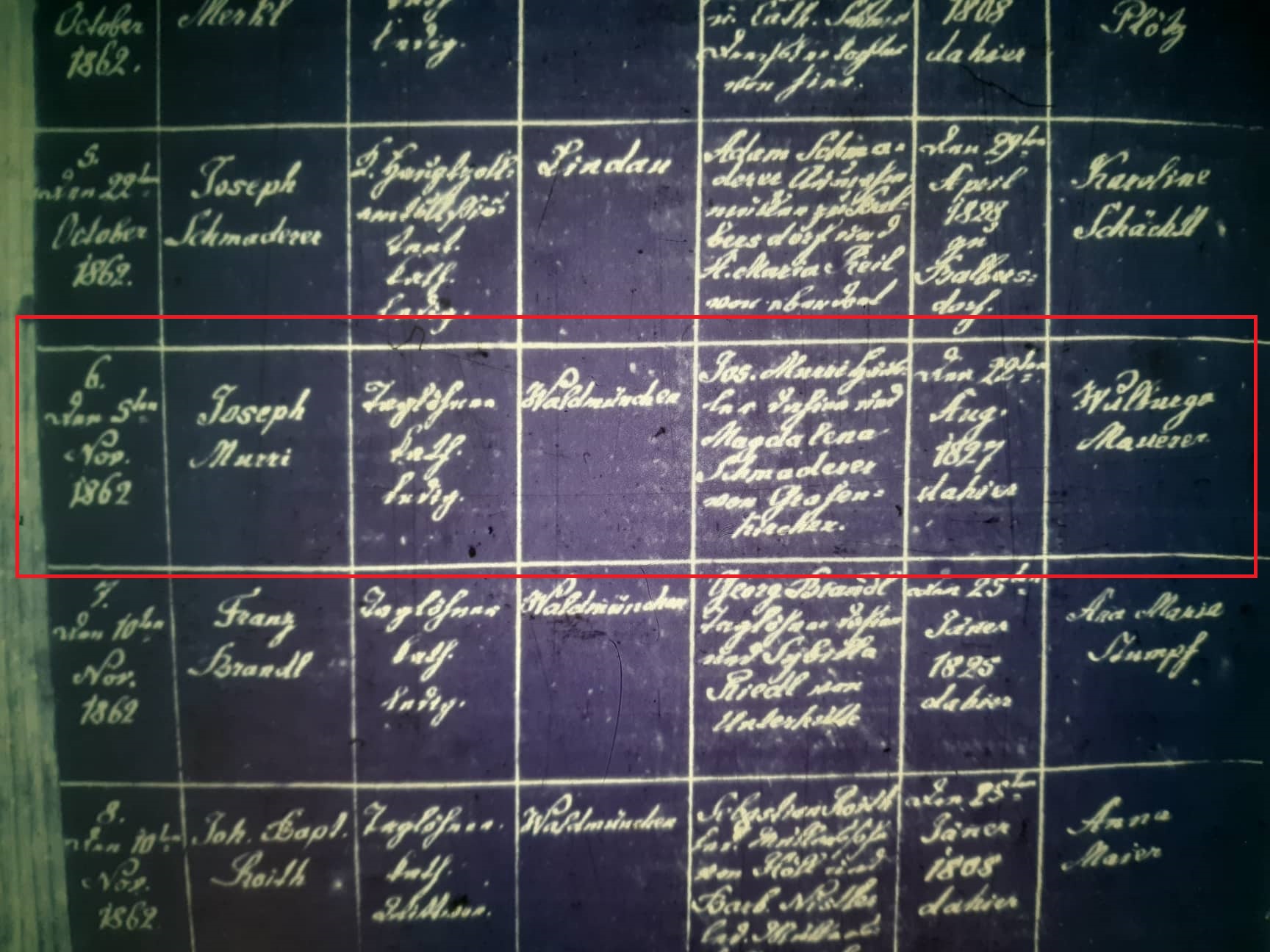
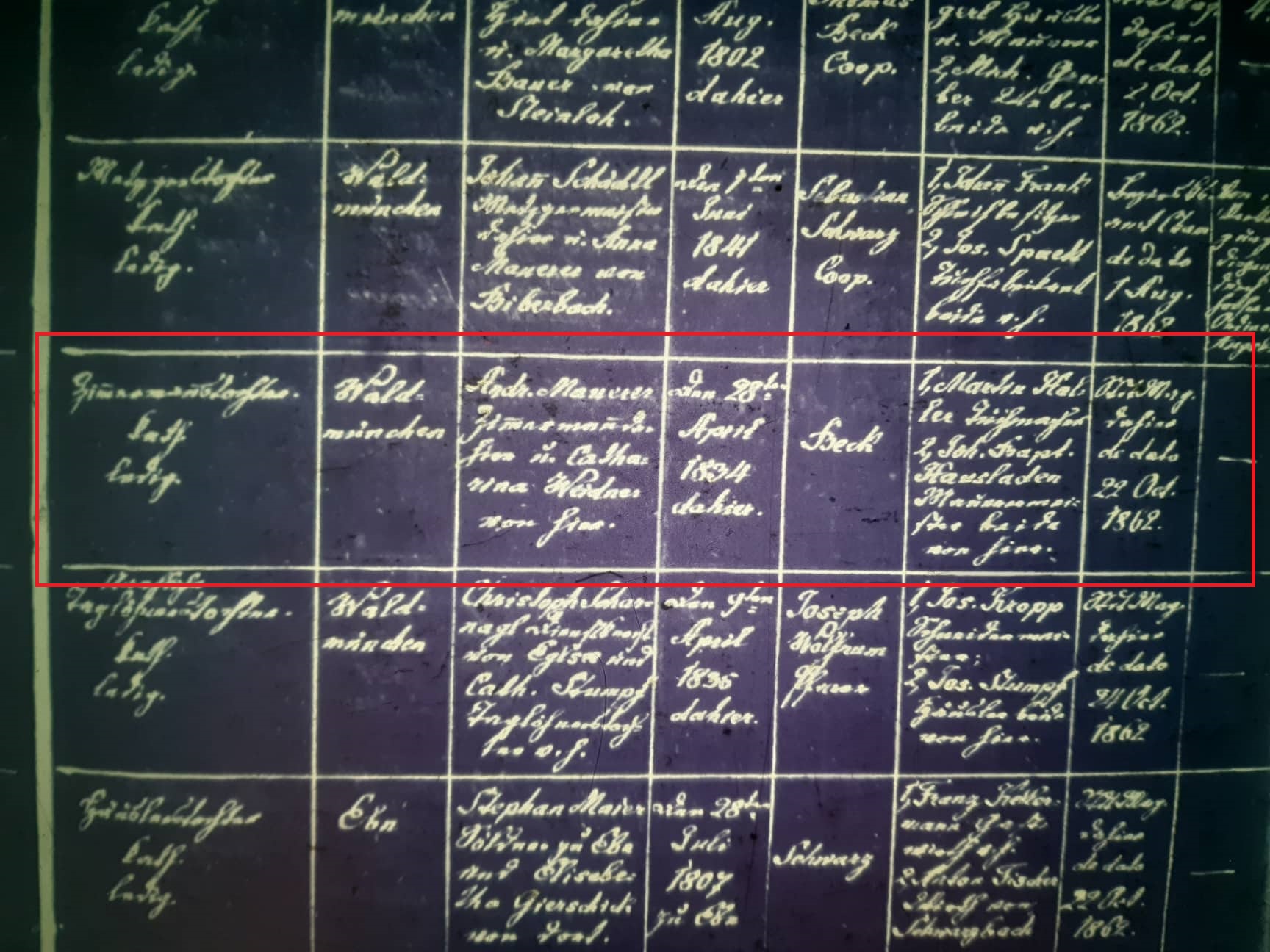
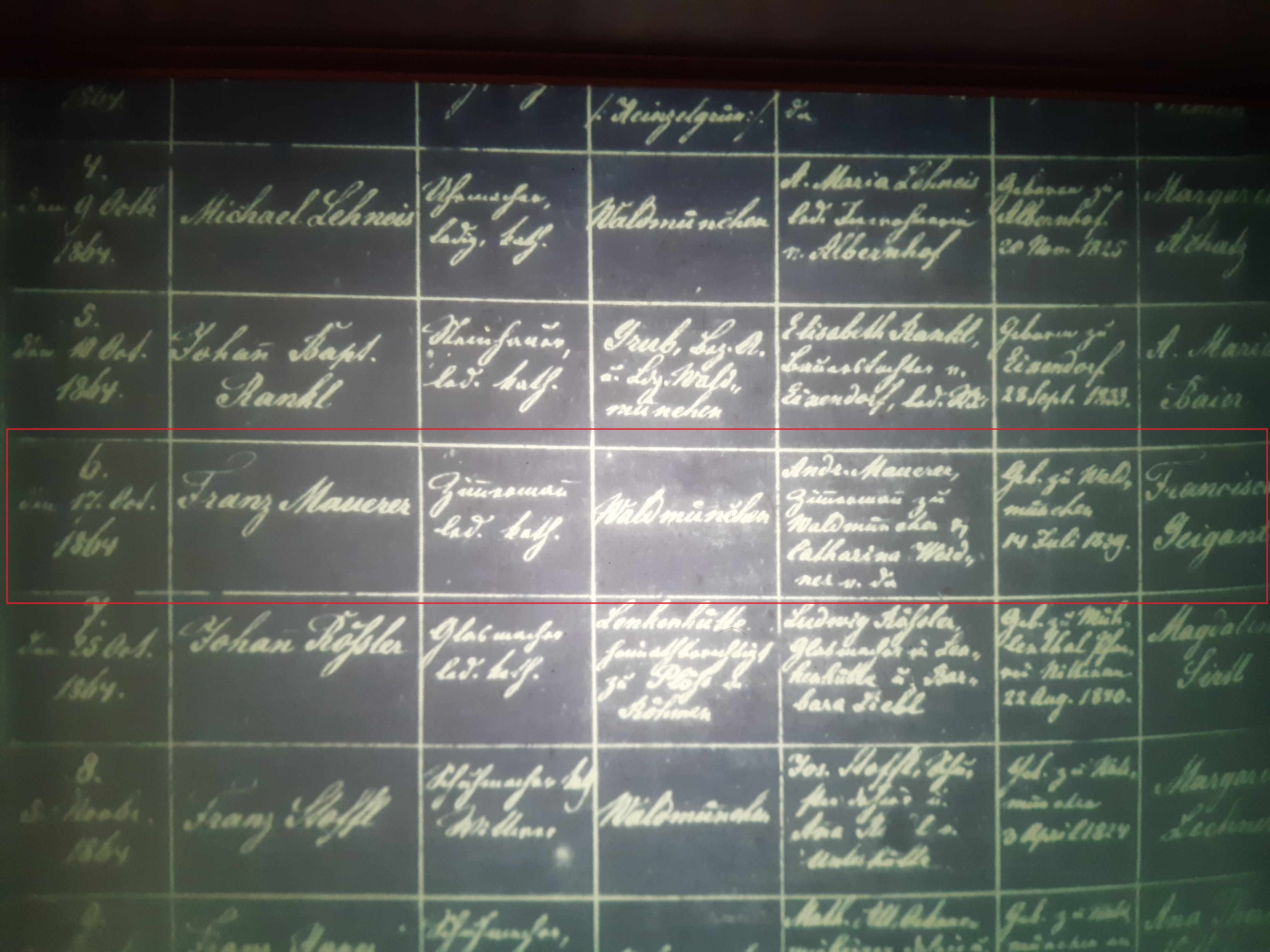
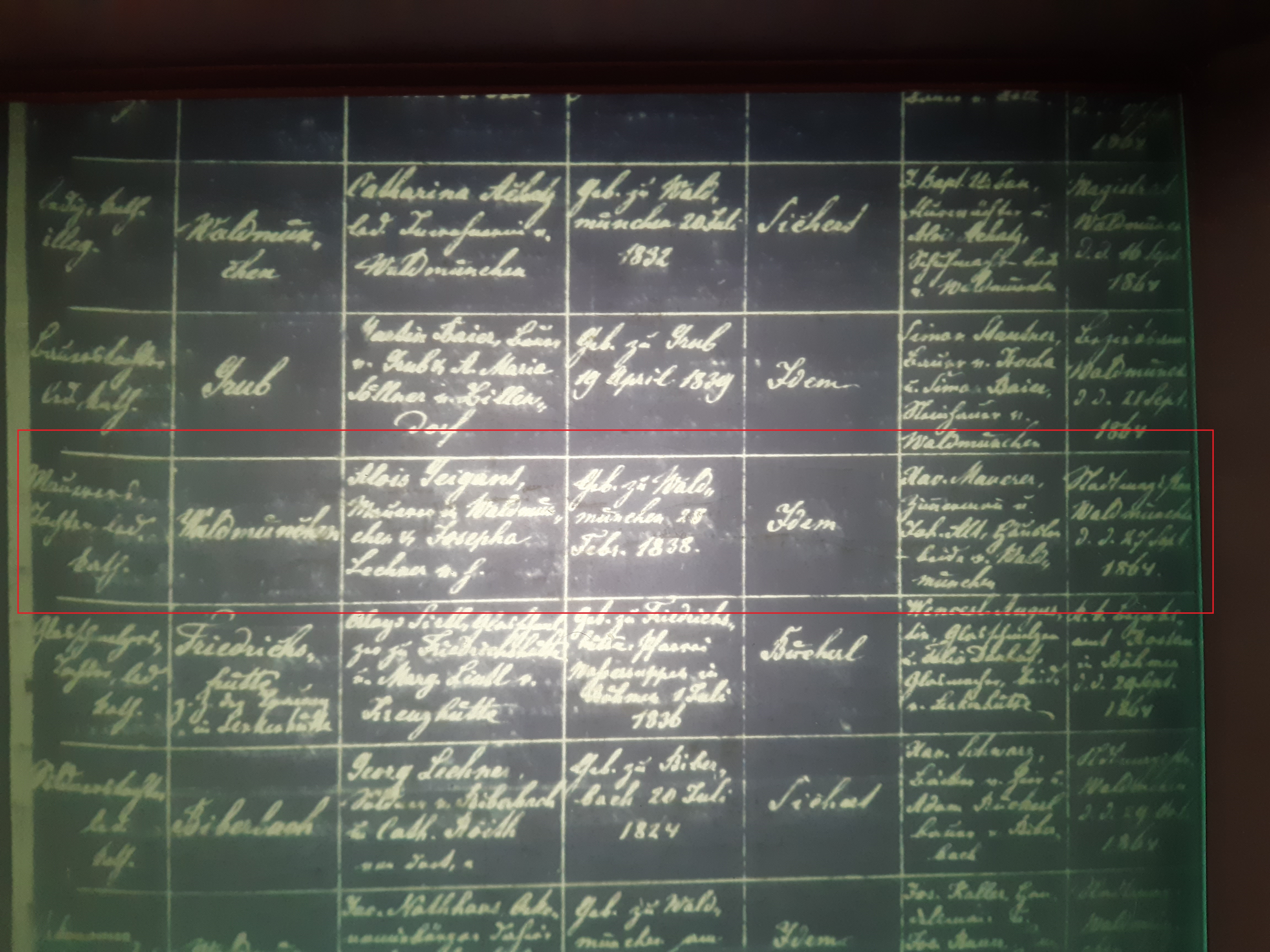


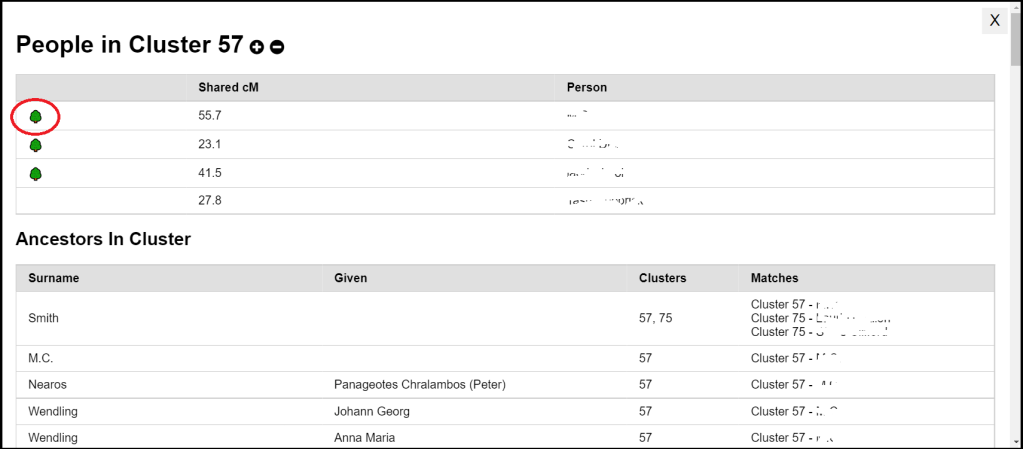


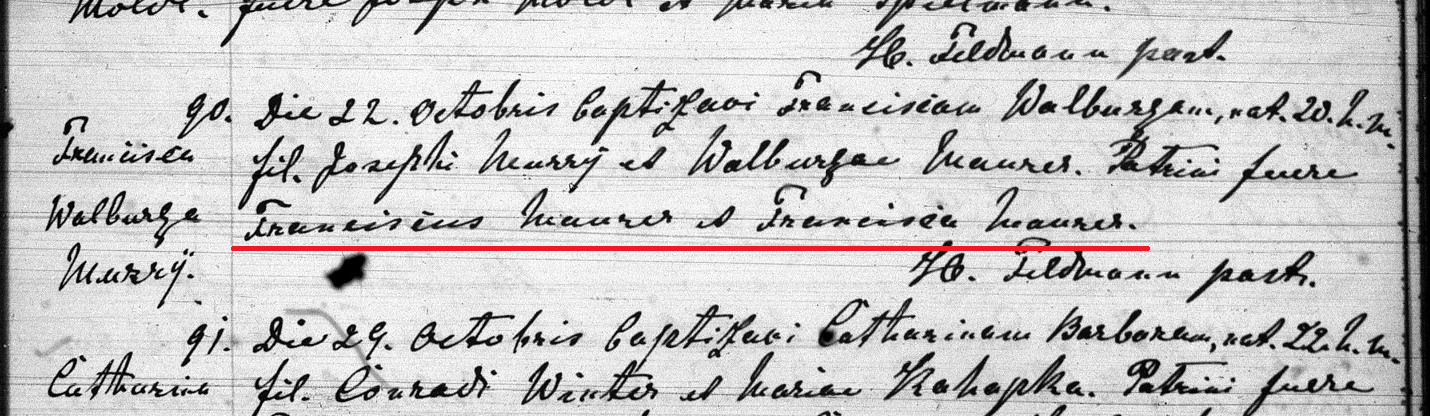
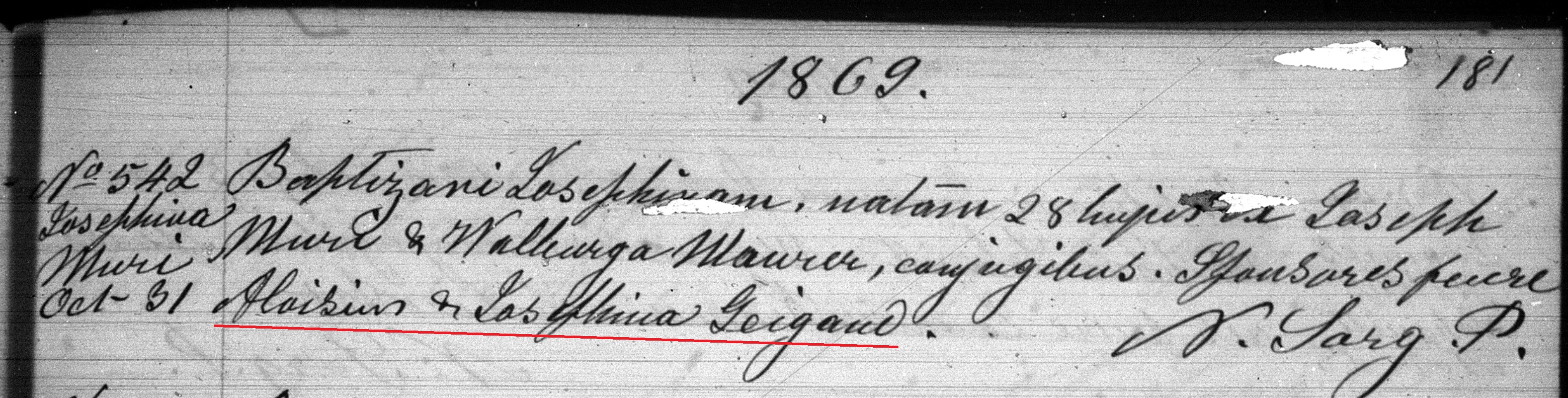

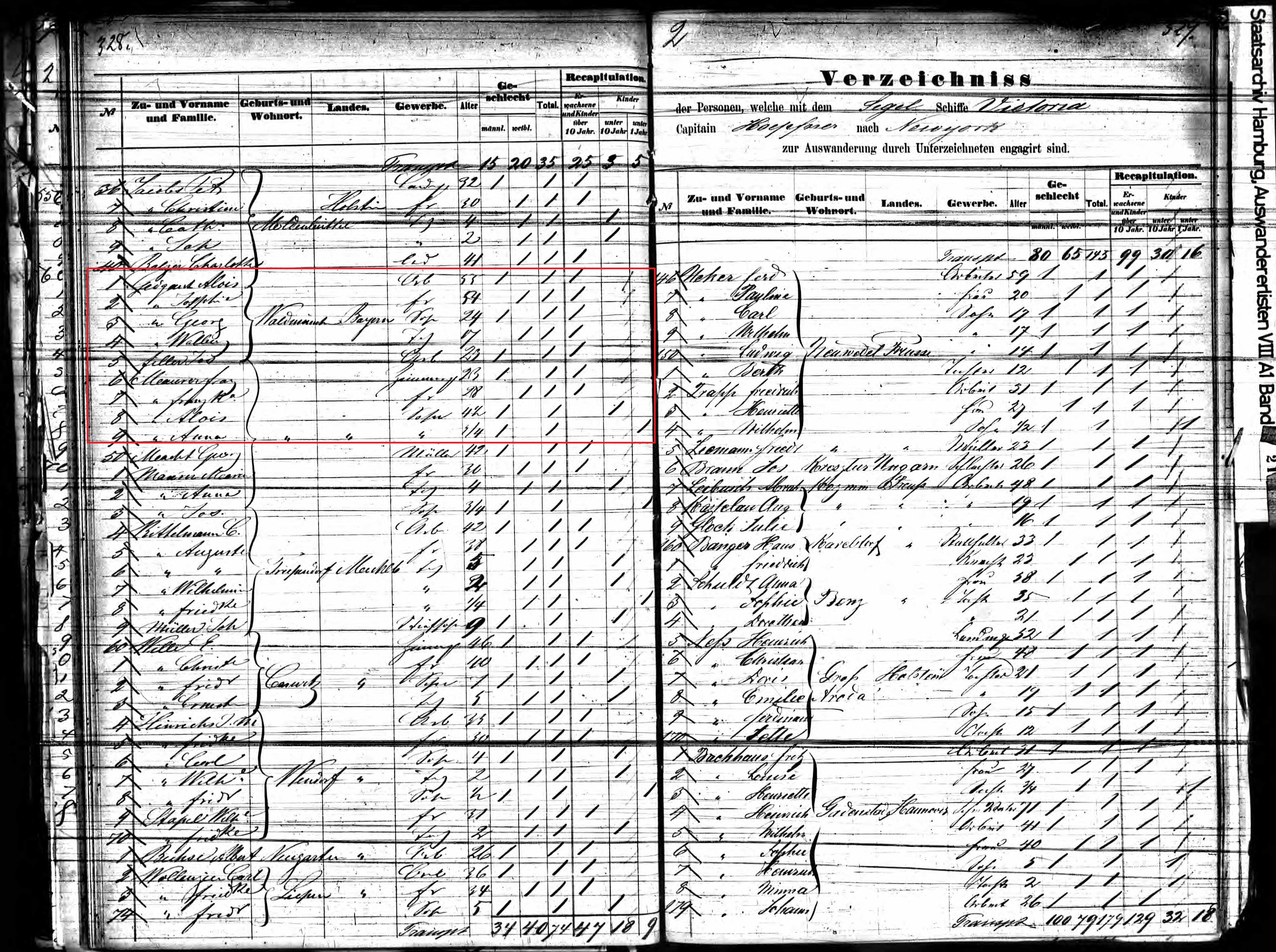

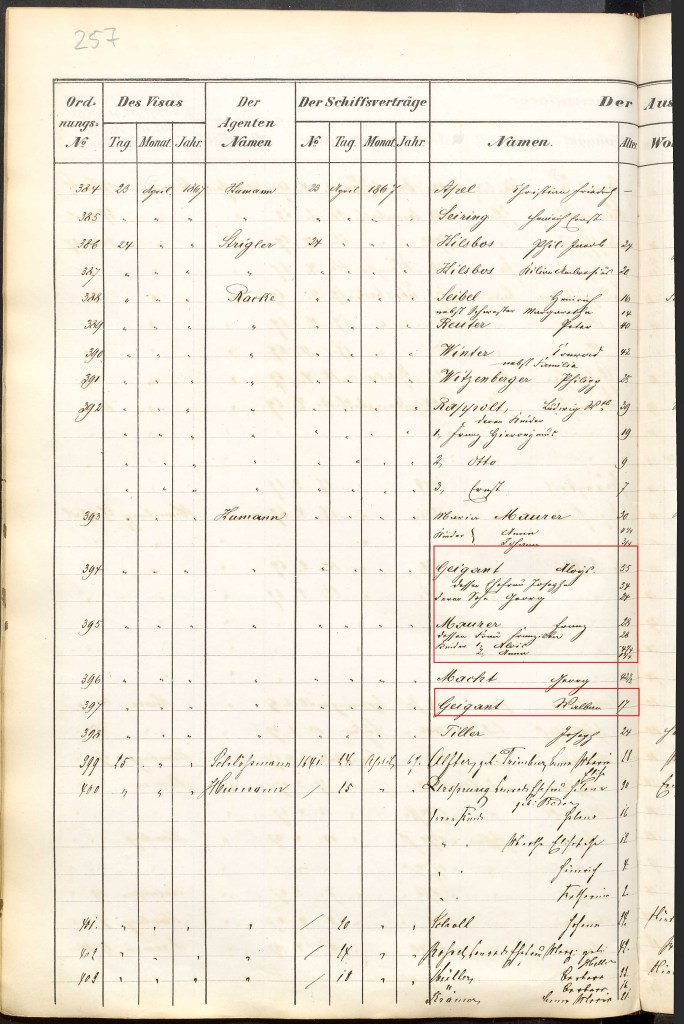

![Mappa jeneralna Województwa Mazowieckiego ułożona według naylepszych zrodeł przez Juliusza Colberg [General map of the Mazowiecki Voivodeship arranged according to the best sources by Juliusz Colberg], 1826.](https://fromshepherdsandshoemakers.com/wp-content/uploads/2022/05/48604650.jpg?w=940)
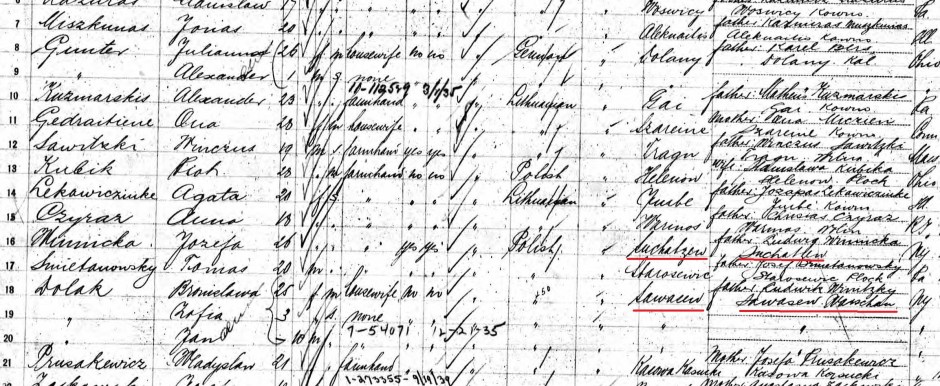
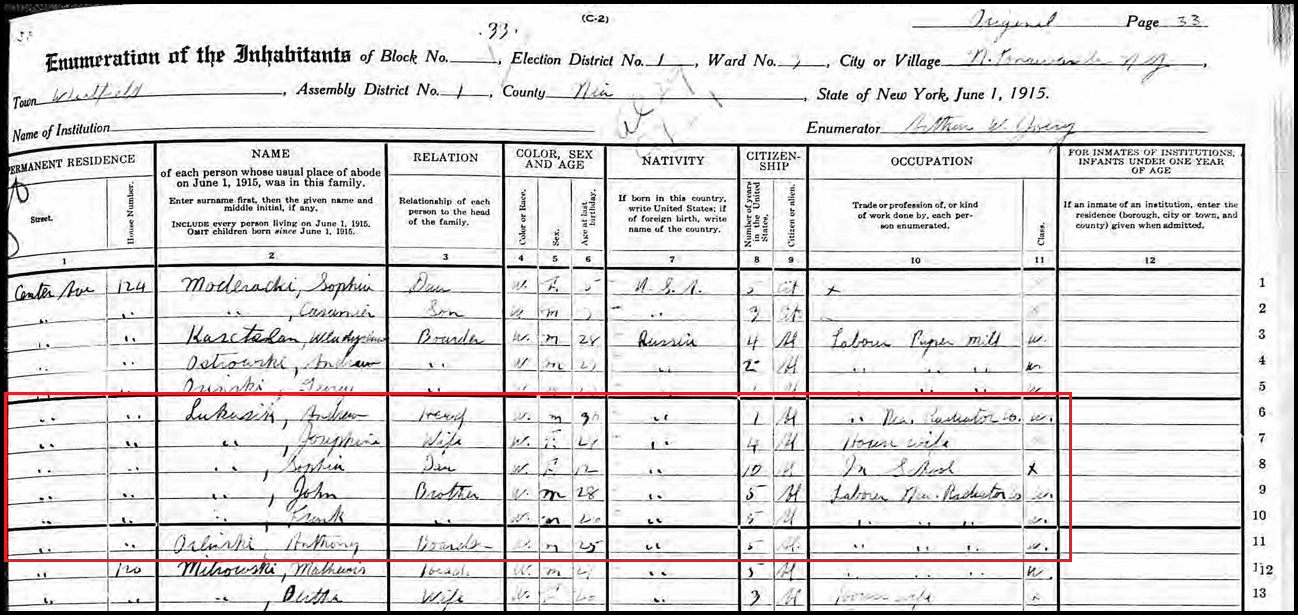

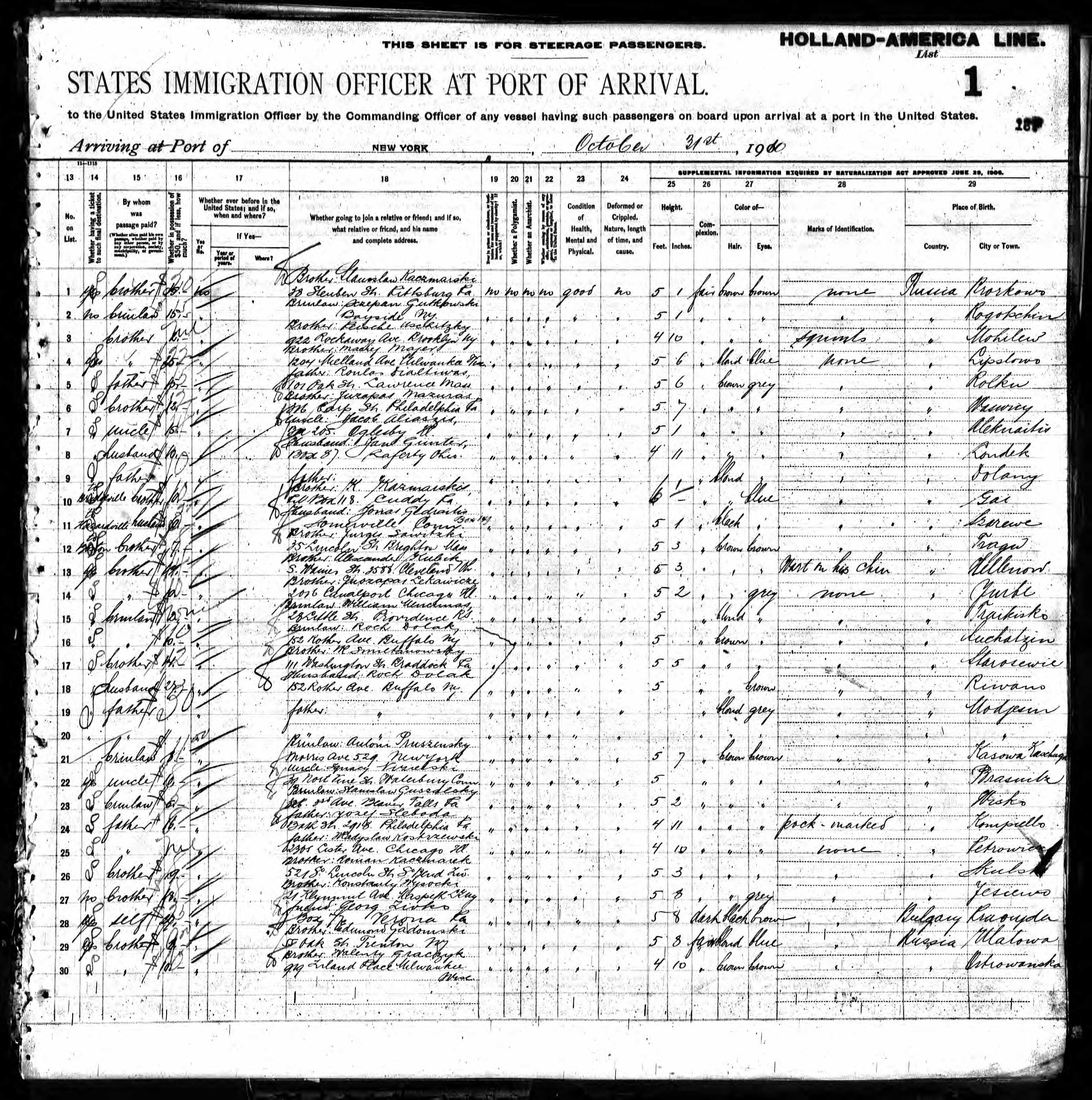
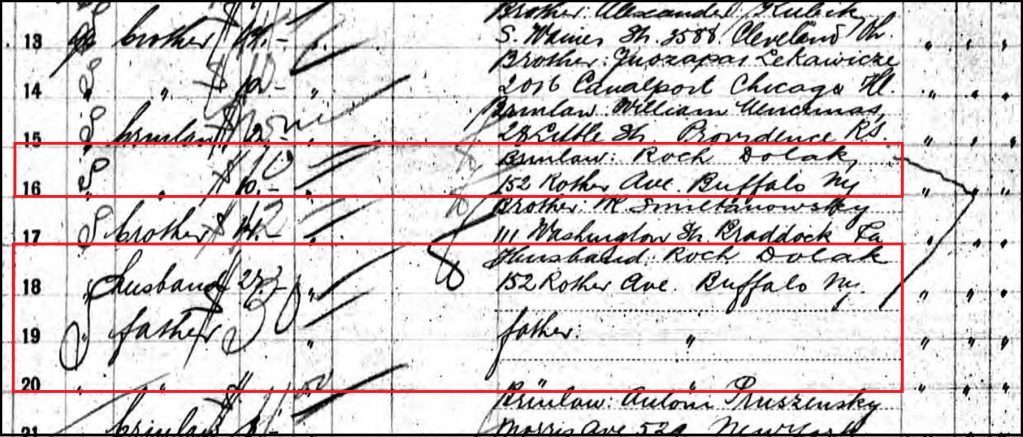
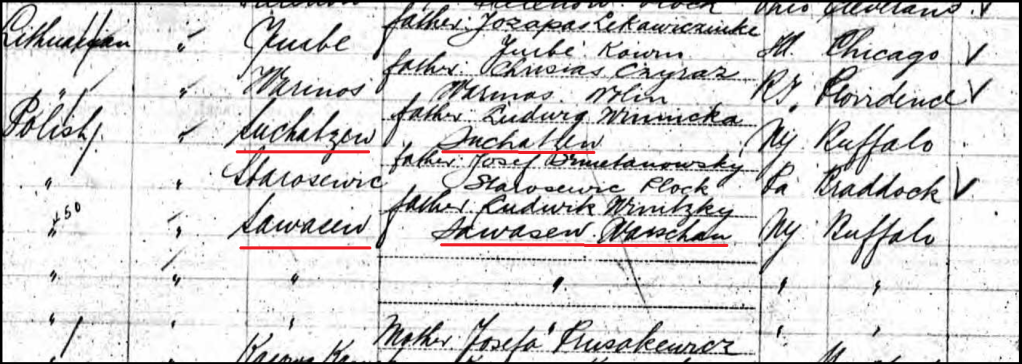
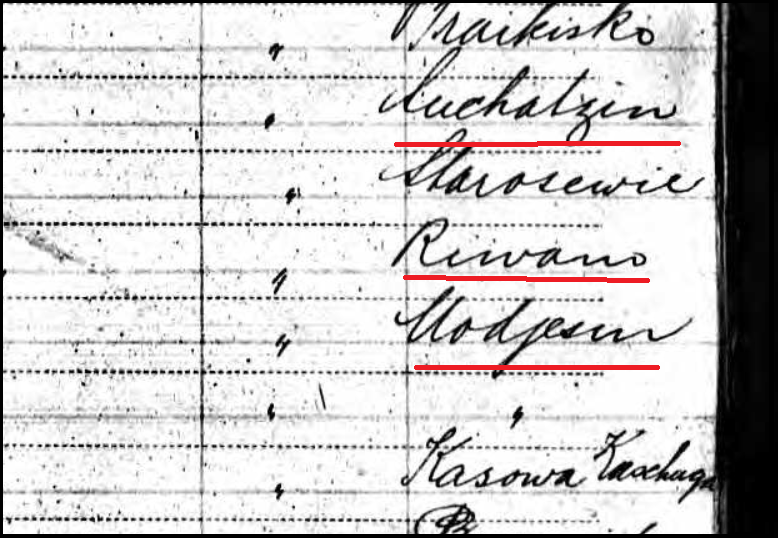

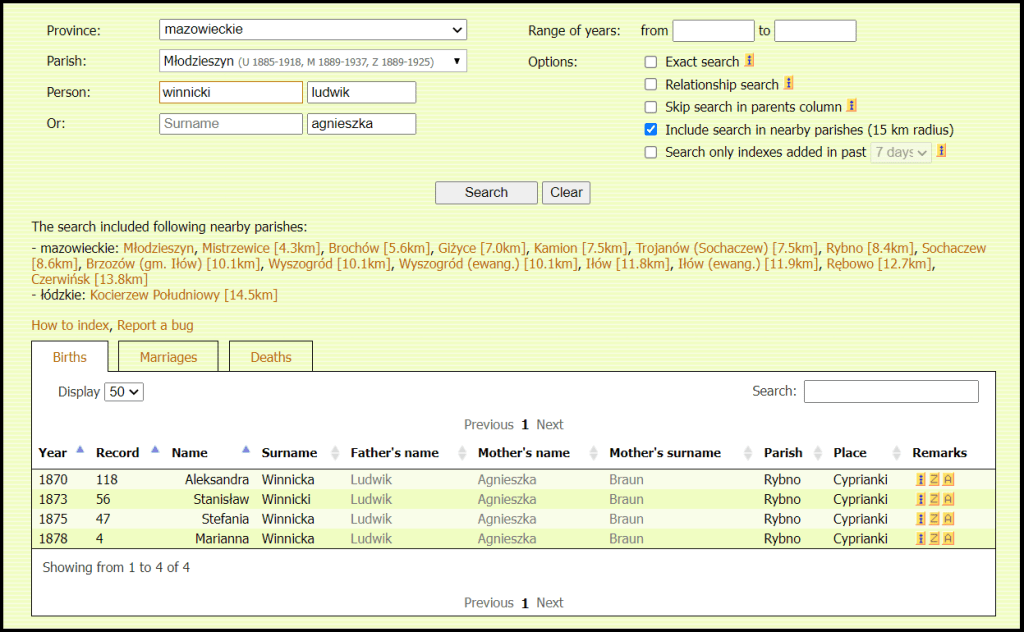
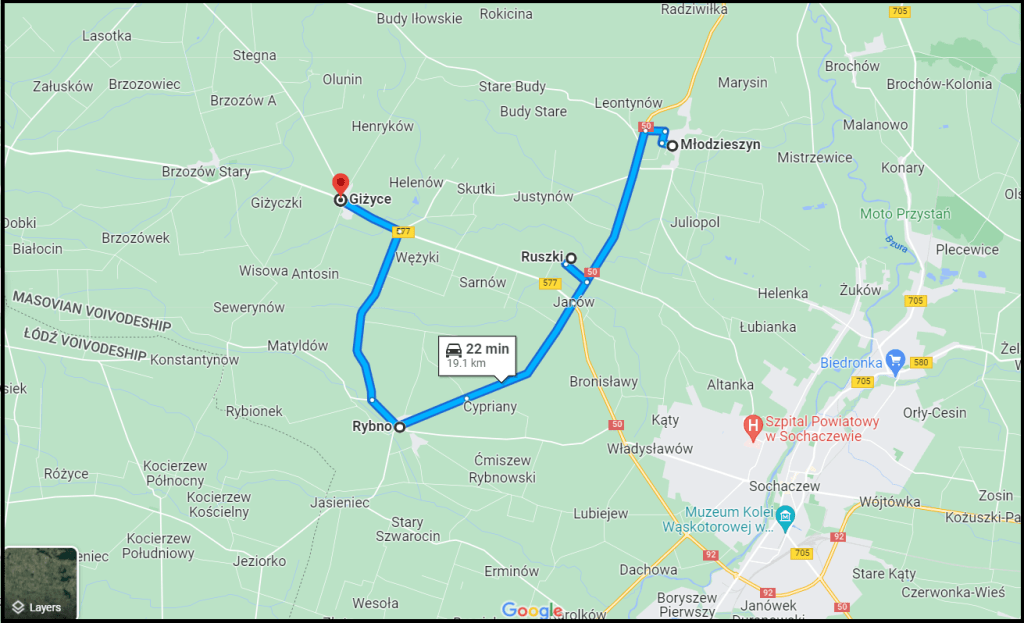


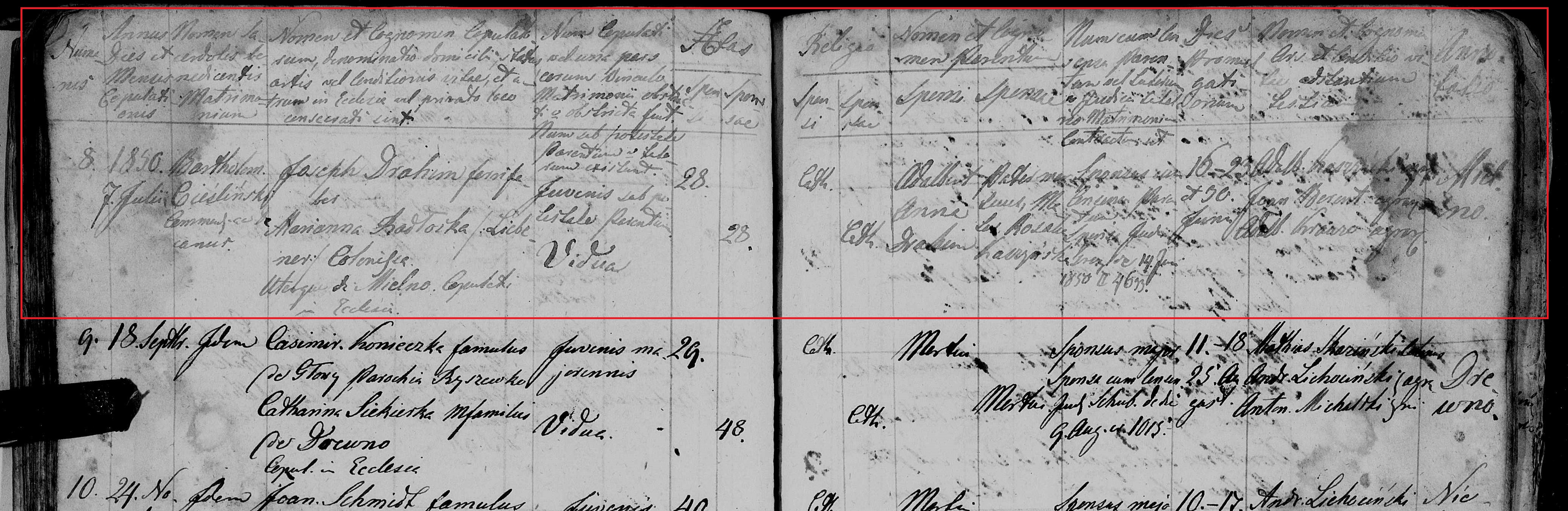
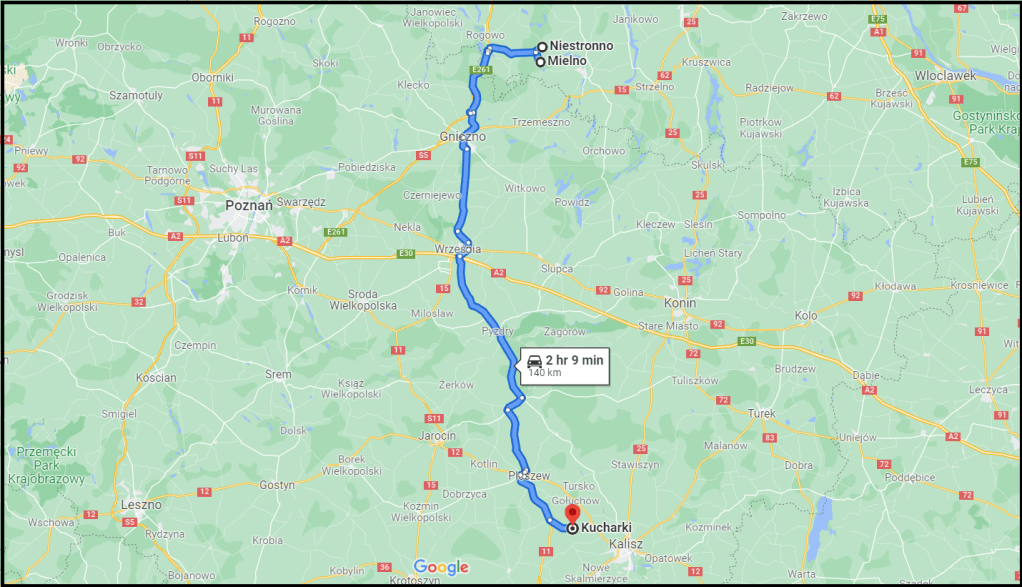

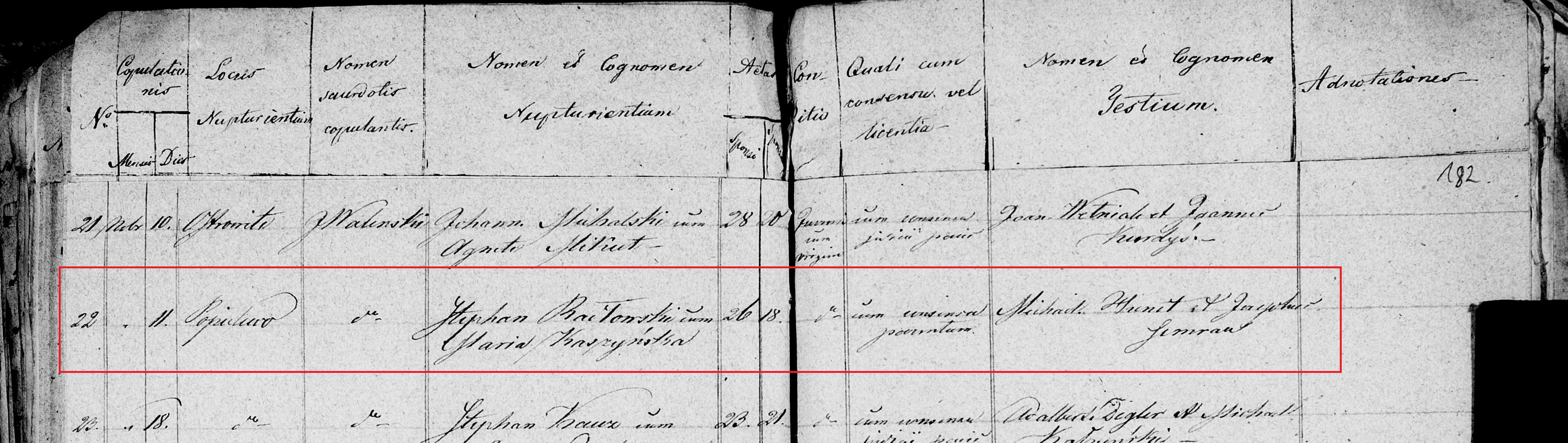

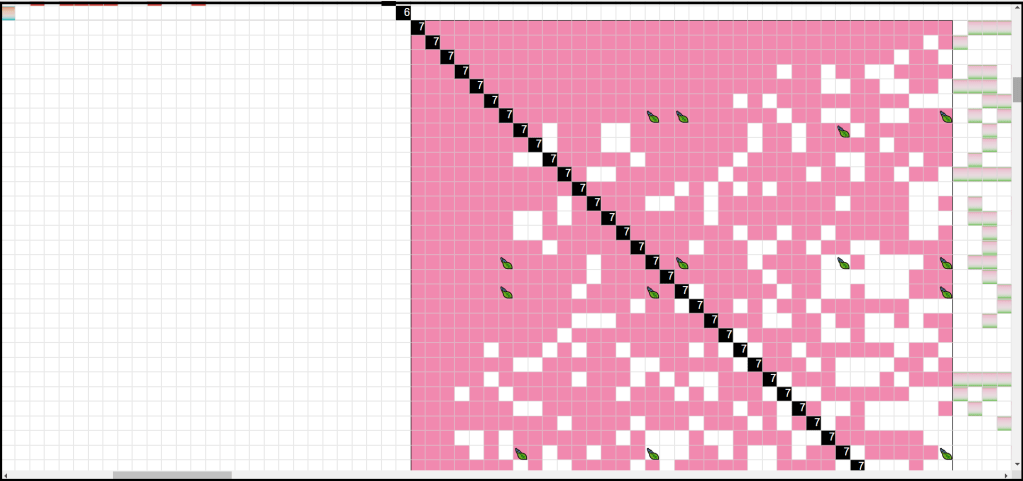

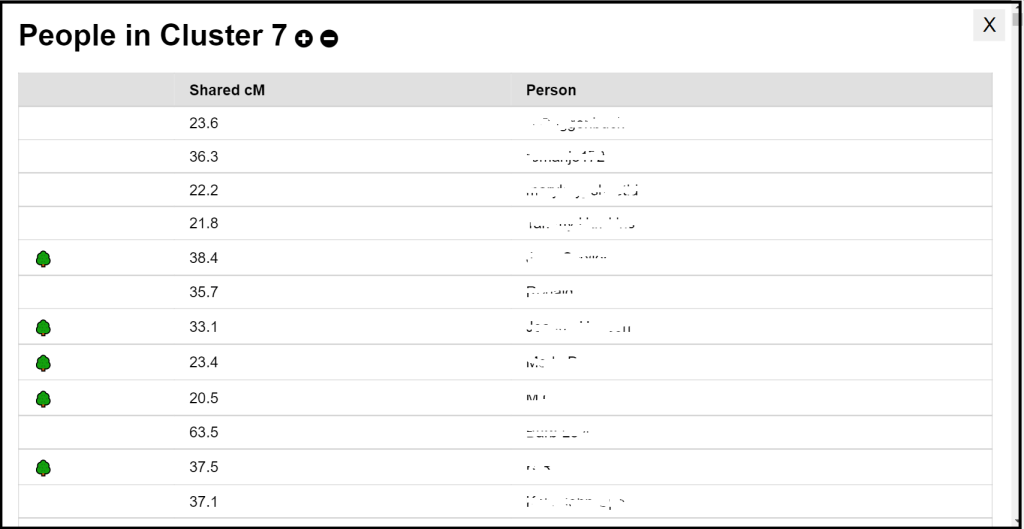





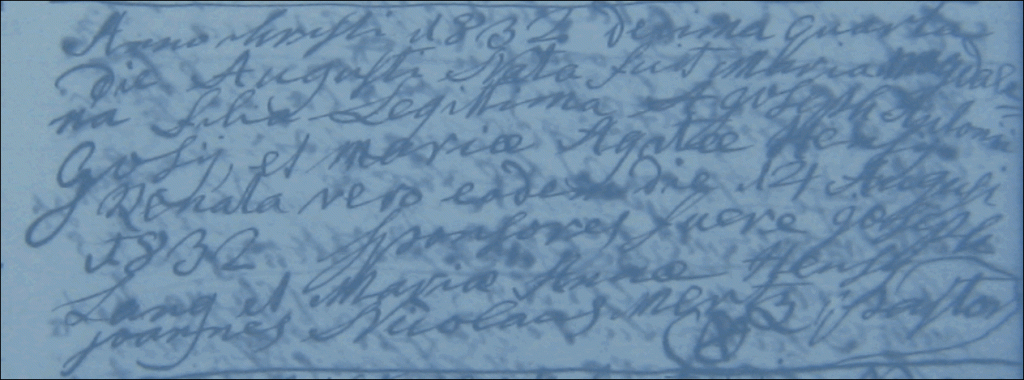





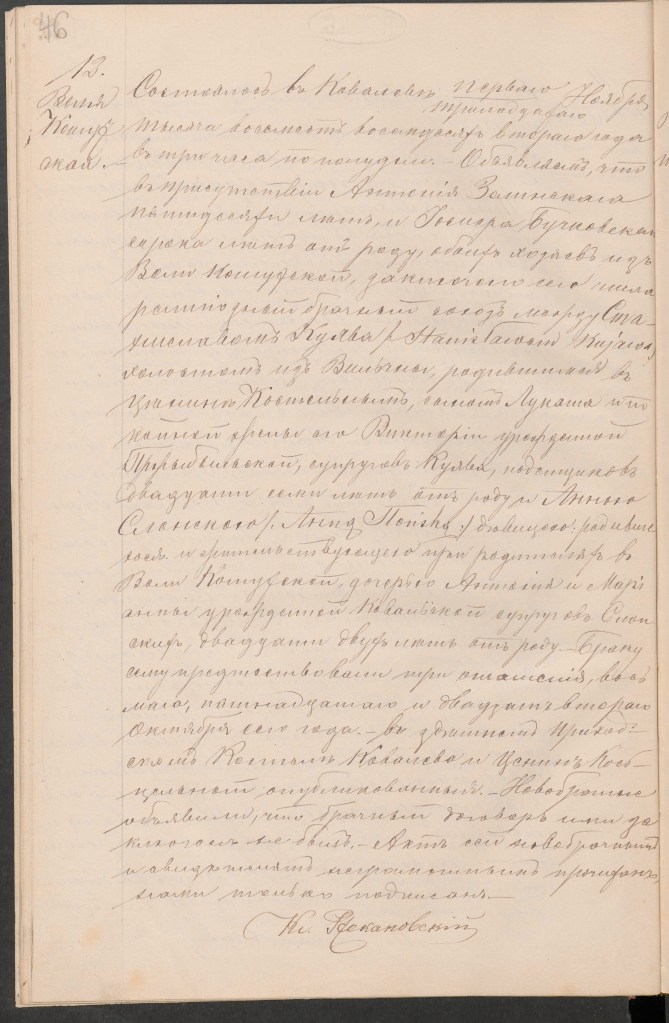
 From Shepherds and Shoemakers