The Many Wives of Józef Grzesiak

Veritatem Temporis filiam esse dixit.” (Truth is the daughter of time.) — Aulus Gellius

Conflicts in documentary evidence happen all the time. The logical resolution of such conflicts is one of the hallmarks of sound genealogical research that separates the professionals and experienced family history researchers from the novices. A perfect illustration of this is the story of my great-great-grandfather, Józef Grzesiak, and his many (?) wives.

Growing up, I used to ask my maternal grandmother to tell me about her mother’s family in Poland, and my desire to document those stories inspired my early family history efforts. Grandma’s mother was Veronica (née Grzesiak) Zazycki, but Grandma never knew the names of her grandparents, because “people didn’t talk about those things back then,” as she told me time and again. Nevertheless, Grandma knew a few details, such as the fact that her mother’s parents owned the grain mill that I wrote about previously. She told the story of how “Veronica’s mother died when Josephine was born, so at age 18, Veronica came to America. She found employment working in the kitchen of a restaurant.  She spoke no English, so her employers called her Mary and they communicated through signs and gestures.  She saved her money and sent it to her two brothers, Władysław (“Walter”) and Tadeusz, (Thaddeus), and her sister Józefa (Josephine), so they could come to America.”1 Grandma also told the story, shared previously, of how Walter married an actress in Poland who didn’t want to leave her career, which ultimately ended their marriage.

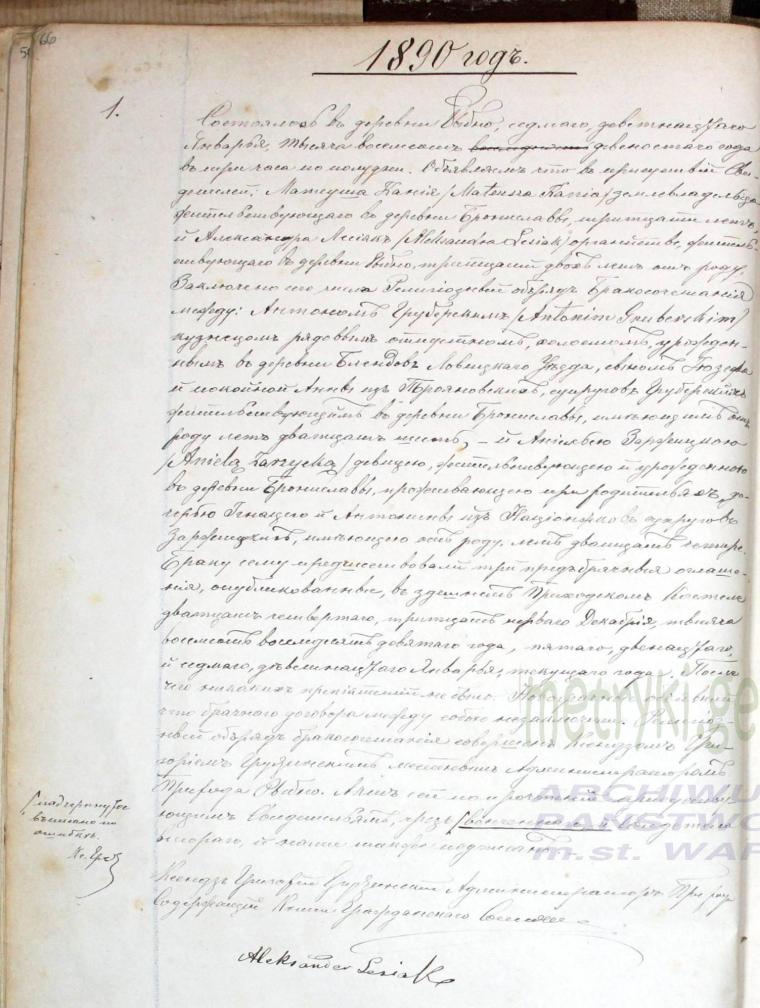
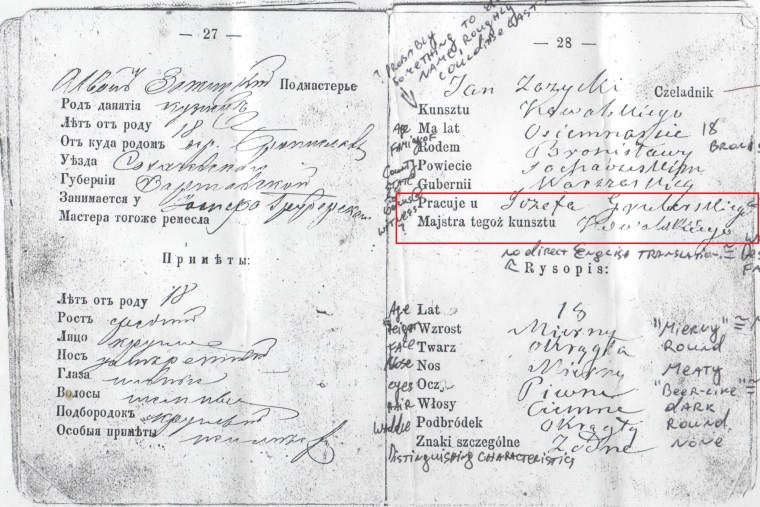
When I started my research, I didn’t know whether or not I’d ever be able to document some of these details, but I figured that it should be easy to answer the question, “Who were Veronica Grzesiak’s parents?” And in fact, it was pretty easy. On her marriage record to John Zazycki in 1901, Veronica reported her parents’ names as Joseph Grzesiak and Marianna Krawczynska (Figure 1).2

Figure 1: Marriage record for John Zazycki and Veronica Grzesiak, 5 August 1901.2Jan & Weronika Zazyki Marriage 1 marked

This document also told me which partition of Poland Grandma’s parents were from (Russian), and Veronica’s age reported here, 22, allowed me to estimate that she was born circa 1879. So far, so good.  However, when Veronica’s brother Thaddeus was married to Mary Gorski, he reported his parents’ names as Joseph Grzesiak and Mary Cebulska (Figure 2).3

Figure 2: Extract from marriage record for Thaddeus Grzesiak and Mayme (Mary) Gorski, 20 April 1910.3

Tadeusz Gresiak & Marya Gorska marriage record 1 marked

Now this was interesting, and it seemed like just the kind of detail that those family stories were likely to gloss over, since “people never talked about these things back then.” Okay, I concluded, no big deal, apparently Veronica and Thaddeus were half-siblings, sharing a father, but different mothers.

However, their sister Josephine named yet a different mother on her marriage record. When she married Joseph Cymerman in 1902, she stated that her parents were Joseph Grzesiak and Anna Nowacka (Figure 3).4

Figure 3: Extract from marriage record for Joseph Cymerman and Josepha Grzesiak, 5 August 1902.4

Jozefa Grzesiak & Jozef Cymermann marriage record 1 marked

Well, okay, maybe Joseph Grzesiak was very unlucky and lost two of his wives, so he married for a third time. It happened. But then there is yet another wife’s name reported on the death record for the oldest Grzesiak sibling, Walter (Figure 4).5

Figure 4: Extract from death record for Walter Grzesiak.5

Walter_Grzesiak_-_death

On this document, Walter was reported to be the son of Joseph Grzesiak and Maryanna Szafron. Now, most genealogists consider death records to be less accurate sources for information about an individual than some other types of records (e.g. marriage records) since the informant is probably grieving, possibly in shock, and may not be well-informed about the early life of the decedent, including parents’ names.  However, in this case, the informant was none other than Thaddeus (signing himself here as Theodore) Grzesiak — Walter’s brother.

So what do we make of this?  We have four siblings, all children of Joseph Grzesiak, but four different mother’s names reported on four different documents by three of the siblings.  Were they all half-siblings, each with the same father but a different mother?  I ran this theory past Grandma while she was still alive, and she didn’t buy it.  She had never heard of Walter, Thaddeus and Josephine being half-siblings to her mother, but she had no explanation for the discrepancies on the documents.  The maiden names reported for the mothers — Marianna Krawczyńska, Marianna Szafron, Marya Cebulska, and Anna Nowacka — weren’t even phonetically similar, apart from the fact that the siblings more or less agreed on a first name of Marianna. And was it grief that caused Thaddeus to change his story, reporting on his own marriage record that his mother was Maria Cebulska but then deciding 36 years later that her name was Marianna Szafron? Was it possible that the Grzesiak siblings did not even know their own mother’s name?  Perhaps there was an explanation:  Grandma said that Veronica’s mother had died (shortly?) after the birth of the youngest sibling, Josephine. Since Thaddeus and Veronica were only 7 and 5 when Josephine was born, maybe none of the children knew her well?

The only way to answer this question was to examine evidence from Polish records. The birth records for Walter, Veronica, Thaddeus and Josephine should tell us who their mothers were. If Joseph had several wives who died in succession, there would be death records for those wives and marriage records to tell the tale.

Polish Records to the Rescue

A very robust paper trail consisting of naturalization records (Figure 5),6 passenger manifests,7,8 and draft registrations,9 in addition to a personal recollection shared with me by Tadeusz Grzesiak’s son, Arthur Gray,10 all pointed to the Grzesiaks’ place of origin as the village of Kowalewo-Opactwo in Słupca County, which was at that time located in the Kalisz gubernia (province) of Russian Poland.

Figure 5: Władysław Grzesiak’s petition for naturalization, 23 January 1917, showing place of birth “Kowalewo, Poland, Russia” on 17 September 1867.Walter Grzesiak Petition

In the church records of Kowalewo, birth records were discovered for each of the immigrant Grzesiak children. Władysław Grzesiak was born 20 September 1867, fairly consistent with the birth date he reported for himself on his naturalization petition (Figure 6).11 

Figure 6: Polish-language birth record for Władysław Grzesiak, born 20 September 1867, with names of parents and child underlined in red.11OLYMPUS DIGITAL CAMERA
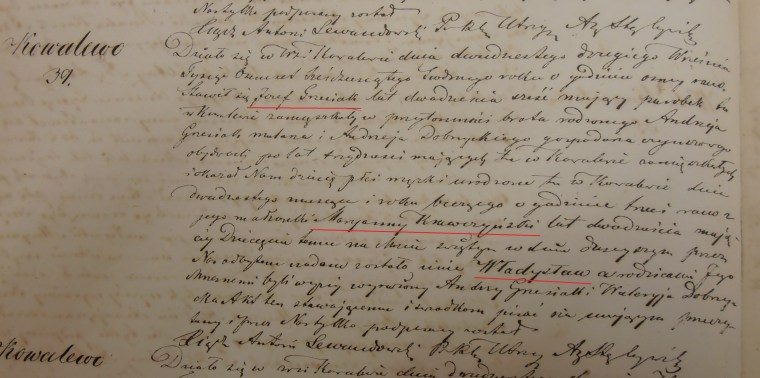
In this document, Władysław’s parents are reported to be Józef Grzesiak, age 26, a farmhand (parobek) residing in Kowalewo, and his wife, Maryanna née Krawczyńska, age 20. Similarly, the birth record for Tadeusz Grzesiak was discovered, and his parents, too, were reported to be Józef Grzesiak and Marianna née Krawczyńska (Figure 7).12

Figure 7: Russian-language Birth record for Tadeusz Grzesiak, born 27 March 1874, with names of parents and child underlined in red.12Tadeusz Grzesiak birth record marked

It’s evident that there’s a language change between these two records. Władysław’s birth record was written in Polish, while Tadeusz’s birth record was written in Russian. This was one of the punitive measures imposed by the Russian Government on Polish territories as a result of the failure of the January Uprising of 1863. Prior to 1867, the use of the Polish language was permitted in official record-keeping, but starting in 1868 (earlier in some areas) official records and even church records were required to be kept only in Russian. Tadeusz’s birth date, 27 March 1874, is a few years off from his date of birth as he reported it on his World War II draft registration — 24 March 1878. However, it was not unusual for people to report their dates of birth inaccurately in an era when there was no reason to know this information precisely, as there is today. In this document, Józef Grzesiak was reported to be a 33-year-old “master of the house” (хозяин), while his wife, Marianna, was age 31. The age difference between Józef and Marianna, which was 6 years in the first record, has magically diminished to 2 years, but again, such discrepancies are very common in these records.

Next, we have the birth record for my great-grandmother, Weronika Grzesiak, who was born 27 December 1876 (Figure 8).13 

Figure 8: Russian-language birth record for Weronika Grzesiak, born 27 December 1876, with names of parents and child underlined in red.13Weronika Grzesiak birth marked

Once again, parents were recorded as Józef Grzesiak, “master of the house,” of Kowalewo, age 37, and his wife, Maryanna née Krawczyńska, age 33.

Finally, the birth record of Józefa Grzesiak was discovered.14 Józefa was born 6 March 1881, and yes, her parents were none other than Józef Grzesiak and Marianna née Krawczyńska (Figure 9).

Figure 9: Russian-language birth record for Józefa Grzesiak, born 6 March 1881, with names of parents and child underlined in red.14Jozefa Grzesiak birth record

This time, Józef Grzesiak was recorded as “master of the house,” age 40, while his wife, Marianna, was age 37. Ultimately, Józef’s and Marianna’s dates of birth can only be known accurately when their birth records are discovered — and I discovered those a long time ago, but that’s another story for another day.

As if this weren’t sufficient evidence to put to rest the notion that the immigrant Grzesiak siblings were half-siblings, the icing on the cake was the search in marriage records and death records for any marriages for Józef Grzesiak or death records for previous wives. The only marriage record discovered was his marriage in Kowalewo in 1865 to Marianna Kawczyńska (sic) (Figure 10).15

Figure 10: Polish-language marriage record from Kowalewo for Józef Grzesiak and Maryanna Kawczyńska (sic), 31 October 1865 with names of the groom and bride underlined in red.15Jozef Grzesiak and Marianna Krawczynska marriage

The fact that this is the only marriage record found for Józef Grzesiak in Kowalewo is unsurprising, given that all of his children’s birth records name the same mother, Marianna Krawczyńska. The date of the record makes sense — they were married about 2 years before Władysław’s birth in 1867, not an unusually long period of time to be married prior to the birth of an eldest child. Józef was described as a 25-year-old bachelor, born in Cienin Zaborny but residing in Kowalewo with his parents, Stanisław and Jadwiga, at the time of his marriage. Marianna was noted to be age 22, born in Zagórów and residing in Kowalewo, daughter of Antoni and Wiktoria.

So at the end of the day, there is absolutely no evidence in Polish records for any wives of Józef Grzesiak other than Marianna Krawczyńska, whom he married in 1865 and with whom he had 6 children: the four immigrant Grzesiak siblings, as well as two daughters, Konstancja and Pelagia, who remained in Poland, and whose story I touched on a bit previously. There was no Maria Cebulska, no Anna Nowacka, no Marianna Szafron. They didn’t exist. Grandma Veronica was the only one of her siblings who accurately reported her mother’s name on a document in the U.S. So where did Tadeusz and Józefa come up with those names? Maybe Grandma was right all along — “people just didn’t talk about those things back then.” Maybe Tadeusz and Józefa really had no idea what their mother’s name was. One thing is certain, though: Marianna Grzesiak did not die when Józefa was born, or even shortly thereafter. No, Marianna Grzesiak died in Russian Poland in 1904, when her youngest daughter Józefa was 23 years old and married.16 So isn’t it a little odd that at least two of her children didn’t appear to know her name, and that the story was handed down that she died before Veronica and her siblings left Poland for America? I have some speculations about that, but it’s another story for another day.

Genealogists usually find that the best strategy for handling conflicting evidence is to keep gathering data until the truth emerges. Sometimes some analytical skill is required to interpret the data, but at other times, it’s just a question of perseverance to find the right records to settle the question. In this case, one could look at the data from U.S. records and conclude that Józef Grzesiak had three or four wives, or one could dig deeper, find the Grzesiak children’s birth records and Józef and Marianna’s marriage record from Poland, and know the truth.

Sources

1 Helen Zielinski, interviews by Julie Szczepankiewicz, circa 1986-1998; Notes from interviews privately held by Julie Szczepankiewicz, Hopkinton, Massachusetts, 2018.

2 City of Buffalo, Bureau of Vital Statistics, marriage record for John Zazycki and Veronica Grzesiak, 5 August 1901, certificate no. 202, Buffalo, Erie, New York, Erie County Clerk’s Office, 92 Franklin Street, Buffalo, New York.

3 New York State Department of Health, Bureau of Vital Statistics, marriage record for Thaddeus Grzesiak and Mayme (Mary) Gorski, 20 April 1910, certificate no. 9051, Buffalo, Erie, New York, Erie County Clerk’s Office, 92 Franklin Street, Buffalo, New York.

City of Buffalo, Bureau of Vital Statistics, marriage record for Joseph Cymerman and Josephine Grzesiak, 5 August 1902, certificate no.198, Buffalo, Erie, New York, Erie County Clerk’s Office, 92 Franklin Street, Buffalo, New York.

New York, Department of Health, Division of Vital Statistics, death certificate for Walter Grzesiak, 25 April 1946, no. 2600, Buffalo, Erie, New York.

Wladyslaw Grzesiak, Petition for Naturalization, No. 4950, 23 January 1917, Supreme Court of New York, Buffalo, Erie, New York.

7 Maryland, Baltimore Passenger Lists, 1820-1948 (image), Veronika Grzesiak, S.S. Willehad, April 1898, https://www.familysearch.org, accessed 25 February 2018.

Maryland, Baltimore Passenger Lists, 1820-1948 (image), Jozef, Kazimira and Jozefa Grzesiak, S.S. Rhein, May 1900, https://www.familysearch.org, accessed 25 February 2018.

World War II Draft Registration Cards, 1942, Draft Registration Cards for Fourth Registration for New York State, 04/27/1942 – 04/27/1942; NAI Number: 2555973; record Group Title: Records of the Selective Service System; Record Group Number: 147, record for Tadeusz George Grzesiak, http://ancestry.com, subscription database, accessed 25 February 2018.

10Arthur Gray, interview by Julie Szczepankiewicz, circa 1998; Notes from interview privately held by Julie Szczepankiewicz, Hopkinton, Massachusetts, 2018.

11 Akta stanu cywilnego Parafii Rzymskokatolickiej Kowalewo-Opactwo (Kowalewo-Opactwo, Słupca, Wielkopolskie, Poland), Księga urodzeń, małżeństw, i zgonów, 1867, births, #39, record for Władysław Grzesiak, accessed in person at the archive by Zbigniew Krawczyński, Archiwum Państwowe w Poznaniu. Oddział w Koninie, 3 Maja 78 Konin, Poland.

12 Akta stanu cywilnego Parafii Rzymskokatolickiej Kowalewo-Opactwo (pow. slupecki), Księga urodzeń, małżeństw, i zgonów, 1874, births, #17, record for Tadeusz Grzesiak, Narodowego Archiwum Cyfrowego, Naczelnej Dyrekcji Archiwów Panstwowych, Szukajwarchiwach, http://www.szukajwarchiwach.pl, accessed on 25 February 2018.

13Akta stanu cywilnego Parafii Rzymskokatolickiej Kowalewo-Opactwo (pow. slupecki),  Księga urodzeń, małżeństw, i zgonów, 1876, births # 72, record for Weronika Grzesiak, accessed on 25 February 2018.

14 Akta stanu cywilnego Parafii Rzymskokatolickiej Kowalewo-Opactwo (pow. slupecki) (Kowalewo-Opactwo, Słupca, Wielkopolskie, Poland), Księga urodzeń, małżeństw, i zgonów, 1881, births, #15, record for Józefa Grzesiak, Narodowego Archiwum Cyfrowego, Naczelnej Dyrekcji Archiwów Panstwowych, Szukajwarchiwach, http://www.szukajwarchiwach.pl, accessed on 25 February 2018.

15Akta stanu cywilnego Parafii Rzymskokatolickiej Kowalewo-Opactwo (pow. slupecki), Księga urodzeń, małżeństw, i zgonów, 1865, marriages, #10, record for Józef Grzesiak and Maryanna Kawczynska, 31 October 1865, Narodowego Archiwum Cyfrowego, Naczelnej Dyrekcji Archiwów Panstwowych, Szukajwarchiwach, http://www.szukajwarchiwach.pl , image 20.jpg, accessed on 25 February 2018.

16 Roman Catholic church, Zagórów parish (Zagórów, Słupca, Wielkopolskie, Poland), Kopie księg metrykalnych, 1808-1947, Akta zgonów 1891-1906, 1904, #52, death record for Marianna Grzesiak, DGS 8018016, Image 383, accessed on 25 February 2018.

© Julie Roberts Szczepankiewicz 2018
Where Were Your Ancestors in 1857?

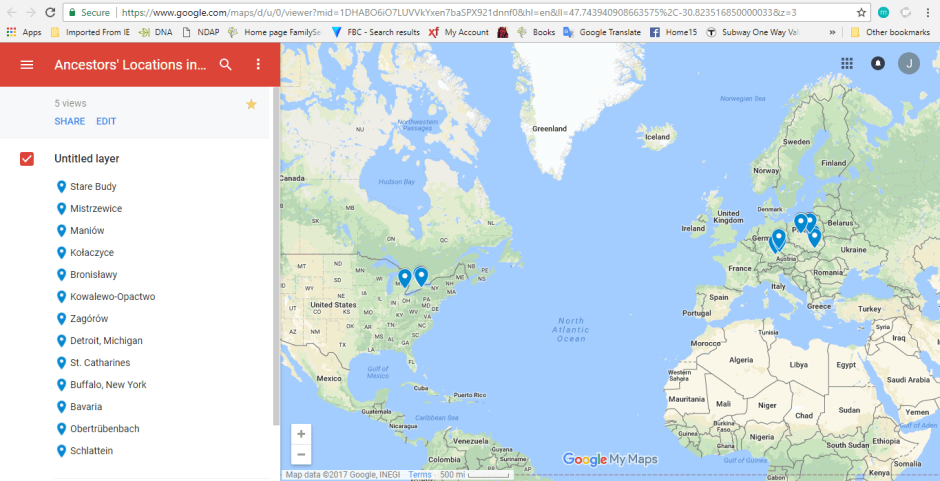
Genealogists often think in terms of family timelines, tracing one particular family line through many generations. However, it occurred to me that it might be interesting to examine my family tree in cross section. That is, what was happening in each of my family lines in the year 1857? I chose that year because I wrote recently about my 3x-great-grandparents’s marriage in Roding, Bavaria in 1857, and that got me wondering what my other ancestors were doing in that same year, and where they were living around the world. It turns out this is a pretty useful (and fun!) exercise. I gained new insights into each family group, and it also served to point out deficiencies in my research, and families that I’ve neglected, that I should perhaps plan to spend more time on in 2018. Here, then, is a summary of my ancestral couples who were alive at that time. Although the map in the featured image is not “clickable,” you can use this link to explore that map in greater depth, if you’d like.

Maternal grandfather’s line

In 1857, my 3x-great-grandparents, Michał Zieliński and Antonia (née Ciećwierz) Zielińska, were living in the village of Mistrzewice in Sochaczew County in what was at that time the Królestwo Polskie or Kingdom of Poland, which officially had some autonomy, but was in reality a puppet state of the Russian Empire. They’d been married about four years, although I don’t know the precise date of their marriage because 19th century records for Mistrzewice prior to 1859 were largely destroyed. Michał and Antonina had one daughter, Zofia, who was about 2, and Michał supported his family as a gospodarz, a farmer who owned his own land.1

Meanwhile, in the nearby village of Budy Stare, Sochaczew County, my 3x-great-grandparents Roch Kalota and Agata (née Kurowska) Kalota welcomed their (probably) oldest daughter, my great-great-grandmother, Marianna Kalota, who was born circa 1857. Again, the destruction of records has been a problem for researching this line, but available records tell us that Roch Kalota, too, was a farmer.2

In the south of Poland in 1857, my 3x-great-grandparents on my Klaus line had not yet married. Jakub Klaus was the son of Wawrzyniec (Lawrence) Klaus and Anna Żala or Żola. He was a young man already 27 years of age, but he did not marry his wife, Franciszka, until 1860.Franciszka Liguz was the daughter of Wawrzyniec Liguz and Małgorzata Warzecha, age 21 in 1857. Both Franciszka and her husband-to-be, Jakub, lived in the village of Maniów in Dąbrowa County in the Galicia region of the Austrian Empire, and Jakub was described as a famulus, or servant.

Still further south in what is now Poland, my 3x-great-grandparents Jakub Łącki and Anna Ptaszkiewicz were 4 years away from their eventual wedding date.4 In 1857, Jakub was a 22-year-old shoemaker from the village of Kołaczyce in Jasło County in the Austrian Empire, and Anna was the 23-year-old daughter of a shoemaker from the same village.

Maternal grandmother’s line

Heading further north again in Poland, back into Sochaczew County in Russian Poland, my 2x-great-grandparents Ignacy and Antonina (née Naciążek) Zarzycki were about 8 years into their marriage, raising their family in the village of Bronisławy. By 1857, they had three children for whom birth records have been discovered, Marianna,5 Paulina,and Tomasz.7 Ignacy was a land-owning farmer who was born in the nearby village of Szwarocin,8 but his wife Antonina’s place of birth remains a mystery.

Moving west now, in 1857 my 3x-great-grandparents Stanisław and Jadwiga (née Dąbrowska) Grzesiak were living in Kowalewo Opactwo, a village that was located in Słupca County at the far western edge of the Russian Empire, within walking distance of the border with Prussia. Ages 51 and 41, respectively, they were already parents to 12 of their 13 children. Stanisław was usually described as a shepherd or a tenant farmer.9

In the nearby town of Zagórów, my 3x-great-grandmother, Wiktoria (née Dębowska) Krawczyńska was living as a 53-year-old widow, having lost her husband Antoni Krawczyński 10 years earlier.10 Antoni had been a shoemaker, and he and Wiktoria were the parents of 8 children, of whom 4 died in infancy. By 1857, the surviving children ranged in age from 27 to 14 — the youngest being my great-great-grandmother, Marianna Krawczyńska.

Paternal grandfather’s line

Meanwhile, in Detroit, Michigan, my 3x-great-grandparents Michael Ruppert and Maria Magdalena Causin were newlyweds in 1857, having married on 12 May of that year.11 Michael had immigrated to the U.S. just four years earlier, at the age of 19, with his parents and siblings.12 The Rupperts were from the village of Heßloch in the Grand Duchy of Hesse-Darmstadt, or what is now Alzey-Worms district in Rhineland-Palatinate, Germany.13 Michael was a carpenter, and he and his family had already begun to use the surname Roberts.14 His wife Maria Magdalena Causin/Casin/Curzon is a bit of a mystery, and will likely be the subject of future blog post, because she doesn’t show up in the records until her marriage in 1857, and her parents’ names are not on her marriage or death records.

In 1857, my 3x-great-grandparents Henry and Catherine (née Grentzinger) Wagner and were also living in Detroit, had been married for 2 years and were parents to their first child, John Wagner.15 Henry was a teamster who had arrived in Detroit about 3 years previously along with his parents and siblings, all immigrants from the village of Roßdorf in the Electorate of Hesse, a state within the German Confederation.16  This was a first marriage for Henry, but a second marriage for Catherine, since she was a young widow after the death of her first husband, Victor Dellinger or Dalmgher.17 In addition to burying her husband some time between 1850-1855, it appears that both of Catherine’s children from that first marriage 18 also died young, since they were not mentioned in the 1860 census in the household of Henry and Catherine Wagner. Catherine herself was an immigrant from Steinsoultz, Haut-Rhin, Alsace, who came to Detroit with her parents and siblings some time between 1830 and 1834.

Across the border and some 225 miles to the east, my 3x-great-grandparents Robert and Elizabeth (née Hodgkinson) Walsh made their home in St. Catharines, Ontario, Canada. In 1857, Elizabeth Walsh was a 39-year-old mother of 5, pregnant with her 6th child, Ellen, who was born in December of that year.19 Elizabeth was the granddaughter and great-granddaughter of United Empire Loyalists, so her family were among the first settlers in St. Catharines. Her husband, Robert Walsh, was a 49-year-old tailor from Ireland whose family origins have proven to be more elusive than his wife’s.

Also living in St. Catharines were my 3x-great-grandparents, Robert and Catherine Dodds. In 1857, Robert was a 40-year-old immigrant from England, usually described as a laborer or farm laborer. Nothing is known about Robert’s family of origin. He married his wife, Catherine, circa 1840, and by 1857 they were the parents of three daughters and three sons.20 Catherine’s origins, and even her maiden name, are unclear. There is evidence that she was born circa 1818 in Martintown, Glengarry, Ontario to parents who were Scottish immigrants or of Scottish extraction, but no birth record or marriage record has yet been discovered for her.

Paternal grandmother’s line

Jacob and Catherine (née Rogg or Rock) Böhringer, my 3x-great-grandparents, were German immigrants from the Black Forest, having lived in the village of Gündelwangen in the Grand Duchy of Baden21 prior to their migration to Buffalo, New York in 1848.22 By 1857, Catherine and Jacob had already buried three of their seven children, including oldest daughter Maria Bertha, who was born in Germany and apparently died on the voyage to America. Jacob was a joiner or a cabinet maker.23

In 1857, my 3x-great-grandparents Joseph Murre and Walburga Maurer were still about 5 years away from their eventual wedding date. They were born and married in Bavaria, Germany, although I have yet to discover their specific place of origin. I don’t know the names of the parents of either Joseph or Walburga. Joseph was a woodworker who was employed in a planing mill in Buffalo, New York in 1870 24 and was later listed as a carpenter in the Buffalo city directory in 1890. He and Walburga arrived in New York on 3 April 1869 with their children Maria, Anna and Johann.25

In October 1857, my 3x-great-grandparents Johann Meier and Anna Maria Urban were married in the parish church in Roding, Bavaria.26 Their first child, Johann Evangelista Meier, was born out of wedlock two years previously although the father was named on the baptismal record with a note that the child was subsequently legitimized. Johann and Anna Maria would go on to have a total of 10 children, 3 of whom migrated to Buffalo, New York.

In 1857, my 4x-great-grandparents, Ulrich Götz or Goetz and Josephine Zinger, were living somewhere in Bavaria and raising their 4-year-old son, Carl Götz, who was my 3x-great-grandfather. Almost nothing is known of this family, including where they lived in Bavaria or the names of Carl’s siblings. Carl grew up to be the second husband of a much older wife, Julia Anna Bäumler, who was already 19 in 1857. Julia had at least one child from a previous relationship, a son, John George Bäumler, who was born in 1858. Julia and Carl married in Bavaria circa 1875, a development which may or may not have influenced John Bäumler’s decision to emigrate from Bavaria to Buffalo, New York in 1876.28 Julia gave birth to her only child with Carl, Anna Götz (my great-great-grandmother), in 1877, and the Götz family eventually followed John Bäumler to Buffalo in 1883. Julia Götz’s death record states that she was born in “Schlattine, Bavaria,” which suggests the village of Schlattein in Neustadt an der Waldnaab, Bavaria, but further research is needed to confirm this location.

So there you have it: a summary of where my ancestors were in the world, and in their lives, in the year 1857. But what about your ancestors? Where were they living, and what were they doing? Is there a more interesting year for your family than 1857? Choose a different year, and tell me your ancestors’ stories!

Selected Sources:

Akta stanu cywilnego parafii rzymskokatolickiej w Mistrzewicach, Polskie Towarzystwo Genealogiczne, Metryki.genealodzy.pl, 1875, Małżeństwa, #2, record for Zofia Zielińska and Piotr Malinowski, accessed on 10 November 2017.

2 Akta stanu cywilnego parafii rzymskokatolickiej w Mlodzieszynie, Polskie Towarzystwo Genealogiczne, Metryki.genealodzy.pl, Księga zgonów 1889-1901, 1895, #59, death record for Wojciech Kalota, accessed on 10 November 2017.

Roman Catholic Church, St. Mary Magdalene parish (Szczucin, Dąbrowa, Małopolskie, Poland), Księgi metrykalne, 1786-1988, Akta małżeństw 1786-1988, Maniów, 1860, 16 September, marriage record for Jacobus Klaus and Francisca Liguz, Family History Library film # 1958428 Items 7-8.

Roman Catholic Church, St. Anne’s Parish (Kołaczyce, Jasło, Podkarpackie, Poland), Śluby, 1826-1889, Stare Kopie, 1861, #11, marriage record for Jacobus Łącki and Anna Ptaszkiewicz.

Roman Catholic Church, St. Bartholomew’s parish (Rybno, Sochaczew, Mazowieckie, Poland), Księga urodzeń 1845-1854, 1850, #48, baptismal record for Maryanna Zarzycka.

Roman Catholic Church, St. Bartholomew’s parish (Rybno, Sochaczew, Mazowieckie, Poland), Księga urodzeń 1845-1854, 1853, #60, baptismal record for Paulina Zarzycka.

Roman Catholic Church, St. Bartholomew’s Parish (Rybno, Sochaczew, Mazowieckie, Poland), Księga urodzeń, 1855-1862, 1856, #48, baptismal record for Tomasz Zarzecki.

Roman Catholic Church, St. Bartholomew’s Parish (Rybno, Sochaczew, Mazowieckie, Poland), 1828, #34, baptismal record for Ignacy Zarzycki.

Akta stanu cywilnego Parafii Rzymskokatolickiej Kowalewo-Opactwo (pow. słupecki), 1832, marriages, #14, record for Stanisław Grzesiak and Jadwiga Dąbrowska, Szukajwarchiwach, http://www.szukajwarchiwach.pl/, accessed 17 November 2017.

10 Roman Catholic Church, Zagórów parish (Zagórów (Słupca), Poznań, Poland), Kopie księg metrykalnych, 1808-1947, 1843, #137, death record for Antoni Krawczyński.; FHL film #2162134, Item 1, Akta zgonów 1844-1849.

11 Roman Catholic Church, St. Joseph’s parish (Detroit, Wayne, Michigan, USA), “Marriages”, 1857, #15, marriage record for Michael Ruppert and Magdalena Causin.

12 New York, Passenger Lists, 1820-1957 (index and image), record for Franz, Catherine, Michael, Arnold, and Catherine Rupard, S.S. William Tell, arrived 4 March 1853, http://ancestry.com, subscription database, Microfilm Serial: M237, 1820-1897; Microfilm Roll: Roll 123; Line: 51; List Number: 146, accessed 17 November 2017.

13 Roman Catholic Church (Heßloch (Kr. Worms), Hesse, Germany), Kirchenbuch, 1715-1876, 1834, baptismal record for Michael Ruppert, FHL film #948719.

14 1860 U.S. Census (population schedule), Detroit, Wayne, Michigan, p. 142, Michael Roberts and Frank Roberts households, http://ancestry.com, subscription database, accessed 17 November 2017.

15 Michigan, County Marriages, 1820-1940, database, Church of Jesus Christ of Latter-Day Saints, FamilySearch, (https://familysearch.org), database with images, 1855, #11, record for Henry Wagner and Catherine Dellinger, accessed 17 November 2017.

16 New York, Passenger Lists, 1820-1957 (image and transcription), record for Henry, Cath., August, Johnny, Gertrude, and Marianne WagnerS.S. Erbpring Luidrich August, arrived 29 September 1853 in New York,  Microfilm Serial: M237, 1820-1897; Microfilm Roll: Roll 132; Line: 12; List Number: 1010,  http://ancestry.com/, subscription database, accessed 17 November 2017.

17 Michigan, County Marriages, 1820-1940,  (images and transcriptions), Wayne County, marriage certificates, 1842-1848, v. B, #1733, marriage record for Victor Dellinger and Catherine Grenzinger, 3 February 1846,  FamilySearch, https://familysearch.org, accessed 17 November 2017.

18 1850 U.S. Federal Census (population schedule), Detroit, Wayne, Michigan, page 156B and 157, Victor Dalmgher household, http://ancestry.com, subscription database, accessed 17 November 2017.  
19 Census of 1861, database, Library and Archives Canada, St. Catharines, Lincoln, Canada West (Ontario), Robert Walsh household, item number 2721097, accessed 17 November 2017.

 20 Census of 1861, database, Library and Archives Canada, Grantham, Lincoln, Canada West (Ontario), Library and Archives Canada, Robert Dodds household, Item number 1884852, accessed 17 November 2017.

21 Roman Catholic Church, Gündelwangen parish (Gündelwangen, Waldshut, Freiburg, Baden-Württemberg, Germany), Kirchenbuchduplikat, 1810-1869, 1847, baptisms, #4, record for Maria Bertha Rogg, p. 165, with addendum on page 171, Family History Library film #1055226.

22 Passenger and Immigration Lists, 1820-1850,  record for Jacob Behringer, Catherine, and Marie Behringer, S.S. Admiral, arrived 4 November 1848 in New York, http://ancestry.com/, subscription database, accessed 17 November 2017.

23 1860 United States Federal Census (population schedule), 7th Ward Buffalo, Erie, New York, p. 77, Jacob Barringer household, http://familysearch.org, accessed 17 November 2017.

24 1860 United States Federal Census (population schedule), 7th Ward Buffalo, Erie, New York, p. 73, Joseph Murri household, http://familysearch.org, accessed 17 November 2017.

25 Passenger Lists, 1820-1957 (image and transcription), record for Joseph, Walburga, Anna, Marie, and Johann Muri, S.S. Hansa, arrived 3 April 1869 in New York,  Microfilm Serial: M237, 1820-1897; Microfilm Roll: Roll 308; Line: 38; List Number: 292. http://ancestry.com/, subscription database, accessed 17 November 2017.

26 BZAR, Roman Catholic Church, St. Pancrus parish (Roding, Cham, Oberpfalz, Germany), Marriage record for Johann Maier and Anna M. Urban, 27 October 1857, Vol. 27, page 3 MF 573.

271900 United States Federal Census (population schedule), Buffalo, Erie, New York, E.D. 107, Sheet 16B, Charles Goetz household, https://.ancestry.com, subscription database, accessed 17 November 2017.

28 1900 United States Federal Census (population schedule), Gainesville, Wyoming, New York, E.D. 122, Sheet 9A, John Baumler household, https://.ancestry.com, subscription database, accessed 17 November 2017.

© Julie Roberts Szczepankiewicz 2017

The Meier Family of Obertrübenbach, Bavaria and Buffalo, New York

Recently, I wrote about my first attempt at translating a German marriage record for my great-great-great-grandparents, Johann Meier and Anna Maria Urban. I was getting a little ahead of myself there, since I never really explained my connection to that couple, so I’d like to take this opportunity to remedy that.

Anna (née Meier) Boehringer (or “Nana,” as she was known by her grandchildren and great-grandchildren) was my father’s maternal grandmother, and one of the three great-grandparents whom I distinctly remember from my childhood. All three of them — Nana; her husband, “Grandpa John” Boehringer; and “Big Grandpa” (Joseph Zielinski) appear in this photograph from a family party in 1969. Although I was too young to remember this particular moment, but I love this photo nonetheless because they’re all in it.

My Three Great Grandparents 1969Anna (née Meier) Boehringer, John Boehringer, and Joseph Zielinski, June 1969, Grand Island, New York.
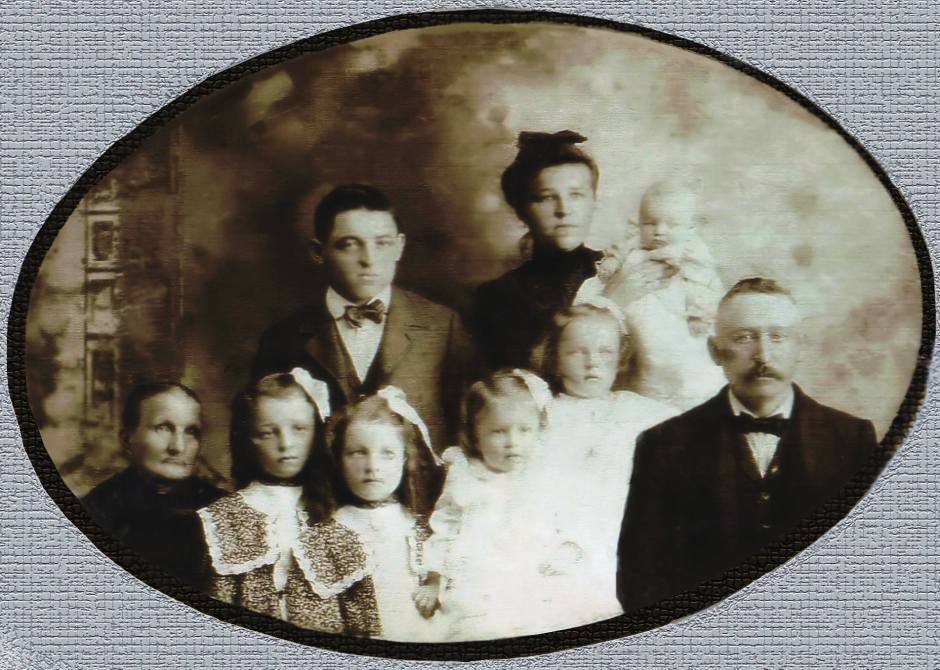
Anna Julia Meier was born 25 April 1895 in Buffalo, New York; the oldest of the 13 children of Wenzeslaus (“Wenzel”) and Anna (née Goetz or Götz) Meier. I’m incredibly fortunate to have a three-generation portrait of Anna with her parents, grandparents, and some of her siblings, taken circa 1903. This version of the photo was retouched by Leslie Utley of the Genealogists Photo Restoration group on Facebook to remove some scratches and flaws. In the front row, left to right, there is my great-great-great-grandmother, Julianna (née Bäumler) Götz (1838-1905). Next to her are her grandchildren, Anna Meier, Julia Meier, Marie Meier, and Frances Meier, followed by my 3x-great-grandfather, Carl Götz (1853-1933). In the back row are Wenzeslaus Meier (1871-1942) and Anna (née Götz) Meier (1877-1949), holding baby Margaret Meier.

Meier 3 generation portrait retouched

One of my most cherished family heirlooms is Nana’s First Communion prayer book, written in German, with her name inscribed in it.


This slideshow requires JavaScript.

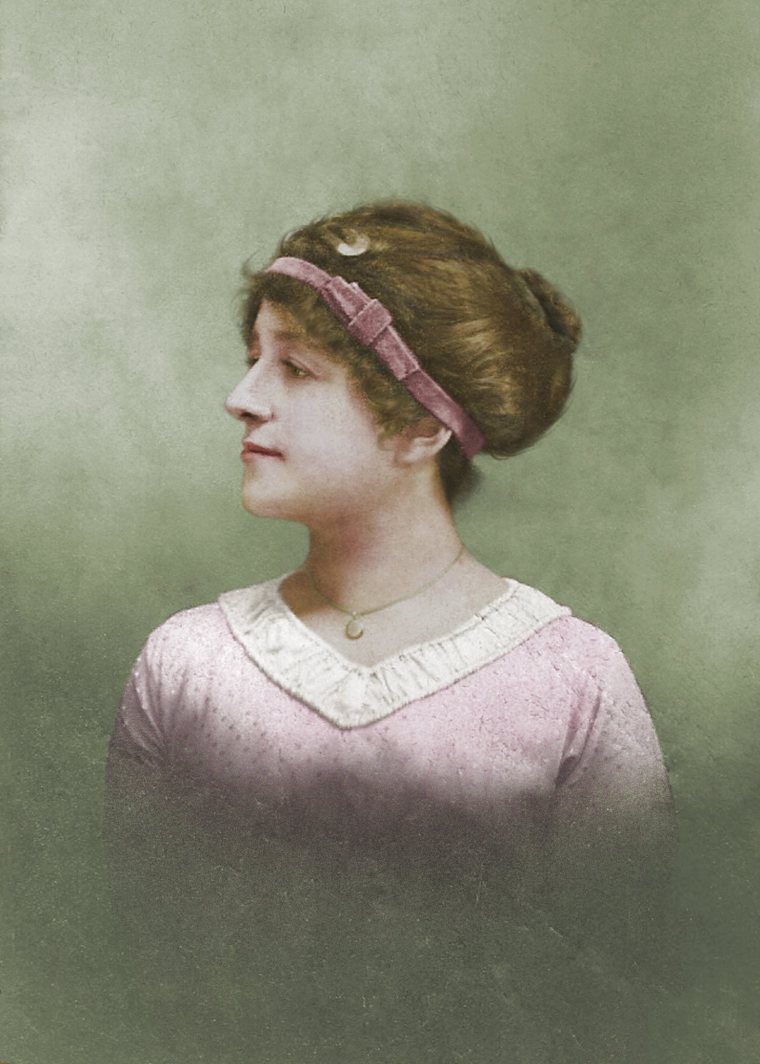
Here’s one more great photo of Nana, at the age of 17 in 1912, retouched to remove creases and colorized by Lisa Binion of the Genealogists Photo Restoration group on Facebook. I love the confidence on her face here, and the hint of a smile around the corners of her mouth.Anna Meier at 17, retouched and colorized by Lisa Binion

As mentioned, Anna’s father was Wenzel Meier, a German immigrant born in Bavaria. Wenzel is on the left in this photo taken circa 1939, presumably at his home in Buffalo, New York.Wenzel Meier on left with neighbor circa 1939According to the Social Security Applications and Claims Index, 1936-2007, he was born 27 March 1871 in Roding, Federal Republic of Germany.1 He came to the U.S. in 1890, on board the S.S. Fulda, which departed from Bremen and Southhampton and arrived in the port of New York on 8 August.2 The passenger manifest states that his last residence was “Obertrubenbach” (Figures 1a and b).

Figure 1a: Extract from passenger manifest for Wenzeslaus Meier, S.S. Fulda, 8 August 1890, far left side of the page.2Wenzel Meier Manifest left crop

Figure 1b: Extract from passenger manifest for Wenzeslaus Meier, S.S. Fulda, 8 August 1890, far right side of the page.2Wenzel Meier Manifest right crop

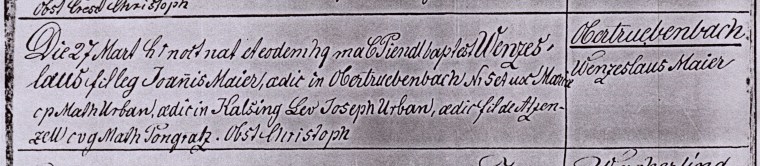
These two pieces of information, Roding and Obertrubenbach, were consistent with the location of Obertrübenbach, which is a village in Cham county, Regierungsbezirk Oberpfalz, in the easternmost part of Bavaria, roughly 20 miles from the present-day border between Germany and the Czech Republic, as shown on the map. (A Regierungsbezirk is an administrative division that’s intermediate between a county and a state.) Obertrübenbach has had a Catholic church, Sts. Peter and Paul, since the second half of the 12th century, but this church has been a filial church of the church in Roding since at least 1391.3 Although the entry for Obertrübenbach in the Meyers Orts- und Verkehrs-Lexikon des Deutschen Reichs (Meyers Gazetteer of the German Empire) does not specify the relationship between the churches, only mentioning that a Catholic church did exist in Obertrübenbach, the online version of the gazetteer confirms that the village belonged to the parish in Roding (claiming FamilySearch as the source for this information). The church of St. Pancras in Roding is indeed where Wenzel Meier was baptized in 1871, and his baptismal record is shown here (Figure 2).The priest who recorded Wenzel’s baptism really loved abbreviations, so a complete transcription and translation of this record was a joint effort by several contributors in the Genealogy Translations group on Facebook, including William F. Hoffman, Mente Pongratz, Gerardo Cacciari, and Jadwiga Berntsson.

Figure 2: Baptismal record for Wenzeslaus Meier, 1871. Transcription (including full words where the priest abbreviated): “Die 27 Mart[ii] h[ora] 1 noct[is] nat[us] et eodem h[ora] 9na [?] a C. Piendl bapt[izatus] est Wenzeslaus fil[ius] leg[itimus] Joan[n]is Maier, aedic[ularii] in Obertruebenbach Nr. 5 et ux[oris] Mariae c[uius] p[ater] Math[aeus] Urban, aedic[ularius] in Kalsing, Lev[antes] Joseph Urban, aedic[ularii] fil[ius] [son of a Häusler] de Alzenzell c[uius] v[ices] g[erens] Math[aeus] Pongratz. Obst[etrix] Christoph”4
Wenzeslaus Meier 1871 crop

In translation, the record states, “On the 27th day of March at 1:00 at night was born, and on the same day at 9:00 in the morning by C. Piendl was baptized Wenzeslaus, legitimate son of Johann Maier, homeowner in Obertruebenbach [house] number 5, and his wife Maria, whose father is Matthias Urban, homeowner in Kalsing. The godfather was Joseph Urban, son of a homeowner, living in Atzenzell, and acting in his place [as proxy godfather] was Mathaeus Pongratz. The midwife was (Crescentia?) Christoph.”

I had originally read the abbreviation aedc as aedt, for aedituus, meaning “sacristan” or “sexton,” but Mente Pongratz set the record straight that it’s actually aedicularius meaning homeowner, equivalent to the term Häusler in German. Moreover, he added that the Latin term aedic. fil. is equivalent to the German word Häuslerssohn, which is the son of homeowner, as opposed to the idea that the priest was describing Joseph Urban as both as homeowner and a son. William F. Hoffman further clarified that the midwife’s given name was likely to be Crescentia, based on the previous entry on the page, which reads “Obst Cresc. Christoph.” In any case, the birth date on this record matches exactly with the date of birth reported by Wenzel Meier on U.S. records, and his parents’ names, which were recorded as John Meier and Mary Uhrman on U.S. documents, are also sufficiently similar that we can be sure this is a match. The variation in surname spelling, Maier rather than Meier, isn’t a big deal, despite the popularity of the surname.

It was Wenzel’s parents, then, whose marriage record from 27 October 1857 I translated in that previous blog post. And now you know a bit more of their story.

Sources:

1U.S., Social Security Applications and Claims Index, 1936-2007 (Provo, UT, USA, Ancestry.com Operations, Inc., 2015), Record for Wenzel Meier, 27 March 1871, Social Security number 122106193, Ancestry.com, subscription database, https://www.ancestry.com/, accessed 20 October 2017.

New York, Passenger Lists, 1820-1957 (images), (Provo, UT, USA: Ancestry.com Operations, Inc., 2010), record for Wenzeslaus Meier, S.S. Fulda, 8 August 1890, accessed 20 October 2017.

3 Obertrübenbach,” Wikipedia, https://de.wikipedia.org, accessed 20 October 2017.

4 BZAR, Roman Catholic Church, St. Pancrus parish (Roding, Cham, Oberpfalz, Germany), baptismal record for Wenzeslaus Maier, born 27 March 1871, vol. 6/213, p. 378, MF 273.

© Julie Roberts Szczepankiewicz 2017


The Final Clue: Tracing the Wagners Back to Germany

As dead people go, Joseph Riel wasn’t even all that interesting to me. He was just an in-law, the husband of my great-great-great-grandaunt, Gertrude Wagner Riel. He was not even a blood relative, much less a direct-line ancestor, and he and Gertrude died without issue, so I cannot hope to find Riel cousins among my DNA matches. And yet it was Joseph Riel’s grave marker that gave me the final clue to the German place of origin of my Wagner family. Before I explain what was on the grave marker and why it mattered, let me introduce you to my Wagners and summarize the evidence for their place of origin in Germany up to this point.

The Henry Wagner Family of Detroit, Michigan

My great-great-great-grandfather was Henry Wagner, born circa 15 December 1829 in Germany.1 According to the 1900 census, which was recorded when Henry was living as a widower in the household of his son of his son, John, Henry arrived in America in 1855 (Figure 1).2

Figure 1: Excerpt from the 1900 census for Detroit, Wayne County, Michigan, showing Henry Wagner in the household of his son, John Wagner.2

Henry Wagner 1900 census crop

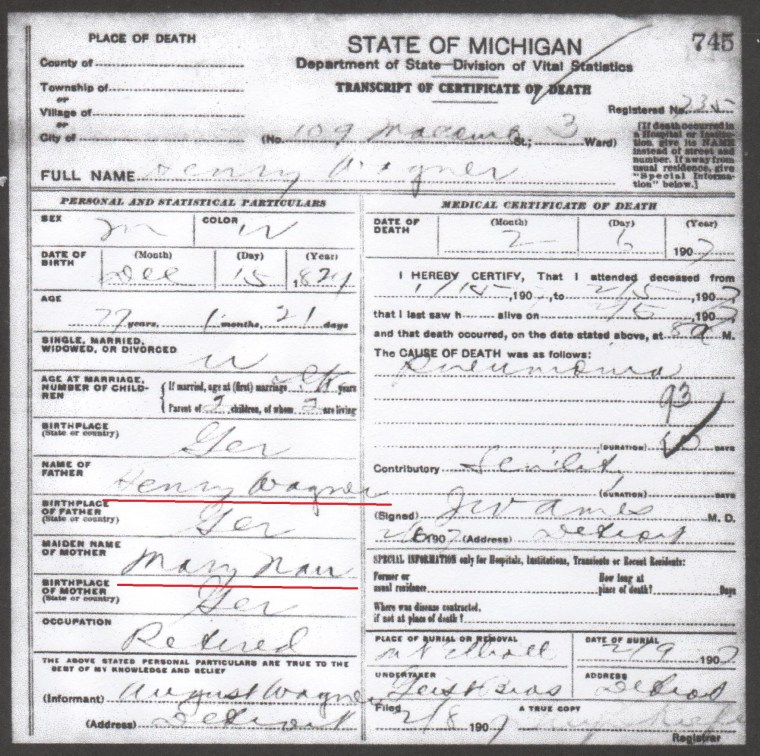
On that census, Henry reported his own date of birth as September 1827, and no baptismal record from Germany has yet been obtained to verify the correct date. Henry Wagner’s death certificate reveals that his father was also named Henry Wagner, and his mother was Mary Nau (Figure 2).3

Figure 2: Death certificate for Henry Wagner, 6 February 1907.3Henry Wagner death certificate

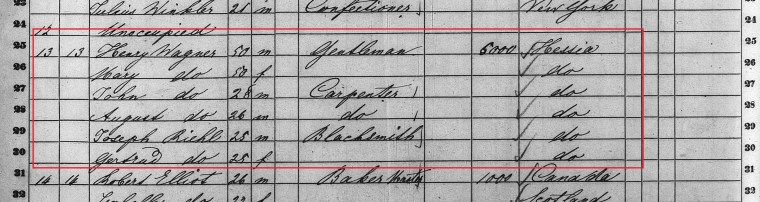
Further digging revealed that Henry (Jr.)’s parents, Henry and Mary (née Nau) Wagner also immigrated. The family can be seen in the 1860 census (Figure 3), living in Detroit.Henry himself was already married by that time and living separately.

Figure 3: Excerpt from the 1860 census showing the family of Henry (Sr.) and Mary Wagner with sons John and August, son-in-law Joseph Riehl (sic), and daughter Gertrude Riehl.4Henry Wagner family 1860 census Detroit

Henry Wagner (Sr.) is noted to be a “gentleman”, born circa 1810 in Hessia, whose personal estate was valued at approximately $5,000. Mary, his wife, was also born circa 1810, and their sons John and August were born circa 1832 and 1834, respectively, and were both employed as carpenters. Son-in-law Joseph Riehl was noted to be a blacksmith and he and his wife, Gertrude, were both born about 1835.

The passenger manifest for Henry Wagner (Sr.) and family does not reveal where they were from in Germany, unfortunately (Figure 4).5

Figure 4: Passenger manifest of the S.S. Erbpring Luidrich August, which arrived in New York 29 September 1853, showing the family of Henry Wagner (Sr.).5

Henry Wagner fam Passenger List

The manifest shows the family of Henry Wagner, a 50-year-old male farmer from Germany traveling to the U.S. Henry’s age suggests a birth year of 1803. The name of the passenger below him appears to be “Cath.;” however, the passenger is marked as a 24-year-old male. No trace has yet been discovered in U.S. records for a Catherine Wagner born circa 1829 who belongs to this family, and “Catherine’s” birth year is approximately correct for Henry Wagner (Jr.) who is missing from this manifest. This suggests one of two possibilities: either (a) Henry Wagner (Jr.) immigrated separately from his family, which would explain his absence from this manifest, and Catherine Wagner is a real sibling for whom evidence may yet turn up in U.S. records with further digging, or (b) the name “Cath.” was recorded in error, and the 24-year-old male passenger listed with the Wagner family was actually Henry (Jr.). The names of the other passengers listed below “Cath.” — August, Johnny and Gertrude — are consistent with the known children of Henry (Sr.) and Mary Wagner, although their ages appear to be 20, 22 and 28 (?), suggesting birth years of 1833, 1831, and 1825, which are a bit off from what was reported in the 1860 census. Interestingly, the family matriarch, Mary (née Nau) Wagner is not mentioned with the family group, although there is a good match for her at the bottom of the page — 50-year-old Marianne Wagner. Since she was separated from the family on the manifest, the possibility existed that perhaps Henry (Jr.) was similarly separated, perhaps on the next page after Marianne’s name. However, all pages of the manifest were checked and there was no match for a Henry Wagner of the appropriate age.

The Search for Henry’s Manifest

To examine the possibility that Henry Wagner (Jr.) traveled separately from his family, another search was made for a manifest for Henry Wagner, born circa 1827-1829 in Germany, arriving in the U.S. circa 1855. A possible match was discovered (Figure 5), which shows a single Henry Wagner who arrived on the S.S. General Jacobi on 3 May 1854.6

Figure 5: Excerpt from manifest for the S.S. General Jacobi, arrived in New York on 3 May 1854.6

Henry Wagner passenger record

According to this manifest, 27-year-old Henry Wagner was a German carpenter who was traveling to Buffalo, New York. His age suggests a birth year of 1827, and his occupation, carpenter, matches the occupation reported for John and August Wagner on the 1860 census. While I was excited to see his place of origin reported as “Fritzlar,” I recognized that this information would not help me unless I could be sure that the passenger described here is “my” Henry Wagner. And his destination, Buffalo, is somewhat problematic, since the Wagner family was not known to live in Buffalo. So although this could be the correct manifest, it’s also possible that this passenger was a different Henry Wagner, since the surname is so common.

At this point, we have two hypotheses to evaluate: (a) this is the manifest for “my” Henry Wagner, and he stopped in Buffalo briefly before moving on to Detroit, or (b) this manifest is for a different Henry Wagner who traveled to Buffalo and remained there. If (b) is correct, we should expect to find evidence of a German immigrant named Henry Wagner who matches this passenger, living in Buffalo or thereabouts. Accordingly, census records for Buffalo, New York and adjacent counties were checked, and there is evidence of a Henry Wagner, born in Germany circa 1830, who arrived in the U.S. circa 1852 and lived in Clarence, New York, which would at that time have been farm country on the outskirts of Buffalo. This suggests that perhaps the Henry Wagner who arrived on the General Jacobi is not my Henry after all. So perhaps my Henry really did arrive with his family on the Erbpring Luidrich August in 1853 and was misrecorded as “Cath.”? I think it’s possible, maybe even likely. But with such a common name, we may never know for certain.

Church Records to the Rescue

Since the Wagners’ place of origin in Germany could not be determined from the passenger manifest, other sources had to be checked. In this case, as it often happens, church records proved to be very helpful. As noted on his death record (Figure 2) Henry Wagner (Jr.) and his wife Catherine (née Grentzinger) had only two children, John and Mary (my great-great-grandmother). Both of them were baptized at Old St. Mary’s parish in Detroit, and their baptismal records revealed the place of origin of both their parents.  Shown here is Mary’s baptismal record (Figure 6).7

Figure 6: Extract from baptismal record for Maria Wagner, born 10 July 1860 in Detroit.7

Maria Wagner 1860 page 1 marked

All names in this record are written in Latin. Although the column headings are cut off in this image, the record indicates that Mary Wagner was born 10 July and baptized 15 July 1860, and that she was the daughter of Henry Wagner of “Roßen ChurHessen” and Catherine Granzinger of Oberelsau. Godparents were named as August Wagner and Maria Wagner, and they were probably the baby’s uncle and paternal grandmother.

The baptismal record for Henry and Catherine’s son John (Figure 7) indicates that he was baptized with the name August, although this is the only record discovered to date in which he was referred to that way.8

Figure 7: Extract from baptismal record for Augustinus Wagner, born 3 May 1856 in Detroit.8Augustinus Wagner 1856 p 1marked

The date of birth for “Augustinus” is approximately consistent with dates of birth reported for John Wagner, and since this was the only other birth record discovered for a child of this couple (and since they were known to have only two children), it’s reasonable to conclude that “Augustinus” is really John. It’s customary in parts of Germany to name a child after the same-sex godparent, and since August Wagner was named as this child’s godfather, that might explain the priest’s error in recording the child’s name, if perhaps the priest was from one of those regions. In any case, this record tells us that Henry Wagner was from “Roßdorf, Chur Hessen” and Catherine Grenzinger was from “Steinsolz, Alsatiae.”

“Chur Hessen” in both these records is a reference to Kurhessen, properly called Kurfürstentum Hessen, the Electorate of Hesse, a German state which existed from 1814-1866, at which time its territory was annexed by Prussia. The territory was also known as Hesse-Cassel or Hesse-Kassel. Although the Meyers gazetteer does not reveal any places called “Roßen” that were located in this area, “Roßdorf” turns out to be a better clue, since there were two places by that name that were in Hesse-Cassel. One of these was located in Hanau County, about 2 km north of Bruchköbel, while the other was located in Kirchhain County,  about 5 km southwest of Amöneburg. Based solely on this information, I had no way of knowing which Roßdorf was meant, so I put the Wagner research on the back burner.

The Final Clue

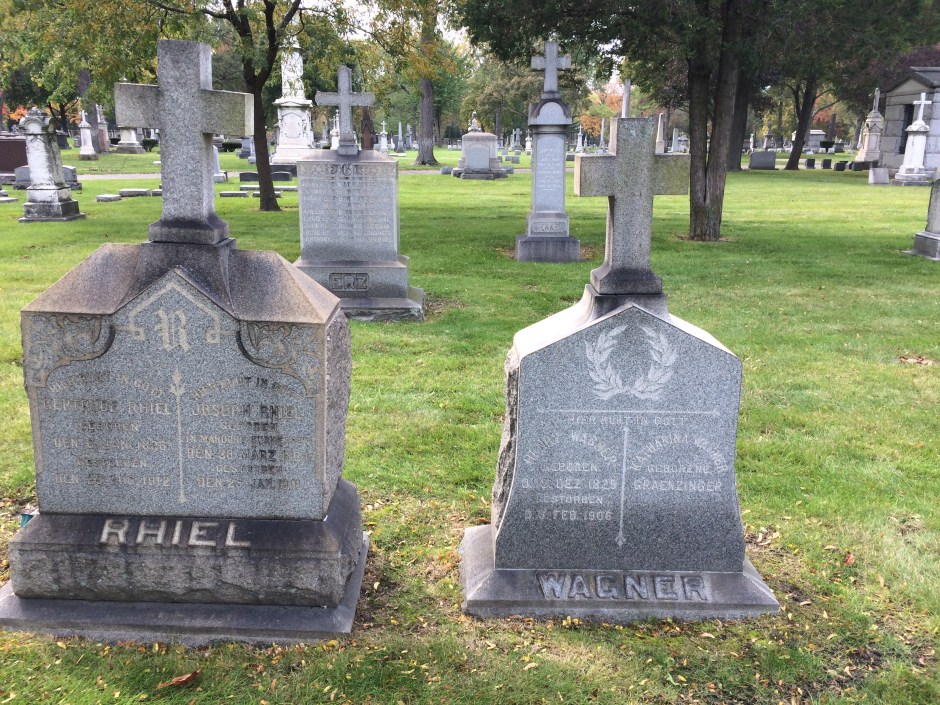
Fast-forward now to last weekend, when I had the opportunity to visit Detroit and present two lectures for the Polish Genealogical Society of Michigan at their annual fall seminar. While in Detroit, I was able to visit Mt. Elliott Cemetery in person. This cemetery is the final resting place of all my immigrant Wagners, as well as some of their descendants, so I was eager to get some photographs. I was somewhat disappointed to find that only two monuments for this family are presently visible, although I was very pleased that one of these was for my great-great-great-grandparents, Henry and Catherine (née Grentzinger) Wagner (shown on the right in the featured image at the top of the page). The other monument is for Gertrude and Joseph Rhiel (sic). As I mentioned in the beginning, I was pleased to find this monument, but not overly excited about it, until I got home and took a closer look at the inscription on it. The inscription states that Joseph Rhiel was “geboren in Mardorf, Kurhessen.” A quick check in Meyers reveals the existence of a village called Mardorf that was located in Kirchhain County. This village is apparently too small to be shown on modern maps, but can be seen in relation to Roßdorf and Amöneburg on this old map of the Kassel region circa 1906 (Figure 8).9

Figure 8: Map showing relative locations of Roßdorf, Mardorf, Amöneburg, and Neustadt, Hesse-Kassel, circa 1906.9Map of Rossdorf and Mardorf

Of course, Meyer’s gazetteer identifies a second location called Mardorf that was in Kurhessen, in Homberg County. How can we be sure that Joseph Riel wasn’t from that Mardorf instead?

Cluster research in genealogy (also known as FAN research, research which focuses on our ancestors’ Friends, Associates, and Neighbors) is based on the principle that our ancestors did not live their lives in a vacuum. One person in a village would decide to move and settle in a new area, and he would be followed by others from the same village — a phenomenon known as chain migration. So it’s more logical to suppose that the Riel and Wagner families were from the same part of Germany, and continued that association in Detroit, rather than supposing that they came from villages that were relatively far apart.

While in Detroit, I also had the opportunity to attend Mass at Old St. Mary’s church — the parish to which my Wagner ancestors belonged. After Mass, I had the good fortune to chat with Randy Bowers, operations manager and archivist at the parish. He gave me a draft of a parish history by John D. Little which states, “In 1830 the first German immigrants — all Catholics and mostly farmers — arrived in Detroit from Neustadt, a small country town of about 2,100.”10 This statement offers further evidence that we’re on the right track in identifying the locations of Roßdorf and Mardorf, since the town of Neustadt can be seen on the map in Figure 8, about 22 km (13 miles) from Roßdorf.

Although the evidence looks pretty good at this point, the identification of the Wagners’  ancestral village must be considered tentative until we find mention of them in the church records for Roßdorf.  There is also a great deal more research that can be done to document the Wagners in Detroit, especially in church records. Unfortunately, I had no time during this visit to utilize the vast genealogical resources of the Burton Historical Collection at the Detroit Public Library, so that research remains on my to-do list for the time being. However, I’m fairly confident that I’m on the right track, since all the clues regarding place of origin for the Wagners and their FANs are pointing to the same location. Joseph Riel may have been just an in-law to my family, and it’s true that he left no descendants. But in retrospect, it turns out that he was a pretty interesting guy after all.

Sources:

1 Mt. Elliott Cemetery (Detroit, Wayne, Michigan), Grave marker for Henry and Katherina Wagner, photographed 27 October 2017. Inscription: “Hier Ruht in Gott/Henry Wagner/Geboren/D. 15 Dez. 1829/Gestorben/D. 6 Feb. 1906/Katharina Wagner/Geborene/Graenzinger.”

2 1900 U.S. Federal Census (population schedule), Detroit, Wayne, Michigan, E.D. 23, sheet 24B, John Wagner household, http://ancestry.com/, subscription database, accessed 3 November 2017.

Death Records, 1897-1920, Michigan Historical Center, Seeking Michigan (http://seekingmichigan.org), 1907, #735, certificate for Henry Wagner, died 6 February 1907 in Detroit, Wayne, Michigan.

1860 U.S. census (population schedule), 3rd Ward Detroit, Wayne, Michigan, page 173, Henry Wagner household, https://www.familysearch.org, accessed 3 November 2017.

New York, Passenger Lists, 1820-1957 (image and transcription), record for Henry, Cath., August, Johnny, Gertrude, and Marianne Wagner, S.S. Erbpring Luidrich August, arrived 29 September 1853 in New York,  Microfilm Serial: M237, 1820-1897; Microfilm Roll: Roll 132; Line: 12; List Number: 1010,  http://ancestry.com/, subscription database, accessed 3 November 2017.

New York, Passenger Lists, 1820-1957 (image and transcription), record for Henry Wagner, S.S. General Jacobi, arrived 3 May 1854 in New York, Microfilm Serial: M237, 1820-1897; Microfilm Roll: Roll 138; Line: 19; List Number: 406http://ancestry.com/, subscription database, accessed 3 November 2017.

Roman Catholic Church, Old St. Mary’s Parish (Greektown, Detroit, Michigan), Baptisms, 1860, #148, p. 359, record for Maria Wagner. “[Record number] 148, [date of baptism] Julii 15, [date of birth] Julii 10, [child’s name] Maria, [father and place of birth] Henricus Wagner Roßen ChurHessen, [mother and place of birth] Cath. Granzinger, Oberelsau [Oberelsass], [[godparents] August Wagner Maria Wagner, [residence] Detroit, [minister] P. Nagel.”

Roman Catholic Church, Old St. Mary’s Parish (Greektown, Detroit, Michigan), Baptisms, 1856, #116, p. 219, record for Augustinus Wagner. “[Record number] 116, [date of baptism] 4 Maji, [date of birth] 3 Maji, [child’s name] Augustinus, [father and place of birth] Henricus Wagner Roßdorf ChurHessen, [mother and place of birth] Catharina Grenzinger, Steinsolz, Alsatiae, [[godparents] Augustinus Wagner et Gertrudis Wagner, [residence] Detroit, [minister] P. Beranek.”

Map, “Kassel” circa 1906 from 3rd Military Mapping Survey of Austria-Hungary, Elte Department of Cartography and Geoinformatics, http://lazarus.elte.hu, accessed 4 November 2017.

10 John D. Little, The History of Old St. Mary’s, p. 4; photocopy to Julie Szczepankiewicz, Hopkinton, Massachusetts, 2017; original held by Randy Bowers, Detroit, Michigan.

© Julie Roberts Szczepankiewicz 2017

Anatomy of a German Marriage Record

In my last post, I wrote about my excitement over my brand-new copy of Hoffman and Shea’s recently published German genealogical translation guide, In Their Words: A Genealogist’s Translation Guide to Polish, German, Latin and Russian Documents: Volume IV: German. I decided to test-drive it using a marriage record from the Bischöfliches Zentralarchiv Regensburg that my friend Mente Pongratz obtained for me a while ago. While most of the documents he obtained were in Latin, there were a few that were in German, and I’ve been saving the German-language ones for this moment. These documents pertain to my Meier family from the village of Obertrübenbach, presently located in Cham County, Oberpfalz, Bayern (Bavaria),. I’ll have to introduce you to my Meiers in the next post, but right now, I want to focus on the process I use when I begin to learn to read genealogical records in an unfamiliar language.

The marriage record in question is for Johann Meier/Maier and his bride, Anna Maria Urban, who were my great-great-great-grandparents, and it comes from the Catholic Church in Roding, Bavaria. Let’s start by looking at the entire document (Figure 1a and b).

Figure 1a: Left page of marriage record for Johann Maier and Anna M. Urban, 27 October 1857.1 The entry pertaining to them is the second one from the bottom.

Johann Meier & Anna Maria Urban 1857 p 1.jpg

Figure 1b: Right page of marriage record for Johann Maier and Anna M. Urban, 27 October 1857.1 The entry pertaining to them is the second one from the bottom.

Johann Meier & Anna Maria Urban 1857 p 2

Remember that I’m starting from the same place as many of you. I have no prior experience with reading, speaking, or writing German, and I’ve never made any serious attempt to decipher records in that language until now. I do have some prior knowledge about the names of my ancestors, and I’m going to leverage that advantage as far as possible. As I looked at this for the first time, my first thought was that learning the cursive letter forms is going to be almost as bad as learning Cyrillic. The letter forms used are an old German cursive script called Kurrent which is sufficiently different from our cursive script that it’s not just a matter of reading bad handwriting. The printed text at the top is in a typeface called Fraktur, which is sufficiently similar to our “Old English” Gothic typefaces that it shouldn’t pose too many problems. That said, one of the first things I should have done when I obtained this document as a hard copy from the archive was was to scan it immediately and open it up on my computer, in order to zoom in on the text, rather than trying to work from the hard copy. Since I didn’t do that, I struggled for a bit with the fact that the Fraktur 𝕭 (B) is almost identical to the Fraktur 𝖁 (V), especially when viewed at a small size. This made it difficult to look up unfamiliar words in the dictionary.

Take It From the Top

Let’s start with looking at the column headings on the left page:Johann Meier & Anna Maria Urban 1857 p 1 top crop

The first thing I did was to check Hoffman and Shea’s section entitled, “Marriage Entries and Certificates: Columnar-Form Original Entries in Registers” to see if this exact form was reproduced. Unfortunately, it was not. However, this section provided a good starting point for me to decipher many of the words found in the column headings without having to resort to the glossary in the back every time. The first column reads Trauung-Tag, or wedding date. The second column is Bräutigame Tauf- und Zuname, Bridegroom, given- and surname. Easy enough so far. In the third column, you’ll notice that the Fraktur 𝕾 looks rather different from our S, and the final 𝖉 in the first word looks almost like a 𝖇, and I found myself referring frequently to Hoffman and Shea’s handy German alphabet chart on page 1, where they show Fraktur, Cursive, and Roman letters all side by side for comparison. However, it’s clear from the examples in the book that the first word in the third column is Stand. and then Religion is easy to read.

The glossary at the back of Hoffman and Shea’s book defines “Stand” as “position, class; (marital) status; occupation; state,” making it clear that the word could have multiple meanings. Moreover, there’s a period after Stand. in this document, so I briefly entertained the idea that perhaps this was intended to be an abbreviation for Standesamt, which is the civil registry office. Now, as it turns out, Hoffman and Shea spell it out on page 232 that, “What we see under Stand will usually be occupation.” However, since I was skipping around in the book, I managed to miss that part initially, so I had to prove this for myself. To rule out the possibility that maybe Stand. meant Standesamt, I checked the Meyers gazetteer for Obertrübenbach, which reported that the Standesamt was in Obertrübenbach itself.  I knew I should be able to locate this word in this document, since I knew that Wenzel Meier’s family came from Obertrübenbach. Sure enough, in the entry for the marriage of Johann Maier and Anna Maria Urban (second from the bottom), “Obertrübenbach” appears in the 4th column on the left page. Since the writing in the 3rd column is completely dissimilar, we know that Stand can’t mean Standesamt in this context. 

Further examination of the entries in this third column reveals that only one word was recorded in most cases (sometimes hyphenated), and the word katholisch does not appear to be written in any of the columns. This makes sense; in a register from a Catholic parish, presumably all or most of the brides and grooms would be Catholic, so perhaps religion was recorded only in cases where one party was of a different faith.  I spent a few minutes wondering whether any of the entries in this column could possibly be ledig (single, unmarried), but then I skipped ahead to the column heading a few columns over, and realized that it reads, Ledig oder Wittwer, dessen gestorbenes (geschieden) Weib, or “single, or widower whose wife is deceased (or separated).Although the glossary defines geschieden as “separated,” in this context I think we can understand it to mean “divorced.” This column heading is interesting in light of the fact that this is a Catholic parish register and the Catholic church does not permit remarriage after divorce. Taken together with the previous column heading that mentioned stating the religion of the bridegroom, I wondered if this might imply that this form was created for use by a variety of religions in Germany, in an era when church records were recognized as legal documents, and I made a mental note to look up the date when civil vital registration (independent from church registration) began in Bavaria.

Since marital status was covered in Column 6, I finally arrived at the conclusion that “Stand” in column 3 must refer to the bridegroom’s occupation. After much back-and-forth between the alphabet chart showing the letter formations in Kurrent, and comparison of all the other entries, I concluded that Johann Maier must be a Häusler, which Hoffman and Shea define as, “cottager, peasant with a small house and garden and a livestock (e.g., a goat), but not enough to support a family.”

The next column heading is Landgericht, Aufenthalts-Ort, meaning, “District Court, place of residence.” This is where the word Obertrübenbach was recorded, which helped me determine the context for Stand in the previous column heading. Next comes Eltern. Bei der Mutter auch der Geschlechts-Name. This is translated to mean, “Parents. With the mother, also the Family Name.” So what we should see in this column are the names of the groom’s parents, with his mother’s maiden name specified. I was able to make out Johann’s father’s name, Christoph, and his mother’s name, Walburga gb. (geboren, i.e. née) Meinzinger. Did it help that I already knew what these names should be? Absolutely. But when you’re just starting out, using every scrap of information available to you is fair game.

The next column heading was also discussed previously, as it’s the one that reads, Ledig oder Wittwer, dessen gestorbenes (geschieden) Weib. In this case, Johann Maier was recorded as ledig, single. After that, the column heading is Geboren wann? wo?, which we understand to mean, “Born when? Where?” Apparently the priest saw no need to record any of the wheres, but he did record Johann’s birthdate for us, 27 July 1827.

Here Comes the Bride

The next columns pertain to the bride, starting with the column that reads, Der Braut Vor – und Geschlechts-Name, which is, “The Bride, given and family-name.” In the relevant entry, the bride’s name is recorded as Anna M. Urban, but her Stand doesn’t make sense to me. The first part of the word looks exactly like Häusler as it’s written in the groom’s column, but it looks like it ends in “𝖘𝖙,” i.e., “Häuslerst.” This isn’t possible. Häuslerin would be a female Häusler, but those final two letters clearly aren’t “𝖎𝖓.” I left this alone for a while and moved on, but after further consideration, I’m wondering if perhaps those final letters really are “𝖘𝖙,” and this was intended to be an abbreviation for Häuslerstochter, “daughter of a Häusler.”

Having completed the first page, I anticipated that the second page would be a little easier since many of the column headings are the same for the bride as they were for the groom. The first column on the right page is Landgericht Aufenthalts-Ort, although this time the word bisheriger, meaning “previous” or “up until now” is inserted after Landgericht. Anna Maria’s residence prior to her marriage was noted to be Kalsing. Her parents, described in the next column (identical column headings to corresponding column on groom’s side), were Johann and A. Maria gb. Ederer.  The next column, which reports whether she was single or a widow, states, led. — possibly abbreviated because by now, the priest’s hand was no doubt cramped from the effort of writing such tiny letters with any degree of precision. Anna Maria Urban was noted to have been born on 11 October 1832 in Kalsing.

We’re in the home stretch, with just four columns to go. The next one up has the heading, Pfarrer Stellvertreter, “Parish Representative,” implying that this column should name the priest who performed the marriage (who might not be the pastor himself). At this point, I had no more lifelines, in that I didn’t know in advance what the name should be here. My best guess was that the first letter is a P, and the last two letters are “-it” or possibly “-is.” Poppit? Poppis? The middle two letters that seem to be repeated contain a downward stroke that suggests either the letter p, g, or z; it doesn’t look like y, f, or h. I tried playing with versions of this surname on a German-language surname distribution site, and even on Google. My new best guess was that the surname might be Kappis, but the fact that this surname does not exist in Cham County today doesn’t bode well for that hypothesis. There’s also the fact that the capital “K” in “Kalsing” and in Klessing (3rd entry from the top in the first column on the second page) is formed quite differently from the first letter in the priest’s name. At this point, I decided to move on again and maybe come back to this name.

The next column is for the witnesses, with given name, surname, occupation, and place of residence. Again, I was without a safety net. The first witness was easy, Georg Maier, but the next line was not so easy: F???? m. (?) and then a word that looked like it might be “Obertrübenbach,” but with half the letters randomly omitted from the middle. Sigh. My guess was that the word beginning with F was an occupation, and maybe what looks like “m.” was actually im (in), so this phrase might describe Georg, rather than indicating the name of a different person. The third line in this column appears to be “Math. Pongratz,” and as this realization dawned on me, I realized that the first letter in that priest’s name really must be P, although I still can’t find a valid German surname that seems to fit that pattern.

The next column, Weltliche Heiraths-Lizenz, refers to a secular marriage license. I had no idea what the initials here are supposed to indicate; they seemed to be “L.R.” in most cases. It would be interesting to know if a secular marriage license could be obtained for further documentation of this marriage. I made a mental note to ask one of my friends who is an expert in German genealogy for more information on the entries in this column and their implications for further research.

The final column, Getraut mit oder ohne Dispens in den Graden, mit oder ohne Denunziationen, seemed to translate as, “Married with or without dispensation in degrees, with or without denunciation,” and some Roman Catholic canonical context is needed to understand this. My sense is that it relates to the need, or lack thereof, for a dispensation for the marriage due to consanguinity, since this need is determined by the degrees of separation in the relationship between the bride and groom. Denunciation in this context seems to refer to the reporting of known impediments to the marriage to the priest beforehand, in response to the announcement of the marriage banns (see “Denunciation of impediments,” here.) So in the case of most of the marriages recorded on these pages, there were no impediments to the marriage that were reported, and therefore there was no need for any dispensations. The one exception to this is the 8th marriage record down from the top (immediately above the record for Johann Maier and Anna Maria Urban), for Wolfgang Niklas and Elisabeth Niklas. Given their shared surname, they were probably relatives by blood or marriage, whose marriage would necessitate a dispensation. I considered trying to decipher the script pertaining to the dispensations, but I felt that I’d banged my head on a wall long enough for one day.

That’s a Wrap

So after all this, my best (first) attempt at translation can be summarized as follows:

  • Wedding date:  27 October 1857
  • Groom’s Name:  Johann Maier
  • Occupation:  Häusler (cottager)
  • Place of Residence:  Obertrübenbach
  • Parents’ Names:  Christoph and Walburga née Meinzinger
  • Marital Status:  single
  • Date of Birth:  27 July 1827
  • Bride’s Name:  Anna M. Urban
  • Occupation:  Häuslerstochter (daughter of a Häusler)
  • Place of Residence:  Kalsing
  • Parents’ Names:  Johann and A. Maria née Ederer
  • Marital Status:  single
  • Date and Place of Birth:  11 October 1832 in Kalsing
  • Parish Representative:  Pa??il or Pa??it (?)
  • Witnesses:  Georg Maier, ?? in Obertr???h, Math. Pongratz.
  • Secular Marriage License:  LR (whatever that means)
  • Marriage dispensation with or without denunciation:  Not applicable

I never did come to any resolution with bits of it, but I can always ask a German friend, or post the record in the Genealogy Translations Facebook group to get help with those little bits, and to have them correct my translation. Even without those options, it’s okay to have small bits remain unresolved. I used to do this all the time when I was translating Russian records, before I discovered Facebook genealogy groups. Now, with a few more years of experience in reading Russian records, I sometimes come across those early translations in my research notes and fill in the little bits that I couldn’t decipher the first time around. Now that I have my first German translation behind me, I know that it can only get easier from here!

If I Can Do This, So Can You!

So what are some general tips to keep in mind when learning to translate documents in a foreign language? Here are seven pointers:

Always look at the entire page, not just a single record.

I think this one ought to be obvious, but it’s really critical to familiarize oneself with all the examples of handwriting on the page.

Use the familiar to decode the unfamiliar.

Find something you recognize on the page — any words that you can recognize or predict based on your prior knowledge, or about what you’ve been told the document says (for example, from an indexed entry) — and use these words as your Rosetta Stone to understand the nuances of the handwriting of this particular writer. Since there are multiple forms of the letter “s” that are possible in Kurrent, for example, does the writer consistently use the same form? Or does he use them all interchangeably?

Use maps and gazetteers to help understand the places mentioned.

A good exercise for me will be to go through the list of places of residence mentioned in this document and see if I can translate them based on the names of villages close to Roding.

Formulate hypotheses and test them.

When you think you’ve deciphered a surname found in a record, test your theory by plugging it into a German language surname distribution database. If the surname exists in Germany today, you may be on the right track, and you score bonus points if the surname is also found in your county of interest. Similarly, if you think you’ve deciphered the priest’s name, try Googling the history of the parish to see if this particular priest was mentioned. Note that Google.de will provide different (and more appropriate) results than English-language Google, and for Polish records, Google.pl is the preferred search engine. You may need to translate your search terms first using Google Translate, which is an approach that is always fraught with peril when working with inflected languages, so keep your searches simple.

Rome wasn’t built in a day.

The more you work with foreign-language records, the more things will start to make sense to you. Especially with different letter forms like Cyrillic and Kurrent, it seems like a certain amount of time has to be spent in the beginning in staring at alphabet charts, committing the letter forms to memory and learning the sounds that each letter makes.  Be patient with yourself. You’ll get there.

Get help when you need it.

Learning to translation foreign-language records is an investment in yourself, but you don’t have to go it alone. The global genealogical community is a very generous one, and there are people who are willing to help you along the way. If you get stuck, you can always post the record and your translation attempt in the Genealogy Translations group on Facebook. Volunteers in that group, or in one of the groups targeted to your ethnic group of interest (German Genealogy, Polish Genealogy, etc.), can usually provide insight into archaic terms and offer historical context to help you understand the record, in addition to merely offering a translation.

Have fun!

Deciphering genealogical records can be quite an enjoyable puzzle, and you’ll gain a useful skill that will help you in your research. I’m really excited to continue my practice with German records, now that Hoffman and Shea’s German genealogical translation guide is here. While you won’t see me offering assistance to others with German translations any time soon, I’m confident that regular practice, the day will come when I can pick up a German document written in Kurrent and read it without having to look up any words in the book. And if I can do that, you can, too!

Note: The first round of edits is in! Apparently I was systematically misreading 𝖇 and 𝖉 in this document, too. I’ve made those changes in the text above. Thank you, Mente. Every correction is a learning opportunity.

Sources:

1 BZAR, Roman Catholic Church, St. Pancrus parish (Roding, Cham, Oberpfalz, Germany), marriage record for Johann Maier and Anna M. Urban, 27 October 1857, vol. 27, pg. 3, MF 573.

© Julie Roberts Szczepankiewicz 2017


Frank Zielinski and the Board of Special Inquiry

“Keep, ancient lands, your storied pomp!” cries she
With silent lips. “Give me your tired, your poor,
Your huddled masses yearning to breathe free,
The wretched refuse of your teeming shore.
Send these, the homeless, tempest-tost to me,
I lift my lamp beside the golden door!”

— Emma Lazarus, The New Colossus, 1883.

Despite Lazarus’ idealized portrayal of America’s welcome toward immigrants, there has always been a fair amount of suspicion toward the most recent wave of newcomers, and concern that they would take away jobs from American citizens or require public assistance. Any family historian who has ever studied a passenger manifest from the early 20th century has seen the columns in which immigrants were required to verify that they were in good mental and physical health, that they were not deformed or crippled, that they were not anarchists or polygamists. Immigrants could be sent back home for any number of reasons, and although only about 2% of Ellis Island immigrants were actually turned away, many of our ancestors were subjected to a more detailed physical exam or a special hearing prior to admittance.

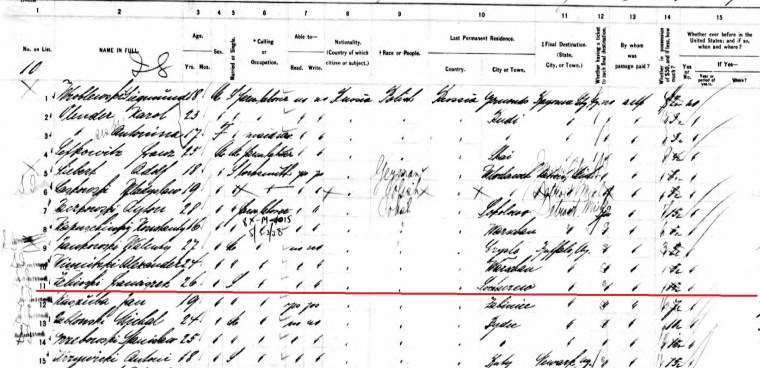
Consequently, many of us have discovered evidence in our own family trees of  immigrants who were detained for a hearing with the Board of Special Inquiry. In my family, my great-grandfather’s brother, Franciszek (Frank) Zieliński, was one such example. Franciszek arrived at Ellis Island on 7 April 1907, and his passenger manifest is shown here on the Ellis Island site (free) or via Ancestry, here (Figure 1).

Figure 1:  Extract from passenger manifest of Franciszek Zelinski (sic) from the S.S. Breslau, 7 April 1907.1Frank Zielinski marked manifest left crop

Franciszek appears on line 11, a single, male farm laborer, age 26, not able to read or write, which was not unusual for men living in Russian Poland at that time. His last permanent residence was noted to be Sochaczew, Russian Poland. Franciszek did not have a ticket to his final destination and he had only one dollar to his name, but he was reported to have paid for his ticket himself. Franciszek and a traveling companion, Aleksander Winnicki, were both going to join the brother-in-law of a third companion, Walenty Jankowski, who reported that he was from the village of Czyste, which is near Sochaczew. Walenty’s brother-in-law, Antoni Bejger (?), was living in Buffalo, New York. Although this manifest page is genealogical gold, it tells only half the story. As evidenced by the “SI” notations and subsequent “Admitted” stamps, all three of these men, along with four others on this page, were flagged for detainment and a hearing with the Board of Special Inquiry (SI).

These Records of Aliens Held for Special Inquiry appear as separate documents that usually constitute the final pages of the ship’s manifest, or possibly the first few pages of the manifest, as some manifests were microfilmed in reverse order. It’s common for a search on Ancestry to reveal one of the manifest pages for a particular immigrant (the main manifest page or the Record of Aliens Held for Special Inquiry page), but not both. However, you can always browse manually to find the additional page if there is reason to suspect that it should exist. Figure 2 shows the page from the Record of Aliens Held for Special Inquiry where Franciszek Zieliński was mentioned.

Figure 2: Record of Aliens Held for Special Inquiry, Franceszek Zelinski (sic), S.S. Breslau, 7 April 1907.2

Board of Special Inquiry manifest Frank Zielinski crop

The left-most columns on this manifest confirm the data found in the original manifest entry for Franciszek, indicating “26m” for a 26-year-old male, followed by his name. The next columns report group number and page number on the manifest where he was originally recorded. There is a column for number of persons held, which was only one, in Franciszek’s case. However, other entries note larger traveling parties, such as the group of 8 recorded further down on the page — a mother traveling with 7 children, who was detained as a Likely Public Charge (L.P.C.). The next column reveals the reason for Frank’s detainment, “C.L.” This notation stands for “Contract Labor,” and Franciszek’s traveling companions, Aleksander Winnicki and Walenty Jankowski, were detained for this same reason.

Apparently, Franciszek and the others were suspected of immigrating in violation of the Alien Contract Labor Law of 1885. This law was intended to discourage the practice among American companies of promising jobs to immigrants upon arrival, bringing them in under contract, or prepaying their passage. In addition,

The law aimed at reducing immigration to the country and supplying the workforce with better skilled trained craftsmen. The act prohibited all companies and individuals from bringing immigrants into the United States under contract or through indentured servitude. A less overt purpose of the law was to raise the quality of new immigrants by excluding people who could not pay their own way to reach the United States. Immigrants who could afford to travel to the United States on their own income were most welcome.3

The next columns on the manifest report the name of the immigration inspector, Leonard, and the actions of the Boards of Special Inquiry. In the case of Franciszek and his friends, the hearings took place on that same day, 7 April (reported in the “Date” column), and a transcript of the proceedings was recorded by the secretary “Lov” on page 10 of the stenographer’s notebook. One such transcript can be found here, although the transcript from Franciszek’s hearing would not have been preserved because he was ultimately admitted to the United States. The only records that were not destroyed were for cases in which the BSI judged in favor of exclusion an immigrant, and the immigrant appealed the decision. The documents surrounding those appeals are housed at the National Archives in Washington, D.C., and additional information about obtaining them can be found here.

The final columns on the far right side of the page are also interesting, in that they provide a tally for the number of breakfasts, lunches and dinners the detained person or party received while in detainment. The cost of these meals was billed to the steamship company. Unfortunately, the top corner of the original page was torn prior to microfilming, so this information is not available in Frank’s case.

Ultimately, Frank was admitted to the U.S., possibly because he was able to persuade the BSI that he did, in fact, pay for his own ticket as he reported on the manifest. Nevertheless, these Records of Aliens Held for Special Inquiry provide fascinating details to add to our understanding of our immigrant ancestors’ stories. So the next time you see an “admitted” stamp on a manifest next to the name of an immigrant ancestor, be sure to dig a little deeper in the manifest to uncover the rest of the story.


For further reading:

Grounds for Exclusion noted on BSI lists:  http://www.jewishgen.org/infofiles/manifests/bsi/causes.html, and

http://www.dvhh.org/dta/usa/general-research/alien_detentions.htm

Interesting story about an immigrant whose admittance was denied by the BSI, but who gained entry upon appeal:

http://www.jewishgen.org/InfoFiles/Manifests/bsi/

Sources:

1 New York, Passenger Lists, 1820-1957 (image), Ancestry.com, (Provo, UT, USA, Ancestry.com Operations Inc, 2003), Record for Franciszek Zelinski, S.S. Breslau, 7 April 1907, list 10, line 11, accessed 8 October 2017.

New York, Passenger Lists, 1820-1957 (image), Ancestry.com, (Provo, UT, USA, Ancestry.com Operations Inc, 2003), Franceszek Zelinski (sic) in Record of Aliens Held for Special Inquiry, S.S. Breslau, 7 April 1907, page 121, accessed 8 October 2017.

Bell, Keith J. “Alien Contract Labor Law of 1885,”  Immigration to the United States, http://immigrationtounitedstates.org, accessed 8 October 2017.

© Julie Roberts Szczepankiewicz 2017


The Leonard Zarzycki Family of Warsaw

Genealogists are often too familiar with the frustration of painstakingly gathering documentation to identify an ancestral village, only to discover that the family didn’t stay there for long, nor did they leave any hint about where they went. Sometimes, it’s just a branch or two that disappears from the records, but in such cases, it can be really difficult to find people in the absence of indexed records. I have quite a few family lines that dead-end this way, but the good news is that indexing efforts in Poland are bringing more and more of these missing relatives to light. Just yesterday, in fact, I managed to discover evidence for a previously unknown Zarzycki cousin who went to Warsaw.

I’ve written about my Zarzycki/Zażycki family in the past. This is the family of my great-grandfather, Jan Zażycki, who was born in the village of Bronisławy in Sochaczew County in 1866, and immigrated to Buffalo, New York. The village of Bronisławy belongs to the parish of Rybno, and it’s challenging to obtain records from this parish since so few of the parish books were ever transferred to the state or diocesan archive. Most of them are still onsite at the parish itself, but thanks to the diligence of my onsite researcher, Justyna Krogulska, and the generous pastor who was willing to permit access to the records, I’ve been able to gather baptismal records for Jan and his siblings, trace the family’s roots a bit further back, and also trace some of Jan’s siblings forward, to identify their spouses and at least some of their children. However, some of Jan’s siblings disappeared from the records in Rybno. Did they die in infancy, and their deaths were somehow not recorded? Did they move and perhaps marry elsewhere in Poland? So far I haven’t found evidence of emigration (I’ve looked), but maybe a surname was dramatically altered?

Today, one of those missing siblings emerged, in the indexed records for Warsaw in the vital records database, Geneteka. Leonard Zarzycki was the youngest brother of my great-grandfather Jan. Leonard was born 6 November 1876,and his marriage to Marianna Majewska was recorded in Rybno parish on 14 February 1904.2 After that marriage, however, the couple disappeared from the records. No birth records for their children were discovered in Rybno, and I had no idea where they went until today, when I discovered the following marriage record for Leonard and Marianna’s son, Zygmunt, at All Saints Church in Warsaw in 1929.3

Zygmunt Zarzycki and Henryka Kurkiewicz 1929 crop

The translation of the record is as follows:

“#525. This happened in Warsaw in the office of All Saints parish on the eighth day of September in the year one thousand nine hundred twenty-nine at ten o’clock in the morning. We declare that — in the presence of witnesses, Leonard Zarzycki, public works entrepreneur, and Michał Kurkiewicz, railroad official, adult residents of Warsaw — that on this day, in this church, was contracted a religous marriage between Zygmunt Zarzycki, bachelor, office worker, having twenty-four years of age, born in the parish of St. Stanisław, son of the living Leonard and Marianna née Majewska, the spouses Zarzycki, residing in Warsaw on Krochmalna Street in house number five thousand four hundred ninety eight in St. Andrew’s parish, and Henryka Michalina Kurkiewicz, single, [residing] with her father, having twenty-four years of age, born in the parish of St. Barbara in Warsaw, daughter of the living Michał and the late Leokadia née Miałkowska, residing in Warsaw on Pańska Street in house number one thousand two hundred forty-three in the parish here. The marriage was preceded by three announcements, proclaimed in the parish of St. Andrew’s and here, on the eighteenth and twenty-fifth days of August and the first day of September. The newlyweds stated that they had no prenuptial agreement between them. The religious ceremony of marriage was performed by Fr. Jan Mecheta, local vicar. This document was read aloud to the newlyweds and witnesses, and we signed. [Signed] Fr. Mecheta, Zygmunt Zarzycki, Henryka Kurkiewicz, Michał Kurkiewicz.”


The ages reported here suggest that both Zygmunt and his bride, Henryka, were born circa 1905 in Warsaw. The parish in which Zygmunt was baptized, St. Stanisław, Bishop and Martyr, was founded in 1611 in the Wola district of Warsaw, and Zygmunt’s birth record was subsequently located in the records from that parish. The address at which Leonard Zarzycki’s family was living at the time of Zygmunt’s marriage, 5498 Krochmalna Street, appears not to correspond to any present address there, but this is hardly surprising, given that 90% of Warsaw was destroyed during World War II. Krochmalna Street itself was a very poor neighborhood, largely Jewish, and the eastern part of the street was within the area walled off by the Nazis in November 1940 to form the Warsaw Ghetto, just 11 years after the date of Zygmunt and Henryka’s wedding.

I have to wonder what happened to the Zarzyckis during the war. Did they leave the city and go back to family in Bronisławy? Were they forcibly relocated? Might they have participated in the Warsaw Uprising? One resource to check for answers to these questions is the “Loss” database. In 2006, The Polish Instytut Pamięci Narodowej (Institute of National Memory) and the Ministerstwo Kultury i Dziedzictwa Narodowego (Ministry of Culture and National Heritage) developed this database to assist families in discovering the fates of individuals who suffered the loss of life or property as a result of Nazi oppression. A broad search for Zarzycki/Zarzycka, with father’s name Leonard (to locate Zygmunt) or Ignacy (to locate Zygmunt’s father, Leonard) did not produce any likely matches, suggesting that the family might, indeed, have left Warsaw before the war.

Another broad search in the indexed records at Geneteka for St. Stanisław Church in Warszawa-Wola reveals a large number of births to Zarzyckis between 1904, when Leonard and Marianna were married, and 1908, when indexed records end for this parish. I hoped that some of these might be for additional children of this couple, so I examined each record individually, since the index is of the “bare bones” variety which lacks key identifying information such as mother’s maiden name. Unfortunately, none were for children of Leonard and Marianna. Zygmunt’s marriage record stated that the family was living in Warsaw in St. Andrew’s parish at that time, so perhaps they moved there soon after he was born, and additional siblings can be found in those records. Birth records for St. Andrew’s are not indexed in Geneteka for the period from 1904-1912, but they’re available (unindexed) at Geneteka‘s sister site, Metryki. So perhaps I’ll be able to discover a few more children of Leonard and Marianna Zarzycki in due time. Stay tuned!

Sources:

Featured Image: All Saints Church in Warsaw, Poland, image courtesy of Wikipedia user Masti, licensed under CC-BY-SA 2.5.

Roman Catholic Church, St. Bartholomew Parish (Rybno, Sochaczew, Mazowieckie, Poland), Księga urodzeń 1870-1880, 1876, #87, baptismal record for Leonard Zarzycki.

Akta stanu cywilnego parafii rzymskokatolickiej w Rybnie, Polskie Towarzystwo Genealogiczne, Metryki.Genealodzy.pl, 1904, #15, marriage record for Leonard Zarzycki and Maryanna Majewska, accessed on 28 September 2017.

Ksiegi metrykalne parafii rzymskokatolickiej Wszystkich Swietych w Warszawie, Polskie Towarzystwo Genealogiczne, Metryki.genealodzy.pl (http://metryki.genealodzy.pl), Ksiega zaslubionych 1929 r., #525, marriage record for Zygmunt Zarzycki and Henryka Michalina Kurkiewicz, accessed on 28 September 2017.

© Julie Roberts Szczepankiewicz 2017

The Mysterious Wanda Gruberska: The Next Chapter

In my last post, I shared an article I wrote for the Polish Genealogical Society of America’s journal, Rodziny, about finding a new DNA match to a cousin who knew only his grandmother’s birth name, Wanda Gruberska, but little else about her, since she was adopted as a child and had her name changed. Today I’d like to provide a few updates to the story, based on new research findings since its publication.

To briefly recap, when I was contacted by this DNA match, I recognized the Gruberski surname because my maternal grandmother’s Zazycki family had multiple ties to the Gruberski family in Poland through marriage. However, Wanda Gruberska herself was not in my family tree, and at that point, I did not know who her parents might be. By process of elimination I was able to identify Wanda’s parents as Jan/John Gruberski and Marianna/Mary (née Pindur) Gruberska, demonstrate that they immigrated to Minnesota, prove that Mary died in 1918, and discover that one of the Gruberskis’ children was living in an orphanage in St. Paul in 1920. However, I still had no direct evidence of Wanda’s birth to these parents or of her own placement in that orphanage. I suspected that Wanda might have been baptized at St. Adalbert’s church in St. Paul, Minnesota, based on her family’s address in city directories.

The Smoking Gun, and a New Sister

What I did not realize at that time was that baptisms and marriages from this parish, as well as other Polish parishes in Minnesota, were indexed by John Rys and compiled into searchable databases which can be accessed via the website of the Polish Genealogical Society of Minnesota. John kindly provided me with a copy of Wanda’s baptismal record (Figure 1),1 as well as a copy of the baptismal record for another sister, Helena Josepha (Figure 2).2

Figure 1: Baptismal record from St. Adalbert’s church, St. Paul, Minnesota, for Wanda Grubarska, born 7 May 1916.1Wanda Gruberska baptism 1916

Figure 2: Baptismal record from St. Adalbert’s church, St. Paul, Minnesota, for Helen Josepha, born 18 March 1914.2Helena Gruberska baptism 1914

Wanda’s surname is spelled “Grubarska” in the first record, and her year of birth, 1916, makes her a full three years younger than her family suspected. However, this birth record is nonetheless a “smoking gun” —  the direct evidence which irrefutably identifies Wanda as a child of the parents whom I predicted for her, based on all prior evidence. Although I was previously unaware of another sister, Helena, it makes sense that John and Mary might have had another child born in the U.S. if Wanda was born as late as 1916. John and Mary’s oldest children, Stanisław and Genowefa, were born in Poland in 1908 and 1910, respectively, and arrived in the U.S. in April 1913 with their mother Mary and uncle Bolesław (Bill) Gruberski. Helena had to have been the first of John and Mary’s children born in the U.S., since her March 1914 birth date suggests that she was conceived in June 1913.

The Godfather

Helena’s godfather, Leon Gruberski, was another surprise, since I don’t have him in my family tree. However, my data on the children of Marianna Zarzycka and Józef Gruberski are still incomplete. As mentioned previously, the family lived in Bronisławy, a village belonging to the parish in Rybno. The majority of the 19th-century records for Rybno have not been microfilmed, nor are they available from the Polish State Archives (apart from a narrow range of years starting in 1886). Instead, the records are still in possession of the local Catholic parish. Thanks to a gracious pastor and a diligent researcher (Justyna Krogulska), I have been able to obtain records for my family from this parish, but it looks like another round of research is in order, focusing specifically on the Gruberski family.

Although Leon’s birth record is currently unavailable, a quick check on Ancestry produced his passenger manifest (Figures 3a and b, which can also be viewed free via Ellis Island):

Figure 3a:  Extract from first page of passenger manifest for Leon Gruberski.4Leon Gruberski passenger manifest page 1

Figure 3b: Extract from second page of passenger manifest for Leon Gruberski.4Leon Gruberski passenger manifest page 2

The manifest informs us that Leon arrived in New York on 5 May 1909, that he was single, and that he was born about 1885 in “Bronislawa.” His nearest relative in that place was his father, Józef Gruberski, who was living in “Bronislawa, Warschau,” and Leon was a citizen of Russia. All of this is consistent with the village of Bronisławy, which was located in the Warsaw gubernia (province) of the Russian Empire. On page 2, we see that he was headed to his “step brother,” Piotr Przanowski, living at 153 Box (?) Street in St. Paul, Minnesota. Leon may have used the term “step brother” in a rather broad sense. The Przanowski family was clearly associated with the Gruberski family because Leon’s brother, Roman Gruberski, was married to Julianna Przanowska, who was the daughter of Stanisław Przanowski and Franciszka Dobińska. A quick check in Geneteka reveals that Julianna did indeed have a brother named Piotr Przanowski, who married Łucja Gajowniczek in Iłów in 1897, and this is probably the Piotr Przanowski mentioned in Leon’s passenger manifest. Assuming that further research does not turn up evidence of a closer relationship, Piotr can’t properly be called a “step brother” to Leon. However, our ancestors typically employed a very expansive concept of family when reporting their relationships to contacts in the U.S., and this fact, compounded with the language barrier, probably explains the notation on the manifest.

In any case, Leon seems to disappear from U.S. records subsequent to that 1909 passenger manifest. We know he must have remained in the U.S. through 1914 at least, since he was godfather to his niece, Helena Józefa, in April of that year. This, in turn, implies that he should be found in the 1910 census. Very often, Polish immigrants can be tough to locate in U.S. census records because their names were misspelled by the census-taker on the original form, or mistranscribed during the indexing process. One of my favorite tricks for getting around this is to omit the surname entirely and search using other known data. However, a search of the 1910 census for men named Leon, no surname specified, born 1880-1890 in Russia, living in St. Paul, Minnesota, produced no promising hits. I also checked for his contact in the U.S., Piotr Przanowski, since occasionally one might see a boarder mistakenly recorded on a census record under the surname of the head of household. I successfully located the household of Peter Przanowski — misindexed as Peter Pozanowski — living in South St. Paul in 1910. I’m sure it’s the right family, because his wife’s name was Lucy and he and his wife reported that they’d been married for 13 years, suggesting a marriage date of 1897. Both of these facts match the marriage record in Geneteka precisely. However, there was no Leon living with them, so for now I’ll put Leon on the back burner and move on.

Crowdsourcing at its Best

Since publishing that article, I also obtained Mary Gruberski’s death certificate (Figure 4).4

Figure 4: Death certificate for Mrs. John (Mary) Gruberski, 11 December 1918.Mary Gruberski death 1918.jpg

At the time of her death, the Gruberskis were living at 844 Gaulthier (sic) Street in St. Paul. Mary’s date of birth was reported to be 25 March 1880, but based on her age reported on her marriage record, 1890 would be a more probable birth year for her. Mary died of epidemic influenza on 14 December 1918 and was buried two days later in Calvary Cemetery. She was reported to be the wife of John Gruberski, but the document is worded in such a way that it makes no distinction between a wife, a widow, and a divorcée, so we cannot tell from this information whether or not John Gruberski is already deceased. However, the fact that John himself was not the informant is potentially significant. The name of the person who was the informant is unclear, but he did not know Mary’s parents’ names, or her precise place of birth, which suggests that he may not have known her well.

I was really bothered by the fact that I couldn’t read the informant’s name on this document. The disjointed appearance of the signature made it look almost like a short name, e.g. Geo. (George) Doun or Dorn, followed by a phrase, which I thought might contain some clue about the relationship of the informant to the deceased. Moreover, the 1910 census did indeed show a man by the name of George Dorn who lived at 1058 Rice Street in St. Paul in 1910, less than a mile from the Gruberskis’ address on the death certificate. However, this theory was blown out of the water last night by the amazing Kasia Dane in the Polish Genealogy group on Facebook.

One of my favorite strategies when I need another pair of eyes or a fresh perspective, is to crowdsource the problem by posting in a Facebook group. I posted this record in Polish Genealogy recently, and after some discussion, Kasia produced irrefutable evidence that the informant was a Belgian immigrant named Georges Dommels-Huizen. Kasia’s most compelling piece of evidence was this World War I draft card, which informs us that Georges was employed as a records clerk at the City and County Hospital in St. Paul, Minnesota. As a hospital records clerk, Georges would have had access to the basic information contained in Mary’s medical chart when she was admitted to the hospital.

Bill Gruberski’s Day in Court

Rather than resting on her laurels, Kasia dug a little deeper and turned up a spectacular find in Internet Archive. It’s often surprising what information one can find by a simple internet search using the name of a research subject combined with an identifying fact or two. In this case, a search for “Mary Gruberski 1918” produced a book entitled Minnesota Reports, which is a summary of cases argued and determined in the Supreme Court of Minnesota, published in 1922.5 The case summary tells us that Mary took out a life insurance policy on herself in 1918, shortly before her death, naming her brother-in-law, Bolesław “Bill” Gruberski, as the beneficiary. The insurer was the Brotherhood of American Yeomen, which was a fraternal beneficiary organization. The policy was issued in September of 1918, but prior to issuance of the life insurance certificate, the insurer required Mary to undergo a physical examination and to answer questions about her own health history, family health history, and her physical condition. The medical examination took place on 18 August 1918, and one of the questions asked was, “Are you pregnant?” At the time of the exam, Mary was 5 1/2 months pregnant, and she delivered a full-term baby on 15 November 1918, one month before her death.

Since the death claim was made so soon after the policy issued, it seems that the insurer balked at making the payout on the policy. They argued that the policy was void if any of the statements made during the medical exam regarding Mary’s physical condition were untrue, and they claimed that Mary stated that she was not pregnant. Never mind that her death was completely unrelated to her pregnancy, the whole case came down to the question of whether or not the statements made during the exam were warranties that could invalidate the insurance certificate if proven to be false. The plaintiff, on the other hand, charged that the medical examiner erroneously inserted Mary’s answers into the medical report, and that Mary did, in fact, admit to being pregnant. Mary was known to be illiterate, with limited English-speaking skills. Both sides offered conflicting testimony regarding Mary’s actual oral statement, and whether or not an interpreter was used, and it was noted to be strange that the medical examiner recorded her waist measurement, yet did not realize that she was 5 1/2 months pregnant. When the case was first tried in the Ramsey County District Court, it was judged in favor of the plaintiff — that is, the insurer was required to pay a death benefit of $1,000 to Bill Gruberski for his sister-in-law’s death. The defendant appealed that verdict, but it was upheld by the State Supreme Court.

So what are the genealogical implications of this new evidence? First, we now know that John and Mary Gruberski had at least 5 children prior to Mary’s death in 1918: Stanisław, Genowefa, Helena, Wanda, and this new baby born in November 1918, just a month before Mary’s death. Second, these data support my suspicion that John Gruberski might have preceded Mary in death. It’s a little odd that she would have named her brother-in-law as her beneficiary if her husband were still alive. Perhaps her intention was to have Bill use the money for the care of her children. In any case, the question remains as to when John Gruberski died, and the probable timeframe for this event is pretty narrow. If John and Mary’s youngest child was born in November 1918, the baby would have been conceived in February of that year. Therefore John must have died some time after the baby’s conception, but before Mary applied for the life insurance policy in August 1918, and named her brother-in-law, and not her husband, as beneficiary. It’s also theoretically possible that John did not die in 1918, but rather abandoned his family and moved back to Poland, and I hope to address this question with further research.

The Seven Siblings

There’s one final new development that I want to share in this next chapter of the story. As mentioned previously, John and Mary’s oldest son, Stanisław, was reported in the 1920 census to be an inmate at St. Joseph’s German Catholic Orphan Society Home in St. Paul, Minnesota. I contacted the Archdiocesan Archives for St. Paul to inquire about records from the orphanage, and was delighted to learn that they do have records for Wanda and all her siblings, which I can request from their archive 100 years after the date of the record.  The earliest records will be available in January 2019 and the latest in September 2025.  It seems a long time to wait, but I’m in this for the long haul. The surprise came when the archivist wrote that they have records for seven Gruberski children, not just five.  Based on the dates of birth of the children previously discovered, the remaining two children must have been born in 1915 and 1917.  Given how large this family was, it seems odd that Stanisław was the only one of the siblings who was reported to be living in the orphanage in 1920. Prior to my correspondence with the Archdiocesan Archive, I assumed that the younger children might already have been adopted by 1920, leaving only Stanisław there. However, assuming that the release dates on the orphanage case files correspond to the dates when each child was legally adopted, there should have been three additional Gruberski children reported on the census, based on the census date of January 1920. Why they were not reported on the census is another mystery for another day.

There’s also the mystery of where these children would have been baptized, since the only baptismal records found at St. Adalbert’s were for Wanda and Helena. The obvious answer is that they must have been baptized in a different parish, so I took a look at the family’s addresses in city directories to determine what other parish they might have lived in. Unfortunately, this approach didn’t help much. In the 19147 city directory for St. Paul, John Gruberski was reported to be living at 720 S. Concord Street, which isn’t especially close to any of the ethnic Polish Roman Catholic churches in St. Paul. In 1915,8 he was listed in several places in the directory.  He appears first in the alphabetical listing of residents, which confirmed the previous home address of 720 S. Concord Street, and was also mentioned in the business directory under both “blacksmiths” and “horseshoers” where it was noted that his blacksmithing business was located at 161 Milford. In 1916,the only Gruberski listing is for “Jochim,” although it’s clearly the same as our John, since he’s a blacksmith working at 161 Milford. This time his residence is reported to be 865 Rice Street, but that’s still only a mile away from St. Adalbert’s.

In 1917,10 I found John’s brother, Bill Gruberski, living and working at his brother’s former address, 161 Milford. Moreover, the 1917 directory shows “Joachim Gruberski,” also a blacksmith, living at 887 Albemarle. Google Maps informs me that 887 Albemarle is about 26 feet away from 161 Milford, so right next door. By 1918,11 there’s no longer any mention of any John, Jochim, or Joachim Gruberski, but William Grubarski is mentioned as a “helper” living at 844 Galtier, which is again, quite close to St. Adalbert’s. 844 Galtier is an address we’ve seen before:  it’s where Mary Gruberski was living at the time of her death in December 1918. Moreover, both of these facts are consistent with our present hypothesis, that John Gruberski died (or perhaps abandoned his family) between February 1918 and November 1918. It seems quite plausible that Mary and her children might have moved in with her brother-in-law and his family if her husband died suddenly while she was pregnant with her seventh child.

Although this analysis of the city directories has helped us to understand some aspects of the story, it did not suggest any other parishes where the Gruberski children might have been baptized, since all the addresses associated with the family point to St. Adalbert’s. At this point, I don’t have any answers, merely speculation. Maybe, for some reason, some of the children were baptized at nearby St. Stanislaus parish, even though it was an ethnic Czech parish and therefore probably not the first choice for Polish immigrants? They were most likely not baptized at the ethnic Polish St. Casimir church in St. Paul, because their baptisms would have been captured in John Rys’s database. So this, too, remains another mystery for another day.

To Be Continued….

To sum it up, this next chapter in the saga of the Gruberski family in St. Paul has been pretty interesting, and the pieces of the story are starting to come together. We now have Wanda’s baptismal record, which provides direct evidence for her parentage, and we have a baptismal record for one additional sibling, Helena. We’ve learned of the existence of three more siblings, previously unknown, and we know the dates on which we can request adoption records for each of the seven siblings from the Archdiocesan Archive. We’ve discovered Leon Gruberski, John’s brother, and have a plan in place for further research in Polish records to obtain his birth record, and the birth records for all additional children of Józef Gruberski and Marianna Zarzycka. The report of a successful lawsuit, brought by Bill Gruberski against the Brotherhood of American Yeomen after their refusal to pay the death claim on Mary Gruberski’s life insurance policy, provided key genealogical details including the date of birth of Mary’s youngest child, and the fact that Mary named her Bill, rather than her husband, as her beneficiary. This, in combination with data from Mary’s death record and city directories, contributed evidence to our developing hypothesis that John Gruberski died between February 1918 and August 1918. Some questions still remain, of which the most important are those regarding the fate of John Gruberski, but hopefully further research can resolve those. Stay tuned!

Sources:

Roman Catholic Church, St. Adalbert’s Parish (St. Paul, Ramsey, Minnesota), Baptisms, 1911-1923, 1916, #61, baptismal record for Wanda Gruberska.

Roman Catholic Church, St. Adalbert’s Parish (St. Paul, Ramsey, Minnesota), Baptisms, 1911-1923, 1914, #15, baptismal record for Helena Josepha Gruberski.

New York, Passenger Lists, 1820-1957  (images and transcription)Year: 1909; Arrival: New York, New York; Microfilm Serial: T715, 1897-1957; Microfilm Roll: Roll 1257; Line: 14; Page Number: 149, record for Leon Gruberski, accessed 31 August 2017

Minnesota, Division of Vital Statistics, Death Certificates, 1918, #8746, record for Mrs. John (Mary) Gruberski, died 14 December 1918 in St. Paul, Ramsey, Minnesota.

Minnesota Reports, Supreme Court of the State of Minnesota (1922), Bill Gruberski v. Brotherhood of American Yeomen, a Fraternal Beneficiary Organization, May 6, 1921, Case number 22,197, pp. 49-53.; book digitized by Google from the library of Harvard University and uploaded to the Internet Archive by user tpb., Internet Archive (https://archive.org/), accessed 31 August 2017.

6 1920 United States Federal Census (image and transcription), Year: 1920; Census Place: St Paul Ward 11, Ramsey, Minnesota; Roll: T625_855; Page: 4A; Enumeration District: 140; Image: 1041, https://www.ancestry.com, Record for Stanislaus Gruberski, accessed 31 August 2017.

7U.S. City Directories, 1821-1989 (image and transcription), R.L. Polk and Co.’s St. Paul City Directory, 1914, (St. Paul, Minnesota: R.L. Polk & Co.), record for John Gruberski, p. 734, https://www.ancestry.com, accessed 31 August 2017.

U.S. City Directories, 1821-1989 (image and transcription), R.L. Polk and Co.’s St. Paul City Directory, 1915, (St. Paul, Minnesota: R.L. Polk & Co.), record for John Gruberski, pp. 698 and 1757, https://www.ancestry.com, accessed 31 August 2017.

U.S. City Directories, 1821-1989 (image and transcription), R.L. Polk and Co.’s St. Paul City Directory, 1916, (St. Paul, Minnesota: R.L. Polk & Co.), record for Jochim Gruberski, p. 712, https://www.ancestry.com, accessed 31 August 2017.

10 U.S. City Directories, 1821-1989 (image and transcription), R.L. Polk and Co.’s St. Paul City Directory, 1917, (St. Paul, Minnesota: R.L. Polk & Co.), record for Bill and Joachim Gruberski, p. 708, https://www.ancestry.com, accessed 31 August 2017.

11 U.S. City Directories, 1821-1989 (image and transcription), R.L. Polk and Co.’s St. Paul City Directory, 1918, (St. Paul, Minnesota: R.L. Polk & Co.), record for Wm. Grubarski, p. 501, https://www.ancestry.com, accessed 31 August 2017.

© Julie Roberts Szczepankiewicz 2017

The Mysterious Wanda Gruberska: A Genetic Genealogy Success Story

Note: This story was originally published in the Spring 2017 issue of Rodziny, the journal of the Polish Genealogical Society of America. With their permission, I’m publishing it again here, with the intention of following it up with some new data that I’ve obtained since it was published.

Recently I got some exciting new autosomal DNA test results for my “Uncle” (mother’s maternal first cousin), Fred Zazycki.  Uncle Fred generously consented to provide a saliva sample for autosomal DNA testing through Ancestry, which is really an incredible gift.  Why is it better for me to have his DNA tested in addition to my own?  Let’s quickly review some basic concepts in genetic genealogy.

The ABCs of DNA

Each of us has 23 pairs of chromosomes located in the nucleus of almost every cell in the body.  These chromosomes contain the genetic material (DNA) that makes us unique individuals.  Of these 23 pairs of chromosomes, 22 pairs are called autosomes, and the final pair are the sex chromosomes.  For men, the sex chromosomes are an X inherited from the mother and a Y inherited from the father.  Women inherit two X chromosomes, one from the mother and one from the father.

One copy of each of the 22 paired autosomes comes from the mother, and one from the father, so roughly half our genetic material comes from each parent. Each parent’s genetic contribution gets cut in half with each successive generation, so although I inherit half my DNA from my mother, I only inherit a quarter of my DNA (on average) from each of my maternal grandparents, and only 1/8 of my DNA (on average) from each of my maternal great-grandparents. If we extend this further, each of us has 64 great-great-great-great-grandparents, and each of them will only contribute 1/64 of our genetic makeup, or about 1.563%, on average. However, due to a process called recombination that affects the way bits of DNA are inherited, these are only statistical averages.  In practice,  one might inherit a bit more or a bit less from any given ancestor, and all of us have many ancestors from whom we’ve inherited no DNA at all.

For this reason, it’s important to try to test the oldest generations in a family first.  Since Uncle Fred is one generation closer than I am to our immigrant ancestor, John Zazycki, Uncle Fred will have inherited an average of twice as much DNA from John Zazycki as I did. This means that his DNA “looks back” into the family tree a generation further than mine is able to.

The Zarzycki and Gruberski families of Bronisławy and Błędów

Almost as soon as Uncle Fred’s DNA test results posted, and before I’d even had a chance to look at them, I already had a message in my Ancestry inbox from a DNA match who wanted to investigate the connection. The DNA match,”Cousin Jon,” has a family tree on Ancestry which included a surname I recognized:  Gruberski.  My great-grandfather John Zazycki had an oldest sister, Marianna Zarzycka, who married Józef Gruberski in 1874 in Rybno (Figure 1).

Figure 1:  Marriage record from the parish in Rybno, Sochaczew County, for Marianna Zarzycka and  Józef Gruberski, 25 October 1874.1

marianna-zarzycka-and-jozef-gruberski-1874

A full translation of this record is provided in the footnotes, if you’re really interested in reading the whole thing.

From this record and from the parish records in Łowicz, we know that Józef Gruberski was a 40-year-old widower when he married 24-year-old Marianna Zarzycka. His first wife, Anna Trojanowska, had died four years earlier, and he came into this second marriage with four children. The records of Rybno also reveal that the paths of the Zarzycki and Gruberski families crossed in other ways besides just this marriage.  In 1890, Józef Gruberski and Anna Trojanowska’s third son, Antoni Gruberski, married Aniela Zarzycka.  Aniela was the younger sister of Antoni’s step-mother, Marianna (née Zarzycka) Gruberska. (Figure 2).

Figure 2:  Marriage record from the parish in Rybno, Sochaczew County, for Aniela Zarzycka and Antoni Gruberski, 19 January 1890.2aniela-zarzycka-and-antoni-gruberski-1890

For my great-grandfather Jan Zarzycki, Józef Gruberski was not only husband to his sister Marianna and father-in-law to his sister Aniela, he was also the boss.  Józef Gruberski was the master blacksmith under whom Jan had apprenticed.  We know this because one of the documents which Jan brought with him from Poland, which was handed down in our family, was an identification booklet that included basic biographical information written in Russian and Polish. (Figure 3).

Figure 3:  Identification booklet from Russian Poland for Jan Zażycki.3jan-zazycki-working-papers-p3

In our family, my grandmother’s brother, Joseph, fondly known as Uncle J, was the one who inherited the book from his father, Jan Zażycki.  He, in turn, passed it down to my cousin, John, who is Jan Zażycki’s namesake.  Consequently, I don’t have the actual book in my possession, but my cousin kindly made a photocopy of some of the pages for me, which included notes from a translator. Some of these aren’t especially accurate, but I don’t have a copy without the notes, so we’ll overlook that part.  The interesting thing to note in this context is the part highlighted in red, that states, “Pracuje u Józefa Gruberskiego/Majstra tegoż kunsztu kowalskiego.”  This tells us that Jan Zażycki was a blacksmith who was working for Józef Gruberski, master of the blacksmithing craft. The word “czeladnik” in the corner next to Jan’s name means “journeyman,” which would suggest that Jan had completed his training and was now fully qualified to be employed as a blacksmith.

Matchmaker, Matchmaker….

Given all the ways in which the Zarzycki family and the Gruberski family had intertwined, it seemed very likely that this must be how Uncle Fred’s new DNA match was connected to our family.  So what do we know about the match itself? Well, GEDmatch reports that it consists of substantial matches on Chromosome 12 (32.8 cM), Chromosome 17 (28.4 cM) and Chromosome 21 (30.4 cM), for a total of a whopping 91.5 cM, which is fantastic, given that this is to a cousin previously unknown to the family (Figures 4a and 4b).

Figure 4a:  GEDmatch Autosomal Comparison Between Uncle Fred and Cousin Jon. Green = base pairs with full match, yellow = base pairs with half match, red = base pairs with no match, and blue = matching segments > 7 cM (centiMorgans, a measure of genetic distance).gedmatch-1

Figure 4b:  gedmatch-2

GEDmatch estimates 3.6 generations to the MRCA (Most Recent Common Ancestor) between Uncle Fred and Cousin Jon.  Interestingly, when I checked my own matches, I also match Cousin Jon, although the match is much smaller.  I ran a GEDmatch Segment Triangulation, which verified that all three of us do share a common segment consisting of 12.2 cM on Chromosome 17 (Figure 5):

Figure 5:  GEDmatch Segment Triangulation graphic showing start and stop points for the matching segment shared by Uncle Fred, Cousin Jon and me.Figure 4

In my case, GEDmatch estimates 5.1 generations to MRCA, even though I’m only one generation away from Uncle Fred, which nicely illustrates the inequalities of DNA inheritance.

The Sad Tale of Wanda Gruberska

So who was the mystery Gruberska cousin? Unfortunately, Cousin Jon’s family didn’t know much about the Gruberski family at all.  According to family recollection, Jon’s grandmother was born Wanda Evangeline Gruberska.  The family believed that she was Polish.  Wanda was born circa 1913, and was left at an orphanage, either in Minnesota or Michigan, shortly after arriving in America.  She was adopted out of the orphanage and her name was changed to Katherine Burke.  By the time the 1930 census was enumerated, she was living with her adoptive family.  Cousin Jon’s family suspected that she was not actually an orphan, but that her biological mother was unable to care for her. Armed with that information, I set out to see how Wanda fit into my family tree.

Since two of the Zarzycki women (Marianna and Aniela) had married Gruberski men (Józef and Antoni), I took a look at both of those lineages to identify the most likely candidates to be Wanda’s father.  Józef and Marianna Gruberski had four children that I’d been able to discover through Polish vital records:  Roman (b. 1876), Jan (b. 1877), Bolesław Leopold (b.1880), and Julia Antonina (b. 1887).  Any one of the boys could have been Wanda’s father, or Julia might have been Wanda’s unwed mother.

Antoni and Aniela Gruberski had two sons, both named Bronisław, the second one (b. 1903) named after the first son Bronisław who died at the age of three. Aniela Gruberska was born in 1863, so she would have been 50 by 1913 when Wanda was born — too old to be Wanda’s mother.  Similarly, her son Bronisław, and any unknown sons born after him, would be too young to be Wanda’s father.  That ruled out that lineage, so the focus must be on the children of Józef and Marianna Gruberski.  What was known about their descendants?

Parish records from Ilów show that Roman Gruberski married Julianna Przanowska on 21 February 1906.4  Although birth records for this parish are online and indexed at Geneteka through 1909, there are no births to this couple during that time, nor are there any births to this couple recorded in any of the indexed records on Geneteka. Parish records from Szymanów reveal that Jan Gruberski married Marianna Pindor on 23 July 1907.5  In addition to the marriage record, indexed records in Geneteka contain one birth for a child from this marriage, that of Stanisław Alfons Gruberski, who was born in Ilów on 1 May 1908.Finally, parish records from Rybno indicate that Bolesław Gruberski married Helena Zarzycka on 6 March 1902.7  Yes, it’s another connection between the Zarzycki and Gruberski families.  Helena was Bolesław’s first cousin once removed, the youngest of the ten children of Wojciech Zarzycki and his wife, Aniela (née Tempińska). Therefore she was first cousin to Bolesław’s mother, Marianna Gruberska, even though there was 31 years’ difference in the ages of the two women.  Bolesław and Helena had at least four children that I’ve been able to discover, Wacław (b. 1902), Marianna (b. 1903), Genowefa (b. 1905) and Stanisław (b. 1906), all of whom married in Nowy Dwór Mazowiecki parish between 1926-1930.

So at this point, we have some individuals who might be good candidates to be the parent(s) of Wanda Gruberska.  Was there any evidence that any of them had emigrated?Yep!  A little digging on Ancestry turned up a passenger manifest from 1910, which showed both Jan and Roman Gruberski coming to the U.S. in 1910 (Figure 6).

Figure 6: First page of the passenger manifest for Jan and Roman Gruberski, arriving 4 May 1910.8new-york-passenger-lists-1820-1957-jan-gruberski

On closer inspection, we see that Jan and Roman Gruberski are reported to be 31 and 34, respectively, suggesting birth years of 1879 and 1876, which is reasonably consistent with what we’d expect for our Gruberski brothers. Younger brother Jan is noted to be a laborer, while Roman was recorded as a blacksmith, consistent with the tradition of blacksmithing in the Gruberski family. Jan is reported to be from “Blędowo,” while Roman is from “Bronisławow,” which correspond to the locations of Błędów and Bronisławy, where the family is know to have lived.  Jan’s nearest relative in the old country is his wife, Marya Gruberska, and Roman’s is his wife, Julia Gruberska — names that fit exactly with what is known about our Gruberski brothers.  They were headed to Buffalo, New York, which is where my great-grandfather Jan Zazycki first settled when he immigrated in 1895.  The manifest contains a second page which I won’t discuss in detail, since we already have more than enough information to verify that these are our Gruberski brothers and since it doesn’t add anything significant or contradict anything already supposed.

So far, so good.  Two of our potential candidates for Wanda’s Gruberska’s father have made it to Buffalo.  But how do we get from Buffalo to an orphanage in Michigan or Minnesota, and which one is the father? Further digging produces a second passenger manifest, this one from 1913, which shows the third brother, Bolesław Gruberski, accompanying his sister-in-law, Marianna Gruberska, to the United States, along with her two children, Stanisław and Genowefa (Figure 7).

Figure 7:  First page of the passenger manifest for the Gruberski family, arriving 22 April 1913.9new-york-passenger-lists-1820-1957-boleslaw-leopold-gruberski

Again, the ages match with what we would expect for our three known Gruberski family members, and there is a new addition to the family:  little Genowefa Gruberska, age 2 years 6 months, who is the daughter of Marianna Gruberska.  Genowefa’s age indicates a birth date of October 1910.  All of them are reported to be from “Jeziorka,” which suggests the village of Jeziorko, about halfway in between Błędów and Bronisławy.  Marianna reported her nearest relative in the old country to be her mother, Florentyna Gonsewska.  The surname Gonsewska is new, perhaps indicating a second marriage, but her mother’s given name was definitely Florentyna.  Marianna’s brother-in-law, Bolesław Gruberski, reports his nearest relative as his wife, Helena Gruberska. The final column gives us a critical bit of information:  they were headed to St. Paul, Minnesota!

The second page of the manifest confirms that their relative in St. Paul is, in fact, Marianna’s husband, Jan Gruberski, who is also reported as the father of Stanisław and Genowefa and the brother of Bolesław (Figure 8).

Figure 8:  Detail of second page of passenger manifest for Gruberski family, arriving 22 April 1913.9detail-of-manifest

The pieces are starting to fall into place, and we’re getting closer now to the orphanage in “Michigan or Minnesota” where Wanda Gruberska was adopted.  The 1915 St. Paul City Directory confirms that our John Gruberski is still living there, two years after the arrival of his wife and children, and that he’s still working as a blacksmith (Figure 9).

Figure 9:  Detail of R.L. Polk and Co.’s St. Paul City Directory 1915, showing John Gruberski.10john-gruberski-1915-city-directory-marked

Since John’s wife Marianna arrived in April of 1913, it’s entirely possible that another daughter, Wanda, could have been born to them by January of 1914, which is reasonably consistent with Wanda’s approximate birth year of 1913. Minnesota did not conduct a state census in 1915, so the next opportunity for catching a glimpse of the whole family in documents would be the 1920 U.S. Census.  However, the only member of the family who is readily found in the 1920 census is the young son, Stanisław — living in an orphanage (Figure 10).

Figure 10:  Detail of the 1920 census for St. Paul (Ward 11), Minnesota, showing Stanislaus Gruberski.111920-united-states-federal-census-stanislaw-alfons-gruberski

Interestingly, Stanisław is the only Gruberski child found in the census listings for that orphanage. His sister Genowefa is not there, nor is there any sign of a sister Wanda. Moreover, I have not yet been able to locate the parents, Jan and Marianna, in the 1920 census.  So what happened?

The Minnesota Deaths and Burials database gives us a clue (Figure 11), although the year of birth is significantly off from what we’ve seen in other records.

Figure 11:  Entry for Mary Gruberski in the Minnesota Deaths and Burials database.12mary-gruberski-death

Marianna’s year of birth suggested by records from Poland (her marriage record and Stanisław’s birth record) was 1890-1891.  However, it was 1886 based on her passenger manifest, and the fact that her husband was the only Gruberski noted in the 1915 St. Paul City Directory suggests that Gruberski wasn’t a popular surname in the city at that time.  Morever, the death date of 1918 is consistent with her son being placed in an orphanage by 1920.  Without a family support system to help care for his children after his wife’s death, John Gruberski may have felt that he had few options.

Epilogue

Of course, this still leaves many unanswered questions, which can hopefully be resolved with more data.  Although the evidence points to Wanda Gruberska being the daughter of Jan and Marianna (née Pindor) Gruberski, it should be possible to confirm that by locating a birth/baptismal record for Wanda.  It would also be nice to obtain death and burial records for her mother and possibly her sister, Genowefa. St. Adalbert’s parish was an ethnic Polish parish located just one mile from the Milford Street address noted for John Gruberski in the 1915 city directory, so that would be a reasonable place to search for such records.  And what became of the father, John Gruberski?  He and his brother Roman seem to disappear from indexed records. However, the paper trail for his brother Bolesław suggests that he adopted the name William in the U.S. (a common choice for men named Bolesław), was still married to Helena (“Ellen”) when he registered for the draft in 1917, was a widower by 1940, and died in Chicago in 1943. Helen is not mentioned in any indexed records in the U.S. discovered to date, apart from her husband’s World War I draft registration. So her stay in the U.S. may have been brief, especially considering that all her children married in Poland.

The story had a happy ending for young Wanda, who became Katherine Burke.  Cousin Jon’s family reports that she married, raised her family, loved to cook, and was beloved by her children and grandchildren until her death in 1991.  But what of her brother, Stanisław Gruberski, last seen as an 11-year-old boy in the orphanage in 1920?  He, too, disappears from the records, but like his sister Wanda, his name might have been changed upon adoption.  We may never know if there are any cousins stemming from his line — unless, of course, they wonder about their origins and turn to DNA testing for answers.

Sources:

Roman Catholic Church, St. Bartholomew Parish (Rybno, Sochaczew, Mazowieckie, Poland), Księga ślubów 1868-1886, 1874, #15, marriage record for Józef Gruberski and Maryanna Zarzycka. “#15, Bronisławy.  It happened in the village of Rybno on the thirteenth/twenty-fifth day of October in the year one thousand eight hundred seventy-four at four o’clock in the afternoon.  We declare that, in the presence of witnesses Maciej Bartoszewski, age thirty-eight, and Wawrzyniec Pytkowski, age forty, both farmers residing in the village of Bronisławy, that on this day was contracted a religious marital union between Józef Gruberski, widower after the death on the tenth/twenty-second day of October in the year one thousand eight hundred seventy in the village of Błędów of his wife, Anna née Trojanowska; blacksmith residing in the village of Błędów, born in the village of Ożarów, age forty, son of the late Mateusz and Nepomucena née Banowska, the spouses Gruberski; and Maryanna Zarzycka, single, born in the village of Bronisławy, age twenty-four, daughter of Ignacy and Antonina née Naciążek, the spouses Zarzycki, farmers residing in the village of Bronisławy; in that same village of Bronisławy residing with her parents.  The marriage was preceded by three announcements on the twenty-second day of September/fourth day of October, the twenty-ninth day of September/eleventh day of October, and the sixth/eighteenth day of October of the current year in Rybno and in the parish church in Łowicz.  The newlyweds stated that they had no prenuptial agreement between them.  The marriage ceremony was performed by Fr. Józef Bijakowski (?).  This Act to the declarant and witnesses was read aloud but signed only by us because they are unable to write.   [Signed] Fr. Józef Bijakowski, pastor of Rybno performing the duties of Civil Registrar.”

Akta stanu cywilnego parafii rzymskokatolickiej w Rybnie, Polskie Towarzystwo Genealogiczne, Metryki.genealodzy.pl:  Projekt indeksacjia metryk parafialnych (http://metryki.genealodzy.pl/), 1890, Marriages, #1, accessed on 26 January 2017. “#1. This happened in the village of Rybno on the seventh/nineteenth day of January in the year one thousand eight hundred ninety at three o’clock in the afternoon.  We declare that, in the presence of witnesses Mateusz Kania, farmer residing in the village of Bronislawy, age thirty-seven (?), and Aleksander Lesiak, organist residing in the village of Rybno, age thirty-two; on this day was contracted a religious marriage between Antoni Gruberski, blacksmith, soldier on leave, single, born in the village of Bledów, in the district of Lowicz, son of Józef and the late Anna née Trojanowska, the spouses Gruberski, residing in the village of Bronislawy, having twenty-six years of age; and Aniela Zarzycka, single, residing and born in the village of Bronislawy, living with her parents, daughter of Ignacy and Antonina née Naciazek, the spouses Zarzycki, having twenty-four years of age.  The marriage was preceded by three readings of the banns in the local parish church on the twenty-fourth and thirty-first days of December in the year one thousand eight hundred eighty nine [corresponding to the fifth and twelvth days of January and the] seventh/nineteenth days of January of the current year, after which no impediments were found.  The newlyweds stated that they had no premarital agreement between them.  The religious ceremony of marriage was performed by Fr. Grigori Gruzinski (?), local administrator of the parish of Rybno.  This document was read aloud to the declarants and witnesses and was signed by Us and by the second witness due to the illiteracy of the other witnesses. [Signed] Fr. Grigori Gruzinski, Administrator of the parish and keeper of vital records [signed] Aleksander Lesiak”

Książka Rzemieślnicza Czeladnika Kunsztu Kowalskiego Jana Zarzyckiego, Worker’s identification book for Jan Zarzycki, 29 August 1886, privately held by John D. Zazycki, Milford, Ohio, 2000.

4  Akta stanu cywilnego parafii rzymskokatolickiej w Ilowie, Polskie Towarzystwo Genealogiczne, Metryki.genealodzy.pl:  Projekt indeksacji metryk parafialnych (http://metryki.genealodzy.pl/), 1906, Marriages, #15, record for Roman Gruberski and Julianna Przanowska, accessed on 26 January 2017.

Akta stanu cywilnego parafii rzymskokatolickiej w Szymanowie, Polskie Towarzystwo Genealogiczne, Metryki.genealodzy.pl:  Projekt indeksacji metryk parafialnych (http://metryki.genealodzy.pl/), 1907, marriages, #25, record for Jan Gruberski and Maryanna Pindor, accessed on 26 January 2017.

Akta stanu cywilnego parafii rzymskokatolickiej w Ilowie, Polskie Towarzystwo Genealogiczne, Metryki.genealodzy.pl:  Projekt indeksacji metryk parafialnych (http://metryki.genealodzy.pl/), 1908, births, #52, record for Stanislaw Alfons Gruberski, accessed on 26 January 2017.

7 Akta stanu cywilnego parafii rzymskokatolickiej w Rybnie, Polskie Towarzystwo Genealogiczne, Metryki.genealodzy.pl:  Projekt indeksacjia metryk parafialnych (http://metryki.genealodzy.pl/), Ksiega slubów 1888-1908, 1902, #6, marriage record for Boleslaw Leopold Gruberski and Helena Zarzycka, accessed on 26 January 2017.

New York, Passenger Lists, 1820-1957 (image), Jan Gruberski and Roman Gruberski, S.S. Bremen, 4 May 1910, http://ancestry.com, subscription database, accessed January 2017.

New York, Passenger Lists, 1820-1957 (image), Marianna, Stanisław, Genowefa, and Bolesław Gruberski, S.S. President Lincoln, 22 April 1913, http://ancestry.com, subscription database, accessed January 2017.

10 U.S. City Directories, 1822-1995 (images), John Gruberski, St. Paul, Minnesota, 1915, http://ancestry.com, subscription database, accessed January 2017.

11 1920 U.S. Census (population schedule), St. Paul, Ramsey, Minnesota, ED 140, sheet 4A, Stanislaus Gruberski, St. Joseph’s German Catholic Orphan Society (institution), http://familysearch.org, accessed January 2017.

12 Minnesota Deaths and Burials, 1835-1990, index-only database, https://familysearch.org, record for Mary Gruberski, 14 Dec 1918; citing St. Paul, Ramsey, Minnesota, reference 1407; FHL microfilm 2,218,025, accessed on 27 January 2017.

© Julie Roberts Szczepankiewicz 2017


The Dog That Didn’t Bark: New Discoveries in my Klaus Family Research, Part II

Negative evidence can play an important role in genealogical research. In his short story, “Silver Blaze,” Sir Arthur Conan Doyle’s famous detective, Sherlock Holmes, uses negative evidence to solve the case of a racehorse who went missing the same night that his trainer was killed. Holmes refers to “the curious incident of the dog in the night-time.” When the detective from Scotland Yard points out, “The dog did nothing in the night-time,” Holmes replies, “That was the curious incident.” In this case, it was the fact that the watch dog did not bark that led Holmes to the realization that it was someone familiar — the horse’s trainer himself — who had led the horse out of his stall during the night. Similarly, negative evidence can be used to support or reject various genealogical research hypotheses, and today I’d like to describe some negative evidence I’ve found in my Klaus research that might back up a family story.

Last week, I began to discuss some wonderful new discoveries that proceeded from my recent dicovery of the marriage record for my great-great-grandparents, Andrzej/Andrew Klaus and Marianna/Mary Łącka, in Buffalo, New York. Previously, I’d written about my erroneous assumption that they’d married in Texas, based on the family story (still unproven) that their oldest sons, Joseph and John, were born there. However, I was astonished to discover that Andrew and Mary actually married in Buffalo on 21 January 1891.1 Although this discovery offers indisputable evidence that Andrew and Mary did not immediately proceed to Texas after their respective arrivals in the U.S., it does not eliminate the possibility that they ever lived there. The lingering question remains, where and when were their oldest sons, Joseph and John, born?

Oh, Baby!

Based on existing evidence, the timeline for the Klaus family history in the U.S. is as follows (Figure 1):

Figure 1: Timeline of Łącki-Klaus history in the U.S. from 1884-1895.

Timeline for Klauses

The first birth that has been documented for this family is that of their third child, Anna, who was born in St. Louis, Missouri, on 26 November 1892.2 If we assume that births are rarely spaced closer than 11 months apart, that suggests that John Klaus could not have been born any more recently than December 1891, and Joseph Klaus could not have been born any more recently than January 1891, assuming the practical minimum of 11 months between births. So there seem to be three possibilities that would fit the timeline:

  1. Joseph and John were twins, both born circa December 1891 after Andrew and Mary’s marriage in January of that year. (This scenario seems least likely, since the 1900 census suggests that Joseph was older.3)
  2. Mary was 9 months pregnant when she married Andrew Klaus and delivered Joseph almost immediately after their marriage.
  3. Joseph was born out of wedlock, circa 1890.

Regarding scenarios 2 and 3, hey, it happens. As the say in genealogy circles, “the first baby can come at any time, after that each pregnancy takes 9 months.”

Deep in the Heart of…. Buffalo?

Now that we’ve reviewed the data and back-calculated to get some idea of when Joseph and John were likely to have been born, we can examine again the issue of where those events might have taken place. This new discovery of Andrew and Mary’s marriage in Buffalo immediately suggested that perhaps the family story about Texas was nothing more than a tall tale. They each entered through the port of New York, and whether or not Andrew ever made it to Plymouth, Pennsylvania, which was the destination he reported on his passenger manifest in 1889,4 they were clearly both in Buffalo by January 1891. So it’s possible that both their oldest sons might also have been born in Buffalo, consistent with all of their documentation.

With this in mind, I decided to start checking baptismal records at ethnic Polish churches in Buffalo, looking for the baptismal records for Joseph and John, starting in December 1891. By 1891, there were only four ethnic Polish Roman Catholic churches in Buffalo:

The only baptisms for children of Andrew and Mary Klaus at St. Stanislaus were the baptisms of the four children born between 1895 and 1900, when the Klaus family returned to Buffalo after their sojourn in St. Louis from 1892-1894.

However, I struck pay dirt almost immediately in the baptisms at St. Adalbert’s from December 1891 — exactly when I predicted I might find a Klaus baptism!  However, it wasn’t a birth record I expected. Instead of finding John Klaus’s birth, or perhaps baptismal records for twins Joseph and John, I found…. Sophia?! (Figure 2):

Figure 2: Baptismal record from St. Adalbert’s parish in Buffalo, New York, for Zofia Klaus, born 3 December 1891.5Sophia Klaus 1891

Sophia, or in Polish, Zofia. Holy cow. She was completely unknown to our family. She must have died in infancy or childhood since she did not appear in the 1900 census. Of course, this raises all kinds of new questions. When and where did she die? Where is she buried?

More importantly, the birth of an additional child really messes up my putative timeline. If Zofia was born in December 1891, that means that John must have been born January 1891, around the same time as his parents’ marriage, or earlier. That, in turn, implies that Joseph must have been born earlier still — circa February 1890. The new timeline looks like this (Figure 3).

Figure 3: New Timeline of Łącki-Klaus history in the U.S. from 1884-1895, based on birth of Sophia Klaus in December 1891.New Klaus timeline

The Plot Thickens

Having one child out of wedlock was no more unusual then than it is now, and I’m not here to judge my ancestors or anyone else. My job is to discover their stories, document their lives, and remember those who came before us. However, it’s probably safe to say that among Polish Roman Catholics of this era, it was less common for the same couple to have more than one child born out of wedlock, which raises possibilities I hadn’t previously considered. Could Mary Łącka have had Joseph with another man prior to her relationship with Andrew, so that Andrew was Joseph’s adoptive father, but not his biological father? Could Mary Łącka have been married previously, and could Joseph be Mary’s son from that marriage?

Unfortunately, no hints are found in Mary and Andrew’s marriage record. In some cases, the priest would use the term “deflorata virgo” in the marriage record of a bride who had had a child out of wedlock or was obviously pregnant when she married. However, this term is not found in the marriage records from St. Stanislaus. It is significantly more likely that the priest would have noted if Mary was a widow, as it was a fairly standard practice throughout the Catholic Church to note any prior marriages for the bride and groom on a marriage record. However, in all of the marriages indexed by Kasia Dane from St. Stan’s for the period from 1873-1913, there was only one, #112 in 1892, that noted that the bride, Rozalia Sierotowska, was a widow. Her previous marriage was mentioned only in the column for the names of her parents, which states, “wdowa której rodzice są nieznani” (widow whose parents are unknown), and the record does not make it clear whether Sierotowska was her married surname or her maiden name. Rather than suggesting that Rozalia was the only widow who remarried at St. Stan’s during all the time, I rather suspect that she was the only widow whose parents’ names were unknown. It seems more probable that other widows and widowers remarried at St. Stan’s between 1873 and 1913, but the priest probably noted previous marriages during the premarital exam, rather than on the actual marriage record itself.  Whether records from the premarital exams were preserved, and whether the church might permit access to them, remains to be determined. However, they might be more informative than these marriage records regarding any prior marriages for Mary Łącka.

Always a Bridesmaid….

So are there any other clues that we can glean from the marriage records themselves that might shed light on Mary Łącka’s history from 1884-1891? You betcha. Kasia Dane’s index is really invaluable in this regard, since it’s simple to search each document for keywords. (For those among you who might be less computer-savvy, you can open a search box for a pdf document by hitting “ctrl-f”.) In the document with marriages from 1874-1888, a search for “Lacka” (no diacritics needed!) informs us that Maria Łącka was a witness to the marriage of Katarzyna Węgrzyn and Jan Lewczyk on 30 June 1886 (#64). Like Mary Łącka, the bride in this record was also from Kołaczyce, so we can be certain that the Mary Łącka mentioned here is indeed my great-great-grandmother, and not merely another person in the parish with the same name. There’s another record from 31 January 1887, the marriage of Stanisław Baran and Katarzyna Strusikowska (#21, at the bottom of the page), which is very faded, but the female witness is arguably Maria Łącka again. Two weeks later, on 14 February 1887, Maria Łącka was again named as a witness to the marriage of Stanisław Skarbek and Maria Michałek (#32). There is no further mention of Maria Łącka or Maria Klaus in any of the marriage records through 1913.

From this, we can conclude the following:

  1. Mary Łącka was in Buffalo as early as 30 June 1886, after her arrival in the U.S. with her father Jakub and brothers Józef and Jan in 1884.
  2. If Mary Łącka was married prior to her marriage with Andrew Klaus, it must have been after 14 February 1887, and that marriage did not take place at St. Stanislaus parish in Buffalo.. The fact that her name was recorded as “Maria Łącka” when she witnessed three marriages between 1886 and 1887 argues strongly in favor of the fact that she was still single at that time, and there are no marriage records for Maria Łącka recorded at St. Stan’s other than the record of her marriage to Andrew Klaus. The likelihood that she was married after 14 February 1887, gave birth to her son Joseph circa 1890, was widowed before January 1891, and was recorded under her maiden name on her marriage record, seems pretty slim. So at this point, I’m leaning toward the “two pregnancies outside of marriage” hypothesis. However, a previous marriage between 1887 and 1890 would still fit the timeline and hasn’t yet been ruled out completely.

“The Dogs That Didn’t Bark” in Buffalo and St. Louis

Finding Zofia’s birth record at St. Adalbert’s was quite a surprise, but interestingly, that was the only Klaus baptismal record I found there. I searched all available baptismal records (back to 1889) and did not find birth records for Joseph and John Klaus. Similarly, I searched baptismal records at Assumption of the Blessed Virgin Mary parish back to 1888 and did not find records for Joseph and John Klaus. The last Polish Catholic parish in Buffalo that they could possibly have been baptized in, St. Casimir, has no records available online. I wrote to them to request a search for these two births, but have not yet received a reply.

On a similar note, I searched death records from St. Adalbert’s for a record for Zofia Klaus, starting from December 1891, when she was born, through December 1892. Her sister Anna was born in St. Louis in November 1892, so the logical possibilities based on existing evidence are:

  1. Zofia died in infancy in another parish in Buffalo.
  2. Zofia died in St. Louis.
  3. Zofia died after her family returned to Buffalo circa 1895. At this point all I know is that she was already deceased by 1900.

To rule out the possibility that Zofia was buried from another parish in Buffalo in infancy, I searched the index to deaths from St. Stanislaus Church, Buffalo, NY (online at Family Search) for her death record. Book 2 contains deaths from 1886-1895, and in the index for this book, there were no listings for Klaus at all. Unfortunately, the collection of records available online for Assumption parish (founded in 1888) contains no death records, and similarly, I can’t check St. Casimir’s records, either. So for the moment, this is as thorough as I can be with the Buffalo records prior to 1892.

To rule out the possibility that Zofia died in St. Louis, I searched death records from St. Stanislaus Kostka Church in St. Louis, Missouri, online at Family Search. I searched from December 1891 through the end of 1895, so if she’d died in St. Louis, I should have picked up her death. Nothing found.

To rule out Possibility #3, that Zofia died after her family returned to Buffalo in 1895, I checked the death index from St. Stan’s (Book 3, deaths from 1895-1927), as well as death records from St. Adalbert’s from 1895-1900 (inclusive), but her death was not found. And again, church records from Assumption parish in Buffalo do not include deaths, so those can’t be checked easily.

So, to recap:

  1. Joseph and John Klaus were both born no later than January 1891, when their parents married. Joseph was probably born circa February 1890.
  2. If they were born in Buffalo, they were not baptized in 3 of the 4 Polish Roman Catholic parishes that existed at that time.
  3. If Sophia Klaus died in Buffalo before 1892 (when her sister was born in St. Louis), her death was not recorded in 2 of the 4 Polish Roman Catholic parishes that existed at that time.
  4. Sophia Klaus’s death was not recorded in the Polish Catholic parish in St. Louis where her sisters were baptized, nor was she buried out of St. Stan’s or St. Adalbert’s between 1895 (when her family returned to Buffalo) and 1900 (when she fails to appear in the 1900 census).

Admittedly, my search is still incomplete since I can’t easily check any parish records for St. Casimir’s and the death records from Assumption parish. But it looks to me like the family story about Joseph and John being born in Texas is still entirely possible. I just need to figure out where the family would have lived, and I have a pretty good idea about how to do that. It’s just a matter of time…. so stay tuned!

Sources:

Roman Catholic Church, St. Stanislaus parish (Buffalo, Erie, New York, USA), Church records, 1873-1917, Marriages, 1891, #26, record for Andrzej Klaus and Marya Łączka, accessed 16 August 2017.

Roman Catholic Church, St. Stanislaus Kostka Parish (St. Louis, Missouri, USA), Church records, 1880-1993, Baptisms, 1880-1923, 1892, #127, record for Anna Klaus, FHL film #1872178, accessed 16 August 2017.

1900 U.S. Federal census (population schedule), Buffalo, Erie, New York, E.D. 84, sheet 28A, Andro Klano (sic) household, https://familysearch.org, accessed 16 August 2017.

Staatsarchiv Hamburg, Hamburg Passenger Lists, 1850-1934 (Provo, UT, USA, Ancestry.com Operations Inc, 2008), http://www.ancestry.com, record for Andrzey Klaus, accessed on 16 August 2017.

Roman Catholic Church, St. Adalbert’s Basilica (Buffalo, Erie, New York, USA), Church records, 1887-1916, Baptisms, 1891, p. 69, record for Sophia Klaus, accessed 16 August 2017.

© Julie Roberts Szczepankiewicz 2017