Challenging Assumptions About Elżbieta Siekierecka

In my last post, I pieced together the relationships of individuals recorded on the Bogacki family monument in St. Stanislaus Cemetery in Cheektowaga, New York (Figures 1 and 2).
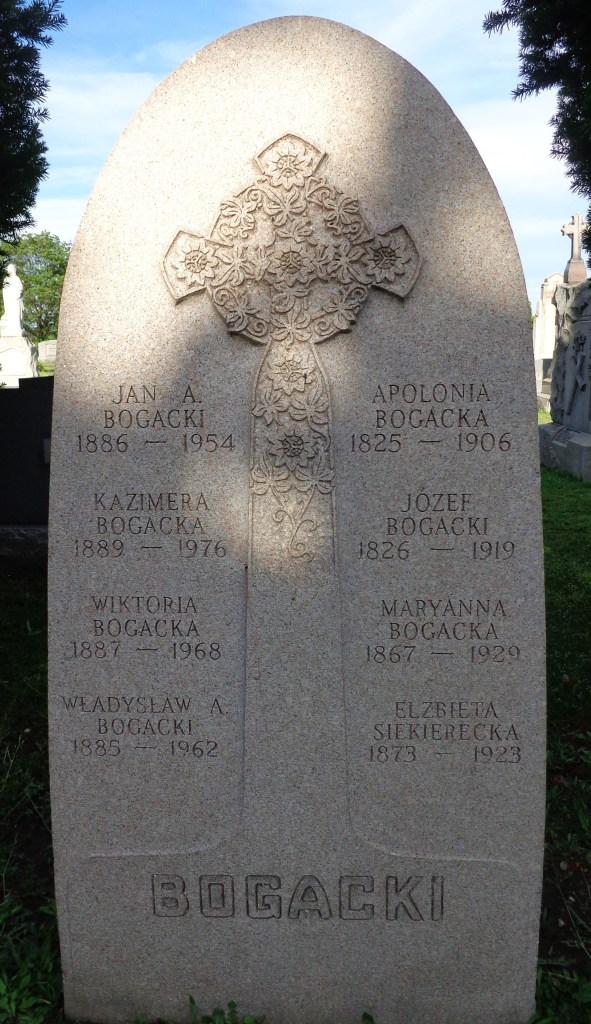
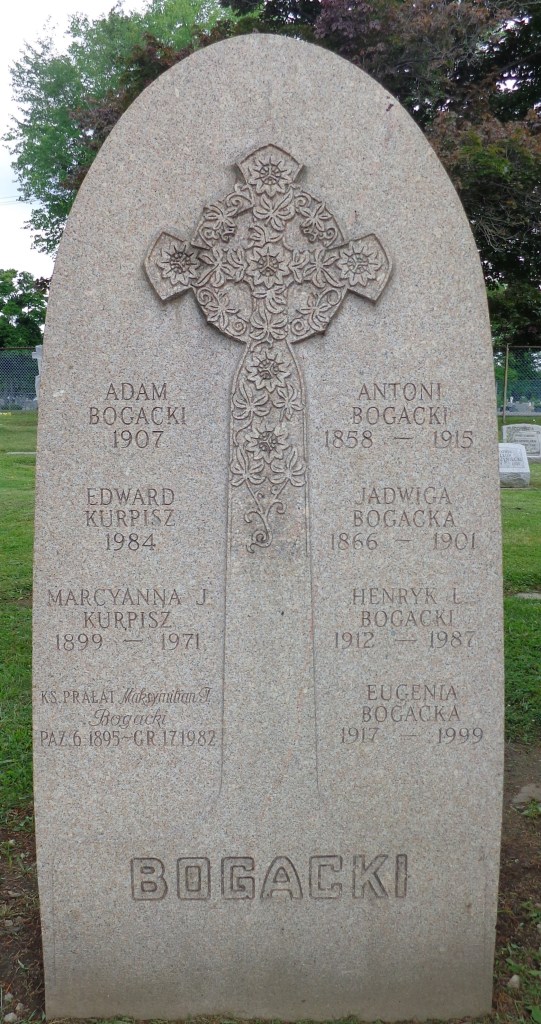
Figure 1: Front of the Bogacki monument in St. Stanislaus Cemetery, Cheektowaga, New York. Photo taken by the author, July 2014.
Figure 2: Back of the Bogacki monument in St. Stanislaus Cemetery, Cheektowaga, New York. Photo taken by the author, July 2014.

The individuals buried here are either descended from the patriarch and matriarch, Józef and Apollonia (Prusiecka) Bogacki, through their son, Antoni Bogacki, and his three wives, Anna Burczykowska (m. 1879), Jadwiga Tądrowska (m. 1892), and Jadwiga’s sister, Maryanna Tądrowska (m. 1901), or else they married into the family. Those who married into the family, in addition to Antoni’s two wives, Jadwiga and Maryanna, were Kazimiera (Pawlicka) Bogacka, who married Jan Bogacki; Wiktoria (Niewczyk) Bogacka, who married Władysław Bogacki; Eugenia (Michalska) Bogacka, who married Henryk Bogacki; and Edward Kurpisz, who married Marcyanna “Marion” (Bogacka) Kurpisz.

That leaves Elżbieta Siekierecka unaccounted for. Her burial in the Bogacki family plot suggests that she was a Bogacka somehow; was her maiden name Bogacka? Or was Siekierecka her maiden name, and she married a Bogacki, as suggested by her Find-a-Grave memorial? [1]

As it turns out, neither is true.

Elżbieta Siekierecka did not leave much trace in U.S. records. Her grave marker informs us that she was born in 1873 and died in 1923, and the New York State Death Index specifies her date and place of death as 1 February 1873 in Cheektowaga, New York.[2] She arrived in the the port of New York on 25 July 1921, so she resided in the U.S. for just 18 months prior to her death.[3]

Elżbieta arrived in the U.S. as a 42-year-old widow with two children, 11-year-old Marya and 9-year-old Antoni. Their ages suggest birth years of 1879, 1910, and 1912, respectively, which makes Elżbieta six years younger than what her grave marker suggests. Her passenger manifest identifies her as a farm laborer whose last permanent residence was “Pozen” (Poznań). Her nearest relative in the country from whence she came was her sister, Marcjanna Szule, who was living in “Staraleka Gub. Pozen.” This suggests the village of Starołęka Wielka, which is currently located in gmina Poznań, Poznań County, in the Wielkopolskie province of Poland. (“Gub.” here is an abbreviation for “gubernia,” which was an administrative division in the Russian Empire comparable to a province. Poznań was never under Russian control, so there was never a “Poznań gubernia.” Moreover, by 1921, Poland had regained its independence, so this village was located in the Poznań voivodeship of the Second Polish Republic.[4] Unfortunately, the clerk who prepared the manifest was apparently unaware of all that.)

Elżbieta was headed to Buffalo, New York, to her sister, “Marya Bogaeta,” living at 76 Rugby Avenue, which is actually Rugby Road on Buffalo’s north side. “Bogaeta” is pretty clearly a mistranscription of Bogacka, in light of present evidence, which would imply that Elżbieta was the sister of Marya (Tądrowska) Bogacka. Marya married Antoni in 1901, and he died in 1915, so she was his widow in 1921 when Elżbieta arrived in the U.S.[5]

Nonetheless, I had been expecting that Elżbieta would have been born a Bogacka, based on her burial in the Bogacki family plot, so my first thought was that the information on the passenger manifest was another example of a Polish immigrant employing a rather expansive definition of family relationships. In my research experience, Polish immigrants sometimes exaggerated the closeness of their relationships to their American contacts, referring to them as “in-laws,” “cousins,” or even “brothers” and “sisters” when there was no evidence for those relationships in historical records. Based on my experience, if Elżbieta were Antoni’s sister, it would not be unusual for her to identify Marya (Tądrowska) Bogacka as her sister, rather than her sister-in-law—especially since Antoni Bogacki was already deceased.

This was my working hypothesis when last I left off with my Bogacki research a few years ago. However, in recent weeks I’ve circled back to it, looking at the data with fresh eyes. That’s when I realized that Elżbieta Siekierecka wasn’t born a Bogacki at all, nor did she marry one: she really was the full sister of Marya (Tądrowska) Bogacka.

What tipped me off was her place of birth, recorded on the second page of her passenger manifest as “Kostrzynie.” Marriage records for Antoni Bogacki and Jadwiga and Marya Tądrowska identify the Tądrowskis’ birthplace as “Kostrzyn, Boruss[ia],” i.e. Kostrzyn, Prussia, as do baptismal records for five of Jadwiga’s children.[6] Jadwiga’s death record similarly identifies her birthplace as “Kostrzyn, Pos[e]n.”[7] The baptismal record for her youngest son, Zygfryd, identifies Jadwiga’s birthplace as “Kościerzyna, Boruss[ia],” which is a different place in Poland, but the body of evidence points to Kostrzyn as being the correct place of origin for the Tądrowski family.[8] The variant spelling recorded on the passenger manifest, “Kostrzynie,” reflects the grammatical declension inherent to the Polish langauge: to say, “I was born in Kostrzyn” in Polish, I would say, “Urodziłam się w Kostrzynie.” A similar conversation probably took place when the passenger manifest was recorded.

In order to prove that Elżbieta Siekierecka was a Tądrowska, I needed to find some evidence of her parentage. Her church burial record or death certificate would likely identify her parents, but a quick search in the PGSNYS databases was negative; she may have been buried from a church which is not indexed. For $11.00, I could request her death certificate from the Town of Cheektowaga (where she died), but why spend money unnecessarily? Her baptismal record or marriage record from Kostrzyn might be easier to find at FamilySearch.

A search for Kostrzyn in the FamilySearch catalog reveals that collections of both Roman Catholic church records and civil vital registrations are available. Unfortunately, image viewing is restricted to a FamilySearch Center or Affiliate Library, so I can’t access these from home. However, the catalog entry also notes that records from Kostrzyn have been indexed, and are included in the database, “Germany, Prussia, Posen, Catholic and Lutheran Church Records, 1430-1998.

Searching this collection requires a bit of patience and persistence, and sometimes a sense of humor. It seems that many of the volunteer indexers who helped to create this database had little to no familiarity with Polish given names, surnames, and Polish diacritics, or perhaps the entire index was AI-generated. I’ve noticed this same problem with other FamilySearch databases, such as, “Poland, Tarnow, Roman Catholic Diocese Church Books, 1612-1900.” These databases are rife with transcription errors, such as “t” for “ł,” “y” for “ą,” etc. Sometimes, it’s possible to guess what the name should have been based on the transcription. For example, the surname “Koztdwska” makes no sense in Polish, but it’s clearly Kozłowska in the original record. Similarly, “Riotrowski” should be Piotrowski, “Kapusienslia” is Kapuścińska, and the absurd “McHael” is Michael. Unfortunately, FamilySearch doesn’t offer an option to submit a correction to transcriptions in their database like Geneteka does, so these errors are likely to persist. Nonetheless, indexed records with errors are better than no indexed records at all, and wildcards can be used to advantage, even when the surnames were butchered by transcribers or are genuinely difficult to read in the original record.

In this case, we’re in luck, because Jadwiga’s and Marya’s marriage records identify their parents as Wawrzyn Tondrowski/Tądrowski and Salomea Luberska, and this combination of given names is uncommon. And to its credit, FamilySearch‘s search algorithm recognizes that the Polish names Wawrzyn or Wawrzyniec are equivalent to the Latin name Laurentius, so it doesn’t matter which version of the name we use for our search.[9] A search for surname “*drowski” with father’s name Wawrzyn and mother’s name Salomea produces 11 baptismal records for children of this couple—including the three buried in the Bogacki family plot, Hedvigis “Tadrowski,” Elisabeth “Tydrowski,” and Marianna “Igdrowski” (Figure 3). All of them were baptized in Kostrzyn, just as expected, although the dates are off a bit from those reported on the Bogacki monument. Jadwiga/Hedwig Tądrowska was born 11 October 1863 (not 1866), Maria/Marya/Marianna (indexed as Igdrowski) was born 19 November 1865 (not 1867), and Elżbieta/Elisabeth (indexed as Tydrowski) was born 18 November 1872 (not 1873). [10]

Figure 3: Result of search for surname “*drowski,” father’s name “Wawrzyn,” and mother’s name “Salomea” in the FamilySearch database, “Deutschland, Preußen, Posen, Katholische und Lutherisch Kirchenbücher, 1430-1998.” Click image to enlarge.

Geneteka, being a Polish website, usually does a better job with transcribing Polish surnames and given names. As it happens, birth records from Kostrzyn are also indexed there, from 1820–1875, so all eleven of these Tądrowski/Tondrowski birth records should be included. Weirdly, a search for surname “T*” with given names Wawrzyn and Salomea only produced four of them (Figure 4).

Figure 4: Search result for births in Kostrzyn with surname T* and given names Wawrzyn and Salomea. Click image to enlarge.

It’s not clear to me why the other seven birth records aren’t found in this search. Maybe Geneteka is just being glitchy and temperamental, but this underscores the importance of checking more than one database, when available, and always consulting the original records before concluding that a particular event did not happen in a particular location.

We should be able to find Elżbieta’s marriage record to (_____) Siekierecki, and birth records for their children identified on the passenger manifest, Marianna and Antoni, as well as (_____) Siekierecki’s death record, for further confirmation that our conclusions thus far are sound.

A search for surname “Siekierecki” with mother’s name Elisabeth produces the children’s birth records (Figure 5).

Figure 5: Result of search for surname “Siekierecki” and mother’s name “Elisabeth” in the FamilySearch database, “Deutschland, Preußen, Posen, Katholische und Lutherisch Kirchenbücher, 1430-1998.” Click image to enlarge.

These records indicate that Marianna and Antoni Siekierecki were born 26 May 1910 and 30 April 1912, respectively, in “Provinz Posen, Preußen,” and but they don’t tell us where in “Provinz Posen” these births were recorded, nor is it possible to locate a handy coverage table like this one provided for the “Poland, Tarnow Roman Catholic Diocese Church Books” collection. [11] Presumably, this information is available when one views the images at a FamilySearch Center or Affiliate Library. Elżbieta’s husband is also identified as Vincentius (Wincenty) Siekierecki. A little more digging produces a death record for a third child of this couple, an unnamed son who died 10 February 1906. [12]

No amount of digging and creative wildcard searching turn up either a marriage record for Elżbieta and Wincenty Siekierecki, or Wincenty’s death record. This result is explained by the catalog entry for Kostrzyn; the magnifying glass icon next to specific collections indicates that Roman Catholic church marriage records were indexed from 1776–1878 with no apparent gaps, and that death records were indexed from 1776–1915 with no gaps after 1820. Since Elżbieta Tądrowska was born in 1873, her marriage took place well after the end of the indexed records, and Wincenty must have died after 1915. All is not lost, however. The Poznań area has good coverage in indexed databases; in addition to this indexed collection at FamilySearch, we can also try Geneteka, the Poznań Project, and BaSIA.

Geneteka has Kostrzyn marriage records indexed from 1818–1899, and Kostrzyn death records indexed up to 1912, so it’s unlikely that we’ll find Wincenty’s death, although we might possibly find his marriage to Elżbieta. However, a search for Wincenty Siekierecki is negative, even when the search is expanded to include all indexed parishes within 15 km of Kostrzyn, suggesting that the marriage took place in 1900 or later. The stated focus of the Poznań Project is on 19th-century marriages, and in keeping with that, they only have Catholic and civil marriage records for Kostrzyn indexed up to 1899. So, it’s unsurprising that a search here for Wincenty and Elżbieta’s marriage record is negative, confirming the Geneteka search result. We hit pay dirt at BaSIA, however. An “extended search” for Wincenty Siekierecki (as opposed to the basic search, which only allows entry of a surname) produces results in four geographic areas, including Kostrzyn-Poznań-Czerniejewo-Swarzęndz (Figure 6).
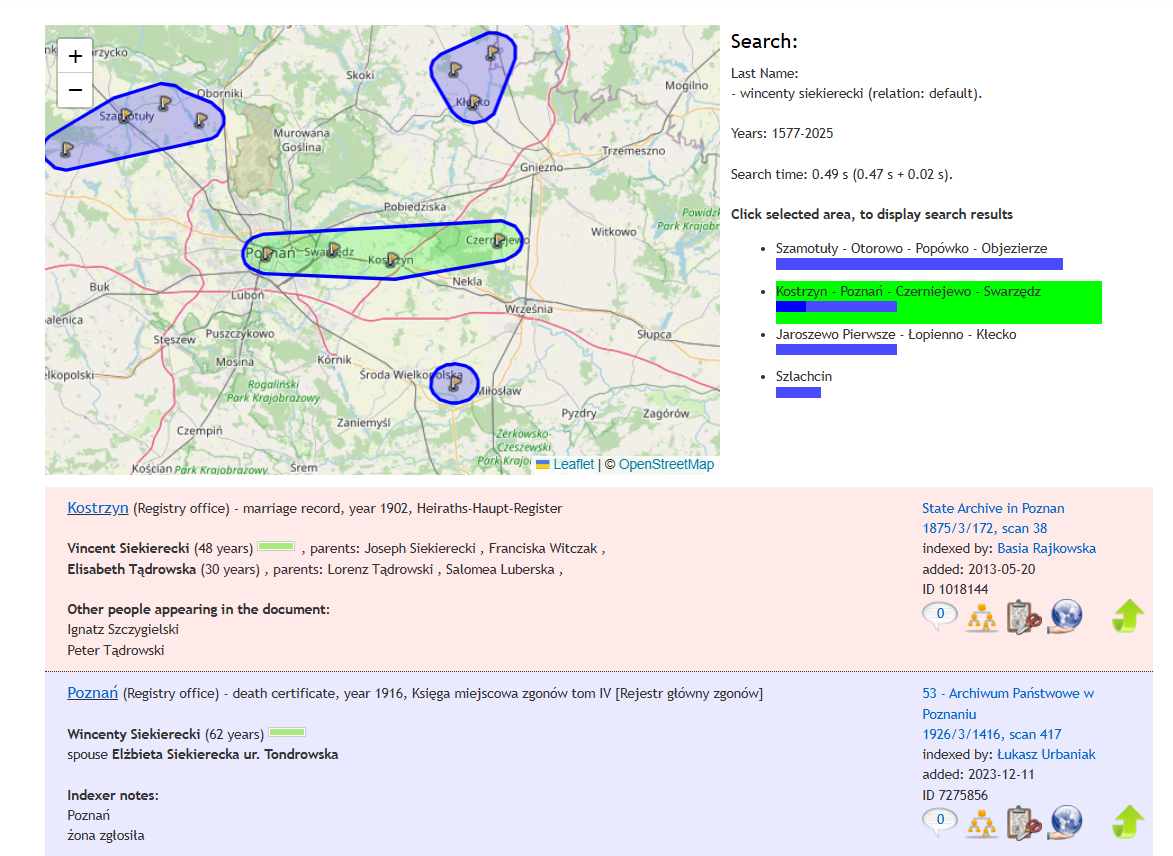
Figure 6: Result of search at BaSIA for Wincenty Siekierecki in the Kostrzyn-Poznań-Czerniejewo-Swarzędz geographic cluster. Click image to enlarge.

Results for the Kostrzyn-Poznań-Czerniejewo-Swarzędz cluster include Wincenty’s marriage record and his death record. Consistent with our expectations based on database searches thus far, Wincenty and Elżbieta were married in Kostrzyn on 30 April 1902, and Wincenty died on 12 November 1916 in Poznań. The marriage and death search results are both linked to digital images of those records from the State Archive in Poznań.[13] (Note that the marriage record covers two pages; the second page is here.) The marriage record identifies Wincenty Siekierecki as a butcher, born 14 December 1854 in Kozakowa (?), son of the deceased master saddler Joseph Siekierecki and his deceased wife Franciszka née Witczak, both last living in Kostrzyn. Elżbieta’s parents’ names and birth date agree with those reported in the indexed record of her baptism. Her father was described as a deceased master cooper, while her mother was still alive and residing in Kostrzyn.

So there we have it. Contrary to what burial in the Bogacki family plot might suggest, Elżbieta Siekierecka was not a Bogacka, nor was she married to one. Her connection to the family was tangential, through her sisters, Marya and Jadwiga (Tądrowska) Bogacki, who were two of the wives of Antoni Bogacki. Those researching the Tądrowski family will find ample material in indexed records from Poland. Happy hunting!

Sources:

[1] Find a Grave, database and images (https://www.findagrave.com/memorial/114761395/elzbieta-bogacka : accessed February 20, 2025), memorial page for Elżbieta Siekierecka Bogacka (1873–1923), Find a Grave Memorial ID 114761395, citing Saint Stanislaus Roman Catholic Cemetery, Cheektowaga, Erie County, New York, USA; Maintained by gravefinderStStans (contributor 47637865).

[2] “New York, U.S., Death Index, 18521956,” database, Ancestry (https://www.ancestry.com/search/collections/61535/records/2626650 : accessed 20 February 2025), Elzbieta Siekierecka, 1 February 1923, Cheektowaga, New York, certificate no. 12148.

[3] Manifest, SS Potomac, departed Danzig 9 July 1921, arrived New York 25 July 1921, list 5, lines 18-20, Elzbieta, Siekierecka family; imaged as “New York, U.S., Arriving Passenger and Crew Lists (including Castle Garden and Ellis Island), 1820-1957,” Ancestry (https://www.ancestry.com/search/collections/7488/records/4028539363 : accessed 20 February 2025); National Archives Microfilm T715, RG 85, “Records of the Immigration and Naturalization Service, 1787-2004.”

[4] Tadeusz Bystrzycki, Skorowidz miejscowości Rzeczypospolitej Polskiej z oznaczeniem terytorjalnie im właściwych władz i urzędów oraz urządzeń komunikacyjnych [Index of Placenames of the Republic of Poland with corresponding governmental agencies and offices, including communication facilities], (Przemyśl and Warszawa: Wydawnictwo Książnicy Naukowej, 1933?), p. 1610, “Starołęka Wielka, wieś i. folw;” digital image, Wielkopolska Biblioteka Cyfrowa [Wielkopolska Digital Library], (https://www.wbc.poznan.pl/dlibra/publication/7126/edition/12786/content : accessed 20 February 2025).

[5] Roman Catholic Church of St. Stanislaus, Bishop & Martyr (Buffalo, Erie, New York, USA), Marriages, Vol. II (1891-1931), p. 10, no. 33, Bogacki-Tądrowska, 2 February 1892; digital image, FamilySearch (https://www.familysearch.org/ark:/61903/3:1:3Q9M-CS4N-64SR-K?cat=23415&i=1416&lang=en : accessed 20 February 2025); and

Roman Catholic Church of the Transfiguration (Buffalo, New York), Deaths, Vol. III (1910-1917), p. 33, no. 16, Antonius Bogacki, 22 February 1915; digital image, FamilySearch (https://www.familysearch.org/ark:/61903/3:1:3Q9M-CS45-1K7V?cat=23193&i=657&lang=en : accessed 22 February 2025).

[6] Bogacki-Tądrowski, 2 February 1892; and

Roman Catholic Church of St. Stanislaus, Bishop & Martyr (Buffalo, Erie, New York, USA), Marriages, Vol. II (1891-1931), p. 65, 1901, no. 35, Bogacki-Tondrowska, 4 June 1901; digital image, FamilySearch (https://www.familysearch.org/ark:/61903/3:1:3Q9M-CS4N-64QV-V?lang=en&i=1471 : accessed 20 February 2025); and

Ibid., Baptisms, Vol. III (1890-1895), p. 358, 1893, no. 506, Piotr Paweł Bogacki, born 4 June 1893; digital image, FamilySearch (https://www.familysearch.org/ark:/61903/3:1:3Q9M-CS4N-6473-X?cat=23415&i=825&lang=en : accessed 20 February 2025); and

Ibid., p. 482, 1894, no. 426, Leon Bogacki; digital image, FamilySearch (https://www.familysearch.org/ark:/61903/3:1:3Q9M-CS4N-643Z-T?cat=23415&i=888&lang=en : accessed 20 February 2025); and

Ibid., p. 634, 1895, no. 699, Max Bogacki, born 6 October 1895; digital image, FamilySearch (https://www.familysearch.org/ark:/61903/3:1:3Q9M-CS4N-647Z-H?cat=23415&i=965&lang=en : accessed 18 February 2025); and

Ibid., Baptisms, Vol. IV (1895-1903), p. 210, 1897, no. 747, Józef Bogacki, born 27 November 1897; digital image, FamilySearch (https://www.familysearch.org/ark:/61903/3:1:3Q9M-CS4N-643Y-L?cat=23415&i=1080&lang=en : accessed 20 February 2025); and

Ibid., p. 310, 1899, no. 18, record for Marcyanna Bogacka, born 10 January 1899; digital image, FamilySearch (https://www.familysearch.org/ark:/61903/3:1:3Q9M-CS4N-643R-Z?cat=23415&i=1132&lang=en; : accessed 20 February 2025).

[7] Ibid., Burials, Vol. III (1895-1927), p. 156, 1901, no. 36, Jadwiga Bogacka; 5 March 1901; digital image, FamilySearch (https://www.familysearch.org/ark:/61903/3:1:3Q9M-CS4G-M44D-G?cat=23415&i=112&lang=en : accessed 20 February 2025).

[8] Ibid., Baptisms, Vol. IV (1895-1903), p. 458, 1901, no. 115, Zygfryd Bogacki, born 25 February 1901; digital image, FamilySearch ( https://www.familysearch.org/ark:/61903/3:1:3Q9M-CS4N-649D-5?cat=23415&i=1209&lang=en : accessed 20 February 2025).

[9] Wikipedia (PL), “Wawrzyniec,” (https://pl.wikipedia.org/wiki/Wawrzyniec : accessed 21 February 2025; page last edited 10 August 2024 at 13:00).

[10] “Deutschland, Preußen, Posen, Katholische und Lutherisch Kirchenbücher, 1430-1998,” database, FamilySearch (https://www.familysearch.org/ark:/61903/1:1:6FZC-MC5D?lang=en : accessed 21 February 2025), Hedvigis Tadrowski, born 11 October 1863; and

Ibid., FamilySearch (https://www.familysearch.org/ark:/61903/1:1:6FZC-H89B?lang=en : accessed 21 February 2025), Marianna Igdrowski, born 19 November 1865; and

Ibid., FamilySearch (https://www.familysearch.org/ark:/61903/1:1:6FZH-81HC?lang=en : accessed 21 February 2025), Elisabeth Tydrowski, born 18 November 1872.

[11] Ibid., FamilySearch (https://www.familysearch.org/ark:/61903/1:1:6FCV-ZLHB?lang=en : accessed 21 February 2025), Marianna Siekierecka, born 24 May 1910; and

Ibid., FamilySearch (https://www.familysearch.org/ark:/61903/1:1:6FCV-SHZQ?lang=en : accessed 21 February 2025), Antonius Siekierecki, born 26 April 1912.

[12] “Deutschland, Preußen, Posen, Katholische und Lutherisch Kirchenbücher, 1430-1998,” database, FamilySearch (https://www.familysearch.org/ark:/61903/1:1:6FC2-KH55?lang=en. : accessed 21 February 2025), (_) Siekierecki, died 10 February 1906.

[13] Urzad Stanu Cywilnego Kostrzyn (pow. sredzki), [Civil registry office of Kostrzyn, Środa County] (Kostrzyn, Środa, Wielkopolskie, Poland), Heiraths-Haupt-Register [Marriage register], 1902, pp. 36-37, no. 18, Siekierecki-Tadrowska; married 15 April 1902; Archiwum Państwowe w Poznaniu [State Archive in Poznań], Sygnatura 53/1875/0/2/172; digital image, Szukaj w Archiwach (https://www.szukajwarchiwach.gov.pl/en/jednostka/-/jednostka/1401374 : accessed 22 February 2025), scans 38 and 39; and

Urząd Stanu Cywilnego Poznań – obwód miejski, Księga miejscowa zgonów tom IV [Rejestr główny zgonów] [Main Death Register, Vol. IV], 1916, no. 2086, Vincent Siekierecki, died 12? November 1916; Archiwum Państwowe w Poznaniu [State Archive in Poznań], Sygnatura 53/1926/0/3/1416; digital image, Szukaj w Archiwach (https://www.szukajwarchiwach.gov.pl/en/jednostka/-/jednostka/23804447 : accessed 22 February 2025), image 217 of 564.

Many thanks to Jody Tzucker, Anne Callanan, Georg Patrzek, and Monika Deimann-Clemens of the Genealogical Translations group on Facebook for their German translation assistance.

© Julie Roberts Szczepankiewicz, 2025

The Bogacki Family Monument

Józef Bogacki (c. 1826–1919) and Apolonia (Prusiecka) Bogacka (c. 1822–1906) were some of my husband’s great-great-great-grandparents. They were Polish immigrants from the Prussian partition of Poland who settled in Buffalo, New York, along with some of their children, who were known to include Teka (Bogacka) Wolińska (1860–1906), and Antoni Bogacki (c. 1858–1915).

Although Tekla (Bogacka) Wolińska and her husband, Józef, are buried in a different location in the cemetery, there is a large monument for other members of the Bogacki family in St. Stanislaus Cemetery in Cheektowaga, New York (Figures 1 and 2).

Figure 1: Front of the Bogacki monument in St. Stanislaus Cemetery, Cheektowaga, New York. Photo taken by the author, July 2014.
Figure 2: Back of the Bogacki monument in St. Stanislaus Cemetery, Cheektowaga, New York. Photo taken by the author, July 2014.

Of course, having so many names on a monument just begs their placement into a family tree.

Judging from the dates on the marker alone, Józef Bogacki and Apolonia Bogacka, born in 1826 and 1825, respectively, are the earliest generation shown. Maryanna Bogacka (b. 1867), Antoni Bogacki (b. 1858), Jadwiga Bogacka (b. 1866), and Elżbieta Siekierecka (b. 1873) comprise the next generation of the family, but we need additional evidence to establish their relationships.

Indexed records from the PGSNYS databases provide a quick-and-dirty clarification (Figure 3).

Figure 3: Search results from the PGSNYS databases for surname “Bogack” and given name “Ant” which reveal two marriage records. Click image to enlarge.

These results include two marriage records (marked in red) from St. Stanislaus for Antoni Bogacki, one to Jadwiga Tądrowska in 1892and the other to Marya Tondrowska in 1901.[1] The “Page” column provides the specific volume, page, and record number for locating the results in the the original church books. Since marriage records from St. Stanislaus are imaged at FamilySearch from 1874–1917, both of these records are readily available.

The marriage records identify Antoni’s parents are Josef Bogacki and Apollonia Prusiecka. Although the maiden names of Antoni’s brides are spelled somewhat differently, Tądrowska and Tondrowska are phonetically similar in Polish. The fact that his wives had the same maiden name suggests that they might have been sisters. A second search in the database collection for “Jadwiga Tadrowska” and “Marya Tondrowska,” confirms this suspicion; both were daughters of Wawrzyn (Lawrence) Tądrowski/Tondrowski and Salomea Luberska.

The search shown in Figure 3 for Antoni Bogacki also confirms that he died in 1915 at the age of 57, which suggests a birth in 1858, and these dates match those on the grave marker (Figure 4).

Figure 4: Search results from the PGSNYS database collection for surname “Bogack” and given name “Ant” which reveal his death record. Click image to enlarge.

Antoni Bogacki was buried from Transfiguration parish in Buffalo, and those images, too, are online at FamilySearch.[2] Church records from ethnic Polish parishes like St. Stanislaus and Transfiguration can be a wonderful source for evidence of place of origin, and in this regard, Antoni’s death record and marriage records do not disappoint. His death record reveals that he was born in “Chelmno, Pruss. Zach.,” while both the marriage records state “Chełmno, Boruss.” Borussia is the Latin name for Prussia, and Prusy Zachodnie is the Polish name for West Prussia, so all the documents point to the same location, the town of Chełmno which is presently located in the Kujawsko-Pomorskie province of Poland.

So far we’ve identified the parents, Józef and Apollonia, and three of the four individuals in the Bogacki “children” generation, Antoni and his wives, Jadwiga and Maria (Tądrowska) Bogacki. Elżbieta Siekierecka remains to be placed on the tree, but hers is an interested story, so we’ll come back to her.

Moving on now to the “grandchildren” generation, based on birth years recorded on the monument, we have Jan Bogacki (born 1886), Kazimiera Bogacka (born 1889), Wiktoria Bogacka (born 1887), Władysław Bogacki (born 1885), Marcyanna J. Kurpisz (born 1899) and a priest, Ks. Prałat [ksiądz prałat] Maksymilian T. Bogacki, whose dates of birth and death are specified as Paź. 6 [Październik, October]1895 and Gr. 17 [Grudzień, December] 1982. A search for Jan Bogacki in the PGSNYS databases produces a number of useful records, including his death notice, which was published in the Polish newspaper, Dziennik dla Wszystkich, on 1 May 1954, as well as the record of his marriage at St. John Kanty on 3 June 1908 to Kazimiera Pawlicka.[3] Another piece falls into place; Kazimiera is certainly the Kazimiera Bogacka who was buried in the Bogacki family plot. The databases additionally contain Jan’s baptismal record from St. Stanislaus parish in 1886.[4] The marriage record and the baptismal record both identify Jan’s parents as Antoni Bogacki and Anna Burczykowska and the baptismal record reiterates Antoni’s place of birth as Chełmno, Boruss[ia].

So, Anna Burczykowska was Antoni’s first wife, although she was not buried in the same plot with Antoni and his subsequent wives. A search for her grave at Find-a-Grave is negative, but PGSNYS member, Barbara Ruppert, has Anna Bogacka’s grave indexed at her Grave Finder at St. Stan’s website, which should always be checked when searching for final resting places of Buffalo’s Polonia.[5] Anna’s death record, indexed in the PGSNYS database, reveals that she died 5 December 1891 and was buried 7 December 1891, consistent with the burial date indexed at the Grave Finder website.[6] The death record also states that Anna was born in Chełmno, adding to the growing body of evidence for the Bogacki family’s origins.

Getting back now to the folks whose names were recorded on that monument, we’ve pretty well confirmed the relationship between Kazimiera and Jan Bogacki—she was his wife. However, it would be nice to find some additional evidence of her birth and death dates. Her newspaper death notice is useful here (Figure 5).[7] Not only does it confirm her date of death (which agrees with the date on the grave marker), it also confirms her husband’s name and the names of her children. But wait, there’s more: two of those names match with as-yet-unidentified names on the grave marker, Henryk/Henry and Eugenia Bogacki.

Figure 5: Death notice from The Buffalo News (Buffalo, New York) for Kazimiera (Pawlicka) Bogacka.

A match for Kazimiera Bogacka in the Social Security Death Index (SSDI) with a date of death of July 1976, reports her date of birth as 23 October 1887.[8] This is off a bit from the date reported on her grave marker, 1889, but that kind of discrepancy is not unusual for individuals born in this era. Since Kazimiera’s marriage record indicated that she was born in Poland, we would need to locate her birth record in order to know definitively which birth date is correct, but that’s another question for another day.

Although the English equivalent of the name Kazimiera is Casimira, fellow Bogacki researchers should be aware that Kazimiera also used the name Catherine or Katherine.[9] It was not unusual for early 20th century Polish Americans to adopt an “American” name that differed from the etymological equivalent of that person’s Polish given name. If you compare Kazimiera/Catherine’s death notice shown in Figure 5 with the death notice of her husband, John Bogacki, published in The Buffalo News on 1 May 1954, you see that the names of the children are the same, although the couple’s oldest son, Charles, was recorded as “Carol” in his father’s death notice.[10] This, again, is due to a variant translation of the Polish name Karol (Charles).[11] If any doubt remains about these conclusions, consider John Bogacki’s obituary, published in the Cheektowaga Times, which identifies his wife as Kazimiera (née Pawlicki) rather than Katherine, and their oldest son as Charles J. Bogacki, rather than Carol.[12]

Since this research into Jan and Kazimiera Bogacki provided some preliminary information on Henry and Eugenia Bogacki, we may as well look them up in the SSDI and locate their newspaper death notices to confirm birth and death dates. Henry’s death notice reports his date of death as 4 March 1987, and the SSDI provides his date of birth, 8 November 1912.[13] Henry’s death notice also gives us Eugenia’s maiden name, Michalski, which is confirmed in Eugenia’s obituary, as well as in the Social Security Applications and Claims Index, which goes beyond the SSDI to provide her parents’ names, John Michalski and Victoria Ledzynska, in addition to her dates of birth (27 June 1917) and death (8 March 1999).[14] Since Henry and Eugenia lived so recently, it’s unsurprising that their birth and death dates agree perfectly with those reported on the Bogacki family monument.

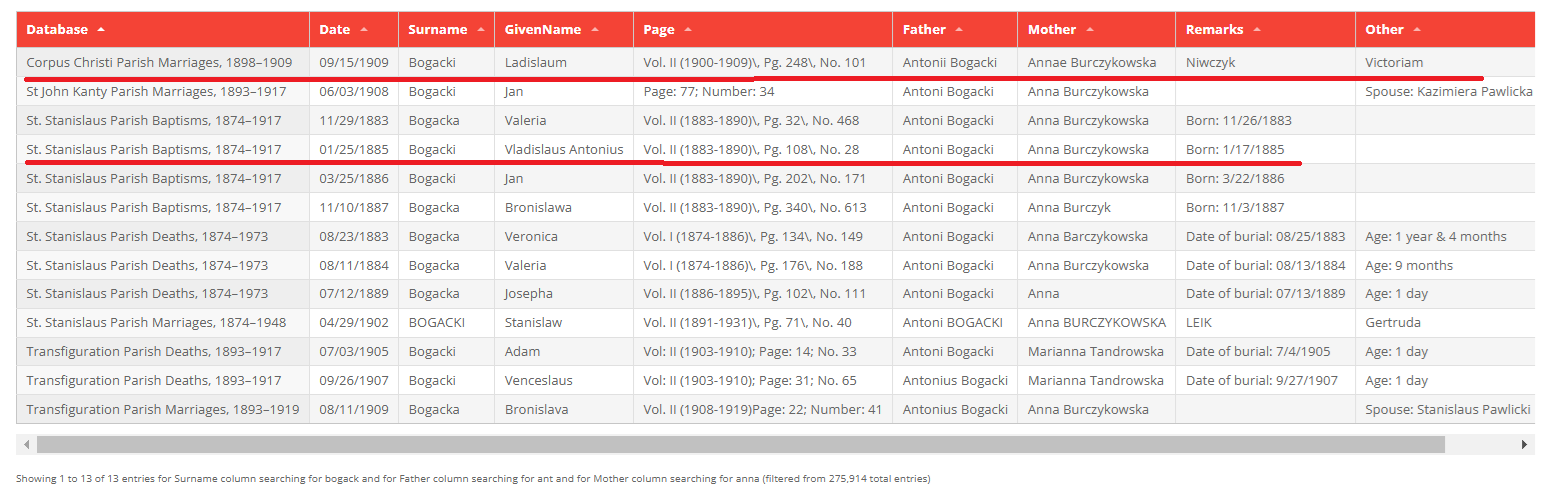
After this brief foray into the “great-grandchildren” generation, let’s move back now to placing the remaining “grandchildren” on the tree, Wiktoria Bogacka (born 1887), Władysław Bogacki (born 1885), Marcyanna J. Kurpisz (born 1899) and Rev. Maksymilian T. Bogacki (born 1895). Another search in the PGSNYS databases for surname “Bogack” with father’s name “Ant” and mother’s name “Anna” produces a slew of baptism, marriage, and death records (Figure 6) for children of Antoni Bogacki and Anna Burczykowska, as well as a couple death records for children of Antoni Bogacki and Marianna Tądrowska (Figure 6).

Figure 6: Search results from the PGSNYS databases for surname “Bogack” with father’s name “Ant” and mother’s name “Anna.” Click image to enlarge.

Underlined results include a baptismal record for Vladislaus Antonius Bogacki, who was born 17 January 1885 and baptized at St. Stanislaus, as well as the record of his marriage to Victoria Niwczyk [sic] at Corpus Christi parish. The baptismal record is available online at FamilySearch, and a digital image of the marriage record is available upon request from PGSNYS.[15] They look like a promising match for the Władysław and Wiktoria on the Bogacki monument. We can repeat our strategy of confirming death dates using the SSDI and newspaper death notices, assuming that Władysław probably adopted the name Walter in later years. Lo, and behold, a search for Walter Bogacki at Newspapers produces his death notice, which confirms his date of death and wife’s name, and the SSDI provides additional confirmation of birth and death dates.[16]

As it turns out, there’s no good match for Wiktoria (Niewczyk) Bogacki in the SSDI, which is not unusual for women in this era. Since her marriage record indicated that she was born in Posen, I’ll bet I can find her birth record in BaSIA, which is a vital records database which focuses on the Wielkopolskie province of Poland, where Poznań is located. In the interest of staying focused, however, I’ll defer that question for another day and get back to the problem of untangling the relationships between members of the Bogacki family identified on their grave monument.

There’s a good match for Marcyanna J. Kurpisz in the PGSNYS databases as Marcyanna Bogacka, daughter of Antoni Bogacki and his second wife, Jadwiga Tądrowska. The PGSNYS index points us to her baptismal record from St. Stanislaus, which confirms her date of birth as 10 January 1899.[17] Her death notice confirms that she died 4 May 1971, and identifies her as Marion H. Kurpisz, rather than Marcyanna J.[18] The different middle initials are easily accounted for if we suppose that her middle name might have been Jadwiga, after her mother; the English version of Jadwiga is Hedwig. The name Marcyanna is a variant spelling of Marcjanna or Marciana, which is the female form of Marcjan, which in turn derives from the Latin name Martianus/Martiana.[19] Etymologically, the name is not equivalent to Marianna (Polish), Marian, or Marion (English); “Martina” would have been closer to the original. However, as we saw previously with Kazimiera/Catherine Bogacka, there were no rules which required Polish Americans to adopt names that were etymologically equivalent to their original names. In fact, until the advent of Social Security, no one was even keeping track, so you might see early 20th century Polish Americans trying out a few different names until they settled upon one they liked.

Marion Kurpisz’s death notice also informs us that her husband was Edward J. Kurpisz, who is undoubtedly the Edward Kurpisz on the grave marker. Edward’s death notice provides his date of death, 9 March 1984, but doesn’t tell us how old he was when he died.[20] The record of his marriage to Marion saves the day, however, providing his precise date of birth, 14 March 1899, and parents’ names, Konstanty Kurpisz and Teodora Wdowicka.[21]

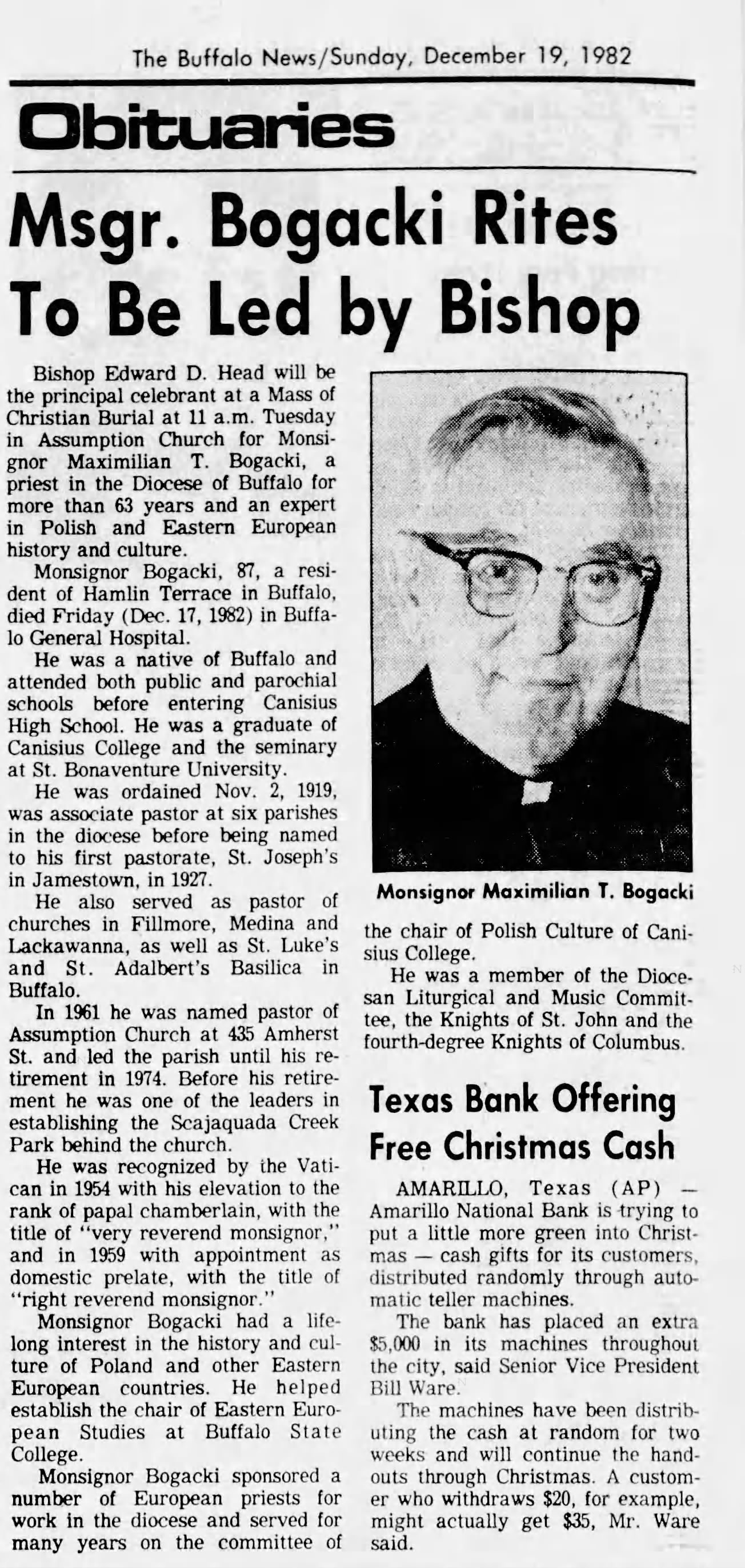
A number of records discovered thus far have mentioned the Right Reverend Monsignor Maksymilian T. Bogacki. He was the priest who performed the marriage for his sister, Marion, and he was also one of the officiants at her funeral Mass. Msgr. Bogacki was born on 6 October 1895 to Antoni Bogacki and his second wife, the former Jadwiga Tądrowska. He was baptized at St. Stanislaus, and a very nice obituary was published in The Buffalo News on 19 December 1982 (Figure 7).[22]

Figure 7: Obituary from The Buffalo News for Msgr. Maximilian T. Bogacki. Click image to enlarge.

At this point, we’ve established relationships between everyone on the Bogacki family monument except for Adam Bogacki and Elżbieta Siekierecka. Elżbieta will be the subject of a future post, but Adam is a bit of a mystery. The grave marker gives only one date for him, 1907, which is probably his death date. However, there are no good matches in broad searches of indexed historical records for an Adam Bogacki who died in Buffalo in 1907. Rather, I suspect that the grave marker may be in error, and the error may stem from conflating two different children of Antoni Bogacki and his third wife, Maria Tądrowska.

A search in the PGSNYS databases for surname “Bogack,” father’s name “Ant” and mother’s name “Mar” produces the two death records shown in Figure 8, from Transfiguration parish.

Figure 8: Death records from Transfiguration parish for Adam and Venceslaus Bogacki. Click image to enlarge.

This search result reveals that Adam Bogacki was born to Antoni Bogacki and Maria Tądrowska on 2 July 1905, and he and died the next day. His death record is available here.[23] Similarly, Antoni and Maria lost another son, Venceslaus (Wacław in Polish) Bogacki, whose death record states that he was born 26 September 1907 and died one day later.[24] Cemetery records may help determine whether it’s Adam Bogacki who was buried in the family plot, and the grave marker incorrectly identifies his year of death (more likely), or whether it’s Wacław, and the grave marker incorrectly identifies his name. By the way, if you’re wondering where their baptismal records are, it may well be that Adam’s and Venceslaus’s baptisms were recorded at Transfiguration. However, baptismal records are only available for this parish up through 1903.

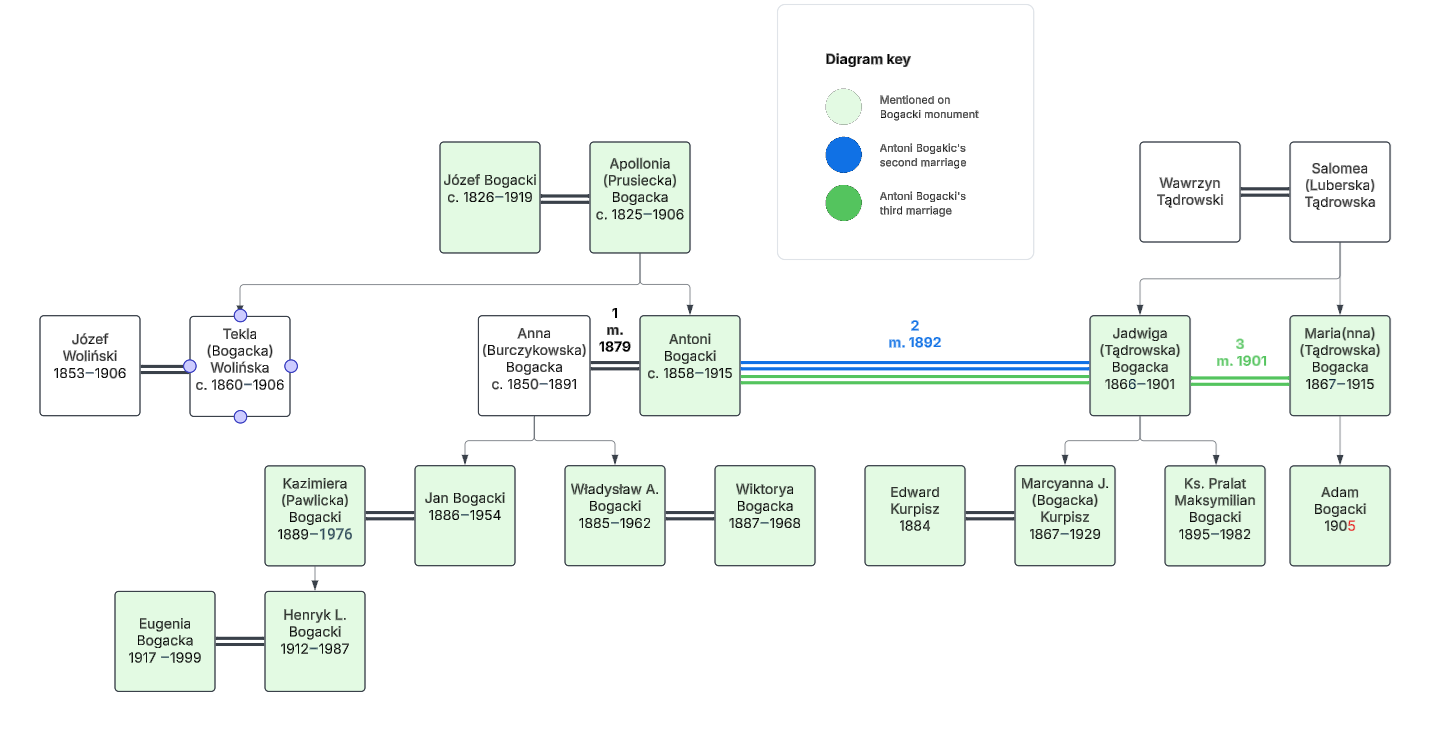
To sum it all up, then, Figure 9 depicts a partial family tree for the Bogacki family, focusing on those members who are buried in the family plot at St. Stanislaus Cemetery. Stay tuned for the story of Elżbieta Siekierecka: Was she a Bogacka?

Figure 9: Partial family tree for the Bogacki family of Buffalo, New York, focusing on those members who are buried in the family plot at St. Stanislaus Cemetery (Figures 1 and 2). Click image to enlarge.

Sources:

[1] Roman Catholic Church of St. Stanislaus, Bishop & Martyr (Buffalo, Erie, New York, USA), Marriages, Vol. II (1891–1931), p. 10, no. 33, Bogacki – Tądrowska, 2 February 1892; digital image, FamilySearch (https://www.familysearch.org/ark:/61903/3:1:3Q9M-CS4N-64SR-K?cat=23415&i=1416&lang=en : accessed 18 February 2025); and

Ibid., p. 65, 1901, no. 35, Bogacki-Tondrowska, 4 June 1901; digital image, FamilySearch (https://www.familysearch.org/ark:/61903/3:1:3Q9M-CS4N-64QV-V?lang=en&i=1471 : accessed 18 February 2025).

[2] Roman Catholic Church of the Transfiguration (Buffalo, New York), Deaths, Vol. III (1910–1917), p. 33, no. 16, Antonius Bogacki, 18 February 1915; digital image, FamilySearch (https://www.familysearch.org/ark:/61903/3:1:3Q9M-CS45-1K7V?cat=23193&i=657&lang=en : accessed 18 February 2025).

[3] Dziennik Dla Wszystkich [Everybody’s Daily] (Buffalo, New York),1 May 1954, p. 10, col. 1, death notice for Jan Bogacki; digital image, NYS Historic Newspapers (https://nyshistoricnewspapers.org/?a=d&d=ddw19540501-01&e=——-en-20–1–txt-txIN———- : 18 February 2025); and

Roman Catholic Church of St. John Kanty (Buffalo, Erie, New York, USA), Marriages, 1893–1949, pp. 77-78, 1908, no. 34, Bogacki-Pawlicka, 3 June 1908; digital image, FamilySearch (https://www.familysearch.org/ark:/61903/3:1:3Q9M-CS4V-692K-3?cat=22232&i=435&lang=en : accessed 18 February 2025).

[4] Roman Catholic Church of St. Stanislaus, Bishop & Martyr (Buffalo, Erie, New York, USA), Baptisms, Vol. II (1883-1890), p. 202, no. 171, Jan Bogacki, born 25 March 1886; digital image, FamilySearch (https://www.familysearch.org/ark:/61903/3:1:3Q9M-CS4N-643N-6?cat=23415&i=419&lang=en : accessed 18 February 2025).

[5] Barbara Ruppert, Gravefinder at St. Stan’s, database, (https://gravefinderatststans.com/details/8912 : accessed 18 February 2025), Anna Bogacka, buried 7 December 1891.

[6] Roman Catholic Church of St. Stanislaus, Bishop & Martyr (Buffalo, Erie, New York, USA), Deaths 1886–1893, 1891, no. 418, Anna Bogacka; digital image, FamilySearch (https://www.familysearch.org/ark:/61903/3:1:3Q9M-CS4N-64SC-9?i=1934&cat=2341526 : accessed 18 February 2025).

[7] The Buffalo News (Buffalo, New York), 27 July 1976, p. 14, “Deaths,” Kazmiera R. (nee Pawlicki) Bogacki, 26 July 1976; digital image, Newspapers (https://www.newspapers.com/article/the-buffalo-news-obituary-for-kazimiera/165815855/ : 18 February 2025).

[8] “United States, Social Security Death Index”, database, FamilySearch (https://www.familysearch.org/ark:/61903/1:1:JPW3-X4Q?lang=en. : accessed 18 February 2025), Kasmiera Bogacki, 23 October 1887–Jul 1976.

[9] Wikipedia (EN), “Casimir,” (https://en.wikipedia.org/wiki/Casimir : accessed 18 February 2025; page last edited 31 October 2024, at 04:29 UTC).

[10] The Buffalo News, (Buffalo, New York), 1 May 1954 (Sat), p. 2, “Deaths,” John A. Bogacki,” 30 April 1954; digital image, Newspapers (https://www.newspapers.com/article/the-buffalo-news-obituary-for-john-a-b/166074067/ : accessed 18 February 2025).

[11] Wikipedia (EN), “Carol (given name),” (https://en.wikipedia.org/wiki/Carol_(given_name) : accessed 18 February 2025; page last edited 29 January 2025, at 22:29 UTC).

[12] Cheektowaga Times (Cheektowaga, New York), 6 May 1954 (Thurs), “Former Policeman, John Bogacki, Dies,” obituary for John A. Bogacki, died 30 April 1954; digital image, Newspapers (https://www.newspapers.com/article/cheektowaga-times-obituary-for-john-a-bo/166075646/ : accessed 18 February 2025).

[13] The Buffalo News, (Buffalo, New York), 6 March 1987 (Fri), p. 14, “Deaths,” Henry L. Bogacki, 4 March 1987; digital images, Newspapers (https://www.newspapers.com/article/the-buffalo-news-obituary-for-henry-l/165909368/ : accessed 18 February 2025; and

“United States, Social Security Death Index,” database, FamilySearch (https://www.familysearch.org/ark:/61903/1:1:JPCS-NPP?lang=en. : accessed 18 February 2025), Henry Bogacki, 8 November 1912–March 1987.

[14] The Buffalo News, (Buffalo, New York), 10 March 1999, p. 35, “Obituaries,” Eugenia Bogacki, died 8 March 1999; digital image, Newspapers (https://www.newspapers.com/article/the-buffalo-news-obituary-for-eugenia-mi/165912268/ : accessed 18 February 2025); and

“U.S., Social Security Applications and Claims Index, 1936-2007,” database, Ancestry (https://www.ancestry.com/search/collections/60901/records/21359069 : accessed 18 February 2025), Eugenia Michalski Bogacki, 27 Jun 1917–8 March 1999.

[15] Roman Catholic Church of St. Stanislaus, Bishop & Martyr (Buffalo, Erie, New York, USA), Baptisms, Vol. II (1883–1890), p. 108, 1885, no. 28, Vladislaus Antonius Bogacki; digital image, FamilySearch (https://www.familysearch.org/ark:/61903/3:1:3Q9M-CS4N-64SX-F?cat=23415&i=371&lang=en : accessed 18 February 2025); and

Roman Catholic Church, Corpus Christi parish (Buffalo, Erie, New York), Marriages, Vol. II ( October 2, 1900 – November 3, 1909), p. 248, 1909, no. 101, Bogacki-Niwczyk; Polish Genealogical Society of New York State.

[16] Buffalo Courier-Express, (Buffalo, New York), 27 Nov 1962 (Tues), p. 18, “Deaths,” Walter A. Bogacki, 25 November 1962; digital image, Newspapers (https://www.newspapers.com/article/buffalo-courier-express-walter-a-bogack/165976015/ : 18 February 2025); and

“U.S., Social Security Death Index, 1935-2014,” database, Ancestry (https://www.ancestry.com/search/collections/3693/records/5492373 : accessed 18 February 2025), Walter Bogacki, 17 January 1885–November 1962.

[17] Roman Catholic Church of St. Stanislaus, Bishop & Martyr (Buffalo, Erie, New York, USA), Baptisms, Vol. IV, (1895-1903), p. 310, 1899, no. 18, record for Marcyanna Bogacka, born 10 January 1899; digital image, FamilySearch (https://www.familysearch.org/ark:/61903/3:1:3Q9M-CS4N-643R-Z?cat=23415&i=1132&lang=en; : accessed 18 February 2025).

[18] The Buffalo News (Buffalo, New York), 5 May 1971 (Weds), “Deaths,” Marion H. (nee Bogacki) Kurpisz, 4 May 1971; digital image, Newspapers (https://www.newspapers.com/article/the-buffalo-news-marion-h-bogacki-kur/166068646/ : accessed 18 February 2025).

[19] Wikipedia (PL), “Marcjana,” (https://pl.wikipedia.org/wiki/Marcjana : accessed 18 February 2025; page last edited 28 June 2023, at 03:15); and

Wikipedia (PL), “Marcjan,” (https://pl.wikipedia.org/wiki/Marcjan : accessed 18 February 2025; page last edited 7 November 2024, at 07:47).

[20] The Buffalo News (Buffalo, New York), 11 March 1984 (Sun), p. 52, “Deaths,” Edward J. Kurpisz, 9 March 1984; digital image, Newspapers (https://www.newspapers.com/article/the-buffalo-news-edward-j-kurpisz-death/166069749/ : accessed 18 February 2025).

[21] Chautauqua County Clerk (Chautauqua, New York), Marriage Certificates & Licenses, 1931-1932, license no. 16540, Kurpisz-Bogacka, married 9 February 1932; digital image, FamilySearch (https://www.familysearch.org/ark:/61903/3:1:939J-T5BJ-7?cc=1618491&i=1755&lang=en : accessed 18 February 2025).

[22] Roman Catholic Church of St. Stanislaus, Bishop & Martyr (Buffalo, Erie, New York, USA), Baptisms, Vol. III (1890-1895), p. 634, 1895, no. 699, Max Bogacki, born 6 October 1895; digital image, FamilySearch (https://www.familysearch.org/ark:/61903/3:1:3Q9M-CS4N-647Z-H?cat=23415&i=965&lang=en : accessed 18 February 2025); and

The Buffalo News, (Buffalo, New York), 19 December 1982 (Sunday), p. 70, “Msgr. Bogacki Rites To Be Led by Bishop,” obituary, Msgr. Maximilian T. Bogacki, died 17 December 1982; digital image, Newspapers (https://www.newspapers.com/article/the-buffalo-news-msgr-maximilian-t-bog/166070781/ : accessed 18 February 2025).

[23] Roman Catholic Church of the Transfiguration (Buffalo, New York), Deaths, Vol II (1903-1910), p. 14, 1905, no. 33, Adam Bogacki, died 3 July 1905; digital image, FamilySearch (https://www.familysearch.org/ark:/61903/3:1:3Q9M-CS45-1KN9?cat=23193&i=560&lang=en : accessed 18 February 2025).

[24] Roman Catholic Church, Transfiguration Parish (Buffalo, New York), Deaths, Vol. II (1903-1910), p. 31, 1907, no. 65, Venceslaus Bogacki, died 26 September 1907; digital image, FamilySearch (https://www.familysearch.org/ark:/61903/3:1:3Q9M-CS45-1KCN?cat=23193&i=577&lang=en : accessed 18 February 2025).

© Julie Roberts Szczepankiewicz, 2025

Final Resting Places of the Last Generation of My Husband’s Family in Poland

In my last post, I discussed the final resting places for the last generation of my family to be buried in Poland. When I wrote it, two of my adult children were in the midst of a two-week trip to Poland, and I wanted them to have a sense of their ancestral origins, even if they’re not all that interested in genealogy. Although their time in Poland is nearly finished, I’d like to continue the story today with a discussion of my husband’s family, and their known, presumed, or hypothetical places of burial in Poland. As with the previous post, I’m taking a bit of advice from my husband, and starting with the oldest generation that my kids knew personally, or knew from family stories: their great-grandparents.

Grandpa Steve’s Family

My husband’s paternal grandfather, Stephan Szczepankiewicz, died in 1998, when my oldest son was still in preschool and my second son was just a toddler. Consequently, none of my kids really knew him, although he lives on in all the family stories. Figure 1 shows his pedigree chart.

Figure 1: Pedigree chart for my husband’s paternal grandfather, Stephan Szczepankiewicz. Blue squares represent people who died in the U.S., while red squares represent those who died in what is now Poland. Click image to enlarge.

Grandpa Steve’s parents were Michał/Michael Szczepankiewicz and his second wife, Agnes Wolińska, both of whom were Polish immigrants. Michael was born in 1873 in the village of Obrona in Konin County, in the Russian partition of Poland, to Wojciech Szczepankiewicz and his second wife, Anna (née Augustyniak), whose dates of death are unknown. Obrona belonged to the parish in Kleczew, and it may be that Wojciech and Anna are buried in the parish cemetery. However, this is somewhat speculative, pending further research.

Grandpa Steve’s mother, Agnes (née Wolińska) Szczepankiewicz, was born in 1888 in the town of Świecie in the Prussian partition of Poland. She was the daughter of Joseph Woliński and Tekla (née Bogacka) , who immigrated with their family to Buffalo, New York, in 1890. Joseph was the son of Antoni Woliński and Agnes (née Kozicka), but I know little about them besides their names. Joseph was born in the village of Kiełbasin in 1853, so I could hazard a guess that perhaps Antoni and Agnes are buried in the Kiełbasin parish cemetery, but that’s only a guess, pending further research.

Tekla (née Bogacka) Wolińska was the daughter of Józef/Joseph Bogacki and Apolonia (née Prusiecka) Bogacka. Apolonia was born circa 1822 and died in Buffalo in 1906, while Józef was born circa 1826 and died in Buffalo in 1919. According to the 1905 census, they’d been living in the U.S. for 16 years, suggesting an arrival circa 1889. The names of her parents were not recorded on her church burial record, and Joseph’s church burial record is not available online, so obtaining a copy of that, as well as copies of both of their death certificates, is on my to-do list. I have yet to delve into any Polish records for this family. Apolonia’s death record, as well as church records pertaining to her children, state that the family was from Chełmno, so I suppose earlier generations of the Bogacki and Prusiecki family might be buried there.

Grandma Angeline’s Family

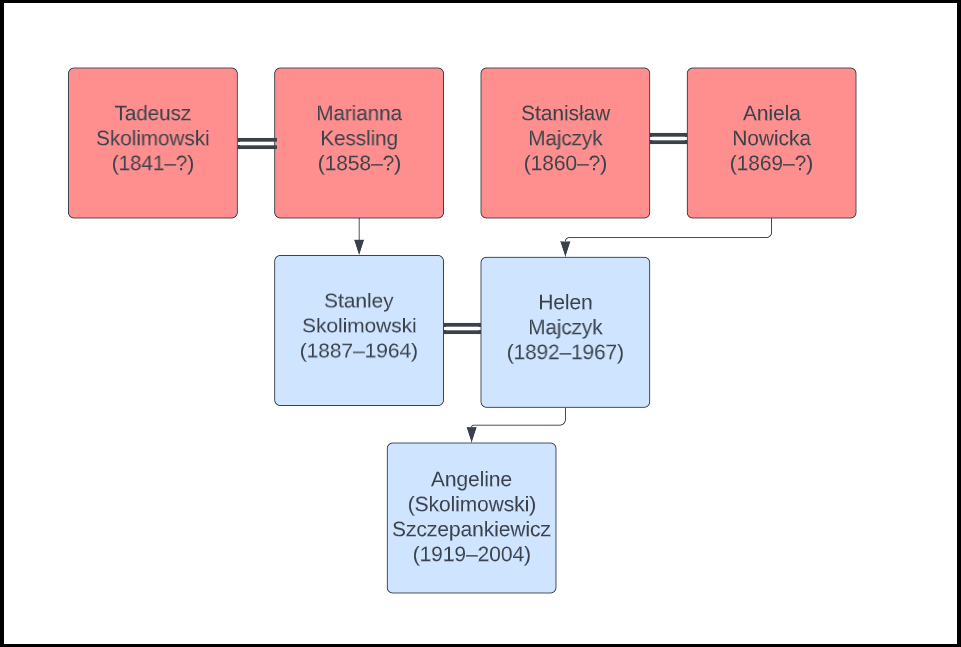
My husband’s paternal grandmother, Angeline (née Skolimowski) Szczepankiewicz, died in 2004, so my sons have some memories of her. Her pedigree chart appears in Figure 2.

Figure 2: Pedigree chart for my husband’s paternal grandmother, Angeline (Skolimowska) Szczepankiewicz. Blue squares represent people who died in the U.S., while red squares represent those who died in what is now Poland. Click image to enlarge.

She was the daughter of Stanisław/Stanley and Helen (née Majczyk) Skolimowski. Stanley was born in the village of Garlino in Mława County in 1887, and was the son of Tadeusz and Marianna (née Kessling) Skolimowski, whose dates of death are unknown. They were known to be living in the village of Uniszki Zawadzki in 1904 when their youngest son, Czesław, was born, so perhaps they were still living there at the time of their deaths. The village of Uniszki Zawadzki belongs to the parish in Wieczfnia, so it’s possible that Tadeusz and Marianna were buried in the parish cemetery there.

Helena Majczyk was born in the village of Rostowa (Żuromin County) to Stanisław and Aniela (née Nowicka) Majczyk. Their dates of death are unknown; however, we could extrapolate again, and assume that they died in the same village in which they were living when their last identified child was born. That child was Czesław, who was born in 1905 in the village of Suwaki, about 8 km from Rostowa. Note that Czesław is merely Stanisław and Aniela’s youngest identified child: since Aniela was only about 36 when Czesław was born, it is likely that the couple had additional children born after him, who will be discovered in further research. Nevertheless, all the villages in which Stanisław and Aniela’s known children were born—Rostowa, Suwaki, and Bojanowa—belong to the parish in Gradzanowo Kościelne, so it’s plausible that Stanisław and Aniela might have been laid to rest in that parish cemetery.

Papa’s Family

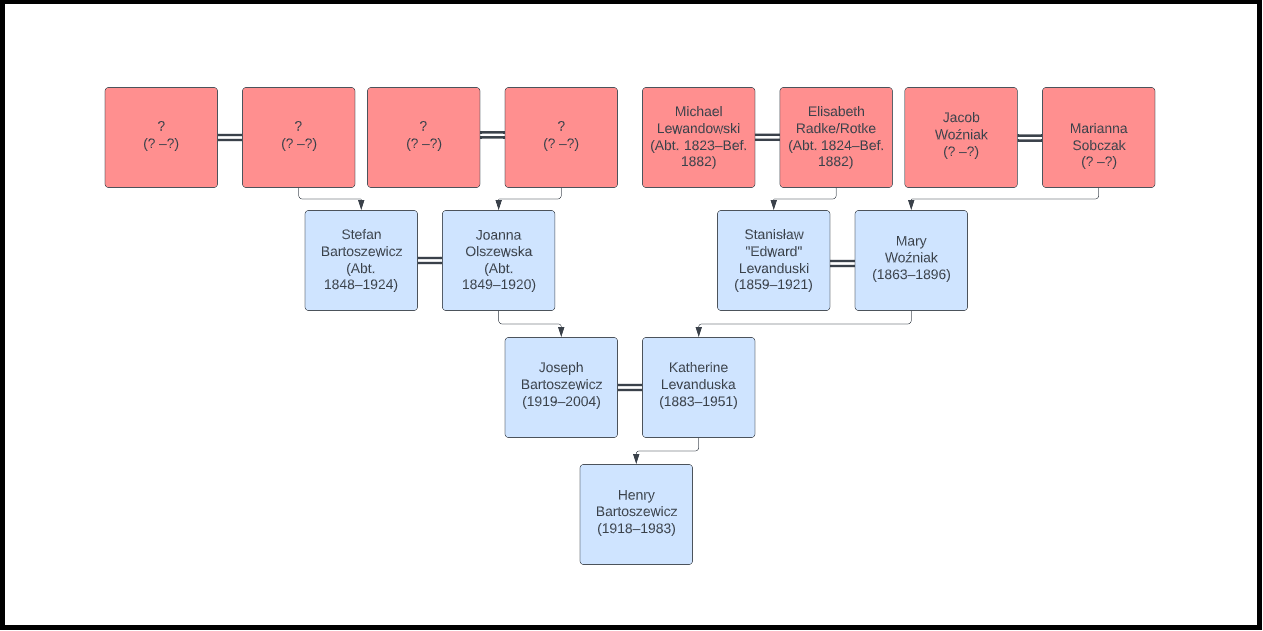
My husband’s maternal grandfather was Henry Bartoszewicz, known as “Papa” to his grandchildren. He was the only one of my husband’s grandparents who was already deceased by the time I met my husband, but I’ve come to know him at least a little bit through all the family stories, which are known to my kids as well. Figure 3 shows his pedigree chart.

Figure 3: Pedigree chart for my husband’s maternal grandfather, Henry Bartoszewicz. Blue squares represent people who died in the U.S., while red squares represent those who died in what is now Poland. Click image to enlarge.

Henry was the son of Józef/Joseph Bartoszewicz and Katarzyna/Katherine (née Lewandowski/Levanduski). Both Joseph and Katherine were Polish immigrants from the Prussian partition, who came to the U.S. with their parents when they were very young. Joseph arrived with his family in 1890, at the age of about eight, while Katherine arrived in 1886, when she was two and a half years old.

Joseph was the son of Stefan/Stephen and Joanna (née Olszewska) Bartoszewicz. They were the parents of perhaps 12 children, about half of whom were born in Poland. More research needs to be done to better understand this family’s history, and I have yet to obtain a birth record for Joseph Bartoszewicz himself. Indexed birth records for Joseph’s known siblings indicate that the family lived in several villages (Kamionki, Zalesie, Smaruj, Brzeźno, and Łysomice) that were all located in Toruń County. However, these villages belong to four different parishes, and I have no further information regarding Stefan and Joanna’s places of birth and marriage, nor have their parents been identified. At this point, the best I can do is guess that my kids’ Bartoszewicz and Olszewski ancestors were buried somewhere in Toruń County.

Katherine Levanduski was the daughter of Stanisław “Edward” Lewandowski/Levanduski and his first wife, Marianna/Mary (née Woźniak). Edward was born in 1859 in the village of Szelejewo (Żnin County) to Michael Lewandowski and Elisabeth (née Radke or Rotka). Although precise dates of death are not yet known for Michael and Elisabeth, the record of marriage for Stanisław/Edward and Marianna stated that the groom’s father died in Szelejewo, and his mother died in Gutfelde (known today as Złotniki Kujawskie). Szelejewo belonged to the parish in Gąsawa, so it’s probable that Michael Lewandowski is buried in the parish cemetery there. Gutfelde/Złotniki belonged to the Catholic parish in Rogowo, so it’s likely that Elisabeth is buried there.

Mary (née Woźniak) Lewandowska was the daughter of Jakub Woźniak and Marianna Sobczak, who were still alive at the time of their daughter’s marriage in 1882. Not much is known about this family, apart from the fact that Mary was born in Brudzyń, and her parents were living in Wola (aka Wola Czewujewska) in 1882, per Mary’s marriage record. Wola belonged to the Catholic parish in Ottensund, presently known as Izdebno, so we can speculate that perhaps Jakub and Marianna were buried in that parish cemetery. However, preliminary research indicates that the parish in Izdebno fell into disrepair and is no longer extant. It was replaced by a new parish founded in 1976 in Czewujewo, with a parish cemetery established in 1977, according to information found here. However, the FamilySearch catalog includes records from Izdebno up until 1952, which suggests that the parish was still in existence at that time, so burial records for Jakub and Marianna should be found in this parish. Despite this fact, there’s no evidence of an old Catholic cemetery in Izdebno, based on Google Maps, and the Wikipedia article on Izdebno mentions only a disused Evangelical (Lutheran) cemetery. Once again, further research is needed, but we can suppose for now that Jakub and Marianna Woźniak might be buried in Izdebno.

Grandma Barth’s Family

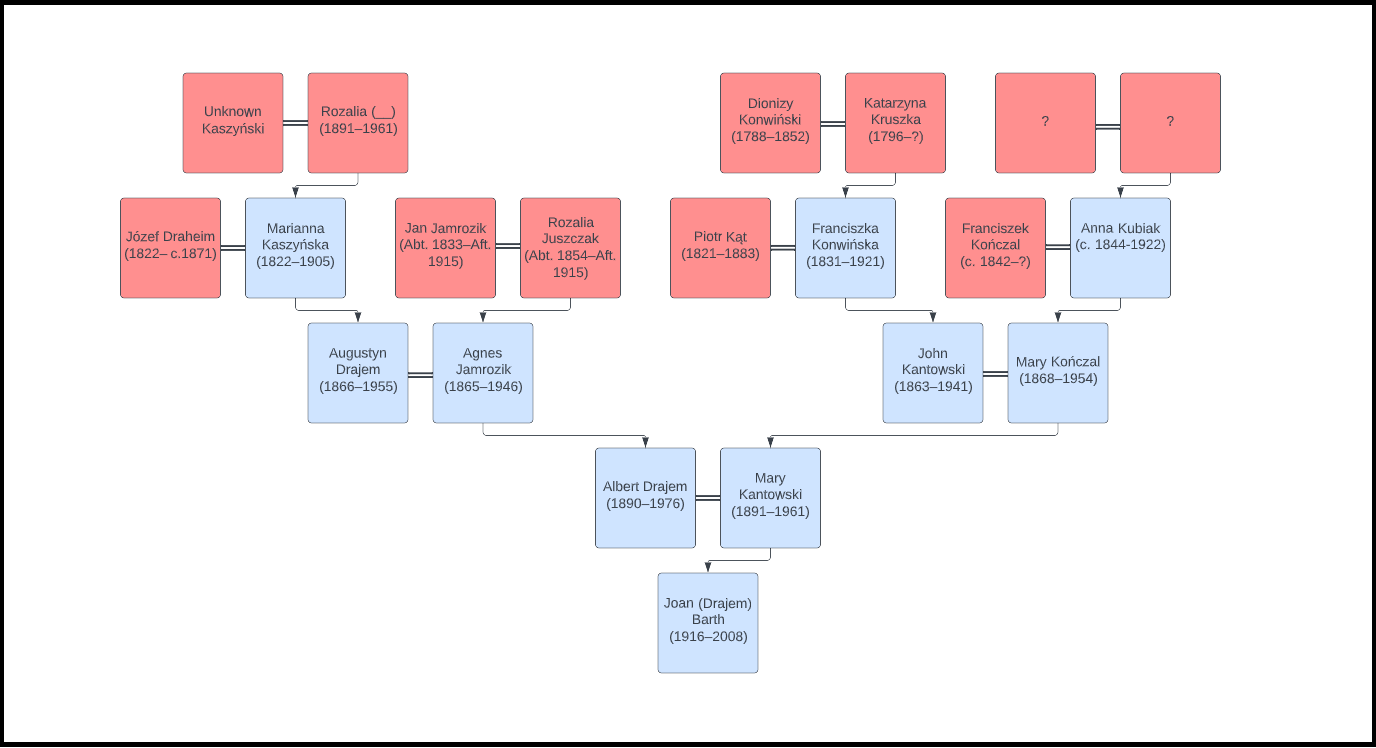
My husband’s maternal grandmother, Joan (née Drajem) Barth, died in 2008, so all of my children remember her. Her pedigree is shown in Figure 4.

Figure 4: Pedigree of my husband’s maternal grandmother, Joan (Drajem) Barth. Blue squares represent people who died in the U.S., while red squares represent those who died in what is now Poland. Click image to enlarge.

Grandma was the daughter of Albert and Mary (née Kantowski) Drajem, both of whom were born in the U.S. to parents who were Polish immigrants from the Prussian partition. Albert was born in Buffalo on 8 April 1890 to Augustyn and Agnieszka (née Jamrozik) Drajem, who were married in Kucharki, in Plezew County, on 1 February 1890. So, although the exact date for their arrival in the U.S. has not been determined, it must have been in February or March of 1890, and Agnieszka would have been heavily pregnant during their voyage.

Augustyn was the son of Józef and Marianna (née Kaszyńska) Drajem, or Draheim. who were married in 1850 in Niestronno (Mogilno County). Józef Draheim’s precise date of death is unknown; however, he was born 30 January 1822, and he was reported to have been 50 years old at the time of his death, according to a life insurance application filled out by his son, Wojciech. This suggests a date of death circa 1872. At the time of Wojciech’s birth in 1862, Józef and his family were living in the village of Mielno (Mogilno County). If we suppose that Józef was still living there ten years later, when he died, then his death should be recorded in Niestronno parish—the parish to which the village of Mielno belonged. It’s probable that he was buried in the Niestronno parish cemetery.

Marianna (née Kaszyńska) Drajem immigrated to Buffalo after her husband’s death, where she died in 1905. She was the daughter of Rozalia (__) Kaszyńska and an unidentified father. (I wrote about my research into Marianna previously.) With so little known about Rozalia and her husband, it’s impossible to guess where they were buried, so I won’t even speculate. Similarly, little is known about the parents of Agnieszka (née Jamrozik) Drajem, Jan Jamrozik and Rozalia (née Juszczak). The Poznań Project indicates that they were married in Kucharki in 1856, so it’s possible that they were buried in that parish cemetery, but there’s not a lot of information, currently, upon which to base this assumption.

Mary Kantowski was the daughter of Jan/John Kąt/Kantowski and Marianna/Mary Kończal who immigrated to Buffalo circa 1886. Jan was the son of Piotr Kąt and Franciszka (née Konwińska). Piotr died 8 March 1883 in the village of Klotyldowo (Żnin County)—a village which belongs to the parish in Łabiszyn. Thus, it’s probable that he was buried in that parish cemetery.

Franciszka (née Konwińska) Kantowska immigrated to Buffalo with her children after the death of her husband. She remarried in 1887 to Jan Wasilewski, and she died in Buffalo in 1921. She was the daughter of Dionizy Konwiński and Katarzyna (née Kruszka), who married in 1812 in Słabomierz (Żnin County). Dionizy died on 19 December 1852 in Wolwark (Nakło County). The village of Wolwark belongs to the parish in Szubin, and it’s likely that the cemetery there was Dionizy’s final resting place. Although Katarzyna (née Kruszka) Konwińska’s precise date of death is unknown, all of her children were born in the village of Wolwark, so it’s reasonable to suppose that she, too, might be buried in the cemetery in Szubin with her husband.

Mary (née Kończal) Kantowski was the daughter of Franciszek Kończal and Anna Kubiak. Anna (née Kubiak) Kończal immigrated to Buffalo to live with her children after the death of her husband, and she died in Buffalo in 1922. Nothing further is known about Franciszek’s date or place of death, or the identities of Anna’s parents. However, Anna and Franciszek were married in Łabiszyn, so Franciszek may have died there.

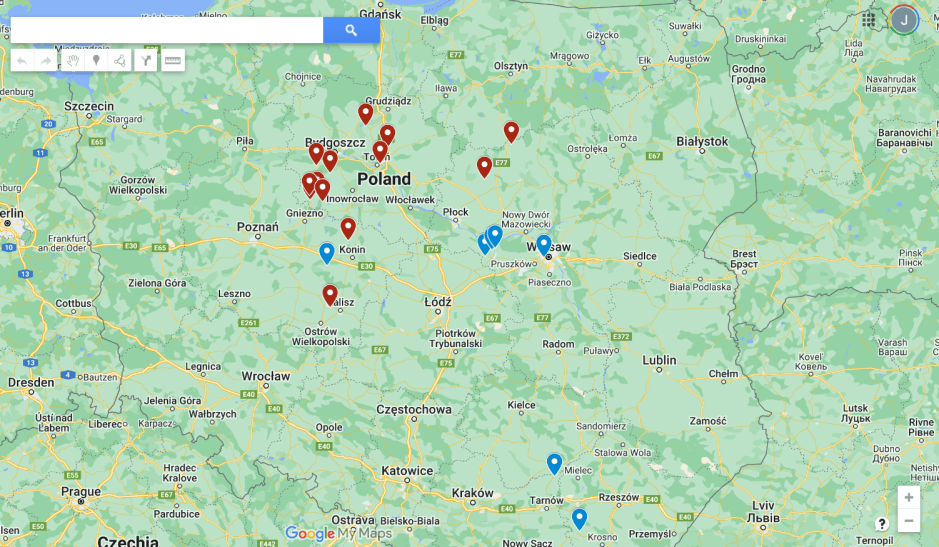
For your viewing pleasure, here is another map which marks all the places discussed in this post, as well as those identified in my first post (my own Polish ancestors).

Conclusions

Analyzing my genealogy data for the purpose of identifying the most recent generation of ancestors who died in Poland has really highlighted all the work that remains to be done on my husband’s family. The data also serve to illustrate the statistical trend of earlier immigration among German nationals (including Poles from the Prussian partition) relative to Russian nationals (including Poles from the Russian partition). And, while it’s impossible to draw any firm conclusions about cultural practices in elder care from these data, I was intrigued by the fact that five of my husband’s 3x-great-grandparents emigrated—all from the Prussian partition— while only one of my 3x-great-grandparents emigrated, from the Austrian partition. Most of these 3x-great-grandparents were over the age of 50 when they migrated, and from this decision, we can infer a preference for uprooting their lives and traveling with their children, rather than remaining in their homeland and living with the families of their siblings or non-emigrant children.

Was that decision influenced by family culture? Was it the result of differing living conditions within each partition of Poland? Are there genetic factors that influence one’s willingness to migrate? I’ve often pondered these questions over the past decade, when dealing with the challenges of long-distance elder care in my own family.

While I may never have definitive answers to these questions, it’s certainly been intriguing to examine my family through the lens of ancestors who died in Poland.

© Julie Roberts Szczepankiewicz 2022

Edited on 19 December 2022 to include current featured image, which was inadvertently omitted when blog post was originally published.

10 March 2023: After reading this article, researchers Ben Kman and Roman Kałużniacki wrote to me independently with a correction regarding my statement that, “there’s no evidence of an old Catholic cemetery in Izdebno, based on Google Maps…” Roman wrote, “There are two cemeteries which may be relevant here. Both of them are marked on the old maps of the area. One is located just half a mile south and on the West side of the road from Czewujewo. This one measures about 0.20 ha in size and is likely the real parish cemetery. But… The other one is quite hidden. It is located just West on the other side of the lake from Izdebno and its size is about 0.4 ha. I have a feeling there might be more to say about it.” Ben wrote, “There is a catholic cemetery in Izdebno.  I have relatives living in Izdebno and my great-grandmother’s brother is buried in that cemetery.  I visit it on every trip I take to Poland.” Thanks, Roman and Ben, for catching this error.

A Catholic Genealogist’s Spiritual Bouquet for All Souls’ Day

November 1 and 2 are two important days in the Roman Catholic tradition—the feasts of All Saints’ Day and All Souls’ Day. On All Saints’ Day, November 1, we celebrate the Church Triumphant—all the faithful deceased, known and unknown, who are now saints in heaven with God. On All Souls’ Day, November 2, our focus shifts to the Church Penitent—all the faithful departed whose souls must undergo purification (Purgatory) in order to enter the joy of heaven. We, the living, are the Church Militant, and together with the Church Triumphant and the Church Penitent, we make up the Communion of Saints. The basic premise of the Communion of Saints is that we’re all in this together: the prayers of the living can benefit those in purgatory, and the intercession of the saints can aide those of us who are still struggling through life.

This act of praying for others is so important, that the Catholic Church designates praying for the living and the deceased as one of the seven Spiritual Acts of Mercy. So, on All Souls’ Day, especially, we are encouraged to remember and pray for our deceased family members. Praying for the faithful departed can certainly be done in a general way, but many of us like to remember our family members by name. Consequently, All Souls’ Day is a holiday that Catholic genealogists can really embrace in a big way, since genealogy is all about the identification of our ancestors by name.

While the Rosary is a popular Catholic devotion for prayer and meditation, it occurred to me that its structure could also lend itself to use in offering a spiritual bouquet for All Souls’ Day. For those who might be unfamiliar with the term, a spiritual bouquet is “a collection of private devotional acts and prayers chosen and performed by one person for the benefit of another.”1 For those who might be unfamiliar with the Rosary, it’s a set of prayers that are recited, using a special string of 60 beads as an aid in keeping track of the progression through the prayers. A Rosary consists of opening prayers, then five sets of prayers called “decades,” followed by closing prayers. Each decade consists of an Our Father, followed by the Hail Mary (repeated ten times), and then the Glory Be. While it’s common to meditate on one of twenty Mysteries—events that took place during the life and death of Jesus and His Mother, Mary—while praying the Rosary, it’s also acceptable to focus on the words of the prayers themselves. I think that approach is easier if one is offering each prayer for a different ancestor or ancestral couple.

There are many ways that the Rosary can be adapted to pray for one’s ancestors, depending on where one begins with the family tree. In my Rosary, I wanted to include the souls of deceased members of both my family, and my husband’s. Since my mother is the only one of our parents who is deceased, I decided to offer the “Hail, Holy Queen” prayer (one of the closing prayers) for her, and offer the ten Hail Mary prayers of each decade for the souls of our grandparents, great-grandparents, and great-great-grandparents, as shown below in Version 1. Praying one decade each for my father-in-law’s family, my mother-in-law’s family, my father’s family, and my mother’s family, leaves one extra decade, which I decided to offer for all souls who have no one to pray for them.

As an alternative, I also set up a version focused only on my family (Version 2). In this version, the first decade is again offered for those souls who have no one to pray for them, followed by a decade each for my paternal grandfather and his family, my paternal grandmother and her family, my maternal grandfather and his family, and my maternal grandmother and her family. It’s a little easier to follow when using an example with names, so I’ve created examples for both Version 1 and Version 2, below. However, please note that in both versions, grandparents’ names have been redacted to protect the privacy of the living (my husband’s parents and my dad).

If you, too, are a Catholic genealogist, you can easily adapt one of these strategies to fit your own family tree. I made it easier for myself by printing out a “cheat sheet” with the names on it, but more power to you if you can do this from memory! Since it takes a little more focus, this is the sort of Rosary that lends itself to a quiet time and place, rather than a “Rosary on the run,” that you might say while you’re out walking or in the car.

May the souls of all the faithful departed, through the mercy of God, rest in peace.

All Souls’ Day Rosary: Version 1

Opening prayers: As usual.

First decade: All souls who have no one to pray for them.

Second decade: My father-in-law’s family

  1. Husband’s paternal grandfather
  2. Husband’s paternal grandmother
  3. Paternal grandfather’s father, Michael Szczepankiewicz
  4. Paternal grandfather’s mother, Agnes (Wolińska) Szczepankiewicz
  5. Paternal grandmother’s father, Stanley Skolimowski
  6. Paternal grandmother’s mother, Helen (Majczyk) Skolimowski
  7. Parents of paternal grandfather’s father, Wojciech and Anna (Augustyniak) Szczepankiewicz
  8. Parents of paternal grandfather’s mother, Joseph and Tekla (Bogacka) Wolinski
  9. Parents of paternal grandmother’s father, Tadeusz and Marianna (Kessling) Skolimowski
  10. Parents of paternal grandmother’s mother, Stanisław and Aniela (Nowicka) Majczyk

Third decade: My mother-in-law’s family

  1. Husband’s maternal grandfather
  2. Husband’s maternal grandmother
  3. Maternal grandfather’s father, Joseph Ferdinand Bartoszewicz
  4. Maternal grandfather’s mother, Katherine (Levanduski) Bartoszewicz
  5. Maternal grandmother’s father, Albert Drajem
  6. Maternal grandmother’s mother, Mary (Kantowski) Drajem
  7. Parents of maternal grandfather’s father, Szczepan and Joanna (Olszewska) Bartoszewicz
  8. Parents of maternal grandfather’s mother, Stanisław “Edward” and Mary (Woźniak) Levanduski
  9. Parents of maternal grandmother’s father, Augustyn and Agnes (Jamrozik) Drajem
  10. Parents of maternal grandmother’s mother, John and Mary (Kończal) Kantowski

Fourth decade: My father’s family

  1. My paternal grandfather
  2. My paternal grandmother
  3. Paternal grandfather’s father, John Frank Roberts
  4. Paternal grandfather’s mother, Katherine Elizabeth (Walsh) Roberts
  5. Paternal grandmother’s father, John Sigismund Boehringer
  6. Paternal grandmother’s mother, Anna Julia (Meier) Boehringer
  7. Parents of paternal grandfather’s father, Michael Frank and Mary Elizabeth (Wagner) Roberts
  8. Parents of paternal grandfather’s mother, Henry and Martha Agnes (Dodds) Walsh
  9. Parents of paternal grandmother’s father, John G. and Anna Franziska (Murri) Boehringer
  10. Parents of paternal grandmother’s mother, Wenzeslaus and Anna (Goetz) Meier

Fifth decade: My mother’s family

  1. My maternal grandfather
  2. My maternal grandmother
  3. Maternal grandfather’s father, Joseph Zielinski
  4. Maternal grandfather’s mother, Genevieve (Klaus) Zielinski
  5. Maternal grandmother’s father, John Zazycki
  6. Maternal grandmother’s mother, Veronica (Grzesiak) Zazycki
  7. Parents of maternal grandfather’s father, Stanisław and Marianna (Kalota) Zieliński
  8. Parents of maternal grandfather’s mother, Andrew and Mary (Łącka) Klaus
  9. Parents of maternal grandmother’s father, Ignacy and Antonina (Naciążek) Zarzycki
  10. Parents of maternal grandmother’s mother, Józef and Marianna (Krawczyńska) Grzesiak

Hail, Holy Queen: For my mother

All Souls’ Day Rosary: Version 2

Opening prayers: As usual.

First decade: All souls with no one to pray for them.

Second decade: My paternal grandfather and his family

  1. Paternal grandfather
  2. Paternal grandfather’s father, John Frank Roberts
  3. Paternal grandfather’s mother, Katherine Elizabeth (Walsh) Roberts
  4. Father of person in 2, Michael Frank Roberts, in my case
  5. Mother of person in 2, Mary Elizabeth (Wagner) Roberts
  6. Father of person in 3, Henry Walsh
  7. Mother of person in 3, Martha Agnes (Dodds) Walsh
  8. All other deceased members of the Roberts family (Surname from 2)
  9. All other deceased members of the Wagner family (Maiden name from 5)
  10. All other deceased members of the Walsh and Dodds families (Surname from 6, Maiden name from 7)

Third decade: My paternal grandmother and her family

  1. Paternal grandmother
  2. Paternal grandmother’s father, John Sigismund Boehringer
  3. Paternal grandmother’s mother, Anna (Meier) Boehringer
  4. Father of person in 2, John G. Boehringer
  5. Mother of person in 2, Anna Franziska (Murri) Boehringer
  6. Father of person in 3, Wenzeslaus Meier
  7. Mother of person in 3, Anna (Goetz) Meier
  8. All other deceased members of the Boehringer family (surname from 2)
  9. All other deceased members of the Murri family (maiden name from 5)
  10. All other deceased members of the Meier and Goetz families (surname from 6, maiden name from 7)

Fourth decade: My maternal grandfather and his family

  1. Maternal Grandfather
  2. Maternal grandfather’s father, Joseph Zielinski
  3. Maternal grandfather’s mother, Genevieve (Klaus) Zielinski
  4. Father of person in 2, Stanisław Zieliński
  5. Mother of person in 2, Marianna (Kalota) Zielińska
  6. Father of person in 3, Andrew Klaus
  7. Mother of person in 3, Mary (Łącka) Klaus
  8. All other deceased members of the Zielinski family (surname from 2)
  9. All other deceased members of the Kalota family (maiden name from 5)
  10. All other deceased members of the Klaus and Łącki families (surname from 6, maiden name from 7)

Fifth decade: My maternal grandmother and her family

  1. Maternal Grandmother
  2. Maternal grandmother’s father, John Zazycki
  3. Maternal grandmother’s mother, Veronica (Grzesiak) Zazycki
  4. Father of person in 2, Ignacy Zarzycki
  5. Mother of person in 2, Antonina (Naciążek) Zarzycka
  6. Father of person in 3, Józef Grzesiak
  7. Mother of person in 3, Marianna (Krawczyńska) Grzesiak
  8. All other deceased members of the Zazycki family (surname from 2)
  9. All other deceased members of the Naciążek family (maiden name from 5)
  10. All other deceased members of the Grzesiak and Krawczyński families (surname from 6 and maiden name from 7)

Hail, Holy Queen: For my mother

Sources:

1 “Spiritual bouquet,” Collins Dictionary (https://www.collinsdictionary.com/us/dictionary/english/spiritual-bouquet : 31 October 2022).

Featured Image: Pixabay, “Holding String of Beads,” Stockvault (https://www.stockvault.net/photo/216640/holding-string-of-beads#, uploaded 22 November 2016, accessed 31 October 2022), Creative Commons license CC0 1.0 Universal.

© Julie Roberts Szczepankiewicz 2022

Playing “Telephone” Across Generations: Documenting Family Stories

Family stories are always the starting point for genealogy research. Beginners are typically instructed to start with themselves and work backwards, interviewing older family members or generational peers to discover what they remember, or remember hearing, about past generations. Often it feels like a game of “telephone” played out over many decades. You may remember “telephone” as that game in which a number of players stand in a circle, and a complicated phrase is whispered from one person to the next. Repetition is not allowed, so although each person does his best to listen carefully, the phrase becomes distorted, often comically, as it is passed around. Finally the result is whispered to the person who began the game, who announces what the original phrase actually was, and everyone gets a good laugh. As family historians, our job is to sift out the wheat from the chaff, using our ancestors’ paper trail to document what we can from the family stories, but keeping in mind that not everything we were told is going to be verifiable.

I became interested in my family history soon after I was married in 1991. My husband and I were incredibly fortunate to have six living grandparents at that time, as well as plenty of their siblings still living. As I’ve tried to document all the many bits of information I gathered from them, one truth in particular has emerged:  if an older relative remembers a specific name, it’s safe to say that the person is connected to the family in some way, even if it’s not in the way that he or she remembers. Remembered names aren’t just pulled out of thin air.

As one example of this, I interviewed Uncle Mike Stevenson (Szczepankiewicz) about the Szczepankiewicz family history. Uncle Mike was the youngest brother of my husband’s grandfather, Stephen Szczepankiewicz. Although he knew a great deal about his father from his mother’s stories, Uncle Mike had never met him: he died on 14 February 1926,1 and Uncle Mike was born 3 months later, on 23 May 1926.Nonetheless, Uncle Mike proved to be a reliable source. He told me that his father, Michael Szczepankiewicz, had never naturalized. This assertion is validated by the 1925 New York State census, in which Michael Szczepankiewicz is listed as an alien (Figure 1):3

Figure 1:  Extract of 1925 New York State census showing Michael Szczepankiewicz and family.3michael-szczepankiewicz-family-1925

This extract shows that 49-year-old Michael Szczepankiewicz was born in Poland, had been living in the U.S. for 20 years, was an alien (“al”) at the time of the census, and was employed in “building labor.” Since Michael died in 1926, and the naturalization process took longer than a year, it would not have been possible for him to naturalize prior to his death. Uncle Mike also mentioned that his father was a stone mason who helped to build Transfiguration Church in Buffalo. Although I have yet to document this directly (maybe payroll records exist in the archive of the diocese of Buffalo dating back to the construction of Transfiguration Church?), the fact that Michael was a construction laborer is consistent with that claim.

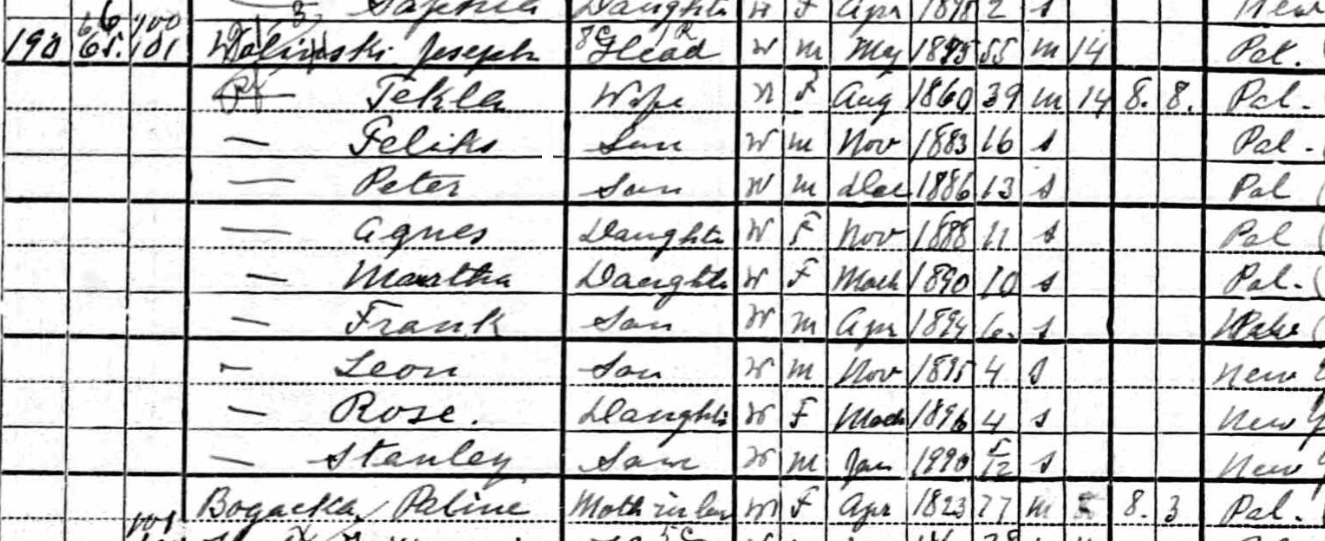
When I asked Uncle Mike about the family of his mother, Agnes (née Wolińska) Szczepankiewicz, he told me that Agnes’s mother was named Apolonia Bogacka. Unfortunately, this didn’t pan out. Records showed that Agnes’s mother’s name was Tekla, as shown by the 1892 census for New York State (Figure 2): 4

Figure 2:  Extract from 1892 census of New York State showing the family of Joseph Wolinski, including wife “Teckla” (sic).4wolinski-family-1892

So where did the name “Apolonia Bogacka” come from? The answer was found in the 1900 census (Figure 3).5  Living with Joseph Wolinski’s family is his mother-in-law, “Paline” Bogacka.  The name “Pauline” was commonly used by women named Apolonia in the U.S. as a more American-sounding equivalent.

Figure 3:  Extract from the 1900 U.S. Federal census showing the family of Joseph Wolinski, including mother-in-law “Paline” (sic) Bogacka.5joseph-wolinski-family-1900-census

So it turns out that Uncle Mike’s great-grandmother had also emigrated, and he was confusing her name with the name of his grandmother!

As another example, my grandfather’s first cousin, Jul Ziomek, told me in a 1992 interview that the mother of her grandmother, Mary (née Łącka) Klaus, was named Janina Unicka. Jul was a very reliable source in other matters, but in this case, her memory did not serve her well. The civil record for Mary Klaus’s second marriage, to Władysław Olszanowicz, tells us that her mother’s name was (phonetically) Anna “Taskavich” (Figure 4).6

Figure 4:  Civil marriage record from North Tonawanda, New York, for Mary Klaus and Władysław Olsanowic (sic).6mary-klaus-second-marriage

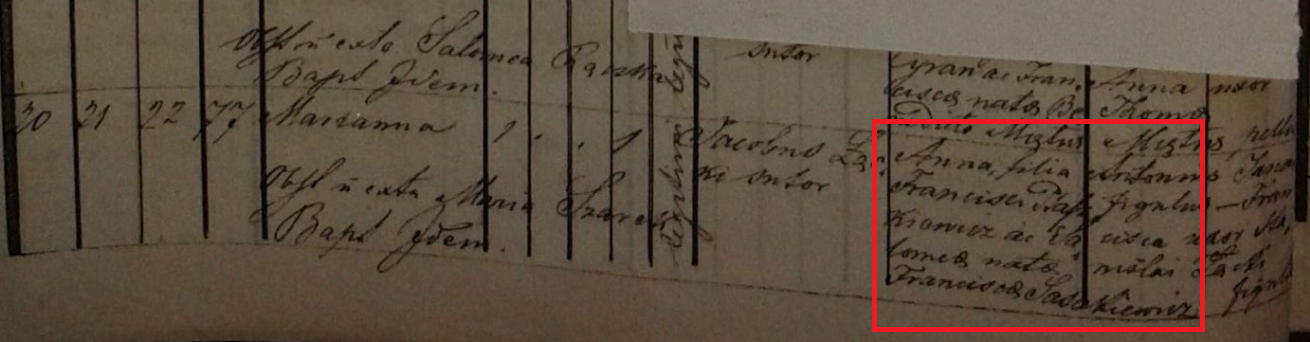
The correct spelling of Mary’s mother’s name in Polish is found on Mary’s baptismal record from her home village of Kołaczyce — she was Anna Ptaszkiewicz (Figure 5).7

Figure 5:  Baptismal record from Kołaczyce, Austrian Poland for Marianna Łącka.7marianna-lacka-birth

The section of the record in the red box pertains to the mother of the child and reads, “Anna filia Francisci Ptaszkiewicz ac Salomea nata Francisco Sasakiewicz.” For those who might be unfamiliar with Latin, this translates as “Anna, daughter of Franciszek Ptaszkiewicz and Salomea, daughter of Franciszek Sasakiewicz.”

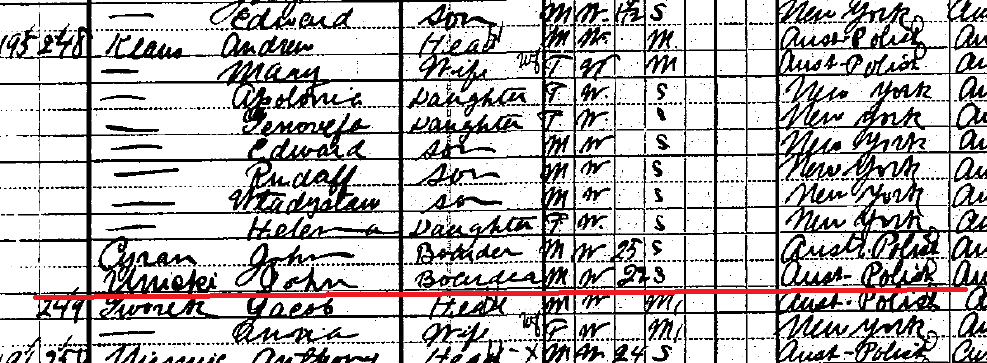
Believe it or not, it’s quite reasonable, based on Polish phonetics, that an English speaker might come up with a spelling of “Taskevich”for “Ptaszkiewicz.”  But no matter how you slice it, this is pretty far off from “Janina Unicka.”  So where did Jul come up with that name? The 1910 census gives us a clue (Figure 6):8

Figure 6:  Andrew Klaus family in the 1910 U.S. Federal census.8andrew-klaus-fam-1910

Living with the family of Mary Klaus, there is a boarder named John Unicki.  At this point I have traced Mary Klaus’s family back in Poland for another 3-4 generations, which is as far back as existing vital records go, and I’ve seen no evidence of the Unicki surname anywhere in the extended family tree.  I’ve concluded that cousin Jul’s memory was inaccurate on this point. It must have been dim memories of this boarder, Jan Unicki, living with her grandparents that caused her to associate the name “Janina Unicka” with her grandmother’s family.

As one final example, my husband’s grandfather, Stephen Szczepankiewicz, told me that his father, Michael Szczepankiewicz, immigrated from Russian Poland to Buffalo, New York, along with four brothers and no sisters. He recalled the names of his father’s brothers as Bernard, Felix, Alexander and Joseph. It turns out that he was partially correct.  Further research indicates that his father did indeed have brothers who also emigrated from Poland to Buffalo who were named Bernard (Anglicized from Bronisław), Alexander, and Joseph.  What Grandpa didn’t know was that there were two more brothers who emigrated, Adam and Walter (also known as “Wadsworth” — both names are Anglicized versions of his Polish name, Władysław), as well as a sister, Marcjanna, who emigrated to Buffalo along with Bronisław and then disappears from records there (Figure 7):9

Figure 7:  Passenger manifest for Marcyanna and Bronisław Szczepankiewicz, arriving in the port of New York on 3 May 1902.9marcjanna-manifest-cropped


Try as I might, I could not document a brother named Felix/Feliks Szczepankiewicz, or find one with a name that was even close to that.  Why would Grandpa remember an Uncle Felix if there never was one? Well, it turns out that there was an Uncle Felix, but it was on his mother’s side, not his father’s side. Grandpa Steve’s mother was Agnes/Agnieszka Wolińska.  If we take a closer look at that 1892 census for the Woliński family shown in Figure 2 and the 1900 census shown in Figure 3, the oldest child in the family is Feliks.  So it seems likely that Grandpa was just mixing up which side of the family Uncle Feliks was from.

As is evident from these examples, family stories work best when used as a starting point for genealogy research, but we can’t let our research end there. Time can play tricks with people’s memories, so it’s important to attempt to document everything we’ve been told.  If conflicts exist between the story and the evidence, consider how these might be reconciled.  As you document each story, you’ll begin to get a sense of the reliabilty of each relative’s memory. If you have any particularly wild stories that you’ve been able to document, please let me know in the comments — I’d love to hear about them!

Sources:

Buffalo, Erie, New York, Death Certificates,1926, certificate #1029, record for Michael Sczepankiewicz (sic).

“United States Social Security Death Index,” database, FamilySearch(https://familysearch.org/ark:/61903/1:1:VMDV-RJ7 : 20 May 2014), Michael A Stevenson, 28 Apr 2011; citing U.S. Social Security Administration, Death Master File, database (Alexandria, Virginia: National Technical Information Service, ongoing), accessed on 8 November 2016.

Ancestry.com, New York, State Census, 1925 (Provo, UT, USA, Ancestry.com Operations, Inc., 2012), http://www.ancestry.com, Record for Stepahn Szczepankiewicz, accessed on 8 November 2016.

Ancestry.com, New York, State Census, 1892 (Provo, UT, USA, Ancestry.com Operations, Inc., 2012), http://www.ancestry.com, Record for Joseph Wolinski household, accessed on 8 November 2016.

Ancestry.com, 1900 United States Federal Census (Provo, UT, USA, Ancestry.com Operations Inc, 2004), http://www.ancestry.com, Year: 1900; Census Place: Buffalo Ward 9, Erie, New York; Roll: T623_1026; Page: 6A; Enumeration District: 69, record for Joseph Wolinski household, accessed on 8 November 2016.

6 “New York, County Marriages, 1847-1848; 1908-1936″, database, Church of Jesus Christ of Latter Day Saints, Family Search, (https://familysearch.org), Wladyslaw Olsanowic and Mary Klaus, 21 Nov 1916; citing county clerk’s office, , New York, United States; FHL microfilm 897,558. accessed on 8 November 2016.

Roman Catholic Church, St. Anna’s Parish (Kołaczyce, Jasło, Podkarpackie, Poland), “Urodzenia, 1826-1889”, Stare Kopie, 1866, #20, Record for Marianna Łącka.

Ancestry.com, 1910 United States Federal Census (Provo, UT, USA, Ancestry.com Operations Inc, 2006), http://www.ancestry.com, Year: 1910; Census Place: North Tonawanda Ward 3, Niagara, New York; Roll: T624_1049; Page: 16B; Enumeration District: 0126; FHL microfilm: 1375062, record for Andrew Klaus, accessed on 8 November 2016.

Ancestry.com, New York, Passenger Lists, 1820-1957 (Provo, UT, USA, Ancestry.com Operations, Inc., 2010), http://www.ancestry.com, Year: 1902; Arrival: New York, New York; Microfilm Serial: T715, 1897-1957; Microfilm Roll: Roll 0272; Line: 5; Page Number: 132, record for Marcyanna Sczezyoankiemg, accessed on 8 November 2016.