Grandma Helen’s Letter: How Family Stories Measure Up

My mother’s been holding out on me. For many years, she’s maintained that she’s really not interested in family history. And I can accept that. Although it’s difficult for me to empathize, I do understand intellectually that there are some people who just aren’t enthralled at the prospect of digging up documents pertaining to long-gone generations of the family, and Mom is one of those people. However, while helping to sort and reorganize accumulated papers in her desk recently, I discovered a folder, neatly marked “Genealogy Information.” What?! Curiosity piqued, I sifted through the contents of the folder, and  discovered that most of it was merely stuff I’d given to her over the years, hard copies of emails I’d written to my parents as I made new family history discoveries. However, some of it was pure genealogical gold, including a bridal picture of my great-grandaunt, Wanda, an envelope of prayer cards from family funerals, and—best of all—a letter written by my grandmother, Helen Zielinski, in 1977.

The letter was addressed to my parents, my sister, and me. At that time, my family was living in Cincinnati, Ohio, while Grandma and Grandpa still lived in North Tonawanda, New York. The letter was dated 4 December, and the first page is delightfully chatty. Grandma noted that she’d call on Friday, thanked Mom for some photos Mom recently sent, expressed concern that my other Grandma, Marie Roberts, had been in the hospital, and offered to send Christmas cookies in case my mother did not have time to bake. The next pages, however, are even better: Grandma provided brief biographical information about each of her parents and Grandpa’s parents, as well as some other interesting tidbits of family history.

This part of the letter was written in order to help my sister with a family history project she was doing in school. At that time, my sister was in 4th grade and I was in 3rd grade, and she was working on a “Roots” project, which (sadly) I was not also required to do when I got to 4th grade. The project was aimed at helping the students discover their family history, so it was necessary for them to interview their elders and ask about previous generations of the family, as well as any family traditions or ethnic customs that were still practiced. I remember when this project was taking place, and I knew that Grandma had contributed a great deal of information. It made sense that Mom would have saved this letter; however, I’d never actually seen it or read it previously.

It’s clear that Grandma really enjoyed helping with the project, and she wrote about how she spoke with two of her cousins, Carrie Baginski and Arthur Gray, to help her fill in the blanks. It was really fascinating for me to read this information, recorded in Grandma’s own handwriting. It was especially interesting to see how this information measured up against the documentary paper trail that I’ve been gathering over the years since then. Here, then, is Grandma’s original information, recalled and recorded by her at the age of 57, in collaboration with information from some of her cousins, compared with “the rest of the story.”

On Joseph Zielinski (My Great-Grandfather):

Starting off with her father-in-law, Joseph Zielinski, Grandma wrote, “Born in Poland in 1892—lived with his parents on a farm in a village called ‘Sochaczew’ near Warsaw. He arrived in New York City in 1914. He left Poland because he would have had to serve in the Russian Army. Joseph had one brother named Frank who was killed in World War II in America. Joseph died at age 80 in August 1973.”[1]
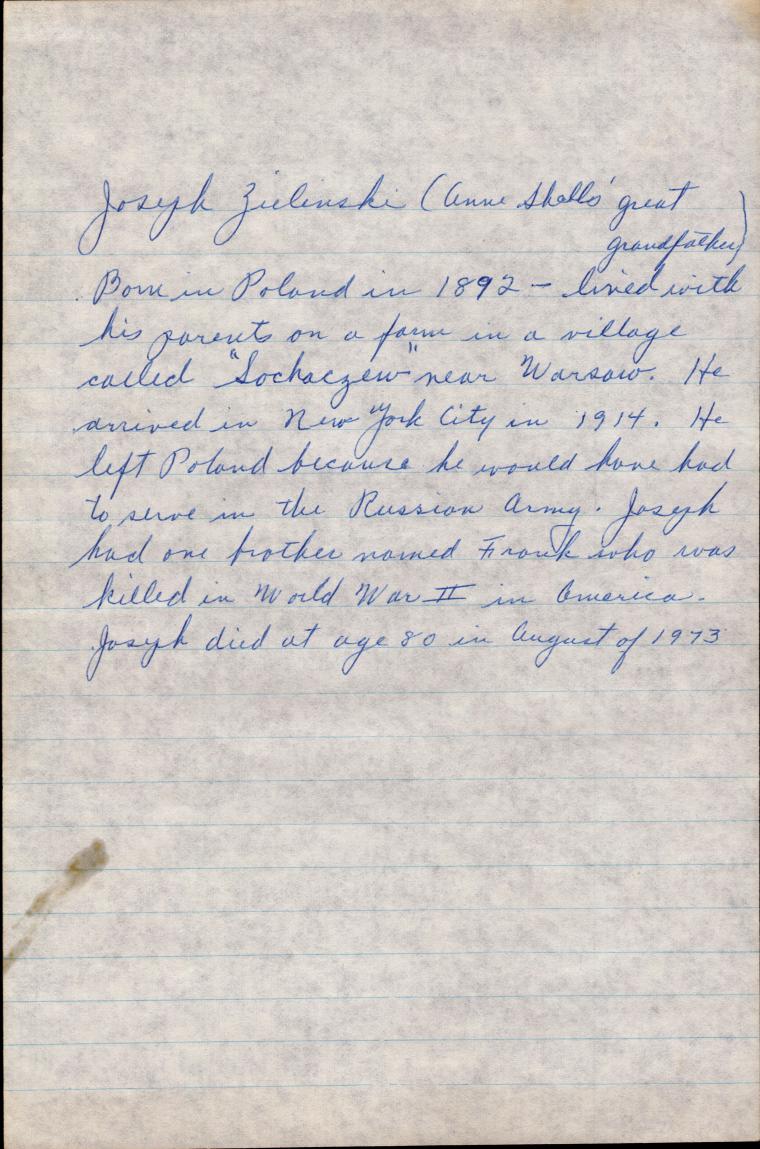
Letter from Grandma Helen 1977 page 3

Analysis: Grandma was spot-on about Joseph’s birth year in 1892, in spite of census records, a World War II draft registration, and the record from his second marriage, which would all argue that Joseph was born between 1893-1894. Joseph’s birth record confirms that he was born 10 October 1892; however, he was born in the village of Mistrzewice, not in the town of Sochaczew. Mistrzewice is located in Sochaczew County, and the Zieliński family’s deeper roots lie in the parish of Sochaczew itself, since Joseph’s grandfather, Michał Archanioł Zieliński, was born in the village of Bibiampol and baptized in Sochaczew. Therefore it’s actually true, in one sense, that the Zieliński family was “from” Sochaczew, although it would have been more accurate (and would have saved me some time in searching!) if the family history had mentioned Mistrzewice as their more recent place of origin.

It may very well be that Joseph left Poland so he would not have to join the Russian army. Exactly how he managed to avoid the conscription that was mandatory in Russia at that time is unclear, but his World War I draft registration does not indicate any prior service in the Russian army. In contrast, the World War I draft card for Joseph’s brother, Frank, states that he served three years in the Russian infantry. Taken together, these facts seem to confirm the family story that Joseph was able to slip out of the Russian Empire before they could force him into service. It’s also true that Joseph’s brother, Frank, was killed in the war. However, he was killed in World War I, not II. It seems likely that Grandma merely made a recording error when she wrote that Frank was killed in World War II, since the oral family tradition always referenced World War I.

Grandma’s wording does not make it clear if she was aware of other siblings that Joseph and Frank might have had, and one might suspect that she would have identified those siblings by name if she could have. I know now that Joseph and Frank had eight additional siblings—five brothers and three sisters. Five of these siblings (three younger brothers and two younger sisters) were still alive when Joseph left Poland for the U.S., and he arrived in 1912—not 1914. All in all, Grandma was pretty accurate in the information she provided.

On Genevieve Zielinski (My Great-Grandmother):

Next, regarding her mother-in-law, Grandma wrote, “Maiden name—Klaus. Born in 1898 in North Tonawanda, N.Y. Married Joseph Zielinski in 1915. They had five children, John (born Oct. 18, 1916), Frank, Helen, Stanley, and Irene. Genevieve died at age 44 in the year 1942.”
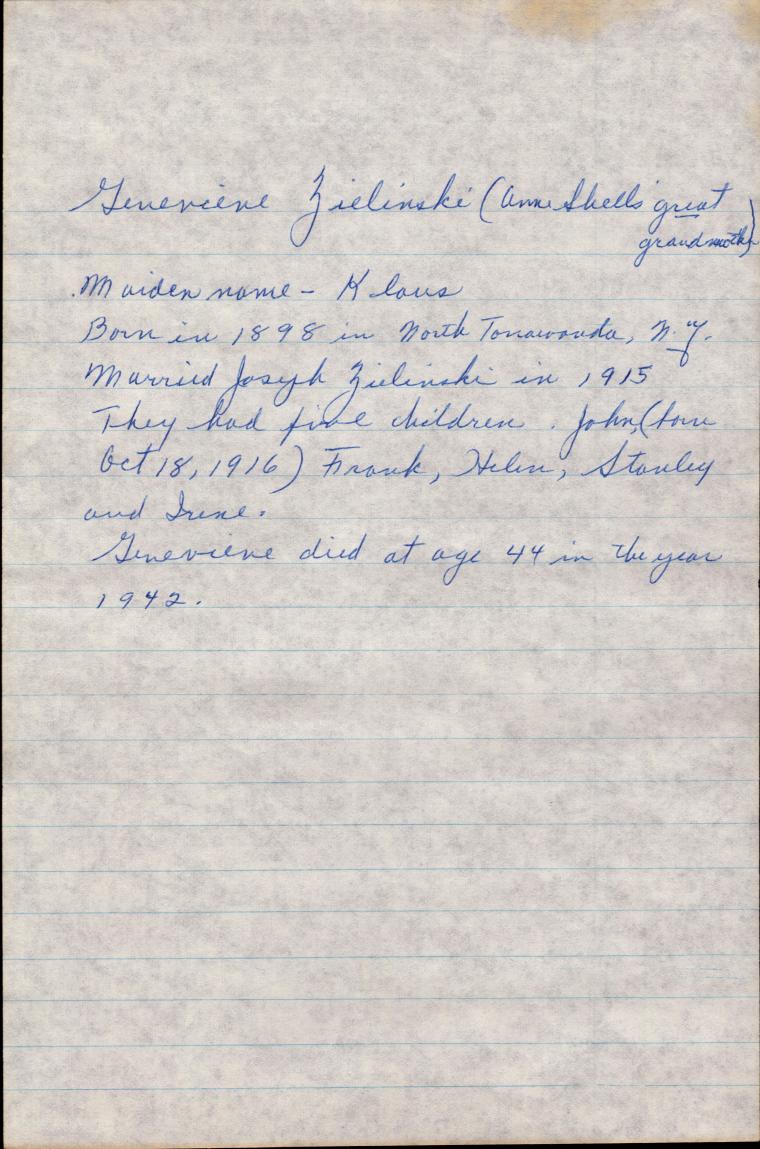
Letter from Grandma Helen 1977 page 4

Analysis: Grandma was pretty close with Genevieve’s birth year, but Genowefa Klaus was, in fact, born 28 September 1897 in Buffalo, New York, rather than in North Tonawanda. She married Joseph Zielinski on 6 October 1915 at the church of Our Lady of Częstochowa in North Tonawanda, and of course, the names of their children (my grandfather and his siblings) are accurate. She died on 6 May 1942 at the age of 44, so once again, Grandma did pretty well.

On Mary Klaus (My Great-Great-Grandmother):

Things start to get a little bumpy with Grandma’s next report about her husband’s grandmother. Regarding Mary Klaus, Genevieve Zielinski’s mother, Grandma wrote, “Maiden name—Olszanowicz. Arrived in Texas from Poland. She and her husband had eight (in N.T.) children, Anna, Joe, Pauline, Eddy, Genevieve, Walter, Helen and Rudolf. Anna is still alive, living in Chicago. Mary died in N. Tonawanda at age 65.”
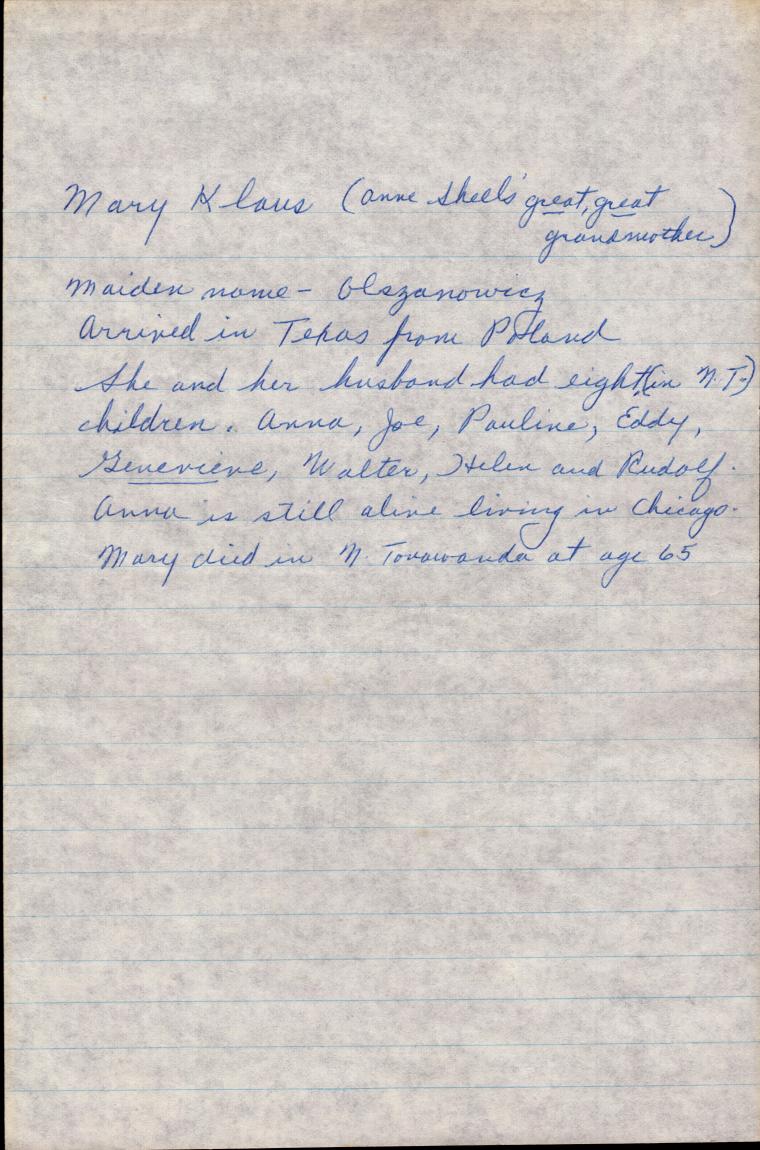
Letter from Grandma Helen 1977 page 5

Analysis: Oh, Grandma. Would that I had never heard that story about Texas. I spent so much time trying to find any possible shred of evidence for our family’s sojourn there. And it wasn’t just you, Grandma. Cousin Julia Ziomek reported that same story, in even greater detail. I wrote about it most recently here, but also here, here, and here. The truth, as near as I can figure, is that the entire story was a fabrication created to avoid embarrassing questions about the circumstances surrounding the births of Mary’s two oldest sons, Joseph and John, who were born out of wedlock in Buffalo, New York, prior to Mary’s marriage to her first husband, Andrew Klaus. Mary’s maiden name was not Olszanowicz, either—it was Łącka. Olszanowicz was the name of her second husband, whom she married after Andrew’s death. That marriage did not last long—only three months, reportedly—which may explain why poor Walter Olszanowicz was so easily forgotten, although his name was still recalled in association with Mary. In total, Mary Klaus had 11 children. In addition to Joseph and John, her children with Andrew included Zofia (who died in infancy), Anna, Pauline, Bolesław (who also died in infancy), Genevieve, Edward, Walter, Rudolf, and Helen. Grandma was right, Anna (née Klaus) Gworek Matysak was still alive in 1977 when this letter was written. However, Mary (née Łącka) Klaus Olszanowicz was quite a bit older than most U.S. records would indicate, and she was actually 75, not 65, when she died in 1942.

On John Zazycki (my great-grandfather):

Grandma wrote the following about her father, John Zazycki: “Born in Warsaw, Poland 1866. Came to the United States and went to Alaska to seek employment. While in Poland he served in the Russian Cavalry and got his apprenticeship as a blacksmith. He died in 1924 at age 58. John’s forefathers were named Zazycki because they lived behind a creek. Za—behind, zekom—creek.”
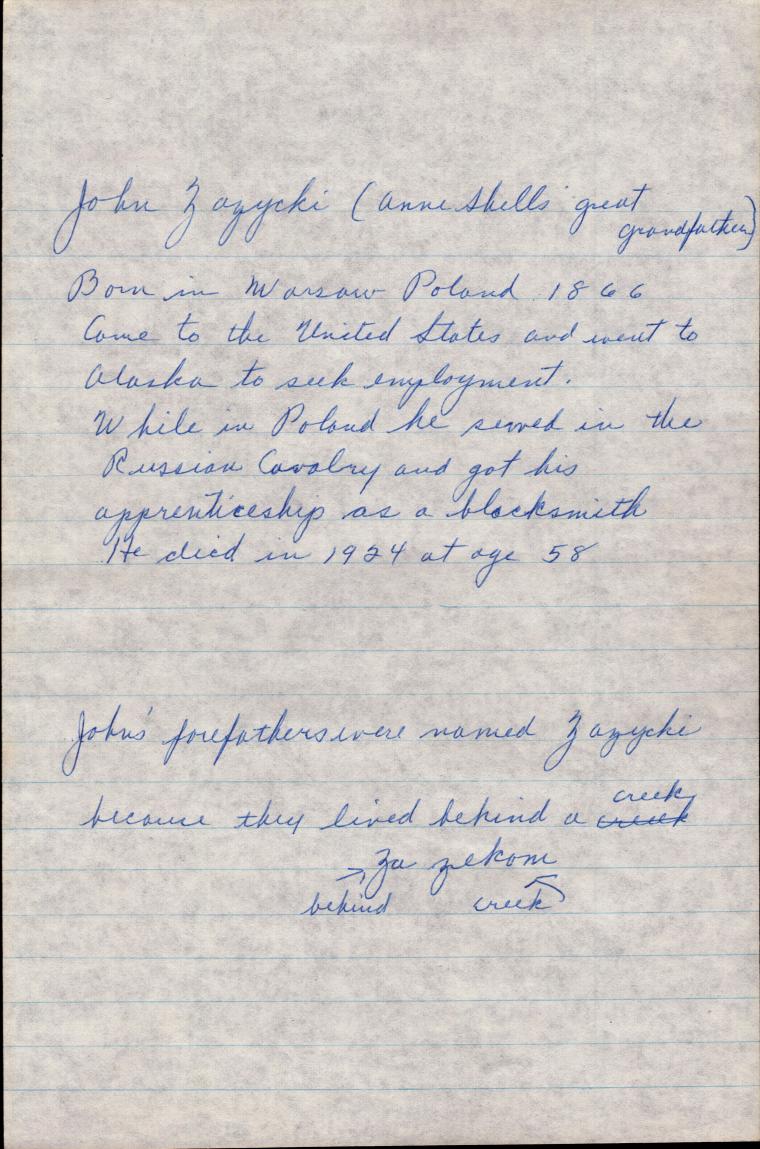
Letter from Grandma Helen 1977 page 6

Analysis: As often happened with immigrants, John Zazycki approximated his birthplace to a nearby large city, rather than citing the small village where he was actually born. I now know that John was born 5 March 1866 in the village of Bronisławy, which was located in Sochaczew County in the Warsaw gubernia, or province of the Russian Empire. So in that sense, Grandma’s information that her father was born in Warsaw in 1866 was correct, if not especially precise, since Bronisławy is about 50 miles west of the city of Warsaw. I have not been able to confirm any Russian military service for John, although it’s quite likely that he did serve, since such service was compulsory. Similarly, John died in 1924 at the age of 58, exactly as Grandma reported, and we have documentary evidence that John was apprenticed to a master blacksmith, Józef Gruberski, who was also his brother-in-law. Even Grandma’s Polish surname etymology is approximately correct, although I’ve read that it should be “za rzeka” (“beyond the river”). That leaves the final statement, that John initially went to Alaska to seek employment prior to his arrival in Buffalo, New York.

It turns out that this is a difficult claim to fact-check. John’s naturalization papers state that he arrived in the U.S. on 15 January 1895, and that he resided in the U.S. continuously for 5 years prior to his petition for naturalization in Buffalo on 12 July 1900. Alaska was a U.S. territory, so presumably, John could have traveled to Alaska following his arrival in New York and still count that time toward his 5-year-residency requirement for naturalization. If he did go to Alaska, he was not there for long, and documenting him there, without knowing a specific location, is akin to chasing down my Klaus family in Texas. And we all know how that ended.

On Veronica Zazycki (My Great-Grandmother):

I’ve written previously about some of the interesting statements made by Grandma about her mother, Veronica Zazycki. Grandma wrote, “Maiden name—Grzesiak. Born in the year 1876 in the village ‘Poznan’ near Warsaw. Her parents owned a grain mill. She had a sister Josephine and two brothers—Walter and Thaddeus. They lived near the church and parish house and Veronika’s mother sewed all the vestments for the priest. Veronika’s mother died when Josephine was born so at age 18 she came to America in year 1894. She found employment working in the kitchen of a restaurant. The people could not speak Polish and Veronika could not speak English so they used sign language and called her Mary. She saved her money and sent it to her two brothers so they could come to America. In the meantime, Walter (her brother) married a Polish actress named Wanda and she did not want to leave her career, so he left without her. They say she died of a broken heart.

Veronika married John Zazycki and they had twin boys as their first born, Benjamin and Roman. Wanda was next, then came Leon, Antoinette, Joseph, Angela, and last but not least, their beautiful baby daughter Helen who is sitting here writing ‘Roots.’

Veronika was a seamstress who supported her family after her husband died. She lived to age 62 and was killed in an automobile accident in 1938. Helen’s birthday is Nov. 30th, 1920.”
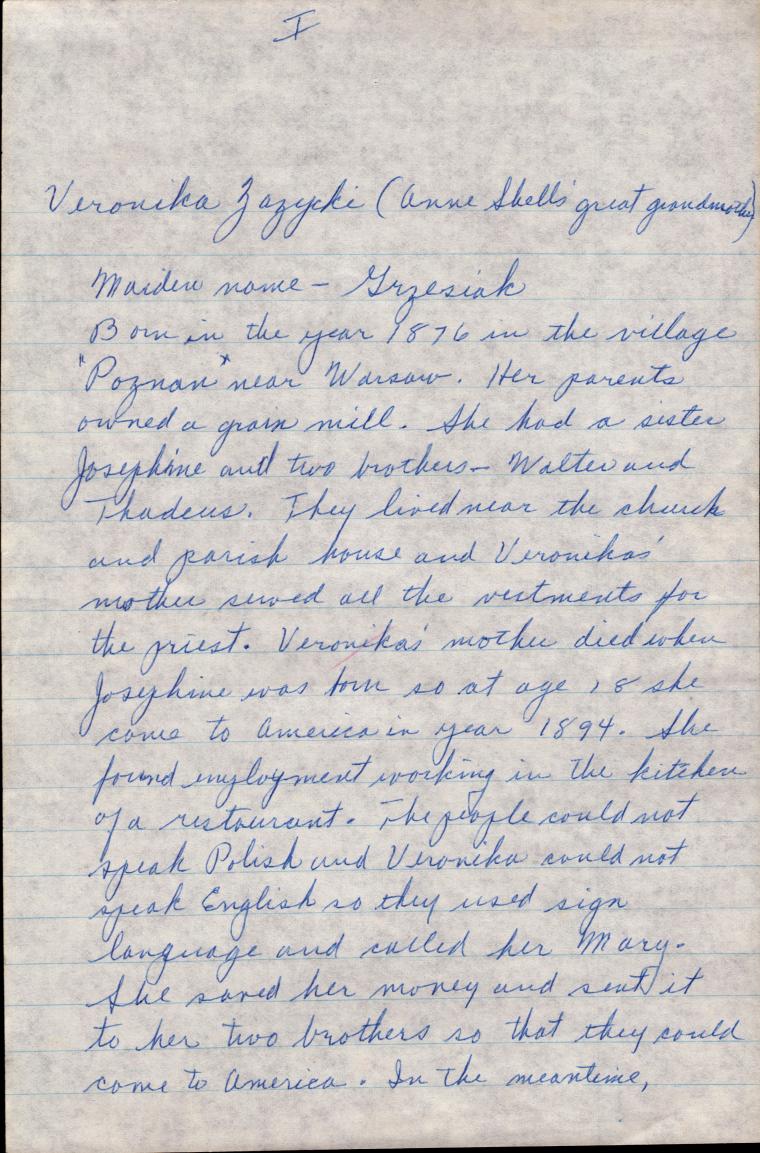
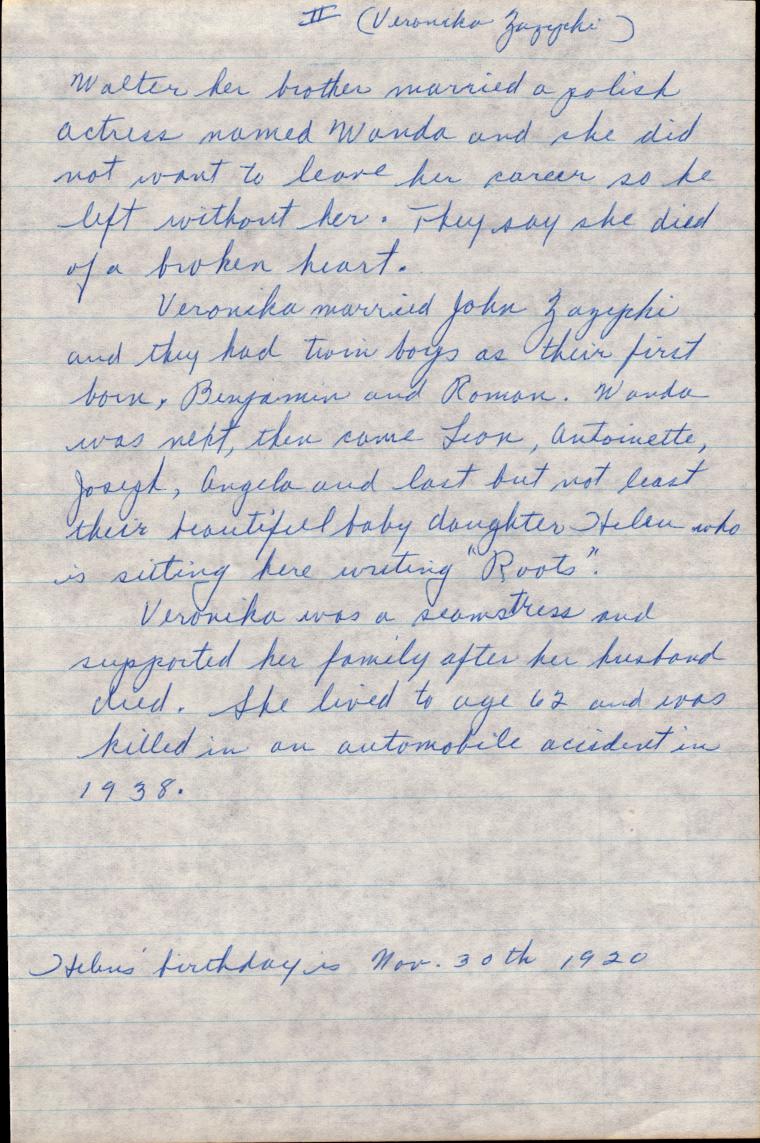
Letter from Grandma Helen 1977 page 8

Letter from Grandma Helen 1977 page 9

Analysis: Veronica (née Grzesiak) Zazycki was born 27 December 1876 in the village of Kowalewo-Opactwo. The village is about 50 miles east of Poznań, but “Poznań near Warsaw” doesn’t make a lot of sense since Poznań and Warsaw are nearly 200 miles apart. Nonetheless, the reference to Warsaw is interesting in light of the fact that members of the Grzesiak family were living in Warsaw in the years after Veronica moved to the U.S. Her passenger manifest informs us that Veronica arrived in Baltimore in March 1898, and in June 1898, her sister Konstancja married Julian Cieniewski in Warsaw, while her brother Walter married Kazimiera Olczak in Warsaw two months later. These facts underscore two more points—first, that Walter’s wife was not named Wanda, but rather Kazimiera; and second, that Veronica had additional siblings besides Walter, Thaddeus and Josephine. Polish birth records from Kowalewo-Opactwo revealed two more Grzesiak sisters, Pelagia and Konstancja, whose existence was not known to Grandma.

The part about the grain mill, and the proximity of the family home to the church, was something I wrote about in a previous post, as there may be some evidence for that. The part about Veronica’s mother dying when Josephine was born is utterly false, however, as Veronica’s mother, Marianna (née Krawczyńska) Grzesiak, did not die until 1904, several years after most of her children were settled in America. Grandma was a bit off on the timing of Veronica’s immigration, since Veronica did not immigrate in 1894, at the age of 18, but rather in March of 1898, at the age of 21. I have not been able to document the story about Veronica working in the kitchen of a restaurant and being called Mary. However, it always struck me as a bit strange that they would call her Mary when Veronica is a not a name that is unusual or difficult to pronounce in English.

I have a hunch that this part of the story may have something to do with another Mary whom I discovered through my research, Mary Staszak. When Veronica immigrated, her passenger manifest reported that she was headed to her “brother-in-law” in Buffalo, Michael Staszak. Further research revealed that Michael was not Veronica’s brother-in-law at all. Nonetheless, Michael’s wife, Marianna (née Derda) Staszak, was from the same village as Veronica and they traveled together on the ship, although they were recorded on different pages of the ship’s manifest. Research in records from Poland has not revealed any obvious way in which Veronica Grzesiak and Mary Staszak were related. My guess is that they were merely good friends, or at best, distant cousins. But the association between the name Mary, and this story from Veronica’s early days in the U.S., strikes me as something more than coincidental.

The next part about Walter and his actress wife is probably accurate. Walter and Kazimieria (née Olczak) Grzesiak did meet and marry in Warsaw, and I wrote about their story previously. At this point, I think she probably was an actress when they met. However, she did not die of a broken heart, nor did she remain in Poland while Walter came to the U.S. alone. In fact, she came to the U.S. in 1900, along with Walter’s sister, Josephine, and the Grzesiak patriarch himself, Józef, father of Walter, Veronica, Thaddeus and Josephine. Kazimiera was still in Buffalo and married to Walter in 1905 when the New York State census was conducted, but they were separated by 1910, and subsequent newspaper articles from 1912 indicate that Kazimiera had left Walter for another man.

The final part of the story, in which Grandma recounts her siblings’ names is, of course, accurate. However, Grandma’s mother died in 1940, not 1938, at the age of 63. The last line is also interesting to me. Grandma’s birth date of record was, indeed, 30 November 1920. However, we always “knew” her birthday was November 25th, and that’s the day we celebrated it. The story was that Grandma was born on Thanksgiving Day, so the registry office was closed. The midwife could not get in to report the birth immediately, and there were penalties for delays in reporting. So, when she finally visited the office on the 30th to report Grandma’s birth, she simply told them that the baby had been born that day. A quick check of a 1920 calendar confirms that Thanksgiving fell on 25 November that year, so I believe that this story is accurate, although I have no way of proving it to be so.

The last page of the letter includes some miscellaneous information about the family. Grandma wrote, “Genevieve Zielinski embroidered the picture in 1940 and gave it to Helen and John in 1941 when we got married. Dad thinks that the name Zielinski was given to the people because they came from Green County. Green is ‘Zielone,’ County would be ‘Miasto.’ Don’t know of any living relatives. I am giving you all the information I could gather after 7 phone calls on Friday. Seems like names and dates were not important. I am happy to give my Granddaughters the enclosed pictures. Perhaps you would want to mention the fact that Daddy’s parents plus John, Frank and Helen went for a visit to Poland in 1921 and stayed for 3 months.”
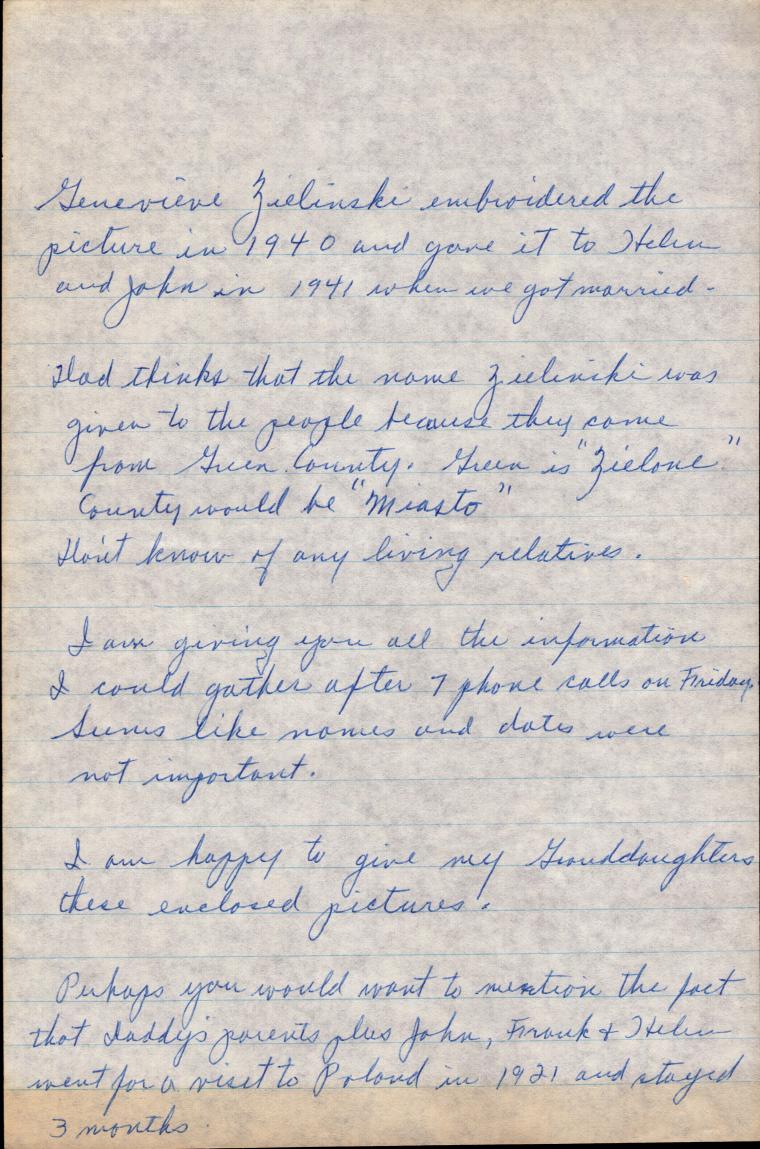
Letter from Grandma Helen 1977 page 10

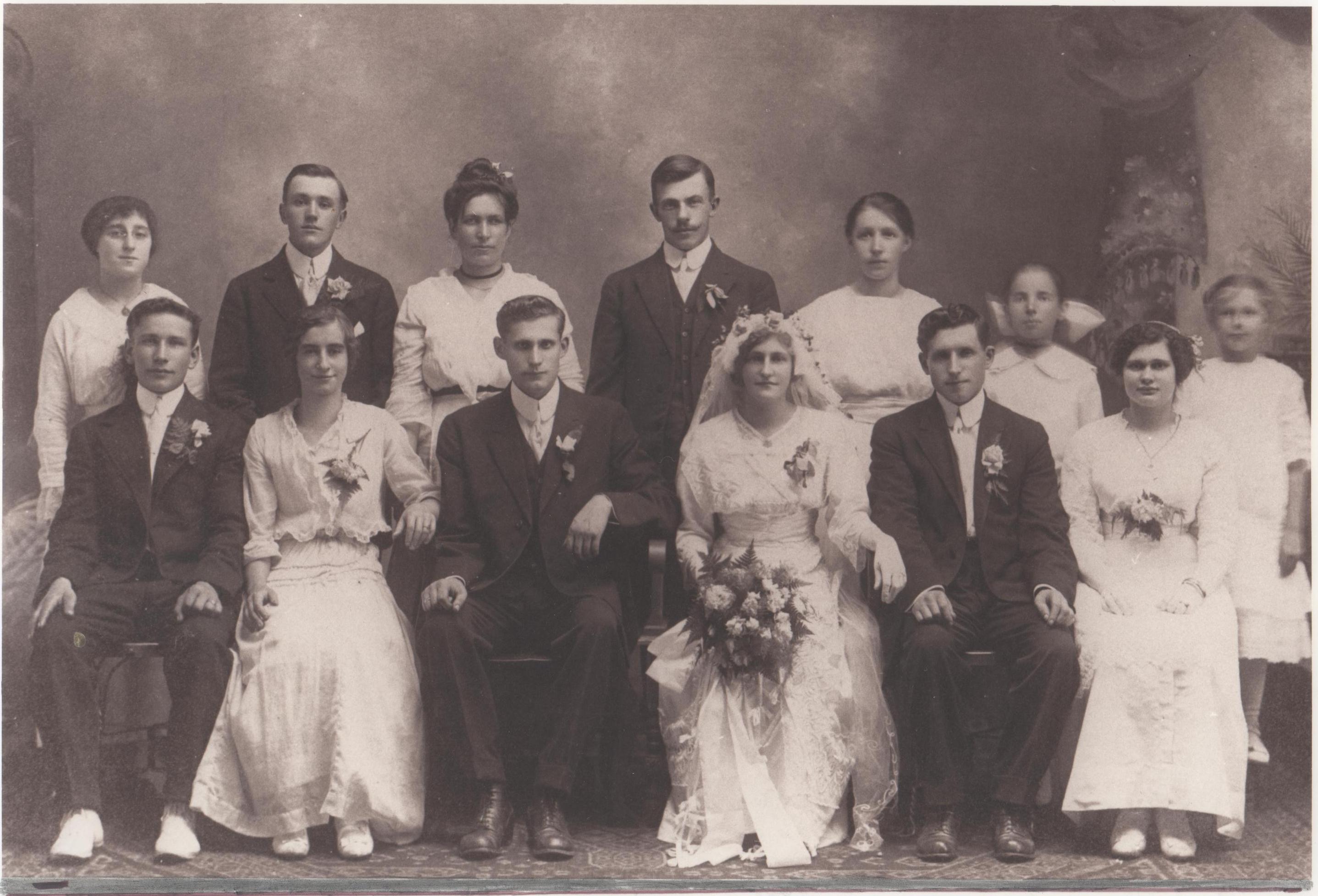
The picture that Grandma referenced (below) is now a cherished family heirloom, of course, belonging to my mother. When Grandma Genevieve stitched that picture in the year before she died, she was a patient in the sanatorium, suffering from tuberculosis.IMG_5037 (2)
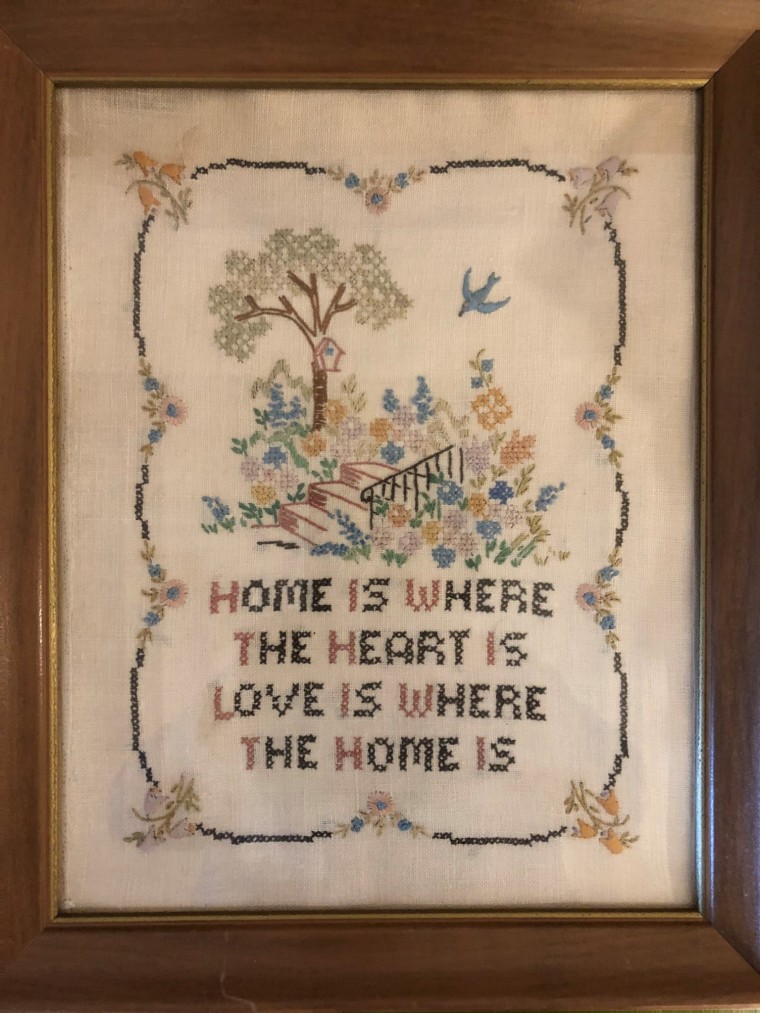
As for the remaining statements, Grandpa’s theory about the origin of the Zieliński surname is pretty much in line with accepted etymology in that the surname derives in some form from the Polish word for “green.” The lack of (close) living relatives from Poland which Grandma mentioned was always a disappointment to me, but ultimately I’ve been able to connect with distant cousins there who were identified through deeper research. The “enclosed pictures” which she mentioned were unfortunately separated from this letter, although I’m certain that my mother still has them, somewhere. And finally, the comment about Grandpa’s family trip back to Poland in 1921 has since been well documented, and I was even able to discover the reason for the trip—the death of the last surviving Zieliński sibling in Poland, Władysław, who died on 23 March 1921, leaving their elderly mother alone to manage the family farm.

So now we’ve come full circle. The family history stories that Grandma recorded in her letter got me started on my path to discover the past, but they are no longer my only source of information. After years of research, I understand which parts of the stories are accurate and which are not, and I even had the opportunity to share with Grandma some of my findings about her family before she passed in 2015. I’m now nearly the age that Grandma was when she wrote that letter, and I’ve taken on her role of story teller, helping a new generation to know a bit about our family’s origins, identifying the patriarchs and matriarchs whose DNA we carry. I only hope that my stories may be as inspirational as hers.

Source:

[1] Helen Zazycki Zielinski, North Tonawanda, New York, to the Roberts family, Cincinnati, Ohio, letter, 4 December 1977, privately held by Julie Szczepankiewicz, Hopkinton, Massachusetts.

© Julie Roberts Szczepankiewicz 2020


From Maniów to Plymouth to Chicopee: The Family of Jan Klaus

Note: This article originally appeared in the fall 2019 issue of Biuletyn Korzenie, the newsletter of the Polish Genealogical Society of Massachusetts. It is being reprinted here with permission.

Jan Klaus was no stranger to me. I’d never met him, of course, but I’d known about this brother of my great-great-grandfather, Andrzej Klaus, since March 2013, when I first discovered his baptismal record in an index at FamilySearch. What I didn’t know was what happened to him. Until recently, I never knew for certain that he immigrated to the U.S., although I suspected it. The name “John Klaus” (or Claus, or Clouse) is sufficiently common that it’s not the kind of name one spends a lot of time chasing when it’s only a collateral line. And I certainly never knew that his descendants settled in Chicopee after his death—that is, until one day, when a DNA match brought all these pieces of the puzzle together.

The Klaus-Liguz Family of Maniów and Wola Mielecka, Galicia

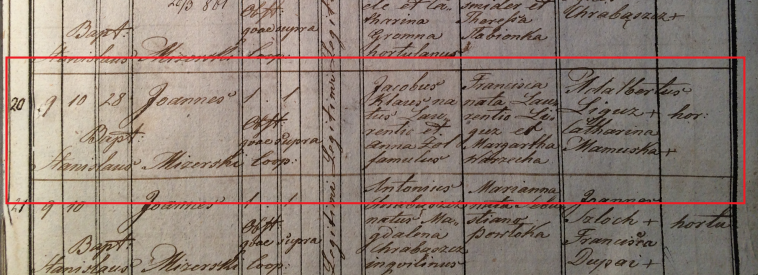
Jan Klaus was born on 9 October 1860 in the village of Maniów, in the Dąbrowa powiat (district or county) of the Galicia province of the Austro-Hungarian Empire.[1] His baptismal record is shown in Figure 1.

Figure 1: Baptismal record from the church of St. Mary Magdalene in Szczucin for Jan Klaus, born 9 October 1860. Transcription of each column is as follows: [Record number] 20, [Date of birth] 9 October 1860, [Date of baptism] 10 October 1860, [House number] 28, [child’s name] Joannes, [religion] Catholic (indicated by tally mark in the appropriate column), [sex] male (indicated by tally mark in the appropriate column), [status] legitimi, [Father] Jacobus Klaus natus Laurentio et Anna Żel, famulus, [Mother] Francisca nata Laurentio Liguz et Margaretha Warzecha, [Godparents] Adalbertus Liguz et Catharina Mamuska, hor. [hortulanus].”

jan-klaus-baptismal-record-marked

The record is in Latin, and states that Joannes Klaus, or Jan Klaus, as he would have been known among the ethnic Poles in that village, was the son of Jacobus (Jakub) Klaus, who was himself the son of Laurentius (Wawrzyniec) Klaus and Anna (née Żel) Klaus. Although it appears to be written as Żel in this document—note that the vowel looks more like the “e” in “Laurentio,” rather than the “a” in “Jacobus”—Anna’s name is more often recorded as Żala. Jan’s mother was noted to be Francisca (Franciszka), daughter of Laurentius (Wawrzyniec) Liguz and Margaretha (Małgorzata) née Warzecha. The godparents were Adalbertus (Wojciech) Liguz and Catharina (Katarzyna) Mamuska. Jan’s father, Jakub, was a servant (famulus) at the time of his birth, and his godfather was a gardener (hortulanus). Jan was baptized at the church of St. Mary Magdalene in Szczucin, the parish to which the village of Maniów belonged at the time of Jan’s birth (Figure 2).

Figure 2: St. Mary Magdalene parish in Szczucin. Photo taken by the author in July 2015.St. Mary Magdalene Church in Szczucin

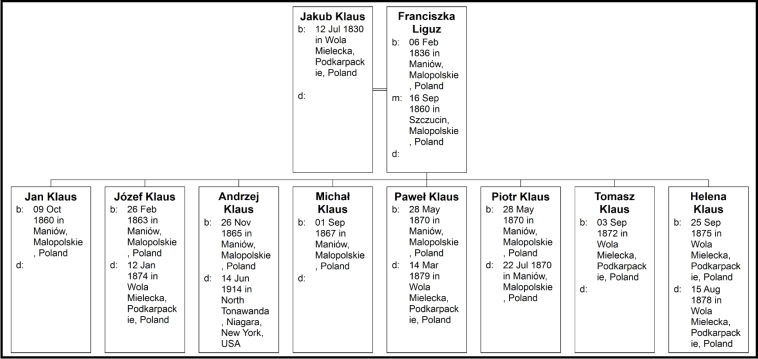
Jan was Jakub and Franciszka’s oldest child. Their marriage record tells us that Jakub was a 30-year-old servant when he married 24-year-old Franciszka on 16 September 1860 in that same parish church of St. Mary Magdalene.[2] At least six more sons were born to Jakub and Franciszka following Jan’s birth: Józef in 1863, Andrzej in 1865, Michał in 1867, twins Piotr and Paweł in 1870, and then Tomasz in 1872, before finally a daughter, Helena, was born in 1875.[3] Several of these children did not survive to adulthood. Unambiguous evidence exists for the deaths of Paweł, Piotr and Helena in childhood.[4] An additional death record from 1874 exists for Józef Klaus, son of Jakub and Franciszka Liguz, but the evidence is problematic, since the record states that he was 7 years old at the time of death, suggesting a birth year circa 1867, rather than 1863.[5] Despite this discrepancy, it seems likely that this is nonetheless the death record for the same Józef Klaus who was born in 1863, which brings the number of Klaus children who died in infancy or childhood to four out of the eight documented births. Figure 3 summarizes these data in chart form.

Figure 3: Children of Jakub Klaus and Franciszka Liguz.Jakub Klaus descendants with border

The Emigrant Klauses

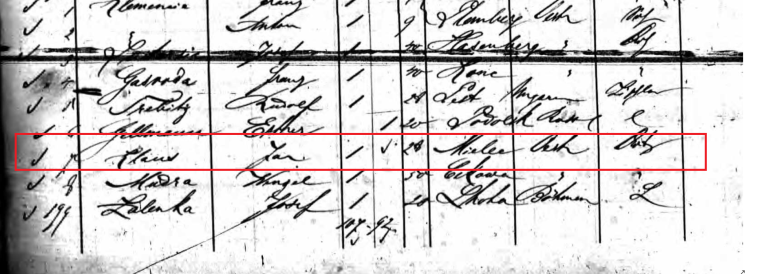
Of the remaining children of Jakub and Franciszka Klaus, I knew that my great-great-grandfather, Andrzej Klaus, immigrated to Buffalo, New York. I subsequently discovered that his brother Tomasz did, as well, since there is a record of the marriage of Tomasz Klaus of “Mielecka Wola, Gal.” to Wiktoria Rak in 1900 at St. Stanislaus Church.[6] The record states that Tomasz was the son of Jakub Klaus and Franciszka Słowik, not Liguz, and research is ongoing to determine if Słowik was perhaps the surname of Franciszka’s second husband, or was merely an error. The fate of Michał Klaus remains unknown, as no death or marriage record for him has yet been discovered in Polish or U.S. records. Jan Klaus similarly seemed to disappear from Polish records, and I suspected that he emigrated when I discovered a Jan Klaus on a Hamburg emigration manifest that seemed to be a good match (Figure 4).[7]

Figure 4: Extracted image from Hamburg passenger manifest showing Jan Klaus.Jan Klaus Hamburg emigration manifest marked

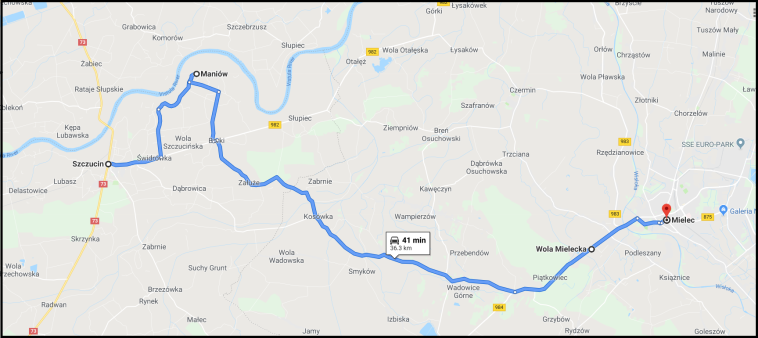
The manifest was from the S.S. Marsala, which departed from Hamburg on 14 September 1888. The passenger, Jan Klaus, was described as a 28-year-old Arbeiter (laborer) from the town of Mielec in the Austrian Empire. His age suggests a date of birth circa 1860, which would be consistent with the date of birth for my great-great-granduncle, and Mielec was the town closest to the small village of Maniów where “my” Jan was born. Figure 5 shows the locations of Szczucin, Maniów, Wola Mielecka, and Mielec in relation to one another.

Figure 5: Places in Poland associated with the Liguz-Klaus family. Jakub was born in Wola Mielecka, Franciszka in Maniów, and some of their children were born in each of these two villages.Map for Jan Klaus blog post

When one finds a Hamburg emigration manifest, it’s often possible to locate the corresponding arrival manifest, and it’s a good idea to seek these out, as they sometimes contain additional information beyond what’s found on the emigration manifest. Jan’s arrival manifest was no exception (Figure 6).

Figure 6: Extracted image from New York arrival manifest showing Jan Klaus.[8]Jan Klaus New York arrival manifest marked

As expected, much of the information on this manifest recapitulated the information found on the manifest recorded at the port of departure. Jan Klaus, age 28 years, was noted to be a male workman from Mielec, Austria. Some of the additional information provided on this manifest was not especially significant, such as the fact that he was marked as an alien (as expected), that he had no baggage, and that he was assigned to the main compartment aboard the ship. More significantly, it was noted that his intended destination was New York—a fact which might be useful in tracing him further in U.S. records. However, this particular manifest included the column, “Date and Cause of Death,” and the line for Jan Klaus contains the notation “11–6.” Given that the Marsala departed Hamburg on 14 September and arrived on 1 October, the significance of these particular numbers is unclear, but certainly the presence of some notation in this column suggested that the passenger Jan Klaus died during the voyage. In the light of this information, and in absence of any good matches for this Jan Klaus in records from Buffalo, where his brothers Andrzej and Tomasz settled, I accepted the tentative conclusion that Jan may not have survived, and I moved on to other research questions.

DNA Points the Way

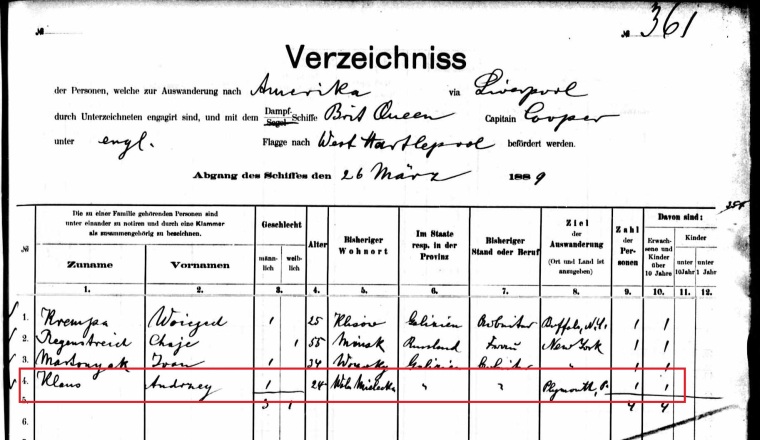
Fast forward to December 2018. While reviewing some of my mother’s DNA matches, I came across a match to “N.F.M.” whose family tree indicated that her great-grandfather was John Klaus, born circa 1861. N.F.M was a DNA match to me as well, although we matched only as distant cousins, sharing a modest 19 centimorgans (cM) across 2 segments. I was immediately intrigued, and my excitement grew when I read that her John Klaus died in Plymouth, Pennsylvania in 1920. This fact was significant to me because my great-great-grandfather Andrzej Klaus named Plymouth, Pennsylvania as his destination when he immigrated in 1889 (Figure 7).[9]

Figure 7: Image extracted from passenger manifest of the British Queen, showing passenger Andrzey [sic] Klaus with destination as Plymouth, Pennsylvania.Andrzej Klaus manifest marked 1889

I was never able to document Andrzej in Plymouth, and since he married Marianna Łącka in Buffalo on 21 January 1891, it’s clear that he didn’t stay in Plymouth for long.[10] Neither could I find a corresponding arrival manifest for the British Queen, which should have arrived in an American port in mid-April 1889 based on its departure from Hamburg on 26 March. The arrival manifest might have stated the name of the friend or relative with whom Andrzej was staying, and lacking this information, I had no basis for further speculation about the identity or surname of this friend or relative. However, in light of this new evidence that I was genetically connected to a descendant of John Klaus from Plymouth, Pennsylvania, a missing piece to the puzzle seemed to fall into place.

An important thing to remember about autosomal DNA testing is that it doesn’t prove anything on its own. Even when there is a paper trail documenting both individuals’ descent from a common ancestor, it could still be the case that the individuals are related through some as yet undiscovered relationship which could be the source of the shared DNA segment. Nevertheless, DNA evidence can be very helpful in cases such as this, when there is a common surname involved, because it can help us identify a target individual or family for further documentary research. Since the match between my mother and N.F.M. was found on Ancestry DNA, it’s not possible to know anything about the chromosome number or specific position of the matching DNA segments. However, shared matches between my mother and N.F.M. can be examined, and the amount of shared DNA (in cM) can be considered as well.

Examination of Shared Centimorgans

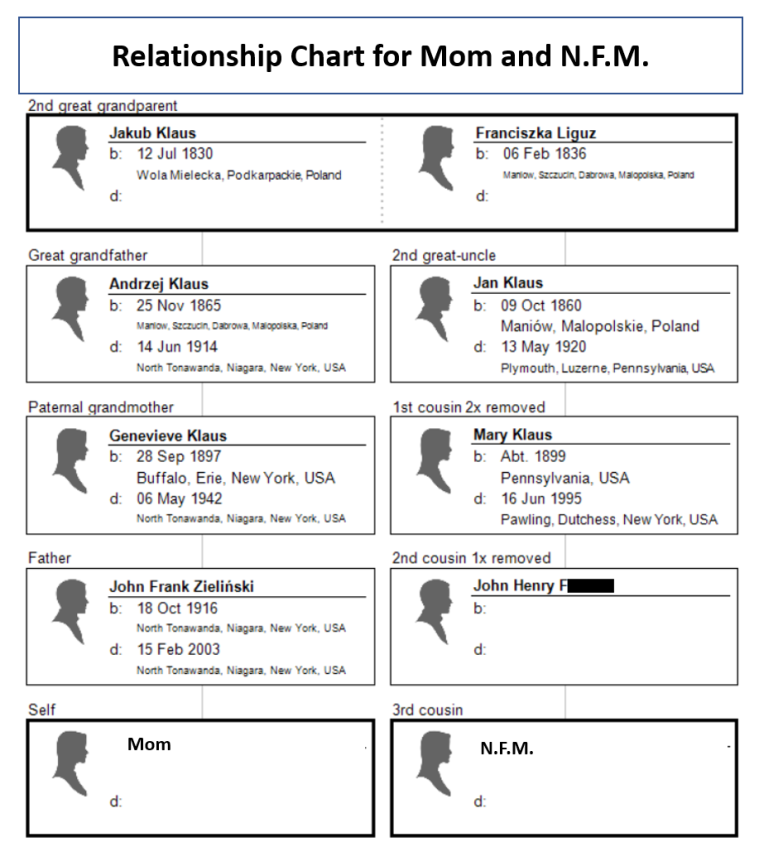
If we begin with the assumption that N.F.M.’s tree is correct—a reasonable assumption in this case—then she is the great-granddaughter of John (Jan in Polish) Klaus and his wife, Mary or Marya Frankowska. Since my mother is the great-granddaughter of John Klaus’s brother Andrzej (Andrew in English), Mom and N.F.M. should be third cousins, and should share an amount of DNA that falls within the normal range for that relationship. According to data gathered by Blaine Bettinger’s “Shared cM Project,” third cousins can be expected to share anywhere from no DNA, up to 274 cM, with an average of 74 cM shared DNA.[11] Since it’s possible that third cousins will not share any DNA (thanks to the random nature of DNA inheritance through recombination), the fact that Mom and N.F.M. share only 25 cM of DNA over 3 segments is not a concern, despite the fact that this amount is below the statistical average expected for this relationship. Moreover, since mom’s line of descent from Andrew was through (1) her father, (2) his mother, and (3) his mother’s father (Figure 8), we would expect that the list of shared matches between Mom and N.F.M. would include additional paternal cousins of Mom’s who were known to be documented descendants of Jakub Klaus and Franciszka Liguz.

Figure 8: Relationship chart for Mom and N.F.M. Since their great-grandfathers (Andrzej and Jan) were siblings, their grandmothers (Genevieve and Mary) were first cousins, and their late fathers (John Frank and John Henry) were second cousins. Some data have been redacted to protect the privacy of the living.Relationship chart for Mom and Nancy Foster Mulroy

Evaluation of Shared Matches

In fact, that’s exactly what we find. For example, Mom has a paternal first cousin, M.D., whose mother was John Frank Zielinski’s sister. This means that M.D. would also be a documented third cousin of N.F.M, although they may or may not share any DNA. As it happens, Ancestry reports M.D. as a shared match between Mom and N.F.M., as predicted. Although it’s not possible to know how many centimorgans of DNA are shared between M.D. and N.F.M. or where those matching segments are located, we know that M.D. and N.F.M must match at the level of 4th cousin or closer, based on Ancestry’s cut-offs for reporting shared matches.

Although M.D. is the only one of Mom’s known cousins who also matches N.F.M., additional DNA evidence can be found in Mom’s match list on Ancestry. Further examination of Mom’s DNA matches revealed a match to R.D.S, who is another great-granddaughter of John Klaus and Mary Frankowska, just like N.F.M. While N.F.M. was descended from John and Mary through their grandson, John Henry (see Figure 8), R.D.S. is descended from them through John Henry’s sister, Mary Catherine. Examination of the shared matches between R.D.S. and Mom produces two of Mom’s documented second cousins, R.S.L. and D.M.R., both of whom are descended from Genevieve Klaus’s sister, Anna Klaus Gworek.

Back to the Paper Trail

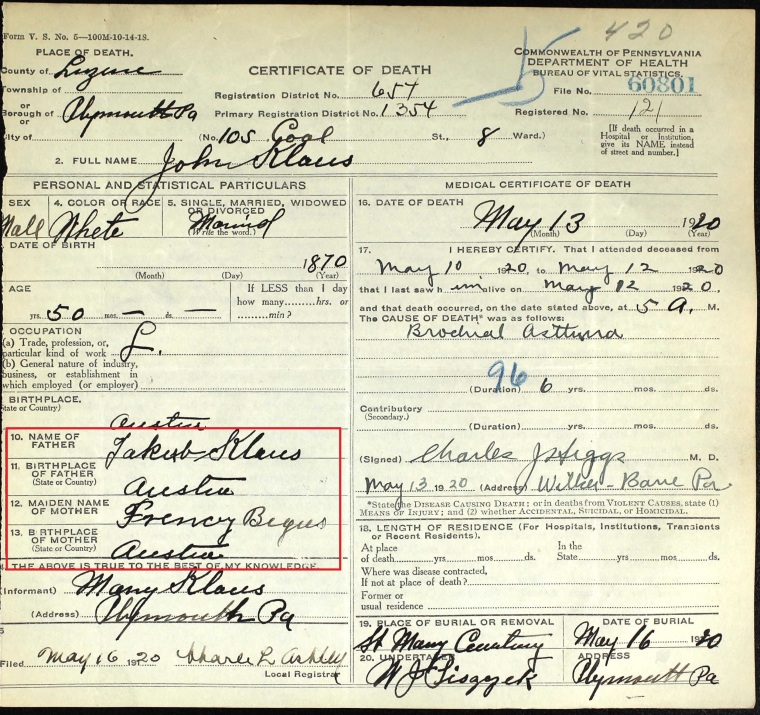
At this point the DNA evidence strongly supports our hypothesis that John Klaus of Plymouth, Pennsylvania, husband of Mary Frankowska, is, in fact, the same as Jan Klaus, brother of Andrzej and son of Jakub Klaus and Franciszka Liguz. Although neither N.F.M. nor R.D.S. had done any research in Polish records, R.D.S.’s tree provided further documentation to add to the growing body of evidence: John Klaus’s death certificate stated his parents’ names as Jakub Klaus and “Frency Bigus” (Figure 9).[12]

Figure 9: Death certificate of John Klaus of Plymouth, Luzerne, Pennsylvania, showing parents’ names.John Klaus death certificate marked

The informant on the certificate was John’s wife, Mary, and it’s easy to see how “Franciszka Liguz” might have been transformed into “Frency Bigus” in a moment of grief, given that she’d probably never met her mother-in-law.

Coming back full circle now to that passenger manifest for Jan Klaus from the S.S. Marsala in 1888, it appears that it was the correct manifest after all. John reported in the 1910 census that he arrived in the U.S. in 1889, which is reasonably consistent with that October 1888 arrival.[13] Moreover, the record of his marriage to Mary “Fratzkoska” [sic] on 21 January 1890 confirms that he was in the U.S. by that date.[14] It may be that New York was his intended destination upon arrival, as recorded on the manifest, and he decided to settle in Plymouth at a later date. Perhaps the numbers written in the “Date and Cause of Death” column had some other obscure significance, since it’s clear that Jan Klaus did not die on the voyage to America. However, the  general agreement between the date of arrival, the passenger’s name, his date of birth, and his origin in Mielec all support the conclusion that this is probably Jan’s passenger manifest, in spite of the discrepancies.

Epilogue: Mary Frankowska’s Story

Following their marriage in 1890, John and Mary went on to have ten children, all born in Pennsylvania, according to the 1910 census. However, only 6 of these children—Thomas, Frances, Mary, Katherine, John Jr., and Leon—were still living in 1910, so there are four more children whose births and deaths might be documented through baptismal records from the church they attended in Plymouth. The oldest son, Thomas Klaus, left Plymouth and was living in Southwick, Hampden, Massachusetts as early as 1914 when he married his wife, Florence Phillips.[15] Frances, Mary, and Katherine Klaus all eventually followed suit and moved to Western Massachusetts, along with their brother Leon. (John Klaus, Jr. settled in Jersey City, New Jersey.) After John Klaus (Sr.) died in Plymouth, Pennsylvania in 1920, his widow Mary (née Frankowska) followed her children to western Massachusetts, where she died in Chicopee in 1923.[16]

When I started researching Jan Klaus’s family for myself, I became curious about Mary Frankowska’s origins. As mentioned, neither of the DNA matches, N.F.M. and R.D.S, had done any research in Polish records, and Mary’s parents’ names were not known. The 1910 census reported that she was born in Austria, and I wondered if perhaps she was from the same part of Galicia as her husband. I decided to check the FamilySearch database, “Poland, Tarnów, Roman Catholic Diocese Church Books, 1612-1900” for her baptism. The name of this database is a bit misleading since it indexes only baptismal records, rather than containing any marriage or death records whose inclusion might be implied by the use of the term “Church Books.”[17] Nevertheless, it can be a good starting point for researching immigrants who are suspected to have originated in the Tarnów region. Interestingly, the search produced a baptismal record for Marianna Josepha Frankowski, daughter of Josephus Frankowski and Anna Dachowski, born 5 August 1863 in—drumroll, please!—“Maniów, Maniów, Kraków, Poland.”[18] This is the same Maniów where Jan Klaus was born, and the year of birth, 1863, was consistent with the year of birth suggested by Mary Klaus’s age as reported on the 1910 census and her marriage record. If this was, in fact, her birth record, then Mary Klaus and her husband John were actually from the same village in Poland—not an uncommon situation, but a delicious bit of research serendipity nonetheless.

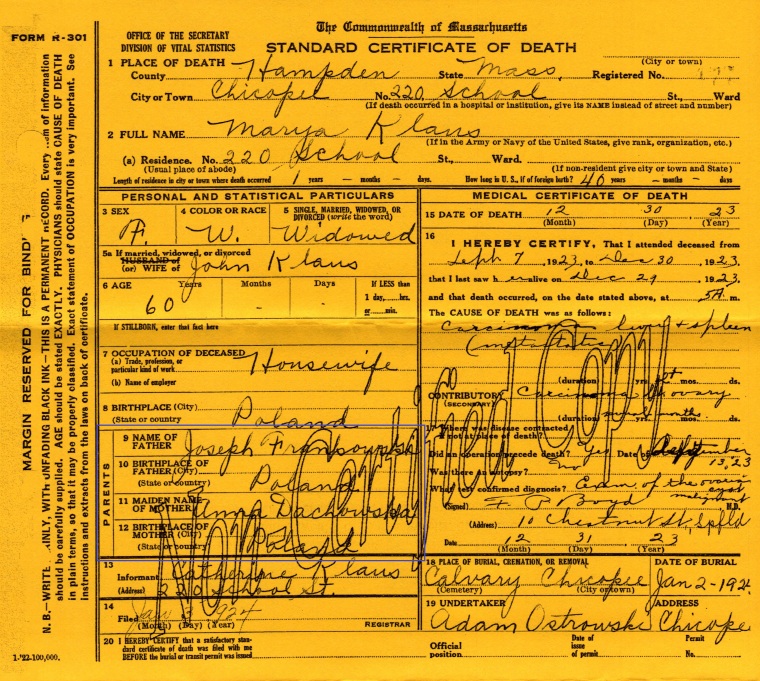
Mary’s death certificate was the linchpin needed to confirm this hypothesis. I requested a copy from the city clerk in Chicopee, and bingo! The parents of Mary Klaus were Joseph Frankowski and Anna Dachowska, a perfect match to the birth record in the FamilySearch index (Figure 10). According to the certificate, Mary died on 30 December 1923 at the age of 60, suggesting a birth year of 1863. Consistent with expectations, the certificate states that she was the widow of John Klaus, was living at 220 School Street, and had been a resident of Chicopee for one year prior to her death. The informant was her daughter Catherine Klaus who was living with her, and Mary was buried in Calvary Cemetery in Chicopee on 2 January 1924.

Figure 10: Death certificate of Mary (née Frankowska) Klaus of Chicopee, Hampden, Massachusetts, widow of John Klaus.Marya Klaus death 1923 cropped marked

More research can still be done in both Polish and U.S. records to flesh out the history of John and Mary (née Frankowska) Klaus and their descendants, but the outline of the story has been firmly established. The paper trail tells the story of Jan’s emigration aboard the S.S. Marsala in 1888, his residence in Plymouth, and his marriage to Marianna Frankowska, a young woman from his home village, in 1890. We know of their 10 children, and we can trace the lineages of some of those children into the present day. Their descendants carry a legacy in the form of bits of DNA which allow us distant cousins to identify each other as fellow descendants of Jakub Klaus and Franciszka Liguz. With every connection we make, our understanding of the family’s history deepens and grows. Who knew that this Buffalo girl had family connections to Chicopee? I do now.

Sources:

[1] Roman Catholic Church, Sanktuarium Matki Bożej Fatimskiej – Różańcowej (Borki, Szczucin, Dąbrowa, Małopolska, Poland), “Ksiąg Metrykalnych,” 1860, births, #20, record for Joannes Klaus, born 9 October 1860.

[2] Roman Catholic Church, St. Mary Magdalene parish (Szczucin, Dąbrowa, Małopolskie, Poland), “Księgi metrykalne, 1786-1988,” Akta małżeństw 1786-1988, Maniów, 1860, 16 September 1860, marriage record for Jacobus Klaus and Francisca Liguz, FHL Film no. 1958428, Items 7-8.

[3] Roman Catholic Church, Sanktuarium Matki Bożej Fatimskiej – Różańcowej (Borki, Szczucin, Dąbrowa, Małopolska, Poland), “Ksiąg Metrykalnych”, 1863, baptismal record for Josephus Klaus, born 26 February 1863; and

Roman Catholic Church, Sanktuarium Matki Bożej Fatimskiej – Różańcowej (Borki, Szczucin, Dąbrowa, Małopolska, Poland), “Ksiąg Metrykalnych”, 1865, births, #37, record for Andreas Klaus, born 25 November 1865; and

Roman Catholic Church, Sanktuarium Matki Bożej Fatimskiej – Różańcowej (Borki, Szczucin, Dąbrowa, Małopolska, Poland), “Ksiąg Metrykalnych”, 1867, #20, baptismal record for Michael Klaus, born 1 September 1867; and

Roman Catholic Church, Sanktuarium Matki Bożej Fatimskiej – Różańcowej (Borki, Szczucin, Dąbrowa, Małopolska, Poland), “Ksiąg Metrykalnych”, 1870, #18, baptismal record for Paulus and Petrus Klaus, born 28 May 1870; and

“Podkarpackie,” database, Polskie Towarzystwo Genealogiczne, Geneteka, (http://geneteka.genealodzy.pl), Search result for Klaus births in Podkarpackie, 1872, #23, Tomasz Klaus, son of Jakub Klaus and Franciszka Nygus (sic), parish Ksiaznice-Wola Mielecka, born in Wola Mielecka on 3 September 1872, source, parish archives, indexed by Krzysztof Gruszka, accessed 3 August 2017; and

“Podkarpackie”, database, Polskie Towarzystwo Genealogiczne, Geneteka, (http://geneteka.genealodzy.pl), Search result for Klaus births in Podkarpackie, 1875, #23, Helena Klaus, son of Jakub Klaus and Franciszka Nygus (sic), parish Ksiaznice-Wola Mielecka, born in Wola Mielecka on 25 September 1875, source, parish archives, indexed by Krzysztof Gruszka, accessed 3 August 2017.

[4] “Podkarpackie”, database, Polskie Towarzystwo Genealogiczne, Geneteka, (http://geneteka.genealodzy.pl), Search result for Klaus deaths in Podkarpackie, 1879, #7, Pawel Klaus, son of Jakub Klaus and Franciszka Liguz, parish Ksiaznice-Wola Mielecka, died in Wola Mielecka on 14 March 1879 at the age of 8 years, source, parish archives, indexed by Krzysztof Gruszka, accessed 3 August 2017; and

Roman Catholic Church, Sanktuarium Matki Bożej Fatimskiej – Różańcowej (Borki, Szczucin, Dąbrowa, Małopolska, Poland), “Ksiąg Metrykalnych”, 1870, #18, baptismal record for Paulus and Petrus Klaus. Note: There is a cross next to Petrus’ name which indicates that he died 22 July 1870; and

“Podkarpackie”, database, Polskie Towarzystwo Genealogiczne, Geneteka, (http://geneteka.genealodzy.pl), Search result for Klaus deaths in Podkarpackie, 1878, #28, Helena Klaus, daughter of Jakub Klaus and Franciszka Liguz, parish Ksiaznice-Wola Mielecka, died in Wola Mielecka on 15 August 1878 at the age of 3 years, source, parish archives, indexed by Krzysztof Gruszka, accessed 3 August 2017.

[5] “Podkarpackie”, database, Polskie Towarzystwo Genealogiczne, Geneteka, (http://geneteka.genealodzy.pl), Search result for Klaus deaths in Podkarpackie, 1874, #4, Józef Klaus, son of Jakub Klaus and Franciszka Liguz, parish Ksiaznice-Wola Mielecka, died in Wola Mielecka on 12 January 1874 at the age of 7 years, source, parish archives, indexed by Krzysztof Gruszka, accessed 3 August 2017.

[6] Roman Catholic Church, St. Stanislaus parish (Buffalo, Erie, New York, USA), Marriages, 1900, #77, record for Tomasz Klaus and Wiktorya Rak, 20 November 1900, accessed as browsable images, “Church records, 1873-1917,” FamilySearch (https://familysearch.org/ark:/61903/3:1:3Q9M-CS4N-64QV-L?i=1468&cat=23415: http://familysearch.org : 7 August 2017), image 1469 of 1979.

[7] “Hamburg Passenger Lists, 1850-1934,“ Ancestry, (http://ancestry.com : 31 July 2019) S.S. Marsala, departing 14 September 1888, p 338, line 197, Jan Klaus, citing Staatsarchiv Hamburg; Hamburg, Deutschland; Hamburger Passagierlisten; Microfilm No.: K_1738, Volume 373-7 I, VIII A 1 Band 062 B.

[8] “New York Passenger Lists, 1820-1891,” database with images, FamilySearch (https://familysearch.org/ark:/61903/1:1:QVSL-CV45 : 17 December 2018), S.S. Marsala , arriving in New York on 1 October 1888, passenger no. 197, Jan Klaus, 1888; citing NARA microfilm publication M237 (Washington, D.C.: National Archives and Records Administration, n.d.).

[9] “Hamburg Passenger Lists, 1850-1934,” Ancestry, (http://ancestry.com : 7 August 2019) S.S. British Queen, departing Hamburg 26 March 1889, p. 361, line 4, passenger Andrzey Klaus, citing Staatsarchiv Hamburg; Hamburg, Deutschland; Hamburger Passagierlisten; Microfilm No.: S_13155, Volume: 373-7 I, VIII B 1 Band 077.

[10] Roman Catholic Church, St. Stanislaus parish (Buffalo, Erie, New York, USA), Marriages, 1891, no. 26, record for Andrzej Klaus and Marya Łączka, 21 January 1891, accessed as browsable images, “Church records, 1873-1917,” FamilySearch (https://familysearch.org/ark:/61903/3:1:3Q9M-CS4N-64SL-7?i=1407&cat=23415 : 7 August 2019), image 1408 of 1979.

[11] Blaine Bettinger, “August 2017 Update to the Shared cM Project,” The Genetic Genealogist, https://thegeneticgenealogist.com: posted 26 August 2017).

[12] Pennsylvania Death Certificates, 1906-1966,” database, Ancestry, (http://ancestry.com : 7 August 2019), Plymouth, Luzerne, Pennsylvania, no. 60801, certificate for John Klaus, died 13 May 1920, citing  Pennsylvania Historic and Museum Commission; Pennsylvania, USA; Pennsylvania, Death Certificates, 1906-1965; Certificate Number Range: 058501-061500, record for John Klaus, citing Pennsylvania (State). Death certificates, 1906–1963. Series 11.90 (1,905 cartons). Records of the Pennsylvania Department of Health, Record Group 11. Pennsylvania Historical and Museum Commission, Harrisburg, Pennsylvania.

[13] “1910 United States Federal Census” (population schedule), Plymouth Ward 5, Luzerne, Pennsylvania, Enumeration District 105, Sheet 5A, John Klaus household, Ancestry (https://ancestry.com : 12 December 2018),  citing NARA microfilm publication T624, roll 1369.

[14] Clerk of Orphans Court of Luzerne County, Marriage License Docket, license no. 7356, John Clause and Mary Fratzkoska, married 21 January 1890, accessed as digital images,”Pennsylvania County Marriages, 1885-1950,” FamilySearch (https://www.familysearch.org :  19 December 2018), DGS no. 004268759, image 292 out of 625.

[15]“Massachusetts, Marriage Records, 1840-1915,” database with images, Ancestry (https://ancestry.com : 19 December 2018),  record for Thomas Klous [sic] and Florence Phillips, June 24, 1914, Southwick, Hampden, Massachusetts.

[16] Chicopee, Hampden, Massachusetts, no. 177 [?], death certificate for Marya Klaus, 30 December 1923; Chicopee Town Clerk’s Office, Chicopee, Massachusetts.

[17] “Poland Tarnow Roman Catholic Diocese Church Books – FamilySearch Historical Records Coverage Table,” FamilySearch (https://www.familysearch.org/wiki/en/Poland_Tarnow_Roman_Catholic_Diocese_Church_Books_-_FamilySearch_Historical_Records_Coverage_Table : 10 August 2019).

[18] “Poland Tarnow Roman Catholic Diocese Church Books, 1612-1900,” Marianna Josepha Frankowski, baptized 5 August 1863, FamilySearch (https://www.familysearch.org/ark:/61903/1:1:X5HQ-G5J : 10 August 2019).

© Julie Roberts Szczepankiewicz 2019

Using the PRADZIAD Database

Update (June 1, 2020): Shortly after this post was written, the Polish state archives announced that the current version of PRADZIAD will only be available through the new version of Szukajwarchiwach. I was disappointed by this development, because I preferred the old PRADZIAD format for displaying search results. However, life is all about change, so adapt we must. A tutorial for using the new Szukajwarchiwach site can be found here.

One of the most frequently-asked questions in Polish genealogy groups on Facebook is, “Where can I find vital records—whether church books or civil registrations—for X parish or registry office?” There are really only four answers to this question: vital records might be at the parish, the diocesan archive, the regional state archive, or the local civil records office (urząd stanu cywilnego, or USC). The devil is in the details, however. Sometimes it’s difficult to ascertain precisely which books are held by a given repository, without a phone call or email to the repository. At other times, it’s much simpler, and one of the tools that makes life simple is the PRADZIAD database.

What is PRADZIAD?

PRADZIAD’s official name is Baza danych Program Rejestracji Akt Metrykalnych i Stanu Cywilnego, or The Program for the Registration of Records from Parish and Civil Registration Offices. The name is also something of a play on words, since “pradziad” is the Polish word for “great-grandfather,” and this database pertains specifically to metrical books and civil registers, which are the source of vital records. Although the database originally (prior to 2011) excluded information from some of the state archives (Lublin, Poznań), it presently contains information on the vital records holdings of all the Polish state archives, plus some additional archives:

  • the Roman Catholic diocesan or archdiocesan archives in Łódź, Poznań, Płock, Szczecin, Warszawa-Praga, Włocławek, and Wrocław;
  • the Książnicy Pomorskiej im. Stanisława Staszica w Szczecinie (the Stanisław Staszic Pomeranian Library in Szczecin);
  • the records for the diocese of Pińsk held by the Archiwum Diecezjalnym w Drohiczynie (Roman Catholic diocesan archive in Drohiczyn);
  • the Fundacji Kultury i Dziedzictwa Ormian Polskich (the Foundation of Culture and Heritage of Polish Armenians); and
  • the “Zabużańskie archive,” which holds record books of the Jewish and Roman Catholic denominations that were formerly located in the Kresy (territories of Poland that became part of the USSR after 1944). The Zabużańskie books are currently stored at the Urząd Stanu Cywilnego m.st. Warszawy (Registry Office of the Capital City of Warsaw) but are gradually being transferred to the Archiwum Główne Akt Dawnych (Central Archive of Historical Records).

How Do I Search PRADZIAD?

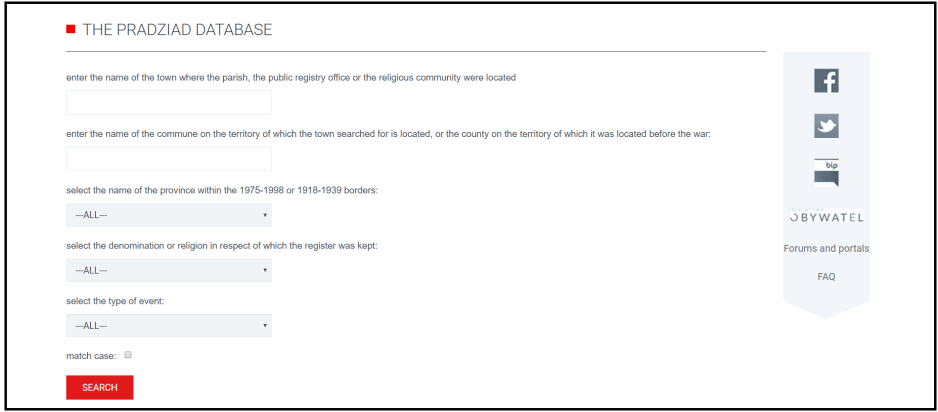
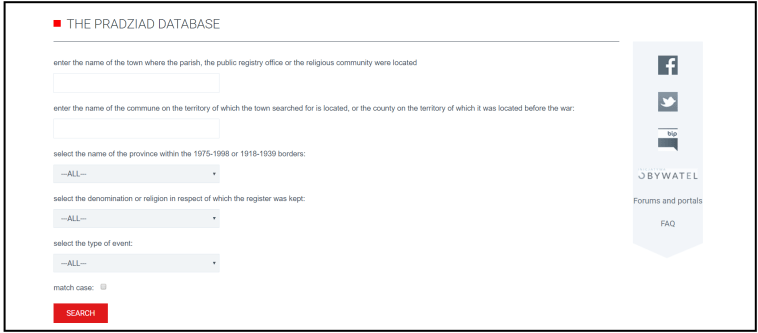
The database can be searched quickly, easily, and with an English search interface, here. This same search screen is shown in Figure 1:

Figure 1: PRADZIAD search screen.PRADZIAD search screen

Although it’s pretty straightforward, there are a few things that are helpful to know in setting up a search.

  1. Diacritics are not required, so searching for “Lodz” will produce results for Łódź.
  2. The search term must be the name of the parish or registry office that served a village, not just the village name. If my ancestors were from Wola Koszucka, a village belonging to the Roman Catholic parish in Kowalewo Opactwo, powiat słupecki (Słupca County), I must search for Kowalewo, not Wola Koszucka. Not sure how to find the parish? Use a gazetteer. A number of them are listed here.
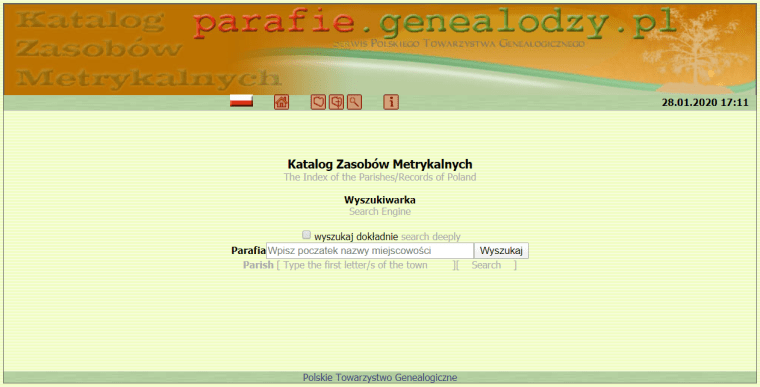
  3. All other input boxes except for the place name are optional. I usually skip the box where it says, “enter the name of the commune on the territory of which the town searched for is located or the county on the territory of which it was located before the war” because it’s easier to refine the search in other ways. However, when searching for a common place name (e.g. Dąbrowa), it’s useful to utilize the drop-down menu in the next option, where it states, “select the name of the province within the 1975-1998 or 1918-1939 borders.” This will help narrow the search results. If the province in which the parish was located under the old administrative structure is not known, there’s a handy tool offered by the PTG (Polskie Towarzystwo Genealogiczne) that can help. The PTG are the same folks who bring us Geneteka and Metryki and a whole host of other genealogical gems, and this particular tool is called the Katalog Zasobów Metrykalnych (Catalog of Metrical Resources). The search page is shown in Figure 2.

Figure 2: Search interface for the Katalog Zasobów Metrykalnych.Katalog

Diacritics are not required here, either, so I can search for “Dabrowa,” and find a list of all the parishes in Poland with “Dąbrowa” as part of the name (Figure 3).

Figure 3: Search results from the Katalog Zasobów Metrykalnych for “Dabrowa.” Only the top 16 search results out of 42 are shown.Katalog results for Dabrowa

The column boxed in red, “stare,” indicates the former województwo (province) to which the parish was assigned during the period from 1975-1998. From this chart, it is apparent that the parish of Dąbrowa which is located in the present-day Mazowieckie province, was formerly within the Ciechanów province. When this information is added to the search screen in PRADZIAD, the search hits are reduced from 111 down to 12.

4. Additional options for limiting search results include specifying the religion, and specifying the type of document (birth, marriage, death, etc.) While I rarely use the latter option, there are definitely times when specifying the religion can be useful.

The Fine Print

As you will have guessed by now, this database does not offer any information on individuals. It’s not a nominal index like Geneteka where the name of an ancestor can be searched. This database will only provide information on the vital-records holdings of the state archives (and a few additional archives, as noted above) for a particular location. A lack of results in PRADZIAD, does not imply that all the vital records for that location were destroyed, as vital records may still be found in the diocesan archive, the parish itself, or the USC (which would typically have the most recent 100 years of civil registrations, which are protected by Polish privacy laws). PRADZIAD offers no information on collections other than metrical books—such as census records, population registers, business records, town records, maps, photographs, notarial records, court records, etc.—which might be available for a given town. These can be discovered through a search at Szukajwarchiwach instead, where results will include all the holdings of the state archives related to a particular search term, including metrical books, where applicable. (For more information on using Szukajwarchiwach, a tutorial is available here.) Finally, search results displayed at PRADZIAD will not offer any indication of which collections might be found online and which can only be obtained by other means. It’s up to the researcher to perform his own due diligence before writing to the archive to request a search. (Examples of sites which offer online scans of vital records from Polish parishes include Szukajwarchiwach, Genealogia w Archiwach, Metryki, GenBaza, FamilySearch, etc.)

So what’s the point in searching only in PRADZIAD, if Szukajwarchiwach offers more comprehensive search results? It may be nothing more than a matter of personal preference, but for a researcher who is focused on finding vital records, the search format may be a little easier, and the results may be a little less to wade through, when using PRADZIAD. More information about writing to archives in Poland and examples of using PRADZIAD can be found here.  Happy researching!

© Julie Roberts Szczepankiewicz 2020


Robert Hodgkinson’s Land

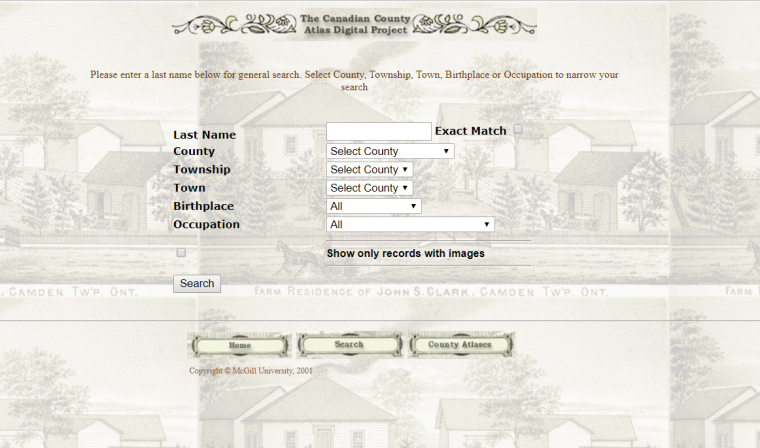
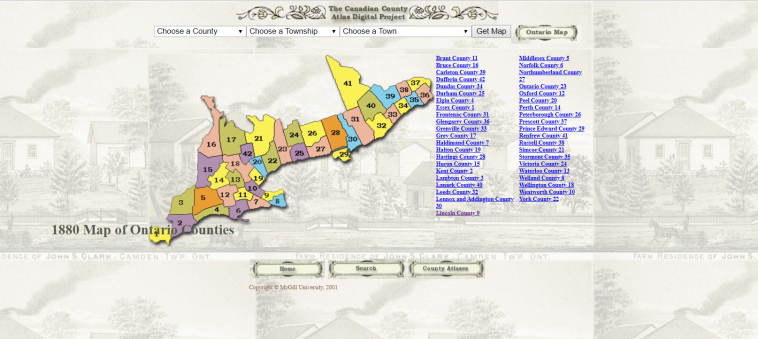
Genealogy and a love of old maps seem to go hand in hand, and I’m always excited to find new sites where I can find maps relevant to my geographic research areas. One site that’s especially nice for those researching Canadian ancestors is the Canadian County Atlas Digital Project site, hosted by McGill University. The site includes an impressive 43 atlases originally published between 1875–1881 from counties in Ontario, Quebec, and the Maritime provinces, but the best part is that property owners’ names were marked on the township maps. The site permits searching by surname (Figure 1), or alternatively, individual township maps can be selected from an 1880 map of Ontario counties (Figure 2)

Figure 1: Search screen for surname searches of the Canadian County Atlas database.Personal name search

Figure 2: Search screen for selecting counties based on 1880 map.Map search screen

So for example, a surname search for “Hodgkinson” produces 8 matches, including two which pertain to land owned by my 4x-great-grandfather, Robert Hodgkinson (Figure 3).

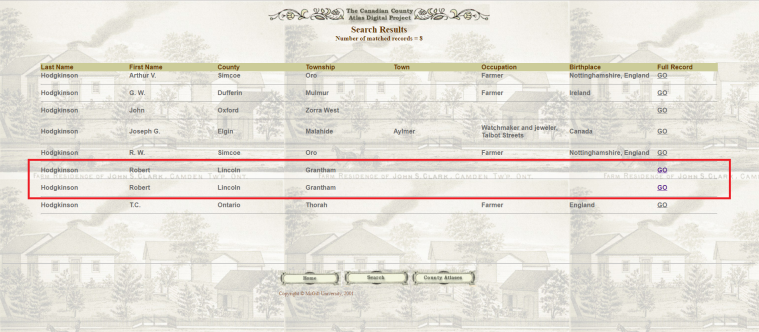
Figure 3: Search results for Hodgkinson, with results for Robert Hodgkinson of Grantham boxed in red.Robert Hodgkinson in Canadian County Atlas Project

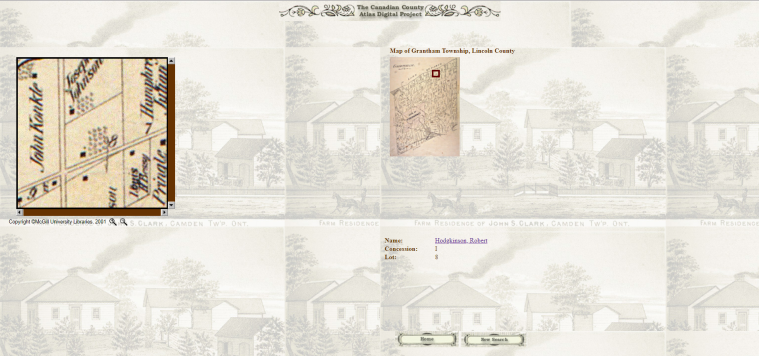
Clicking “Go” for the first result shown indicates that Robert Hodgkinson owned a parcel of 130 acres on Lot 8, Concession I (Figure 4).

Figure 4: Full record for first search result for Robert Hodgkinson.Robert Hodgkinson search result 1

In Upper Canada following the American Revolution, undeveloped land was divided into townships, which were then subdivided into concessions, which were typically rectangular parcels of land, 1 1/4 miles wide, with concession roads running between them. Concessions were then divided into 200-acre lots, which could be further divided as needed. Robert Hodgkinson’s parcel of land, located on Lot 8, Concession I, can be viewed by clicking “Locate on Map,  which produces a close crop of the parcel in question as well as a thumbnail image of the map on which the parcel appears (Figure 5).

Figure 5: Mapped location of first parcel of land noted to be owned by Robert Hodgkinson.Hodgkinson parcel 1

When the process is repeated for the second search result in Figure 3, we can see that Robert Hodgkinson owned a second parcel of land immediately south of the first parcel, located on Lot 8 on Concession II.

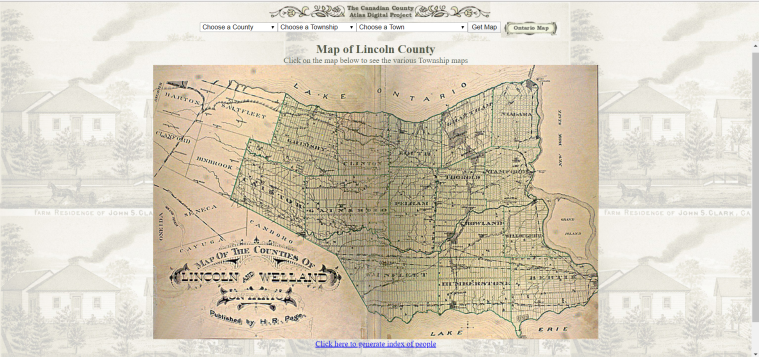
To view these parcels in a broader geographic context, we can find the map on which they appear by returning to the map search page shown in Figure 2. Lincoln County is number 9 on the map index, and clicking on it produces a map from which individual townships can be selected (Figure 6).

Figure 6: Map of Lincoln County with individual township maps. Map of Lincoln county

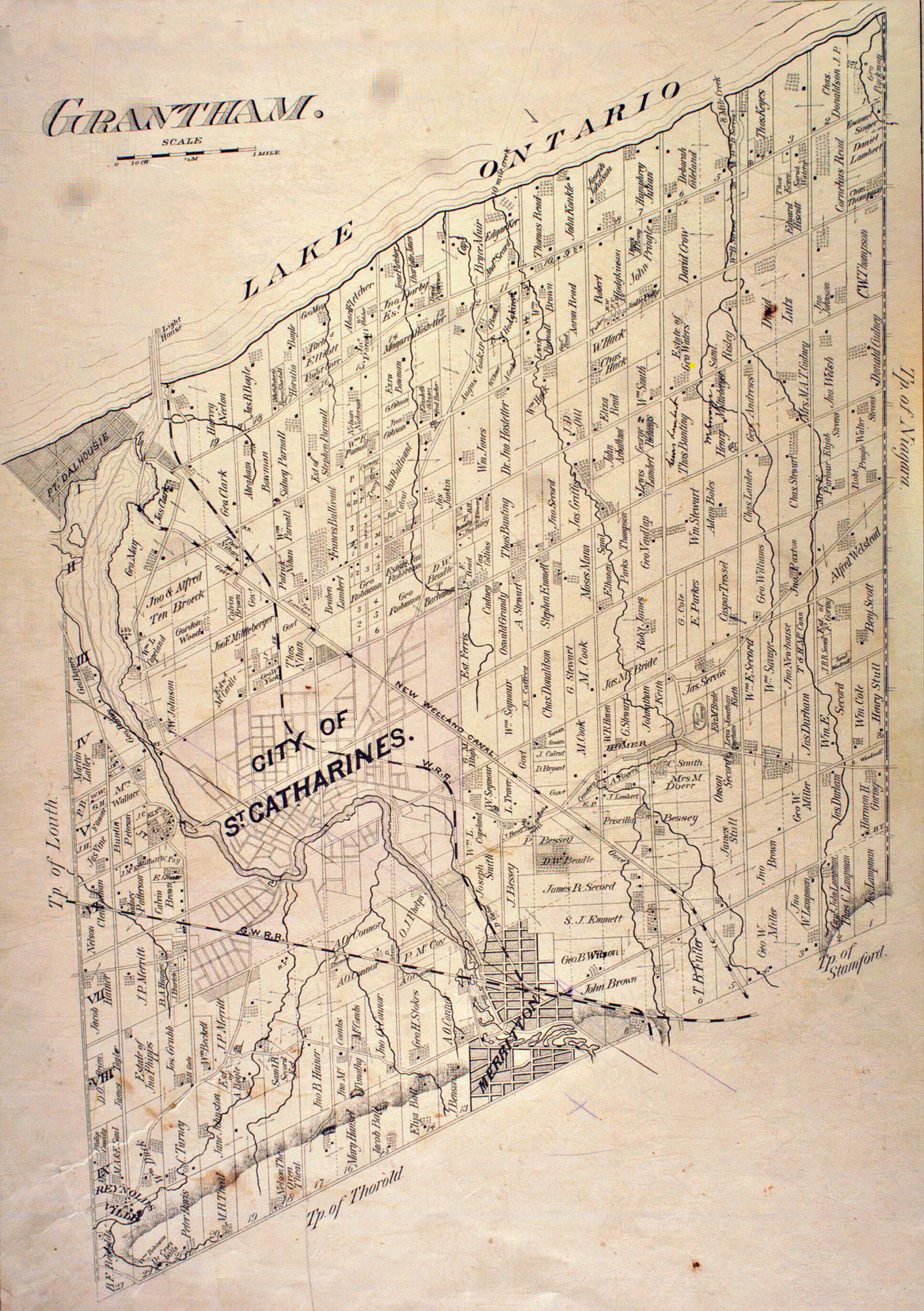
Clicking on Grantham township produces a map of Grantham from 1876 (Figure 7) with an option to click to a closer view.

Figure 7: 1876 map of Grantham township.

Zooming in really allows us to see the lay of the land, so to speak, and both parcels of  Robert Hodgkinson’s land on Lot 8, Concession I and Lot 8, Concession II are clearly indicated (Figure 8). It’s evident that lots were numbered from east to west, starting at the border of Grantham Township and Niagara Township to the east, and concessions were numbered from north to south, starting at Lake Ontario.

Figure 8: Robert Hodgkinson’s land, Lot 8, Concession I and Lot 8, Concession II.Robert Hodgkinson's land close crop

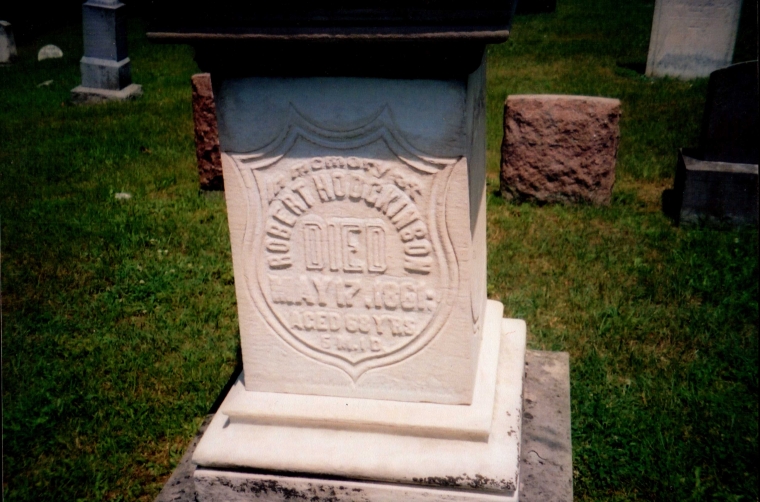
What’s interesting here is that Robert Hodgkinson’s name was associated with these parcels of land as late as 1876, when the map was created, although he died in 1861, as his grave marker asserts (Figure 9).

Figure 9: Grave marker for Robert Hodgkinson, Victoria Lawn Cemetery, St. Catharines, Ontario. Photo credit Carol Roberts Fischer.robert-hodgkinson-grave-marker-rotated.jpg

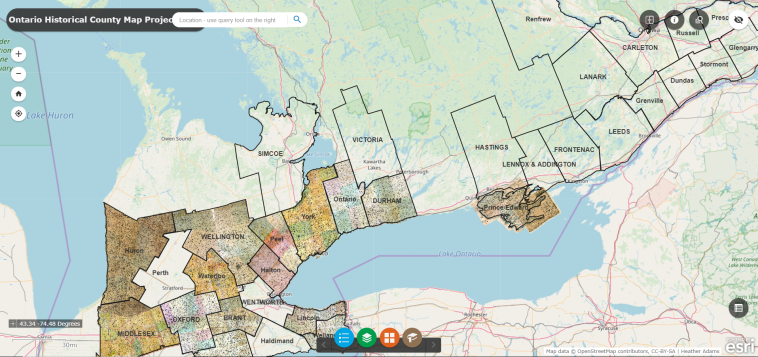
As it happens, an earlier map of the area can be found thanks to a similar mapping project, the Ontario Historical County Maps Project, hosted by the University of Toronto. This project includes maps of 54 counties, produced between 1856 and 1888, and new maps continue to be added to the database. The main search page is shown in Figure 10.

Figure 10: Search portal for Ontario Historical County Maps Project.Ontario Historical County Maps Project

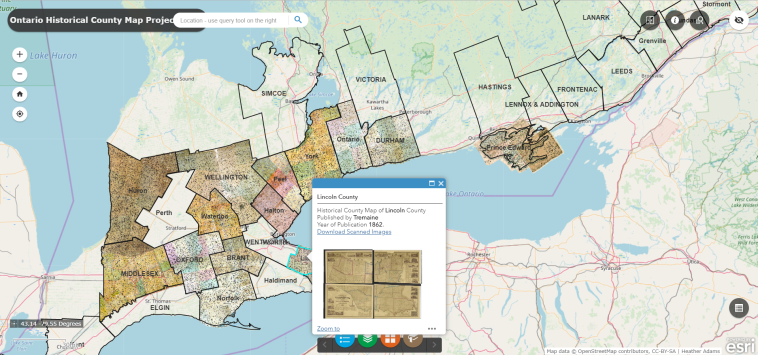
The map can be explored in several ways. Clicking on a county of interest, such as Lincoln County, reveals the source maps that were used for the site, and offers an option to download the scanned images (Figure 11). In the case of Lincoln County, the source map is from 1862, the year after Robert Hodgkinson died, and 14 years earlier than the map available from the Canadian County Atlas Digital Project.

Figure 11: Options for viewing maps of Lincoln County.Lincoln County map options

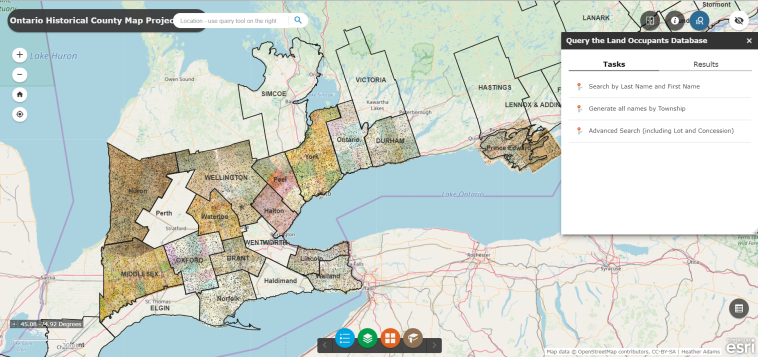
To quickly locate a particular land owner, one can search the Land Occupants Database by clicking the magnifying glass icon located near the upper right corner of the page (Figure 12). The database offers the capability to search by first and last name, and an option to generate a list of all the names found in a particular township, as well as an advanced search option which permits searching by lot number and concession number.

Figure 12: Land Occupants Database search portal.Land Occupants Database search option

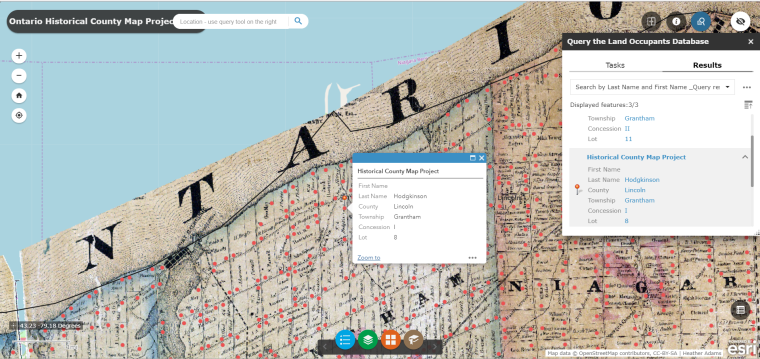
A search for all land occupants with the surname Hodgkinson in this database returns three results, two of whom were land owners in Grantham:  F.A. Hodgkinson, on Concession II, Lot 11, and Hodgkinson with no given name specified, on Concession I, Lot 8. Selecting that second option pinpoints it on the map (Figure 13).

Figure 13: Search result for Hodgkinson on Concession I, Lot 8 in Grantham.Hodgkinson Plot 1862 map

Zooming in reveals that the indicated plot is actually one of two plots owned by the estate of R. Hodgkinson (Figure 14). This is consistent with the information obtained from the 1876 map, which indicated that Robert Hodgkinson owned part of Lot 8 on Concession I, in addition to owning all of Lot 8 on Concession II, and with the fact that Robert Hodgkinson himself died in 1861, so the land would have been in the possession of his heirs by 1862 when the map was created.

Having two maps created 14 years apart also enables us to note changes in ownership. According to the 1876 map, the lakefront portion of Lot 8 on Concession I was owned by Joseph Johnson (Figure 8), which suggests that Robert Hodgkinson’s estate must have sold that portion of the land some time between 1862 and 1876 when the second map was created.

Figure 14: Close-up view of parcel owned by the estate of R. Hodgkinson, boxed in red.Estate of R Hodgkinson

Zooming in still further converts the historical map to the current road map, and Robert Hodgkinson’s land is shown to be bordered by Read Road to the west, with Lakeshore Road running between Concessions 1 and 2, and Church Road bordering the Hodgkinson parcel to the south (Figure 15). Thomas Bate’s land lay in between the Hodgkinson land and Stewart Road, so the eastern border of the Hodgkinson land lies approximately halfway between Read Road and Stewart Road. The map also reveals that Read Road forms the present-day border between St. Catharines and Niagara-on-the-Lake, so the former Hodgkinson property lies right at the western end of present-day Niagara-on-the-Lake, Ontario.

Figure 15: Contemporary road map indicating location of Robert Hodgkinson’s land.Hodgkinson Modern Map

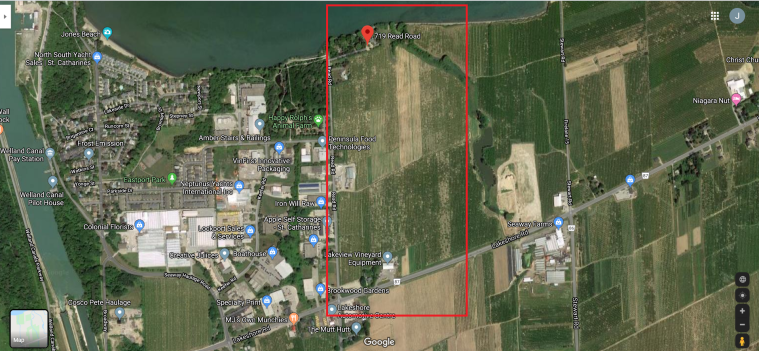
Of course, it’s always fun to check the satellite view to see what lies on one’s ancestral lands today. In this case (Figure 16), it looks like Lakeview Vineyard Equipment is located on Robert Hodgkinson’s land, along with a number of other homes and businesses with addresses along Read, Lakeshore, and Church Roads. There’s also quite a nice luxury home on a 21-acre estate that is most definitely located on land that once belonged to Robert Hodgkinson.

Figure 16: Satellite view of Robert Hodgkinson’s land today, with the approximate location of Lot 8 on Concession 1 boxed in red.Satellite map view

Anyone with ancestors who were landowners in Ontario in the mid-to-late 19th century can easily lose a few hours playing with these maps. They offer a fascinating glimpse into the past, as well as a bridge to the present. Inspired by these maps, I think I’ll plan a trip to Niagara-on-the-Lake this summer, and include a drive down Read Road, turning onto Lakeshore. I’ll park the car someplace where I can look out across the fields, feel the sunlight on my skin and the breeze in my hair. And I’ll remember that, once upon a time, Robert Hodgkinson, whose DNA I carry, probably looked out across those same fields more than a century before I was born.

© Julie Roberts Szczepankiewicz 2020


Party Like It’s 1899, Continued

In my last post, I wrote about an imaginary visit to the year 1899, prompted by a post in the Facebook group, “GAA (Genealogy Addicts Anonymous)” In that group, Admin Claudia D’Souza recently posed the question to the members of the group, “Imagine you wake up and you are in the year 1899! Who are you going to visit, & what are you going to find out?” I had quite a bit of fun thinking about that question—so much fun, in fact, that I decided to break up my musings into two posts. Since I already discussed my game plan for visiting and interviewing my relatives on my paternal side, I’ll move on now to my plan for visiting my maternal relatives, based on hypothetical time travel to August 31st, 1899. I’ve updated the interactive map to include all the new places I’ll be visiting on my journey.

My Maternal Grandmother’s Family

Many of my Mom’s relatives were already in Buffalo by today’s date in 1899, so I’ll start my journey there. I’ll head first to 25 Clark Street, on Buffalo’s East Side. This is where 22-year-old Weronika/Veronica Grzesiak has been living in Buffalo for a little over a year, boarding with the family of Michał/Michael and Marianna/Mary (née Derda) Staszak.

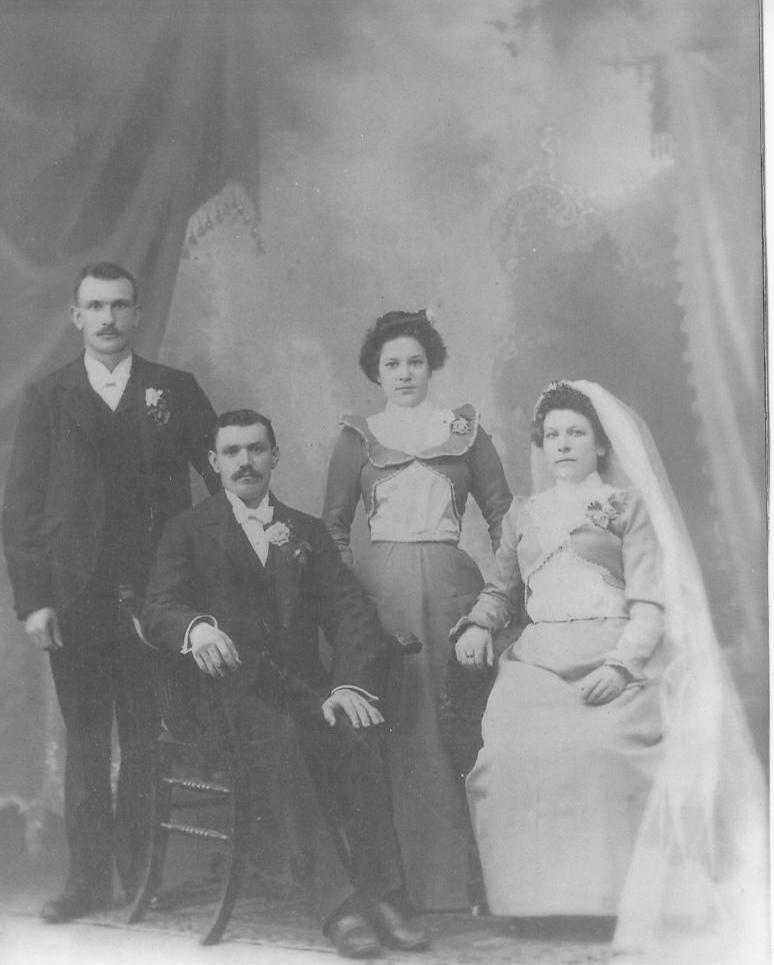
Figure 1: Wedding portrait of Weronika Grzesiak and Jan Zażycki, 5 August 1901, Buffalo, New York. Left to right, Tadeusz Grzesiak (brother of the bride), Jan Zażycki, Józefa Grzesiak (sister of the bride), Weronika Grzesiak.Veronica Grzesiak & John Zazycki wedding

Veronica, who will be my great-grandmother, named Michael Staszak as the relative she was going to join, and her passenger manifest clearly states “brother-in-law and sister,” which suggests that she must be related to his wife. Interestingly, Polish records offer no evidence that Veronica and Mary were related in any way, much less through a relationship as close as sister or half-sister. However, Mary Staszak was from Kowalewo-Opactwo, the same village in which Veronica grew up, so it’s probable that they were good friends. Moreover, Veronica and Mary traveled together on the S.S. Willehad when they made the journey from Kowalewo to Buffalo, along with Michael and Mary’s two children, 9-year-old Józefa and 7-year-old Franciszek.

I know a lot about Veronica’s ancestry, yet I still have questions about her family. I know that at least two of her siblings, Władysław and Konstancja, moved to Warsaw and were married there in August 1898 and June 1898, respectively. What prompted their move? Did any of the other siblings move as well? What happened to Pelagia, the sister who disappears from the records after her birth in Kowalewo in 1869? I know that Veronica is working hard in the kitchen of a restaurant and saving up her money to bring her father and siblings to the U.S. I also know that one year from now, her father, Józef, and siblings Tadeusz, Józefa, Władysław, and Władysław’s wife, Kazimiera, will join her in Buffalo. Why will her mother, Marianna (née Krawczyńska) Grzesiak, not come as well? Will she merely choose to stay in Warsaw with her daughter Konstancja and Konstancja’s husband, Julian Cieniewski?

By May of 1900 when most of the family leaves for America, Konstancja will already be pregnant with her daughter Wiktoria, due in December. Will she simply plead for her mother to stay with her and help her through the birth, until Marianna finally relents and allows her husband and other children to go to America without her? Or was something else going on? Why will Józef report on his passenger manifest that he was a widower, and why will three of her children appear not to know their mother’s name, reporting it variously on U.S. records as Anna Nowacka, Mary Cebulska, and Marianna Szafron? Why will the story be handed down that Marianna Grzesiak was already deceased by the time Veronica left for America, when in fact she will not die until 1904? All these facts seem to suggest that Marianna was estranged from her family for some reason. Was this the case, or am I just over-interpreting the data?
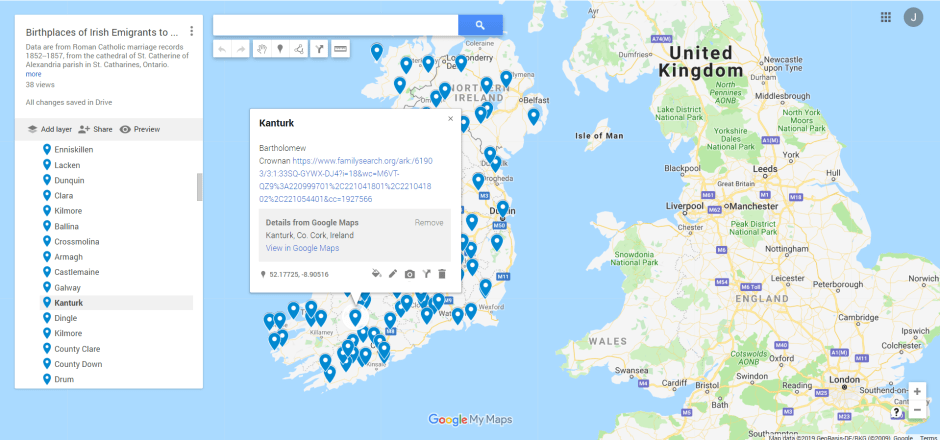
More answers might be found by visiting her family in the Old Country, so I’ll book passage to Bremen or Hamburg, and from there, make my way to Warsaw, where I hope to find Weronika’s oldest brother, Władysław Grzesiak, and his new bride, Kazimiera (née Olczak), living in the Koło neighborhood within the Wola district of the city. I’ll want to ask Władysław where his parents are living, and which of his siblings are also living in Warsaw. I expect I’ll find the youngest sister, Józefa, here, since family stories handed down among her descendants suggest that she, too, may have lived in Warsaw just prior to emigration. It may very well be that the entire Grzesiak family has moved here within the past year. Władysław’s marriage record from August 1898 stated that his parents were living in “Borowo,” although the record failed to specify which place was meant, out of nearly two dozen places by that name located within the borders of Poland today. However, Józef Grzesiak was apparently living in Warsaw by 27 March 1899, since he was named as a witness on the birth record for his first grandson, Marian Cieniewski, son of Konstancja Grzesiak and Julian Cieniewski. Sadly, the record notes that baby Marian was born alive and was baptized with water, but died the same day.

Once Władysław gives me his parents’ address, I will be eager to visit the home of Józef and Marianna (née Krawczyńska) Grzesiak, my great-great-grandparents. They’re a couple shrouded in mystery for me, for reasons already described. It’s speculation, but I’ve often wondered if Marianna might have suffered from some mental illness. In an era when mental illness were poorly understood, it was not uncommon for families to distance themselves from their afflicted loved ones, even going so far as to tell the younger generations that their elder relative was already deceased. It’s difficult to understand precisely why Marianna’s death record from 1904 states that she was a pauper, living in Zagórów, the village of her birth, yet survived by her husband, Józef. Why would she have been a pauper, since she had a husband and at least one adult daughter living in Warsaw, who might presumably be able to care for her? A visit to 1899 won’t tell me where and when Józef will eventually die, and his death record has not yet been discovered. Still, I will enjoy the chance to get to know them a bit, and also to discover whether the unique pierogi recipe handed down in my family—filled with a combination of sauerkraut, potatoes, and onions—originated with Marianna, or was an invention of her daughter Weronika. 

When my visit with the Grzesiaks has ended, I’ll head back to Buffalo, to 44 Lathrop Street to visit Weronika Grzesiak’s future husband and my great-grandfather, Jan/John Zażycki. John is a 33-year-old molder in a factory, who has been living in the U.S. for 4 years and has already declared his intention to become a U.S. citizen. I wonder if he and Veronica have met yet? While I know something of Jan’s paternal ancestry, his mother, Antonina (née Naciążek) Zarzycka, has been a stumbling block for me. Maybe he can tell me where she was born, and where his parents were married. Maybe he can tell me something about her siblings and parents. Was he really the only one of the 11 children in his family who immigrated to America, as present data suggest? What prompted that move?

Antonina herself was still alive in 1899, so when I’ve finished my interview with John, I’ll return to Poland (imaginary travel is cheap, after all!) and make my way to the small village of Bronisławy, about 43 miles west of Warsaw. There I’ll find Antonina and her husband, Ignacy Zarzycki. Ignacy is a 71-year-old peasant farmer who owns his own land—a gospodarz, in Polish. His wife is about the same age, and they are the parents of 11 children, although they have already buried four of them, including a son, Roman, who died 8 years ago at the age of 19. Ironically, their son John will also have a son named Roman who will die an untimely death at the age of 23, but they don’t know this yet. I’m sure they’ll be eager for information about John, and how he’s faring in America. I’ll be equally eager for information on the whereabouts of their son, Tomasz, for whom I’ve not yet been able to locate a marriage or death record. Given the difficulty with obtaining records from parishes in this area, it’s likely that he married and settled in another nearby parish, but which one? 

Mostly, however, I’ll want to hear Antonina’s story. Is my current hypothesis correct, that  her parents were Mateusz Naciążęk and Petronella Trawińska? Who were her siblings? It will be fascinating to meet this woman whose origins have been such a mystery to me, my most recent ancestor about whom so little is known. Antonina won’t be able to tell me where she will die, of course, but I will be sure to ascertain the whereabouts of all of her living, adult children, since she may go to live with one of them when her husband Ignacy passes away in two years’ time. I have evidence that two of her children, Leonard and Karol, moved to Warsaw, while two daughters, Aniela Gruberska and Marianna Gruberska, were living in villages within the nearby parish of Młodzieszyn.  A third daughter, Ewa Klejn, was living in the vicinity of Sochaczew in 1880, but at the present time that’s all I know. 

My Maternal Grandfather’s Family

Having concluded my visits with my maternal grandmother’s family, I’ll book passage back to America to meet my maternal grandfather’s relatives. My journey will take me back to Buffalo once again—back to Clark Street, no less—where my great-great-grandparents, Andrzej/Andrew and Marianna/Mary (née Łącka) Klaus, are living at 43 Clark Street, less than a block away from the home of Veronica Grzesiak.

Figure 2: Wedding photo of Mary Łącka Klaus and her second husband, Władysław/Walter Olszanowicz, 21 November 1916, North Tonawanda, New York. Back Row, left to right: Apolonia/Pauline Klaus Sobuś (Mary’s daughter), holding her son, Edward Sobuś; Stanisław/Stanley Sobuś (Pauline’s husband); Anna Klaus Gworek (Mary’s daughter); Jacob Gworek (Anna’s husband); Genowefa/Genevieve Klaus Zielinska (Mary’s daughter, my great-grandmother).
Front Row, left to right: Julia Sobuś Ziomek (Cousin Jul, daughter of Pauline Klaus Sobuś); Unknown (most probably the groom’s marriage witness, Mary Jedrychanka); Walter Olszanowicz ; Mary Łącka Klaus; Joseph Zieliński (Genevieve’s husband, my great-grandfather); Marie Gworek Glitta (crouching on floor, Anna’s daughter); Helen Klaus (Mary’s daughter)null_00001

In 1899, Andrew is a 33-year-old day laborer and the father of three daughters, Anna, Pauline, and Genowefa/Genevieve (my great-grandmother, Figure 3). He and his 32-year-old wife Mary have already buried two children, a daughter named Zofia/Sophia, and a son named Bolesław. Andrew is also the step-father to Mary’s two sons, Joseph and John, who were born prior to their marriage. On this date in 1899, Mary is heavily pregnant with the couple’s sixth child, Edward, who will be born on September 11th. I know a great deal about both of their families, but there are still missing details.

Figure 3: Genevieve Klaus on her First Communion day, circa 1907.Genevieve Klaus 1st Communion circa 1907

I’ll want to ask Andrew what happened to his brother Michał, who disappears from the records in Poland. I’m also curious to know why he chose to move on to Buffalo, New York, instead of remaining in Plymouth, Pennsylvania, where his brother John Klaus was already living. I’ll be very interested to ask Mary what happened to her father, Jakub Łącki, and her brother, Józef/Joseph, who immigrated with her. Jakub disappears from the records completely after the passenger manifest documenting his arrival in New York in 1884. There’s a family story about a family member who died on the voyage, but it was supposed to be one of Mary’s and Andrew’s children. There’s no evidence that Mary and Andrew knew each other until he arrived in Buffalo circa 1890; could it be that the story got confused, and it was Mary’s father, Jakub, who died on the voyage? Evidence for Joseph Łącki after emigration is also scant. Where is he now? 

After planting a kiss on the forehead of the toddler who will be my great-grandmother, it’s time to return to Sochaczew County in the Russian Empire, this time for a visit to the village of Mistrzewice. Once in the village, I’m sure the locals will be able to direct me to the farm of Stanisław and Marianna (née Kalota) Zieliński, my great-great-grandparents. Stanisław is a 36-year-old farmer (gospodarz) whose father first moved to Mistrzewice from the nearby village of Bibiampol, just a few miles to the south. Marianna grew up in the village of Budy Stare, about five miles to the east. They are the parents of seven sons, although only five of them are currently living: 13-year-old Franciszek, 7-year-old Józef (my great-grandfather), 4-year-old Szczepan, 2-year-old Władysław, and baby Jan, who was just born in March.

Figure 3: Wedding photo of Joseph Zielinski and Genevieve Klaus, 6 October 1915. The best man, Franciszek/Frank Zielinski, seated on other side of the bride, and the woman seated on the other side of the groom is most likely the maid of honor, Josephine Urbaniak.Genevieve Klaus & Joseph Zielinski wedding party

I have a pretty good handle on the deeper ancestry of both Stanisław and Marianna, for at least a few generations. Due to the difficulty in accessing records, I don’t know the names of Marianna’s maternal great-grandparents, but then again, she may not know them, either. Mostly, I’ll enjoy this opportunity to get to know the two of them, observing their interactions with each other and with their children. There are no family stories whatsoever about what Stanisław was like, but the stories that have survived about Marianna, who will die in 1936, don’t paint a picture of a very kind woman. That said, Marianna will experience a great deal of loss in her life, as she will outlive her husband and nine of her ten children. But right now, that’s mostly in Marianna’s future. Perhaps now, in 1899, she is a more cheerful, hopeful woman—a younger wife and mother, still in the prime of her life.

I have one final stop to make before I leave the year 1899, to the village of Budy Stare, to meet Marianna’s father—my great-great-great-grandfather, Roch Kalota. In his prime, Roch was a farmer, but now he’s about 61, and I wonder if he’s starting to slow down and let his sons do more of the hard work around the farm. My understanding of Roch’s family is somewhat incomplete. I know that he married a 21-year-old widow, Agata (née Kurowska) Orlińska, in 1858, and that they had at least seven children together. There are a few gaps in the chronology of their children’s births, however, due to difficulty in accessing church records from their parish, so hopefully Roch can fill those in for me. Agata passed away in 1895, and most of his children are married and have children of their own. The youngest two (that I’m aware of), Katarzyna and Antoni, are still unmarried and living at home, and I’ll enjoy chatting with them as well.

That will wrap up my time-travel to the year 1899. All in all, this was a pretty enjoyable exercise, imagining the life of each of my ancestors in that particular year in their lives. Pondering what is known about each person also helps me to see how much is still unknown in each family’s story. In some cases, this information may yet be discovered without any time machines, so I don’t mean to suggest that every question raised here is necessarily a “brick wall.” It may be that the answers will be found easily, once I make time to do the research, or once I’m able to gain access to the records. So it’s probably time to get back to the present and start looking for the documents that will lead me to the answers I seek. 

© Julie Roberts Szczepankiewicz 2019


Party Like It’s 1899!

It’s no secret that I’m a fan of leveraging social media for genealogy, and Facebook genealogy groups hold a special place in my heart. One group that is very informative, and also just plain fun, is the group “GAA (Genealogy Addicts Anonymous)” where Admin Claudia D’Souza recently posted the following question to the members of the group: “Imagine you wake up and you are in the year 1899! Who are you going to visit, & what are you going to find out?” I had quite a bit of fun thinking about that question, so here’s my game plan for my hypothetical time travel to July 24th, 1899. I’ve also created an interactive map of the places I’ll be visiting on my journey.

My Paternal Grandfather’s Family

I’ll begin my travels in my hometown of Buffalo, New York, where I’ll visit the home of Charles and Nellie DeVere at 1567 Niagara Street. I’ll want to meet Nellie’s mom, 81-year-old Elizabeth (née Hodgkinson) Walsh, who was living with Charles and Nellie per the 1900 census. Elizabeth, whose photos appears in Figure 1, is my 3x-great-grandmother, so I’ll be anxious to see if she can tell me where in Ireland her late husband Robert Walsh was from and what his parents’ names were. While I’m interviewing her, I’ll be sure to ask about her mother’s maiden name as well, since Elizabeth’s mother is known to family historians only as Christiana Hodgkinson. There are rumors that she may have been a Laraway, but this is still unproven. Anything else that she can tell me about Christiana’s family—where they came from, her parents’ and siblings’ names—will be a bonus, since she’s nearly a complete mystery to me.

Elizabeth was 14 years old when her grandfather, John Hodgkinson, died, so she probably knew him and may be able to tell me something about his family. I know that John Hodgkinson was a United Empire Loyalist who served in Butler’s Rangers during the American Revolution. He married his second wife—my 5x-great-grandmother, Sarah Spencer—after the death of his first wife, Mary Moore, but the timeline is not clear to me. What year did Mary die, and what year did he marry Sarah? Were there other children from his first marriage besides Samuel Hodgkinson, who was baptized in Schaghticoke, New York in 1776? I wonder if his marriage to Sarah a happy one, or merely a marriage of convenience, since young Samuel needed a mother, and since John was already acquainted with Sarah’s family, having served with her father, Robert Spencer, in Butler’s Rangers.

After my delightful visit with Elizabeth Walsh, I’ll take the street car that runs down Niagara Street to travel about 2.5 miles north to 73 Evelyn Street in Buffalo, the home of my 2x-great-grandparents, Henry and Martha (née Dodds) Walsh, to meet them and their children, including 16-year-old Katherine Elizabeth Walsh, who will be my great-grandmother.

Figure 1: Four generations of the Walsh family. Image retouched by Jordan Sakal. On the far left, Elizabeth (née Hodgkinson) Walsh (1818-1907). On the far right, her son Henry Walsh (1847-1907). Next to Henry is his oldest daughter, Marion (née Walsh) Frank (1878-1954), and next to her is her daughter, Alice Marion Frank.

walsh-4-generation-photo

In 1899, Henry is a 52-year-old teamster who has been living in Buffalo for the past 12 years, having moved his family there from St. Catharines, Ontario, in 1887. He and Martha are the parents of 9 children, including baby Gladys Mildred Walsh, who was just born in April. I’m sure they’ll also want to tell me about their first grandchild, Alice Marion Frank, who was born in March of 1899 to their oldest daughter, Marion, and her husband, George W. Frank. Martha Walsh is a busy 40-year-old mother and homemaker, so I’ll offer to help her in the kitchen while she tells me about her mother, Catherine Dodds, who died in 1872 when Martha was just 13. Can she tell me Catherine’s maiden name? Was it Grant, or Irving, since both of those names have been recorded, or something else? Was one of those names the name of a previous husband she may have had prior to her marriage to Robert Dodds? What can she tell me about Catherine’s parents? Were they Scottish immigrants to Glengarry, Ontario who arrived in the early 19th century, or was their Scotch ancestry more distant, originating with Scottish highlanders who settled first in upstate New York in the mid-18th century, only arriving in Canada after the Revolutionary War?

It may be that Martha is unable to answer my questions, so I’ll take a train to St. Catharines to pay a visit to her father, Robert Dodds, my 3x-great-grandfather. In 1899, Robert is living on Niagara Street with his daughter, Hannah Carty, and her husband James. In addition to asking him about his late wife, I’ll be eager to ask him about his own family history. Where in England was he born, exactly? Documentary and DNA evidence suggest the region around Northumberland and Durham, but solid evidence has been slim. When did he come to Canada? How and where did he meet his wife Catherine, and where and when did they marry? Who were his parents? Did he have siblings, and did any of them come to Canada, or did they remain in England? When my visit with Robert is finished, I’ll head back to Buffalo to meet my great-great-grandparents, Michael Frank (generally known by this time as Frank Michael) Roberts and Mary Elizabeth (née Wagner) Roberts and their family (Figure 2).

Figure 2: Frank M. Roberts (1858–1930) and Mary E. (née Wagner) Roberts (1860–1946) with their four sons, unknown date. From left to right, John Frank Roberts, Frank M. Roberts, George A. Roberts, Mary E. Roberts, Harry Michael Roberts, Bert Fred Roberts.Roberts family portrait

In 1899, Frank Roberts was a 41-year-old architect, artist, and the father of four sons, living at 439 Vermont Street. According to a biography published in the Buffalo Artists’ Directory in 1926, Frank trained under Gordon Lloyd, an architect of some prominence in the Detroit area where Frank was born. He and his wife, Mary Elizabeth Wagner, were the children of immigrants from Germany and Alsace, and I know a fair amount about their family histories, with the exception of Frank’s mother’s ancestry. Frank’s mother was Mary Magdalena (née Causin, Casin or Curzon) Roberts, and she remains a mystery to me. She was born in Buffalo, New York circa 1832 to parents who were most likely Alsatian, but their names were not recorded on her marriage or death records, nor have I been able to find a promising match for a baptismal record in the records from St. Louis Church, which was the only Roman Catholic parish in Buffalo at that time. So I’ll be eager to ask Frank all about her. Did she have siblings? What prompted her move to Detroit, where she was married in 1857? Were her parents already deceased by that point? How did she meet her husband, Michael Ruppert or Roberts, a German immigrant from Heßloch in the Alzey-Worms district of the Rhineland-Palatinate?

When my interview with Frank is finished, I’ll have more questions for Mary Roberts, my 2x-great-grandmother, and 16-year-old John, who will be my great-grandfather. I’m curious about Mary’s maternal grandparents, Peter and Elizabeth Grentzinger, who immigrated to Detroit from the village of Steinsoultz in the Haut-Rhin department of Alsace. Where and when did Peter die? There is evidence that Elizabeth Grentzinger remarried Henry Diegel after Peter’s death, but curiously, her grave marker states only that she was the wife of Peter Grentzinger, never mentioning the second husband who paid for the grave. If Mary seems open to discussing it, I may delicately inquire as to whether her mother, Catherine (née Grentzinger) Wagner, ever spoke of her first husband, Victor Dellinger or Dalmgher. Catherine and Victor had two children, John and Elizabeth, born circa 1847 and 1849, who must have died along with their father before Catherine’s second marriage to Henry Wagner in 1855. I’ll finish my time in the Roberts home by asking young John if he happens to know a nice girl named Katherine Walsh from Evelyn Street. I think she might be just his type.

Although Frank Roberts’s parents are both deceased by 1899, Mary’s father, Carl Heinrich (“Henry”) Wagner, is still living in Detroit with her brother, John, and his family at 270 Beaubien Street. I’ll take a train to Detroit to visit him next. Since I already know quite a bit about his ancestry, what I’ll want to learn from 3x-great-Grandpa Henry is what it was like to come to the U.S. as a young man of 24 in 1853. What was it like, growing up in the small German village of Roßdorf? What were his parents like as individuals? How about his late wife, Catherine? After our chat is finished, I’ll head back to Buffalo to visit my paternal grandmother’s family, starting with the family of my great-great-grandparents, Wenzeslaus and Anna (née Goetz or Götz) Meier.

My Paternal Grandmother’s Family

In 1899, Wenzel and Anna Meier are living in a two-family home at 225 Mills Street with their three daughters, 4-year-old Anna (who will be my great-grandmother), 2-year-old Julia, and baby Marie, who was just born in May. They don’t know it yet but they will eventually add 10 more children to their family. Wenzel is a 28-year-old German immigrant from the village of Obertrübenbach in Bavaria, who has been living in Buffalo for nine years and works as a butcher. His parents are still alive in Germany, so I’ll ask how they’re doing, and if he’s had any recent correspondence with them. I’ll also ask about his siblings back in Germany—Anna Maria, Franz Xavier, and Eduard—whose fates are unknown to me. Wenzel’s wife, 22-year-old Anna, is busy with the children, but her parents, Carl and Julianna (née Baeumler or Bäumler) Goetz, occupy the second home in the dwelling, so I seek them out.

Figure 3: Three generations of the Baeumler/Goetz/Meier family circa 1903. Image retouched by Lesley Utley. Front row, left to right, Julianna (née Bäumler) Götz (1838-1905); her grandchildren, Anna Meier, Julia Meier, Marie Meier, and Frances Meier; her husband, Carl Götz (1853-1933). Back row, Wenzeslaus Meier (1871-1942) and Anna (née Götz) Meier (1877-1949), holding baby Margaret Meier.Meier 3 generation portrait retouched

Carl Goetz is a 46-year-old German immigrant from the village of Leuchtenberg in Bavaria. He and his wife, 62-year-old Margaretha Juliane (known as Julianna or Julia), came to Buffalo in 1883, following in the footsteps of Julianna’s son, John Baeumler, who was already settled here. John’s birth record states that he was illegitimate, born to the unmarried Julianna Baeumler, but it’s interesting to note that after his birth, Julianna married her first husband, Johann Gottfried Baeumler, who happened to share a surname with her. Johann Gottfried was a 64-year-old widower when he married 27-year-old Julianna in 1864 in the village of Plößberg in Bavaria. Were they distant relatives? And was Johann the father of John Baeumler? Johann and Julianna had been married for just three years when he died in 1867. Julianna lived as a widow, raising her son alone, until her marriage to Carl in 1875, when she was 38 and he was 22. In an era and culture in which marriages were contracted for more practical reasons than romantic love, such marriages as Julianna’s may not be unusual, and for that matter, it may be true that their marriage was a love match. But I will be interested to observe the dynamic between Carl and Julianna. I hope they have found some measure of happiness and contentment together.

The last family to visit on my Dad’s side will be the family of my great-grandfather, John Sigismund Boehringer. In 1899, Anna (née Murre or Muri) Boehringer is a 33-year-old widow and mother of four children, living at 555 Sherman Street in Buffalo. Her oldest son, Edward, is just 13, and the youngest, John—who will be my great-grandfather—is seven. John was not quite three years old when his father, John G. Boehringer, passed away in November 1894. Anna works as a tailor, but it’s been difficult to provide for her family. John will always remember days in his childhood when they were so hungry that they trapped and ate sparrows for food. I’ve made some headway with researching John G. Boehringer’s family—I know, for example, that he was born in Buffalo in 1861 to Jacob and Catherine (née Rogg or Rock) Boehringer, German immigrants from the region around Lenzkirch in the Black Forest—so I’m confident that further progress simply requires time and effort. However, research into Anna Boehringer’s family has been more difficult.

Figure 4: John G. and Anna (née Murre) Boehringer on their wedding day, 29 April 1885, Buffalo, New York.John G Boehringer and Anna Murre wedding

Anna Murre was born in Bavaria in 1865, the second child of Joseph and Walburga (née Maurer) Murre. She immigrated to Buffalo with her parents and two siblings in 1869, but so far U.S. records, including church records, have offered no evidence of specific place of origin. Where was she born, and what can she tell me about her parents and grandparents?

Having finished with my paternal side of the family, I’ll visit my maternal relatives in my next post.  Stay tuned!

© Julie Roberts Szczepankiewicz 2019

Mapping Birthplaces of Irish Immigrants to St. Catharines

Lately I’ve been writing quite a bit about my attempts to find the place of origin for my great-great-great grandfather, Robert Walsh/Welsh/Welch who was born somewhere in Ireland between 1808-1816 and who immigrated to St. Catharines, Upper Canada some time before his marriage to Elizabeth Hodgkinson circa 1843. Lacking any evidence for specific place of origin in records pertaining directly to Robert Walsh or his documented close relatives (possibly siblings), Thomas Walsh and Bridget Maria Walsh, I examined records pertaining to their FANs (Friends, Associates and Neighbors), a technique known as cluster research. Focusing specifically on marriage witnesses and godparents that Robert and Elizabeth Walsh chose for their children, I identified a number of places in Ireland where the Walsh FANs were from, as discussed in a recent post. Unfortunately, there was no geographic trend indicated by these places. They included County Limerick, County Sligo, County Clare, and County Tyrone, which suggests that the connections between the Walshes and these individuals were forged post-immigration rather than pre-immigration.

Since the Walshes’ FANs gave me no great clues, I decided to broaden the circle by another level, and see if there were any trends that could be observed by examining all the marriage records which mention a Walsh bride or groom or a Walsh mother of the bride or mother of the groom. As noted previously, the earliest available records are found in the collection Baptisms, marriages 1852–1860, and I focused on these primarily since the marriage records from this book typically mention the specific place of origin of the bride and groom. This is in contrast to the later book of Marriages, 1858–1910 in which only the immigrant’s country of origin was typically specified, although there was a span of years (images 12–16, with a few additional entries on images 10, 20, 23 and 27) when some thoughtful priest recorded the county of origin for Irish immigrants as well. I did not observe any examples of baptismal records where the place of origin of immigrant parents was noted. In the interest of time, I did not include the data regarding county of origin when it was mentioned in the collection Marriages, 1858–1910. Instead, I focused only on the earliest records.

Admittedly, this strategy is not ideal due to the popularity of the Walsh surname, nor was it especially helpful. I discovered the following:

  • There were four Walsh brides. One was from Cahersiveen, County Kerry; one was from Askeaton, County Limerick; one was from County Cork, no specific village or parish indicated, and one was from someplace whose name cannot be accurately determined because it ran into the margin of the book.
  • There were no Walsh grooms.
  • There were two brides with a mother who was a Walsh. They were from Westport, County Mayo, and “Myrish” (probably Moyrus), County Galway.
  • There were five grooms with a mother who was a Walsh. They were from Westport, County Mayo; Ballyguran, County Waterford; Bohola, County Mayo; Ballymartin, County Cork; and one additional place that could not be deciphered, in County Tipperary.

Again, there were no obvious geographic trends, nor were there any clues in those other Walsh marriage records that might suggest that any of them were related to my Walsh family.

Since I was already in the business of working with the data from these church records from the cathedral of St. Catherine of Alexandria, I decided to try one last strategy. I created a map of all the places of origin in Ireland mentioned in those marriage records, dated from 1852–1857.

The Method Behind the Madness

The map can be accessed by clicking here. Each pin on the map is a unique place of origin mentioned in the records from St. Catharines. However, in some cases, there were multiple immigrants from the same location. Clicking on a pin on the map will produce the name of the immigrant(s) who were from that location, along with a link to the page of church records where the source marriage record can be found.  Although the basic idea is pretty simple, there are a few points to be made about the actual implementation.

  1. Although the vast majority of individuals mentioned in these marriage records were Irish immigrants, there were some natives of Canada West, New York, Quebec, Scotland, England, Holland, and Prussia in the mix. Since my focus was on identifying places of origin in Ireland, I ignored any other places that were mentioned.
  2. Since data were extracted from a Roman Catholic church book, most individuals named were Roman Catholic. However, in a few cases mixed (interfaith) marriages were noted so one should check the source to see if a person of interest might have been Protestant.
  3. Original spellings were preserved to the extent that I could read them. Some names like Crownan and Cronnin/Cronin may have common origins or may even be the same family.
  4. In cases where the name of the bride or groom was recorded differently in the page margin than in the marriage record itself, the name used in the record was the name used on the map.
  5. Places mentioned in the records vary in degree of precision, ranging from a village, or civil parish to a townland or county. If a more precise place of origin was indicated, it was usually reported along with the county name, which helped in distinguishing between places with the same name (e.g. Newport, County Mayo and Newport, County Tipperary). Place names were rendered phonetically, so spellings used were frequently incorrect. In many cases it was possible to guess which place was meant, e.g. “Iniscarthy,” County Wexford, is almost certainly meant to be Enniscorthy, County Wexford; “Cloonmile” in County Tipperary is likely to be Clonmel, “Dunbeck,” County Clare is probably Doonbeg, etc. In a few cases I could not find a good phonetic match for the place name, due in part to illegible handwriting. In those instances, only the county was recorded.

The Results

Places of origin for a total of 267 immigrants were mapped. These immigrants represented all 32 counties in Ireland, with a small majority (45 immigrants, or 16.8% of the total) coming from places within County Mayo. Additional data are summarized in Figure 1, below.

Figure 1: Number and percent of immigrants from each Irish county who were mentioned in the marriage records dated between 1852–1857 from St. Catherine of Alexandria parish, St. Catharines, Ontario. Percentages do not add up to exactly 100% due to rounding.

Irish immigrants data

One wonders how these numbers compare with the population of each Irish county circa 1841, when the Walshes may have emigrated. Was the emigration proportional to the population, or was there disproportionate emigration from particular counties? According to statistics found on Wikipedia, the top five Irish counties ranked in order of population in 1841 were Cork, Galway, Tipperary, Mayo, and Dublin.1 In contrast, the top five Irish counties reported as birthplaces of immigrants to St. Catharines were Mayo, Cork, Tipperary, Clare, and Kerry, and this difference may reflect the impact of chain migration. Perhaps these data will help me prioritize my searches for my Walsh/Cavanagh family among the almost 200 parishes where both of these surnames are known to exist. Unfortunately, there have been no easy answers, but if genealogy were always easy, our successes would be much less satisfying.

Sources:

1 “Irish Population Analysis,” Wikipedia (https://en.wikipedia.org : 29 June 2019).

© Julie Roberts Szczepankiewicz 2019

Farewell to Texas

So often, what we find in our genealogical search process depends on what we’re looking for. We all come in with some preconceived notions about our ancestors based on oral family history, and although those stories often contain a kernel of truth, it’s embedded within a distorted narrative. Sometimes those narratives are quite compelling, and it’s hard to let them go, but it’s necessary to do that in order to examine our ancestors’ stories objectively and ask the right questions that will lead us to the truth.

For quite a while now, I’ve been wrestling (albeit intermittently) with the question of where and when Joseph and John Klaus were born. They were the oldest brothers of my great-grandmother, Genowefa/Genevieve (née Klaus) Zielinski. There’s a captivating story that they were born in Texas while their parents, Andrzej/Andrew and Marianna/Marya/Mary (née Łącka) Klaus lived there for a while circa 1890 before moving to St. Louis, Missouri, and then on to Buffalo and finally North Tonawanda, New York. I’ve written about this research previously (most recently here), and about the problematic timeline for their proposed birth events in Texas. To quickly summarize the evidence regarding date and place of birth for each of them, the 1900 census states that Joseph was born March 1891 in New York, and John was born June 1892 in New York.1 However, that same census also states that their sisters Anna and Pauline were born in New York, although birth and baptismal records for Anna and Pauline confirm that they were born in St. Louis, consistent with the family story.2 Joseph’s World War I draft registration states that he was born 17 February 1886—however, Andrew Klaus did not immigrate to the U.S. until 1889.3 Joseph’s marriage record suggests a birth year of 1887, and his death certificate states that he was born 25 February 1886 in Buffalo.4

John died at the age of 15, leaving only a very brief paper trail. In addition to the 1900 census, he was mentioned in a newspaper article about his arrest for stealing coal, dated 27 January 1905 .5 He was reported to be age 15 at that time, suggesting a date of birth circa 1889. John died of tubercular meningitis on 18 June 1905 at the age of 15 years, 8 months, 3 days, suggesting a date of birth of 15 October 1889.6 According to his death certificate, he was born in New York.

So all the evidence pointed to a birthplace in New York for both Joseph and John, but their birth records remained elusive, and I was still somehow hoping that I’d find them in Texas. I’d checked all the ethnic Polish Roman Catholic parishes in Buffalo that were in existence at the time of their births (St. Stanislaus, St. Adalbert, and Assumption of the Blessed Virgin Mary) and had not found their baptismal records. Since Andrew Klaus and Mary Łącka did not marry until 21 January 1891 in Buffalo, it seemed likely that Joseph and John were both born out of wedlock, or that Mary was married previously. However, I could find no evidence for a prior marriage for Mary in the records from St. Stanislaus, the parish to which she belonged when she married Andrew Klaus.

Yet sometimes I amaze myself with my own stupidity.

There I was, standing at the kitchen sink the other night, washing up the dinner dishes, not thinking about anything in particular, when suddenly it hit me. Despite the fact that I knew that one or both of the oldest Klaus boys was likely to have been born out of wedlock, what name did I search for when I checked the baptismal index for St. Stanislaus? Klaus! (Stupid, right? Gah!) Somehow, despite obvious evidence to the contrary, I was assuming a scenario in which Andrew was still the father of Joseph and John, even if they were born prior to his marriage to Mary. Immediately I ran to my computer to check the baptismal index for Józef Łącki, and lo, and behold—there he was (Figure 1)!

Figure 1: Baptismal record from St. Stanislaus Church for Józef Łącki, born 25 February 1888.7Joseph Łącki birth 1888 cropped

He was there all along, right where he was supposed to be. Born 25 February 1888 in Buffalo, consistent with existing evidence for his date of birth, Joseph was baptized the following day and was noted to be the illegitimate son of Maryanna Łącka of Kołaczyce, Galitia [sic]. Godparents were Mikołaj Kołodziej and Marya Graca. Done and dusted.

So now I’ve found Joseph, but where’s John? A search of the baptismal index for Łącki births failed to turn up any additional children born to Mary Łącka, and the marriage index did not indicate any other marriages for her besides the one to Andrzej Klaus in 1891. Could John have been baptized in another parish—maybe in Texas? There’s got to be some truth to that family story, right? Cousin Jul accurately reported the family’s sojourn in St. Louis, so why would the tale about Texas be untrue?

I decided to go through the all the baptisms from St. Stanislaus in 1889 individually, and that’s when I found John Klaus—more or less (Figure 2).

Figure 2: Baptismal record from St. Stanislaus parish for Jan Konieczny, born 10 October 1889.8 Jan Klaus 1889 crop

According to this record, Jan Konieczny was born 10 October 1889 and baptized the same day. He was the son of Maryanna Łącka of Kołaczyce, Galicia—unmistakably the right mother. But his father was noted to be Jan Konieczny of “Brzyski, Gal.” This suggests the present-day village of Brzyska in Jasło County, which is just a little over 2 miles from Kołaczyce. The date of birth and mother’s name mean this has got to be our John Klaus, but there’s no marriage record for Jan Konieczny and Mary Łącka in the records of St. Stanislaus. There is, however, a marriage record for Jan Konieczny and Karolina Nyc, who married at St. Stan’s on 2 September 1889, a month before this child’s birth (Figure 3).

Figure 3: Marriage record from St. Stanislaus parish for Jan Konieczny and Karolina Nyc, 2 September 1889.9Jan Konieczny marriage 1889

According to the marriage record, Jan Konieczny married Karolina Nyc on 2 September 1889. He was the son of Maciej Konieczny and Katarzyna, whose maiden name was not specified, and he was born in “Brzesko, Gal.” Brzesko is a village in Galicia located approximately 43 miles east of the village of Brzyski mentioned in the baptismal record. Karolina Nyc was another native of Galicia, born in the village of Brzeźnica to Bartłomiej Nyc and Maria Polniaszek. There were three unique places in Galicia called Brzeźnica, so further research would be needed to determine in which one of these villages Karolina was born.

So what’s going on here? Are there two different men named Jan Konieczny, one from Brzyski who married to Mary Łącka and was the father of her child, Jan, as suggested by the birth record, and a second Jan Konieczny from Brzesko who was the husband of Karolina Nyc? A survey of indexed records from Ancestry and FamilySearch does not support the hypothesis that there were two different men named Jan/John Konieczny, both from Galicia/Austrian Poland and living in Buffalo concurrently. Moreover, the difference between the two records in the spelling of Jan’s place of origin, Brzesko vs. Brzyski, is a minor discrepancy of a sort that’s common in the records from St. Stanislaus. In fact, in baptismal records for the children of Andrew and Mary Klaus, Andrew’s place of origin was recorded as Maniówo, Maniewo, Szczeciny, and Monowice, when in fact he was born in Maniów in gmina Szczucin.10

If we believe, then, that Jan Konieczny, the father of Mary Łącka’s child, is the same Jan Konieczny who married Karolina Nyc just a month earlier, what are the implications of that? The birth record does not explicitly state that the child, Jan Konieczny, was born from the legitimate marriage of Jan Konieczny and Mary Łącka, it only states that Jan was the father. It would be unusual, but not unheard of, for a father to acknowledge such a child born out of wedlock. In such cases there is sometimes a notation on the baptismal record, “pater naturalis,” or “natural father,” but this record includes no such notation.

Could it be that the father’s given name was recorded incorrectly? This seems more plausible. The evenness and consistency of the handwriting throughout these images suggests that these records may have been recopied at some point prior to microfilming by the Latter-Day Saints. If originals are available at the diocesan archive in Buffalo, and if access to these records could be obtained, they might contain some answers. So if we suppose that Mary Łącka was married previously to another man named Konieczny, who was he, and where is their marriage record? It seems like it should be at St. Stan’s, since that was the parish in which Mary was living when she gave birth to her oldest sons Joseph and John in 1888 and 1889, respectively, and also the parish in which she was living when she married Andrew Klaus in 1891. Yet the only record of marriage for a woman with the surname Łącka or Łączka between 1874-1894 in St. Stanislaus parish (as determined by searching Kasia Dane’s online index of marriage records from St. Stan’s) is the record for Mary and Andrew Klaus. Similarly, there are no Konieczny marriage records that suggest that the bride may have been Mary Łącka under a badly misspelled or mistranscribed surname. However, that index does reveal a connection between the Konieczny and Łącki families. On 30 June 1886, Maria Łącka and Jakób (or Jakub, in modern Polish) Konieczny were witnesses to the marriage of Jan Lewczyk and Katarzyna Węgrzyn (Figure 4).

Figure 4: Marriage record from St. Stanislaus parish for Jan Lewczyk and Katarzyna Węgrzyn, 30 June 1886.11Jan Lewczyk and Katarzyna Wegrzyn 1886

According to this record, the bride was also a native of Kołaczyce like Mary Łącka, although neither the surname Węgrzyn nor her mother’s maiden name, Ochałek, appears in my family tree. This suggests that Katarzyna and Mary may have been more distant cousins, or perhaps just old friends. More relevant to the question at hand, this record offers evidence of a Jakub Konieczny with whom Mary Łącka was at least acquainted as of June 1886. Could the birth record for Jan Konieczny have been recorded in error—should it have been Jakub Konieczny who was the father?

All of this is entirely speculative, since there’s not much evidence to go on, in absence of a marriage record for Mary Łącka to any man with the surname Konieczny. While there’s always the possibility that Mary eloped and married in a “Gretna Green” location (Erie, Pennsylvania seems to have been such a location for people in the Buffalo, New York area), elopement was far less likely for ethnic Poles. Babies might be born out of wedlock for a variety of reasons, and I have no interest in speculating on the circumstances of their conception or pronouncing moral judgments on my ancestors. Nonetheless, the fact that those babies were always baptized within a few days of birth is a testament to the importance of the Catholic faith in the family’s culture, so it’s extremely unlikely that Mary would have settled for a civil marriage outside of the church. Moreover, if Mary Łącka had been married prior to her marriage to Andrew Klaus, there should be not only a marriage record, but also a death record for her first husband dated some time between 1889 when Jan Konieczny/Klaus was conceived, and January 1891 when Mary married Andrew Klaus. However, searches of the Buffalo, New York death index from 1885–1891, as well as the New York State death indexes from 1889, 1890 and 1891, did not reveal any Konieczny deaths.

Of course, not every immigrant who came to the U.S. remained here. Many worked for a few years and then took their savings back to the Old Country with them. Could it be that Jakub fathered a child with Mary and then returned to Poland? A search of indexed records at FamilySearch and Ancestry does not offer evidence for a Jakub/Jacob/James Konieczny from Galicia/Austrian Poland who was already in Buffalo by 1890. Church records were also examined to determine the given names of all the Konieczny men mentioned in them. Both marriage records from 1874–1894, and baptismal records from Volumes I, II and III, which cover the years from 1874–1895, were examined. Based on these, the following Konieczny men were identified:

  • Walenty (father of Anna, 17 July 1890, and Zofia, 16 April 1893)
  • Wojciech (father of Andrzej, born 26 November 1882; Anastazja, born 6 April 1889, and Józefa, born 17 August 1887)
  • Szczepan (father of Helena, born 5 May 1880, and Franciszek, born 4 October 1881)
  • Jan (father of Władysław, born 24 December 1890; Marya, born 21 January 1893, and Stanisław, born 24 August 1895). According to marriage records, Jan was the brother of 
  • Andrzej (father of Anna, born 5 December 1893, and Honorata, born 4 October 1895).

There’s no further mention of Jakub Konieczny in these church records after the marriage of Jan Lewczyk and Katarzyna Węgrzyn in 1886, suggesting that he may have moved back to Poland or relocated within the U.S.

Ultimately, we may never know who the father of Jan Klaus really was. As so often happens with genealogy, each new answer creates additional questions. Despite these uncertainties, I’m convinced that the Jan Konieczny, who was born in Buffalo, New York on 10 October 1889 and baptized the same day at St. Stanislaus parish, son of Marya Łącka and “Jan Konieczny,” was, in fact, the same child who grew up with Andrew Klaus as his foster father, and was later known as John Klaus. John Klaus, my great-granduncle—or half great-granduncle, as appears now to be the case, wasn’t born in Texas after all, nor was his oldest brother (or half-brother), Joseph. So why the elaborate story about the family living in Texas? Maybe it was intended to be an amusing tall tale that was misunderstood as the truth by Mary Klaus’s grandchildren. If nothing else, I’ve learned another lesson in examining my assumptions as I research. Farewell, Texas. You were never part of my family history after all.

Sources:

1 “United States Census, 1900,” Buffalo Ward 11, Erie, New York, Enumeration District 84, Sheet 28A, line 41, Andro Klano [sic] household, accessed as digital images, FamilySearch (https://familysearch.org : 17 June 2019), New York > Erie > ED 84 Election District 3 Buffalo city Ward 11 > image 55 of 59; citing NARA microfilm publication T623 (Washington, D.C.: National Archives and Records Administration, n.d.).

Roman Catholic Church, St. Stanislaus Kostka Parish (St. Louis, Missouri, USA), Baptismal Records, January 1, 1888–May 5, 1895, 1892, no. 127, record for Anna Klaus, accessed as browsable images, “Church records, 1880-1993,” FamilySearch (https://familysearch.org : 19 June 2019), Film 1872178/DGS 7856319 > Item 4, Baptisms > image 283 of 1149; and 

Roman Catholic Church, St. Stanislaus Kostka Parish (St. Louis, Missouri, USA), Baptismal Records, January 1, 1888–May 5, 1895, 1894, no. 2, record for Apolonia Klaus, accessed as browsable images, “Church records, 1880-1993,” FamilySearch (https://familysearch.org : 19 June 2019), Film 1872178/DGS 7856319 > Item 4, Baptisms > image 301 of 1149.

3 “United States World War I Draft Registration Cards, 1917-1918,” database with images, FamilySearch (https://www.familysearch.org : 19 June 2019), Joseph J Claus, 1917-1918; citing Chautauqua County no 1, New York, United States, NARA microfilm publication M1509 (Washington D.C.: National Archives and Records Administration, n.d.); FHL microfilm 1,712,292; and

Staatsarchiv Hamburg, “Hamburg Passenger Lists, 1850-1934” (database with images), record for Andrzey KlausAncestry (https://www.ancestry.com : 19 June 2019), Staatsarchiv Hamburg; Hamburg, Deutschland; Hamburger Passagierlisten; Volume: 373-7 I, VIII B 1 Band 077; Page: 361; Microfilm No.: S_13155.

4 Dunkirk, Chautauqua, New York, marriage certificate no. 431 (1910), Joseph Klaus and Mary Brzuszkiewicz; Dunkirk City Clerk’s Office, 342 Central Avenue, Dunkirk, New York; and

Dunkirk, Chautauqua, New York, death certificate no. 130 (1918), Joseph Claus, 7 October 1918; Dunkirk City Clerk’s Office, 342 Central Avenue,
Dunkirk, New York.

“Coal Thieves Were Fined,” The Evening News (North Tonawanda, New York), 27 January 1905, p. 1, Old Fulton New York Post Cards (https://fultonhistory.com. : 4 August 2017).

North Tonawanda, Niagara, New York, death certificates no. 2016 (1905), John Klaus, 18 June 1905; North Tonawanda City Clerk’s Office, 216 Payne Avenue, North Tonawanda, New York.

7 Roman Catholic Church, St. Stanislaus parish (Buffalo, Erie, New York, USA), baptismal register II, 1883-1890, p. 368, no. 137, record for Józef Łącki, born 25 February 1888 accessed as browsable images, “Church records, 1873-1917,” FamilySearch (http://familysearch.org : 19 June 2019) Baptisms 1874-1903 > image 502 out of 1979.

8 Roman Catholic Church, St. Stanislaus parish (Buffalo, Erie, New York, USA), baptismal register II, 1883-1890, p. 532, no. 702, record for Jan Konieczny, born 10 October 1889, accessed as browsable images, “Church records, 1873-1917,” FamilySearch (http://familysearch.org : 19 June 2019) Baptisms 1874-1903 > image 584 of 1979.

9 Roman Catholic Church, St. Stanislaus parish (Buffalo, Erie, New York, USA), Matr. 1873–1891, p. 154, no. 88, marriage record for Jan Konieczny and Karolina Nyc, 2 September 1889, accessed as browsable images, “Church records, 1873-1917,” FamilySearch (http://familysearch.org : 19 June 2019), image 1385 of 1979.

10 Roman Catholic Church, St. Stanislaus parish (Buffalo, Erie, New York, USA), baptismal register III, 1890-1895, p. 640, no. 757, record for Bolesław Klaus, born 24 October 1895, accessed as browsable images, “Church records, 1873-1917,” FamilySearch (http://familysearch.org : 19 June 2019) image 502 out of 1979; and 

Roman Catholic Church, St. Stanislaus parish (Buffalo, Erie, New York, USA), baptismal register IV, 1895-1903, p. 196, no. 620, record for Genowefa Klaus, born 28 September 1897, accessed as browsable images, “Church records, 1873-1917,” FamilySearch (http://familysearch.org : 19 June 2019) image 1074 out of 1979; and 

Ibid., p. 352, no. 396, record for Edward Klaus, born 11 September 1899, accessed as browsable images, “Church records, 1873-1917,” FamilySearch (http://familysearch.org : 19 June 2019) image 1155 out of 1979; and 

Ibid., p. 426, no. 476, record for Władysław Klaus, born 10 October 1900, accessed as browsable images, “Church records, 1873-1917,” FamilySearch (http://familysearch.org : 19 June 2019) image 1194 out of 1979.

© Julie Roberts Szczepankiewicz 2019


11 Roman Catholic Church, St. Stanislaus parish (Buffalo, Erie, New York, USA), Matr. 1873–1891, p. 90, 1886, no. 64, marriage record for Jan Lewczyk and Katarzyna Węgrzyn, 30 June 1886, accessed as browsable images, “Church records, 1873-1917,” FamilySearch (http://familysearch.org : 19 June 2019) Marriages > image 1353 of 1979.


Hot on the Trail of the Walshes: Determining Place of Origin in Ireland

In a previous post, I wrote about some progress I’ve made toward identifying potential parents for my 3x-great-grandfather, Robert Walsh. Thomas Walsh and Bridget Maria Walsh McNamara may or may not have been his siblings, but it’s clear that they were some kind of close family members to Robert, and that they were also full siblings to each other, since marriage records indicate that both Thomas and Maria were children of James Walsh and Catherine Cavanagh. Knowing the name, approximate date of birth, and parents’ names for an immigrant ancestor could potentially provide enough information to start looking for that ancestor in records from the Old Country, if the surname is relatively uncommon. However, the surname Walsh is the fourth most popular surname in Ireland today, and Cavanagh (or Kavanagh) is ranked at number 53 for popularity, with both surnames found throughout Ireland.1 For this reason, it makes sense to try to determine a precise place of origin for my immigrant Walsh siblings, rather than trying to leap into Irish records prematurely.

So far, this has been an uphill battle. Most of the strategies that have been successful when determining place of origin for my Polish ancestors have not worked here. Robert Walsh was already in Canada by the time of his marriage to Canadian-born Elizabeth Hodgkinson circa 1843. There are no surviving passenger manifests for immigration to Canadian ports prior to 1865, so we can’t hope to find a passenger manifest which states his birthplace or last residence within Ireland.2 Although a passenger manifest might be found if he arrived first in a U.S. port and then made his way to St. Catharines, I have no reason to believe that this was the case, and no identifying information that might help me to distinguish my Robert Walsh/Welch/Welsh from the scores of Irish immigrants by that name who immigrated via U.S. ports. Since Canada and Ireland were both part of the British Empire prior to Canadian confederation in 1867, naturalization was not necessary for Irish immigrants to Canada, which eliminates the possibility that a naturalization record will state place of origin.3 Neither have any of the church records provided any clues, since available baptismal records and marriage records for my known Walsh relatives do not specify immigrants’ place of origin, and burial records are not available. However, cluster research might help with this question, just as it did with identifying potential parents for Robert Walsh.

Chain migration is defined as “the process by which migrants from a particular town follow others from that town to a particular destination,”4 and it’s a phenomenon that many of us family historians have documented. In my own research, I’ve discovered that many of the Polish immigrants to North Tonawanda, New York in the period from 1900–1918 were from Sochaczew County, and many of the German immigrants to Detroit in the 1830s–1850s were from the area around Neustadt in the Marburg-Biedenkopf district. Could there be a similar, common place of origin for many of the Irish immigrants who chose St. Catharines as their destination? More importantly, can we identify that place of origin using existing data?

The cathedral parish of St. Catherine of Alexandria was established to serve the Irish laborers who built both the first Welland canal which opened in 1829, as well as the second Welland canal which was built in the 1840s.5 This work on the canal may have been a factor in Robert Walsh’s decision to immigrate. Although he was a merchant tailor rather than a laborer or canal worker, it may have been that Robert decided to leave Ireland for Canada to serve the clothing needs of this growing Irish community. Moreover, it is perhaps significant that Robert emigrated prior to the Irish Potato Famine of 1845–1849. In times of major crisis such as that famine, one might suppose that emigrants would be less particular about their destination. However, since Robert was a pre-Famine immigrant, his decision to go to St. Catharines may have been made in light of more ordinary considerations.

Of course, it’s too much to hope that all of the Irish immigrants to St. Catharines came from one location in Ireland, but it could potentially direct future research if I were to discover that, for example, most of the immigrants turned out to be from one or two counties within Ireland. Unfortunately, it’s not possible to examine church records from St. Catharines dated prior to the Great Famine. The earliest available records start in 1852, which suggests that any early chain migration patterns which may have existed will likely be obscured by the sheer volume of Irish immigration to Canada after the Great Famine. Nonetheless, desperate times call for desperate measures, and at this point I can’t think of any available genealogical data sets which might be more useful than church records in providing clues about migration patterns from Ireland to St. Catharines. To borrow an aviation cliché from my dad, I’m running out of altitude, air speed, and ideas.

So, here’s the plan:

  • Analyze the data from the earliest available collection of church records from the cathedral parish of St. Catherine of Alexandria, the parish in which my ancestors settled, to see if any trends emerge regarding specific place of origin of Irish immigrants.
  • Pay special attention to data from any records of individuals known to be associated with my Walsh ancestors.
  • Use this information to prioritize searches for my ancestors in records from Ireland.

I’m planning to use John Grenham’s Irish genealogy site, Irish Ancestors, to identify the various collections which might be useful in tracking down my Walshes, and I purchased a short-term subscription to RootsIreland, which offers a number of databases of indexed records. (Spoiler alert: I’ve searched both these sites for “low-hanging fruit”—easily-found indexed records relevant to my research—and come up empty.) John Grenham’s site has a helpful feature which allows one to search by a surname (e.g. Walsh), and then cross-reference with a second surname (e.g. Cavanagh) to identify civil parishes in which both surnames were found in Griffith’s Valuation (1847–1864). Unfortunately, the Irish Ancestors site identified close to 200 parishes in which both surnames, Walsh and Cavanagh, were found. Given my research background in Polish records, that number seemed ridiculously high to me. I thought there had to be a better way to narrow the focus before attempting research in Irish records. However, after chatting about this research with Irish genealogy expert, Donna Moughty, at the New England Regional Genealogical Consortium (NERGC) conference in Manchester this past April, I learned that refinement might not be possible here. In Donna’s opinion, finding specific place of origin for pre-Famine immigrants from Ireland is generally so difficult that she thought my best bet under these circumstances would be that “brute force” method, systematically going through all the parishes identified at John Grenham’s site in which both the Walsh and Cavanagh surnames were known to exist. So be it.

Did I mention that I’m also in a race against the clock? I have an opportunity to follow my husband to Dublin on a business trip in a few weeks and it would be wonderful if I could squeeze in a day trip to the birthplace of Robert Walsh while I’m there. Of course, real life has a nasty habit of getting in the way of genealogy, so it’s not possible for me to devote myself full-time to the pursuit of the Walsh Ancestral Village. The unfortunate reality is that there’s a good chance I will not be able to identify the birthplace of Robert, Thomas, and Bridget Maria Walsh prior to setting foot on the Emerald Isle. At least I want the satisfaction of knowing I gave it my best possible shot.

So, I made a careful study of the available marriage and baptismal records for St. Catherine of Alexandria parish. The earliest available records are found in the collection Baptisms, marriages 1852–1860, and I focused on these primarily since the marriage records from this book typically mention the specific place of origin of the bride and groom. This is in contrast to the later book of Marriages, 1858–1910 in which only the immigrant’s country of origin is typically specified, although there was a span of years (images 12–16, with a few additional entries on images 10, 20, 23 and 27) when some thoughtful priest recorded the county of origin for Irish immigrants as well. I did not observe any examples of baptismal records where the place of origin of immigrant parents was noted. In the interest of time, I did not include the data regarding county of origin when it was mentioned in the book Marriages, 1858–1910. Instead, I focused only on the earliest records.

As the title suggests, the book Baptisms, Marriages 1852-1860 contains both baptismal records and marriage records, intermingled on the same pages through 1857, when the parish began recording marriages in a separate book. I began by making a spreadsheet indexing all the baptisms which mention surnames Walsh/Welsh or Cavanagh in any capacity (mother, father, godmother or godfather). I did the same with the marriage records, indexing all those records in which the bride or groom was a Walsh, one of the witnesses was a Walsh, or the maiden name of the mother of either the bride or groom was Walsh. I also included all the marriage and baptism records that mention the known godparents of the children of Robert and Elizabeth Walsh. By doing this, I gained some interesting insights into the Walsh family’s network within their parish community in St. Catharines. However, it’s impossible to say which of these relationships were forged after immigration and which, if any, might stem from a common community in Ireland.

Among the potentially relevant discoveries were the following:

  • Thomas Walsh’s wife, Maryann Cronin, had a full brother named Michael Cronin who married Jane Alcox in 1856. Their marriage record stated that Michael was from County Limerick, while Jane was a native of St. Catharines, like Elizabeth (née Hodgkinson) Walsh.6
  • Michael and Maryann Cronin had another full sister, Margaret Cronin, who married Robert McNamara in 1861.7 One of the witnesses to the marriage was John Fitzgerald—probably the same John Fitzgerald who served as godfather to Elizabeth Walsh (daughter of Robert Walsh) in 1854.
  • In 1858, Margaret Cronin was named as godmother to Thomas Cronin, son of John Cronin and Winifred Walsh.8 It’s tempting to speculate that this is the same Margaret Cronin who was sister to Michael and Maryann, and that Winifred Walsh might be related to “my” Walshes. However, there’s not enough evidence at this point to support that conclusion, and in any case, no marriage record for John and Winifred was found which might indicate her specific place of origin within Ireland.
  • Patrick McNamara, the husband of Bridget Maria Walsh, had a brother named John McNamara, who married the widowed Margaret (née Battle) McBride in November 1854.9  Margaret was the godmother of Elizabeth Walsh (Robert’s daughter) in May 1854.10 John McNamara was noted to be a native of Killuran, County Clare, while Margaret Battle was born in County Sligo. It’s not clear if Patrick and John McNamara were related in some way to Robert McNamara, husband of Margaret Cronin. However, it’s clear that any relationship that might have existed was more distant than siblings, since Patrick and John were reported to be sons of Timothy McNamara and Catherine Sullivan, while Robert was the son of Michael McNamara and Mary Gleeson.
  • Thomas Coil (or Coyle) and Jane Parks, who served as godparents to Nellie Walsh in August 1857,11 were married to each other in February 1857,12 exemplifying the priest’s tendency to record women under their maiden names, or under both married and maiden. Thomas Coyle was noted to be a native of County Tyrone, while Jane Parks was native to St. Catharines.
  • Although there were a couple baptismal records for a child of a Cavanah/Cavanagh mother or father, as well as a couple of baptismal records in which a Cavanagh served as a godfather, there’s no evidence that the individuals mentioned in those records were connected with each other, or with my Walsh/Cavanagh relatives.
  • There seems to be a connection between the Walsh family and the O’Driscol family, but the significance of that connection is unclear. Robert Walsh (presumably “my” Robert Walsh, since he was the only adult by that name living in St. Catharines in the 1861 census) served as godfatber to Helena McGuire in 1854, daughter of Daniel McGuire and Mary O’Driscol.13 In 1858, he was named as godfather to Edward O’Driscol, son of Michael O’Driscol and Catherine O’Driscol.14


To recap, the individuals mentioned above were the closest FANs (Friends, Associates and Neighbors) of Robert, Thomas, and Bridget Maria Walsh for whom I can identify some place of origin. The diversity of locations in Ireland associated with them underscores the difficulty in the task of locating my Walsh ancestors in Irish records. While it may be possible that one of these individuals happens to be from the same hometown as my Walshes, it may also be that all of them met in St. Catharines and were brought together by the common bond of being couples in which one spouse was a native of Upper Canada (in the case of Jane Parks, Jane Alcox, and Elizabeth Hodgkinson) while the other spouse was an immigrant from Ireland. In any case, my starting point in Irish records will be the locations mentioned in the records for these FANs of the Walshes: County Limerick, County Sligo, County Clare, and County Tyrone.

Sources:

1 “Top 100 Irish Surnames & Last Names (Family Names Ranked),” Ireland Before You Die (https://www.irelandbeforeyoudie.com : 7 June 2019).

2 “Passenger Lists, 1865-1922,” Library and Archives Canada (https://www.bac-lac.gc.ca : 7 June 2019).

3 “Canada Naturalization and Citizenship,” FamilySearch, (https://www.familysearch.org : 7 June 2019).

4 “Chain Migration,” Wikipedia (https://en.wikipedia.org/ : 7 June 2019).

5 “History of Our Parish,” Cathedral of St. Catherine of Alexandria—Diocese of St. Catharines (https://www.thecathedralinstcatharines.com/history : 7 June 2019).

6 Roman Catholic Church, Cathedral of St. Catherine of Alexandria (St. Catharines, Ontario, Canada), Baptisms & Marriages 1852–1860, unnumbered entries, unnumbered pages in chronological order, 1856, “Marriage Mich’l Cronin ac Jane Alex,” 19 August 1856, accessed as browsable images, “Ontario Roman Catholic Church Records, 1760-1923,” FamilySearch (https://www.familysearch.org/ : 7 June 2019) path Lincoln > St. Catharines > Cathedral of St. Catherine of Alexandria > Baptisms, marriages 1852-1860 > image 59 of 104.

7 Roman Catholic Church, Cathedral of St. Catherine of Alexandria (St. Catharines, Ontario, Canada), Marriage Register, Jan. 19, 1858–May 11, 1911, unnumbered pages, unnumbered entries in chronological order, 1861, Robert McNamara and Margaret Cronin, 10 January 1861, accessed as browsable images, “Ontario, Roman Catholic Church Records, 1760-1923,” Family Search (https://www.familysearch.org : 7 June 2019), path: Lincoln > St. Catharines > Cathedral of St. Catherine of Alexandria > Marriages 1858-1910 > image 9 of 48.

8 Roman Catholic Church, Cathedral of St. Catherine of Alexandria (St. Catharines, Ontario, Canada), Baptisms & Marriages 1852–1860, unnumbered entries, unnumbered pages in chronological order, 1856, “Baptism Thomas Cronin,” born 1 November 1858, accessed as browsable images, “Ontario Roman Catholic Church Records, 1760-1923,” FamilySearch (https://www.familysearch.org/ : 7 June 2019) path Lincoln > St. Catharines > Cathedral of St. Catherine of Alexandria > Baptisms, marriages 1852-1860 > image 86 of 104.

9 Roman Catholic Church, Cathedral of St. Catherine of Alexandria (St. Catharines, Ontario, Canada), Baptisms & Marriages 1852–1860, 1854, unnumbered pages, “42nd marriage, John McNamara and Margaret Battle,” 23 November 1854, accessed as browsable images, FamilySearch (https://familysearch.org: 7 June 2019), path: Lincoln County > St Catharines > Cathedral of St Catherine of Alexandria > Baptisms, Marriages 1852-1860, image 36 of 104.

10 Roman Catholic Church, Cathedral of St. Catherine of Alexandria (St. Catharines, Ontario, Canada), Baptisms & Marriages 1852–1860, unnumbered pages in chronological order, 1854, “88th Bapt. Elizabeth Walsh,” born 21 May 1854, accessed as browsable images, “Ontario Roman Catholic Church Records, 1760-1923,” FamilySearch (https://www.familysearch.org/ : 7 June 2019) path Lincoln > St. Catharines > Cathedral of St. Catherine of Alexandria > Baptisms, marriages 1852-1860 > image 28 of 104.

11 Roman Catholic Church, Cathedral of St. Catherine of Alexandria (St. Catharines, Ontario, Canada), Baptisms & Marriages 1852–1860, unnumbered entries, unnumbered pages in chronological order, 1854, “Baptism Ellenor Walsh,” born 24 December 1856, accessed as browsable images, “Ontario Roman Catholic Church Records, 1760-1923,” FamilySearch (https://www.familysearch.org/ : 7 June 2019) path Lincoln > St. Catharines > Cathedral of St. Catherine of Alexandria > Baptisms, marriages 1852-1860 > image 72 of 104.

12 Roman Catholic Church, Cathedral of St. Catherine of Alexandria (St. Catharines, Ontario, Canada), Baptisms & Marriages 1852–1860, 1854, unnumbered entries, unnumbered pages in chronological order, “Marriage Thos. Coyle and Jane Park,” 19 February 1857, accessed as browsable images, FamilySearch (https://familysearch.org: 7 June 2019), path: Lincoln County > St Catharines > Cathedral of St Catherine of Alexandria > Baptisms, Marriages 1852-1860, image 66 of 104.

13 Roman Catholic Church, Cathedral of St. Catherine of Alexandria (St. Catharines, Ontario, Canada), Baptisms & Marriages 1852–1860, unnumbered entries, unnumbered pages in chronological order, 1854, “9th Baptism Helena McGuire,” born 11 December 1853, accessed as browsable images, “Ontario Roman Catholic Church Records, 1760-1923,” FamilySearch (https://www.familysearch.org/ : 7 June 2019) path Lincoln > St. Catharines > Cathedral of St. Catherine of Alexandria > Baptisms, marriages 1852-1860 > image 22 of 104.

14 Roman Catholic Church, Cathedral of St. Catherine of Alexandria (St. Catharines, Ontario, Canada), Baptisms & Marriages 1852–1860, unnumbered entries, unnumbered pages in chronological order, 1858, “Baptism Edward O’Druscol [sic],” born 9 May 1858, accessed as browsable images, “Ontario Roman Catholic Church Records, 1760-1923,” FamilySearch (https://www.familysearch.org/ : 7 June 2019) path Lincoln > St. Catharines > Cathedral of St. Catherine of Alexandria > Baptisms, marriages 1852-1860 > image 81 of 104.

© Julie Roberts Szczepankiewicz 2019


No Scan in Geneteka? No problem!

I’ve said it before, but it’s worth repeating: the lack of a scan linked to a record found in Geneteka does not imply that no scan is available online.

I was reminded of this recently while researching my Wilczek family. A search of marriage records from Mazowieckie province for children of Andrzej Wilczek and Anna Kornacka produced the results shown in Figure 1:

Figure 1: Geneteka search results for marriage records from any indexed parish in Mazowieckie province which mention Andrzej Wilczek and Anna Kornacka together.Wilczek marriages in Mazowieckie

While the first two marriage records are linked to scans, the last one, from Iłów parish, is not. Hovering over the “Z” reveals that the original record is in possession of the Archiwum Państwowe w Warszawie Oddział w Grodzisku Mazowieckim (Grodzisk Mazowieckie branch of the state archive of Warsaw). Although this seems to suggest that the only way to obtain a scan is to write to that archive to request a copy of the marriage record, the reality is that this record can be accessed online from either of two repositories, GenBaza or Metryki.

GenBaza

GenBaza, whose home page is shown in Figure 2, is a digital archive of Polish vital records privately hosted through the generosity of Tomasz Nitsch. Although the main site is found here, it’s necessary to register first at GenPol (Figure 3). Creating an account is free.

Figure 2: GenBaza‘s home page.GenBaza screen shot

Figure 3: GenPol‘s home page.GenPol home page

GenPol’s site can be switched to English by clicking the British flag icon shown under the login area, boxed in red in the image. To create a new account, click “Zarejestruj się” and follow the instructions. Note that if you want to view the GenBaza site itself in English, clicking “English version” in the upper right corner won’t get you very far. What’s shown in Figure 2 is the “English version.” (It states “Wersja Polska” in the upper right corner in the image because that’s what you click to change it to Polish.) Using the English version helps a tiny bit when it comes to viewing the scans themselves, but if you want to read the material on the home page in actual English, you’re better off translating the page via Google Translate by copying the URL for the page into the input text window, as shown in Figure 4, and then clicking on the resulting link in the output box.

Figure 5: Using Google Translate to translate web pages from Polish to English.Google Translate window

Alternatively, those who use Chrome as their browser can right-click anywhere on a web page and select, “Translate to English” as shown in Figure 6.

Figure 6: Using Google Chrome to translate web pages from Polish to English.English translation via Chrome

Getting back to GenBaza, the nice thing about it is that fluency in Polish is not necessary in order to navigate the site and locate vital records. C. Michael Eliasz-Solomon wrote an excellent tutorial for using GenBaza at his blog, Stanczyk — Internet Muse, which I highly recommend. However, I’ll quickly walk through the steps I used to obtain a scan of that 1909 marriage record from Iłów that was indexed in Geneteka.

Records on GenBaza are arranged according to the archive which houses them, so some familiarity with the archival structure in Poland is helpful if one wishes to locate scans for a particular parish. To quickly determine which archive holds the records for a parish or registry office, check the PRADZIAD database. Although this database is no longer being updated, the version that existed in July 2018 is still available, and I personally prefer PRADZIAD’s display format to that of Szukajwarchiwach when it comes to determining the range of available records, but either site will do. In this case, however, when the object is simply to find a scan that’s already been indexed in Geneteka, we can determine the archive simply by hovering over the “z” in the indexed entry.

Once I’m logged into the GenBaza site, I select the parent archive from the list on the left (Figure 7). In the case of Iłow, the records are at the Archiwum Państwowe w Warszawie Oddział w Grodzisku Mazowieckim, so the parent archive is AP_Warszawa.

Figure 7: Root directory for archives with scans in GenBaza.GenBaza root directory

When we click on AP_Warszawa, we get a list of all the branch archives that operate under the umbrella of the state archive of Warsaw (Figure 8). From this list we choose AP_Grodzisk.

Figure 8: Directory of branch archives within the State Archive of Warsaw system.AP Grodzisk

This brings us to the list of available vital records collections from this archive (Figure 9). Remember that civil records from this part of “Poland” were maintained by each religious denomination separately starting in 1826, so denominations are indicated by abbreviations, such as “ew” for “ewangelickie” (Lutheran), “moj” for “mojżeszowe” (Jewish), etc.  Another important abbreviation which you will see in GenBaza is “gm,” which refers to “gmina.” As it’s used in GenBaza, this term designates collections of civil vital records created in the Duchy of Warsaw and the Russian partition between 1808-1825. During this period the local Catholic priest usually served as the civil registrar for everyone in the gmina (an administrative division comprised of multiple villages but smaller than a county), regardless of religion. Of course, the majority of collections in GenBaza are not designated with any of these abbreviations. and in these cases, the default seems to vary based on the collections themselves. For example, most of the undesignated collections from AP_Gdańsk—an archive which mainly holds records from places that were in the Prussian partition—are civil vital registrations,  which were introduced in the Prussian Empire in 1874. On the other hand, most of the undesignated collections from AP_Warszawa—an archive which mainly holds records from places that were in the Russian partition—are civil records for Roman Catholics, created at Roman Catholic parishes. These are generalizations, and your mileage may vary, so your best bet is to click around within a collection. The style of the records themselves will usually tell you about their origin.

Figure 9: List of vital records collections from AP Grodzisk Mazowieckie for which scans are available from GenBaza.AP Grodzisk parishes

From this list of parishes in AP Grodzisk, I can scroll down to find Iłów and then click on it, which brings us to the page shown in Figure 10.

Figure 10: List of scans available from Iłów parish.Ilow

The list on the left indicates eight collections of civil birth (U, urodzenia), marriage (M, małżeństwa) and death (Z, zgony) records created by the Roman Catholic parish in Iłów and dating from 1889–1927. There is also a collection of civil records created by the Lutheran parish in Iłów (“Iłów_ew”), and clicking on this link will open up to a similar list of vital records collections dating from 1834–1934.

The marriage record indexed in Geneteka for Franciszek Wilczek and Katarzyna Widyńska was number 22 in 1909, so it will be in the collection entitled “1890–1910 M_05.” Clicking on this link opens up the range of individual years shown in Figure 11.

Figure 11: List of individual years within the collection of civil marriage records from the Roman Catholic parish in Iłów, 1890-1910.Ilow marriages 1890-1910

Clicking on “1909” brings up the page shown in Figure 12, where we can select an individual image file to view. These are named according to the numbered marriage records contained on each, so marriage record number 22 will be on the image “_22-23.jpg.”

Figure 12:  Individual image files for 1909 marriages. 1909 marriages

Clicking on that image file brings us at long last to the image of the marriage record of Franciszek Wilczek and Katarzyna Widyńska which was indexed in Geneteka with no link to a scan (Figure 13).

Figure 13: Marriage record for Franciszek Wilczek and Katarzyna Widyńska, 7 November 1909.Franciszek Wilczek marriage in GenBaza

Since Iłów was located within the Russian Empire in 1909, the record is in Russian rather than Polish. However, it was common practice to write the names of the key participants first in Russian and then again in Polish. So even without an ability to read Russian, it’s possible to ascertain that this is the correct record by scanning through the text to find the names of the target individuals. In the example above, Franciszek Wilczek’s name, written in Russian and Polish (in the instrumental grammatical case, so Franciszek becomes Franciszkiem and Wilczek becomes Wilczkiem) is underlined in red. To download a copy of this record in full resolution, click the “Pobierz zdjęcie” button boxed in green.

Metryki

The second digital archive in which a scan of this marriage record can be found is Metryki.genealodzy.pl (Figure 14). A common theme is evident in the names of these digital archives, since both contain the word “metryki.” “Metryki” is just the plural form of “metryka,” which can mean certificate, registers or metrics. In other words, these are birth, marriage and death registers. Many researchers refer to Metryki.genealodzy.pl as “Metryki” and Metryki.GenBaza.pl as “GenBaza” for simplicity’s sake.

Figure 14: Metryki.genealodzy.pl home page.Metryki screen shot

Metryki is the work of the Polskie Towarzystwo Genealogiczne, or Polish Genealogical Society, and is supported financially by donations to the society. I’ve written previously about using this site, so again, a detailed tutorial is not necessary. However, typing  “Ilow” into the search box and selecting the records from Iłów, 1889-1910, results in that same book of marriages, 1890-1910, that is found at GenBaza. Further drilling down to marriages from 1909, and then to the image file which contains marriage number 22, results in exactly the same image of the marriage record for Franciszek Wilczek and Katarzyna Widyńska (Figure 15).

Figure 15: Marriage record for Franciszek Wilczek and Katarzyna Widyńska, 7 November 1909.Metryki marriage record.png

Since both Metryki and GenBaza offer the same image in this case, it makes sense to obtain the record from Metryki and avoid the hassle of having to log in to the GenBaza site (and then continue to log in periodically, since the site seems to require frequent re-logins). However, it’s important to recognize that, while there is some redundancy between these sites, the overlap is not complete, and each of the major sites from which one can obtain scans of Polish vital records (e.g. Szukajwarchiwach, FamilySearch, AGAD, AP Przemyślu, etc.) offers some unique collections that are not duplicated elsewhere.

Although Franciszek Wilczek’s marriage record was found in GenBaza and Metryki, the specific sites that might contain a particular scan will vary depending on the parish or registry office in question. Knowing which sites to check when no scan is linked to an indexed entry is sometimes a matter of experience. However, help is always available via Facebook groups, an assortment of which can be found in Katherine R. Willson’s indexed list. Of course, not every indexed entry without a linked scan has a secret scan lurking online somewhere. In some cases, indexes were created from parish or diocesan archival collections for which no online scans are available. In those cases, the best recourse may indeed be to write to the archive identified by the “z” infodot in the indexed entry. The good news is that an indexed entry in Geneteka means that the record exists somewhere, and with a little perseverance, it can be tracked down.

© Julie Roberts Szczepankiewicz 2019