Słowik or Liguz? Małgorzata Warzecha’s Story

Many of us are familiar with the wonderful information that can be found in Catholic church records. Details such as parents’ names, dates of birth, and place of origin make these records well worth exploring. However, these church records can sometimes introduce mysteries that can only be explained through still deeper research.

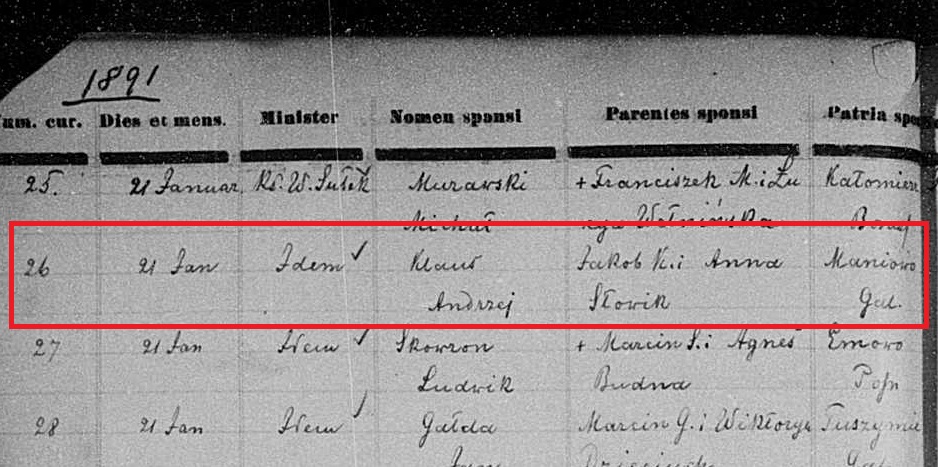
One such mystery involves the marriage records I discovered for my great-great-grandfather, Andrzej Klaus, and his brother, Tomasz, which I discussed in a post back in 2017.[1] At that time, I noted that Andrzej’s mother was identified as Anna Słowik in the record of Andrzej’s marriage to Marianna Łącka, which took place at St. Stanislaus Church in Buffalo on 21 January 1891 (Figure 1).[2]

Figure 1: Detail from the marriage record of Andrzej Klaus and Marianna Łącka, showing Andrzej’s parents’ names as” Jakob K. i Anna Słowik,” and his place of birth as “Maniowo, Gal.” The record is in a mixture of Polish and Latin; “Gal.” is an abbreviation for the Galicia province of the Austrian Empire, and Maniowo is a misspelling of Maniów.[2]

Similarly, when Andrzej’s brother, Tomasz Klaus, married Wiktoria Rak at St. Stanislaus on 20 November 1900, the groom’s mother was identified as Franciszka Słowik (Figure 2).[3]
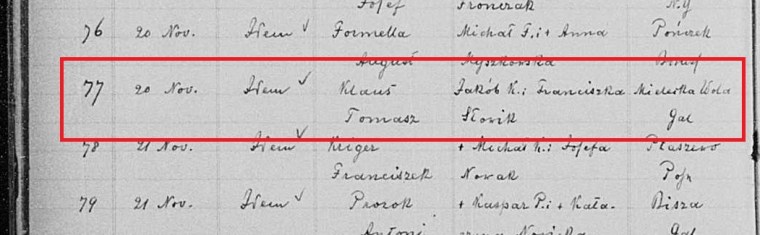
Figure 2: Detail from the marriage record of Tomasz Klaus and Wiktoria Rak, showing Tomasz’s parents’ names as “Jakób K. i Franciszka Słowik,” and his place of birth as “Mielecka Wola, Gal[icia].”[3]

That’s all well and good, except for the fact that I have good evidence that Andrzej and Tomasz were the sons of Jakub Klaus and Franciszka Liguz. Where does the name Słowik come in? Why did both her sons report this as their mother’s maiden name, why did Andrzej report her given name as Anna, and why am I so certain that her name was really Liguz?

The answers lie in church records created at the parish of St. Mary Magdalene in Szczucin, located in Dąbrowa County, in the Galicia province of the Austrian Empire. This was the parish that served the village of Maniów, where the Klaus family lived. Maniów is presently located in gmina Szczucin, Dąbrowa County, in the Małopolskie province of Poland. In 1981, the village was reassigned to a new parish, Our Lady of Fatima & the Rosary, which was established in the village of Borki. According to local custom, when a village is reassigned to a new parish, the church books for that village are transferred from the old parish to the new parish. So, it was in Borki that I first laid eyes on the books containing the baptismal records for my great-grandfather, Andrzej Klaus, and his siblings, even those those baptisms took place in Szczucin.

Church records revealed that Jakub Klaus and Franciszka Liguz were married on 16 September 1860 in Szczucin (Figure 3).[4]

Figure 3: Marriage record from Szczucin for Jakub Klaus and Franciszka Liguz, 16 September 1860.[4]

The Latin marriage record stated that the groom, Jacobus Klaus, was a Catholic, single, 30-year-old servant (famulus), and the son of Laurentius and Anna (née Zolowna) Klaus. Because the records were kept in Latin, Latin forms of given names were used. However, the individuals identified in the records would have been known to their communities by their Polish names, to Laurentius would have been called Wawrzyniec and Jacobus would have been called Jakub. (The name Anna is the same in Latin, Polish, and English.) Note also that the groom’s mother’s maiden name (Zolowna) was given in an old form not used today; the “-ówna” ending signifies an unmarried woman of the Zola family, although her name has also been spelled as Żala and Żola on other records. The bride, 24-year-old Francisca Liguz (Franciszka in Polish), was Catholic, single, and the daughter of Laurentius Liguz and Margaretha (Małgorzata) Warzecha. Witnesses were Adalbertus (Wojciech) Liguz and Joannes (Jan) Mamuśka.

Baptismal records identified eight children born to this couple:

  1. Jan Klaus, born 09 October 1860 in Maniów,[5] died 13 May 1920 in Plymouth, Luzerne, Pennsylvania, USA;[6]
  2. Józef Klaus, born 26 February 1863 in Maniów,[7] died 12 January 1874 in Wola Mielecka;[8]
  3. Andrzej Klaus, born 25 November 1865 in Maniów,[9] died 14 June 1914 in North Tonawanda, Niagara, New York, USA;[10]
  4. Michał Klaus, born 01 September 1867 in Maniów,[11] no death or marriage record yet discovered;
  5. Paweł Klaus, born 28 May 1870 in Maniów,[12] died 14 March 1879 in Wola Mielecka;[13]
  6. Piotr Klaus, born 28 May 1870 in Maniów,[14] died 22 July 1870 in Maniów;[15]
  7. Tomasz Klaus, born 03 September 1872 in Wola Mielecka,[16] died 28 December 1911 in Buffalo, Erie, New York, USA;[17]
  8. Helena Klaus, born 25 September 1875 in Wola Mielecka,[18] died 15 August 1878 in Wola Mielecka.[19]

Baptismal records from Galicia typically identify not only the parents of the child, but also the grandparents, the baptismal records for Andrzej Klaus and each of his siblings identified their mother as Francisca, daughter of Laurentius Liguz and Margaretha Warzecha.

Franciszka Liguz herself was born 6 February 1836 in Maniów, the oldest child of Wawrzyniec and Małgorzata (Warzecha) Liguz (Figure 4) .[20]
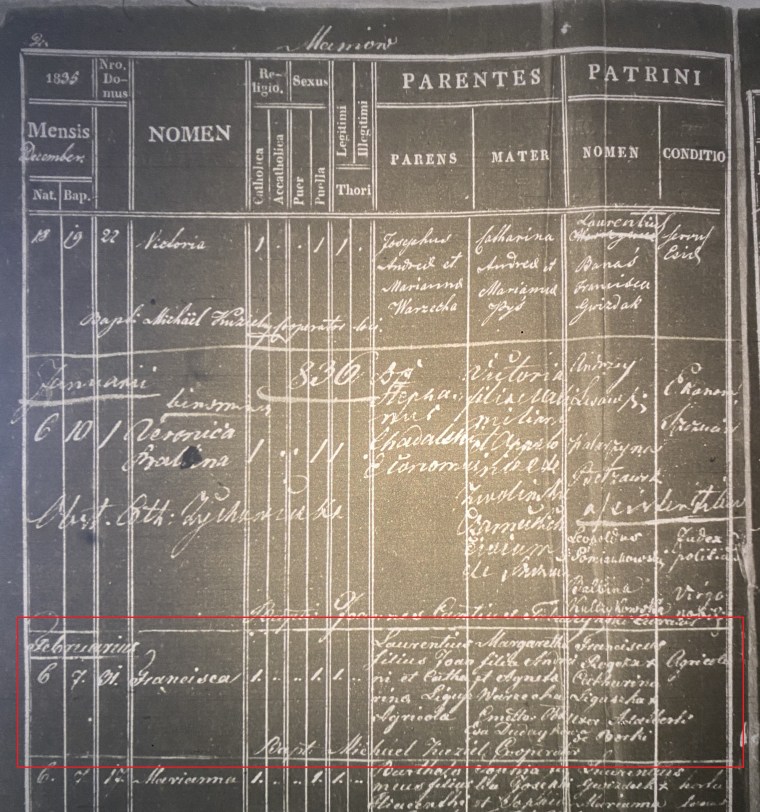
Figure 4: Franciszka Liguz’s baptismal record, which states that she was born 6 February 1836 in Maniów, house number 31, and baptized the next day. She was Catholic, female, and legitimate. Her father was Laurentius, a farmer (agricola), son of Joannes (Jan) and Catharina (Katarzyna) Liguz. Her mother was Margaretha, daughter of peasants (cmetho) Andreas and Agnes Warzecha. The midwife was Eva Dudaykowa, and the godparents were Franciscus Rogoza and Catharina Liguszka (Liguz), wife of Adalbert [Liguz] of Borki. The godparents were farmers (agricola). Franciszka was baptized by Fr. Michael Kuziel, Cooperator (assistant pastor).[20]

Her birth record identified her parents as Laurentius, son of Joannes and Catharina Liguz, and Margaretha, daughter of Andreas and Agnes Warzecha. Wawrzyniec/Laurentius Liguz and Małgorzata/Margaretha Warzecha were married on 28 May 1832 in Szczucin (Figure 5).[21] The marriage record identified Wawrzyniec as a 40-year-old widower, while the bride was just 17 years old. Parents’ names were not reported for Wawrzyniec, but Małgorzata’s father was named Andreas/Andrzej, consistent with the information reported on Franciszka Liguz’s birth record.
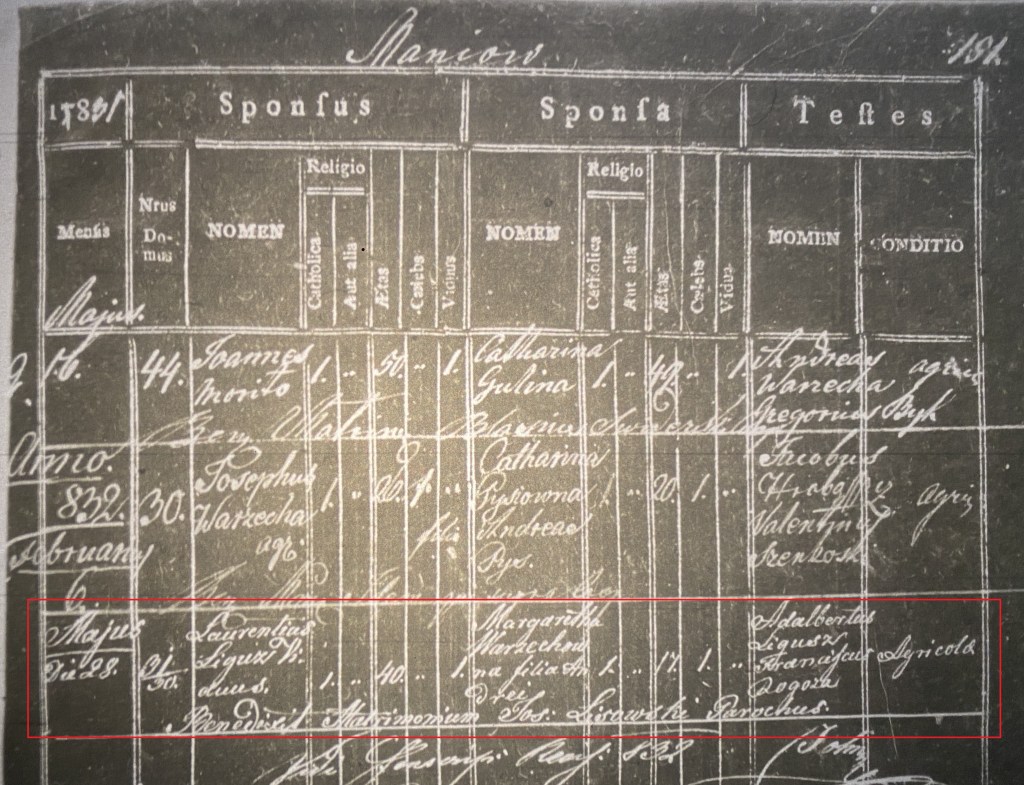
Figure 5: Marriage record from Szczucin for Laurentius Liguz and Margaretha Warzecha, who were married 28 May 1832.[21]

Wawrzyniec and Małgorzata had six children together:

  1. Franciszka, born 06 February 1836 in Maniów,[22] date of death unknown;
  2. Józefa Zofia Liguz, born 11 January 1838 in Maniów,[23] date of death unknown;
  3. Jan Liguz, born 01 January 1840 in Maniów,[24] died 4 January 1840;[25]
  4. Sebastian Liguz, born 01 Janaury 1840 in Maniów, [26] died 2 January 1840;[27]
  5. Jan Liguz, born 13 June 1841 in Maniów,[28] died 8 September 1841;[29]
  6. Józef Liguz, born 2 March 1844 in Maniów,[30] died 16 May 1846.[31]

The twins, Jan and Sebastian, both died within a few days of birth, and the younger son named Jan, born in 1841, died at the age of 3 months. Wawrzyniec Liguz died at the age of 55 on 6 November 1845, leaving Małgorzata as a 30-year-old widow with three children, ages 9, 7, and 20 months.

How Małgorzata supported her young family during the next three years is unclear. Church records described her late husband, Wawrzyniec, as a “hortulanus,” which was a peasant with a small, garden-sized plot of land.[32] They were residents of house number 31 in Maniów, but she was living at house number 40 at the time of her second marriage to Jan Podkówka, on 1 November 1848 in Szczucin, suggesting that she may have moved in with other family members after her husband’s death.[33]

Jan Podkówka was a 50-year-old father and widower when he married Małgorzata Liguz. The couple had two children together:

  1. Tomasz Podkówka, born 5 November 1849,[34] died 16 November 1873;[35]
  2. Agata Podkówka, born 1 February 1852,[36] died 6 March 1910.[37]

Jan Podkówka must have died before 27 January 1856,[38] because that was when Małgorzata married a third time, to another widower, Antoni Słowik.[39] Here, at last, is the answer to the mystery found in the Buffalo church records regarding the identification of Andrzej and Tomasz Klaus’s mother as Słowik rather than Liguz. Figure 6 shows a simplified version of Małgorzata’s family tree.
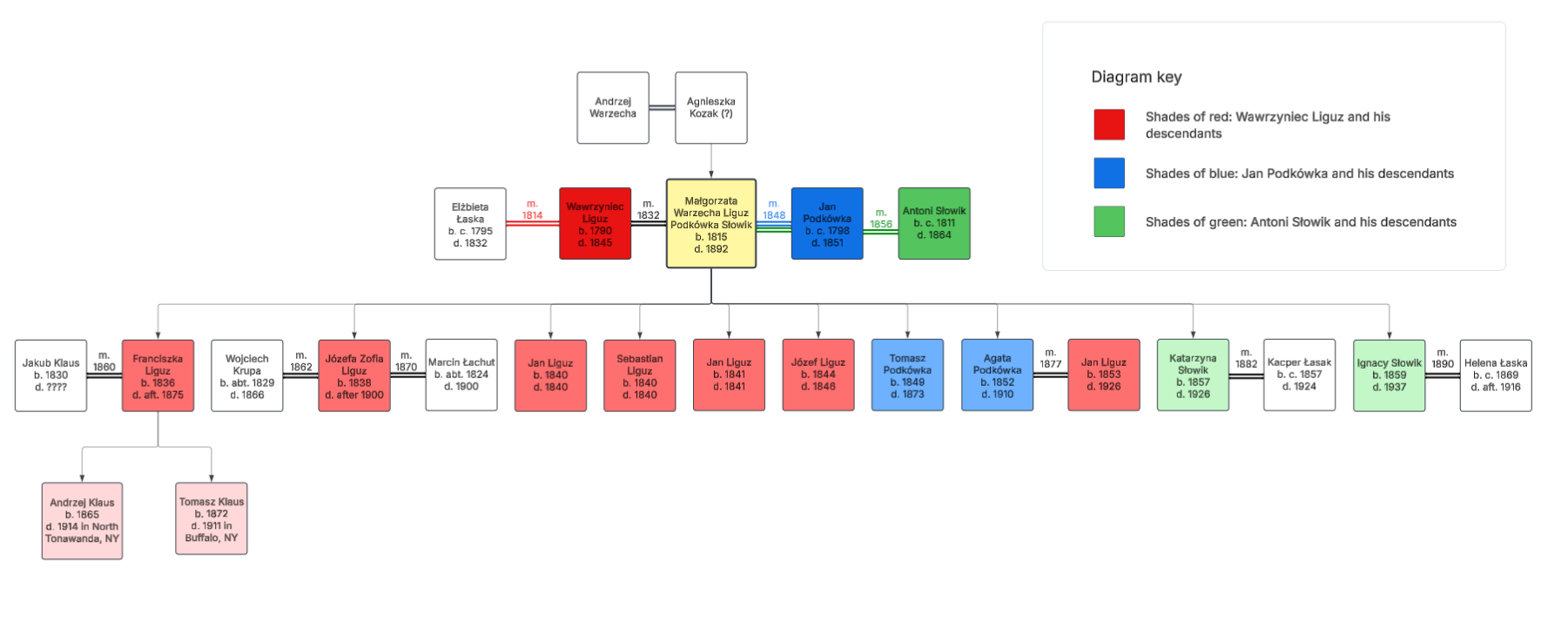
Figure 6: Simplified family tree for Małgorzata Warzecha Liguz Podkówka Słowik, which includes her parents, her husbands, and all her children. The chart does not include previous marriages of Jan Podkówka and Antoni Słowik. Her children’s spouses are shown, but the chart does not include all of Małgorzata’s grandchildren. Click image to enlarge.

At the time of her marriage to Antoni Słowik, Małgorzata was a 41-year-old mother of eight children, four of whom were still alive. Franciszka Liguz and Józefa Zofia Liguz were ages 20 and 18, respectively, while Tomasz Podkówka and Agata Podkówka were 7 and nearly 4 years old, respectively. Antoni and Małgorzata had two children together prior to his death on 4 April 1864:[40]

  1. Katarzyna Słowik, born 14 February 1857 in Borki,[41] died 25 April 1902 in Delastowice;[42]
  2. Ignacy Słowik, born 28 July 1859 in Borki,[43] died 5 October 1937 in Maniów.[44]

It’s unclear why Andrzej and Tomasz Klaus would have reported their mother’s maiden name as Słowik rather than Liguz, and why Andrzej would have reported her given name as Anna, rather than Franciszka. It may have been a simple misunderstanding of the question, providing her name at the time of their marriages, rather than her maiden name. It’s also possible that an error was introduced during recopying of the church books from St. Stanislaus in Buffalo; the fact that all the church records from St. Stanislaus appear to be in the same handwriting suggests that these are not original records.

Widowed for the third time at the age of 49, Małgorzata never remarried after Antoni’s death in 1864. Her oldest child, Franciszka, had been married for four years by the time her stepfather, Antoni Słowik, died. Małgorzata’s second child, Józefa Zofia (known as Zofia), had married Wojciech Krupa on 27 July 1862, so she, too, was living independently.[45] Tomasz Podkówka, age 14, was old enough to be a help to his mother, along with his younger sister, Agata Podkówka, age 12. Katarzyna and Ignacy Słowik were only 7 and 5 when their father died, and once again, it’s unclear how Małgorzata managed to support her family following her husband’s death, although it’s probable that she relied on assistance from additional family members.

Małgorzata Warzecha Liguz Podkówka Słowik died at the age of almost 77 on 7 January 1892, having outlived all three husbands, and five of her ten children.[46] Her death record, shown in Figure 7, identified each of her previous husbands. At the time of her death, Małgorzata was living in house number 33 in Borki, and further research may identify the owner of that home.

Figure 7: Death record for Margaretha widow of 1. Laurentius Liguz, 2, Joannes Podkówka, 3. Antonius Słowik, née Warzecha, age 77; causes of death, marasmus.[46]

Researching Małgorzata’s life revealed more than just names and dates—it uncovered a narrative of resilience, adaptation, and change. Her multiple marriages and the resulting blended family echo the complex structures many genealogists discover in their own research. Many questions still remain, but this is the nature of genealogical research; our ancestors left behind breadcrumbs, not roadmaps, and it’s up to us to piece together their stories with patience and persistence.

© Julie Roberts Szczepankiewicz 2025


[1] Julie R. Szczepankiewicz, “And the Walls Came Tumbling Down: New Discoveries in My Klaus Family Research, Part I,” From Shepherds and Shoemakers (https://fromshepherdsandshoemakers.com/), published 8 August 2017, accessed 12 March 2025.

[2] Roman Catholic of St. Stanislaus, Bishop & Martyr (Buffalo, Erie, New York, USA), Marriages, Vol. II (1891-1931), p. 1, 1891, no. 26, Klaus-Łączka, 21 January 1891; digital image, FamilySearch (https://familysearch.org/ark:/61903/3:1:3Q9M-CS4N-64SL-7?i=1407&cat=23415 : accessed 15 March 2025).

[3] Ibid., p. 62, 1900, no. 77, Klaus-Rak, 20 November 1900; digital image, FamilySearch (https://www.familysearch.org/ark:/61903/3:1:3Q9M-CS4N-64QV-L?i=1468&cat=23415&lang=en : accessed 8 August 2017).

[4] Roman Catholic Church of St. Mary Magdalene (Szczucin, Dąbrowa, Małopolskie, Poland), Maniów, Akta małżeństw [Marriage records], 1860, 16 September, Klaus-Liguz; FamilySearch Library, film no. 1958428 Items 7-8.

[5] Roman Catholic Church, Sanktuarium Matki Bożej Fatimskiej – Różańcowej (Borki, Szczucin, Dąbrowa, Małopolska, Poland), Baptisms, 1860, no. 20, Joannes Klaus; parish archive. Mother was recorded as “Francisca nata Laurentio Liguz et Margaretha Warzecha.”

[6] Pennsylvania, USA, Death Certificates, 1920, no. 60801, John Klaus, died 13 May 1920; imaged as, “Pennsylvania Death Certificates, 1906-1966,” database, Ancestry, (http://ancestry.com : 13 March 2025).

[7] Roman Catholic Church, Sanktuarium Matki Bożej Fatimskiej – Różańcowej (Borki, Szczucin, Dąbrowa, Małopolska, Poland), Baptisms, 1863, unnumbered entries in chronological order, Josephus Klaus, born 26 February 1863. Mother was recorded as “Francisca nata Laurentio Liguz et Margaretha Warzecha.”

[8] Polskie Towarzystwo Genealogiczne [Polish Genealogical Society], Geneteka, database (https://geneteka.genealodzy.pl/ : accessed 15 March 2025), search result for Klaus deaths in Podkarpackie, 1874, no.4, Józef Klaus, son of Jakub Klaus and Franciszka Liguz, parish Książnice-Wola Mielecka, died in Wola Mielecka on 12 January 1874 at the age of 7 years, source: parish archives, indexed by Krzysztof Gruszka.

[9] Roman Catholic Church, Sanktuarium Matki Bożej Fatimskiej – Różańcowej (Borki, Szczucin, Dąbrowa, Małopolska, Poland), Baptisms, 1865, no. 37, Andreas Klaus, born 25 November 1865. Mother was recorded as “Francisca nata Liguz fil: Laurentii et Margarethae natae Warzecha.”

[10] North Tonawanda City Clerk (North Tonawanda, Niagara, New York, USA), Death Certificates, 1914, no. 82, Andro Klaus, 14 June 1914.

[11] Roman Catholic Church, Sanktuarium Matki Bożej Fatimskiej – Różańcowej (Borki, Szczucin, Dąbrowa, Małopolska, Poland), Baptisms, 1867, no. 20, Michael Klaus, born 1 September 1867. Mother was recorded as “Francisca nata Liguz fil. Laurentii et Margarethae natae Warzecha.”

[12] Ibid., 1870, no.18, gemini, Paulus, Petrus Klaus, born 28 May 1870. Mother was recorded as “Francisca filia Laurentii Liguz et Margaritha Warzecha.”

[13] Polskie Towarzystwo Genealogiczne [Polish Genealogical Society], Geneteka, database (https://geneteka.genealodzy.pl/ : accessed 13 March 2025), search result for Klaus deaths in Podkarpackie, 1879, no. 7, Paweł Klaus, son of Jakub Klaus and Franciszka Liguz, parish Książnice-Wola Mielecka, died in Wola Mielecka on 14 March 1879 at the age of 8 years, source: parish archives, indexed by Krzysztof Gruszka.

[14] See note 12.

[15] Ibid.; a cross next to Petrus’ name indicates that he died, and the date “22/7 1870” is recorded under his name.

[16] Polskie Towarzystwo Genealogiczne [Polish Genealogical Society] Geneteka, database (https://geneteka.genealodzy.pl/ : accessed 15 March 2025), search result for Klaus births in Podkarpackie, 1872, no. 23, Tomasz Klaus, son of Jakub Klaus and Franciszka Nygus [sic], parish Książnice-Wola Mielecka, born in Wola Mielecka on 3 September 1872, source: parish archives, indexed by Krzysztof Gruszka, accessed 15 March 2025.

[17] Roman Catholic Church of Corpus Christi (Buffalo, Erie, New York, USA), “Deaths, 1902-1916,” p. 68, 1911, no. 139, Thomas Klaus, 28 December 1911; Polish Genealogical Society of New York State.

[18] Ibid., 1875, #23, Helena Klaus, son of Jakub Klaus and Franciszka Nygus [sic], parish Książnice-Wola Mielecka, born in Wola Mielecka on 25 September 1875, source: parish archives, indexed by Krzysztof Gruszka.

[19] Polskie Towarzystwo Genealogiczne [Polish Genealogical Society], Geneteka, database, (https://geneteka.genealodzy.pl/ : accessed 13 March 2025), search result for Klaus deaths in Podkarpackie, 1878, no. 28, Helena Klaus, daughter of Jakub Klaus and Franciszka Liguz, parish Książnice-Wola Mielecka, died in Wola Mielecka on 15 August 1878 at the age of 3 years, source, parish archives, indexed by Krzysztof Gruszka.

[20] Roman Catholic Church of St. Mary Magdalene (Szczucin, Dąbrowa, Małopolska, Poland), Maniów, Liber Baptizatorum, 1836, unnumbered entries in chronological order, Francisca Liguz, 6 February 1836; FamilySearch Library film no. 1958427, items 12-14.

[21] Ibid., Maniów, Akta małżeństw, 1832, Liguz-Warzechow, 28 May 1832; FSL film no.1958428, items 7-8.

[22] See note 20.

[23] Roman Catholic Church of St. Mary Magdalene, (Szczucin, Dąbrowa, Małopolskie, Poland), Liber Baptizatorum, Maniów, 1838, no. 2, Josepha Sophia Liguz, born 11 January 1838; FamilySearch film no. 1958427, Items 12-14.

[24] Ibid., 1840, no. 2, Joannes Liguz, born 01 January 1840; FamilySearch film 1958427, Items 12-14.

[25] “Poland, Church Books, 1568-1990,” database, FamilySearch (https://www.familysearch.org/ark:/61903/1:1:6VQ2-VSPW?lang=en : accessed 13 March 2025), Joannes Liguz, died 4 January 1840.

[26] Ibid.,1840, no. 3, Sebastianus Liguz, 01 January 1840; FamilySearch film 1958427, Items 12-14.

[27] Polskie Towarzystwo Genealogiczne [Polish Genealogical Society], Geneteka, database,  (http://geneteka.genealodzy.pl/ : accessed 13 March 2025), search result for deaths in Malopolska, 1840, no1, Sebastian Liguz, son of Wawrzyniec and Malgorzata, Parish: Szczucin, Place: Maniów, Remarks: 1 day [old], date of death: 2 January 1840, Source: parish archive, Indexed by Marc68.

[28] Roman Catholic Church, St. Mary Magdalene parish (Szczucin, Dąbrowa, Małopolskie, Poland), Liber Baptizatorum, Maniów, 1841, no. 12, Joannes Liguz, 13 June 1841; FamilySearch film no. 1958427, Items 12-14.

[29] “Poland, Church Books, 1568-1990,” database, FamilySearch (https://www.familysearch.org/ark:/61903/1:1:6VQ2-4HM9?lang=en : accessed 13 March 2025), Joannes Liguz, died 8 September 1841 in Borki, son of Laurentii Liguz and Margaretha Warzczonka.

[30] Roman Catholic Church, St. Mary Magdalene parish (Szczucin, Dąbrowa, Małopolskie, Poland), Liber Baptizatorum, Maniów, 1844, unnumbered entries in chronological order, Josephus Liguz, 2 March 1844, FamilySearch film no.1958427, Items 12-14.

[31] “Poland, Church Books, 1568-1990,” database, FamilySearch (https://www.familysearch.org/ark:/61903/1:1:6VQ2-QZJW?lang=en : accessed 13 March 2025), Josephus Liguz, died 16 May 1846, son of Laurentii Liguz and Margaretha Marzcrzona [sic].

[32] William F. Hoffman and Jonathan D. Shea, In Their Words: A Genealogist’s Translation Guide to Polish, German, Lain, and Russian Documents: Volume III: Latin (Language & Lineage Press, 2018), p. 272.

[33] Roman Catholic Church, St. Mary Magdalene parish (Szczucin, Dąbrowa, Małopolskie, Poland), Liber Matrimoniorum [Book of marriages], Maniów, 1848, Joannes Podkówka and Margaretha Ligus, nee Warzecha, 1 November 1848; FamilySearch film no. 1958428, Items 7-8.

[34] Ibid., Liber Baptizatorum, Maniów, 1849, no. 18, Thomas Podkówka, 5 November 1849; FamilySearch film no. 1958427, Items 12-14.

[35] Polskie Towarzystwo Genealogiczne [Polish Genealogical Society], Geneteka, database, Geneteka.genealodzy.pl, (http://geneteka.genealodzy.pl/ : accessed 14 March 2025), search result for Podkówka deaths in Malopolskie, 1873, no. 57, Tomasz Podkówka, son of Jan and Malgorzata Warzecha, Parish: Szczucin, Place: Maniów, Remarks: 25 years [of age], died 16 November 1873, source: parish archive, indexed by Marc68.

[36] Roman Catholic Church, St. Mary Magdalene parish (Szczucin, Dąbrowa, Małopolskie, Poland), Liber Baptizatorum [birth records], Maniów ,1852, no. 5, Agatha Podkówka, 1 February 1852; FamilySearch film no. 1958427 Items 12-14.

[37] Roman Catholic Church, St. Mary Magdalene Parish (Szczucin, Malopolskie, Poland), “Akta stanu cywilnego Parafii Rzymskokatolickiej w Szczucinie,” Ksiega Aktów Zgonów od 1890 – 1913 [Book of Death Certificates from 1890 – 1913], p. 140, Maniów, 1910, no. 6, Agata Liguz, died 6 March 1910; digital image, Szukajwarchiwach (https://www.szukajwarchiwach.gov.pl : accessed 16 March 2025), reference code 33/630/0/-/3, image 74 of 123.

[38] Roman Catholic Church, St. Mary Magdalene parish (Szczucin, Dąbrowa, Małopolskie, Poland), Akta małżeństw [Marriage records] 1786-1866, 1856, Maniów, unnumbered entries in chronological order, Antonius Słowik and Margaretha Podkowka, 27 January 1856; FamilySearch film no. 1958428, Item 3.

[39] There is no clear match in Geneteka for a death record for Jan Podkówka. An online conception date calculator indicates that Agata Podkówka would have been conceived between 20 April 1851 and 27 April 1851. That suggests that Jan Podkówka died between 20 April 1851 and 26 January 1856.

The only death for a Jan Podkówka in Małopolskie that comes close is that of Jan Podkówka, who died in Maniów on 1 December 1851. He was age 52, which suggests a birth circa 1799, consistent with his age at the time of his marriage to Małgorzata (Warzecha) Liguz, but he was reported to be the husband of Katarzyna, not Małgorzata. If this death record is the correct one for Jan Podkówka, husband of Małgorzata, then it’s curious that Agata Podkówka’s baptismal record from February 1852 did not mention that her father was deceased. However, it’s noteworthy that Jan and Małgorzata’s marriage record, and the birth record for their son Tomasz, indicate that he was living in house number 34 in Maniów. Agata’s birth record (presumably made after Jan’s death) indicates that she was born in house number 19 in Maniów, consistent with the prediction that Małgorzata would have had to move in with other family members after Jan’s death.

[40] Polskie Towarzystwo Genealogiczne [Polish Genealogical Society], Geneteka, database, (http://geneteka.genealodzy.pl/ : accessed 17 March 2025), search result for Antoni Slowik in Małopolskie, Deaths, 1864, no. 4, Antoni Slowik, parish: Szczucin, place: Borki, remarks: house no. 33, 58 years, husband of Malgorzata Warzecha, died 4 April 1864; source: parish archive, indexed by Marc68.

[41] Ibid., search result for surnames Slowik and Warzecha in Małopolskie, Births, 1857, no. 5, Katarzyna Slowik, daughter of Antoni and Malgorzata Warzecha, parish: Szczucin, place: Borki, remarks: house number 33, date of birth, 14 February 1857, source: parish archive, indexed by Marc68.

[42] Roman Catholic Church, St. Mary Magdalene Parish (Szczucin, Małopolskie, Poland), “Akta stanu cywilnego Parafii Rzymskokatolickiej w Szczucinie,” Ksiega Aktów Zgonów od 1890 – 1913 [Book of Deaths from 1890 – 1913], p. 184, Delastowice, 1902, no. 2, Catharina Lasak, died 25 April 1902; digital image, Szukaj w Archiwach (https://www.szukajwarchiwach.gov.pl : accessed 17 March 2025), reference code 33/630/0/-/3, scan 96 of 123.

[43] Polskie Towarzystwo Genealogiczne [Polish Genealogical Society], Geneteka, database, (http://geneteka.genealodzy.pl/ : accessed 17 March 2025), search result for surnames Slowik and Warzecha in Małopolskie, Births, 1859, no. 11, Ignacy Slowik, son of Antoni and Malgorzata Warzecha, parish: Szczucin, place: Borki, house no. 33, remarks: house no. 33, date of birth, 28 July 1859, source: parish archive, indexed by Marc68.

[44] Ibid., search result for Ignacy Slowik in Małopolskie, Deaths, 1937, no. 7, Ignacy Slowik, parish: Szczucin, place: Maniów, remarks: age 78, husband of Helena Łaska, date of death, 5 October 1937, source: parish archive, indexed by Marc68.

[45] Ibid., search result for Zofia Liguz in Malopolskie, Marriages, 1862, Wojciech Krupa, son of Walenty and Marianna Krzyzek, and Zofia Liguz, daughter of Wawrzyniec and Malgorzata Warzecha, parish: Szczucin, remarks: groom’s age, 33, bride’s age, 24; place: Borki, date of marriage, 27 July 1862.

[46] Roman Catholic Church, St. Mary Magdalene parish (Szczucin, Dąbrowa, Małopolskie, Poland), Księga Aktów Zgonów [Book of death certificates], 1890-1913, 1892, no. 1, Margaritha Liguz Podkówka Słowik nee Warzecha; imaged as “Akta stanu cywilnego Parafii Rzymskokatolickiej w Szczucinie, 1890-1932,” Szukaj w Archiwach (https://www.szukajwarchiwach.gov.pl/en/jednostka/-/jednostka/19224209 : 5 April 2024), Sygnatura 33/630/0/-/3, scan 5 of 123.
Challenging Assumptions About Elżbieta Siekierecka

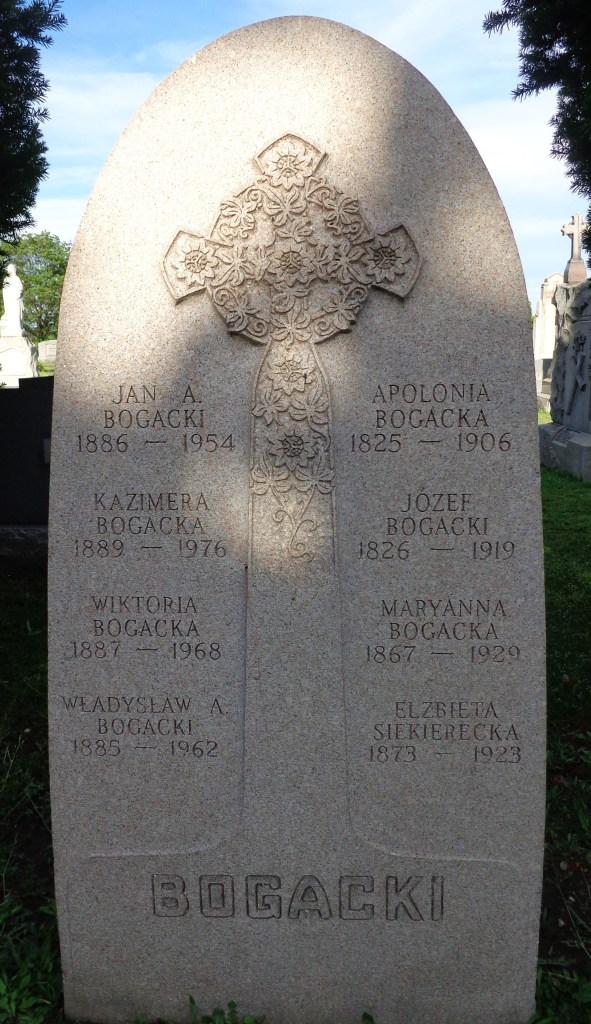
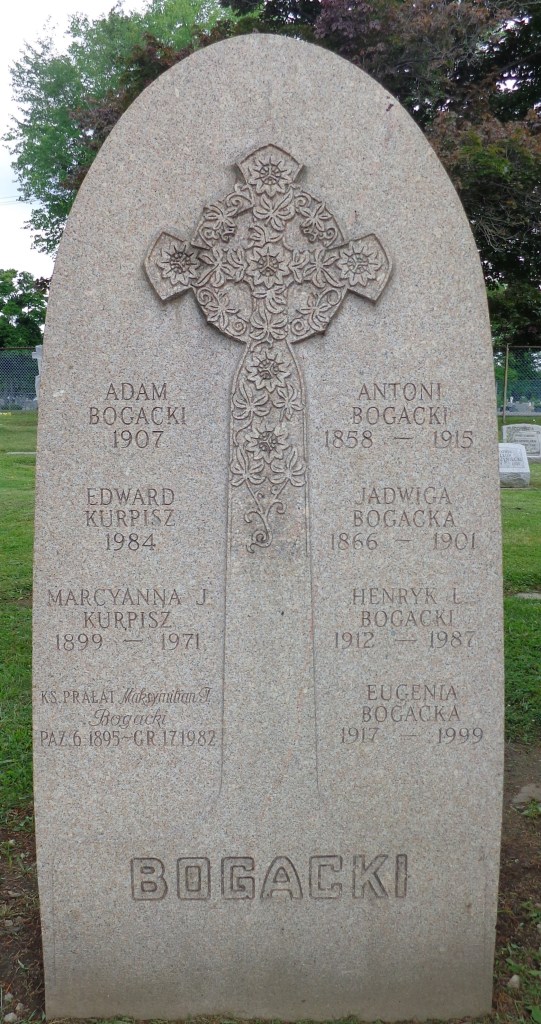
In my last post, I pieced together the relationships of individuals recorded on the Bogacki family monument in St. Stanislaus Cemetery in Cheektowaga, New York (Figures 1 and 2).

Figure 1: Front of the Bogacki monument in St. Stanislaus Cemetery, Cheektowaga, New York. Photo taken by the author, July 2014.
Figure 2: Back of the Bogacki monument in St. Stanislaus Cemetery, Cheektowaga, New York. Photo taken by the author, July 2014.

The individuals buried here are either descended from the patriarch and matriarch, Józef and Apollonia (Prusiecka) Bogacki, through their son, Antoni Bogacki, and his three wives, Anna Burczykowska (m. 1879), Jadwiga Tądrowska (m. 1892), and Jadwiga’s sister, Maryanna Tądrowska (m. 1901), or else they married into the family. Those who married into the family, in addition to Antoni’s two wives, Jadwiga and Maryanna, were Kazimiera (Pawlicka) Bogacka, who married Jan Bogacki; Wiktoria (Niewczyk) Bogacka, who married Władysław Bogacki; Eugenia (Michalska) Bogacka, who married Henryk Bogacki; and Edward Kurpisz, who married Marcyanna “Marion” (Bogacka) Kurpisz.

That leaves Elżbieta Siekierecka unaccounted for. Her burial in the Bogacki family plot suggests that she was a Bogacka somehow; was her maiden name Bogacka? Or was Siekierecka her maiden name, and she married a Bogacki, as suggested by her Find-a-Grave memorial? [1]

As it turns out, neither is true.

Elżbieta Siekierecka did not leave much trace in U.S. records. Her grave marker informs us that she was born in 1873 and died in 1923, and the New York State Death Index specifies her date and place of death as 1 February 1873 in Cheektowaga, New York.[2] She arrived in the the port of New York on 25 July 1921, so she resided in the U.S. for just 18 months prior to her death.[3]

Elżbieta arrived in the U.S. as a 42-year-old widow with two children, 11-year-old Marya and 9-year-old Antoni. Their ages suggest birth years of 1879, 1910, and 1912, respectively, which makes Elżbieta six years younger than what her grave marker suggests. Her passenger manifest identifies her as a farm laborer whose last permanent residence was “Pozen” (Poznań). Her nearest relative in the country from whence she came was her sister, Marcjanna Szule, who was living in “Staraleka Gub. Pozen.” This suggests the village of Starołęka Wielka, which is currently located in gmina Poznań, Poznań County, in the Wielkopolskie province of Poland. (“Gub.” here is an abbreviation for “gubernia,” which was an administrative division in the Russian Empire comparable to a province. Poznań was never under Russian control, so there was never a “Poznań gubernia.” Moreover, by 1921, Poland had regained its independence, so this village was located in the Poznań voivodeship of the Second Polish Republic.[4] Unfortunately, the clerk who prepared the manifest was apparently unaware of all that.)

Elżbieta was headed to Buffalo, New York, to her sister, “Marya Bogaeta,” living at 76 Rugby Avenue, which is actually Rugby Road on Buffalo’s north side. “Bogaeta” is pretty clearly a mistranscription of Bogacka, in light of present evidence, which would imply that Elżbieta was the sister of Marya (Tądrowska) Bogacka. Marya married Antoni in 1901, and he died in 1915, so she was his widow in 1921 when Elżbieta arrived in the U.S.[5]

Nonetheless, I had been expecting that Elżbieta would have been born a Bogacka, based on her burial in the Bogacki family plot, so my first thought was that the information on the passenger manifest was another example of a Polish immigrant employing a rather expansive definition of family relationships. In my research experience, Polish immigrants sometimes exaggerated the closeness of their relationships to their American contacts, referring to them as “in-laws,” “cousins,” or even “brothers” and “sisters” when there was no evidence for those relationships in historical records. Based on my experience, if Elżbieta were Antoni’s sister, it would not be unusual for her to identify Marya (Tądrowska) Bogacka as her sister, rather than her sister-in-law—especially since Antoni Bogacki was already deceased.

This was my working hypothesis when last I left off with my Bogacki research a few years ago. However, in recent weeks I’ve circled back to it, looking at the data with fresh eyes. That’s when I realized that Elżbieta Siekierecka wasn’t born a Bogacki at all, nor did she marry one: she really was the full sister of Marya (Tądrowska) Bogacka.

What tipped me off was her place of birth, recorded on the second page of her passenger manifest as “Kostrzynie.” Marriage records for Antoni Bogacki and Jadwiga and Marya Tądrowska identify the Tądrowskis’ birthplace as “Kostrzyn, Boruss[ia],” i.e. Kostrzyn, Prussia, as do baptismal records for five of Jadwiga’s children.[6] Jadwiga’s death record similarly identifies her birthplace as “Kostrzyn, Pos[e]n.”[7] The baptismal record for her youngest son, Zygfryd, identifies Jadwiga’s birthplace as “Kościerzyna, Boruss[ia],” which is a different place in Poland, but the body of evidence points to Kostrzyn as being the correct place of origin for the Tądrowski family.[8] The variant spelling recorded on the passenger manifest, “Kostrzynie,” reflects the grammatical declension inherent to the Polish langauge: to say, “I was born in Kostrzyn” in Polish, I would say, “Urodziłam się w Kostrzynie.” A similar conversation probably took place when the passenger manifest was recorded.

In order to prove that Elżbieta Siekierecka was a Tądrowska, I needed to find some evidence of her parentage. Her church burial record or death certificate would likely identify her parents, but a quick search in the PGSNYS databases was negative; she may have been buried from a church which is not indexed. For $11.00, I could request her death certificate from the Town of Cheektowaga (where she died), but why spend money unnecessarily? Her baptismal record or marriage record from Kostrzyn might be easier to find at FamilySearch.

A search for Kostrzyn in the FamilySearch catalog reveals that collections of both Roman Catholic church records and civil vital registrations are available. Unfortunately, image viewing is restricted to a FamilySearch Center or Affiliate Library, so I can’t access these from home. However, the catalog entry also notes that records from Kostrzyn have been indexed, and are included in the database, “Germany, Prussia, Posen, Catholic and Lutheran Church Records, 1430-1998.

Searching this collection requires a bit of patience and persistence, and sometimes a sense of humor. It seems that many of the volunteer indexers who helped to create this database had little to no familiarity with Polish given names, surnames, and Polish diacritics, or perhaps the entire index was AI-generated. I’ve noticed this same problem with other FamilySearch databases, such as, “Poland, Tarnow, Roman Catholic Diocese Church Books, 1612-1900.” These databases are rife with transcription errors, such as “t” for “ł,” “y” for “ą,” etc. Sometimes, it’s possible to guess what the name should have been based on the transcription. For example, the surname “Koztdwska” makes no sense in Polish, but it’s clearly Kozłowska in the original record. Similarly, “Riotrowski” should be Piotrowski, “Kapusienslia” is Kapuścińska, and the absurd “McHael” is Michael. Unfortunately, FamilySearch doesn’t offer an option to submit a correction to transcriptions in their database like Geneteka does, so these errors are likely to persist. Nonetheless, indexed records with errors are better than no indexed records at all, and wildcards can be used to advantage, even when the surnames were butchered by transcribers or are genuinely difficult to read in the original record.

In this case, we’re in luck, because Jadwiga’s and Marya’s marriage records identify their parents as Wawrzyn Tondrowski/Tądrowski and Salomea Luberska, and this combination of given names is uncommon. And to its credit, FamilySearch‘s search algorithm recognizes that the Polish names Wawrzyn or Wawrzyniec are equivalent to the Latin name Laurentius, so it doesn’t matter which version of the name we use for our search.[9] A search for surname “*drowski” with father’s name Wawrzyn and mother’s name Salomea produces 11 baptismal records for children of this couple—including the three buried in the Bogacki family plot, Hedvigis “Tadrowski,” Elisabeth “Tydrowski,” and Marianna “Igdrowski” (Figure 3). All of them were baptized in Kostrzyn, just as expected, although the dates are off a bit from those reported on the Bogacki monument. Jadwiga/Hedwig Tądrowska was born 11 October 1863 (not 1866), Maria/Marya/Marianna (indexed as Igdrowski) was born 19 November 1865 (not 1867), and Elżbieta/Elisabeth (indexed as Tydrowski) was born 18 November 1872 (not 1873). [10]

Figure 3: Result of search for surname “*drowski,” father’s name “Wawrzyn,” and mother’s name “Salomea” in the FamilySearch database, “Deutschland, Preußen, Posen, Katholische und Lutherisch Kirchenbücher, 1430-1998.” Click image to enlarge.

Geneteka, being a Polish website, usually does a better job with transcribing Polish surnames and given names. As it happens, birth records from Kostrzyn are also indexed there, from 1820–1875, so all eleven of these Tądrowski/Tondrowski birth records should be included. Weirdly, a search for surname “T*” with given names Wawrzyn and Salomea only produced four of them (Figure 4).

Figure 4: Search result for births in Kostrzyn with surname T* and given names Wawrzyn and Salomea. Click image to enlarge.

It’s not clear to me why the other seven birth records aren’t found in this search. Maybe Geneteka is just being glitchy and temperamental, but this underscores the importance of checking more than one database, when available, and always consulting the original records before concluding that a particular event did not happen in a particular location.

We should be able to find Elżbieta’s marriage record to (_____) Siekierecki, and birth records for their children identified on the passenger manifest, Marianna and Antoni, as well as (_____) Siekierecki’s death record, for further confirmation that our conclusions thus far are sound.

A search for surname “Siekierecki” with mother’s name Elisabeth produces the children’s birth records (Figure 5).

Figure 5: Result of search for surname “Siekierecki” and mother’s name “Elisabeth” in the FamilySearch database, “Deutschland, Preußen, Posen, Katholische und Lutherisch Kirchenbücher, 1430-1998.” Click image to enlarge.

These records indicate that Marianna and Antoni Siekierecki were born 26 May 1910 and 30 April 1912, respectively, in “Provinz Posen, Preußen,” and but they don’t tell us where in “Provinz Posen” these births were recorded, nor is it possible to locate a handy coverage table like this one provided for the “Poland, Tarnow Roman Catholic Diocese Church Books” collection. [11] Presumably, this information is available when one views the images at a FamilySearch Center or Affiliate Library. Elżbieta’s husband is also identified as Vincentius (Wincenty) Siekierecki. A little more digging produces a death record for a third child of this couple, an unnamed son who died 10 February 1906. [12]

No amount of digging and creative wildcard searching turn up either a marriage record for Elżbieta and Wincenty Siekierecki, or Wincenty’s death record. This result is explained by the catalog entry for Kostrzyn; the magnifying glass icon next to specific collections indicates that Roman Catholic church marriage records were indexed from 1776–1878 with no apparent gaps, and that death records were indexed from 1776–1915 with no gaps after 1820. Since Elżbieta Tądrowska was born in 1873, her marriage took place well after the end of the indexed records, and Wincenty must have died after 1915. All is not lost, however. The Poznań area has good coverage in indexed databases; in addition to this indexed collection at FamilySearch, we can also try Geneteka, the Poznań Project, and BaSIA.

Geneteka has Kostrzyn marriage records indexed from 1818–1899, and Kostrzyn death records indexed up to 1912, so it’s unlikely that we’ll find Wincenty’s death, although we might possibly find his marriage to Elżbieta. However, a search for Wincenty Siekierecki is negative, even when the search is expanded to include all indexed parishes within 15 km of Kostrzyn, suggesting that the marriage took place in 1900 or later. The stated focus of the Poznań Project is on 19th-century marriages, and in keeping with that, they only have Catholic and civil marriage records for Kostrzyn indexed up to 1899. So, it’s unsurprising that a search here for Wincenty and Elżbieta’s marriage record is negative, confirming the Geneteka search result. We hit pay dirt at BaSIA, however. An “extended search” for Wincenty Siekierecki (as opposed to the basic search, which only allows entry of a surname) produces results in four geographic areas, including Kostrzyn-Poznań-Czerniejewo-Swarzęndz (Figure 6).

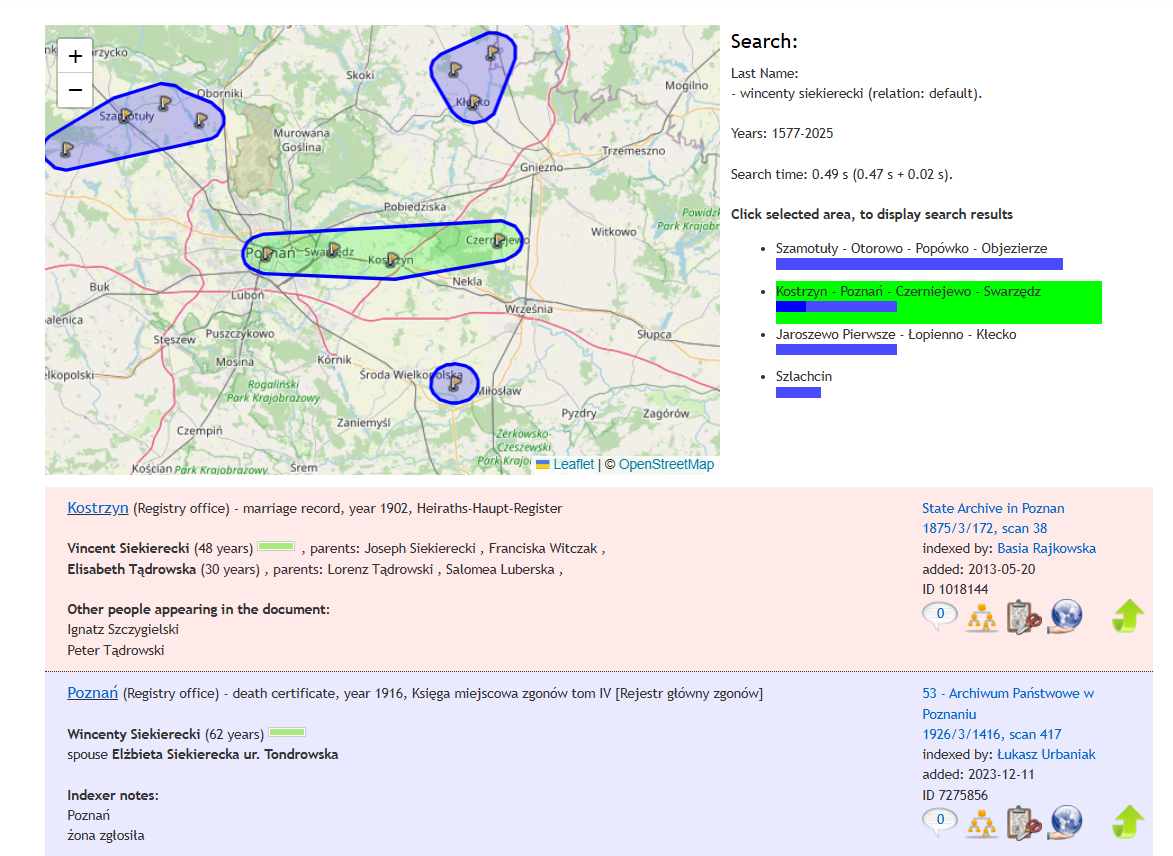
Figure 6: Result of search at BaSIA for Wincenty Siekierecki in the Kostrzyn-Poznań-Czerniejewo-Swarzędz geographic cluster. Click image to enlarge.

Results for the Kostrzyn-Poznań-Czerniejewo-Swarzędz cluster include Wincenty’s marriage record and his death record. Consistent with our expectations based on database searches thus far, Wincenty and Elżbieta were married in Kostrzyn on 30 April 1902, and Wincenty died on 12 November 1916 in Poznań. The marriage and death search results are both linked to digital images of those records from the State Archive in Poznań.[13] (Note that the marriage record covers two pages; the second page is here.) The marriage record identifies Wincenty Siekierecki as a butcher, born 14 December 1854 in Kozakowa (?), son of the deceased master saddler Joseph Siekierecki and his deceased wife Franciszka née Witczak, both last living in Kostrzyn. Elżbieta’s parents’ names and birth date agree with those reported in the indexed record of her baptism. Her father was described as a deceased master cooper, while her mother was still alive and residing in Kostrzyn.

So there we have it. Contrary to what burial in the Bogacki family plot might suggest, Elżbieta Siekierecka was not a Bogacka, nor was she married to one. Her connection to the family was tangential, through her sisters, Marya and Jadwiga (Tądrowska) Bogacki, who were two of the wives of Antoni Bogacki. Those researching the Tądrowski family will find ample material in indexed records from Poland. Happy hunting!

Sources:

[1] Find a Grave, database and images (https://www.findagrave.com/memorial/114761395/elzbieta-bogacka : accessed February 20, 2025), memorial page for Elżbieta Siekierecka Bogacka (1873–1923), Find a Grave Memorial ID 114761395, citing Saint Stanislaus Roman Catholic Cemetery, Cheektowaga, Erie County, New York, USA; Maintained by gravefinderStStans (contributor 47637865).

[2] “New York, U.S., Death Index, 18521956,” database, Ancestry (https://www.ancestry.com/search/collections/61535/records/2626650 : accessed 20 February 2025), Elzbieta Siekierecka, 1 February 1923, Cheektowaga, New York, certificate no. 12148.

[3] Manifest, SS Potomac, departed Danzig 9 July 1921, arrived New York 25 July 1921, list 5, lines 18-20, Elzbieta, Siekierecka family; imaged as “New York, U.S., Arriving Passenger and Crew Lists (including Castle Garden and Ellis Island), 1820-1957,” Ancestry (https://www.ancestry.com/search/collections/7488/records/4028539363 : accessed 20 February 2025); National Archives Microfilm T715, RG 85, “Records of the Immigration and Naturalization Service, 1787-2004.”

[4] Tadeusz Bystrzycki, Skorowidz miejscowości Rzeczypospolitej Polskiej z oznaczeniem terytorjalnie im właściwych władz i urzędów oraz urządzeń komunikacyjnych [Index of Placenames of the Republic of Poland with corresponding governmental agencies and offices, including communication facilities], (Przemyśl and Warszawa: Wydawnictwo Książnicy Naukowej, 1933?), p. 1610, “Starołęka Wielka, wieś i. folw;” digital image, Wielkopolska Biblioteka Cyfrowa [Wielkopolska Digital Library], (https://www.wbc.poznan.pl/dlibra/publication/7126/edition/12786/content : accessed 20 February 2025).

[5] Roman Catholic Church of St. Stanislaus, Bishop & Martyr (Buffalo, Erie, New York, USA), Marriages, Vol. II (1891-1931), p. 10, no. 33, Bogacki-Tądrowska, 2 February 1892; digital image, FamilySearch (https://www.familysearch.org/ark:/61903/3:1:3Q9M-CS4N-64SR-K?cat=23415&i=1416&lang=en : accessed 20 February 2025); and

Roman Catholic Church of the Transfiguration (Buffalo, New York), Deaths, Vol. III (1910-1917), p. 33, no. 16, Antonius Bogacki, 22 February 1915; digital image, FamilySearch (https://www.familysearch.org/ark:/61903/3:1:3Q9M-CS45-1K7V?cat=23193&i=657&lang=en : accessed 22 February 2025).

[6] Bogacki-Tądrowski, 2 February 1892; and

Roman Catholic Church of St. Stanislaus, Bishop & Martyr (Buffalo, Erie, New York, USA), Marriages, Vol. II (1891-1931), p. 65, 1901, no. 35, Bogacki-Tondrowska, 4 June 1901; digital image, FamilySearch (https://www.familysearch.org/ark:/61903/3:1:3Q9M-CS4N-64QV-V?lang=en&i=1471 : accessed 20 February 2025); and

Ibid., Baptisms, Vol. III (1890-1895), p. 358, 1893, no. 506, Piotr Paweł Bogacki, born 4 June 1893; digital image, FamilySearch (https://www.familysearch.org/ark:/61903/3:1:3Q9M-CS4N-6473-X?cat=23415&i=825&lang=en : accessed 20 February 2025); and

Ibid., p. 482, 1894, no. 426, Leon Bogacki; digital image, FamilySearch (https://www.familysearch.org/ark:/61903/3:1:3Q9M-CS4N-643Z-T?cat=23415&i=888&lang=en : accessed 20 February 2025); and

Ibid., p. 634, 1895, no. 699, Max Bogacki, born 6 October 1895; digital image, FamilySearch (https://www.familysearch.org/ark:/61903/3:1:3Q9M-CS4N-647Z-H?cat=23415&i=965&lang=en : accessed 18 February 2025); and

Ibid., Baptisms, Vol. IV (1895-1903), p. 210, 1897, no. 747, Józef Bogacki, born 27 November 1897; digital image, FamilySearch (https://www.familysearch.org/ark:/61903/3:1:3Q9M-CS4N-643Y-L?cat=23415&i=1080&lang=en : accessed 20 February 2025); and

Ibid., p. 310, 1899, no. 18, record for Marcyanna Bogacka, born 10 January 1899; digital image, FamilySearch (https://www.familysearch.org/ark:/61903/3:1:3Q9M-CS4N-643R-Z?cat=23415&i=1132&lang=en; : accessed 20 February 2025).

[7] Ibid., Burials, Vol. III (1895-1927), p. 156, 1901, no. 36, Jadwiga Bogacka; 5 March 1901; digital image, FamilySearch (https://www.familysearch.org/ark:/61903/3:1:3Q9M-CS4G-M44D-G?cat=23415&i=112&lang=en : accessed 20 February 2025).

[8] Ibid., Baptisms, Vol. IV (1895-1903), p. 458, 1901, no. 115, Zygfryd Bogacki, born 25 February 1901; digital image, FamilySearch ( https://www.familysearch.org/ark:/61903/3:1:3Q9M-CS4N-649D-5?cat=23415&i=1209&lang=en : accessed 20 February 2025).

[9] Wikipedia (PL), “Wawrzyniec,” (https://pl.wikipedia.org/wiki/Wawrzyniec : accessed 21 February 2025; page last edited 10 August 2024 at 13:00).

[10] “Deutschland, Preußen, Posen, Katholische und Lutherisch Kirchenbücher, 1430-1998,” database, FamilySearch (https://www.familysearch.org/ark:/61903/1:1:6FZC-MC5D?lang=en : accessed 21 February 2025), Hedvigis Tadrowski, born 11 October 1863; and

Ibid., FamilySearch (https://www.familysearch.org/ark:/61903/1:1:6FZC-H89B?lang=en : accessed 21 February 2025), Marianna Igdrowski, born 19 November 1865; and

Ibid., FamilySearch (https://www.familysearch.org/ark:/61903/1:1:6FZH-81HC?lang=en : accessed 21 February 2025), Elisabeth Tydrowski, born 18 November 1872.

[11] Ibid., FamilySearch (https://www.familysearch.org/ark:/61903/1:1:6FCV-ZLHB?lang=en : accessed 21 February 2025), Marianna Siekierecka, born 24 May 1910; and

Ibid., FamilySearch (https://www.familysearch.org/ark:/61903/1:1:6FCV-SHZQ?lang=en : accessed 21 February 2025), Antonius Siekierecki, born 26 April 1912.

[12] “Deutschland, Preußen, Posen, Katholische und Lutherisch Kirchenbücher, 1430-1998,” database, FamilySearch (https://www.familysearch.org/ark:/61903/1:1:6FC2-KH55?lang=en. : accessed 21 February 2025), (_) Siekierecki, died 10 February 1906.

[13] Urzad Stanu Cywilnego Kostrzyn (pow. sredzki), [Civil registry office of Kostrzyn, Środa County] (Kostrzyn, Środa, Wielkopolskie, Poland), Heiraths-Haupt-Register [Marriage register], 1902, pp. 36-37, no. 18, Siekierecki-Tadrowska; married 15 April 1902; Archiwum Państwowe w Poznaniu [State Archive in Poznań], Sygnatura 53/1875/0/2/172; digital image, Szukaj w Archiwach (https://www.szukajwarchiwach.gov.pl/en/jednostka/-/jednostka/1401374 : accessed 22 February 2025), scans 38 and 39; and

Urząd Stanu Cywilnego Poznań – obwód miejski, Księga miejscowa zgonów tom IV [Rejestr główny zgonów] [Main Death Register, Vol. IV], 1916, no. 2086, Vincent Siekierecki, died 12? November 1916; Archiwum Państwowe w Poznaniu [State Archive in Poznań], Sygnatura 53/1926/0/3/1416; digital image, Szukaj w Archiwach (https://www.szukajwarchiwach.gov.pl/en/jednostka/-/jednostka/23804447 : accessed 22 February 2025), image 217 of 564.

Many thanks to Jody Tzucker, Anne Callanan, Georg Patrzek, and Monika Deimann-Clemens of the Genealogical Translations group on Facebook for their German translation assistance.

© Julie Roberts Szczepankiewicz, 2025

The Bogacki Family Monument

Józef Bogacki (c. 1826–1919) and Apolonia (Prusiecka) Bogacka (c. 1822–1906) were some of my husband’s great-great-great-grandparents. They were Polish immigrants from the Prussian partition of Poland who settled in Buffalo, New York, along with some of their children, who were known to include Teka (Bogacka) Wolińska (1860–1906), and Antoni Bogacki (c. 1858–1915).

Although Tekla (Bogacka) Wolińska and her husband, Józef, are buried in a different location in the cemetery, there is a large monument for other members of the Bogacki family in St. Stanislaus Cemetery in Cheektowaga, New York (Figures 1 and 2).

Figure 1: Front of the Bogacki monument in St. Stanislaus Cemetery, Cheektowaga, New York. Photo taken by the author, July 2014.
Figure 2: Back of the Bogacki monument in St. Stanislaus Cemetery, Cheektowaga, New York. Photo taken by the author, July 2014.

Of course, having so many names on a monument just begs their placement into a family tree.

Judging from the dates on the marker alone, Józef Bogacki and Apolonia Bogacka, born in 1826 and 1825, respectively, are the earliest generation shown. Maryanna Bogacka (b. 1867), Antoni Bogacki (b. 1858), Jadwiga Bogacka (b. 1866), and Elżbieta Siekierecka (b. 1873) comprise the next generation of the family, but we need additional evidence to establish their relationships.

Indexed records from the PGSNYS databases provide a quick-and-dirty clarification (Figure 3).

Figure 3: Search results from the PGSNYS databases for surname “Bogack” and given name “Ant” which reveal two marriage records. Click image to enlarge.

These results include two marriage records (marked in red) from St. Stanislaus for Antoni Bogacki, one to Jadwiga Tądrowska in 1892and the other to Marya Tondrowska in 1901.[1] The “Page” column provides the specific volume, page, and record number for locating the results in the the original church books. Since marriage records from St. Stanislaus are imaged at FamilySearch from 1874–1917, both of these records are readily available.

The marriage records identify Antoni’s parents are Josef Bogacki and Apollonia Prusiecka. Although the maiden names of Antoni’s brides are spelled somewhat differently, Tądrowska and Tondrowska are phonetically similar in Polish. The fact that his wives had the same maiden name suggests that they might have been sisters. A second search in the database collection for “Jadwiga Tadrowska” and “Marya Tondrowska,” confirms this suspicion; both were daughters of Wawrzyn (Lawrence) Tądrowski/Tondrowski and Salomea Luberska.

The search shown in Figure 3 for Antoni Bogacki also confirms that he died in 1915 at the age of 57, which suggests a birth in 1858, and these dates match those on the grave marker (Figure 4).

Figure 4: Search results from the PGSNYS database collection for surname “Bogack” and given name “Ant” which reveal his death record. Click image to enlarge.

Antoni Bogacki was buried from Transfiguration parish in Buffalo, and those images, too, are online at FamilySearch.[2] Church records from ethnic Polish parishes like St. Stanislaus and Transfiguration can be a wonderful source for evidence of place of origin, and in this regard, Antoni’s death record and marriage records do not disappoint. His death record reveals that he was born in “Chelmno, Pruss. Zach.,” while both the marriage records state “Chełmno, Boruss.” Borussia is the Latin name for Prussia, and Prusy Zachodnie is the Polish name for West Prussia, so all the documents point to the same location, the town of Chełmno which is presently located in the Kujawsko-Pomorskie province of Poland.

So far we’ve identified the parents, Józef and Apollonia, and three of the four individuals in the Bogacki “children” generation, Antoni and his wives, Jadwiga and Maria (Tądrowska) Bogacki. Elżbieta Siekierecka remains to be placed on the tree, but hers is an interested story, so we’ll come back to her.

Moving on now to the “grandchildren” generation, based on birth years recorded on the monument, we have Jan Bogacki (born 1886), Kazimiera Bogacka (born 1889), Wiktoria Bogacka (born 1887), Władysław Bogacki (born 1885), Marcyanna J. Kurpisz (born 1899) and a priest, Ks. Prałat [ksiądz prałat] Maksymilian T. Bogacki, whose dates of birth and death are specified as Paź. 6 [Październik, October]1895 and Gr. 17 [Grudzień, December] 1982. A search for Jan Bogacki in the PGSNYS databases produces a number of useful records, including his death notice, which was published in the Polish newspaper, Dziennik dla Wszystkich, on 1 May 1954, as well as the record of his marriage at St. John Kanty on 3 June 1908 to Kazimiera Pawlicka.[3] Another piece falls into place; Kazimiera is certainly the Kazimiera Bogacka who was buried in the Bogacki family plot. The databases additionally contain Jan’s baptismal record from St. Stanislaus parish in 1886.[4] The marriage record and the baptismal record both identify Jan’s parents as Antoni Bogacki and Anna Burczykowska and the baptismal record reiterates Antoni’s place of birth as Chełmno, Boruss[ia].

So, Anna Burczykowska was Antoni’s first wife, although she was not buried in the same plot with Antoni and his subsequent wives. A search for her grave at Find-a-Grave is negative, but PGSNYS member, Barbara Ruppert, has Anna Bogacka’s grave indexed at her Grave Finder at St. Stan’s website, which should always be checked when searching for final resting places of Buffalo’s Polonia.[5] Anna’s death record, indexed in the PGSNYS database, reveals that she died 5 December 1891 and was buried 7 December 1891, consistent with the burial date indexed at the Grave Finder website.[6] The death record also states that Anna was born in Chełmno, adding to the growing body of evidence for the Bogacki family’s origins.

Getting back now to the folks whose names were recorded on that monument, we’ve pretty well confirmed the relationship between Kazimiera and Jan Bogacki—she was his wife. However, it would be nice to find some additional evidence of her birth and death dates. Her newspaper death notice is useful here (Figure 5).[7] Not only does it confirm her date of death (which agrees with the date on the grave marker), it also confirms her husband’s name and the names of her children. But wait, there’s more: two of those names match with as-yet-unidentified names on the grave marker, Henryk/Henry and Eugenia Bogacki.

Figure 5: Death notice from The Buffalo News (Buffalo, New York) for Kazimiera (Pawlicka) Bogacka.

A match for Kazimiera Bogacka in the Social Security Death Index (SSDI) with a date of death of July 1976, reports her date of birth as 23 October 1887.[8] This is off a bit from the date reported on her grave marker, 1889, but that kind of discrepancy is not unusual for individuals born in this era. Since Kazimiera’s marriage record indicated that she was born in Poland, we would need to locate her birth record in order to know definitively which birth date is correct, but that’s another question for another day.

Although the English equivalent of the name Kazimiera is Casimira, fellow Bogacki researchers should be aware that Kazimiera also used the name Catherine or Katherine.[9] It was not unusual for early 20th century Polish Americans to adopt an “American” name that differed from the etymological equivalent of that person’s Polish given name. If you compare Kazimiera/Catherine’s death notice shown in Figure 5 with the death notice of her husband, John Bogacki, published in The Buffalo News on 1 May 1954, you see that the names of the children are the same, although the couple’s oldest son, Charles, was recorded as “Carol” in his father’s death notice.[10] This, again, is due to a variant translation of the Polish name Karol (Charles).[11] If any doubt remains about these conclusions, consider John Bogacki’s obituary, published in the Cheektowaga Times, which identifies his wife as Kazimiera (née Pawlicki) rather than Katherine, and their oldest son as Charles J. Bogacki, rather than Carol.[12]

Since this research into Jan and Kazimiera Bogacki provided some preliminary information on Henry and Eugenia Bogacki, we may as well look them up in the SSDI and locate their newspaper death notices to confirm birth and death dates. Henry’s death notice reports his date of death as 4 March 1987, and the SSDI provides his date of birth, 8 November 1912.[13] Henry’s death notice also gives us Eugenia’s maiden name, Michalski, which is confirmed in Eugenia’s obituary, as well as in the Social Security Applications and Claims Index, which goes beyond the SSDI to provide her parents’ names, John Michalski and Victoria Ledzynska, in addition to her dates of birth (27 June 1917) and death (8 March 1999).[14] Since Henry and Eugenia lived so recently, it’s unsurprising that their birth and death dates agree perfectly with those reported on the Bogacki family monument.

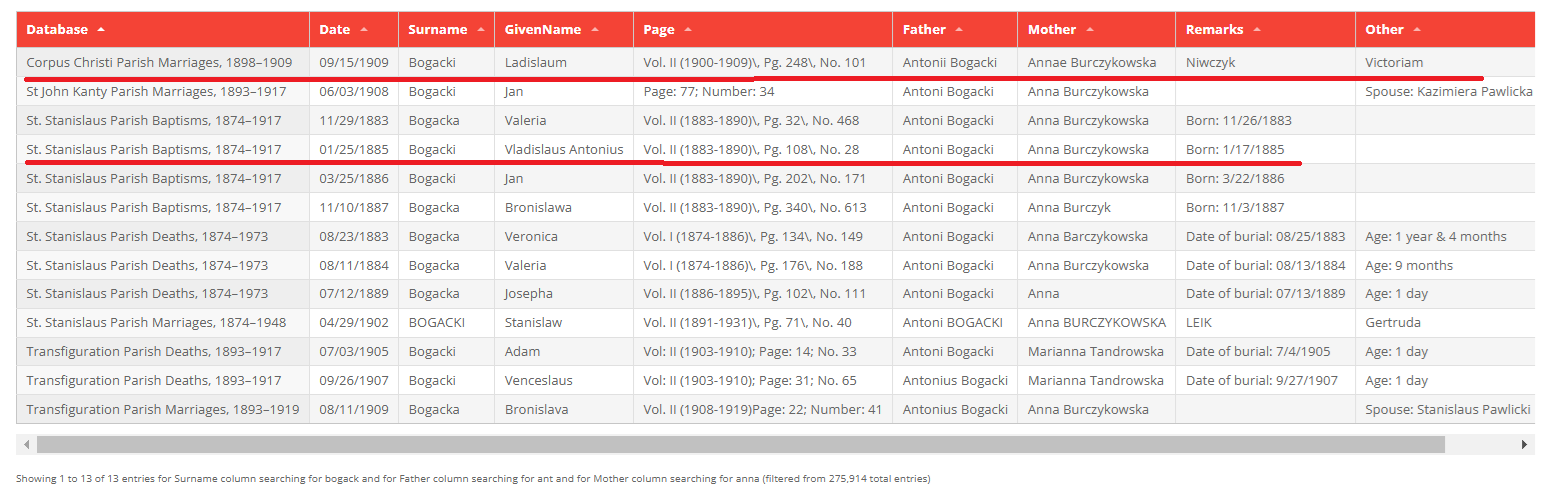
After this brief foray into the “great-grandchildren” generation, let’s move back now to placing the remaining “grandchildren” on the tree, Wiktoria Bogacka (born 1887), Władysław Bogacki (born 1885), Marcyanna J. Kurpisz (born 1899) and Rev. Maksymilian T. Bogacki (born 1895). Another search in the PGSNYS databases for surname “Bogack” with father’s name “Ant” and mother’s name “Anna” produces a slew of baptism, marriage, and death records (Figure 6) for children of Antoni Bogacki and Anna Burczykowska, as well as a couple death records for children of Antoni Bogacki and Marianna Tądrowska (Figure 6).

Figure 6: Search results from the PGSNYS databases for surname “Bogack” with father’s name “Ant” and mother’s name “Anna.” Click image to enlarge.

Underlined results include a baptismal record for Vladislaus Antonius Bogacki, who was born 17 January 1885 and baptized at St. Stanislaus, as well as the record of his marriage to Victoria Niwczyk [sic] at Corpus Christi parish. The baptismal record is available online at FamilySearch, and a digital image of the marriage record is available upon request from PGSNYS.[15] They look like a promising match for the Władysław and Wiktoria on the Bogacki monument. We can repeat our strategy of confirming death dates using the SSDI and newspaper death notices, assuming that Władysław probably adopted the name Walter in later years. Lo, and behold, a search for Walter Bogacki at Newspapers produces his death notice, which confirms his date of death and wife’s name, and the SSDI provides additional confirmation of birth and death dates.[16]

As it turns out, there’s no good match for Wiktoria (Niewczyk) Bogacki in the SSDI, which is not unusual for women in this era. Since her marriage record indicated that she was born in Posen, I’ll bet I can find her birth record in BaSIA, which is a vital records database which focuses on the Wielkopolskie province of Poland, where Poznań is located. In the interest of staying focused, however, I’ll defer that question for another day and get back to the problem of untangling the relationships between members of the Bogacki family identified on their grave monument.

There’s a good match for Marcyanna J. Kurpisz in the PGSNYS databases as Marcyanna Bogacka, daughter of Antoni Bogacki and his second wife, Jadwiga Tądrowska. The PGSNYS index points us to her baptismal record from St. Stanislaus, which confirms her date of birth as 10 January 1899.[17] Her death notice confirms that she died 4 May 1971, and identifies her as Marion H. Kurpisz, rather than Marcyanna J.[18] The different middle initials are easily accounted for if we suppose that her middle name might have been Jadwiga, after her mother; the English version of Jadwiga is Hedwig. The name Marcyanna is a variant spelling of Marcjanna or Marciana, which is the female form of Marcjan, which in turn derives from the Latin name Martianus/Martiana.[19] Etymologically, the name is not equivalent to Marianna (Polish), Marian, or Marion (English); “Martina” would have been closer to the original. However, as we saw previously with Kazimiera/Catherine Bogacka, there were no rules which required Polish Americans to adopt names that were etymologically equivalent to their original names. In fact, until the advent of Social Security, no one was even keeping track, so you might see early 20th century Polish Americans trying out a few different names until they settled upon one they liked.

Marion Kurpisz’s death notice also informs us that her husband was Edward J. Kurpisz, who is undoubtedly the Edward Kurpisz on the grave marker. Edward’s death notice provides his date of death, 9 March 1984, but doesn’t tell us how old he was when he died.[20] The record of his marriage to Marion saves the day, however, providing his precise date of birth, 14 March 1899, and parents’ names, Konstanty Kurpisz and Teodora Wdowicka.[21]

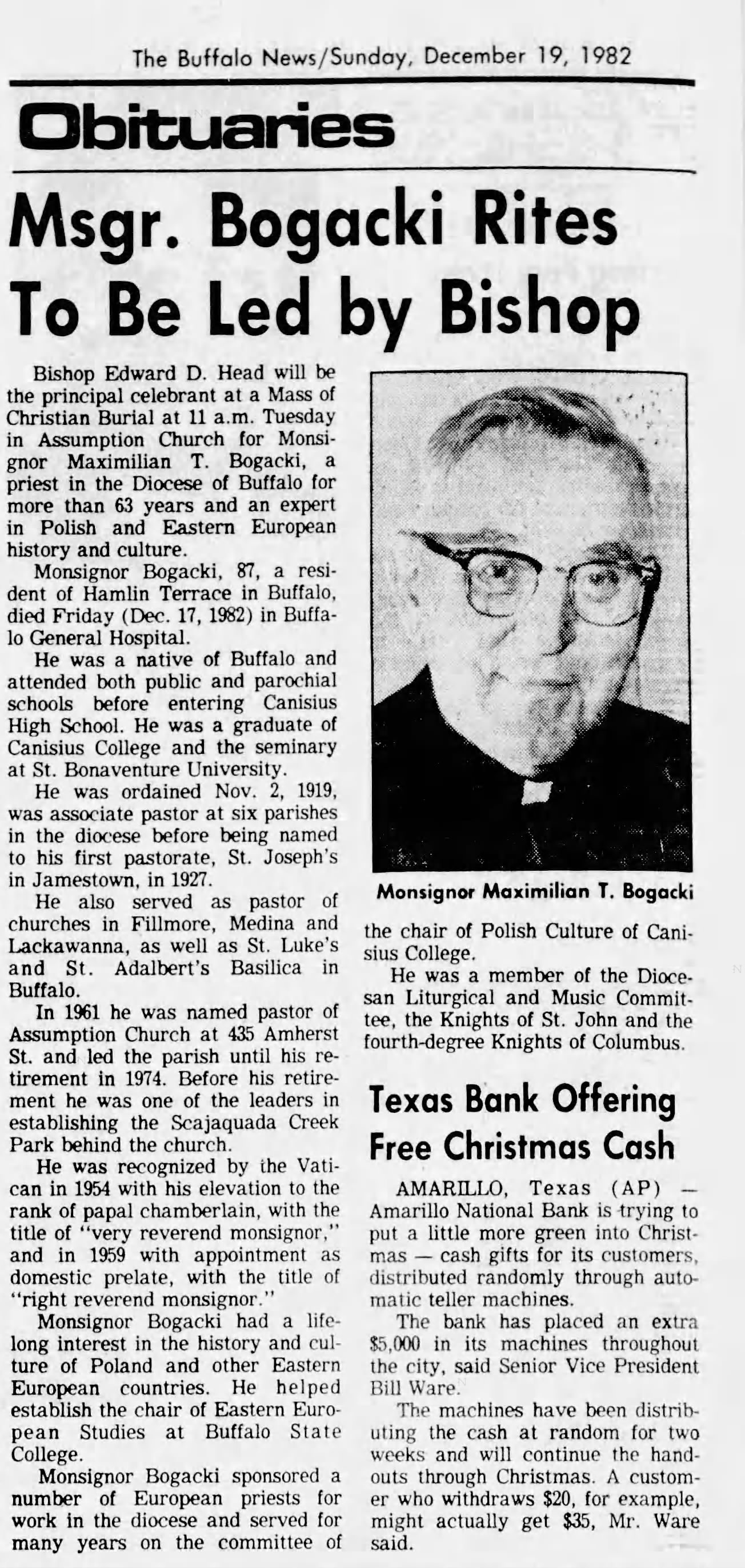
A number of records discovered thus far have mentioned the Right Reverend Monsignor Maksymilian T. Bogacki. He was the priest who performed the marriage for his sister, Marion, and he was also one of the officiants at her funeral Mass. Msgr. Bogacki was born on 6 October 1895 to Antoni Bogacki and his second wife, the former Jadwiga Tądrowska. He was baptized at St. Stanislaus, and a very nice obituary was published in The Buffalo News on 19 December 1982 (Figure 7).[22]

Figure 7: Obituary from The Buffalo News for Msgr. Maximilian T. Bogacki. Click image to enlarge.

At this point, we’ve established relationships between everyone on the Bogacki family monument except for Adam Bogacki and Elżbieta Siekierecka. Elżbieta will be the subject of a future post, but Adam is a bit of a mystery. The grave marker gives only one date for him, 1907, which is probably his death date. However, there are no good matches in broad searches of indexed historical records for an Adam Bogacki who died in Buffalo in 1907. Rather, I suspect that the grave marker may be in error, and the error may stem from conflating two different children of Antoni Bogacki and his third wife, Maria Tądrowska.

A search in the PGSNYS databases for surname “Bogack,” father’s name “Ant” and mother’s name “Mar” produces the two death records shown in Figure 8, from Transfiguration parish.

Figure 8: Death records from Transfiguration parish for Adam and Venceslaus Bogacki. Click image to enlarge.

This search result reveals that Adam Bogacki was born to Antoni Bogacki and Maria Tądrowska on 2 July 1905, and he and died the next day. His death record is available here.[23] Similarly, Antoni and Maria lost another son, Venceslaus (Wacław in Polish) Bogacki, whose death record states that he was born 26 September 1907 and died one day later.[24] Cemetery records may help determine whether it’s Adam Bogacki who was buried in the family plot, and the grave marker incorrectly identifies his year of death (more likely), or whether it’s Wacław, and the grave marker incorrectly identifies his name. By the way, if you’re wondering where their baptismal records are, it may well be that Adam’s and Venceslaus’s baptisms were recorded at Transfiguration. However, baptismal records are only available for this parish up through 1903.

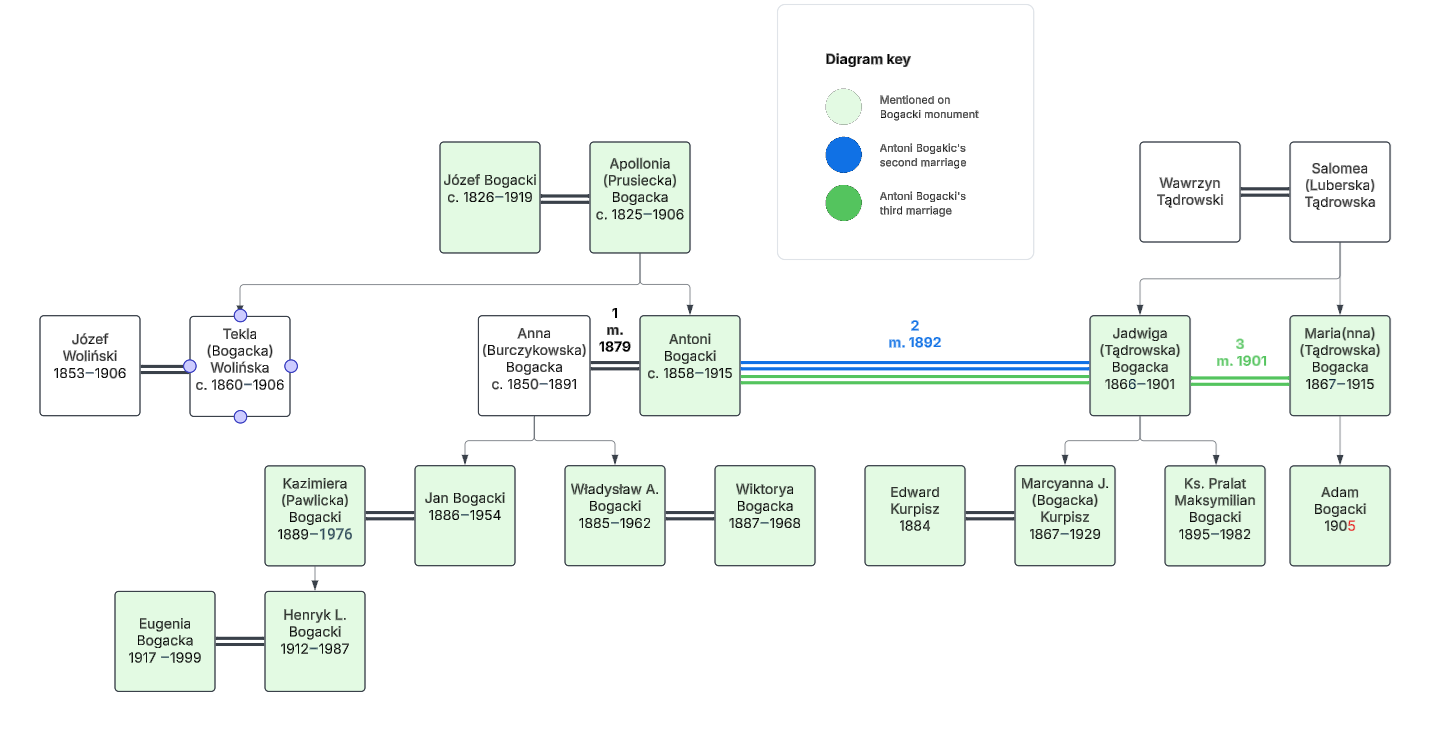
To sum it all up, then, Figure 9 depicts a partial family tree for the Bogacki family, focusing on those members who are buried in the family plot at St. Stanislaus Cemetery. Stay tuned for the story of Elżbieta Siekierecka: Was she a Bogacka?
Figure 9: Partial family tree for the Bogacki family of Buffalo, New York, focusing on those members who are buried in the family plot at St. Stanislaus Cemetery (Figures 1 and 2). Click image to enlarge.

Sources:

[1] Roman Catholic Church of St. Stanislaus, Bishop & Martyr (Buffalo, Erie, New York, USA), Marriages, Vol. II (1891–1931), p. 10, no. 33, Bogacki – Tądrowska, 2 February 1892; digital image, FamilySearch (https://www.familysearch.org/ark:/61903/3:1:3Q9M-CS4N-64SR-K?cat=23415&i=1416&lang=en : accessed 18 February 2025); and

Ibid., p. 65, 1901, no. 35, Bogacki-Tondrowska, 4 June 1901; digital image, FamilySearch (https://www.familysearch.org/ark:/61903/3:1:3Q9M-CS4N-64QV-V?lang=en&i=1471 : accessed 18 February 2025).

[2] Roman Catholic Church of the Transfiguration (Buffalo, New York), Deaths, Vol. III (1910–1917), p. 33, no. 16, Antonius Bogacki, 18 February 1915; digital image, FamilySearch (https://www.familysearch.org/ark:/61903/3:1:3Q9M-CS45-1K7V?cat=23193&i=657&lang=en : accessed 18 February 2025).

[3] Dziennik Dla Wszystkich [Everybody’s Daily] (Buffalo, New York),1 May 1954, p. 10, col. 1, death notice for Jan Bogacki; digital image, NYS Historic Newspapers (https://nyshistoricnewspapers.org/?a=d&d=ddw19540501-01&e=——-en-20–1–txt-txIN———- : 18 February 2025); and

Roman Catholic Church of St. John Kanty (Buffalo, Erie, New York, USA), Marriages, 1893–1949, pp. 77-78, 1908, no. 34, Bogacki-Pawlicka, 3 June 1908; digital image, FamilySearch (https://www.familysearch.org/ark:/61903/3:1:3Q9M-CS4V-692K-3?cat=22232&i=435&lang=en : accessed 18 February 2025).

[4] Roman Catholic Church of St. Stanislaus, Bishop & Martyr (Buffalo, Erie, New York, USA), Baptisms, Vol. II (1883-1890), p. 202, no. 171, Jan Bogacki, born 25 March 1886; digital image, FamilySearch (https://www.familysearch.org/ark:/61903/3:1:3Q9M-CS4N-643N-6?cat=23415&i=419&lang=en : accessed 18 February 2025).

[5] Barbara Ruppert, Gravefinder at St. Stan’s, database, (https://gravefinderatststans.com/details/8912 : accessed 18 February 2025), Anna Bogacka, buried 7 December 1891.

[6] Roman Catholic Church of St. Stanislaus, Bishop & Martyr (Buffalo, Erie, New York, USA), Deaths 1886–1893, 1891, no. 418, Anna Bogacka; digital image, FamilySearch (https://www.familysearch.org/ark:/61903/3:1:3Q9M-CS4N-64SC-9?i=1934&cat=2341526 : accessed 18 February 2025).

[7] The Buffalo News (Buffalo, New York), 27 July 1976, p. 14, “Deaths,” Kazmiera R. (nee Pawlicki) Bogacki, 26 July 1976; digital image, Newspapers (https://www.newspapers.com/article/the-buffalo-news-obituary-for-kazimiera/165815855/ : 18 February 2025).

[8] “United States, Social Security Death Index”, database, FamilySearch (https://www.familysearch.org/ark:/61903/1:1:JPW3-X4Q?lang=en. : accessed 18 February 2025), Kasmiera Bogacki, 23 October 1887–Jul 1976.

[9] Wikipedia (EN), “Casimir,” (https://en.wikipedia.org/wiki/Casimir : accessed 18 February 2025; page last edited 31 October 2024, at 04:29 UTC).

[10] The Buffalo News, (Buffalo, New York), 1 May 1954 (Sat), p. 2, “Deaths,” John A. Bogacki,” 30 April 1954; digital image, Newspapers (https://www.newspapers.com/article/the-buffalo-news-obituary-for-john-a-b/166074067/ : accessed 18 February 2025).

[11] Wikipedia (EN), “Carol (given name),” (https://en.wikipedia.org/wiki/Carol_(given_name) : accessed 18 February 2025; page last edited 29 January 2025, at 22:29 UTC).

[12] Cheektowaga Times (Cheektowaga, New York), 6 May 1954 (Thurs), “Former Policeman, John Bogacki, Dies,” obituary for John A. Bogacki, died 30 April 1954; digital image, Newspapers (https://www.newspapers.com/article/cheektowaga-times-obituary-for-john-a-bo/166075646/ : accessed 18 February 2025).

[13] The Buffalo News, (Buffalo, New York), 6 March 1987 (Fri), p. 14, “Deaths,” Henry L. Bogacki, 4 March 1987; digital images, Newspapers (https://www.newspapers.com/article/the-buffalo-news-obituary-for-henry-l/165909368/ : accessed 18 February 2025; and

“United States, Social Security Death Index,” database, FamilySearch (https://www.familysearch.org/ark:/61903/1:1:JPCS-NPP?lang=en. : accessed 18 February 2025), Henry Bogacki, 8 November 1912–March 1987.

[14] The Buffalo News, (Buffalo, New York), 10 March 1999, p. 35, “Obituaries,” Eugenia Bogacki, died 8 March 1999; digital image, Newspapers (https://www.newspapers.com/article/the-buffalo-news-obituary-for-eugenia-mi/165912268/ : accessed 18 February 2025); and

“U.S., Social Security Applications and Claims Index, 1936-2007,” database, Ancestry (https://www.ancestry.com/search/collections/60901/records/21359069 : accessed 18 February 2025), Eugenia Michalski Bogacki, 27 Jun 1917–8 March 1999.

[15] Roman Catholic Church of St. Stanislaus, Bishop & Martyr (Buffalo, Erie, New York, USA), Baptisms, Vol. II (1883–1890), p. 108, 1885, no. 28, Vladislaus Antonius Bogacki; digital image, FamilySearch (https://www.familysearch.org/ark:/61903/3:1:3Q9M-CS4N-64SX-F?cat=23415&i=371&lang=en : accessed 18 February 2025); and

Roman Catholic Church, Corpus Christi parish (Buffalo, Erie, New York), Marriages, Vol. II ( October 2, 1900 – November 3, 1909), p. 248, 1909, no. 101, Bogacki-Niwczyk; Polish Genealogical Society of New York State.

[16] Buffalo Courier-Express, (Buffalo, New York), 27 Nov 1962 (Tues), p. 18, “Deaths,” Walter A. Bogacki, 25 November 1962; digital image, Newspapers (https://www.newspapers.com/article/buffalo-courier-express-walter-a-bogack/165976015/ : 18 February 2025); and

“U.S., Social Security Death Index, 1935-2014,” database, Ancestry (https://www.ancestry.com/search/collections/3693/records/5492373 : accessed 18 February 2025), Walter Bogacki, 17 January 1885–November 1962.

[17] Roman Catholic Church of St. Stanislaus, Bishop & Martyr (Buffalo, Erie, New York, USA), Baptisms, Vol. IV, (1895-1903), p. 310, 1899, no. 18, record for Marcyanna Bogacka, born 10 January 1899; digital image, FamilySearch (https://www.familysearch.org/ark:/61903/3:1:3Q9M-CS4N-643R-Z?cat=23415&i=1132&lang=en; : accessed 18 February 2025).

[18] The Buffalo News (Buffalo, New York), 5 May 1971 (Weds), “Deaths,” Marion H. (nee Bogacki) Kurpisz, 4 May 1971; digital image, Newspapers (https://www.newspapers.com/article/the-buffalo-news-marion-h-bogacki-kur/166068646/ : accessed 18 February 2025).

[19] Wikipedia (PL), “Marcjana,” (https://pl.wikipedia.org/wiki/Marcjana : accessed 18 February 2025; page last edited 28 June 2023, at 03:15); and

Wikipedia (PL), “Marcjan,” (https://pl.wikipedia.org/wiki/Marcjan : accessed 18 February 2025; page last edited 7 November 2024, at 07:47).

[20] The Buffalo News (Buffalo, New York), 11 March 1984 (Sun), p. 52, “Deaths,” Edward J. Kurpisz, 9 March 1984; digital image, Newspapers (https://www.newspapers.com/article/the-buffalo-news-edward-j-kurpisz-death/166069749/ : accessed 18 February 2025).

[21] Chautauqua County Clerk (Chautauqua, New York), Marriage Certificates & Licenses, 1931-1932, license no. 16540, Kurpisz-Bogacka, married 9 February 1932; digital image, FamilySearch (https://www.familysearch.org/ark:/61903/3:1:939J-T5BJ-7?cc=1618491&i=1755&lang=en : accessed 18 February 2025).

[22] Roman Catholic Church of St. Stanislaus, Bishop & Martyr (Buffalo, Erie, New York, USA), Baptisms, Vol. III (1890-1895), p. 634, 1895, no. 699, Max Bogacki, born 6 October 1895; digital image, FamilySearch (https://www.familysearch.org/ark:/61903/3:1:3Q9M-CS4N-647Z-H?cat=23415&i=965&lang=en : accessed 18 February 2025); and

The Buffalo News, (Buffalo, New York), 19 December 1982 (Sunday), p. 70, “Msgr. Bogacki Rites To Be Led by Bishop,” obituary, Msgr. Maximilian T. Bogacki, died 17 December 1982; digital image, Newspapers (https://www.newspapers.com/article/the-buffalo-news-msgr-maximilian-t-bog/166070781/ : accessed 18 February 2025).

[23] Roman Catholic Church of the Transfiguration (Buffalo, New York), Deaths, Vol II (1903-1910), p. 14, 1905, no. 33, Adam Bogacki, died 3 July 1905; digital image, FamilySearch (https://www.familysearch.org/ark:/61903/3:1:3Q9M-CS45-1KN9?cat=23193&i=560&lang=en : accessed 18 February 2025).

[24] Roman Catholic Church, Transfiguration Parish (Buffalo, New York), Deaths, Vol. II (1903-1910), p. 31, 1907, no. 65, Venceslaus Bogacki, died 26 September 1907; digital image, FamilySearch (https://www.familysearch.org/ark:/61903/3:1:3Q9M-CS45-1KCN?cat=23193&i=577&lang=en : accessed 18 February 2025).

© Julie Roberts Szczepankiewicz, 2025

Back on the Trail: In Search of Marie Madeleine Cossin

It’s been a long time since I’ve written about my family in this blog, but I’m just going to skip the explanations and excuses and get to the good stuff.

Maria Magdalena (Causin/Cossin) Roberts (1832–1894) was one of my long-time brick-wall ancestors whose family origins I was eventually able to discover. Born 14 August 1832 in Buffalo, New York to Alsatian immigrants, Joseph Antoine and Marie Agathe (Hensÿ) Cossin, she migrated to Detroit, Michigan where she was married on 12 May 1857 to German immigrant, Michael Ruppert/Roberts. Michael worked as a carpenter, and the couple remained in Detroit for the rest of their lives. Maria Magdalena—usually recorded as Mary—kept the house and raised eight children, four of whom outlived her. She died 27 February 1894 in Nankin, Michigan.

Although I was able to definitively identify her parents and their origin in the villages of Pfetterhouse and Seppois-le-Bas in the Haut-Rhin district of Alsace, many questions remain. Those early years between her birth in Buffalo and her marriage in Detroit remain a mystery, along with the fates of her parents. Where did they die? Did they, too, migrate to Detroit, or were they already deceased in Buffalo by the time of Maria Magdalena’s marriage? It’s been difficult to document the family with certainty in historical records from either Buffalo or Detroit, and the many variant spellings of the surname—ranging from the preferred Cossin, to Curzon, to Gosÿ—have added to the challenge.

Recently, I returned to my research on this family, hoping that a newspaper search might produce some new clues. To my delight and astonishment, I found the little article shown here, published in the Detroit Free Press on 7 August 1894—just over five months after Mary Roberts died.

Clearly, I’m not the only one who has sought Maria Magdalena’s whereabouts! I am certain that the woman described in the Personals ad must be “my” Maria Magdalena, who was born in 1832, and was still “Mademoiselle” in 1855, since she did not marry Michael Roberts until 1857. According to the ad, she was already living in Detroit by 22 April 1855, which adds another point to the timeline. Most interesting is the identification of a brother, Anthony, born in 1838, which is brand new information! Where was he born, Buffalo, Detroit, or somewhere else?

A quick search on Ancestry revealed that Y. J. Cicotte of Detroit was probably Y.G. Cicotte, who was enumerated in the 1870 census and was identified as a lawyer. The 1880 Detroit City Directory identified Julius Stoll of 185 Randolph Street as being in the Real Estate and Insurance business. It’s likely, then, that neither of these men was necessarily a friend of Maria Magdalena’s; they were merely professionals whose services had been engaged, first by Maria Magdalena herself in 1855, and then in 1894 by her friends in Alsace who wondered about her whereabouts.

Why did her “friends in Alsace” wait so long to seek her out? Was there some new development back home that led them to break the silence of nearly 40 years? The Detroit Free Press is digitized online at Newspapers for the entire period from 1855 through 1894, and this Personals ad is the only reference to any of these Cossins. If Mary’s friends in Alsace had made attempts to contact her previously through similar Personals ads, those ads should have turned up. Or was it Mary herself who broke off the correspondence, apparently without even informing them of her marriage?

The fact that these friends inquired only after Mary and her brother, but not her parents, suggests that perhaps Joseph Antoine and Marie Agathe were deceased before 1855. Previously, I’d checked the Buffalo, New York Death Index, 1852–1884 for evidence of their deaths, but did not find them. The cemetery where Mary Roberts herself is buried, Mount Elliott in Detroit, offers a database of records from five local cemeteries, and the Cossins are not found. However, the database appears to be incomplete, because I searched the names of five additional relatives known to be buried in that cemetery, and only one of them turned up in the database. So, I emailed the cemetery, and I’m waiting for their reply. Last year, I also checked death records for 1836–1857 from St. Louis parish in Buffalo, where Mary Cossin Roberts was baptized, and did not find them. However, it might be worth another look just in case I missed them the first time. I definitely need to check those baptismal records again for the birth of Anthony Cossin circa 1838.

So many questions, so little time!

© Julie Roberts Szczepankiewicz, 2024

The Levanduski Family and the Buffalo Cereal Company Disaster of 1910

Note: This story was originally published in the Spring 2023 issue of Rodziny. It is reprinted here with permission.

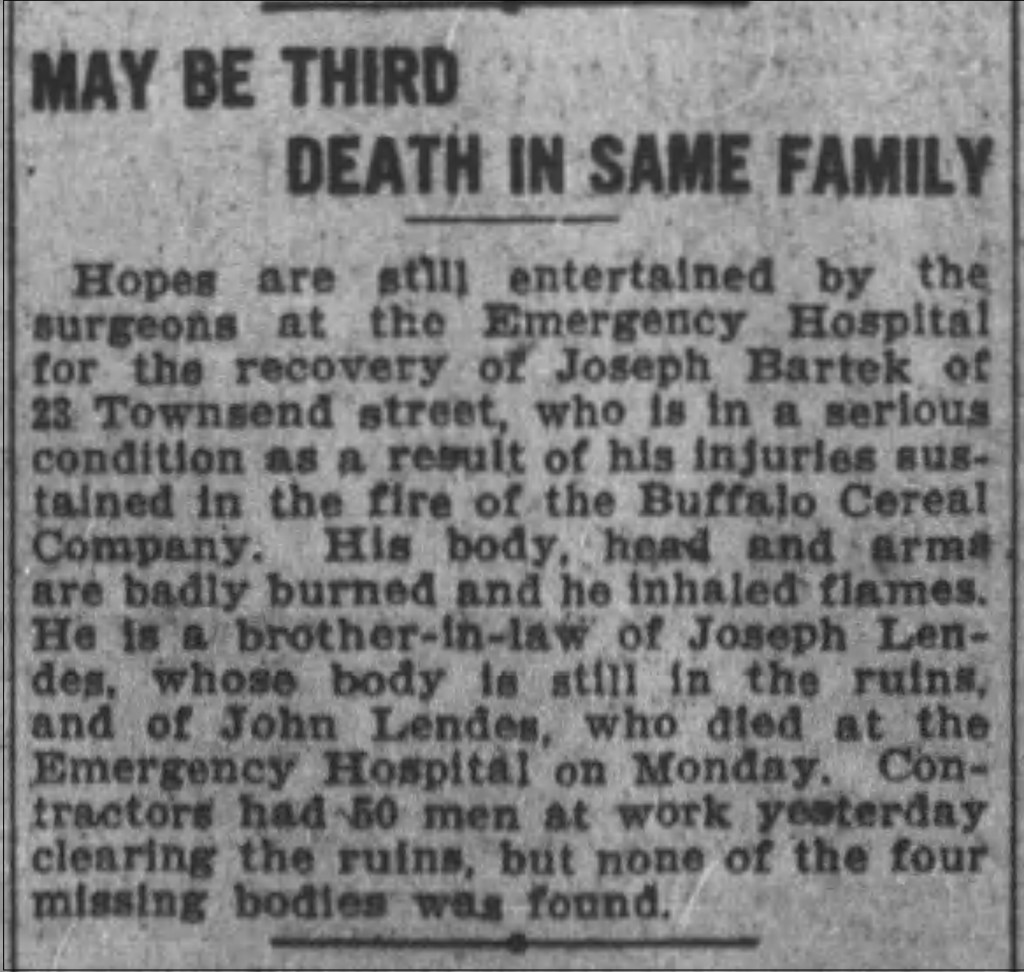
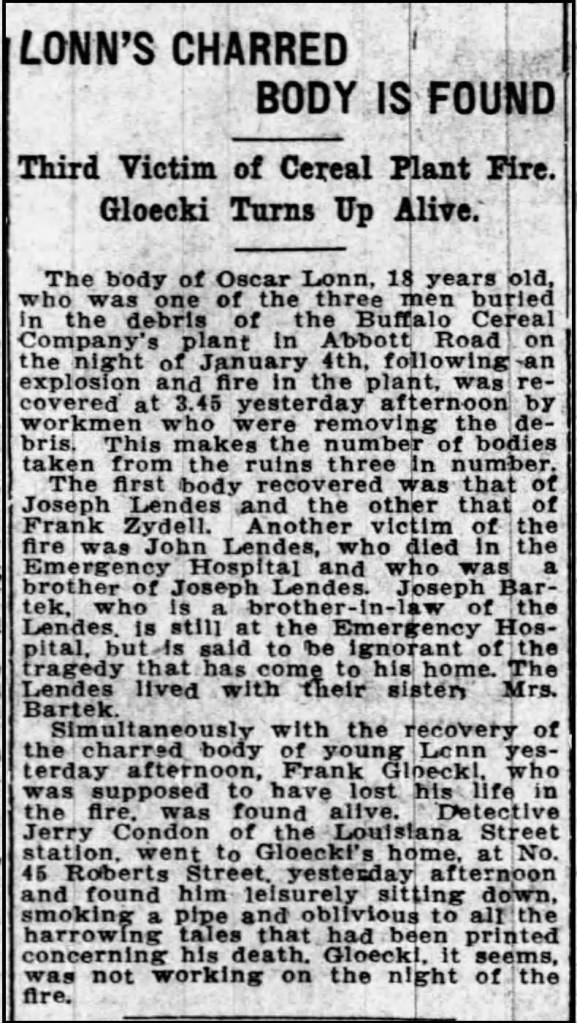
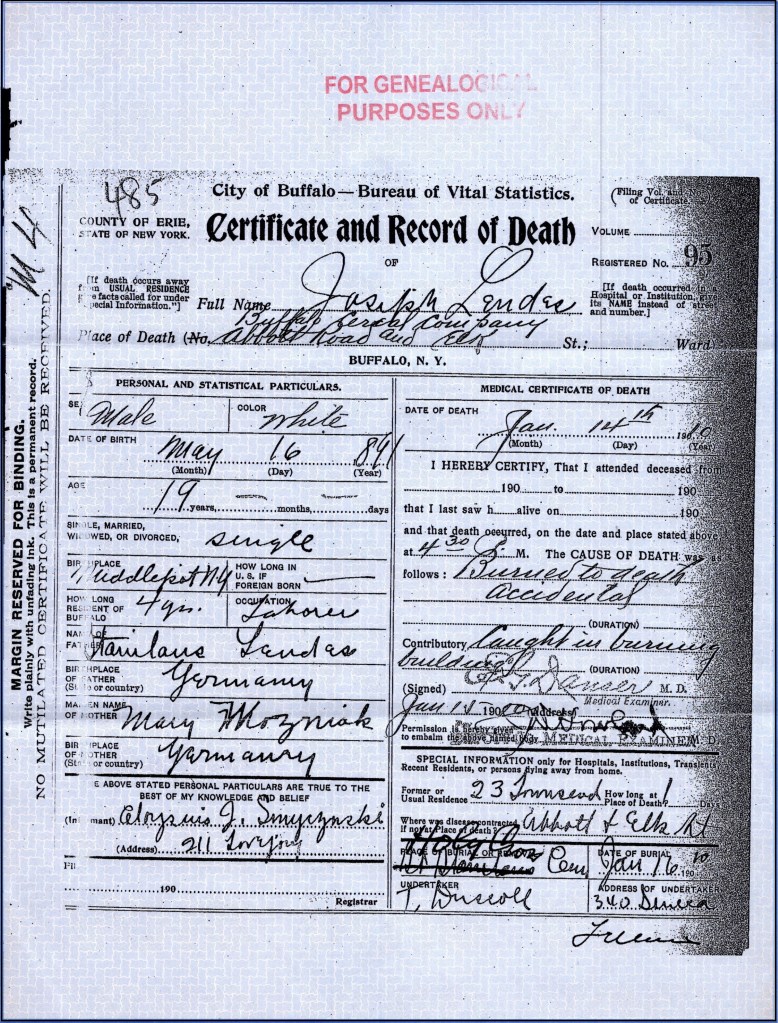
Family stories are what draw many of us into researching our family histories. Back in the late 1980s, when I first began asking my husband’s grandmother, Joan (Drajem) Barth, about the family history, she shared with me a story about her father-in-law, Joseph Bartoszewicz, who was badly burned and injured in a fire when he was a young man. She recalled that the fire was in a sugar factory in the Larkin Building on Seneca Street in Buffalo, New York, and that her father-in-law had been a foreman in the factory. She also recalled that her mother-in-law, Katherine (Levanduski) Bartoszewicz had a brother or brothers who may have been killed or injured in the fire. Grandma couldn’t tell me much more about the Levanduski brothers; this was the family of her deceased husband, Henry Bartoszewicz/Barth, and “people didn’t talk about those things back then.”

My curiosity was piqued, but my early attempts to research both the Levanduski family and the Bartoszewicz family, and learn more about that fire, were thwarted by the many versions of surnames and given names that were in use by the family. The original Polish form of the surname, Lewandowski, was ranked 6th for popularity among Polish surnames circa 1990,1 and the family favored phonetic versions of the surname, such as Levanduski, Levendeski, and Levandoski, in the U.S. Similarly, documents related to the Bartoszewicz family contain variant spellings such as Bartosiewicz, Bartusiewicz, and Bartoszewski. Although Grandma was very specific about the fire taking place “in the Larkin Building on Seneca Street” in Buffalo, I could find no evidence from newspaper articles that such a fire took place in the appropriate time period, which she guessed was the early 1920s. Stymied by these road blocks, it was easy to defer this research, and investigate other family lines instead.

Over the years, as more documents and scanned newspapers became available online, I was able to gradually chip away at this puzzle, and uncover the tragic story of the Lewandowski family, and the disaster that was directly responsible for the loss of two lives—and was indirectly responsible for the loss of a third life. This, then, is their story.

The Lewandowski Family of Wola Czewujewska

The Lewandowski family originated in what is now the Poznań area of Poland, but was at that time the Posen province of Prussia. For the purpose of this story, we’ll exclude the family’s deeper origins, and begin with Stanisław Lewandowski and Marianna Woźniak, who married on 9 September 1882 in Rogowo (Żnin County).2 (Their marriage record was discussed in a previous post.) At the time of their marriage, Stanisław was a 22-year-old Knecht (farmhand or servant), living in Wola Czewujewska, and Marianna was a 19-year-old Knechtstochter (daughter of farmhands or servants), also living in Wola. Both were Roman Catholic. The Meyers Orts- und Verkehrs-lexikon des deutschen Reichs, which is a gazetteer of places located within the German Empire, identifies Wola as a Rittergut, or landed estate, which suggests that Stanisław and Marianna were employed in service at the manor.3

Following their marriage, Stanisław and Marianna had two children, both born in Wola: Katarzyna (Catharina/Katherine), born 11 October 1883, and Jan (Johann/John), born 5 May 1885.4 On 10 April 1886, the Lewandowski family emigrated from Prussia, departing from the port of Hamburg, along with Marianna’s sister, Weronika Woźniak, and another relative, Michał Lewandowski.5 Further research is needed to determine precisely Michał’s relationship to Stanisław, but the fact that he was also from Wola, and was traveling with them, suggests that he was a relative, despite the popularity of the surname. Their departure manifest is shown in Figure 1.

Figure 1: Emigration manifest from the port of Hamburg for the family of Stanisław and Marianna Lewandowski, as well as Marianna’s sister, Weronika Woźniak, and another probable relative, Michał Lewandowski. Click image to enlarge.

According to this manifest, Stanisław Lewandowsky [sic] was a 27-year-old laborer from Wolla, Prussia. His wife, recorded as Maria, was age 23, and their children, Kataryna [sic] and Jan, were ages three and one. All the information is consistent with expectations based on prior evidence.

From Stanisław to Edward, and Patrick to Peter

The Lewandowski family settled in the hamlet of Shelby in rural Orleans County, New York, about 40 miles northeast of Buffalo. Although a Polish parish—Sacred Heart church in Medina— would eventually be founded in Orleans County, there was no ethnic Polish parish there when Stanisław and Marianna arrived with their family in 1886. Instead, the family belonged to St. Stephen’s parish in Middleport, New York, about six miles away, and this is where the birth of their next child was recorded in 1888 (Figure 2).6

Figure 2: Baptismal record from St. Stephen’s church in Middleport, New York, for Patricius (Patrick) Levendeski, born 28 May 1888. Click image to enlarge.

This baptismal record testifies to the language barrier which the Lewandowski family encountered in rural Orleans County, which ultimately led to the adoption of the phonetic version of the surname, Levanduski, used by the family today. The record is written in Latin and states, “Junii 10. Baptizavi Patricium (per errorem Catherinam vocatum) natum 28 ult. ex Eduardo Levendeski et Maria Wisnaik. Sponsores Michael Wisnaik et Rosa Kotriss,” which translates, “I baptized Patrick (named Catherine by mistake), born on the 28th last [month], of Edward Levendeski and Maria Wisnaik. Sponsors [were] MIchael Wisnaik and Rosa Kotriss.” One wonders at the extent of communication difficulties that would lead the priest to baptize a child as Catherine, and then record the child’s name as Patrick, when this same child would ultimately be known as Peter in almost all historical records.

The fact that Stanisław was recorded as Edward here is also noteworthy. When I began my research, I had no idea that Edward was not the original name of Katherine Levanduski’s father, as my husband’s family was unaware of any name change. I only discovered this fact through correspondence with a distant cousin in Medina, Joe Levanduski, who found me back in 2007 through an Orleans County surname database hosted by New York GenWeb. Joe noticed that I was researching the Lewandowski/Levanduski surname and contacted me. He wrote, “I show Stanislaw Lewanduski….became a citizen in 1891, changing his name to Edward…. The story I got about the name change was great-grandfather worked in a quarry and they spelled his name wrong on his paycheck. He couldn’t get them to spell it right so it evolved to what it is today.”7 I’m ever grateful to Joe for tipping me off to that unexpected name change from Stanisław to Edward, since my efforts to obtain a passenger manifest and pursue research in Polish records had been unproductive prior to that point.

In 1891, Edward and Mary Levanduski’s fourth child, Joseph, was baptized at St. Stephen’s church (Figure 3).8

Figure 3: Baptismal record from St. Stephen’s church in Middleport, New York, for Josephus Levendeski, born 15 February 1891. Click image to enlarge.

The record states, “Feb. 17. Baptizavi Josephum natum 15 inst. ex Eduardo Levendeski et Maria Wisnaik. Sponsores fuerunt Andreas Hoffman & Veronica Lipkoski,” which translates from Latin as, “Feb. 17. I baptized Joseph, born on the 15th of this [month] of Edward Levendeski and Maria Wisnaik. Sponsors were Andrew Hoffman and Veronica Lipkoski.” Joseph’s godmother, Veronica Lipkoski, was none other than his maternal aunt, Weronika Woźniak, who married Stanisław “Edward” Lipkoski (or Lepkoske) on 22 June 1889 in Middleport.9

Edward Levanduski naturalized as a U.S. citizen on 14 September 1891 under the name Stanislaw Lewandowski in the Orleans County Court in Albion.10 His naturalization status was reflected in the 1892 New York State census, where he was recorded under the name “Adcker Lewenoboski,” shown in Figure 4.11

Figure 4: 1892 New York State census for the hamlet of Shelby, New York, showing the family of Adcker Lewenoboski [sic]. Click image to enlarge.

The family group described in this census record consists of 31-year-old Adcker Lewenoboski [sic], a laborer born in Poland and a naturalized citizen; his 29-year-old wife, Mary, 9-year-old daughter Catherine, and 7-year-old son, John, all of whom were also born in Poland and noted to be aliens. Additionally, the census identified the couple’s two U.S.-born children, 3-year-old Patrick and 1-year-old Joseph. Apart from the obvious miscommunication regarding the family surname and Edward’s given name, the names and ages of family members are all consistent with established evidence. Moreover, the family group listed immediately below the Lewandowski family is the family of Mary Levanduski’s sister, Veronica Lepkoske, who adopted the name Lena in the U.S.

In December of 1892, another daughter, Veronica, was born to Edward and Mary Levanduski.12 No death record has been found for her, but she was apparently deceased between March 1899 and 26 June 1900, when the census was enumerated.13 One more daughter, Anna Levanduski, was born in 1894.14 On 10 April 1896, Mary (Woźniak) Levanduski died of diffuse septic peritonitis at the age of 32, leaving Edward a 36-year-old widower and father of six children, with the oldest being 12 years of age and the youngest being not quite two years old.15 An expeditious second marriage was a necessity, and Edward’s bride was 29-year-old Antonina Budzińska, whom he married at St. Stephen’s in Middleport on 12 May 1896 (Figure 5).16

Figure 5: Marriage record for Edward Levanduski and Antonia [sic] Budzinski. Click image to enlarge.

Antonina, recorded occasionally as Antoinette, but most often called Anna, was born 5 January 1867 in Morhardsburg, known today as Morasy, to Jan/Johann and Katarzyna/Catharina (Łukomska) Budziński.17 Morasy is a mere 12 miles from Edward’s last residence in Poland, and it is likely that Edward and “Anna” were connected through the vast network of Prussian Poles who migrated to Western New York from Edward’s and Anna’s home counties of Żnin and Mogilno. Her marriage record to Edward states, “Tribus bannorum rite factis publicationibus conjunxi in matrimonio Edwardum filium Michaelis Levendeski et Elizabeth Rotka et Antoniam filiam Joannis Budinski et Catharinae Lukomski. Testes Laurentius Hoffman et Veronica Lepkoski fuerunt. (B) Jacobus J. Roche,” which translates, “After the publication of three banns, I joined in marriage Edward, son of Michael Levendeski and Elizabeth Rotka, and Antonia, daughter of Joannes Budinski [sic] and Catharina Lukomski. Witnesses were Laurence Hoffman and Veronica Lepkoski.”

Children came quickly for Edward and Anna. Anthony was born first, in 1897, followed by Ladislaus/Walter in 1898 and Martha in 1899.18 By 1900, when the family was enumerated in the census, the oldest three children—Katherine, John, and Patrick/Peter—are not listed with the rest of the family (Figures 6a and b).19

Figure 6a: First page showing the Edward Levanduski family in the 1900 census. Click image to enlarge.
Figure 6b: Second page showing Martha Levanduski in the 1900 census. Click image to enlarge.

However, the census tells us that in 1900, Edward Lavendusky [sic] was employed as a quarry laborer. He owned his home (with a mortgage), and he could speak English, although he could not read or write. His naturalization status, date of arrival, length of marriage, age, and place of birth are all consistent with prior evidence. His wife, Anna, was a more recent immigrant, having arrived in the U.S. circa 1893, according to this record. The children were identified as 10-year-old Joe, born February 1890; 6-year-old Anna, born June 1894; 3-year-old Tony, born May 1897; 1-year-old Wallace, born August 1898, and 10-month-old Martha, born July 1899. Once again, all the data are approximately consistent with prior evidence, although Walter was recorded as Wallace. This is not surprising in light of the fact that his baptismal name was Ladislaus, which is the Latin form of the Polish name Władysław, a name which has no direct English translation. Men with this name often adopted the name Walter, but there were no hard-and-fast rules for this, as evidenced by Walter’s father’s choice to go from Stanisław to Edward rather than adopting the name Stanley, which was a more popular choice among men named Stanisław.

It’s not certain why the oldest three children were not mentioned here, but neither are there any definitive matches for Katherine, John, and Peter Levenduski anywhere else in the 1900 census. A miscommunication seems most likely; if the older children were away from the house when the census-taker came by, perhaps they were simply missed in the tally. This hypothesis is supported by the fact that all the children were still living at home in 1905 (Figure 7).20

Figure 7: The Edward Levanduski family in the 1905 New York State Census. Click image to enlarge.

By 1905, 22-year-old Katie and 21-year-old John were both employed as servants. Peter, age 17, and his 15-year-old brother, Joseph, were employed as day laborers, like their father. Anna, Anthony, and Walter were at school. Little Martha Levanduski, whose brief life was captured in the 1900 census, enumerated in June, died in August of that year.21 By 1905, the family had come to include two new members, as well: Mary Levanduski, born in 1901, and Josephine, born in 1903.22 The Levanduski family was now complete.

On 29 April 1907, Katherine Levanduski wed Joseph Bartoszewicz at St. Stephen’s parish in Middleport (Figure 8).23 Joseph was the son of Stephan/Stefan Bartoszewicz and Joanna Olszewska, and like Katherine, he was born in the Prussian partition of Poland and came to the U.S. as a small child.24 As evidenced by their marriage record, Joseph was a resident of Buffalo in 1907. The witnesses to the marriage were Joseph’s sister, Anna Bartoszewicz, and Katherine’s brother, John Levanduski. On 15 December 1907, Katherine Bartoszewicz gave birth to the couple’s first child, a daughter whom they named Anna.25

Figure 8: Marriage record from St. Stephen’s church in Middleport for Joseph Bartoszewicz and Katherine Levanduski, 29 April 1907.

The Buffalo Cereal Company

By 1909, the family was living at 23 Townsend Street in Buffalo, and Joseph was employed as a foreman at the Buffalo Cereal Company plant, located at the intersection of Elk Street and Abbott Road, about two miles from his home (Figure 9).26

Figure 9: The Buffalo Cereal Company plant as it appeared in 1908.

The Buffalo Cereal Company was established in 1901, and the plant was completed in 1902. According to A History of Buffalo: Its Men and Institutions: Biographical Sketches of Leading Citizens, published in 1908,

“The plant consists of two groups of buildings, conveniently arranged and divided into eight sections, consisting of elevator, cereal mill, feed mill, drying and cleaning house, transformer house, and three warehouses. The buildings occupy a space of about seventy-five by three hundred and ninety feet, and are substantially built of brick and stone, with the exception of the elevator, which is of the usual crib construction and covered with corrugated iron. The plant is operated by electrical power from Niagara Falls, of which it has an installation of about seven hundred horsepower.

The elevator is equipped with the latest machinery for handling grain, and has an excellent system of dust collecting, which makes this part of the plant remarkably clean. …

The cleaning and drying house is a six-story fireproof building, constructed entirely of brick and steel, with the exception that the floors and bin work are constructed of reinforced concrete. One end of this building contains two large Hess driers, which have a capacity of several thousand bushels of corn and oats per day. These driers are operated by separate motors, and the drying is done entirely by steam, the operation thus being made practically free from all danger of fire. …

The company has shown steady growth since its organization, the milling plant alone giving employment to over one hundred men.”27

The emphasis on both the cleanliness of the plant, and its sturdy, fireproof construction, was probably intended to reassure readers regarding its safety and modernity in an era when flour mill explosions were regularly reported in the newspapers. A quick search for “flour mill explosion” or “grain mill explosion” in Newspapers or in the free digital newspaper archive, Old Fulton New York Postcards, suggests that the explosive nature of flour dust was recognized as early as the 1870s, and this problem continue to be an industrial concern even today. While most of us don’t think of flour as particularly hazardous—and in typical home settings, it’s not—flour dust is highly combustible. In order for flour dust to explode, certain conditions must be met: the flour must be finely dispersed in the air, in a confined space, and in the presence of an ignition source—such as a spark caused by static electricity.28 These conditions are all found in grain mills, and they all combined to create the explosion that caused the deaths of Joseph and John Levanduski, and seriously injured Joseph Bartoszewicz.

From Bartoszewicz to Bartek and Levanduski to Lendes

As I mentioned in the beginning, my early attempts to document this family tragedy were hampered by a lack of factual evidence. As with most family stories, Grandma’s account of the “fire in the sugar factory in the Larkin Building” contained a kernel of truth, but the devil is in the details. Buffalo had a number of grain mills back in the day, and without knowing the exact location or time period of the event, it was difficult to discover more information. Moreover, I was searching newspapers for the family surnames as they were usually encountered: phonetic variants of Bartoszewicz and Levanduski. What finally gave me my breakthrough, however, was a short entry in my research notes, where I recorded a comment from Grandma that Katherine Bartoszewicz used the name Bartek informally, circa 1930. This fact was confirmed by the 1909 Buffalo City Directory, in which Joseph Bartoszewicz appears twice, under the name Bartoszewicz, and also under the name Bartek (Figures 10a and b).29 In both entries, he was listed as a foreman, living at 23 Townsend Street.

Figure 10a: Joseph Bartosiewicz in the 1909 Buffalo City Directory.
Figure 10b: Joseph Bartek in the 1909 Buffalo City Directory.

When I repeated my newspaper searches using this surname, at long last, I was able to locate articles about the fire at the Buffalo Cereal Company plant in 1910. And the Levanduski brothers? They were using the name Lendes! Figure 11 shows one of many newspaper headlines regarding the disaster.30

Figure 11: Front page of the Buffalo Evening News, 12 pm edition, on 5 January 1910 reporting the explosion at the Buffalo Cereal Company plant. Click image to enlarge.

The Explosion

On the evening of 4 January 1910, with 30 men at work in the plant, the yellow corn mill of the Buffalo Cereal Company exploded into flames. The explosion was believed to have been caused by dust accumulations that were ignited by sparks from a dynamo. Eleven men were in the yellow corn mill where the explosion occurred, and the rest were in the white corn mill, the 8-story grain elevator, and the warehouse. The group of eleven men included Joseph Bartek, foreman of the night crew, and Joseph Lendes. Joseph Lendes had been sent to the top of an 85-foot tower to keep clear the mouth of the grain spout while his brother-in-law, Joseph Bartek, worked below with the other men.

The explosion completely destroyed the grain elevator and the yellow corn mill. Four men were reported to have died in the explosion and the resulting three-alarm fire, identified as Joseph Lendes, Frank Gloecki [sic], Fred Laney, and Louis Krennan. Of Joseph Lendes, the article states, “nothing could be found. The little platform on which he had stood at the time the explosion occurred was wrecked, and the roof was completely torn away. That the man escaped with his life seems improbable.” Nine more men were injured, including John Landers [sic] of 23 Townsend Street, Joseph Bartek, Chris Schultz, John Shea, George Seligman, Fred Tryon, John H. Willis, Paul Fisher, and John Gorski. John Landers was reported to be a bag sewer, who suffered “face, hands, and body burns” and was sent to Emergency Hospital, “recovery doubtful.” (The former Emergency Hospital is presently known as Sheehan Memorial Hospital.30) The article continued to report that of all the injured, John Landers was burned the worst. Joseph Bartek, the night foreman, was also sent to Emergency Hospital and was reported to be seriously burned, but “may recover.” The men who had been working in the other areas of the plant were reported to have fought their way through the smoke and flames to drag the injured men to safety.

The Buffalo Evening News published the story of the explosion at noon, 3 pm, and 5 pm on January 5. By the time the 5 pm edition was published, the story had been updated to include photos of some of the victims, including Joseph “Bartek” Bartoszewicz and John “Lendes” Levanduski (Figure 12). These were the only photos of Joseph Bartoszewicz and John Levanduski which my husband’s family had ever seen.

Figure 12: Photos of Joseph Bartoszewicz and John Levanduski, identified as victims of the Buffalo Cereal Company plant explosion. Click image to enlarge.

The Buffalo Courier reported on the same disaster, but in their article, John Landers was called John Lendes and Joseph Bartek was called Joseph Bortek.32 The Courier specified the relationship between John and Joseph, stating, “Joseph Landes, a brother of John, who is at Emergency Hospital, is another of the missing. John Landes said that his brother was working only a few feet away from him and he could not understand how they became separated even in the confusion following the explosion.” Interestingly, the Courier‘s report omits any mention of Frank Gloecki or Glodecki among the missing and presumed dead. The article further reported that some of the injured were initially taken to Crotty’s saloon at 82 Abbott Road, where the ambulances were summoned by Crotty, and, “When John Lendes was being carried to the ambulance from the saloon he became half crazed with pain and broke away from the attendants. He ran for half a block before he was captured by the doctors and then had to be overpowered before he could be taken to the hospital.”

The Aftermath

In the days and weeks that followed, the Levanduski family’s personal tragedy continued to unfold in the newspapers. On January 6, the Buffalo Commercial reported that Fred Laney, initially thought to have been killed in the explosion, was found alive, but that Joseph Lendes and Frank Glodecki remained unaccounted for. The frozen ruins were being searched for their bodies, but fire engines were “still pumping water on the smoldering mounds of grain.”33 According to the Commercial, Joseph Bartek and Chris Schultz were still in the Emergency Hospital but were recovering, while John Lendes and the others were still in serious condition. On January 10, the Buffalo Times reported that John Lendes died of his injuries.34 The article erroneously reports John’s age as 44, rather than 24, and similarly misstates Joseph’s age as 38, rather than 18. Despite this discrepancy, the article states that both of them lived “at the home of their sister, Mrs. Joseph Bartek, at No. 23 Townsend Street,” and continues, “Bartek, who was foreman at the elevator, was among those who received injuries at the fire and is now at the Emergency Hospital. Owing to his condition he was not informed this morning of the death of his brother-in-law in the same ward of the hospital in which he is lying.” John Levanduski was reported to be the fifth fatality from the explosion, with the other victims identified as Oscar Lawn [sic], Frank Gloeck, and Frank Zydell, and Joseph Lendes.

By January 11, Christopher Schultz had died, and Joseph Bartek had taken a turn for the worse (Figure 13).35 Both men had been initially considered to be doing well and likely to recover. By the 13th, grim headlines suggested that Joseph Bartek might not recover (Figure 14).36

Figure 13: Article from the Buffalo Evening News reporting the death of Christopher Schultz.
Figure 14: Article from the Buffalo Evening News reporting the worsening condition of Joseph Bartek.

On January 15, the Buffalo Evening News reported that the body of Joseph “Lendes” Levanduski was recovered from the ruins (Figure 15).37 The article noted that Mrs. Joseph Bartek, sister of the deceased, “was called away from the bedside of her husband at the Emergency Hospital to identify the body of her brother.” By January 30, Joseph Bartek was still reported to be in the hospital, and the body of Oscar Lonn (or Lawn) was discovered.38 Incredibly, Frank Gloecki, who was initially identified as a victim of the explosion, was found to be alive, having never been at work on the night of the fire. As the article states, “Detective Jerry Condon of the Louisiana Street [Police] station, went to Gloecki’s home at No. 45 Roberts Street yesterday afternoon and found him leisurely sitting down, smoking a pipe and oblivious to all the harrowing tales that had been printed concerning his death.”

Figure 15: Report from the Buffalo Evening News of the recovery of the body of Joseph Lendes from the ruins of the Buffalo Cereal Company’s plant.
Figure 16: Report from The Buffalo Times of the recovery of the body of Oscar Lonn.

Eventually, Joseph Bartoszewicz was able to recover from that fire to the extent that he was able to return to full-time employment. However, the physical and psychological trauma of this fire left scars that remained with him until his dying day. His story remains to be told at another time.

Lendes, Lewandowski, and Levanduski, Revisited

Although all the details of the tragedy at the Buffalo Cereal Company plant on the night of 4 January 1910 lined up well with that kernel of truth in Grandma’s story, I nevertheless obtained copies the death certificates for both John and Joseph Lendes. Joseph’s death certificate is shown in Figure 17.39

Figure 17: Death certificate for Joseph Lendes, date of death recorded as 14 January 1910.

The death certificate corrects the error reported in the newspaper that Joseph was 38 years old, and identifies him as the 19-year-old son of Stanislaus Lendes and Mary Wozniak, both born in Germany. (Joseph was only 18 in January 1910, but would turn 19 in May.) His date and place of birth, 16 May 1891 in Middleport, New York, agree with prior evidence. Joseph was buried in Holy Cross Cemetery, located in Lackawanna, New York, on 16 January 1910.

John’s death certificate is shows in Figure 18.40

Figure 18: Death certificate of John Lewandowski, 10 January 1910.

Despite having been identified in the newspapers as John Lendes, John’s death certificate gave him back his original surname, John Lewandowski. His sister, Katherine Bartoszewicz of 23 Townsend Street was the informant, and she identified their parents as Stanislaus Lewandowski and Mary Wozniak. As with the death certificate for his brother, Joseph, the document corrects John’s age as it was erroneously reported in the newspaper, from 44 years to 24 years, 8 months, and 4 days. He was reported to have been born 6 May 1885 in Germany, consistent with prior evidence, and he was buried in St. Stanislaus Cemetery. His cause of death was “burns, accidental,” as a result of having been “caught in burning building.” Interestingly, John was reported to have been a resident of Buffalo for only one year, while Joseph had been a resident for four years. It may be that the information regarding Joseph’s residency is incorrect, since Katherine Bartoszewicz herself had likely only been a resident of Buffalo for the three years since her marriage in 1907.

John Levanduski’s death was also reported in the local Polish newspaper, the Polak w Ameryce (Figure 19).41

Figure 19: Death notice for Jan Lewandowski from the Polak w Ameryce, 11 January 1910.

The death notice reads in translation,

“On Monday, the 10th day of January in the year 1910 at 7:10 in the morning, departed this world after short and heavy suffering, after having received the Sacraments, of holy memory,

Jan Lewandowski

The late Jan Lewandowski was born on 6 May 1885 in the Grand Duchy of Poznań. He came to America in 1885, 24 years ago.
The funeral will be held on Wednesday, 12 January, at 9:45 a.m. from the home of the bereaved at 23 Townsend St. to the church of St. Stanislaus, Bishop and Martyr, and afterwards to the place of eternal rest. To this sad rite the bereaved are invited.

Stanisław Lewandowski, father, Katarzyna and Anna, sisters, Piotr, brother, and Józef Bartoszewicz, brother-in-law.”

The information on the death notice agrees with all the previous evidence for John Levanduski’s place and date of birth, arrival in the U.S., and the names of his surviving father and full siblings. The death notice was obtained courtesy of the Polish Genealogical Society of New York State, following a search of their databases. The PGSNYS also offers this guide for translation of these death notices.

Every family has its share of loss, sorrow, and tragedy, and the Levanduski family was certainly no exception. Unfortunately, the family stories that draw us into genealogical research don’t always have happy endings, but the tragic stories are no less worthy of being told. Although John and Joseph Levanduski left no descendants to remember them and to say their names, their story was preserved in the paper trail of newspapers and documents. With a little persistence, that story has come to light. Rest in peace, John and Joseph Levanduski.

© Julie Roberts Szczepankiewicz 2022

Sources:

1 “Najpopularniejsze nazwiska w Polsce” [Most popular surnames in Poland], Internet Archive, Wayback Machine (https://web.archive.org/web/20080518171439/http://www.futrega.org/etc/nazwiska.html : 04 March 2022), citing site capture from 18 May 2008, citing original data from the Słownik Nazwisk współcześnie w Polsce używanych [Dictionary of Polish Surnames in Modern Usage] found at http://herby.com.pl/.

2 “Urząd Stanu Cywilnego Rogowo-Wieś, 1874-1913,” (Rogowo, Żnin, Kujawsko-Pomorskie, Poland), Akta małżeństw, 1882, no. 38, Stanislaus Lewandowski and Marianna Wozniak, 9 September 1882; digital image, Genealogiawarchiwach (https://www.genealogiawarchiwach.pl/ : 04 March 2022), images 39 and 40 of 68, citing Archiwum Państwowe w Bydgoszczy Oddział w Inowrocławiu, Sygnatura 7/540/0/2.2/26.

3 “Wola 1)” [Wola, Znin, Bromberg, Posen, Preussen], Search the Meyers Gazetteer (https://www.meyersgaz.org/ : 04 March 2022), citing Uetrecht, E. (Erich), Meyers Orts- und Verkehrs-Lexikon des Deutschen Reichs, 5th edition, Leipzig and Wien: Bibliographisches Institut, 1912, p 1180.

4 “Urząd Stanu Cywilnego Rogowo-Wieś, 1874-1913,” Akta urodzeń, 1883, no. 208, Catharina Lewandowska, 11 October 1883; digital image, Genealogiawarchiwach (https://www.genealogiawarchiwach.pl : 04 March 2022), image 209 of 268, citing Archiwum Państwowe w Bydgoszczy Oddział w Inowrocławiu, Sygnatura 7/540/0/2.1/28; and

“Urząd Stanu Cywilnego Rogowo-Wieś, 1874-1913,” 1885, Akta urodzeń, no. 93, Johann Lewandowski, 5 May 1885; digital images, Genealogiawarchiwach (https://www.genealogiawarchiwach.pl : 04 March 2022), image 93 of 262, citing Archiwum Państwowe w Bydgoszczy Oddział w Inowrocławiu, Sygnatura 7/540/0/2.1/34.

5 Manifest, SS Sprite, departing Hamburg, Deutschland, 10 April 1886, p. 559, lines 11-15, Lewandowsky family and Weronika Wozniak; imaged as “Hamburg Passenger Lists, 1850-1934,” database with images, Ancestry (https://ancestry.com/ : 04 March 2022); citing Staatsarchiv Hamburg, Bestand: 373-7 I, VIII (Auswanderungsamt I). Mikrofilmrollen K 1701 – K 2008, S 17363 – S 17383, 13116 – 13183.

6 Roman Catholic Church, St. Stephen’s parish (Middleport, Niagara, New York, USA), “Church Records, 1878-1917,” Baptisms, 1878-1901, unnumbered entries in chronological order, 10 June, Patricius Levendeski, born 28 May 1888; digital image, FamilySearch (https://www.familysearch.org : 3 March 2022), FHL film no. 1378522, item 1/DGS no. 8273181, image 19 of 154.

7 Joseph J. Levanduski, Jr., Medina, New York, email to Julie Szczepankiewicz, 14 March 2007; Correspondence with Joseph Levanduski, privately held by Julie Szczepankiewicz.

8 Roman Catholic Church, St. Stephen’s parish (Middleport, Niagara, New York, USA), “Church Records, 1878-1917,” Baptisms, 1878-1901, 1891, unnumbered entries in chronological order, 17 February, Josephum Levendeski, born 15 February 1891; digital image, FamilySearch (https://www.familysearch.org: 05 March 2022), FHL film no. 1378522, item 1/DGS no. 8273181, image 23 of 154.

9 Roman Catholic Church, St. Stephen’s parish (Middleport, Niagara, New York, USA), “Church Records, 1878-1917,” Marriages, 1878–1900, unnumbered entries in chronological order, 1889, June 22, Eduardus Lipkoski and Veronica Wisnaik; digital image, FamilySearch (https://www.familysearch.org : 6 March 2022), Family History Library film no. 1378522, item 4/DGS no. 8273181, image 128 of 154.

10 New York, Supreme Court, Orleans County, Petitions for Naturalization, 1887-1893, vol. 5, p. 291, Stanislaw Lewandowski, 14 September 1891; digital image, FamilySearch (https://www.familysearch.org : 06 March 2022); image 169 of 278.

11 New York, State Census, 1892, Orleans County population schedule, Shelby, Election District no. 3, page 15, Adcker Lewenoboski household; digital image, Ancestry (https://search.ancestry.com : 6 March 2022), citing New York State Education Department, Office of Cultural Education. New York State Library, Albany, NY.

12 Roman Catholic Church, St. Stephen’s parish (Middleport, Niagara, New York, USA), Church Records, 1878-1917, unnumbered entries in chronological order, 1893, 1 January, Veronica Levenduski, born 26 December 1892; digital image, FamilySearch (https://www.familysearch.org : 7 March 2022), Family History Library film no. 1378522 item 1/DGS no. 8273181, image 26 of 154.

13 Death records from St. Stephen’s in Middleport are available from the date of Veronica’s birth through March 1899, and there is no death record for her. There is also no good match in the “New York, U.S., Death Index, 1852-1956,” searching for “?e??nd?sk*” in 1896 +/- 5 years.

14 Roman Catholic Church, St. Stephen’s parish (Middleport, Niagara, New York, USA), Church Records, 1878-1917, Baptisms, 1878-1901, unnumbered entries in chronological order, 1894, 24 June, Anna Levendeski, born 14 June 1894; digital image, FamilySearch (https://www.familysearch.org : 7 March 2022), Family History Library film no. 1378522, item 1/DGS no. 8273181, image 27 of 154.

15 Town Clerk, Shelby, Orleans, New York, Death Register, unknown range of dates, no. 72, Mary Levenduski, 10 April 1896; Shelby Town Hall, 4062 Salt Works Rd., Medina, New York.

16 Roman Catholic Church, St. Stephen’s parish (Middleport, Niagara, New York, USA), Church Records, 1878-1917, Record of Marriages, 1878–1900, unnumbered entries in chronological order, Levendeski et Budzinski, 12 May 1896; digital image, FamilySearch (https://www.familysearch.org/ : 7 March 2022), Family History Library film no. 1378522, item 1/DGS no. 8273181, image 132 of 154.

17 Roman Catholic Church (Niestronno, Mogilno, Kujawsko-Pomorskie, Poland), “Ksiegi metrykalne, 1722-1952,” Akta urodzen 1866-1913, 1867, no. 1, Antonina Budzinska, born 5 January 1867; digital images, FamilySearch (https://www.familysearch.org/ : 7 March 2022), Family History Library Film no .2151453 item 5/DGS no. 8120936, image 873 of 1037.

18 Roman Catholic Church, St. Stephen’s parish (Middleport, Niagara, New York, USA), Church Records, 1878-1917, Baptisms, 1878-1901, 1897, unnumbered entries in chronological order, 28 February, Antonius Levendeski, born 23 February 1897; digital image, FamilySearch (https://www.familysearch.org: 07 March 2022), FHL film no. 1378522, item 1/DGS no. 8273181, image 30 of 154; and

Ibid., 1898, 14 August, Ladislaus Lavenduski, born 8 August 1898; image 33 of 154; and

Ibid., 1899, July 23, Martha Levinduski, born 14 July 1899; image 63 of 154.

19 1900 United States Federal Census, Orleans County population schedule, Shelby township, Enumeration District 110, sheets 21A and B, family no. 543, Edward Lavendusky household; digital image, Ancestry (https://www.ancestry.com/ : 9 March 2022), citing NARA publication T623, 1,854 rolls, no particular roll specified.

20 1905 New York State census, Orleans County population schedule, town of Shelby, Election District 2, page 43, lines 3-13, Edward Levenduski household; database with images, Ancestry (https://www.ancestry.com : 9 March 2022), “New York, U.S., State Censuses, 1880, 1892, 1905” > 1905 > Orleans > Shelby > image74 of 80.

21“New York, U.S., Death Index, 1852-1956,” database with images, Ancestry (https://search.ancestry.com/ : 9 March 2022), Martha Levenduski, 13 August 1900, Shelby, New York, certificate no. 32891.

22 Roman Catholic Church, St. Stephen’s parish (Middleport, Niagara, New York, USA), Baptizorum Registrum, 1899-1943, p 15, unnumbered entries in chronological order, Josepha Levinduski, born 17 February 1903; digital image, FamilySearch (https://www.familysearch.org : 10 March 2022), “Church Records, 1878-1917,” FHL film no. 1378522, item 1/DGS no. 8273181, image 70 of 154; and

Ibid., Mariannam Levinduski, born 30 January 1901; image 67 of 154.

23 Roman Catholic Church, St. Stephen’s parish (Middleport, Niagara, New York), “Record of Marriages, 1900 – ?”, p 18, 1907, unnumbered entries in chronological order, 29 April, Bartoszewicz & Levinduski; Holy Trinity Parish (Parish created by merger of St. Stephen’s in Middleport with Sacred Heart and St. Mary’s parishes in Medina), 211 Eagle Street, Medina, New York.

24 Manifest, SS Pennsylvania, arrived 13 October 1890, p 3, lines 19-29, Bartuszewitz family; imaged as “Pennsylvania, U.S., Arriving Passenger and Crew Lists, 1800-1962.” database with images, Ancestry (http://search.ancestry.com : 12 March 2022), citing National Archives at Washington, D.C., “Passenger Lists of Vessels Arriving at Philadelphia, Pennsylvania,” Record Group No. 85, series T840, roll no. 14, image 345 of 860.

25 Supreme Court of Erie County, New York, Petition for Naturalization no. 2653, Joseph Bartoszewicz, 9 February 1914; Erie County Clerk, 92 Franklin St., Buffalo, NY 14202.

26 Buffalo Street Directory 1909, no author or original publication data available, p 168, entry for Bartosiewicz, Joseph, accessed as browsable images, Ancestry (https://www.ancestry.com/ : 12 March 2022), path: “U.S. City Directories, 1822-1995,” > New York > Erie > Buffalo > 1909 > Buffalo, New York, City Directory, 1909 > image 82 of 482; and

Hausauer-Jones Printing Company, A History of the City of Buffalo: Its Men and Institutions: Biiographical Sketches of Leading Citizens, (Buffalo, New York: The Buffalo Evening News, 1908), pp 123-124, “The Buffalo Cereal Company;” e-book, Internet Archive (https://archive.org/ : 12 March 2022).

27 Ibid.

28 “Reducing the Risk of Explosion in Flour Mills,” Hafcovac (https://www.hafcovac.com/blog/ : posted 16 January 2020, accessed 12 March 2022).

29 Buffalo Street Directory 1909, no author or original publication data available, p 167, entry for Bartek, Joseph, and p 168, entry for Bartosiewicz, Joseph, accessed as browsable images, Ancestry (https://www.ancestraccessed as browsable images, Ancestry (https://www.ancestry.com/ : 15 May 2020), path: “U.S. City Directories, 1822-1995,” > New York > Erie > Buffalo > 1909 > Buffalo, New York, City Directory, 1909 > images 81 and 82 of 482.

30 “Explosion Wrecks Plant, Kills Three Men and Injures Nine: Spontaneous Combustion Cause of $150,000 Conflagration at Buffalo Cereal Company, Abbott Road and Elk Street.,” Buffalo Evening News (Buffalo, New York), 05 January 1910 (Wednesday), 12 pm edition, p. 1, cols. 1–3; 3 pm edition, p. 1; 5:00 pm edition, pp. 1 and 5; digital images, Newspapers (https://www.newspapers.com/image/351516885/ : 14 March 2022).

31 “Sisters of Charity Hospital (Buffalo, N.Y.),” Social Networks and Archival Context (https://snaccooperative.org/ : 14 March 2022).

32 “Explosion Wrecks Big Plant; Nine Seriously Hurt, Three Are Missing,” Buffalo Courier (Buffalo, New York) 5 January 1910, p 1, cols 5-6, page 7, cols. 2-3; digital image, Newspapers (https://www.newspapers.com : 14 March 2022). https://www.newspapers.com/image/370538152.

33 “Laney is Alive: Was Thought to Have Been Killed in Cereal Company Explosion. Two Still Missing. Frozen Ruins Are Being Searched for Bodies of Lendes and Glodecki,” The Buffalo Commercial (Buffalo, New York), 6 June 1910 (Thursday), p. 10, col. 3; digital image, Newspapers (https://www.newspapers.com :14 March 2022).

34 “Dies While His Brother’s Body Lies in Debris: John Lendes, A Victim of Buffalo Cereal Company’s Fire. Bodies of Joseph Lendes and Three Other Men Still in the Ruins,” The Buffalo Times (Buffalo, New York), 10 January 1910 (Monday), p 4, col. 3; digital image, Newspapers (https://www.newspapers.com : 14 March 2022).

35 “Sixth Victim of Cereal Company Fire,” Buffalo Evening News (Buffalo, New York) 11 January 1910 (Tuesday), p 11, col. 6; digital image, Newspapers (https://www.newspapers.com : 15 March 2022), image 27 of 32.

36 “May Be Third Death in Same Family,” Buffalo Evening News (Buffalo, New York), 13 January 1910 (Thursday), p. 11, col. 2; digital image, Newspapers (https://www.newspapers.com : 15 March 2022), image 27 of 32.

37 “Joseph Lendes’ Body Found in the Ruins: First of Four Victims of the Buffalo Cereal Company Fire to Be Recovered,” Buffalo Evening News (Buffalo, New York), 15 January 1910 (Saturday), p. 1, col. 2; digital image, Newspapers (https://www.newspapers.com : 15 March 2022), image 1 of 24.

38 “Lonn’s Charred Body Is Found: Third Victim of Cereal Plant Fire. Gloecki Turns Up Alive,” The Buffalo Times (Buffalo, New York), 30 January 1910 (Sunday); digital image, Newspapers (https://www.newspapers.com : 15 March 2022), image 29 of 63.

39 City of Buffalo, Bureau of Vital Statistics (Buffalo, Erie, New York), “Death Certificates,” 1910, no. 95, Joseph Lendes, 14 January 1910, Erie County Clerk’s Office, 92 Franklin St., Buffalo, New York.

40 Ibid., no. 422, John Lewandowski, 10 January 1910.

41Polak w Ameryce (Buffalo, New York), 11 January 1910, death notice for Jan Lewandowski, Polish Genealogical Society of New York State, Buffalo, New York.

6 Reasons Why You Should Join a (Polish) Genealogical Society

In January, I started a new term as President of the Polish Genealogical Society of New York State (PGSNYS). I’m excited to be serving in this role, despite the learning curve that comes with any new position. Although my duties as President have cut into my available time for research and writing, I’m rolling up my sleeves and giving it my best effort, because I believe in the work that the PGSNYS is doing.

Some of you may be wondering if there’s still a role for traditional genealogical societies in era of internet genealogy—whether the focus is Polish research, or anything else. I confess that there was a time in my life when I, too, wondered if the success of Facebook genealogy groups might spur the demise of traditional genealogical societies. And don’t misunderstand me; I’m still a fan of Facebook genealogy groups, for all the reasons I wrote about previously. While parts of that post are outdated (Facebook has changed quite a bit since 2016!), Facebook groups continue to be great resource for genealogists. However, I believe that traditional genealogical societies serve as a complement to Facebook groups, offering unique value, and they deserve our support. Here’s what your membership to a genealogical society provides:

Personal Research Assistance

Most genealogical societies offer some form of personal research assistance to their members, in the form of planned outreach events like PGSNYS’s spring and fall Genealogy Fairs, or the upcoming spring conference of the Polish Genealogical Society of Massachusetts (PGSMA), with the theme, “Whom Do I Ask? Grandma and Grandpa Are Gone.” The genealogical community is typically generous, and most societies have experienced researchers among their members who are willing to offer some guidance for those who are just starting out. Bear in mind that “research guidance” doesn’t mean that the society’s volunteers will create an entire family tree for you, but they can often suggest resources and strategies to help you further your research goals. In some cases, a donation to the society is requested in exchange for simple look-ups, or more in-depth research in local resources, performed by volunteers from the society. The Ontario Genealogical Society is one group whose services I have personally used for onsite research into records pertaining to my ancestors living in the Niagara Peninsula.

Access to the Society’s Newsletter or Journal

Whether it’s Rodziny, published by the Polish Genealogical Society of America (PGSA), the Western New York Genealogist, published by the Western New York Genealogical Society, PGSNYS’ own Searchers, or the scholarly National Genealogical Society Quarterly, most or all genealogical societies offer some form of publication which is a benefit of membership. These publications typically contain articles written by society members about their own family history research, which illustrate their use of methodology and resources. Additional content may include book reviews, research library acquisitions, website tutorials, and news regarding the society’s upcoming events and current projects. Reading about the methods used by other researchers for breaking through their brick walls can give you insight into how to break through some of your own. Sometimes you may even discover articles that pertain to your own family history research, written by distant cousins. Journal and newsletter editors are always looking for new material, so consider writing up a story or two from your own family history research to share with a larger audience.

Since genealogical society publications are such an important resource, it’s worth mentioning that the Allen County Public Library offers a subject index to genealogy and local history periodicals. The Periodical Source Index, or PERSI, can be searched free of charge at the website of the Allen County Public Library Genealogy Center (Figure 1). The database currently includes more than 3 million citations, and relevant search results can be ordered from the library. The cost is $7.50 per order form (up to six articles) prepaid, and then 20 cents per page for copying, or free email delivery.

Figure 1: Home page for PERSI at the Allen County Public Library Genealogy Center website.

Educational Presentations

Genealogical society meetings usually involve a lecture or presentation on some topic related to the group’s focus. During the dark days of the COVID-19 pandemic, most societies had to adapt their meetings to a videoconference (Zoom) format. While many of us missed the in-person interactions at society meetings, the switch to videoconferencing offered access to genealogy lectures hosted by societies located all over the globe, for the first time in history. Although the pandemic is largely behind us, videoconferencing is here to stay. Many societies have opted to continue hosting their meetings by Zoom, or to host hybrid meetings, with a speaker presenting for a local, live audience, while simultaneously Zooming the lecture for out-of-area society members or those who prefer to join remotely. This has been a boon for many who are researching Polish ancestors, due to the increased availability of lectures from researchers located in Poland.

The format of educational presentations will vary, and may include a brief business meeting for the host society prior to the lecture. These business meetings can also be informative, as they offer attendees a chance learn about the society’s ongoing projects and upcoming events. Presentations are usually free for members, and sometimes free for the general public, although some societies charge non-members a nominal fee, to help defray the cost of bringing in speakers. Genealogical society lectures are an excellent opportunity to learn about cutting-edge resources and methods in the fast-paced, ever-changing world of internet-driven genealogy. And while the national conferences like the National Genealogical Society (NGS) conference or RootsTech, or regional conferences like NERGC, offer connection with researchers and topics on a large scale, the smaller conferences hosted by organizations such as the Polish Genealogical Societies in Massachusetts (PGSMA), Connecticut (PGSCTNE) and Chicago (PGSA) are an opportunity to focus on ethnic research in those areas where your ancestors lived. Attending a genealogy conference held in a city where your ancestors lived provides an opportunity for onsite research in local libraries, archives, and cemeteries, as well.

Discounts on Society Publications and Services

Some genealogical societies, such as the Polish Genealogical Society of America and the Polish Genealogical Society of Michigan, maintain online stores where one can purchase printed books and digital media. Members can log in to get a discount on their purchases. Research services are often discounted for society members as well, and some of the offerings of these local societies are unique and extremely valuable to researchers. PGSA, for example, offers a database for Polish Roman Catholic Union of America (PRCUA) life insurance claims. The PRCUA had branches throughout the U.S. in cities with Polish communities, and the database contains just over 61,000 entries. If you find your ancestor in the database, this is your lucky day, because death claim packets can be genealogical goldmines. Claim packets dated after 1912 usually include a death certificate, as well as the original insurance application, an example of which is shown in Figure 2.

Figure 2: Application for life insurance from the PRCUA for Wojciech Drajem, 6 February 1915. Source: Polish Roman Catholic Union of America, Applicant’s Certificate (Zeznania Kandydata) for Wojciech Drajem, 6 February 1915, claim no. 22169, certificate no. 112904.

This example, which was discovered through the PGSA database, pertains to Wojciech Drajem, a Polish immigrant to Buffalo, New York, and information on just this page includes his date of birth, parents’ given names, approximate ages of his parents at their time of death, number of siblings and their ages and causes of death, health information, address, and a signature. (See here for a discussion of this document in the context of my Drajem research.) This page is just one of the eleven pages contained within his death claim packet. Copies of individual death claim packets are available from PGSA for the modest price of $10 per name for members and $15 for non-members.

Support for Unique, Local, Digitization and Indexing Projects

Opportunities abound for researchers who are willing to volunteer a little time to index or transcribe historical records. While such opportunities exist nationally and internationally, with organizations ranging from FamilySearch and the National Archives to Geneteka, local genealogical societies are often in need of volunteers for indexing as well. Indexing historical record collections from places where your ancestors lived is a great way to immerse yourself in the surnames, pedigrees, and history of those communities. Both PGSNYS and PGSCTNE have ongoing indexing projects for collections such as PGSCTNE’s Polish-American marriage records and anniversary book records, and PGSNYS’s Dziennik dla Wszystkich death notices and funerary prayer cards (obrazki). If you have Polish-American ancestors who settled in these areas, it’s definitely worth a search in these societies’ databases to see if you can find your family there. Figure 3 shows an image of a funerary prayer card for Wojciech Drajem which I recently contributed to the project. Some of the cards in the collection are in Polish, while others are in English. Translation assistance for Polish obrazki and death notices can be found in this guide, prepared by the PGSNYS.

Figure 3a: Image from funerary prayer card (obrazek) for Wojciech Drajem, my husband’s great-great-granduncle (or 3x-great-uncle).
Figure 3b: Funerary prayer card (obrazek) for Wojciech Drajem. This obrazek is part of a collection given to me by my husband’s grandmother.

Buffalo’s Polish-language newspaper, the Dziennik dla Wszystkich [Everybody’s Daily] is a significant source of information about the daily lives of Polish immigrants and first- and second-generation Americans of Polish descent in Western New York. Details about their civic contributions, social and professional lives, and community roles, can help add “flesh” to the “bare bones” of names and dates in our family trees. In order to make the contents of the paper accessible to researchers, PGSNYS went above and beyond the creation of their database of death notices published in the Dziennik, and initiated a project to digitize entire issues of the paper. Images of papers digitized to date have been uploaded to NYS Historic Newspapers, where they are keyword- and surname-searchable by optical character recognition (OCR). Please note that as of this writing, the site seems to be having an issue with the search engine, and searches were returning no results even for words known to be contained within the text. The issue has been reported to the Northern New York Library Network that administers the site, and hopefully it will be fixed soon. In the meantime, issues of the paper can still be browsed, which means that images are available for death notices discovered in a search of the Dziennik database.

Camaraderie with Other Genealogy Fanatics

Let’s face it, genealogy is a passion that not everyone “gets.” Not everyone gets excited about taking photos in a cemetery, or is exhilarated by the discovery of a “new” ancestral village. Lots of folks just don’t care if you’ve discovered a new set of 4x-great-grandparents. Genealogical societies offer a chance for connection with other like-minded individuals, who can celebrate your discoveries with you, and empathize with your frustration about those “brick walls” in your family tree. They may even be able to help you brainstorm some strategies. When you join a genealogical society based in one of your ancestral cities or towns, there’s a good chance that some of the members will share an interest in one or more of your ancestral surnames, in addition to an interest in the local history of that place. You may even discover distant cousins and research collaborators within the membership.

Finally, if you think those genealogical societies are worth your membership dollars, you may also discover that they’re worth your time. I’ve enjoyed collaborating with my colleagues from various genealogical societies over many years, and some of those collaborations have turned into friendships. What’s more, I enjoy the satisfaction that comes from our combined efforts achieving fruition, whether in the form of a successful educational event, or a new contribution to a digital archive or database. So, despite that learning curve with the presidency of PGSNYS, I know I’m not alone. We have a great mixture of experienced, longtime members on our board of directors, as well as some enthusiastic, knowledgeable newcomers, who bring a variety of skills to the table. Together, we’re committed to making the PGSNYS the best that it can be, in service to the Polish-American genealogical community with roots in Western New York.

Check out some of the Polish genealogical societies mentioned here, or these located in Minnesota, Cleveland, Toledo, and Texas. There’s a lot to discover!

© Julie Roberts Szczepankiewicz 2023

Back to Basics: Tracking Name Changes in Genealogy

Note: This article was originally published in the Fall 2022 issue of Biuletyn Korzenie, the newsletter of the Polish Genealogical Society of Massachusetts. It is reprinted here with permission.

If you’ve been researching your family tree for more than five minutes, you’ve probably discovered that name changes and variant spellings are commonly found in historical records for our ancestors. Whether those changes happened because our ancestors were illiterate or semi-literate, or because they wanted to assimilate into an American culture that didn’t appreciate “foreign” sounding names, or because people just weren’t as particular about names back then, it’s a problem that most family historians will face at one time or another. It’s particularly important to resolve this issue, and have some evidence for the original version of a family’s surname, before attempting research in records from Europe. So, how does one go about determining the original form of a surname? Let’s consider the following case study.

Helen Bittner of Buffalo, New York

My brother-in-law, Hank Nowak, had a grandmother named Helen (Bittner) Nowak, and he was aware of a family story that her maiden surname, Bittner, had been changed from something else. Hank asked me to do a little research into his family history to see if I could determine when the surname was changed, and what the original surname had been. To answer these questions, I started with the 1925 New York State census, and confirmed with my brother-in-law that the names, ages, and place of residence matched with known facts for his family. That census is shown in Figure 1.1

Figure 1: Detail from 1925 New York State census showing the family of Victoria Bittner living on Marion Street in Buffalo. Click to view larger image.

In 1925, Helen Bittner was 19 years old, living with her 56-year-old mother, Victoria, and her 17-year-old sister, Władysława, at 162 Marion Street in Buffalo. Helen was employed at a box manufacturing factory, and Władysława’s occupation, “enameling,” suggested that she was employed in some aspect of the porcelain enamel coatings industry. Both Helen and Władysława were born in the U.S., while their widowed mother, Victoria, was born in Poland. Victoria’s age suggested a date of birth circa 1869, and she was noted to have been living in the U.S. for 20 years, which suggested an arrival date of about 1905. According to this census, Victoria was still an alien in 1925, and if this is correct, then it’s unlikely that she petitioned to naturalize, since she died in 1928.2

The Bitner Family in 1920

Having identified Helen Bittner and the members of her household in 1925, the next step was to locate the family in the 1920 census, shown in Figure 2.3

Figure 2: Victoria Bitner (sic) household in the 1920 U.S. census in Clarence, New York. Click to view larger image.

In 1920, the Bitner family—spelled with only one “t” this time—was living in Clarence, New York, rather than within the city of Buffalo. However, careful examination of the data for each family member allowed me to be certain this was still the same family. Once again, Victoria Bittner was reported to be a widow, whose native tongue was Polish and who was born in Galicia circa 1866. In this context, “Galicia” refers to the Galicia region of the Austrian Empire, a region which spans what is now southeastern Poland and southwestern Ukraine. Although Victoria’s age (and therefore her predicted birth year) are a few years off from our expectations based on the 1925 census, the data are nonetheless well within the typical margin of error observed in records for Polish immigrants of this era. She reported an immigration year of 1904, and—in contrast to the 1925 census—this record states that she was naturalized, although the exact year of naturalization was not recorded.

Naturalization records can often provide answers to questions about name changes, since immigrants who naturalized after 1906 were required to provide a certificate of arrival along with their petition for naturalization.4 These certificates were intended to verify the length of time that an immigrant had been living in the United States. In addition to documenting the date of arrival and name of the ship on which the immigrant traveled, they also include the name under which the immigrant traveled, if different from the name that person was using at the time of petition. A thorough research into the Bittners’ family history would include an attempt to obtain naturalization records for family members born in Poland. However, this step was ultimately unnecessary in order to simply answer the question about the family’s original surname.

In 1920, Victoria’s household included a son, John K. Bittner, who had presumably moved out by 1925. He was reported to be a naturalized citizen who had arrived in 1904 and was 22 years old in 1920, suggesting a birth year circa 1898. Another daughter, 17-year-old Viola V. Bittner, was also living with the family, born circa 1903, and arriving circa 1904. Rounding out the family group in 1920 were Helen J. Bittner and Lottie J. Bittner, whose ages and places of birth are consistent with the Helen and Władysława described in the 1925 census. As an added bonus, the final member of this household was the children’s grandmother, indexed as “Thressa Blagek,” but identified through further research as Teresa Klocek, Wiktoria’s mother. Teresa was widowed, arrived in 1915, and was reported to be 80 years old, which implies a birth year circa 1840.

It’s worth noting that Polish immigrants often changed their given names, as well as their surnames, in their efforts to assimilate into American culture. Neither “Victoria” nor “Viola” is a Polish spelling since the Polish alphabet lacks the letter “v.” Although a direct translation of Viola in Polish would be Wiola, research experience suggests that her name was more probably Waleria in Polish. Since “Władysława” is an unfamiliar name to American ears, many women with this name chose to go by the nickname “Lottie,” which was popular at the time and bears a vague phonetic resemblance to the original Polish name. When in need of a more formal version, the name “Charlotte” was often used, although it’s important to remember that neither “Lottie” nor “Charlotte” can be considered a translation of “Władysława” in an etymological sense. So, when looking for records from Poland for this family, we may expect to see them recorded as Wiktoria, Jan, Waleria (or Wiola), Helena, Władysława, and Teresa.

Still the Bittner Family in 1915

Continuing the move backwards in time, the 1915 New York State census was examined next (Figure 3).5

Figure 3: Joseph Bittner household in the 1915 New York State census in Clarence, New York. Click to view larger image.

In 1915, the Bittner family was living in Clarence, New York, as they were in 1920. This census offers an introduction to the Bittner family patriarch, Joseph (or Józef in Polish), who was described as a 51-year-old farmer, born in Austria and a naturalized citizen who had been living in the U.S. for 12 years. This information suggests an arrival circa 1903 and a date of birth circa 1864 in Galicia. Victoria’s age, 48, is consistent with a date of birth circa 1867, comparable with existing evidence. Like her husband, she was reported to have been living in the U.S. for 12 years. However, it’s evident that the family did not all travel to the U.S. together, based on the length of U.S. residency reported by each of the children.

“Thresa” (sic) Klocek was identified here as Joseph Bittner’s mother-in-law, and her birth year (1845) and arrival date (1913) are sufficiently consistent with the data reported in the 1920 census that we can be sure she is identical to the Theresa “Blagek” described therein. In 1915, the Bittner family included a married daughter, 25-year-old Rose Kieta, who reported an arrival in the U.S. circa 1905. Her husband was not identified in this record, but her two sons, 4-year-old Joseph Kieta and 2-year-old Walter Kieta, were living with her and her parents. Rose would be known as Rozalia in Polish records, and although her sons were born in the U.S., it is likely that “Walter” would be identified as Władysław in any Polish-language documents, while Joseph would be Józef. Names and ages of the remaining family members—John, Viola, Helen, and Lottie—are consistent with previous evidence.

The “Watkawitz” Family in 1910

Locating the family in the 1910 census proved to be a bit of a challenge. Broad searches across all indexed databases at Ancestry for Joseph Bittner, born 1864 in Austria, wife Victoria, residing in Erie County, New York (which should pick up residences in both Clarence and in Buffalo) did not produce results from the 1910 census. When this happens, it’s usually helpful to drill down directly to the desired database by selecting “Census and Voter Lists,” “1910s”, and then, “1910 United States Federal Census.” This method permitted comparison of all 97 search hits produced by Ancestry’s algorithms in response to these search parameters. When the search hits were examined, it was evident that there were no good matches for the family of Joseph Bittner. However, that was an indication that I was zeroing in on the research question: what was the original name of the Bittner family? I repeated the search in the database, “1910 United States Federal Census,” without any surname for the family, searching only for given name “Joseph,” born 1864 in Austria, wife Victoria, living in Erie County, New York. The top search result for the family of Joseph “Watkawitz” was definitely the target family (Figure 4).6

Figure 4: Joseph “Watkawitz” household in the 1910 census in Clarence, New York. Click to view larger image.

In 1910, the “Watkawitz” family was living at 77 Chandler Street in Buffalo. Examination of the family group reveals the same cast of characters we’d found on other census records, with a few new details. In this census record, “Viola” was, indeed, recorded as Valeria, and the family group included three daughters not identified previously—19-year-old Katie, 16-year-old Annie, and 15-year-old Maria. In Polish records, we might expect them to be recorded as Katarzyna, Anna, and Marianna. All of them must have been married or deceased by 1920, since it would have been atypical in Polish-American culture for unmarried girls to be living independently. The grandmother, Teresa Klocek, is absent from this record, as expected based on prior evidence that she immigrated circa 1913.

Both Joseph and Victoria were reported to have arrived in 1902, a bit earlier than the estimates found previously. A clearer picture of the family’s immigration has now emerged, with evidence that the family members came over in four waves: Joseph and Victoria first, followed by Rose about two years later, circa 1904. Katie, Annie, Maria, and John came next, circa 1906, and finally, their maternal grandmother Teresa joined the family in America circa 1913. All of those passenger manifests should provide ample evidence for discovering the family’s place of origin in Poland.

The whole family was “Austrian Polish,” and in 1910, there was clearly a language barrier, because Victoria reported that she was the mother of seven children, all of whom were still living, yet she had eight children. One might suppose that the oldest daughter, Rosa, was Joseph’s child from a previous marriage, except that Joseph and Victoria reported that they’d been married for 21 years, and Rosa was only 20 years old, which implied that they were married when she was born. This interpretation was further supported by the “1” next to the “M” in column 8, indicating that it was the first marriage for both of them. Moreover, in column 17, “Whether able to speak English,” neither Joseph nor Victoria claimed knowledge of this language; Joseph reported that he spoke German, while Victoria reported that she spoke Polish.

From Batkiewicz to Bittner

The 1910 census offered our first clue as to the family’s original surname, but “Watkawitz” is not a valid Polish surname. The ending, “-kawitz,” suggested a phonetic corruption of a surname ending in “-kiewicz.” “Watkiewicz” and “Wątkiewicz” are both valid Polish surnames, however, and might be found in Polish records for this family. However, it’s impossible to state anything definitively on the basis of one record. Sound conclusions in genealogical research must be based upon a body of evidence, so I turned to city directories to see how this family might have been listed there.

I opted to use wild cards in my search to help ferret out different surname spellings. Ancestry permits the use of the asterisk (*) as a “wild card” search term, to replace one or more letters in a word. It can be used at any point in the word, so a search for “Jo*” will return results for Joseph, Josef, Jozef, John, Jonathan, Joachim, Josephine, Joanna, etc. I set up the search in Ancestry’s “Directories and Member Lists” category for given name “Jo*” and surname “*kiewicz,” living in “Buffalo, Erie, New York.” I specified “1910” in the “Any Event” field, and in the “Keyword” field, I added, “Chandler,” which was the name of the street that the family was living on in the 1910 census. The first three search hits that resulted were from Buffalo city directories in 1908, 1909, and 1910 (Figures 5a, 5b, 5c).7

Figure 5a: 1908 Buffalo city directory showing Joseph Bartkiewicz living at 77 Chandler Street, indexed as Dartkiewicz (sic).
Figure 5b: 1909 Buffalo city directory showing Joseph Batkiewicz living at 77 Chandler Street.
Figure 5c: 1910 Buffalo city directory showing Joseph Batkiewicz living at 77 Chandler Street.

As shown in these images, the same Joseph “Watkawitz” who was recorded at 77 Chandler Street in Buffalo in the 1910 census, was recorded in the city directory under the name Joseph Batkiewicz at that same address that same year. He was similarly recorded as Joseph Batkiewicz in 1909, but in 1908, he was recorded as Joseph Bartkiewicz. This does not necessarily imply that Bartkiewicz is a “more original” version of the surname than Batkiewicz. The fact is, there is no single, true version of any surname. Even in records from Poland, it’s common to see multiple versions of a surname used for the same family, so “Bartoszewicz” might be recorded as Bartosiewicz, or even Bartoszewski, and “Maciążek” might be recorded as Raciążek, Naciążek, and Naciąszek. It’s usually necessary to collect dozens of documents to discover any patterns of surname evolution over time, and it’s important not to place too much emphasis on any one, particular source. As my undergraduate research mentor used to say, “Keep gathering data, and truth will emerge.”

Conclusions

At this point, there was good initial progress with genealogical research for the Batkiewicz/Bittner family in Buffalo. The family group was tracked in census records and city directories from 1908 through 1925, and these records provided an introduction to family members from three generations of the family. Further research should be directed at locating passenger manifests, naturalization records, and church records in order to discover their place of origin in Galicia; tracing the family in Polish records, and gathering additional documentation of their history in the U.S. through newspapers, cemetery records, civil vital registrations, military records, etc. The focus of this initial round of research was limited to gathering evidence for the family’s original surname, however, and this goal was accomplished: at some point between 1910 and 1915, while living in Buffalo, New York, the family transitioned from Batkiewicz/Bartkiewicz/Watkiewicz/Wątkiewicz to Bitner/Bittner.

Steps to Success

Although beginning researchers are sometimes overwhelmed by name changes such as those described here, it’s not difficult to apply this same process to your own family history research if you keep in mind these tips:

  1. Thoroughly analyze each document you find. Details such as names and ages of family members, occupations, and place of residence will assist in definitive identification of a family group or individual. These facts become critically important when there is more than one person with the same name living in the same town or village at the same time.
  2. Keep track of all the variant spellings you find, and the date at which that spelling was recorded. Desktop genealogy software such as Family Tree Maker, RootsMagic, Legacy, etc., permit the input of multiple facts for the same field, and a source citation can be attached to each. Figure 6 illustrates this for Joseph Batkiewicz.
  3. Familiarize yourself with popular Polish given names, the diminutive versions of those names, and their English etymological equivalents. A good list can be found here, and another great resource is First Names of the Polish Commonwealth: Origins & Meanings by William F. Hoffman and George W. Helon.8 Be aware that not all Polish names have direct English translations, as was the case for Władysława Batkiewicz, aka Lottie Bittner. Immigrants who chose to alter their given name were free to choose whatever name they preferred, and sometimes atypical choices were made such as Mikołaj (Nicholas) becoming Michael, or Jadwiga (Hedwig) becoming Ida or Hattie. Although “Stanley” was a popular choice for men named Stanisław, my husband’s great-great-grandfather Stanisław chose to go by “Edward” in the U.S.! Keep an open mind as you research.
  4. Wild card searching is your friend. Each site has its own rules regarding the use of wildcards, so familiarize yourself with the capabilities of each site. Both FamilySearch and Ancestry, for example, will permit the use of both the question mark (?) to replace one character, and the asterisk (*) to replace multiple characters.9 However, the popular Polish vital records database, Geneteka, only permits the use of the asterisk, and it can’t be used at the beginning of a surname or given name.
  5. If you’re struggling to transcribe a Polish surname from a document in which the handwriting is cramped, faded, or otherwise difficult to read, use the Słownik Nazwisk (dictionary of surnames) database to help educate your guesses. The database permits the use of both the question mark and asterisk wild cards, and is very helpful in identifying valid surname possibilities. For example, if you’re pretty sure that a particular surname follows the pattern of “S?????ankie??cz” where each question mark is a letter you can’t make out, you can search for “S*ankie*cz” and obtain a list of Polish surnames that fit that pattern. William F. Hoffman wrote a wonderful tutorial for using this site that’s available from Jewish Records Indexing—Poland.10
Figure 6: “Person View” for Joseph Batkiewicz in my Family Tree Maker software, showing multiple name facts with source citations attached to each. Click image to enlarge.

If you’re just starting to explore your Polish family history, hopefully these tips will give you the skills and confidence you need to progress with your research. Happy hunting!

Sources:

1 New York, State Census, 1925, Erie County population census, Buffalo Ward 21, Assembly District 02, Election District 12, p 89, house number 162, lines 5–7, Victoria Bittner household; digital image, Ancestry (https://www.ancestry.com/ : 16 February 2022), citing data from New York State Archives, Albany, New York.

2 Find a Grave, database and images (https://www.findagrave.com/memorial/93742468/victoria-bittner : accessed 16 February 2022), memorial page for Victoria Bittner (1869–1928), Find a Grave Memorial ID 93742468, citing Saint Mary’s Cemetery, Swormville, Erie County, New York, USA ; Maintained by Roy Woodruff (contributor 47291486).

3 1920 United States Federal Census, Erie County population schedule, Clarence township Enumeration District 0274, Sheet 5A, family no. 111, Victoria Bitner household; digital image, Ancestry (https://www.ancestry.com/ : 16 February 2022), citing NARA microfilm publication T625, roll 1110 of 2076 rolls.

4 “United States Naturalization and Citizenship,” FamilySearch (https://www.familysearch.org/wiki/en/United_States_Naturalization_and_Citizenship : 16 February 2022).

5 New York, State Census, 1915, Erie County population schedule, Clarence township, Assembly District 09, Election District 02, p 16, lines 19–28, Joseph Bittner household; digital image, Ancestry (https://www.ancestry.com/ : 16 February 2022), citing New York State Archives, Albany, New York.

6 1910 United States Federal Census, Erie County, New York, population schedule, Buffalo Ward 18, Enumeration District 0178, Sheet 26B, house no. 77, family no. 479, Joseph Watkawitz household; digital image, Ancestry (https://www.ancestry.com/ : 16 February 2022), citing NARA microfilm publication T624, roll 946 of 1,178.

7 “U.S., City Directories, 1822-1995,” database with images, Ancestry (https://www.ancestry.com/ : 16 February 2022), Bartkiewicz, Joseph [indexed as Dartkiewicz], 77 Chandler St., Buffalo, New York, USA; citing The Buffalo Directory (Buffalo, New York: The Courier Company of Buffalo, 1908), p 167; and

Ibid., Batkiewicz, Joseph, 77 Chandler Street, Buffalo, New York, USA, 1909; citing Buffalo, New York, Directory (Buffalo, New York: The Courier Company, 1909), p 170; and

Ibid., Batkiewicz, Joseph, 77 Chandler St., Buffalo, New York, USA, 1910; citing The Buffalo Directory (Buffalo, New York: The Courier Company of Buffalo, 1910), p 171.

8 Hoffman, William F. and George W. Helon, First Names of the Polish Commonwealth: Origins & Meanings (Chicago, Illinois: Polish Genealogical Society of America, 1998). ISBN 10: 092420706X  ISBN 13: 9780924207068. Available from the Polish Genealogical Society of America’s bookstore.

9 Phil Dunn and Susan Burleson, “Searching with Wildcards in FamilySearch,” FamilySearch Blog, posted 10 April 2014 (https://www.familysearch.org/en/blog : 16 February 2022); and

Searching with Wild Cards,” Ancestry Support (https://support.ancestry.com/ : 16 February 2022).

10 William F. “Fred” Hoffman, “The Słownik Nazwisk is Online,” Jewish Records Indexing—Poland (https://jri-poland.org/slownik.htm : 16 February 2022).

© Julie Roberts Szczepankiewicz 2022

Final Resting Places of the Last Generation of My Husband’s Family in Poland

In my last post, I discussed the final resting places for the last generation of my family to be buried in Poland. When I wrote it, two of my adult children were in the midst of a two-week trip to Poland, and I wanted them to have a sense of their ancestral origins, even if they’re not all that interested in genealogy. Although their time in Poland is nearly finished, I’d like to continue the story today with a discussion of my husband’s family, and their known, presumed, or hypothetical places of burial in Poland. As with the previous post, I’m taking a bit of advice from my husband, and starting with the oldest generation that my kids knew personally, or knew from family stories: their great-grandparents.

Grandpa Steve’s Family

My husband’s paternal grandfather, Stephan Szczepankiewicz, died in 1998, when my oldest son was still in preschool and my second son was just a toddler. Consequently, none of my kids really knew him, although he lives on in all the family stories. Figure 1 shows his pedigree chart.

Figure 1: Pedigree chart for my husband’s paternal grandfather, Stephan Szczepankiewicz. Blue squares represent people who died in the U.S., while red squares represent those who died in what is now Poland. Click image to enlarge.

Grandpa Steve’s parents were Michał/Michael Szczepankiewicz and his second wife, Agnes Wolińska, both of whom were Polish immigrants. Michael was born in 1873 in the village of Obrona in Konin County, in the Russian partition of Poland, to Wojciech Szczepankiewicz and his second wife, Anna (née Augustyniak), whose dates of death are unknown. Obrona belonged to the parish in Kleczew, and it may be that Wojciech and Anna are buried in the parish cemetery. However, this is somewhat speculative, pending further research.

Grandpa Steve’s mother, Agnes (née Wolińska) Szczepankiewicz, was born in 1888 in the town of Świecie in the Prussian partition of Poland. She was the daughter of Joseph Woliński and Tekla (née Bogacka) , who immigrated with their family to Buffalo, New York, in 1890. Joseph was the son of Antoni Woliński and Agnes (née Kozicka), but I know little about them besides their names. Joseph was born in the village of Kiełbasin in 1853, so I could hazard a guess that perhaps Antoni and Agnes are buried in the Kiełbasin parish cemetery, but that’s only a guess, pending further research.

Tekla (née Bogacka) Wolińska was the daughter of Józef/Joseph Bogacki and Apolonia (née Prusiecka) Bogacka. Apolonia was born circa 1822 and died in Buffalo in 1906, while Józef was born circa 1826 and died in Buffalo in 1919. According to the 1905 census, they’d been living in the U.S. for 16 years, suggesting an arrival circa 1889. The names of her parents were not recorded on her church burial record, and Joseph’s church burial record is not available online, so obtaining a copy of that, as well as copies of both of their death certificates, is on my to-do list. I have yet to delve into any Polish records for this family. Apolonia’s death record, as well as church records pertaining to her children, state that the family was from Chełmno, so I suppose earlier generations of the Bogacki and Prusiecki family might be buried there.

Grandma Angeline’s Family

My husband’s paternal grandmother, Angeline (née Skolimowski) Szczepankiewicz, died in 2004, so my sons have some memories of her. Her pedigree chart appears in Figure 2.

Figure 2: Pedigree chart for my husband’s paternal grandmother, Angeline (Skolimowska) Szczepankiewicz. Blue squares represent people who died in the U.S., while red squares represent those who died in what is now Poland. Click image to enlarge.

She was the daughter of Stanisław/Stanley and Helen (née Majczyk) Skolimowski. Stanley was born in the village of Garlino in Mława County in 1887, and was the son of Tadeusz and Marianna (née Kessling) Skolimowski, whose dates of death are unknown. They were known to be living in the village of Uniszki Zawadzki in 1904 when their youngest son, Czesław, was born, so perhaps they were still living there at the time of their deaths. The village of Uniszki Zawadzki belongs to the parish in Wieczfnia, so it’s possible that Tadeusz and Marianna were buried in the parish cemetery there.

Helena Majczyk was born in the village of Rostowa (Żuromin County) to Stanisław and Aniela (née Nowicka) Majczyk. Their dates of death are unknown; however, we could extrapolate again, and assume that they died in the same village in which they were living when their last identified child was born. That child was Czesław, who was born in 1905 in the village of Suwaki, about 8 km from Rostowa. Note that Czesław is merely Stanisław and Aniela’s youngest identified child: since Aniela was only about 36 when Czesław was born, it is likely that the couple had additional children born after him, who will be discovered in further research. Nevertheless, all the villages in which Stanisław and Aniela’s known children were born—Rostowa, Suwaki, and Bojanowa—belong to the parish in Gradzanowo Kościelne, so it’s plausible that Stanisław and Aniela might have been laid to rest in that parish cemetery.

Papa’s Family

My husband’s maternal grandfather was Henry Bartoszewicz, known as “Papa” to his grandchildren. He was the only one of my husband’s grandparents who was already deceased by the time I met my husband, but I’ve come to know him at least a little bit through all the family stories, which are known to my kids as well. Figure 3 shows his pedigree chart.

Figure 3: Pedigree chart for my husband’s maternal grandfather, Henry Bartoszewicz. Blue squares represent people who died in the U.S., while red squares represent those who died in what is now Poland. Click image to enlarge.

Henry was the son of Józef/Joseph Bartoszewicz and Katarzyna/Katherine (née Lewandowski/Levanduski). Both Joseph and Katherine were Polish immigrants from the Prussian partition, who came to the U.S. with their parents when they were very young. Joseph arrived with his family in 1890, at the age of about eight, while Katherine arrived in 1886, when she was two and a half years old.

Joseph was the son of Stefan/Stephen and Joanna (née Olszewska) Bartoszewicz. They were the parents of perhaps 12 children, about half of whom were born in Poland. More research needs to be done to better understand this family’s history, and I have yet to obtain a birth record for Joseph Bartoszewicz himself. Indexed birth records for Joseph’s known siblings indicate that the family lived in several villages (Kamionki, Zalesie, Smaruj, Brzeźno, and Łysomice) that were all located in Toruń County. However, these villages belong to four different parishes, and I have no further information regarding Stefan and Joanna’s places of birth and marriage, nor have their parents been identified. At this point, the best I can do is guess that my kids’ Bartoszewicz and Olszewski ancestors were buried somewhere in Toruń County.

Katherine Levanduski was the daughter of Stanisław “Edward” Lewandowski/Levanduski and his first wife, Marianna/Mary (née Woźniak). Edward was born in 1859 in the village of Szelejewo (Żnin County) to Michael Lewandowski and Elisabeth (née Radke or Rotka). Although precise dates of death are not yet known for Michael and Elisabeth, the record of marriage for Stanisław/Edward and Marianna stated that the groom’s father died in Szelejewo, and his mother died in Gutfelde (known today as Złotniki Kujawskie). Szelejewo belonged to the parish in Gąsawa, so it’s probable that Michael Lewandowski is buried in the parish cemetery there. Gutfelde/Złotniki belonged to the Catholic parish in Rogowo, so it’s likely that Elisabeth is buried there.

Mary (née Woźniak) Lewandowska was the daughter of Jakub Woźniak and Marianna Sobczak, who were still alive at the time of their daughter’s marriage in 1882. Not much is known about this family, apart from the fact that Mary was born in Brudzyń, and her parents were living in Wola (aka Wola Czewujewska) in 1882, per Mary’s marriage record. Wola belonged to the Catholic parish in Ottensund, presently known as Izdebno, so we can speculate that perhaps Jakub and Marianna were buried in that parish cemetery. However, preliminary research indicates that the parish in Izdebno fell into disrepair and is no longer extant. It was replaced by a new parish founded in 1976 in Czewujewo, with a parish cemetery established in 1977, according to information found here. However, the FamilySearch catalog includes records from Izdebno up until 1952, which suggests that the parish was still in existence at that time, so burial records for Jakub and Marianna should be found in this parish. Despite this fact, there’s no evidence of an old Catholic cemetery in Izdebno, based on Google Maps, and the Wikipedia article on Izdebno mentions only a disused Evangelical (Lutheran) cemetery. Once again, further research is needed, but we can suppose for now that Jakub and Marianna Woźniak might be buried in Izdebno.

Grandma Barth’s Family

My husband’s maternal grandmother, Joan (née Drajem) Barth, died in 2008, so all of my children remember her. Her pedigree is shown in Figure 4.

Figure 4: Pedigree of my husband’s maternal grandmother, Joan (Drajem) Barth. Blue squares represent people who died in the U.S., while red squares represent those who died in what is now Poland. Click image to enlarge.

Grandma was the daughter of Albert and Mary (née Kantowski) Drajem, both of whom were born in the U.S. to parents who were Polish immigrants from the Prussian partition. Albert was born in Buffalo on 8 April 1890 to Augustyn and Agnieszka (née Jamrozik) Drajem, who were married in Kucharki, in Plezew County, on 1 February 1890. So, although the exact date for their arrival in the U.S. has not been determined, it must have been in February or March of 1890, and Agnieszka would have been heavily pregnant during their voyage.

Augustyn was the son of Józef and Marianna (née Kaszyńska) Drajem, or Draheim. who were married in 1850 in Niestronno (Mogilno County). Józef Draheim’s precise date of death is unknown; however, he was born 30 January 1822, and he was reported to have been 50 years old at the time of his death, according to a life insurance application filled out by his son, Wojciech. This suggests a date of death circa 1872. At the time of Wojciech’s birth in 1862, Józef and his family were living in the village of Mielno (Mogilno County). If we suppose that Józef was still living there ten years later, when he died, then his death should be recorded in Niestronno parish—the parish to which the village of Mielno belonged. It’s probable that he was buried in the Niestronno parish cemetery.

Marianna (née Kaszyńska) Drajem immigrated to Buffalo after her husband’s death, where she died in 1905. She was the daughter of Rozalia (__) Kaszyńska and an unidentified father. (I wrote about my research into Marianna previously.) With so little known about Rozalia and her husband, it’s impossible to guess where they were buried, so I won’t even speculate. Similarly, little is known about the parents of Agnieszka (née Jamrozik) Drajem, Jan Jamrozik and Rozalia (née Juszczak). The Poznań Project indicates that they were married in Kucharki in 1856, so it’s possible that they were buried in that parish cemetery, but there’s not a lot of information, currently, upon which to base this assumption.

Mary Kantowski was the daughter of Jan/John Kąt/Kantowski and Marianna/Mary Kończal who immigrated to Buffalo circa 1886. Jan was the son of Piotr Kąt and Franciszka (née Konwińska). Piotr died 8 March 1883 in the village of Klotyldowo (Żnin County)—a village which belongs to the parish in Łabiszyn. Thus, it’s probable that he was buried in that parish cemetery.

Franciszka (née Konwińska) Kantowska immigrated to Buffalo with her children after the death of her husband. She remarried in 1887 to Jan Wasilewski, and she died in Buffalo in 1921. She was the daughter of Dionizy Konwiński and Katarzyna (née Kruszka), who married in 1812 in Słabomierz (Żnin County). Dionizy died on 19 December 1852 in Wolwark (Nakło County). The village of Wolwark belongs to the parish in Szubin, and it’s likely that the cemetery there was Dionizy’s final resting place. Although Katarzyna (née Kruszka) Konwińska’s precise date of death is unknown, all of her children were born in the village of Wolwark, so it’s reasonable to suppose that she, too, might be buried in the cemetery in Szubin with her husband.

Mary (née Kończal) Kantowski was the daughter of Franciszek Kończal and Anna Kubiak. Anna (née Kubiak) Kończal immigrated to Buffalo to live with her children after the death of her husband, and she died in Buffalo in 1922. Nothing further is known about Franciszek’s date or place of death, or the identities of Anna’s parents. However, Anna and Franciszek were married in Łabiszyn, so Franciszek may have died there.

For your viewing pleasure, here is another map which marks all the places discussed in this post, as well as those identified in my first post (my own Polish ancestors).

Conclusions

Analyzing my genealogy data for the purpose of identifying the most recent generation of ancestors who died in Poland has really highlighted all the work that remains to be done on my husband’s family. The data also serve to illustrate the statistical trend of earlier immigration among German nationals (including Poles from the Prussian partition) relative to Russian nationals (including Poles from the Russian partition). And, while it’s impossible to draw any firm conclusions about cultural practices in elder care from these data, I was intrigued by the fact that five of my husband’s 3x-great-grandparents emigrated—all from the Prussian partition— while only one of my 3x-great-grandparents emigrated, from the Austrian partition. Most of these 3x-great-grandparents were over the age of 50 when they migrated, and from this decision, we can infer a preference for uprooting their lives and traveling with their children, rather than remaining in their homeland and living with the families of their siblings or non-emigrant children.

Was that decision influenced by family culture? Was it the result of differing living conditions within each partition of Poland? Are there genetic factors that influence one’s willingness to migrate? I’ve often pondered these questions over the past decade, when dealing with the challenges of long-distance elder care in my own family.

While I may never have definitive answers to these questions, it’s certainly been intriguing to examine my family through the lens of ancestors who died in Poland.

© Julie Roberts Szczepankiewicz 2022

Edited on 19 December 2022 to include current featured image, which was inadvertently omitted when blog post was originally published.

10 March 2023: After reading this article, researchers Ben Kman and Roman Kałużniacki wrote to me independently with a correction regarding my statement that, “there’s no evidence of an old Catholic cemetery in Izdebno, based on Google Maps…” Roman wrote, “There are two cemeteries which may be relevant here. Both of them are marked on the old maps of the area. One is located just half a mile south and on the West side of the road from Czewujewo. This one measures about 0.20 ha in size and is likely the real parish cemetery. But… The other one is quite hidden. It is located just West on the other side of the lake from Izdebno and its size is about 0.4 ha. I have a feeling there might be more to say about it.” Ben wrote, “There is a catholic cemetery in Izdebno.  I have relatives living in Izdebno and my great-grandmother’s brother is buried in that cemetery.  I visit it on every trip I take to Poland.” Thanks, Roman and Ben, for catching this error.

Final Resting Places of the Last Generation of My Family in Poland

Two of my adult children are in Poland right now, spending two weeks there during the Advent season. I’m so excited for them to have this opportunity to visit the land that was home to three-quarters of their ancestors. Neither of them is especially interested in genealogy, so their tour is focused on sightseeing, and discovering a bit of the history and culture of Poland. Consequently, I have no expectation that my kids will tour the cemeteries where their ancestors were laid to rest. I’ve discovered that visiting cemeteries isn’t really the kind of thing that non-genealogists seem to enjoy, for some odd reason. (Yes, my tongue is planted firmly in my cheek as I write that.) Nonetheless, I started thinking about the most recent generation of our family who lived and died in Poland: the parents of the immigrants. Who were they, when did they live, what churches were they buried from, and in what cemeteries were they buried?

A Word About Polish Cemeteries…

Even if my kids did wish to visit our ancestral cemeteries, there wouldn’t be much to see in terms of ancestral graves, because none of those graves are still marked. Although it seems strange to us here in the U.S.—and particular so here in New England, where we have an abundance of cemeteries with grave markers that date back to the early 1700s—permanent graves are uncommon in Poland. Graves are rented out for a particular term—perhaps 25 years—and at the end of that period, the family must renew the lease in order to maintain the grave. If the cemetery fees are not paid, the grave is resold, and the grave marker is replaced with a new one. For this reason, it’s rare to find grave markers in Poland that are more than 100 years old. In fact, when we visited Poland in 2015, the only grave of a known relative that I could identify in all the ancestral cemeteries we visited, was that of Barbara (née Kalota) Mikołajewska, sister of my great-great-grandmother, Marianna (née Kalota) Zielińska. Barbara was buried in this Mikołajewski family plot, shown in Figure 1.

Figure 1: Grave of Barbara Mikołajewska in the Młodzieszyn parish cemetery. Photo taken by the author.

Despite the fact that the graves are no longer marked, most of the small, country parishes in Poland have only one Catholic cemetery. So, if a death was recorded in a particular parish, it follows that the deceased was buried in that parish cemetery. Consequently, there’s a feeling of connection for me that comes from visiting an ancestral village—and particularly its cemetery; a connection that comes from the knowledge that, in this place, my family had roots. These are the streets my ancestors walked, and the fields that they farmed. This is the church where they came to pray; where they stood before the congregation to be joined in holy matrimony, and where they brought their babies to be baptized. This is the cemetery where they were laid to rest, and where they returned to dust. This place is a part of my DNA, just as my ancestors’ DNA has become a part of this place.

But how to convey this to my non-genealogist kids? Making family history meaningful and interesting to my immediate family has always been a challenge for me, so whenever I have a family history story to tell—especially one related to a distant ancestor—my husband has always advised me to start with someone he knows.

My kids have nine great-great-grandparents who were themselves born in what is now Poland, and three more who were born in the U.S. of Polish immigrant parents. However, some of those great-great-grandparents who were born in Poland came to the U.S. with their parents. So, we have to go back several generations to uncover the 3x-, 4x-, and 5x-great-grandparents who were still living in Poland when they died. Those connections are pretty distant for non-genealogists to appreciate, so I’ll take my husband’s advice, and frame these ancestors in terms of their relationships to great-grandparents that my children knew personally, or knew from family stories.

Grandma Helen’s Family

My maternal grandmother, Helen (née Zazycki) Zielinski, died in 2015, so all my children knew her well. Her pedigree chart is shown in Figure 1.

Figure 1: Pedigree chart for my maternal grandmother Helen (née Zazycki) Zielinski. Blue squares represent people who died in the U.S., while red squares represent those who died in what is now Poland. Click image to enlarge.

Grandma’s father, Jan/John Zazycki/Zarzycki, was born in 1866 in the village of Bronisławy in Sochaczew County. John died in North Tonawanda, New York, but his parents both died in Poland. His father, Ignacy Zarzycki, died on 8 August 1901 in Bronisławy—a village which belongs to the parish in Rybno. Ignacy was survived by his wife, Antonina (née Naciążek), who died on 14 May 1915 in the Ochota district of Warsaw. She was probably living with her son, Karol, at the time of her death, since he was named as a witness on her death record, and was identified as a resident in Ochota. Antonina’s death was recorded at the parish of St. Stanisław in the Wola district of Warsaw, which suggests that she was buried in the Cmentarz Wolski w Warszawie (Wolska Cemetery in Warsaw), which was established in 1854 and belongs to the parish of St. Stanisław.

Grandma Helen’s mother, Weronika/Veronica (née Grzesiak) Zazycki, was born in the village of Kowalewo-Opactwo in Słupca County in 1876. Her mother, Marianna (née Krawczyńska) Grzesiak, died in the village of Zagórów on 29 May 1904. Curiously, this is contrary to the story I heard from Grandma Helen, that Veronica’s mother was already deceased when Veronica emigrated in 1898, but that’s another story for another day. Grandma Helen had no idea that her father, Józef Grzesiak, ever set foot in the U.S., so she was astonished (and somewhat doubtful) when I discovered a passenger manifest for a family group which included Józef, his daughter, Józefa, and daughter-in-law, Kazimiera Grzesiak. The family arrived in May 1900 and Józef was enumerated in the 1900 census in June, but after that, he disappeared. Oral family history held that Kazimiera was disenchanted with life in the U.S, left her husband, and returned to Poland. I suspect Józef returned as well, since he disappears from U.S. records after that 1900 census, and since his wife was, in fact, still living until 1904.

It’s unclear where Józef went when he returned to Poland, but it is probable that he died in Poland rather than the U.S. His wife’s death record mentioned Józef as a surviving spouse, which implies that he was living in Zagórów when she died in 1904, and that he died between 1904 and 1939 (assuming he lived no more than 100 years). However, no death record was found for him in Zagórów, or in Kowalewo-Opactwo, the parish where he was married and his children were born. The family lived in Warsaw circa 1899, where two of Józef’s children married, and he was named as a witness on the 1899 birth record of his grandson, Marian Cieniewski. Thus far, no death record has been found for Józef in Warsaw, either, but the large number of churches there makes the search difficult. He is not listed in the Buffalo, New York, Death Index, which was searched from 1897 through 1914, so it’s unlikely that he died in Buffalo. Józef Grzesiak’s place and date of death remains a mystery that may one day be solved, as additional indexed records come online.

Grandpa John’s Family

My maternal grandfather, John Zielinski, died on 15 February 2003. My oldest son remembers him pretty well, although he was not quite nine years old when Grandpa died. My other sons have some memories of him, but my daughter knows him only from stories. His pedigree chart is shown in Figure 2.

Figure 2: Pedigree chart for my maternal grandfather, John Zielinski. Blue squares represent people who died in the U.S., while red squares represent those who died in what is now Poland. Click image to enlarge.

Grandpa’s father, Joseph/Józef Zieliński, was born in the village of Mistrzewice (Sochaczew County) in 1892, to Stanisław Zieliński and Marianna (née Kalota) Zielińska. Stanisław died 23 December 1915 in Mistrzewice, a village which once had its own parish church, but which was reassigned to the parish in Młodzieszyn in 1898. I suppose, but do not know with certainty, that Stanisław would have been buried in the old cemetery in Mistrzewice, rather than the cemetery in Młodzieszyn. Both cemeteries are still in use today, but searching burials online (for example, at Mogiły (Graves) does not provide much insight into use of the cemeteries during the early 20th century, since most of the graves from that era have new occupants by now.

Marianna Zielińska died 4 April 1936 while living in the village of Budy Stare with her sister. I wrote about her difficult history here. She was the most recent ancestor to die while still living in Poland, and Grandpa John met her when, as a small boy, he returned to Poland with his parents in 1921 for a visit. That visit was precipitated by the death of Grandpa John’s uncle, Władysław Zieliński, who died on 23 March 1921 at the age of 23, leaving his elderly mother, Marianna, as the sole survivor of the family in Poland.

It’s not clear why Marianna did not emigrate when her son, Joseph, returned to the U.S. with his family. They were already settled in North Tonawanda, and enjoying a good life there. But for whatever reason, she chose to remain in Poland, presumably giving up the family farm that Grandpa remembered. I have yet to discover the location of that farm, or documents pertaining to its sale.

Marianna Zielińska had three sisters whom I have been able to identify to date: Barbara, who married Józef Mikołajewski; Józefa, who married Roch Sikora; and Katarzyna, who married Wojciech Wilczek. Marianna outlived both Barbara and Józefa, which suggests that she was living with Katarzyna Wilczek at the time of her death—a conclusion which is supported by the fact that Wojciech and Katarzyna lived in Budy Stare, the village in which Marianna died. Since the village of Budy Stare belongs to the parish in Młodzieszyn, it’s likely that Marianna Zielińska was laid to rest in the that cemetery—perhaps in a grave that is currently occupied by more recent generations of the Wilczek family.

Grandpa John’s mother, Genowefa/Genevieve (née Klaus) Zielinski, was born in Buffalo in 1898, to parents who were Polish immigrants from the Galicia region, in villages that are located in southeastern Poland today. Grandma Genevieve’s mother was Marianna/Mary (née Łącka) Klaus, who was born in the village of Kołaczyce, in the foothills of the Carpathian Mountains. She emigrated in 1884 with her father, Jakub Łącki, and brothers, Jan and Józef, after the death of her mother, Anna, in 1879.

More research is needed to determine Jakub’s date and place of death, since he disappears from indexed records subsequent to his passenger manifest. Since his daughter, Mary, was married in Buffalo, New York, in 1891, he may have died there. However, the family had ties to the Polish community in Dunkirk, New York, and Find-A-Grave contains a promising match for Joseph Lacki’s grave in St. Hyacinth Cemetery in Dunkirk. It’s possible that Jakub is buried in that cemetery as well, without a marker. Further research is needed here; however, the situation with his wife is more definitive. Anna (née Ptaszkiewicz) Łącka, Mary’s mother and Jakub’s wife, died on 13 November 1879 in Kołaczyce, and was laid to rest in the parish cemetery. Jakub’s parents, Franciszek Łącki and Magdalena (née Gębczyńska) Łącka, were buried in that cemetery as well, after their respective deaths on 12 December 1847 and 17 January 1848.

Grandpa John’s mother, Grandma Genevieve (née Klaus) Zielinski, was the daughter of Andrzej/Andrew Klaus, who was born in the village of Maniów in Dąbrowa county, a village which lies just south of the Wisła/Vistula River, along the modern-day border between the Małopolskie Voivodeship and the Świętokrzyskie Voivodeship. Andrew immigrated to the U.S. in 1889, proceeding first to Plymouth, Pennsylvania, according to his passenger manifest, before moving on to Buffalo, where he married Mary Łącka in 1891. His parents were Jakub and Franciszka (née Liguz) Klaus, whose dates and places of death are unknown. Prior to 1981, the village of Maniów belonged to the parish in Szczucin, so they were presumably buried in the parish cemetery there.

And Now, a Map

When it comes to telling family history stories, my husband gave me another piece of sound advice: keep it short, or people’s eyes will start to glaze over. I’m pretty sure that by now, only die-hard genealogists are still reading this, given its length. So, for the sake of my children in Poland, for whom it was also intended, I’ve created the “TL;DR” version. (That’s “too long; didn’t read,” for those of you who aren’t keeping current with your internet acronyms.) Here is a map, showing each of these ancestral burial places.

In contrast to the situation in my family, five of my husband’s Polish immigrant great-grandparents came to the U.S. with their parents. So, it takes a little longer to dig back to the last generation buried in Poland. I’ll discuss them in my next post. As for my kids, I love you, and I hope you’re having a wonderful time in the land of your ancestors!

© Julie Roberts Szczepankiewicz 2022

The Walsh-Roberts Family Bible

Recently, my aunt Carol (Roberts) Fischer honored me with the gift of becoming the next custodian of the Walsh-Roberts family Bible, preserved in our family since 1884. The Bible is still gorgeous, despite having suffered the ravages of time, and it must have been quite splendid when it was new. Its sheer size—standing at almost four inches tall—and weight have caused the binding to fall apart. Although the front cover has come off, none of the pages are loose. I’m looking into having it rebound in a way that preserves the front and back covers, so it can continue to be enjoyed for the next 140 years.

Flyleaf of the Walsh-Roberts family Bible with inscription. Click image to enlarge.

The inscription on the flyleaf reads, “Martha A. Welch, Her Book, St. Catharines, March 24th, 1884.” I don’t know the possible significance of the date. Martha Agnes (Dodds) Walsh (or Welch) was born 11 March 1859, so perhaps the Bible was a somewhat-belated gift for her 25th birthday. When this Bible was presented to her, Martha would have been a young mother of three little girls: 5-year-old Marion, 3 1/2-year-old Clara Ellen, and 7-month-old Katherine Elizabeth (my great-grandmother).

Martha Agnes (Dodds) Walsh, the original owner of the family Bible.

The Bible features an elaborate presentation page stamped with gold leaf which states, “Presented to Martha Agnes Walsh from Robert Dodds, March 1884. Robert Dodds was Martha’s father—my great-great-great-grandfather—who was born circa 1817 in England, and lived in St. Catharines, Ontario, and Yarmouth (Elgin County) Ontario, prior to his death in 1906. The handwriting on this page is different from the handwriting on the flyleaf, and I would like to think this page was inscribed by Robert Dodds himself, but I doubt it, for reasons I’ll discuss shortly.

Presentation page from family Bible. Click image to enlarge.

Census records described Robert as a Methodist in 1861 and 1881, and as a member of the Church of England in 1871, 1891, and 1901. Martha’s husband, Henry Walsh, was a nominal Roman Catholic, but apparently not practicing. Martha raised their children in the Episcopal faith. It’s unsurprising, then, that Robert selected this translation of the Bible to give to Martha, since it contains the King James version of the New Testament in parallel with the Revised Version.

Title page of the family Bible, published by C.R. Parish & Co., Toronto, Canada, and Grand Rapids, Michigan. Click image to enlarge.

The Revised Version of the New Testament was first published in 1881, while the Old Testament and Apocrypha were not published until 1885 and 1894, respectively.1 This explains why the title page specifies, “Revised New Testament,” rather than simply, “Revised Version.”

The Bible is replete with numerous illustrations, such as the ones shown below.

Image, “The “Light of the World,” painted by Holman Hunt; W.G. Jackman, engraver.2 Click image to enlarge.
Illuminated text of the Beatitudes, decorated in gold leaf. Click image to enlarge.
Illuminated text of the Lord’s Prayer, opposite image of the Holy Family, with sheet of onion skin paper still in place to protect the illustration. Click image to enlarge.
“The Holy Family,” painted by F. Ittenbach, engraved and printed by Illman Brothers3. Click image to enlarge.

The Bible also includes some charming and helpful Bible study aids, such as maps, lists of parables and miracles, tables of measures of weights, lengths, coins, etc.; a “Table of Kindred and Affinity forbidden to Marry together,” a “Complete List of the High Priests of the Hebrews,” “Remarkable Rivers and Lakes,” and more.

Also included is a summary of the “Principal Events of the History of the World from A.D. 98 to 1882,” by Rev. William Brown, D.D. I suspect that this is the same Rev. William Brown, D.D. (1766–1835), who wrote Antiquities of the Jews and served as pastor of Eskdalemuir parish in Scotland.4

The Bible has had a few additions inserted between its pages over the years, such as this poplar (?) leaf.

Poplar (?) leaf, inserted into the family Bible. Click image to enlarge.

I wonder if there was some special significance there. Who put it there? Was it Martha, or one of the subsequent owners of the Bible? Was it merely a pretty autumn leaf, whose color has now faded, that was pressed between the pages of the Bible so it could dry flat, or was it from a favorite tree that was meaningful to Martha in some way? Was the leaf inserted into the Bible at random, or deliberately placed at the start of the New Testament?

Genealogical Data from the Walsh-Roberts Family Bible

Of course, an important part of any old family Bible, from a genealogist’s perspective, is the compilation of family births, marriages and deaths that were carefully recorded in its pages, and this Bible does not disappoint. Inserted on a loose card within the Bible is the only marriage record we have for Martha Agnes Dodds and Henry Walsh.

Marriage certificate for Henry Walsh and Martha Agnes Dodds, 22 November 1877. Click image to enlarge.

The certificate states that Henry Welsh [sic] and Martha Agnes Dodds were married on 22 November 1877 at Niagara Suspension Bridge in the State of New York by Jos. L. Bennett, Minister. The two names recorded to the left of his were presumably the witnesses, Mary L. Dier and Jacob A. Gutbrodt. This certificate will be analyzed in greater depth in a future blog post.

In addition to the marriage certificate stored within the pages of the Bible, Martha’s marriage record was also inscribed in a place of honor within the book itself.

Inscription page for the marriage of Martha Agnes Dodds and Henry Walsh

The handwriting on this page, especially the way “Walsh” and “Dodds” are written, appears to be the same as the handwriting on the presentation page of the Bible, which causes me to suspect that it was Martha who inscribed both of these pages, rather than her father, Robert Dodds. It’s also interesting to note that Henry’s name was spelled “Walsh,” here, rather than “Welsh,” which was the spelling used on the certificate. The place of marriage was noted to be Niagara Falls, rather than the older designation, “Suspension Bridge, New York,”

A certificate of marriage for Martha’s daughter, Katherine Walsh, to John Frank Roberts (recorded as Frank John) was similarly preserved within the pages of the Bible.

Certificate of marriage for John Frank (aka Frank John) Roberts and Katr Walsh, 10 June 1903.

According to this certificate, Frank John Roberts and Katherine (abbreviated as Katr) Walsh of Buffalo, New York, were married by Albert L. Grein, the pastor of Pilgrim Church, on 10 June 1903. The witnesses to the marriage were Frances Hurst and Edward Doersam. This may be the only record of this marriage that exists; I wrote to Pilgrim Congregational Church (currently know as Pilgrim-St. Luke’s United Church of Christ)5 back in September 2020 to see if they had a copy of the marriage record, and was informed that they have no records dating back that far, and that it was probably “in the records we lost in one of the two electrical fires we’ve had over the years.” 6

While we don’t have a wedding photo of John Frank Roberts and Katherine Walsh, we do have one photo of them, taken at about the same time.

John Frank (aka Frank John) and Katherine Elizabeth (Walsh) Roberts, circa 1903.

There is also this portrait taken to commemorate their 50th wedding anniversary in 1953.

John Frank (aka Frank John) and Katherine Elizabeth (Walsh) Roberts, 50th wedding anniversary photo, 1953.

In addition to the two loose marriage certificates that were kept with the Bible, the Bible contained pages for Births, Marriages, Deaths, and Memoranda.

Inscription pages for births and deaths in the Walsh-Roberts family. Click image to enlarge.

The dates of birth for all of Martha’s ten children were recorded, although the identical ink used in each entry suggests that they may have been inscribed all at the same time, rather than being inscribed individually when each child was born. Henry and Martha’s own birth dates finish the list. I’m especially fond of the unusual spelling of Katherine Walsh’s name that her mother used, “Catheryne,” which would not be out of place in our modern era. Although the Henry and Martha Walsh and their oldest four children were born in St. Catharines, the family migrated to Buffalo, New York in 1887, where all of the younger children were born, beginning with Agnes.

The deaths inscribed in the Bible seem to have been filled in closer to the time of each event, as evidenced by the different handwritings and inks. After Martha Walsh died in 1935, the Bible passed into the hands of her daughter, Katherine (Walsh) Roberts. The latest event recorded was the death of Clara B. (Walsh) Ulrich in 1960.

The inscription page for marriages is shown below.

Inscription page for marriages in the Walsh-Roberts family. Click image to enlarge.

The first two marriages seem to have been inscribed at the same time as the births, since the ink and handwriting are the same. I’m amused by the fact that the grooms’ names were apparently an afterthought, inserted in a different handwriting made subsequent to the original entry.

The Bible also contains a page of memoranda, which include entries about world events that Martha or Katherine presumably considered to be significant, such as the Pan American Exposition,7 held in Buffalo in 1901; the St. Louis World’s Fair in 1903 (formally known as the Louisiana Purchase Exhibition8 and held in 1904), and the “San Francis. Fair,” (Panama-Pacific International Exposition)9 held in 1915. In addition to these events, there is the curious note, “Stewart at 13 mts. (^on the table) could kick his left hind leg.” It’s unclear exactly what was meant by this, and in a spirit of charity, I’ve been trying to avoid dwelling on the implications of this statement for Uncle Stewart’s motor development or physical appearance. In any case, these memoranda certainly add to the unique charm and character of this family Bible.

Memoranda page from the Walsh-Roberts family Bible. Click image to enlarge.

Last, but certainly not least, are several pages of family photos at the end of the Bible.

First page of snapshots from the Walsh-Roberts family Bible. Top left photo, Cathlyn Roberts and William Roberts, the youngest two children of Frank (aka John Frank) and Katherine Roberts. Top right photo, Harry W. Roberts (Frank and Katherine’s third son). Bottom right photo, unknown. Click image to enlarge.
Second and third pages of snapshots from the Walsh-Roberts family Bible. Left page, top left: Frank A. Roberts (Frank and Katherine’s oldest son). Left page, top right: unknown. Right page, top right: unknown. Right page, lower left, Frank, Fred, Harry, and Cathlyn Roberts (oldest four of Frank and Katherine Roberts’ children). Right page, lower right: Frank (aka John Frank) Roberts with his second son, Fred. Click image to enlarge.
Final page of snapshots from the Walsh-Roberts family Bible. Top left, Katherine (Walsh) Roberts with Frank and Fred (her oldest two sons). Top right, unknown. Bottom left, Donna Roberts circa 1933 (Frank and Katherine’s granddaughter, only child of Frank and Annabelle (Walquist) Roberts. Bottom right, Frank, Fred, Harry, and Cathlyn Roberts (Frank and Katherine Roberts’ oldest four children).

Aunt Carol was able to identify the individuals in most of these photos for me, and her notes are provided in the captions.

Katherine Roberts was, by all accounts, a loving grandmother who doted on her grandchildren. She is shown below in the summer of 1942 with five of those grandchildren, and a sixth in the portrait on the wall behind her

Katherine (Walsh) Roberts with her grandchildren (not identified individually to protect the privacy of the living).

Katherine passed her family Bible to her daughter, Cathlyn Roberts, who, in turn, passed it down to Aunt Carol (her niece), since Aunt Carol had established herself by that point as the family historian for her generation. I’m honored and delighted to be the next caretaker of the Walsh-Roberts family Bible, with all its precious inscriptions, photos, and certificates, that serve to document our family’s history.

Sources:

Featured image: Cover of the Walsh-Roberts family Bible.

1 “Revised Version,” Wikipedia (https://en.wikipedia.org/wiki/Revised_Version : 16 November 2022).

2 “William Holman Hunt,” Wikipedia (https://en.wikipedia.org/wiki/William_Holman_Hunt : 16 November 2022); and

“Category:Engravings by William G. Jackman,” Wikimedia Commons (https://commons.wikimedia.org/wiki/Category:Engravings_by_William_G._Jackman : 16 November 2022).

3 “Franz Ittenbach,” Wikipedia (https://en.wikipedia.org/wiki/Franz_Ittenbach : 16 November 2022); and

“Biography of Illman Brothers (XIX),” ArtPrice.com: The World Leader in Art Market Information (https://www.artprice.com/artist/196973/illman-brothers/biography : 16 November 2022).

4 William Brown, D.D., Minister of Eskdalemuir, Antiquities of the Jews, Carefully Compiles from Authentic Sources and Their Customs Illustrated from Modern Travels, in Two Volumes, Volume I (London: Rodwell and Martin, 1820); e-book, Google Books (https://books.google.com/ : 16 November 2022); and

The Editors of the Gazetteer for Scotland, “Parish of Eskdalemuir,” Gazetteer for Scotland (https://www.scottish-places.info/parishes/parhistory988.html : 16 November 2022).

5“Pilgrim St. Luke’s UCC,” (https://pilgrimstlukes.org/ : 16 November 2022).

6 Marianne Rathman, Buffalo, New York, to Julie Szczepankiewicz, email, 8 September 2020, “Re: Church Records,” Roberts research files, privately held by Szczepankiewicz, Hopkinton, Massachusetts.

7 “Pan-American Exposition,” Wikipedia (https://en.wikipedia.org/wiki/Pan-American_Exposition : 16 November 2022).

8 “Louisiana Purchase Exposition,” Wikipedia (https://en.wikipedia.org/wiki/Louisiana_Purchase_Exposition : 16 November 2022).

9 “Panama-Pacific International Exposition,” Wikipedia (https://en.wikipedia.org/wiki/Panama%E2%80%93Pacific_International_Exposition : 16 November 2022).

© Julie Roberts Szczepankiewicz 2022