Gaining a Toehold: Identifying a Potential Place of Origin for Joseph and Walburga Murre

The longer I research, the more I am convinced of the unstoppable power of cluster research, combined with autosomal DNA testing, when it comes to breaking through genealogical brick walls. Cluster research is also known as FAN research—genealogical research into an ancestor’s friends, associates and neighbors—and this method has proven to be very successful when the paper trail dries up, and historical records cannot be found which offer direct evidence for parentage or place of origin.

Last autumn, this combination helped me break through a long-standing brick wall, and discover the place of origin of my Causin/Cossin ancestors from Pfetterhouse, Alsace, France. Bolstered by that success, I’ve been attempting to utilize that same magic combination of FAN plus DNA research to discover the origins of my Murre/Muri ancestors, who immigrated to Buffalo, New York in 1869 from somewhere in Bavaria.

From Bavaria to Buffalo: The Joseph Murre Family

Let me start with a brief introduction to my 3x-great-grandparents, Joseph and Walburga (Maurer) Murre. Joseph Murre (or Murrÿ, Muri, Murri, Murrie, etc.) was born circa 1825 in Bavaria, Germany.1 Around 1862, he married Walburga Maurer, who was born circa 1835.2 They had at least three children while in Germany: Maria/Mary Murre, born circa 1863; Anna Murre (my great-great-grandmother), born 27 September 1865; and Johann/John F. Murre, born circa April 1867.3 The Murre family emigrated from the port of Bremen, arriving in New York on 3 April 1869 aboard the SS Hansa.4 Their passenger manifest is shown in Figure 1.

Figure 1: Manifest from the SS Hansa showing the family of Joseph, Walburga, Maria, Anna, and Johann Muri (sic). Click image to enlarge.

Unfortunately, the manifest does not specify a place of origin beyond simply “Bavaria,” and neither have any other records discovered to date been informative in that regard—including naturalization records and church records, which are so often helpful in identifying an immigrant’s place of origin.

Three more children were born to Joseph and Walburga Murre in Buffalo: Josephine, born in 1869, Alois/Aloysius Joseph, born in 1872, and Frances Walburga, born in 1876.5 Walburga Murre—who became known as Barbara in the U.S.—died on 18 September 1886 and is buried in the United German & French Cemetery in Cheektowaga, New York.6 Her husband, Joseph, was living in the Erie County Almshouse at the time of the 1900 census, and he died in 1905.7 He, too, is buried in the United German & French Cemetery in Cheektowaga, albeit in a different plot from the one where Walburga is buried.

While it would oversimplify the situation considerably to state that this summary is “all” that was known about the Murre/Maurer family, the fact remains that thus far, I have not identified any siblings or parents for either Joseph Murre or Walburga Maurer, nor have I been able to identify their place of origin in Bavaria.

Step 1: Use DNA to Light the Way

When faced with a similar research question for my Causin/Cossin line, I believe I missed an opportunity by failing to exploit genetic genealogy methodology early on in the research. Now that I’m older and wiser, I decided to tackle my Murre/Maurer origins question using genetic genealogy methods right from the start. Specifically, I began by examining the Collins-Leeds Method autoclusters of my Dad’s autosomal DNA matches, gathered from all his Ancestry DNA matches who share between 20 cM (centimorgans, a unit of genetic distance) and 400 cM of DNA with him. These autoclusters are created by the DNAGedcom Client, an app available with a subscription to DNAGedcom. The clusters are displayed in a matrix that resembles the one shown in Figure 2.

Figure 2: A portion of the Collins-Leeds Method autosomal cluster matrix generated by the DNAGedcom client for Ancestry DNA matches who share between 20 cM and 400 cM DNA with my dad.

At the time I ran this autocluster analysis, Dad had 385 Ancestry DNA matches who met the specified requirements of sharing between 20 and 400 cM DNA with him. So, Figure 2 shows only a portion of the matrix, which is set up as a grid with those 385 names along the top and also along the left side. Those 385 people are organized into clusters based on common ancestry, and Cluster 57, indicated by the red arrow, is the cluster to focus on to start. Clicking the popup box, “View Cluster,” brings up the image shown in Figure 3.
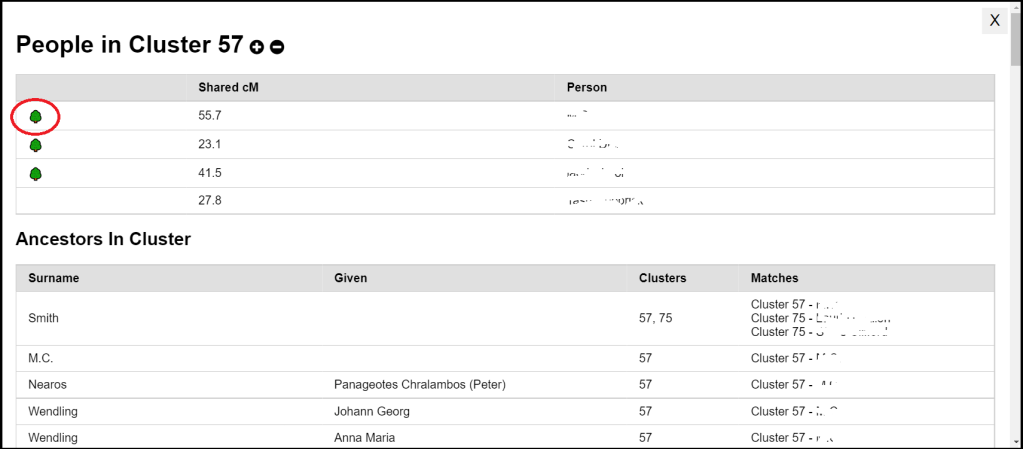
Figure 3: Details about Cluster 57, obtained by selecting “View Cluster” option in autocluster matrix generated by the DNAGedcom Client.

The green tree icon (circled in red) indicates a DNA match with a family tree linked to his or her test results; names of matches (in the “Person” column) have been redacted for privacy. By scrolling down through the list of Ancestors in Cluster, or by examining the trees (when available), I was able to determine that two of these DNA matches are descendants of Josephine (Murre) Hummel—the sister of my great-great-grandmother, Anna (Murre) Boehringer. The third match lacks a family tree, so it’s not immediately clear how we are related; however, these initial findings imply that we must be related through DNA passed down from ancestors of either Joseph Murre or Walburga Maurer.

The fourth member of that Cluster 57, whom I’ll call L.O., is even more interesting, because her family tree indicates that she is the great-granddaughter of German immigrants Frank and Matilda Maurer of Buffalo, New York. L.O. is the DNA match who shares 41.5 cM DNA with my dad, in the list of people in Cluster 57 shown in Figure 3. At this point, I did not have any information on Frank Maurer’s ancestry. But the fact that he shared a surname with Walburga Maurer, combined with the fact that one of his descendants shares DNA with three documented descendants of hers, strongly suggested that (a) Cluster 57 is a Maurer DNA cluster and not a Murre DNA cluster, and (b) Frank must somehow be related to Walburga.

Hoping to gather more data, I examined the Collins-Leeds Method autoclusters that were generated from gathering Dad’s DNA matches who shared between 9 cM and 400 cM DNA with him. By dropping the minimum threshold for inclusion in the analysis all the way down to 9 cM, I picked up DNA matches who are related more distantly, and the total number of individuals included in the analysis jumped from 385 to 1,651. The cluster that contains the same individuals found in Cluster 57 of the previous analysis, is now numbered as Cluster 334, shown in Figure 4.

Figure 4: A portion of the Collins-Leeds Method autosomal cluster matrix generated by the DNAGedcom client for Ancestry DNA matches who share between 9 cM and 400 cM DNA with my Dad.

Examination of the new and improved version of that “Maurer Cluster” (Cluster 334) revealed that there’s some overlap with the adjacent Cluster 335, as well as some other DNA matches (336–342) that are more loosely related, creating a supercluster. That supercluster includes all the greyed-out boxes around Clusters 334 and 335.

Inspection of available family trees for people in the 334–342 supercluster produced the following data (Figure 5):

Match IDShared cM with DadPedigree notes
L.O.41.5 cMGranddaughter of Eleanor Maurer, daughter of Franz Maurer & Matilda Grenz
M.L.11.1 cMGreat-granddaughter of John J. Maurer, son of Franz Maurer & Matilda Grenz
C.M.11.0 cMGrandson of Joseph J. Maurer, son of Franz Maurer & Matilda Grenz
R.H.10.8 cMGrandson of John J. Maurer, son of Franz Maurer & Matilda Grenz
D.U.9.2 cMGrandson of Eleanor Maurer, daughter of Franz Maurer & Matilda Grenz
T.M.10 cMGrandson of John J. Maurer, son of Franz Maurer & Matilda Grenz
Figure 5: Summary of DNA and family tree data for DNA matches from supercluster 334–342 whose precise relationship to my Dad has yet to be determined.

The DNA matches summarized in Figure 5 were in addition to other DNA matches from that cluster who were already known to me as descendants of Joseph and Walburga (Maurer) Murre.

Most of these matches are in the 10 cM range, with the outlier being L.O., who shares roughly 42 cM with my dad, and this variability may be due simply to the randomness of DNA inheritance through recombination. However, other possibilities exist, such as the possibility that L.O. shares more than the expected amount of DNA with Dad because she’s also related to him in some other way, besides just the Maurer connection. That’s a question for another day, but in any case, there’s ample DNA evidence here to suggest that the genetic link between my family and all these DNA cousins lies in that Maurer DNA. Nonetheless, the precise relationship between Franz Maurer and my 3x-great-grandmother, Walburga (Maurer) Murre, remains unclear. Were they siblings, or perhaps first cousins? If we hypothesize that Franz and Walburga were siblings, then that would mean that Dad and all these great-grandchildren of Franz Maurer would be third cousins once removed (3C1R). While it’s within the realm of statistical possibility for 3C1R to share only 10 cM DNA, according to data from the Shared cM Project, a more distant relationship between Franz and Walburga is more probable.

Step 2: Research Franz Maurer’s Family in Historical Records

Now that we’ve identified a family of interest, who was Franz Maurer, and what evidence can be found in historical records that might offer some clues for our research question? Preliminary research indicated that Franz/Frank Maurer was born circa 1839 in Bavaria, and was married to Franziska/Frances Geigand in Germany. Figure 6 shows the family in the 1880 census.8

Figure 6: 1880 U.S. Census showing the family of Franz Maurer living at 240 Locust Street in Buffalo, New York.

Franz was a carpenter, born in Bavaria, and the couple had two children while in Germany: a son, Alois, born circa 1861, and a daughter, Anna, born about 1865. They immigrated in 1867,9 and settled in Buffalo, New York, in the same parish where my Murre family would settle two years later—St. Boniface, formerly located at 145 Mulberry Street. Church records show that another son, Joseph, was born to Franz and Franziska on 18 August 1867, followed by Michael on 21 July 1869.10 Twin boys, Joannes Aloisius and Franciscus (as they were identified in their Latin baptismal records), were born on 2 February 1872,11 but they both died of smallpox that summer, which also took the life of four-year-old Joseph.12 Another son, Frank, was born on 26 June 1873, followed by Henry on 14 July 1876.13 A daughter, Francisca, born 18 August 1880,14 must also have died in infancy, because she disappears from the records. She is not, however, buried in the same cemetery plot as many of the other Maurer children who died in childhood.

On 15 April 1881, Franziska/Frances Maurer died,15 leaving behind her husband and five living children, ranging in age from about 5 years to 20 years old. Four months later, on 22 August 1881,16 Franz remarried a fellow German immigrant, 33-year-old Franziska (Eppler or Ebler) Schabel, a widow whose previous husband, Frank Schabel, died in April 1880.17 At the time of her remarriage, Frances was the mother of two children, Frank Schabel, Jr. (about age 4), and Rose Schabel, who was barely two years old.18 Although Frank Jr. retained his biological father’s surname, Rose was subsequently known as Rose Maurer, and she identified her father as Francis Maurer—not Schabel—on her marriage record.19 Although Frances was still within her childbearing years when she married Frank Maurer, no children from this marriage have been discovered thus far.

The second Frances Maurer must have died before 1888, because Franz Maurer remarried for the third time on 24 January of that year.20 Oddly, there is no evidence for Frances’ death in the Buffalo, New York, death index 1885–1891. However, there may have been a miscommunication with the civil clerks when the certificate was recorded, because there is a death certificate for a Frank Marer (sic) in that time period, which might be that of Frances, despite the masculine version of the given name.21 (Research is ongoing.)

Franz Maurer’s new bride was 34-year-old Matilda Grenz, another German immigrant, and four children were born to this couple: Joseph, on 15 January 1889; Matilda, on 30 April 1891, John, on 21 December 1892, and Eleanor, on 22 January 1897.22 Franz/Frank Maurer, Sr., died in 1910 and is buried in the United German & French Cemetery.23 In 1924, his wife, Matilda, passed away, and she is buried by his side.24

Step 3: Confirm FAN Club Membership

As expected, evidence from Joseph and Walburga Murre’s FAN club confirms the importance of the Franz Maurer family to my quest for the origins of my Maurer/Murre ancestors. Joseph and Walburga Murre named Franz and Franziska Maurer as godparents to their youngest child, Frances Walburga Murre, whose baptismal record from St. Boniface church is shown in Figure 7.25
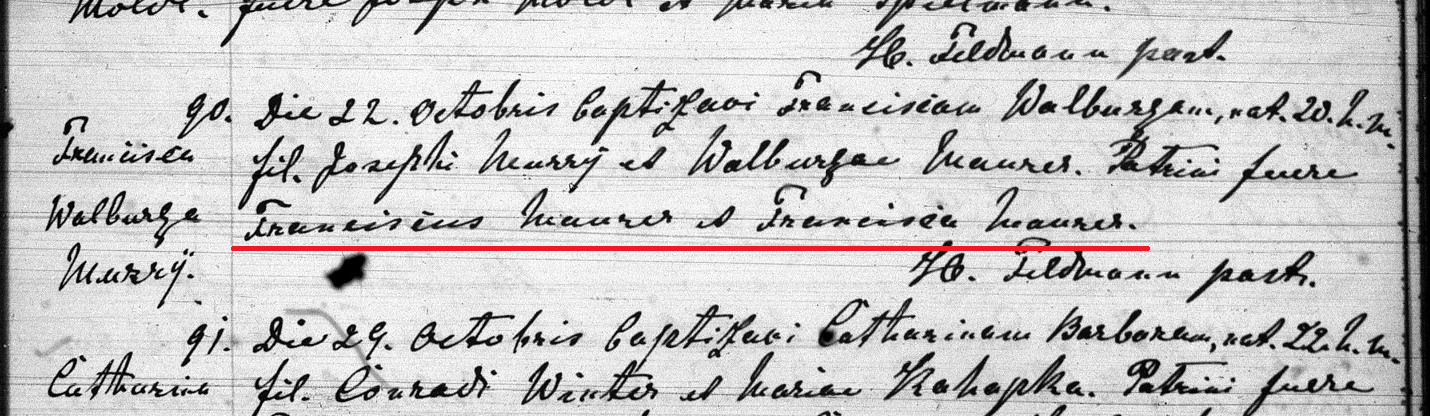
Figure 7: Baptismal record from St. Boniface Church in Buffalo, New York, for Francisca Walburga Murre. Click image to enlarge. The record states, “Die 22 Octobris baptizavi Franciscam Walburgam, nat[am] 20 h[ujus] m[ensis] fil[ia] Josephi Murrÿ et Walburgae Maurer. Patrini fuere Franciscus Maurer et Francisca Maurer.” In translation, “On the 22nd day of October, I baptized Francisca Walburga, born on the 20th of this month, daughter of Joseph Murrÿ and Walburga Maurer. Godparents were Franciscus Maurer and Francisca Maurer.”

Interestingly, for both of their other Buffalo-born children, Josephine and Alois Joseph, they named as godparents Alois Geigand and his wife, Josephine. Josephine Murre’s baptismal record is shown in Figure 8.26
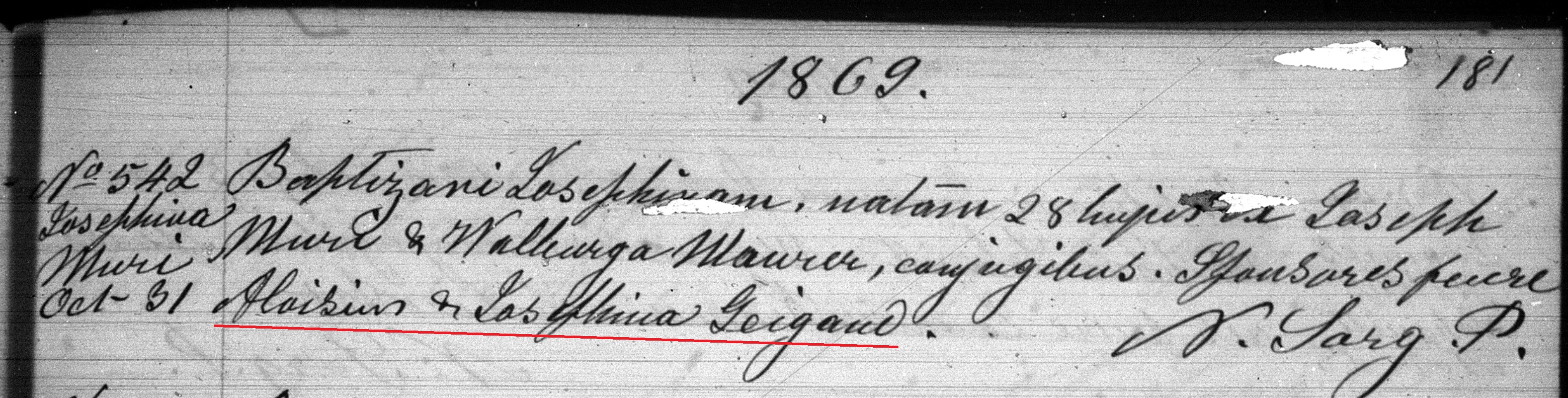
Figure 8: Baptismal record from St. Boniface Church in Buffalo, New York, for Josephine Murre. Click image to enlarge. The record states, “No. 542, Josephina Muri Oct 31. Baptizavi Josephinam, natam 28 hujus ex Joseph Muri & Walburga Maurer, conjugibus. Sponsores fuere Aloisius & Josephina Geigand.” In translation, “I baptized Josephine, born on the 28th of this [month] of Joseph Muri & Walburga Maurer, spouses. Sponsors were Aloisius & Josephine Geigand.”

Cemetery data from United German and French Cemetery, where Walburga and Joseph were buried, confirm the close relationship between the Maurer and Geigand families. The lot where Walburga was laid to rest was a large one, with at least 20 burials in it, owned by Alois Geigand and Frank Maurer.27 Of the twenty burials, all but four of them have been identified as descendants of Maurer or Geigand families. (Those remaining four burials may also be related, but currently their connection to these families is unclear.) The 1880 census, shown previously in Figure 6, also illustrates the strong links between the families, since they were living in the same house at 240 Locust Street at that time. A detail from this census is shown in Figure 9.

Figure 9: Detail from 1880 census showing Alois and Josephine Geigand living with the family of Frank Maurer in Buffalo, New York. Click image to enlarge.

According to this census, Alois and Josephine Geigand were both 68 years old, which implies that they were born circa 1812. These ages suggest that perhaps they might be the parents of Frances (Geigand) Maurer, and I’m hoping that her burial record from St. Boniface might shed some light on that.

This brings us to the Hamburg emigration manifest for these folks, the document that gives me a glimmer of hope that I might be able to discover the origins of my Maurer/Murre family (Figure 10).28
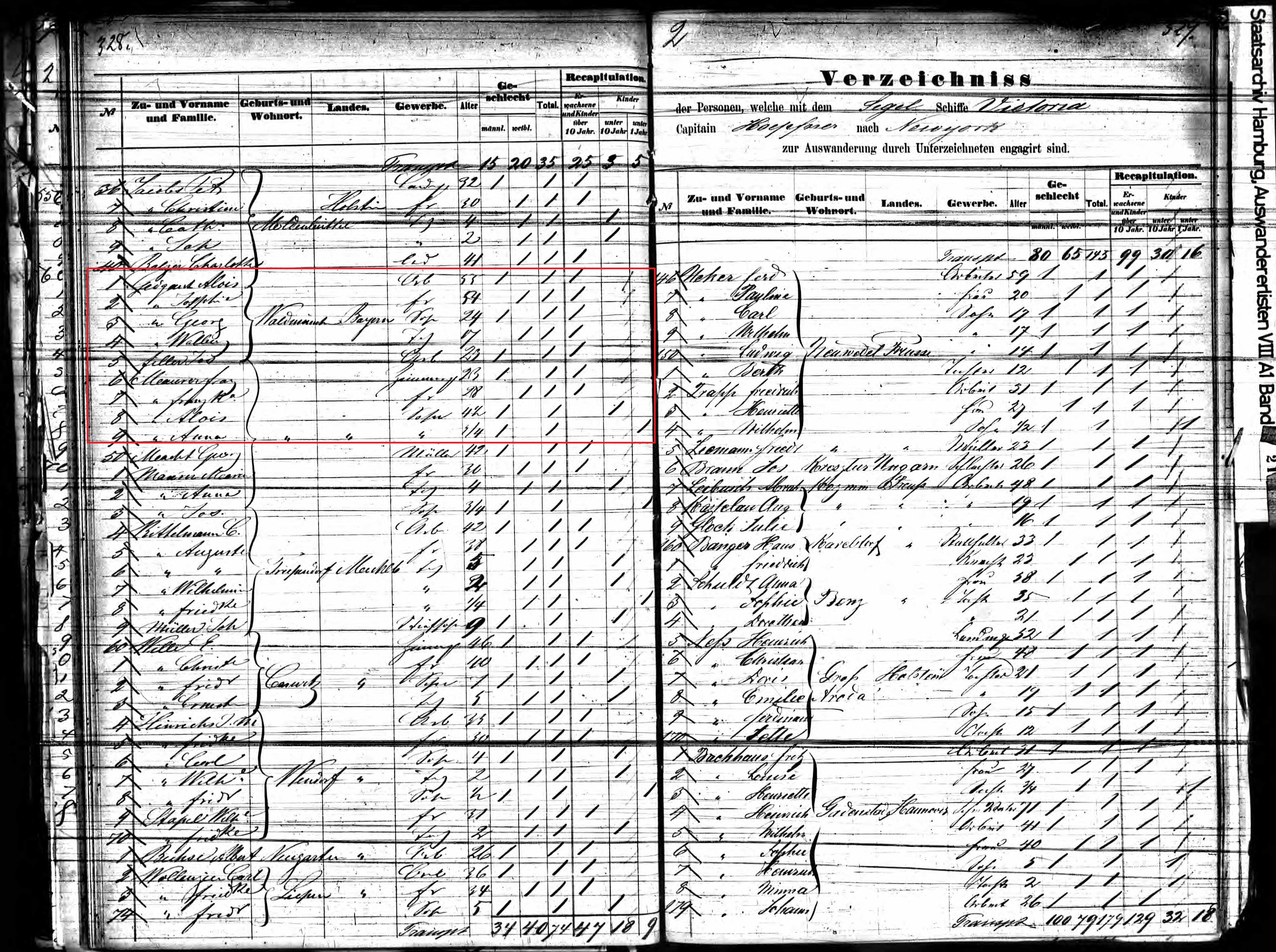
Figure 10: Hamburg emigration manifest for the Geigand and Maurer families, who departed for New York on 1 May 1867 on the SS Victoria. Click image to enlarge.

This manifest is irrefutably the correct one for these families. The names and ages of all passengers line up perfectly with data from U.S. records, confirming that 55-year-old laborer, Alois Geigand (indexed as Geigant), and his 54-year-old wife, Josephine, traveled to the U.S. with their two children, 24-year-old Georg and 17-year-old Walbur (sic), aboard the SS Victoria, departing from Hamburg on 1 May 1867. Traveling with them were the family of Franz (indexed as “Fraz”) Maurer, a 23-year-old carpenter; his wife, Franziska, and two children, Alois and Anna. Their place of origin was indexed by Ancestry as Waldmünchen, Bayern—a town in Bavaria, Germany, that’s barely two miles from the Czech border (Figure 11).

Figure 11: Location of Waldmünchen. Click image for interactive Google Map.

It’s always good to get more than one piece of evidence for place of origin before attempting to dive into records from Europe, and in this case, the emigration register from Mainz, Germany, provided that additional evidence (Figures 12a and b).29
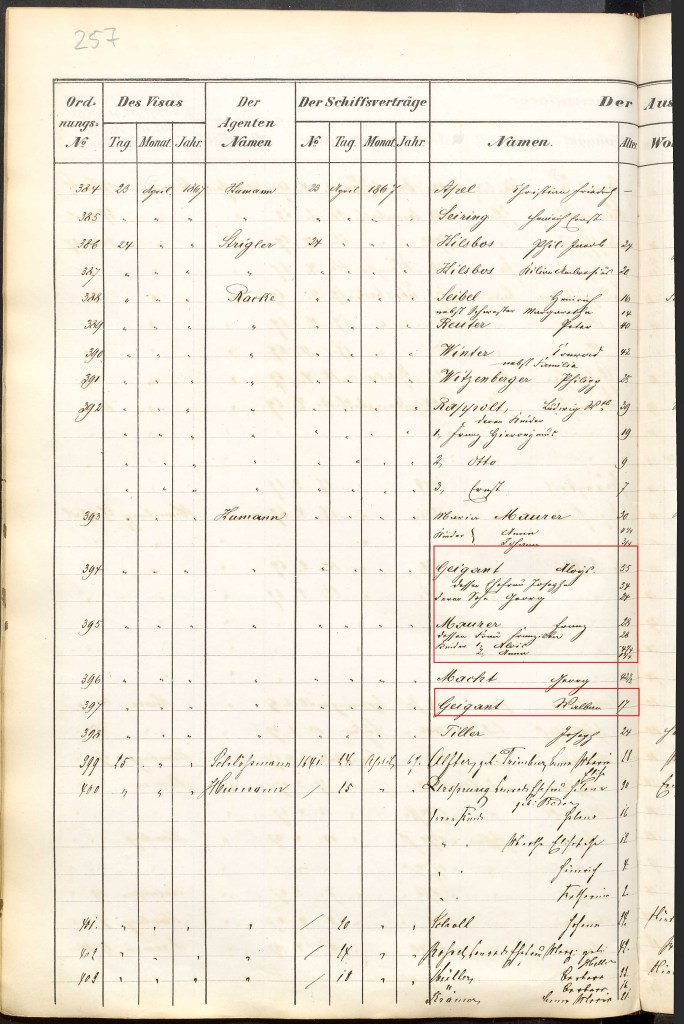
Figure 12a: First page of the emigration register from Mainz, Germany, identifying the families of Aloys Geigand and Franz Maurer. 17-year-old Walbur Geigand, who was identified as Alois’s daughter on the passenger manifest, appears two rows down.
Figure 12b: Second page of the emigration register from Mainz, Germany, identifying the families of Alois Geigand and Franz Maurer. 17-year-old Walbur Geigand, who was identified as Alois’s daughter on the passenger manifest, appears two rows down.

Professional researcher, Marcel Elias, provided the following translation of these entries:

“Nr. 394, 24 April 1867, agent’s name Humann, Schiffsvertrag (a confirmation about booked ticket) from 24 April 1867, Names of emigrants:

Geigant Aloys, 55yo

his wife Josepha, 54 yo,

their son Georg, 24 yo

all from Waldmünchen, Bayern, Auswanderungszeugniss (approval for emigration) from Waldmünchen from 27 March 1867, heading to New York, port of departure Hamburg on April 26

Nr. 395, 24 April 1867, agent’s name Humann, Schiffsvertrag (a confirmation about booked ticket) from 24 April 1867, Names of emigrants:

Maurer, Franz, 28yo

his wife Franziska, 26 (or 28 yo)

children: Alois, 4 ¼

Anna 1 ¼

all from Waldmünchen, Bayern, Auswanderungszeugniss (approval for emigration) from Waldmünchen from 27 March 1867, heading to New York, port of departure Hamburg on April 26″

Observant readers may have noticed that there were other emigrants from Waldmünchen recorded on both the passenger manifest, as well as the emigration register. These other emigrants included group 393, consisting of 30-year-old Maria Maurer and her children, Anna and Johann, as well as 42-year-old Georg Macht. They, too, belong to the Maurer-Geigand FAN Club, and I was not surprised to discover that Maria and Georg were married at St. Boniface on 18 June 1867, less than two months after they arrived in Buffalo.30 Ship-board romance or marriage of convenience? Who knows?

Step 4: Seek Evidence for Murre/Maurer Family in Records from Waldmünchen

Unfortunately, my own ancestors, Joseph and Walburga Murre, were not found in the database of Mainz, Germany, emigration registers, which suggests that they registered in another administrative center. (They also departed from Bremen, rather than Hamburg.) So, these two pieces of evidence—the passenger manifest and the emigration register—are my best hope for tracking down my Murre family. You may also note that Ancestry indexed the last place of residence of the emigrant Maurer-Geigand clan as “Waldmühlen,” rather than “Waldmünchen,” based on the “Wohnort” column. However, the place was clearly recorded as Waldmünchen in the “Legitimationen” column in Figure 12b. This discrepancy might be concerning, apart from the fact that I also happened to find a Buffalo Evening News article from 1933 about the 60th wedding anniversary of Joseph and Anna (Pongratz) Geigand, which states that Joseph Geigand was born in Waldmünchen, Bavaria, Germany, and came to the U.S. in 1871.31 Do I know how Joseph Geigand is related to my family at this point? Heck no. Nonetheless, FAN principles would suggest that he’s got to be a part of the Maurer-Geigand FAN Club, and at this point, that’s good enough for me.

Finding my Murre family in records from Waldmünchen sounds pretty straightforward, but it’s not a slam-dunk. It may be that the Maurers were approximating their place of origin to Waldmünchen, when in fact they were from some smaller village in the vicinity. We won’t know until we try. However, trying is not something I can do on my own. FamilySearch has no scans online for Roman Catholic records from Waldmünchen, nor am I sufficiently proficient in my ability to read German. Church records from Waldmünchen are at the Bischöfliche Zentralarchiv Regensburg (diocesan archive in Regensburg), which is an archive that’s quite familiar to Marcel Elias, the professional researcher I mentioned previously. So, I handed the ball off to Marcel, and I’m awaiting his results with bated breath. Stay tuned.

Sources:

1 1900 U.S. Census, Erie County, New York, population schedule, Buffalo Ward 25, Enumeration District 222, Sheet 2A, Erie County Almshouse, line 16, Joseph Murri; digital image, Ancestry (https://www.ancestry.com/ : 12 July 2022), citing Family History Library microfilm no. 1241033, original data from National Archives and Records Administration publication T623, 1854 rolls.

2 1870 United States Federal Census, Erie County, New York, population schedule, Buffalo Ward 7, page 73, family no. 603, Joseph Murri household; digital image, Ancestry (https://www.ancestry.com/ : 12 July 2022), citing NARA microfilm publication M593, roll 934 of 1,761 rolls. Washington, D.C.: National Archives and Records Administration, n.d; Family History Library Film no. 552433.

3 1880 United States Federal Census, Erie County, New York, population schedule, Buffalo city, Enumeration District 147, sheet 12D, family no. 120, Joseph Murry household; digital image, Ancestry (https://www.ancestry.com : 12 July 2022), citing NARA microfilm publication T9, roll 830 of 1,454 rolls, Records of the Bureau of the Census, Record Group 29, National Archives, Washington, D.C., Family History microfilm no.1254830; and

New York State Department of Health, Division of Vital Statistics, Death Certificates, no. 2064, Anna Mertz, 29 March 1936; Buffalo, New York, City Clerk, 1302 City Hall, 65 Niagara Square, Buffalo, New York; and

1900 U.S. Census, Erie County, New York, population schedule, West Seneca, Enumeration District 264, Sheet 28A, line 10, John Murra in Alois Klug household; digital image, Ancestry (http://search.ancestry.com : 12 July 2022), citing National Archives and Records Administration, 1900. T623, roll 1034 of 1854 rolls, FHL microfilm no. 1241034.

4 Manifest, SS Hansa, arriving 3 April 1869, lines 38-42, Muri family; imaged as “New York, U.S., Arriving Passenger and Crew Lists (including Castle Garden and Ellis Island), 1820-1957,” database with images, Ancestry (https://www.ancestry.com/ : 12 July 2022); citing Microfilm Serial M237, 1820-1897; Line 42; List no. 292.

5 St. Boniface Roman Catholic Parish Records,142 Locust St. Buffalo, New York, microfilm publication, 2 rolls (Buffalo & Erie County Public Library : Western New York Genealogical Society, 1982), Roll 1: Baptisms (1849-1912), 1869, no. 542, baptismal record for Josephina Muri; and

Ibid., 1872, no. 977, baptismal record for Aloisius Joseph Muri; and

Ibid., 1876, no. 90, baptismal record for Francisca Walburga Murrÿ.

6 Ibid., 1886, baptisms, no. 124, record for Walburga Barbara Murry. Although it was recorded among the baptisms, the text makes it clear that this is a death record. “Walburga Barb. Murry. no. 124. Die 18a Sept. Walburga Barbara Murri quinqueqinta duos annos nata animam Deo reddidit confesso atque Viatico refecta die 20a b.m. rite sepultum est ejus corpus. Ferdinand Kolb.”; and

United German and French Cemetery Roman Catholic Cemetery, Mount Calvary Cemetery Group (500 Pine Ridge Heritage Boulevard, Cheektowaga, New York) to Julie Szczepankiewicz, Murre/Maurer/Geigand burial data, including record of lot owners for Lot 66, Section S; diagram of plot, and record of burials on lot; burial records for Walburga Barb Murri (1886) and Joseph Murre (1905).

7 Ibid., and

1900 U.S. Census, record for Joseph Murri.

8 1880 United States Federal Census, Erie County, New York, population schedule, Buffalo city, Enumeration District 147, page 31C, family no. 305, Frank Maurer household; digital image, Ancestry (https://www.ancestry.com/discoveryui-content/view/1716337:6742 : 12 July 2022), citing NARA microfilm publication T9, roll 830 of 1,454 rolls, Records of the Bureau of the Census, Record Group 29. National Archives, Washington, D.C.

9 Manifest, SS Victoria, departing 1 May 1867 Hamburg to New York, p328, nos. 46-49, Franz Maurer family (indexed as Fraz); imaged as “Hamburg Passenger Lists, 1850-1934,” Ancestry (https://www.ancestry.com : 12 July 2022), citing Staatsarchiv Hamburg; Hamburg, Deutschland; Hamburger Passagierlisten; Volume: 373-7 I, VIII A 1 Band 021 A; Page: 327; Microfilm No.: K_1712.

10 “New York Births and Christenings, 1640-1962”, database, FamilySearch (https://www.familysearch.org/ark:/61903/1:1:FDT1-CXT : 12 July 2022), Joseph Maurer, born 18 August 1867; and

Ibid., Michael Maurer, born 21 July 1869.

11 Ibid., Joannes Aloisius Maurer, born 2 February 1872; and

Ibid., Franciscus Maurer, born 2 February 1872.

12 United German and French Cemetery Roman Catholic Cemetery, record of burials for Lot 66, Section S.

13 “New York Births and Christenings, 1640-1962”, database, Franciscus X. Maurer, born 26 June 1873; and

Ibid., Henricum Aloysium Mauerer, born 14 July 1876.

14 Ibid., Francisca Maurer, born 19 August 1880.

15 Find a Grave, database and images (https://www.findagrave.com/memorial/79956024/franziska-mauerer : accessed 12 July 2022), memorial page for Franziska Mauerer (28 Feb 1838–15 Apr 1881), Find a Grave Memorial ID 79956024, citing United German and French Cemetery, Cheektowaga, Erie County, New York, USA ; Maintained by Phyllis Meyer (contributor 47083260).

16 “New York Marriages, 1686-1980”, database, FamilySearch ( https://www.familysearch.org/ark:/61903/1:1:F6S7-SJ6 : 12 July 2022), Franciscus Maurer and Francisca Schable, 22 August 1881.

17 1880 U.S. Census, Erie County, New York, mortality schedule, Buffalo city, Enumeration District 141, sheet 1, line 19, Frank Schabel, died April 1880; imaged as “U.S., Federal Census Mortality Schedules, 1850-1885,” Ancestry (https://www.ancestry.com/ : 12 July 2022), citing New York State Education Department, Office of Cultural Education, Albany, New York; Archive Roll No. M10.

18 1880 United States Federal Census, Erie County, New York population schedule, Buffalo city, Enumeration District 141, Sheet 93A, household no. 249, Francis (sic) Schabel household; digital image, Ancestry (https://www.ancestry.com/ : 12 July 2022), citing NARA microfilm publication T9, roll 829 of1,454 rolls.

19 Roman Catholic Church, Our Lady of Lourdes parish (Buffalo, Erie, New York, USA), Marriages, 1883-1907,1903, no. 22, Joannes C. Bauer et Rosa K. Maurer, 17 June 1903; digital image, FamilySearch (https://www.familysearch.org/ark:/61903/3:1:3QSQ-G928-9NHL : 12 July 2022), “Church records, 1850-1924,” Family History Library film no. 1292741/DGS no. 4023115, image 1048 of 1740.

20 “New York Marriages, 1686-1980”, database, Franz Maurer and Matilda Grenz, 24 January 1888.

21 City of Buffalo, Buffalo, NY, Death Index, 1885-1891, p. 486, Marer, Frank, unknown date (bet. 1885-1891), Vol. 10, p 62; digital image, Internet Archive (https://archive.org/ : 12 July 2022), image 549 of 990.

22 “New York Births and Christenings, 1640-1962”, database, Joseph Maurer, born 15 January 1889; and

“U.S., Social Security Applications and Claims Index, 1936-2007,” database, Ancestry (https://www.ancestry.com/ : 12 July 2022), Matilda Catherine Maurer, born 30 April 1891, SSN 058342914; and “New York Births and Christenings, 1640-1962”, database, Martinam Maurer, born 30 April 1891. Matilda’s baptismal record identifies her as Martina, with the same date of birth, but I believe they are the same individual.

“New York Births and Christenings, 1640-1962,” database, Johannem Maurer, born 21 December 1892; and

“New York Births and Christenings, 1640-1962”, database, Elleonoram Maurer, born 22 January 1897.

23 Find a Grave, database and images (https://www.findagrave.com/memorial/79897696/frank-x-maurer : accessed 12 July 2022), memorial page for Frank X. Maurer (1839–1910), Find a Grave Memorial ID 79897696, citing United German and French Cemetery, Cheektowaga, Erie County, New York, USA ; Maintained by DPotzler (contributor 47357059).

24 Find a Grave, database and images (https://www.findagrave.com/memorial/79896453/matilda-r-maurer : accessed 12 July 2022), memorial page for Matilda R. Grenz Maurer (1853–19 Mar 1924), Find a Grave Memorial ID 79896453, citing United German and French Cemetery, Cheektowaga, Erie County, New York, USA ; Maintained by DPotzler (contributor 47357059).

25 St. Boniface Roman Catholic Parish Records,142 Locust St. Buffalo, New York, 1876, no. 90, baptismal record for Francisca Walburga Murrÿ.

26 Ibid., 1869, no. 542, baptismal record for Josephina Muri.

27 United German and French Cemetery Roman Catholic Cemetery, record of lot owners and record of burials on Lot 66, Section S.

28 Manifest, SS Victoria, families of Franz Maurer and Alois Geigant.

29 “Mainz, Germany, Emigration Register, 1856-1877,” database and images, Ancestry (https://www.ancestry.com/ : 12 July 2022), Franz Mauer family (Ordnungs no. 395), Aloys Geigand family (Ordnungs no. 394), and Walbur Geigand (Ordnungs no. 397), Auswanderungszeugniss [approval for emigration] from Waldmünchen from 27 March 1867, schiffsverträge [shipping contract] 24 April 1867, citing Auswanderungsregister 1856-1877, Stadtarchiv Mainz, Germany, Serial no. 395, Identification no. 1632, reference no. 70 / 1358.

30 “New York Marriages, 1686-1980,” database, Maria Maurer and Georgius Macht, 18 June 1867.

31 Buffalo Evening News (Buffalo, New York), 21 April 1933 (Friday), p 21, col 2, “Married 60 Years,” anniversary announcement for Joseph and Anna (Pongratz) Geigand,” digital image, Newspapers (https://www.newspapers.com/ : 12 July 2022).

© Julie Roberts Szczepankiewicz 2022

Celebrating My Blogiversary!

It’s hard to believe it, but I started this blog six years ago today as a way to share my family history discoveries and my enthusiasm for genealogy with fellow genealogists, distant cousins, research collaborators, and everyone in between. For six years, you’ve celebrated my successes with me and commiserated with my stumbling, offering encouragement for all those “brick walls.” I’ve shared my musings, insights, resources, and strategies, and you’ve shared your own tips, kind remarks, and research challenges. I’ve gotten to know new living cousins, and discovered dozens of “new” ancestors and deceased relatives to add to my family tree.

So what does six years of blogging look like, by the numbers? Like this:

My favorite discoveries from the past six years, in no particular order:

  • The origins of my immigrant Causin/Cossin ancestors from Alsace.
  • The marriage record of my great-grandmother’s brother, Władysław/Walter Grzesiak, who unexpectedly married in Warsaw, 150 miles from his birthplace, which opened the door to additional new discoveries for my Grzesiak family.
  • The marriage record from Buffalo, New York, for my great-great-grandparents, Marianna/Mary Łącka and Andrzej/Andrew Klaus, and the baptismal records of Mary’s first two sons, which finally disproved the family myth that the Klaus family ever lived in Texas.
  • The identification of distant cousins on my Klaus, Słoński, Wilczek, Panek, Dodds, Zarzycki, and Causin lines, made through DNA testing, which led to a clearer understanding of the migrations and dispersions of those families.
  • The discovery of a baptismal record for Ellender Hodgkinson, which spurred further research into her godmother, Mary Hodgkinson, which in turn led to the discovery of the last will and testament of John Hodgkinson, Sr., which identified previously unknown siblings of my 5x-great-grandfather, John Hodgkinson, and offered direct evidence that his father also immigrated to the U.S. from England.
  • The marriage record for my 3x-great-grandmother, Catherine Grentzinger, and her first husband, Victor Dehlinger, which opened doors into further discoveries into the origins of the Dehlinger and Grentzinger families.
  • The death records from Młodzieszyn for the siblings of my great-grandfather, Joseph Zielinski, which allowed me to piece together a timeline that finally explained why my grandfather returned to Poland with his parents in 1921.
  • The grave marker of Joseph and Gertrude (Wagner) Riel from Mt. Elliott Cemetery in Detroit, which identified Joseph’s place of birth in Germany, which allowed me to leverage the FAN principal and definitively identify the the place of origin of my Wagner ancestors.

Time certainly does fly when you’re having fun! I’m looking forward to further adventures in genealogy, and I’m excited to be able to share my discoveries with you. Thanks for all the positive feedback and encouragement over the past six years. It’s been a pleasure and a privilege to have your company on this journey.

© Julie Roberts Szczepankiewicz 2022

Postcard Poet: Sister Mary Rose Kantowska

My in-laws came to visit for Easter this year, and I had a chance to sit down with my mother-in-law and sort through a huge box of old family photos that had belonged to her mother, Joanna (Drajem) Barth. Mom was invaluable in identifying the individuals in them, although in some cases Grandma Barth had done this job for us by making notes on the backs of the photos. One of these photos was of Grandma Barth’s maternal aunt, Sister Mary Rose Kantowska, F.S.S.J. (Figure 1).1

Figure 1: Photograph of Sr. Mary Rose Kantowska, circa 1920. Photo restoration courtesy of Karolina Augustynowicz King.

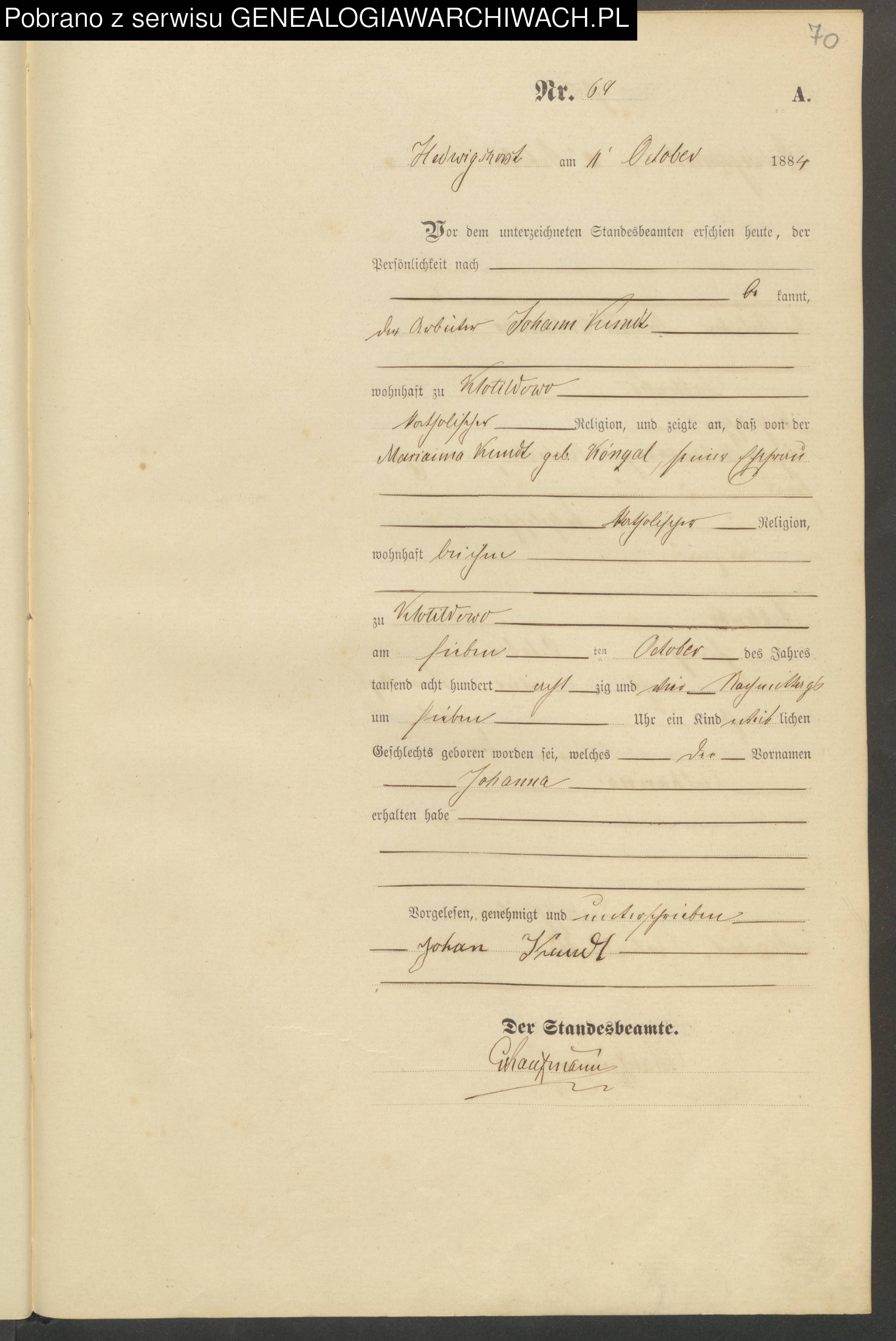
Sister Mary Rose was born Johanna Kundt on 7 October 1884 in Klotildowo, Kreis Schubin (Schubin County), in the Posen province of the German Empire. This location is presently known as Klotyldowo, powiat żniński (Żnin County), in the Kujawsko-Pomorskie province of Poland. She was the oldest daughter of Johann and Marianna (Kończal) Kundt, or Kąt, as the family was recorded in Polish parish registers. According to oral family tradition, the family adopted the surname Kantowski, since they felt it was more acceptable to American ears than their original surname. Joanna Kantowski’s birth record is shown in Figure 2.2

Figure 2: Civil birth record from the registry office in Jabłówko for Johanna Kundt (Joanna Kantowska) born 7 October 1884. Click image to enlarge. Transcription and translation are provided in the footnotes. Note that Jan Kantowski’s signature appears at the bottom of the record.

The Kantowski family immigrated to Buffalo, New York, circa 1886, where another daughter, Stanisława Maria, was born to them on 8 September 1886.3 Figure 3 shows the young family circa early 1887.4

Figure 3: Jan and Maria (Kończal) Kantowski with daughters Joanna and Stanisława (“Stasia”), circa 1887. Photo restoration courtesy of Karolina Augustynowicz King.

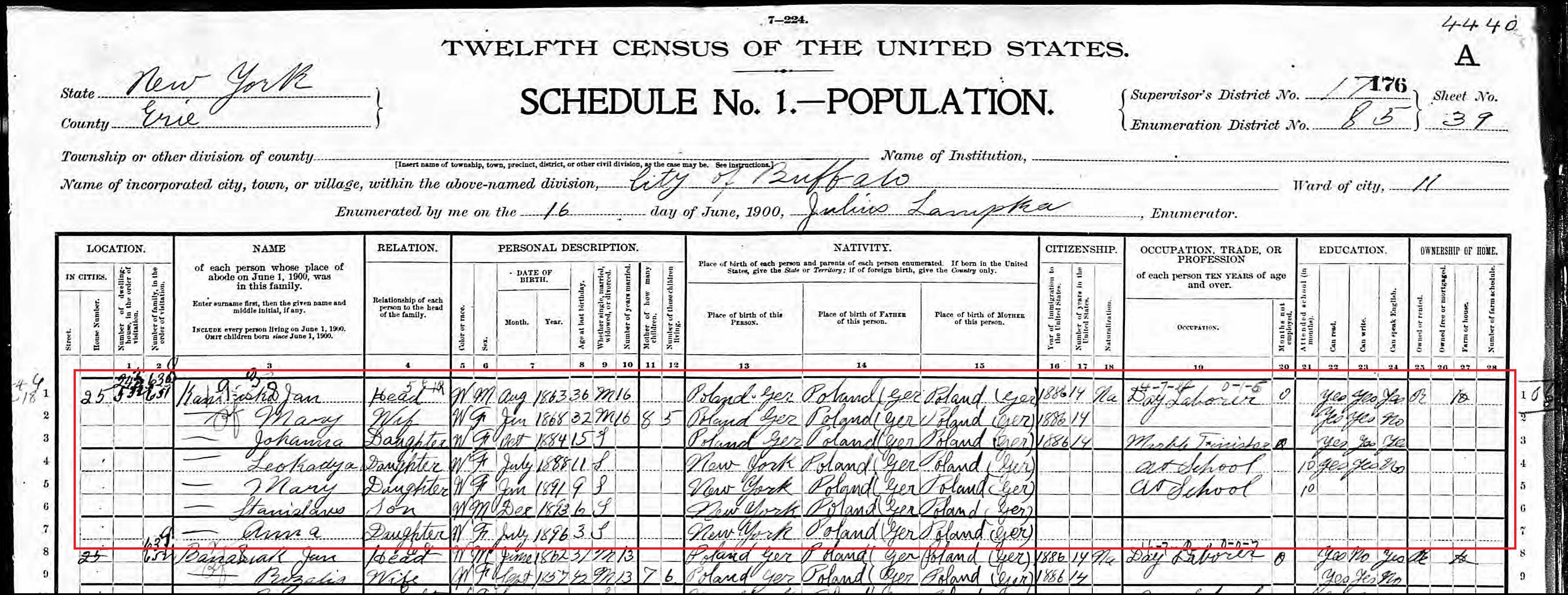
In 1900, the Kantowski family was living at 25 Newton Street, according to the 1900 census.5 At 15 years of age, Johanna was employed as a Marble Finisher.

Figure 4: 1900 census showing the John Kantowski living at 25 Newton Street in Buffalo, New York. Click image to enlarge.

Two years later, she entered the convent of the Franciscan Sisters of St. Joseph.6 Her obituary stated that she was a teacher, whose career spanned about 40 years and included teaching positions in Shamokin, Pennsylvania and Milwaukee, Wisconsin (Figure 5).7

Figure 5: Obituary from the Buffalo Courier-Express for Sr. Mary Rose Kantowski, published 21 May 1968 (Tuesday).

Sister Mary Rose was also a loving and affectionate aunt to her many nieces and nephews. Her younger sister, Mary Kantowski, married Albert Drajem on 22 October 1912, and by 1916, Albert and Mary were the parents of three children—Victor Albert Drajem, born in 1913, and twins, Joanna and Stanley Drajem, born in 1916. A simplified family tree is shown in Figure 6.

Figure 6: Simplified family tree showing the children of John and Mary (Kończal) Kantowski, including Joanna Kantowska (Sr. Mary Rose), and the family of her sister, Mary (Kantowska) Drajem as it existed in 1917. Click image to enlarge.

The three siblings—Victor, Joanna and Stanley—appear in a photo from circa 1917, shown in Figure 7.8

Figure 7: Victor Drajem and twins Joanna and Stanley Drajem, circa 1917. Photo restoration courtesy of Karolina Augustynowicz King.

Joanna Drajem—my husband’s grandmother, otherwise known as Grandma Barth—preserved three postcards with holiday greetings, addressed jointly to her and to her twin brother, Stanley, by Sr. Mary Rose. Although Grandma wrote on the postcards that they were from 1916 and 1917, it seems that the last postcard, with Easter greetings addressed to little Jania alone, must have been written after Stanley’s death in 1919.9 The first post card is shown in Figures 8a and b.

Figure 8a: Front of Valentine’s Day postcard from Sr. Mary Rose Kantowska to twin siblings Joanna (“Jania”) and Stanley (“Stasiu”), her niece and nephew.
Figure 8b: Reverse of of Valentine’s Day postcard from Sr. Mary Rose Kantowska to twin siblings Joanna (“Jania”) and Stanley (“Stasiu”), her niece and nephew.

The following transcriptions and translations were kindly provided by Dr. Roman Kałużniacki.

Postcard 1: Isn’t It Fun To Be Sweethearts

1916 – 1917

“Czy Jania i Stasiu też tak się kochają
jak te dwoje które na tym obrazku przedstawiają.

Do Jania and Staś love each other also so
as these two who themselves on the photo show?

Jakie one szczęśliwe nic im nie brakuje,
jedno przy drugiem siedzi i swą radość czuje.

How happy they are nothing they lack,
One by the other sit and their joy feel,

Niechaj i waszym maleństwom tak czas miło leci,
By pozostały miłe wspomnienia jak jeszcze były małe dzieci.

Let the time for your youngsters also warmly flow,
That sweet memories remain as little children they still were.

Ze chociaż kłopotu nieraz narobiły
a i bez uciechy dni one nie były.

That though trouble at times they caused
but yet no such days without joy there were.

Kiedy szczebiotaniem naśladować chciały
to co od innych usłyszały.

When they wanted to mimic with twitters
That which they overheard from others.

Tak niech im słodko płyną młodociane dni
Jak błogo jest temu co mu się dobrze śni.

So for them let sweetly flow youthful days
As blissfully as for one who soundly dreams.”

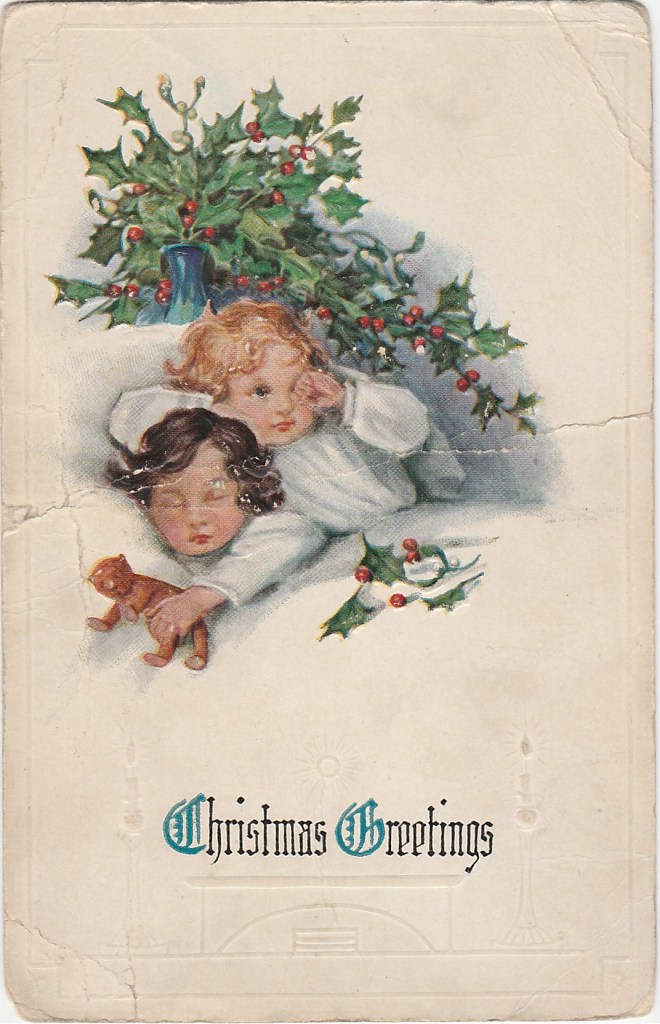
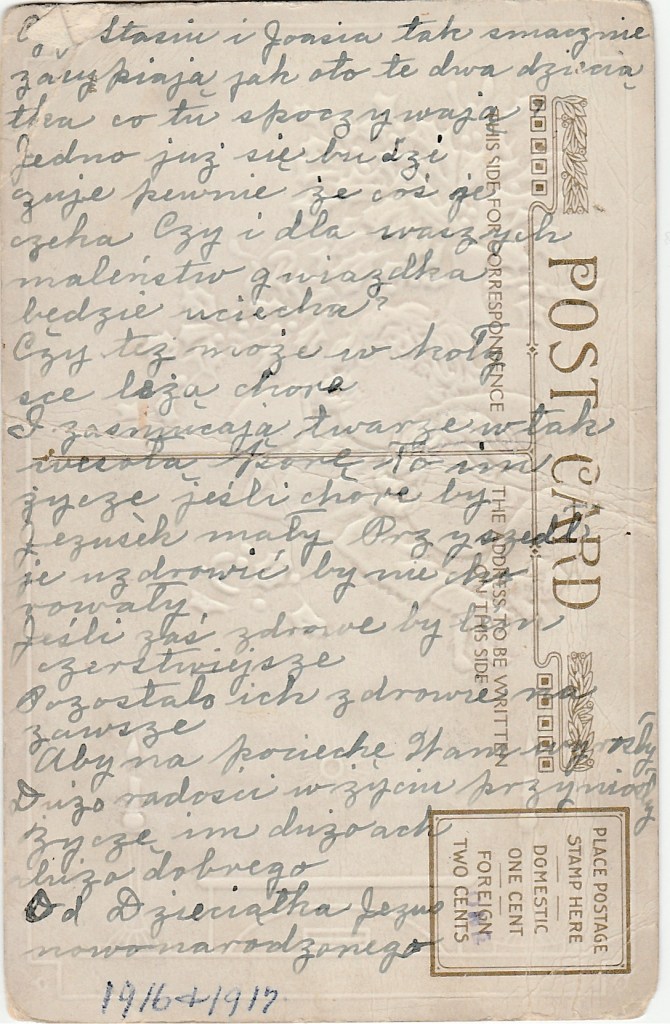
The second postcard is a Christmas card, shown in Figures 9a and b.

Figure 9a: Front of Christmas postcard from Sr. Mary Rose Kantowska to twin siblings Joanna (“Jania”) and Stanley (“Stasiu”), her niece and nephew.
Figure 9b: Reverse of Christmas postcard from Sr. Mary Rose Kantowska to twin siblings Joanna (“Jania”) and Stanley (“Stasiu”), her niece and nephew.

Postcard 2: Christmas Greetings

“Czy Stasiu i Joasia tak smacznie zasypiają
jak oto te dwa dzieciątka co tu spoczywają?

Do Staś and Joasia so charmingly fall asleep
As these two babes who here do rest?

Jedno już się budzi czuje pewnie że coś je czeka
Czy i dla waszych maleństw gwiazdka będzie uciecha?

One already wakens feeling something for it awaits
Will the Christmas star also bring for your little ones joy?

Czy też może w kołysce leżą chore
I zasmucają twarze w tak wesołą porę.

Perhaps they also lay sick in the cradle
And sadden their faces at such a joyful time.

To im życzę jeśli chore by Jezusek mały
Przyszedł je uzdrowić by nie chorowały.

Then I wish if they are ill that little Jesus
Come to heal that they not ail.

Jeśli zaś zdrowe by tem czerstwiejsze
Pozostało ich zdrowie na zawsze.

If else healthy that for them yet ruddier
Remain their health forever.

Aby na pociechę Wam wyrosły
Dużo radości w życiu przyniosły.

That they for you grow up in comfort
That much joy in life they bring.

Życzę im dużo ach dużo dobrego
Od Dzieciątka Jezus nowo narodzonego.

I wish them all oh so much good
From Baby Jesus newly born.”

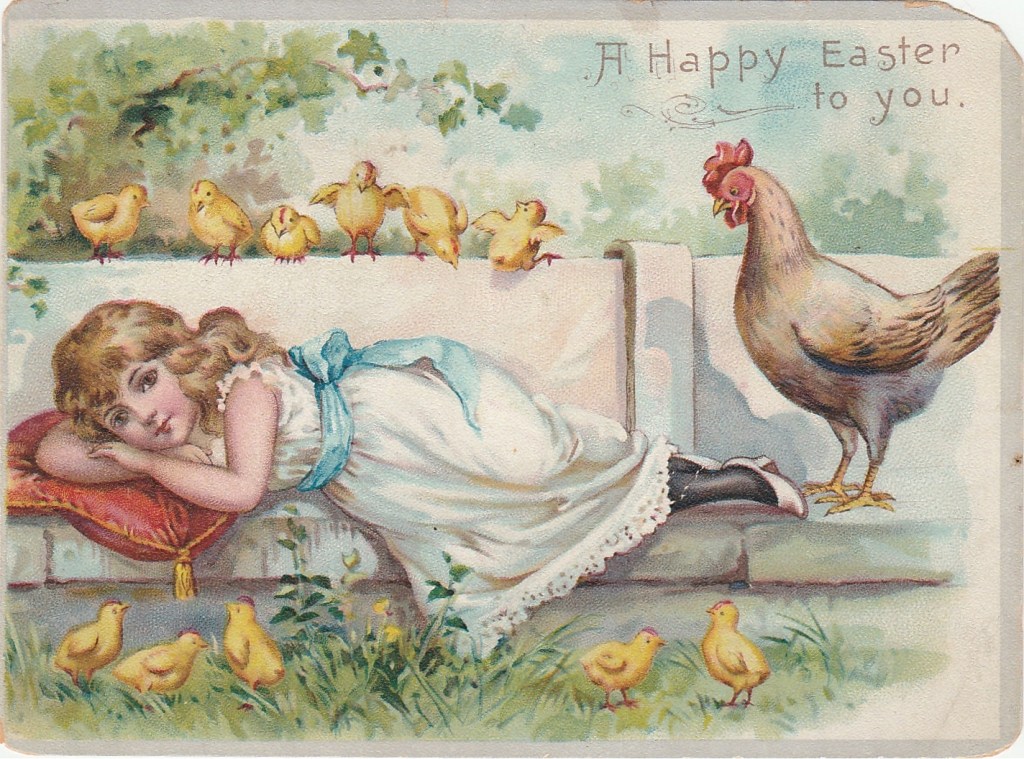
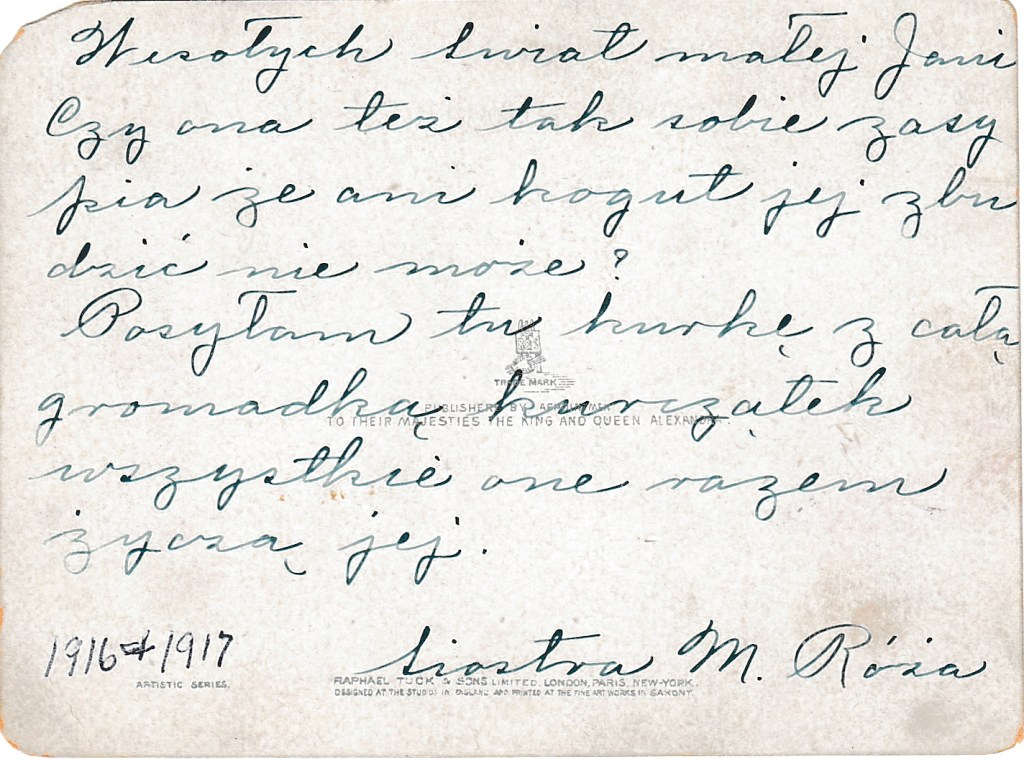
Finally, the third postcard with Easter greetings is shown in Figures 10a and b.

Figure 10a: Front of Easter postcard from Sr. Mary Rose Kantowska to her niece Joanna (“Jania”) Drajem.
Figure 10b: Reverse of Easter postcard from Sr. Mary Rose Kantowska to her niece Joanna (“Jania”) Drajem.

Postcard 3: A Happy Easter to you.

“Wesołych Świąt małej Jani
Czy ona też tak sobie zasypia że ani kogut jej zbudzić nie może?
Posyłam tu kurkę z całą gromadką kurczatek wszystkie one razem życzą jej.

Happy Easter for little Jania
Does she herself also so falls asleep that not even a rooster can her awaken?
Here I send a hen with her entire clutch, they all together wish her.

1916 – 1917 Siostra M. Róża”

It’s delightful to find such treasures among the documents preserved in Grandma Barth’s personal archives. Through her postcard poetry, written more than a century ago, a bit of Sister Rose’s personality, warmth and affection has been preserved for generations to come.

Sources:

1 Joan (Drajem) Barth, Kantowski/Drajem/Barth/Szczepankiewicz Family Photographs, circa 1880s–2008; privately held by Julie Szczepankiewcz, Hopkinton, Massachusetts, 2022.

2 Urząd Stanu Cywilnego Jabłówko (Jabłówko, Szubin, Kujawsko-Pomorskie, Poland), Akta urodzeń [birth records] 1874-1911, 1884, no. 69, Johanna Kandt; digital image, Genealogiawarchiwach (https://www.genealogiawarchiwach.pl/ : 30 April 2022), citing Archiwum Państwowe w Bydgoszczy, Sygnatura 6/1698/0/2.1/031, image 70 of 84.

Transcription:

Nr. 69. Hedwigshorst am 11 Oktober 1884. Vor dem untergezeichneten Standesbeamten erschien heute, der Persönlichkeit nach bekannt, der arbeiter Johann Kundt wohnhaft zu Klotildowo, katholischer Religion, und zeigte an, daß von der Marianna Kundt geb[orenen] Kończal, seiner Ehefrau katholischer Religion, wohnhaft bei ihm zu Klotildowo am sieben Oktober des Jahres tausend acht hundert achtzig und vier Nachmittags um sieben Uhr ein Kind weiblichen Geschlechts geboren worden sei, welches den Vornamen Johanna erhalten habe. Vorgelesen, genehmigt und unterschrieben Johann Kundt Der Standesbeamte ???

Translation:

No. 69. Hedwigshorst on 11 October 1884. Before the undersigned registrar appeared today the laborer Johann Kundt, personally known, resident in Klotildowo, of the Catholic religion, and reported that Marianna Kundt, née Kończal, his wife, of the Catholic religion, living with him in Klotildowo, gave birth on the seventh of October of the year one thousand eight hundred and eighty and four at seven o’clock p.m. to a child of the female sex, which was given the first name Johanna. Read out, approved and signed by Johann Kundt, The registrar ???

3 Roman Catholic Church, St. Stanislaus parish (Buffalo, Erie, New York, USA), Church records, 1873-1917, Baptisms 1874-1903, 1886, no. 556, Stanisława Maria Kantowska; digital image, FamilySearch (https://www.familysearch.org : 30 April 2022), Family History Library film no.1292864/DGS no. 7897436, image 441 of 2958.

4 Joan (Drajem) Barth, Kantowski/Drajem/Barth/Szczepankiewicz Family Photographs, circa 1880s–2008; privately held by Julie Szczepankiewcz, Hopkinton, Massachusetts, 2022.

51900 United States Federal Census, Erie County, New York, population schedule, Buffalo Ward 11, Enumeration District 0085, Sheet 39A, household no. 638, lines 1-7, Jan Kantowski household; digital image, Ancestry (https://www.ancestry.com : 30 April 2022), citing National Archives and Records Administration publication no. T623, 1854 rolls, no specific roll cited.

6 Buffalo Courier-Express (Buffalo, New York), 21 May 1968 (Tuesday), p 5, col. 5, obituary for Sister Mary Rose, FSSJ; digital image, Old Fulton New York Postcards (https://www.fultonhistory.com/Fulton.html : 30 April 2022), image “Buffalo NY Courier Express 1968 – 7798.pdf”.

7 Ibid.

8Joan (Drajem) Barth, Kantowski/Drajem/Barth/Szczepankiewicz Family Photographs, circa 1880s–2008; privately held by Julie Szczepankiewcz, Hopkinton, Massachusetts, 2022.

9 City Clerk, Buffalo, Erie County, New York, “Buffalo, NY, Death Index, 1915-1919,” Stanley Drajem, vol. 320, no. 1087, 1919; digital image, Internet Archive, (https://archive.org/details/Buffalo_NY_Death_Index_1915-1919 : 30 April 2022), image 266 of 1297.

© Julie Roberts Szczepankiewicz 2022
Manifest Mayhem! Identifying Józefa (Winnicka) Łukasik’s Place of Origin

One of the greatest challenges for genealogists who are attempting to make the leap from historical documents in the U.S., to historical documents in the Old Country (wherever that may be), is accurate identification of the immigrant’s place of origin. All too often, place names are badly butchered in source documents, which can be frustrating and perplexing for novice researchers. Recently, I found a passenger manifest that exemplified a classic place-name butchering, which I’d like to discuss today, along with some tips for identifying the correct, “unbutchered” place name.

Introducing Józefa (Winnicka) Łukasik

I’ve been researching a family of immigrants to North Tonawanda, New York, on behalf of a distant cousin and DNA match who lives in Poland. This cousin had a great-grandfather, Jan Łukasik, who came to the U.S. and lived here for a few years, along with his brothers, Andrzej and Franciszek. Jan Łukasik eventually returned to Poland, while Andrzej and Franciszek remained here, and my cousin was hoping to obtain a more complete picture of the history of this family in the U.S.

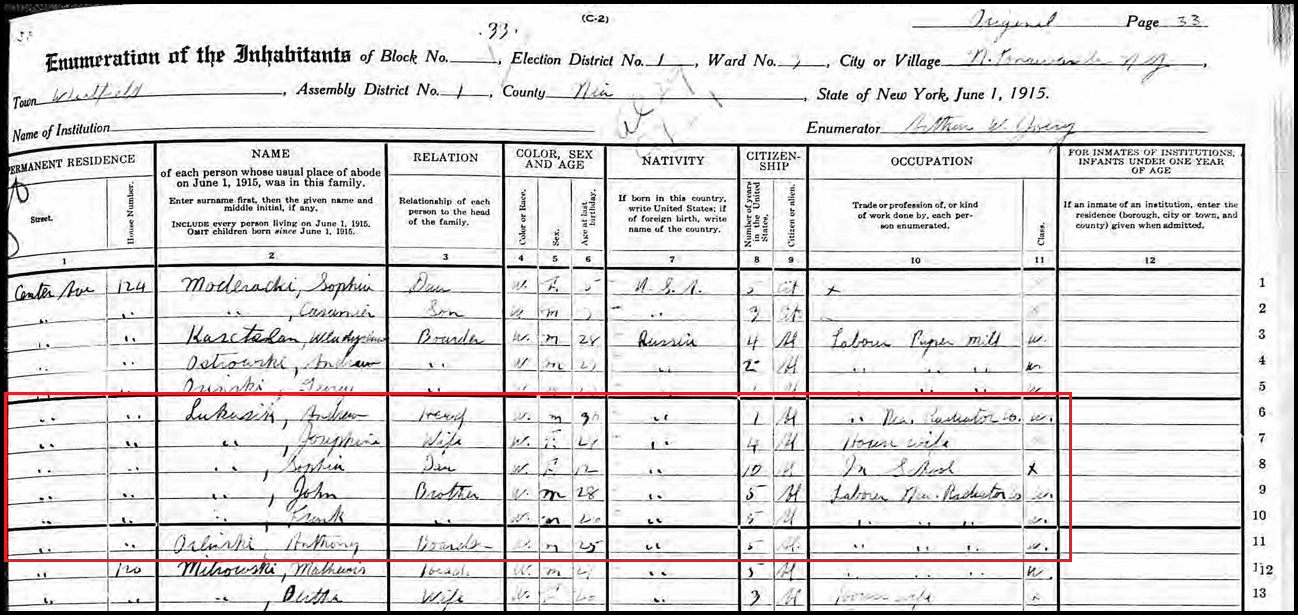
In 1915, all three of the Lukasik brothers were found to be living at 124 Center Avenue in North Tonawanda, as shown in Figure 1.1

Figure 1: Andrew Lukasik household in the 1915 New York State Census. Click image to enlarge.

Per the 1915 New York State census, the household included 30-year-old Andrew Lukasik, his 28-year-old wife, Josephine, and a 12-year-old daughter, Sophia, as well as two brothers—28-year-old John and 26-year-old Frank—and a boarder, Anthony Orlinski, age 25. All were recorded as having been born in Russia, but all arrived at different times. The length of U.S. residency reported for John, Frank and Anthony, 5 years, suggests an arrival circa 1910, while Andrew was reported as having arrived just a year earlier, circa 1914. Josephine was reported to have been living in the U.S. for four years, suggesting an arrival in 1911. Sophia is a bit of a mystery, in light of other evidence found for this family, but we’ll ignore that for now and focus on the primary research subjects, Andrew, Frank, and John Lukasik.

My Polish cousin informed me that the Łukasiks were from the parish of Młodzieszyn in Sochaczew County—information which was unsurprising to me, since I’ve found that many of the Polish immigrants who settled in North Tonawanda were from Sochaczew County, including two of my great-grandfathers, John Zazycki and Joseph Zielinski. In fact, thanks to chain migration, census records from “the Avenues” (North Tonawanda’s Polish enclave) read very much like a roll call of the families found in church books from Sochaczew County: Zieliński, Pałka, Kalisiak, Kalota, Szymański, Duplicki, Zażycki, Sikora, Orliński, Wieczorek, Pisarek, Koszelak, Rokicki, Włodarczyk, Adamczyk, Dąbrowski, Wilczek, and more. To be clear, I have not traced the origins of every Polish family in North Tonawanda with one of those surnames, and some of those names (e.g. Zieliński, Dąbrowski, Sikora) are so popular that the bearers might have originated anywhere in Poland. Nonetheless, I’d be willing to bet that many of the folks with those surnames who settled in North Tonawanda were originally from Sochaczew County.

So, when I discovered a record of marriage for Andrzej Lukasik and Josephine “Winicka” [sic] on 3 November 1914 in Buffalo, New York, my first thought was that Andrew married a girl from his hometown.2 I, too, have Winnicki ancestors from the parish of Młodzieszyn, and Winnicki is a popular surname in Sochaczew County. A quick way to test that hypothesis would be to find evidence for Józefa Winnicka’s place of origin from an online document such as her passenger manifest.

Finding the Manifest

Józefa Winnicka’s passenger manifest proved to be a tad elusive. From census and cemetery records, I knew that she was born between 1882 and 1887, and that she was from the Russian partition of Poland, consistent with the location of Sochaczew County.3 The 1915 and 1925 New York State censuses reported lengths of U.S. residency consistent with an arrival in 1911, and 1911 was also recorded as her year of arrival in the 1920 and 1930 U.S. censuses. I assumed that she would be traveling under her maiden name, Winnicka, since she did not marry Andrew Lukasik until 1914, and that her destination was probably Buffalo, where she married, rather than North Tonawanda. Nonetheless, there were no promising search hits. Not to worry, though; persistence usually wins the day, and there are a number of strategies that can be tried when an initial search fails to turn up the right passenger manifest, so I kept searching.

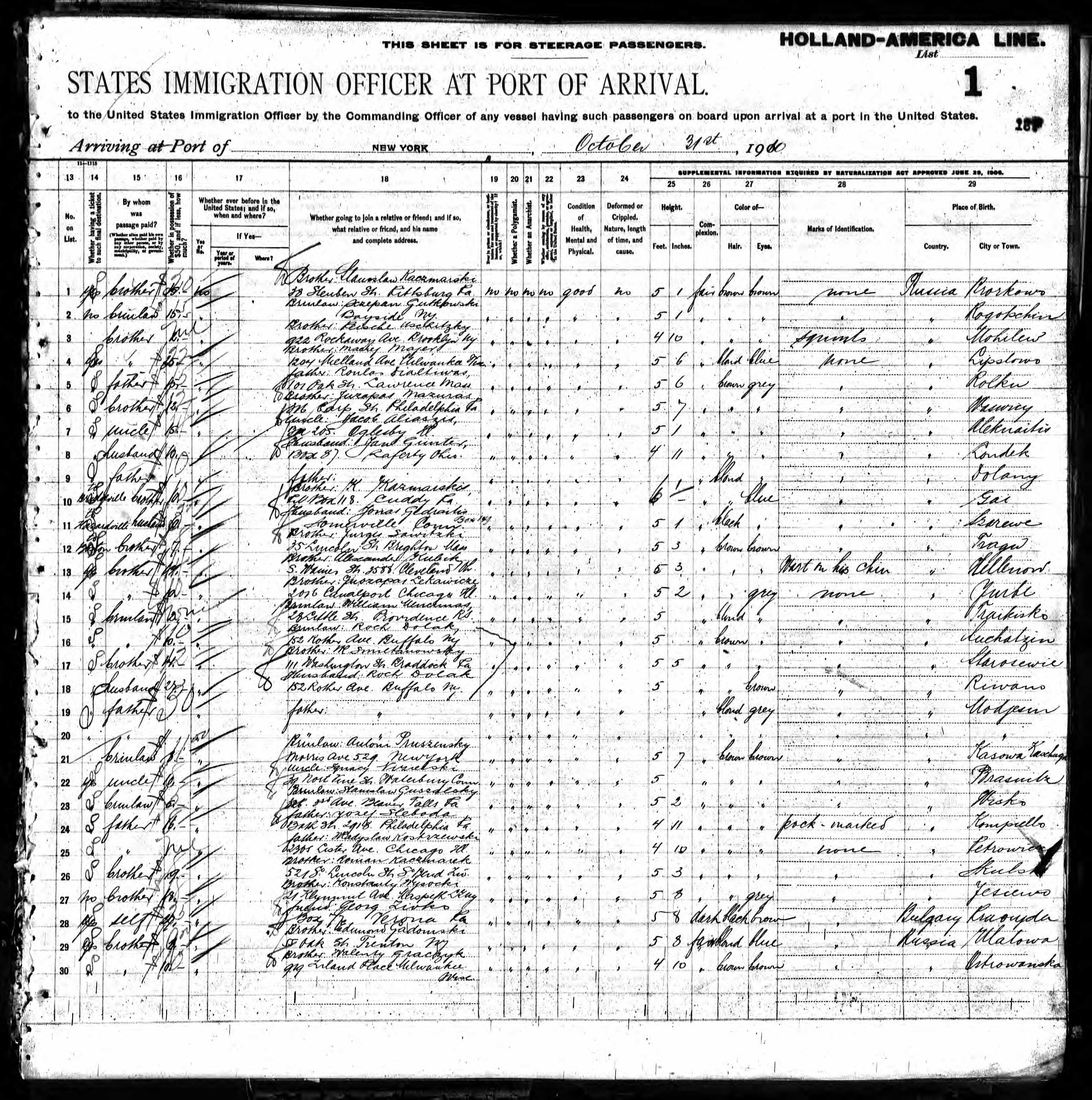
In this case, the use of wildcards ultimately proved to be effective. Ancestry had her indexed as “Jozefa Minnicka,” although she was clearly the right person. The two-page manifest is shown in Figures 2a and b.4

Figure 2a: First page of the passenger manifest from the SS Nieuw Amsterdam, showing Józefa Winnicka, traveling to Buffalo, New York, arriving in the port of New York on 31 October 1910. Click image to enlarge.
Figure 2b: Second page of the passenger manifest from the SS Nieuw Amsterdam, showing Józefa Winnicka, traveling to Buffalo, New York, arriving in the port of New York on 31 October 1910. Click image to enlarge.

Józefa Winnicka appears on line 16 of the manifest for the SS Nieuw Amsterdam, which departed from the port of Rotterdam on 22 October 1910, and arrived in New York on 31 October. She was identified as a single, female, farmhand, age 26, able to read and write. Her age suggests a birth circa 1884, and this date and her arrival date are both within the expected ballpark based on the accumulated body of evidence. She was an ethnic Pole and a Russian citizen, consistent with the fact that Poland was not an independent nation in 1910. (If that statement is confusing, here is a brief summary of Poland’s changing borders.) So far, so good.

Suchatzew, Suchatzin, Sawacew and Sawasew

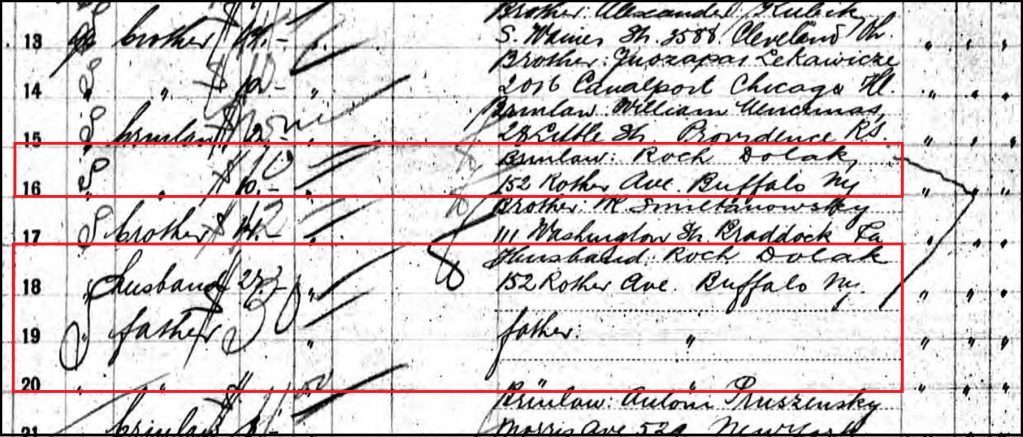
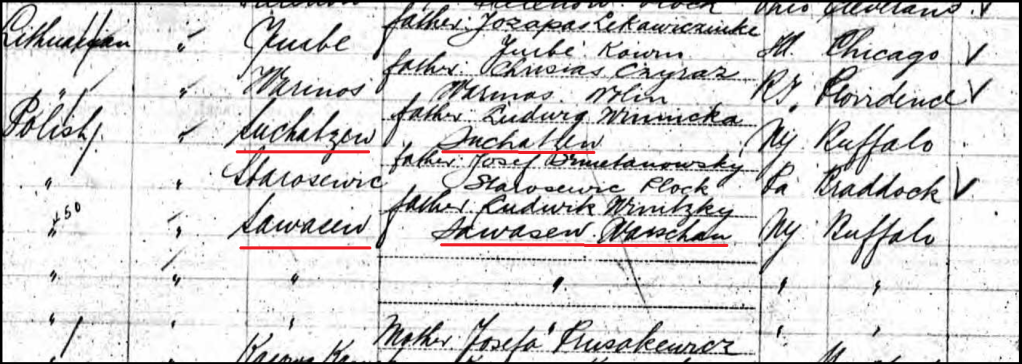
The smoking-gun evidence needed for Józefa’s place of origin was found in the next columns. Her last permanent residence was recorded as “Suchatzew, Russia.” Her nearest relative in the country from whence she came was her father, Ludwig Winnicka [sic] from “Suchatzew.” We’ll come back to that place name in a moment. Józefa was traveling to Buffalo, New York, and on the second page, the record further specified that Józefa’s contact in the U.S. was her brother-in-law, Roch Dolak, residing at 152 Rother Avenue in Buffalo. Following details regarding her physical and mental condition and her philosophical disposition, the final column identified her place of birth as “Suchatzin, Russia.”

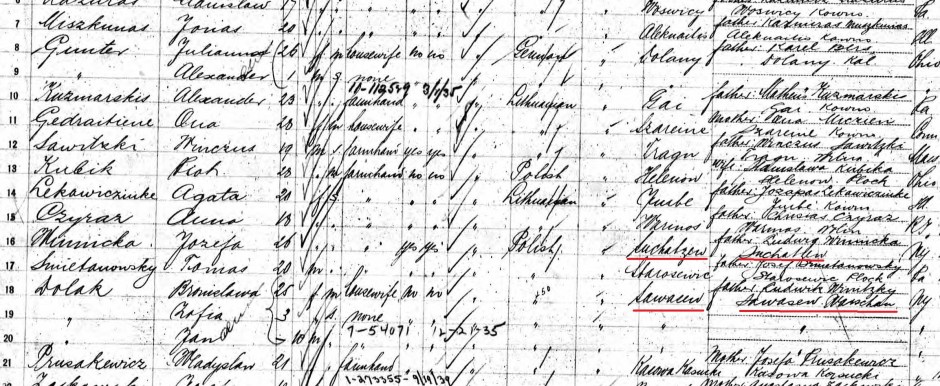
I was willing to bet that both of these spellings, “Suchatzew” and “Suchatzin,” were intended to refer to either the town of Sochaczew, or the county of Sochaczew, so I believed this was good evidence that my assumption was correct about Andrew Lukasik marrying a girl from his hometown. However, this manifest offered further confirmation of her place of origin, because Józefa was not traveling alone. Although it was not immediately obvious from the first page of the manifest, the second page of the manifest shows Józefa on line 16, bracketed together with three other passengers who were recorded on lines 18, 19, and 20 (Figure 3).

Figure 3: Detail from page 2 of the manifest from the SS Nieuw Amsterdam, showing Józefa Winnicka on line 16, bracketed together with a group of three other passengers from lines 18, 19 and 20.

The first page of that manifest identified these passengers as 25-year-old Bronisława Dolak and her children, 3-year-old Zofia, and 10-month-old Jan. Like Józefa, Bronisława named her father as her nearest relative in the Old Country, but this time his name was spelled “Ludwik Winitzky,” rather than “Ludwig Winnicka,” and his place of residence was spelled, “Sawasew, Warschau.” Similarly, Bronisława’s last place of residence was spelled, “Sawacew” (Figure 4).

Figure 4: Detail from page 1 of the manifest from the SS Nieuw Amsterdam, showing the last place of residence of Józefa Winnicka, “Suchatzew,” and her father’s place of residence, “Suchatzew.” Two lines below, her sister’s last place of residence was recorded as, “Sawacew,” and their father’s place of residence was recorded as “Sawasew, Warschau.”

Despite such wildly disparate spellings, it’s clear that “Sawacew” and Sawasew” must also refer to the town of Sochaczew or the county of Sochaczew, since Józefa and Bronisława had the same father, Ludwik Winnicki. At that time, Sochaczew was located in the Warsaw (Warschau, in German) gubernia, or province, which explains the reference to Warsaw in the entry on line 18. The use of such different spellings for both the place name and the father’s name, on the same manifest, nicely illustrates the importance of keeping an open mind when it comes to evaluating spellings found in historical documents.

The final column on the second page of the manifest is also enlightening (Figure 5).

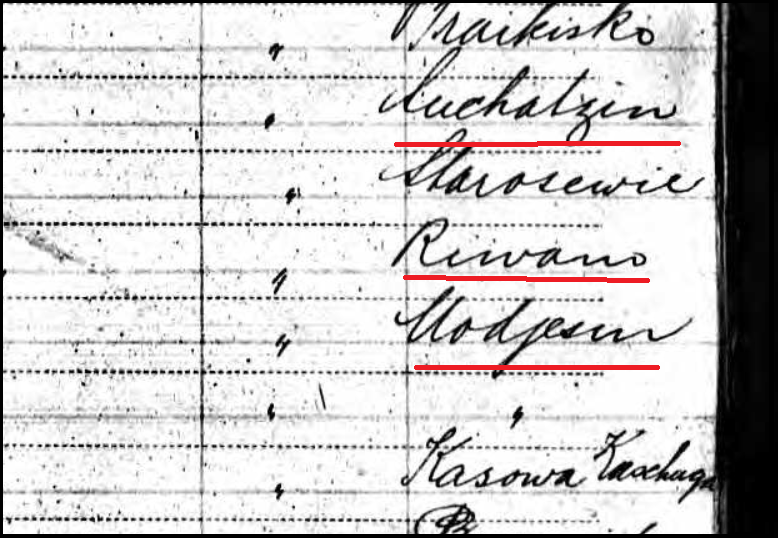
Figure 5: Final column on page 2 of the manifest from the SS Nieuw Amsterdam, showing the places of birth of Józefa Winnicka, Bronisława (Winnicka) Dolak, and Zofia and Jan Dolak.

While Józefa Winnicka was reported to have been born in “Suchatzin,” (or Suchatzew?), her sister Bronisława’s birthplace looks like “Riwano,” while both children were born in “Modjesin.” Although “Modjesin” is a rough phonetic match to the actual village of Młodzieszyn, it took me a minute to realize that “Riwano” must be referring to the village of Rybno, another village in Sochaczew County, located 11 km/7 miles from Młodzieszyn.

Confirming Place Identification Using Geneteka

Of course, all of these place-name identifications can only be considered as speculative, until evidence for the target immigrant is found in historical records from that location. In this case, confirmation can be found in indexed Polish vital records from the Geneteka database. A search in all indexed parishes in Mazowieckie province for birth records containing surnames Dolek and Winnicki predictably turned up the births of Zofia and Jan Dolak, in or near Młodzieszyn parish (Figure 6).

Figure 6: Geneteka search result for all indexed births in Mazowieckie province containing surnames Dolak and Winnicka. Click image for interactive search page.

Although it was stated on the manifest that both children were born in Młodzieszyn, Geneteka informs us that only Zofia was born in Młodzieszyn, while Jan was born in the nearby village of Ruszki, which belonged to the parish in Giżyce, where he was baptized. (Clicking the “skan” button reveals that Jan’s birth record was, in fact, number 39 for 1909, not number 38, so the middle entry in Figure 6 is an error in the database.)

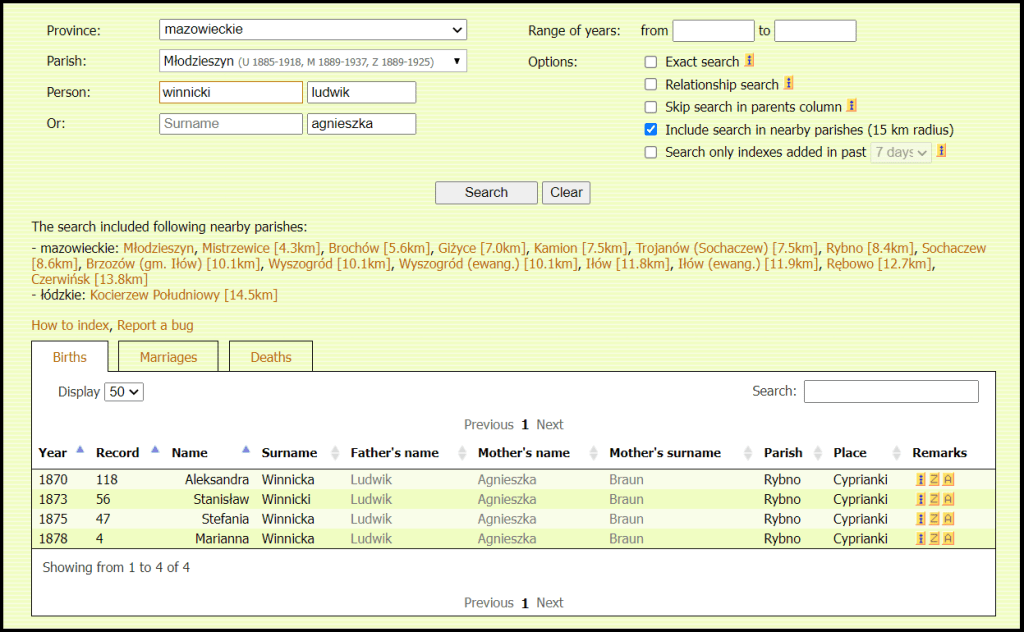
A public member tree online at Ancestry suggested that Józefa (Winnicka) Łukasik’s parents were “Ludwik Winicka” [sic] and “Agnieszka Bralun.”5 Although no source was cited for that information, I suspect it came from Josephine’s marriage record, or perhaps her death certificate, neither of which is available online. A search at Geneteka for records pertaining to Ludwik Winnicki and wife’s name Agnieszka (no maiden name specified) in indexed parishes within 15 km of Młodzieszyn, produced birth records for four children of Ludwiki Winnicki and Agnieszka Braun, all of whom were born in the village of Cyprianki and baptized in the parish of Rybno between 1870 and 1878 (Figure 7).

Figure 7: Geneteka search result for birth records mentioning Ludwik Winnick and Agnieszka (no maiden name specified) in indexed parishes within 15 km of Młodzieszyn. Click image for interactive search page.

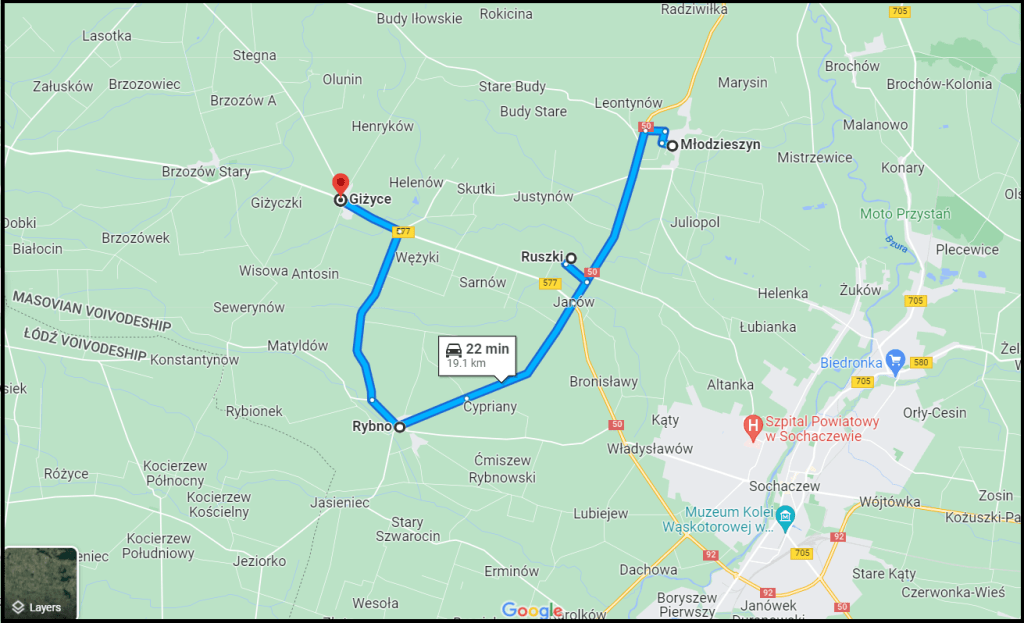
Although birth records for Józefa and Bronisława are not included in this search result, limiting the search to Rybno parish provides the explanation: there’s a gap in indexed birth records for Rybno from 1879 through 1887, which would encompass their births circa 1884 and 1885. All of these locations can be found on the map in Figure 8 except Cyprianki, which may be too small a place to be included in this Google Map, but which can be found on the map here, a little to the north of Cypriany, and about halfway between Cypriany and Rybno.

Figure 8: Map showing locations of Młodzieszyn, Ruszki, Rybno, and Giżyce, relative to the county seat, Sochaczew, to the southeast.

Tips for Deciphering Mangled Place Names

I had a bit of an unfair advantage when it came to deciphering Józefa Winnicka’s place of origin from the manifest, since I already had a hunch about where she was from. But what if that weren’t the case? How would a person know that Suchatzew and Sawasew were supposed to be Sochaczew? The following strategies might help:

  1. Obtain more than one piece of evidence for place of origin. Passenger manifests, naturalization records, church records, and draft registrations are all common sources for this information, but place of origin might be found on a variety of other documents. Don’t limit your search to the research target, but look at the big picture and consider all known relatives of that person who also immigrated.
  2. Don’t overlook the second page of a passenger manifest, in cases where one exists. It’s a common rookie mistake to think that a document is limited to only one page, since the search engines at Ancestry, FamilySearch, etc., link to only one image. However, some passenger manifests, WWII draft cards, passport applications, and most naturalization files, consist of multiple pages. Be sure to use the arrow keys to browse through the additional images that come before and after the linked image, to ensure that you’ve seen all there is to see. Had I not done this, I would not have found the references to Rybno and Młodzieszyn.
  3. Consider that immigrants may have approximated their place of origin to the county or province seat, rather than referring to the specific, small village. Although Józefa Winnicka claimed to have been born in Sochaczew, birth records for the parish of Sochaczew are indexed in Geneteka from 1849 through 1884 without gaps, yet her birth record is not there. It’s probable that she was, in fact, baptized in Rybno, like her siblings who appear in Figure 7, but that she mentioned the county seat instead, as a larger (and presumably more recognizable) place.
  4. Use a phonetic gazetteer to decode place names that were recorded phonetically by the clerk. There are two that I use regularly, the JewishGen Gazetteer and the Baza Miejscowości Kresowych (Eastern Borderlands Places). The scope of the former is quite broad, and it can be used to identify places located in Europe, North Africa, the Middle East, and Central Asia, while the latter is specific to places in the Kresy Wschodnie, or eastern borderlands region (places that were within the borders of Poland during the era of the Second Republic, but are now located in western Ukraine, western Belarus, and southeastern Lithuania). The JewishGen Gazetteer offers quite a few search options for Soundex and fuzzy searches, and a search for “Suchatzew” using Beider-Morse Phonetic Matching quickly zeroed in on the town and county of Sochaczew (Figure 9).
Figure 9: JewishGen Gazetteer search result for “Suchatzew” using Beider-Morse Phonetic Matching. Click image to enlarge.

Although Beider-Morse did the trick here, I tend to use the second search option, Daitch-Mokotoff Soundex, more frequently, because it gives me more search hits. However, some trial-and-error will likely be involved in the process either way. The resulting list of search hits can be whittled down through consultation with the map; for example, the first candidate in the list shown in Figure 8, Sukhachëva, turns out to be located in Russia’s Oryol Oblast, a good 650 miles from the eastern border of Poland today, and well outside of Poland’s borders at any point in history. If all the evidence points to Józefa (Winnicka) Łukasik’s birthplace being in Poland (albeit the Russian partition of Poland), Sukhachëva can be safely ruled out.

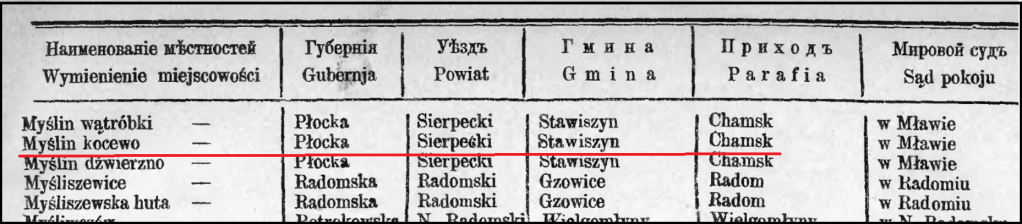
5. Use a period gazetteer to reconcile “conflicting evidence.” While Młodzieszyn and Sochaczew are unique place names in Poland, there are 26 places in Poland today called Rybno, according to Mapa.szukacz.pl. If one were researching Bronisława Dolak and came across a reference to Rybno on one document, but to Sochaczew on another, a quick check in a gazetteer can shed some light on the confusion and aid in identifying the correct Rybno (Figure 10).6 An annotated list of useful gazetteers for Polish genealogy can be found here.

Figure 10: Entries for Rybno found in the Skorowidz Królestwa Polskiego (Index of the Kingdom of Poland).

6. Use Geneteka (or another indexed vital records database) to quickly test hypotheses about an immigrant’s place of origin. This may not work every time, but Geneteka is such a substantial database, that you stand a good chance of finding some trace of your family there, even if your target immigrant is not included. In this case, Józefa (Winnicka) Łukasik was not found in Geneteka, but evidence for her parents and for her sister’s family was sufficient to confirm accurate identification of several parishes which can be searched for records pertaining to the Winnicki family.

Deciphering place names on historical records can be pretty challenging at times, and manifests like this one for Józefa Winnicka may leave you wondering whether to laugh or to cry at the awful misspellings. However, the right tools and strategies, combined with some patience and persistence, will usually win the day. Happy researching!

Sources:

1 1915 New York State Census, Niagara County population schedule, North Tonawanda Ward 03, Assembly District 01, Enumeration District 01, p 33, lines 6-11, Andrew Lukasik household; digital image, Ancestry (https://www.ancestry.com/ : 22 April 2022).

2 “New York State, Marriage Index, 1881-1967,” database with images, Ancestry (https://search.ancestry.com/ : 22 April 2022), Andrzej Lukasik and Jozefa Winicka, 3 November 1914, Buffalo, New York, certificate no. 35186.

3 1920 U.S. Federal Census, Niagara County population schedule, North Tonawanda Ward 03, Enumeration District 38, Sheet 4B, house no. 72, family no. 63, Andrew Lukasik household; digital image, Ancestry (https://www.ancestry.com : 21 March 2022), citing NARA microfilm publication T625, roll 1240 of 2076 rolls; and

1925 census of New York State, Niagara County population schedule, 3rd Ward North Tonawanda, Election District 01, Assembly District 01, p 43, Andrew Lukasik household; digital image, Ancestry (https://www.ancestry.com : 22 April 2022); and

1930 U.S Federal Census, Niagara County population schedule, 3rd Ward North Tonawanda, Enumeration District 32-87, Sheet 25B, house no. 26, family no. 539, Andy Lukassik household; digital image, Ancestry (https://www.ancestry.com/ : 22 April 2022), citing National Archives and Records Administration publication T626, 2,667 rolls, Family History Library microfilm 2341353; and

1940 U.S. Federal census, Niagara County, New York, population schedule, North Tonawanda Ward 3, Enumeration District 32-130, Sheet 8B, house no. 26, visitation no. 135, Andrew and Chester Lukasik households; digital image, Ancestry (https://www.ancestry.com/ : 22 April 2022), citing National Archives and Records Administration microfilm publication T627, roll 2,698 of 4,643 rolls; and

Find a Grave, database and images (https://www.findagrave.com/memorial/228947128/jozefa-lukasik : accessed 22 March 2022), memorial page for Jozefa “Josephine” Winnicka Lukasik (1884–13 Aug 1968), Find a Grave Memorial ID 228947128, citing Mount Olivet Cemetery, Kenmore, Erie County, New York, USA ; Maintained by Bonnie O’Brien (contributor 50514324).

4 Manifest, SS Nieuw Amsterdam, arriving 31 October 1910, p 167, lines 16, 18, 19 and 20, Jozefa Winnicka [indexed as Minnicka] and Dolak family; imaged as “New York, U.S., Arriving Passenger and Crew Lists (including Castle Garden and Ellis Island), 1820-1957,” database with images, Ancestry (https://search.ancestry.com : 21 April 2022); citing Records of the U.S. Customs Service, Record Group 36, National Archives at Washington, D.C. Passenger and Crew Lists of Vessels Arriving at New York, New York, 1897-1957, Microfilm Publication T715, 8892 rolls, NAI: 300346, no specific roll cited.

5 Ancestry user “GiacomoKennedy,” public member tree, “Imogene Pasel – October 10, 2018,” Ancestry Public Member Trees database, Ancestry (https://www.ancestry.com/ : 21 April 2022).

6 I. Zinberg, Skorowidz Królestwa Polskiego czyli Spis alfabetyczny miast, wsi, folwarków, kolonii i wszystkich nomenklatur w guberniach Królestwa Polskiego, z wykazaniem: gubernii, powiatu, gminy, parafii, sądu pokoju lub gminnego, oraz najbliższej stacyi pocztowej, wraz z oddzielnym spisem gmin podług najświeższej ich liczby i nazwy ułożony, wykazujący: odległość każdej danej gminy od miasta powiatowego i sądu swojego gminnego; czy i jakie znajdują się w gminie zakłady fabryczne lub przemysłowe, szkoły itp. oraz ludność każdej gminy, obejmujący także podział sądownictwa krajowego świeżo urządzonego, Tom 2 (Warsaw: W. Drukarni, I.J. Ałapina 1877), pp 125-126, “Rybno,” digital images, Śląska Biblioteka Cyfrowa (https://www.sbc.org.pl/ : 24 April 2022).

© Julie Roberts Szczepankiewicz 2022

Kroczewo Revisited

It’s the dawn of a new day (metaphorically, if not literally), and I’m happy to report that Kroczewo’s been found! After last night’s post about the elusive village of Kroczewo, several people wrote to me, proposing candidates for its location. Two of those people were William F. “Fred” Hoffman, and Kasia Dane, and both of them nailed it.

I’ve mentioned both Fred and Kasia in this blog previously. Fred is the author, editor, translator, and publisher whose books include the best genealogical translation guides for Polish, Russian, German, and Latin that I’ve found: the In Their Words series, co-authored with Jonathan Shea, which you can read about on their website. He’s also the editor of Rodziny (the journal of the Polish Genealogical Society of America), and the free monthly e-zine Gen Dobry!, in addition to his other scholarly and professional activities. Kasia is an experienced researcher who published an index of Polish immigrants found in the 1920 census in Buffalo, New York, back in the 1990s, before indexes to U.S. census records were readily available online. In those days, I was trying to kick-start my family history research in between changing diapers, and her indexes were invaluable to me. She continued her efforts with an online index to church records from St. Stanislaus parish in Buffalo, the mother church of Buffalo Polonia. I’ve had the pleasure of meeting both Kasia and Fred, and the resources which they used to answer the Kroczewo question will be part of my arsenal going forward. I thought those resources were well worth sharing here, and they both gave me permission to quote them. So without further ado, we’ll start with Fred’s comments:

“Hi, Julie,
I found your latest blog entry very interesting. It made me wonder if any of my sources would tell us something about the mysterious Kroczewo.

I checked one of the best sources around, Nazwy miejscowe Polski or NMP, an ongoing multi-volume publication on names of places in Poland. The volume we need, No. V, can be downloaded here:
https://rcin.org.pl/dlibra/publication/15561/edition/2982

On page 318, attached, it lists Kroczewo, and the first entry is for “Kroczewo (1), a village no longer existing, was located in Raciąż gmina, Ciechanów province, 1 km. west of Raciąż.” It shows various forms of the names seen in documents over the years, then discusses the derivation of the name, saying it comes from the basic root seen in the verb kroczyć, “to step, to walk in rather large steps, formally.”

That may be helpful in that now we know this village no longer exists, so finding it on recent maps will be difficult. But it lay just 1 km. west of Raciąż. That has to be some help. Then I took a look at this map:
http://maps.mapywig.org/m/WIG_maps/series/100K/P37_S30_RACIAZ_1935_nnqsZct_BN_Sygn.ZZK_S-101_A.jpg

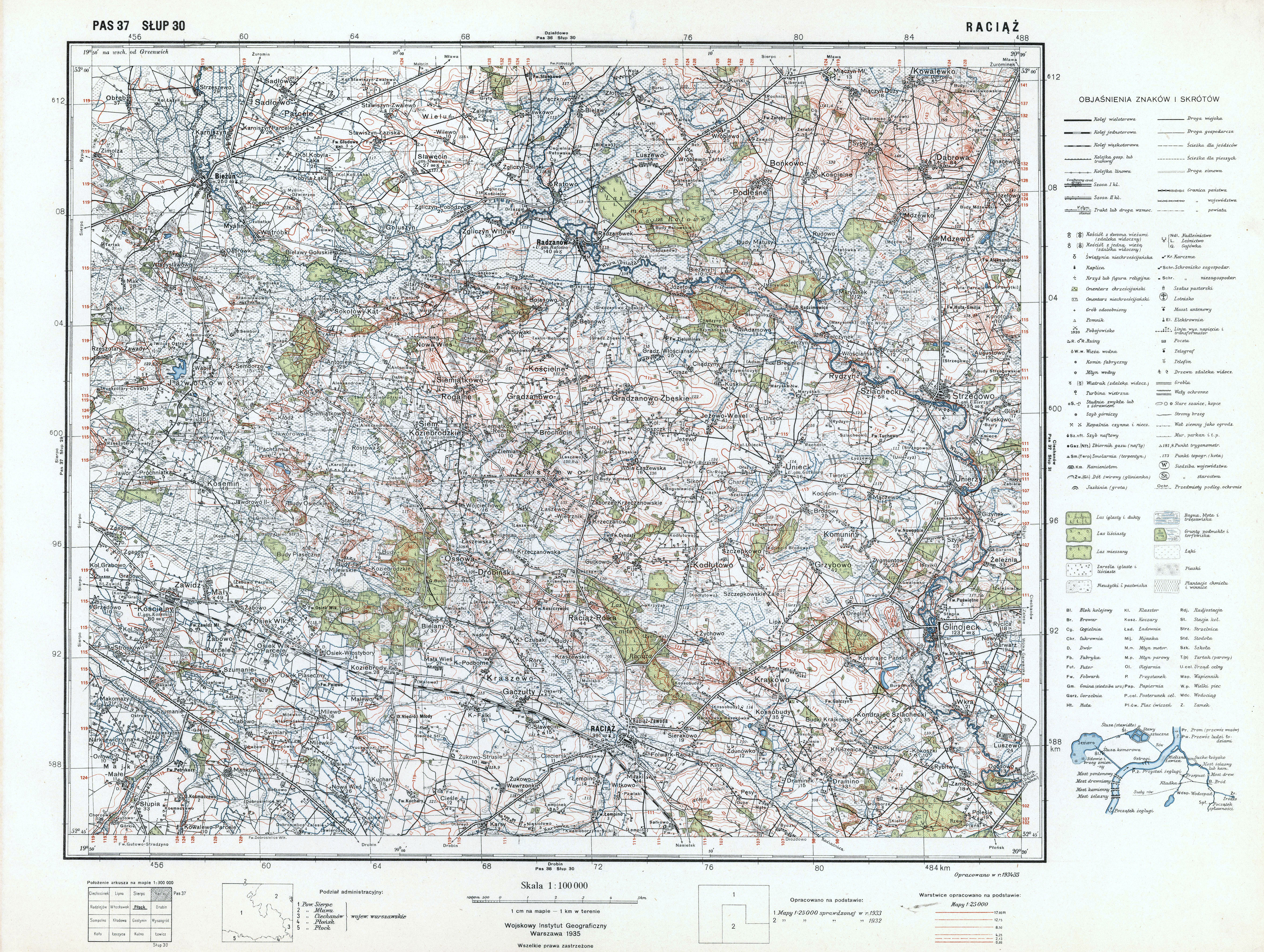
I’m attaching a detail of the map, and I circled a place named Kruczewo very near Raciąż. It is not too unusual to see -o- and -u- vary in Polish names — and I notice NMP does not have an entry for Kruczewo. Maybe?

I also think you’re right that ф. on the Russian map is probably short for Фольварокъ = Polish folwark.

I haven’t given you the answer, but I hope I’ve given you a little more to work with. Good luck!

Fred”

Figure 1 shows the page Fred mentioned from the Nazwy miejscowe Polski with the specified entry boxed in red.1

Figure 1: Entry for Kroczewo from the book, Nazwy miejscowe Polski : historia, pochodzen, ie, zmiany. [T.] 5, Ko-Ky [Polish Place Names: History, Origins, and Changes, Vol. 5, Ko-Ky].

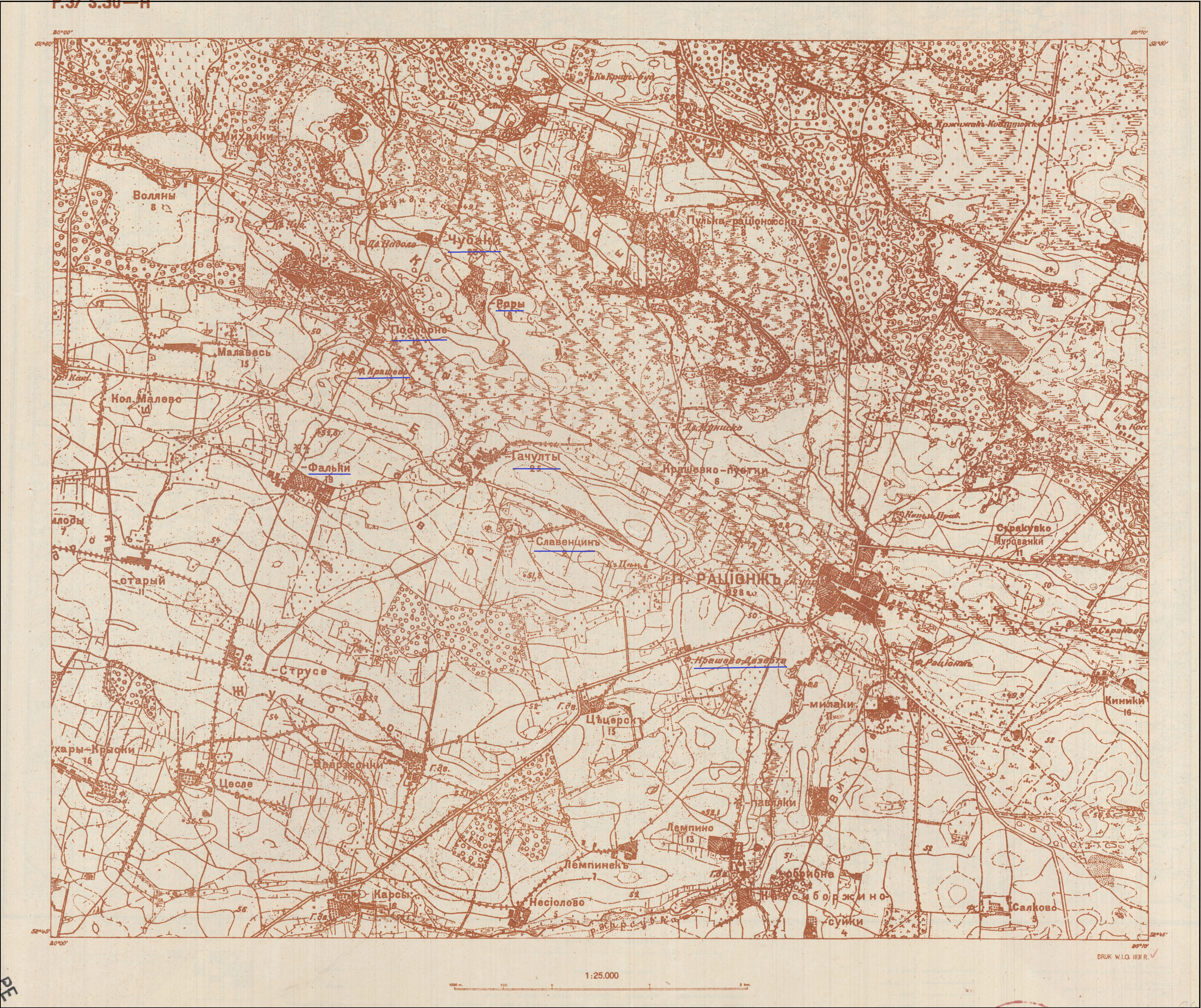
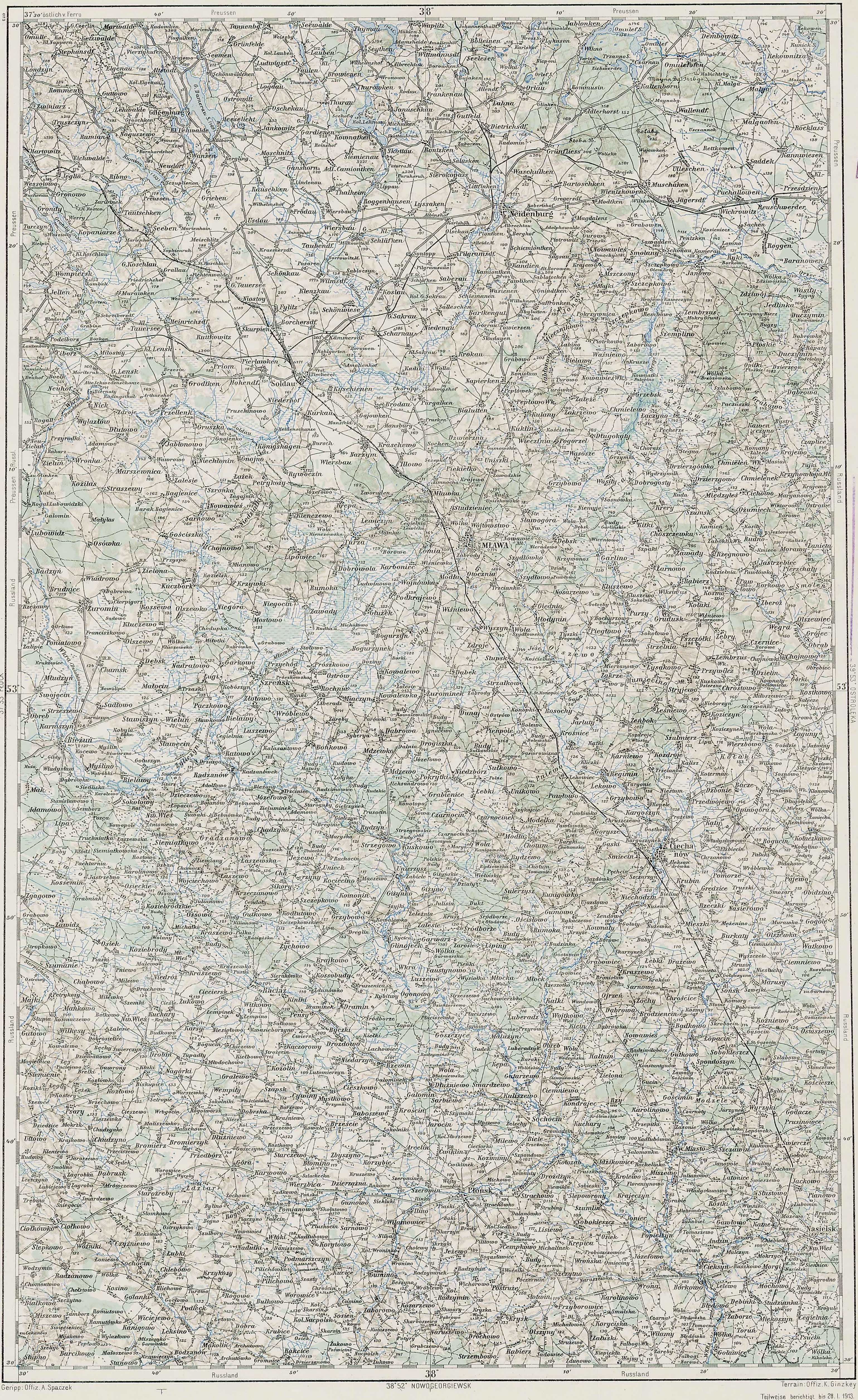

The map which Fred mentioned is a 1:100,000-scale map of Raciąż from 1935, which can be accessed from the index here, while previously, I had consulted the 1931 map of Raciąż at 1:25,000 scale, which can be accessed from the index here. The map he sent is shown in Figure 2.2

Figure 2: Map showing location of Kruczewo, 1 km west of Raciąż.

In hindsight, I think I was too focused on finding a map with a small scale (i.e. one that shows a smaller area in greater detail), or a map that was more contemporary to Antoni Nowicki’s birth in 1844. Ultimately, although Fred and I both used maps from the same source, the Wojskowy Instytut Geograficzny (the Polish Military Geographical Institute), the 1:100,000 scale map from 1935 that Fred selected was sufficient to answer the question, while the 1:25,000 scale map from 1931 did not. Go figure.

Meanwhile, Kasia Dane approached the problem with a search in Google Books. She wrote,

“Julie, I read your latest and found this in Google Books: “KROCZEWSCY rzadko KROCZOWSCY h GRABIE z Kroczewa w ziemi zakroczymskiej Jest Kroczewo i pod Raciążem na którym również pewnie ciż sami Kroczewscy dziedziczyli.” It’s not much to go on but could it help a little? It is from Herbarz polski Wiadomosći historyczno-genealogiczne o rodach szlacheckich, Volume 12, by Adam Boniecki (1908).

Also, http://www.slownik.ihpan.edu.pl/search.php?id=13637 which puts it at 1 km w[est] of Raciąż?”

The book she referenced, Herbarz polski: Wiadomosći historyczno-genealogiczne o rodach szlacheckich (Polish Heraldry: Historical and Genealogical Information about Noble Families), mentions Kroczewo in the context of a place of origin for minor nobles of the Kroczewski family, who were apparently owners of the village of Kroczewo near Raciąż.3 The second site she mentioned is one with which I was completely unfamiliar, entitled, Słownik historyczno-geograficzny ziem polskich w średniowieczu, (Historical and Geographical Dictionary of Polish Lands in the Middle Ages). As the introduction explains, the site is the result of efforts dating back to the 1920s, to create a historical and geographical dictionary of Poland that would be the modern successor to the Słownik geograficzny Królestwa Polskiego i innych krajów słowiańskich. The ambitious project lasted for decades, and came to include an overwhelming amount of material. Some of the volumes were published by the Instytut Historii Polskiej Akademii Nauk (Institute of History of the Polish Academy of Sciences), while other volumes that were planned were never realized. Ultimately, all the volumes that were published will be made available online, after a two-year moratorium to protect the interests of the publishers.

The online Słownik historyczno-geograficzny can easily be searched for place names, although the entries themselves contain numerous abbreviations, making them a bit formidable to translate. Figure 3 shows the entry for Kroczewo, with the location underlined in red.4 Historical detail aside, it doesn’t take much translating to understand that it was 1 km from Raciąż, in line with the place identified on Fred’s map in Figure 2.

Figure 3: Entry for Kroczewo in the Słownik historyczno-geograficzny ziem polskich w średniowieczu.

As I think about this, it’s somewhat amazing to me that I found that birth record after all. Antoni Nowicki’s marriage record mentioned Kroczewo as his place of birth, and Kroczewo it was, all along. My strategy for locating the place based on finding a place that was similar phonetically was fundamentally flawed, and it was a stroke of luck that brought me to the correct parish, Raciąż.

Wow.

Had the right Kroczewo not been phonetically similar to the name of a village belonging to the parish in Raciąż, I might be looking still!

Putting a more positive spin on this, genealogical discovery is definitely a process, and no one hits a home run every time they’re at bat. Usually, when I hit a road block, I move on and come back to the question at a later date. Had I done this with the Kroczewo problem, hacking away at it with fresh eyes and renewed enthusiasm at some point in the future, I might have eventually stumbled upon the answer on my own. However, through blogging I leveraged the social network in the same way that genealogy message boards and Facebook groups do, and I’m a big fan of using those methods to find information related to the ancestral hunt. Thanks to Fred and Kasia, I’m getting by with a little help from my friends, once again.

© Julie Roberts Szczepankiewicz 2022
Sources:

1 Kazimierz Rymut, editor, Nazwy miejscowe Polski : historia, pochodzen, ie, zmiany. [T.] 5, Ko-Ky [Polish Place Names: History, Origins, and Changes, Vol. 5, Ko-Ky], (Kraków, Poland: Wydawnictwo Instytutu Języka Polskiego PAN, 2003), p. 320; digital image, Repozytorium Cyfrowe Instytutów Naukowych (https://rcin.org.pl/dlibra/ : 29 March 2022), image 318 of 537.

2 Wojskowy Instytut Geograficzny, 4206 @ WIG – Mapa Taktyczna Polski 1:100 000 /1924 – 1939/, [Tactical Map of Poland], “P37_S30_RACIAZ_1935_300dpi_bcuj298338-288240.jpg;” digital image, Archiwum Map Wojskowego Instytutu Geograficznego 1919–1939 (http://mapywig.org/ : 29 March 2022).

3 Adam Boniecki, Herbarz polski: Wiadomosći historyczno-genealogiczne o rodach szlacheckich (Polish Heraldry: Historical and Genealogical Information about Noble Families), Vol. 12 (Warsaw, Poland: Gebethner i Wolff, 1908), p. 257; e-book, Google Books (https://www.google.com/books/ : 29 March 2022), image 299 of 424.

4 Tomasz Jurek, editor, Słownik historyczno-geograficzny ziem polskich w średniowieczu (Historical and Geographical Dictionary of Polish Lands in the Middle Ages), electronic edition, Instytut Historii Polskiej Akademii Nauk (http://www.slownik.ihpan.edu.pl/index.php : 29 March 2022), “Kroczewo,” citing “Płock,” p. 152.

Still Searching for Kroczewo

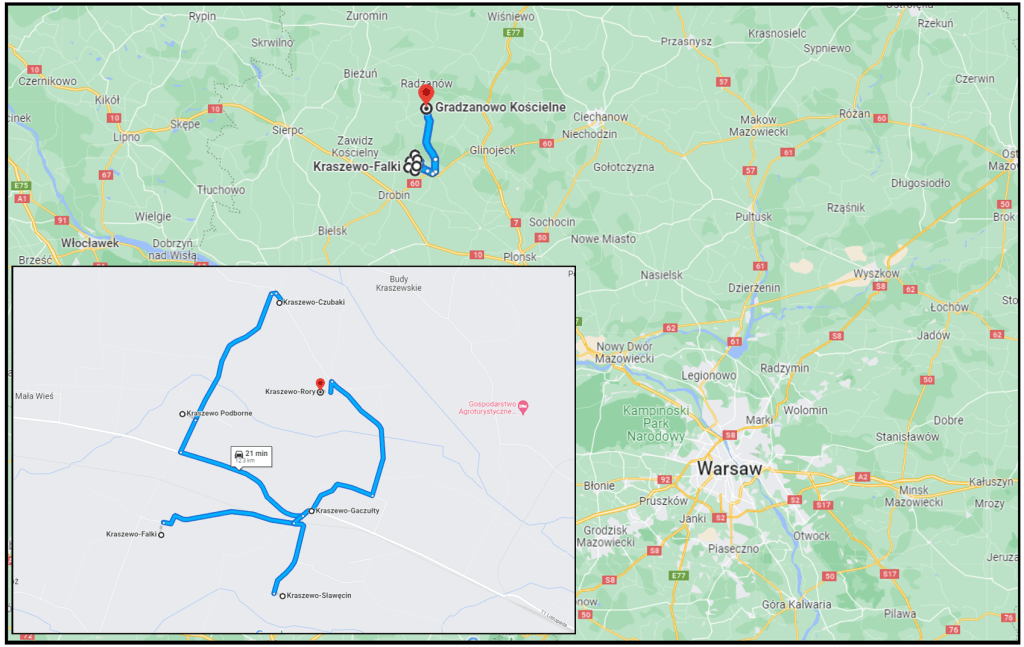
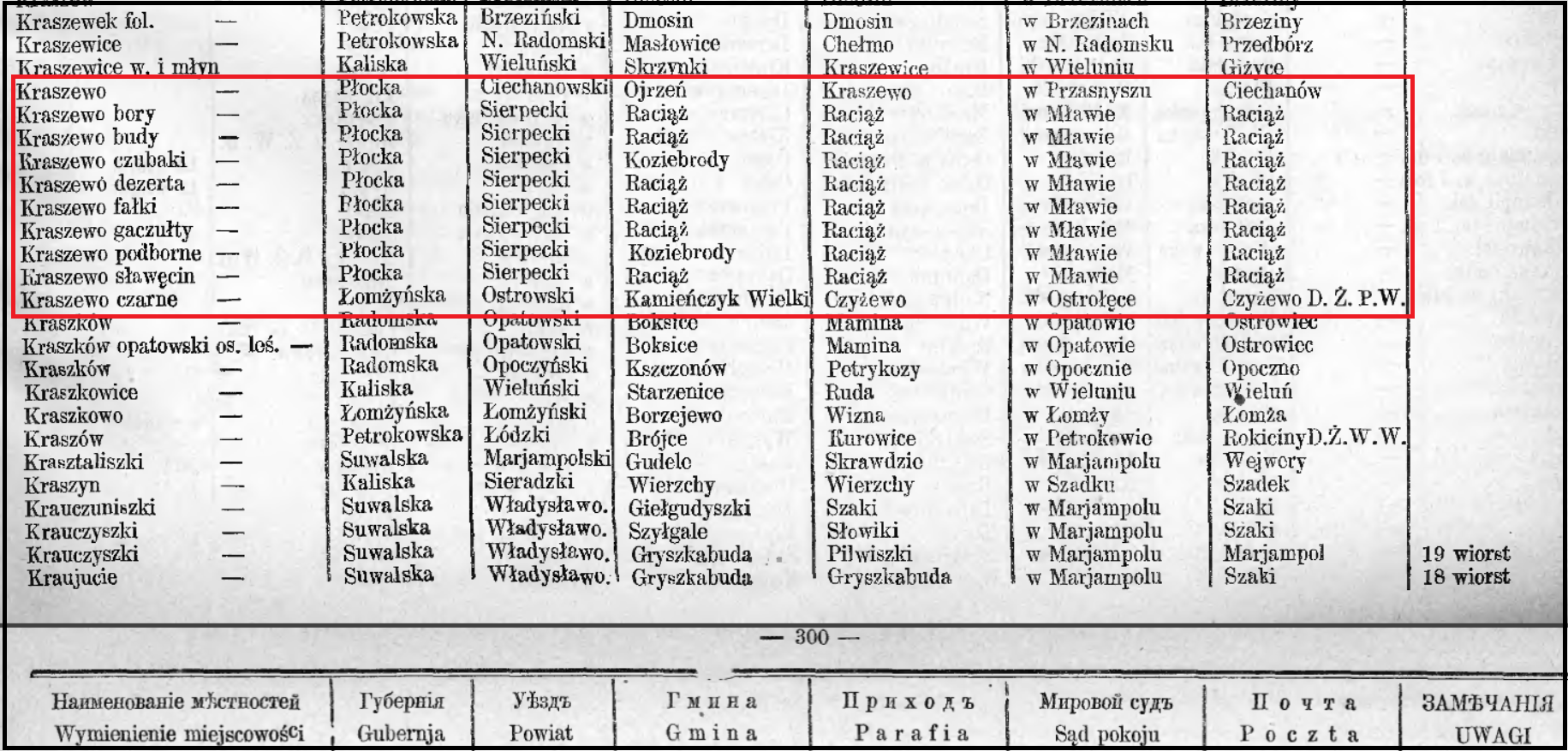
Last week, I wrote about my attempts to nail down a place of birth for my husband’s great-great-great-grandfather, Antoni Nowicki, whose marriage record from Gradzanowo Kościelne stated that he was born in the village of Kroczewo. There’s only one village in Poland today called Kroczewo, but Antoni Nowicki was definitely not born there. So, I identified a couple alternative locations that were phonetically similar to Kroczewo, including a constellation of villages whose names start with Kraszewo (Figure 1).

Figure 1: Map showing locations of Gradzanowo Kościelne with inset showing locations of Kraszewo-Czubaki, Kraszewo Podborne, Kraszewo-Rory, Kraszewo-Fałki, Kraszewo Sławęcin, and Kraszewo-Gaczułty. Click image for interactive Google Map.

All of these “Kraszewos” belong to the parish in Raciąż, and although birth records from the time of Antoni’s birth are digitized at FamilySearch, access is restricted, so I figured the research would have to wait until my next opportunity to visit my local Family History Center (FHC).

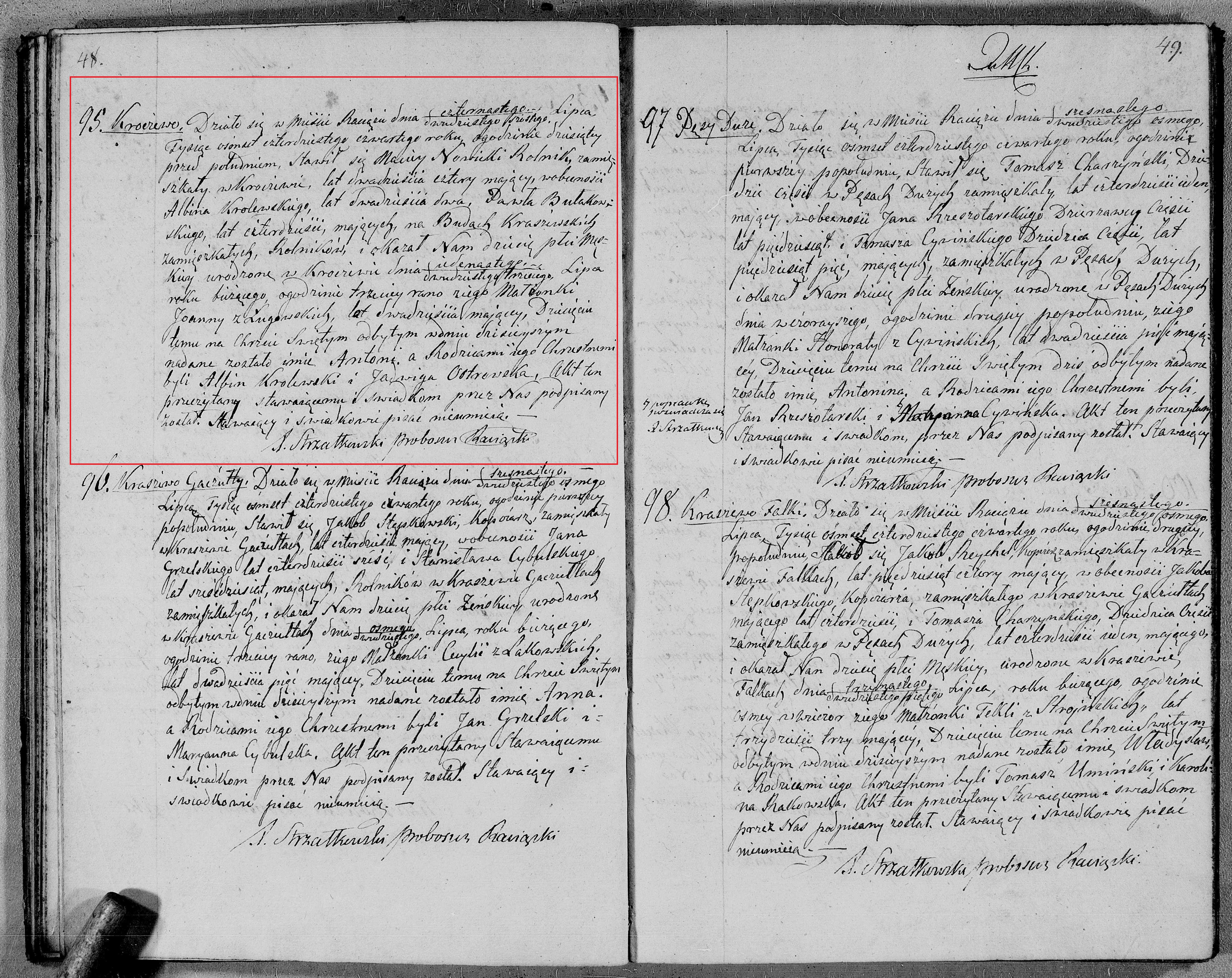
After writing that post, I took a look at my calendar, and realized that it might be a while before I had a chance to make it to the FHC. So, I opted for a quick remote research request from the Family History Library, in the hopes that they could at least give me a “yes” or “no” about whether Antoni Nowicki was baptized in Raciąż. This past Wednesday, that answer turned out to be “yes,” and they replied with a copy of Antoni’s birth record (Figure 2).1

Figure 2: Birth record from Raciąż parish for Antoni Nowicki, born 23 July 1844. Click image to enlarge.

The record is in Polish, and is transcribed as follows:

“95. Kroczewo.

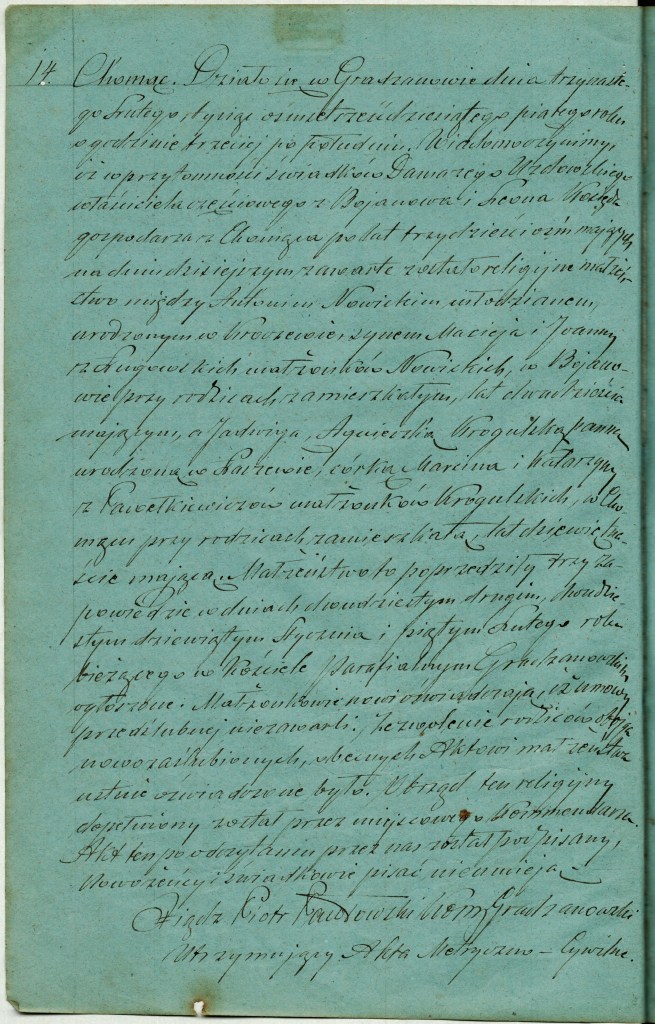
Działo się w mieście Raciążu dnia czternastego/dwudziestego szóstego Lipca, Tysiąc ośmset czterdziestego czwartego roku o godzinie dziesiątej przed południem. Stawił się Maciej Nowicki, Rolnik, zamieszkały w Kroczewie, lat dwadzieścia cztery mający, w obecności Albina Krolewskiego, lat dwadzieścia dwa, Pawła Bułakowskiego, lat czterdzieści mających, na Budach Kraszewskich zamieszkałych, rolników, i okazał Nam dziecię płci męskiej urodzone w Kroczewie dnia siedemnastego/dwudziestego trzeciego Lipca roku bieżącego o godzinie trzeciej rano z jego małżonki Joanny z Ługowskich, lat dwadzieścia mającej. Dziecięciu temu na Chrzcie Świętym odbytym w dniu dzisiejszym nadane zostało imię Antoni, a rodzicami jego Chrzestnymi byli Albin Królewski i Jadwiga Ostrowska (?). Akt ten przeczytany stawającemu i świadkom przez Nas podpisany został. Stawający i świadkowie pisać nie umieją. [Signed] X. Strzałkowski, proboszcz Raciążki”

In English, this translates as,

“95. Kroczewo.

This happened in the town of Raciąż on the fourteenth/twenty-sixth day of July, in the year one thousand eight hundred and forty-four, at ten o’clock in the morning. Maciej Nowicki appeared, a farmer, residing in Kroczewo, having twenty-four years of age, in the presence of Albin Krolewski, aged twenty-two, Pawel Bułakowski, aged forty, residents in Budy Kraszewskie, farmers, and presented to us a male child born in Kroczewo on the seventeenth/twenty-third day of July of the current year at three o’clock in the morning from his spouse Joanna, née Ługowska, aged twenty. At Holy Baptism, performed today, the child was given the name Antoni, and his godparents were Albin Królewski and Jadwiga Ostrowska (?). This document was read to the declarant and to the witnesses and was signed by Us. The declarant and the witnesses are unable to write. [Signed] Fr. Strzałkowski, pastor of Raciąż.”

This document adds to the growing body of evidence for the Nowicki family by providing a precise birth date for Antoni, who was born 23 July 1844. His parents’ ages suggest birth years circa 1820 for Maciej, and 1824 for Joanna, which makes Joanna a bit older, potentially, than what was supposed previously. Only one other document has thus far been discovered which offers evidence for her year of birth, and that document—the birth record for her son, Franciszek— suggested that she was born circa 1826. Most importantly, this document resolves the practical question of where to look for additional records for this family: Raciąż.

What it does not resolve is the question about where Antoni’s birthplace was located. He was definitely born in Kroczewo; the spelling is identical to the spelling of his birthplace as it was recorded in his marriage record, apart from the fact that this priest had an interesting habit of using the Polish ż in words where a z is typically used, e.g. cżternastego. So although Antoni’s place of birth was recorded as Krocżewo, I think we can safely interpret that as a simple Kroczewo. But where the heck was it? Other records on that same page refer to Kraszewo Gaczułty and Kraszewo Falki, yet the priest distinguished this place name from those in his spelling, which suggests that this was not merely another name for one of the assorted Kraszewos identified thus far. The Słownik Geograficzne Królestwa Polskiego i innych krajów słowiańskich, which typically mentions alternate spellings for place names when they were known to exist, does not mention any places called Kroczewo other than the one in Płońsk County, which is the wrong Kroczewo (not the one in Raciąż parish). Neither do the entries for the assorted Kraszewo villages mention any alternate spellings that might identify the precise location of “Kroczewo.”

It might be possible to locate a map which includes Kroczewo, assuming a map could be found for the correct time period, and at a sufficient scale to include very small villages. This 1:200,000-scale map from 1913 shows Kraszewo, and “Kraszewo Budy,” which appears to be the village known as Budy Kraszewskie today, given its position relative to “Pulka-Raciążska” which is Pólka-Raciąż today, but no Kroczewo (Figure 3).2

Figure 3: Detail from 1913 map showing locations of Kraszewo Budy, Kraszewo, and Gradzanowo. Click image to enlarge.

I tried again with a map from the David Rumsey collection, originally published in 1856 (Figure 4).3 Unfortunately, at only 1:370,000 scale, the map only shows the larger villages. Raciąż is called Racionz on this map, but it’s unclear to me whether the “Radzanowo” mentioned here is actually Gradzanowo Kościelne, or if it refers instead to the village of Radzanów, located a little over 5 km north of Gradzanowo.

Figure 4: Detail from 1856 map showing locations of Radzanowo [sic] and Raciąż (Racionz). Click image to enlarge.

Next up was a map by Juliusz Kolberg, published in 1827 at a map scale ranging from 1:477,000 to about 1:525,000 (Figure 5).4

Figure 5: Detail from 1827 map showing locations of Radzanowo, Gradzanowo Kośc[ielne], and three of the Kraszewos (Czubaki, Podborne, and Gaczułki). Click image to enlarge.

This map clearly differentiates between Radzanowo and Gradzanowo, and shows three of the Kraszewo villages—Kraszewo Czubaki, Kraszewo Podborze [sic] and Kraszewo Gaczołki [sic]—to the northwest of Raciąż. Note that Kraszewo Podborze is called Kraszewo Podborne today, and Kraszewo Gaczołki is Kraszewo Gaczułty. Scanning all the other place names on the map within a reasonable distance of the parish in Raciąż, I don’t see any places called Kroczewo.

I finally pulled out the big guns and located a Russian-language 1931 map published at a 1:25,000 scale from the Wojskowy Instytut Geograficzny (Military Geographic Institute). This map scale is such that an entire map quadrant is dedicated to the town of Raciąż and its environs (Figure 6).

Figure 6: 1931 Russian-language map of Raciąż and its environs. Click image to enlarge. From top to bottom, places underlined in blue are -Чубаки [Kraszewo-Czubaki], -Роры [Kraszewo-Rory], Подборне [Kraszewo Podborne], Ф Крашево [F. Kraszewo?], -Фальки [Kraszewo Falki], -Гачулти [Kraszewo Gaczułti], -Славенцинъ [Kraszewo-Sławęcin], and Ф. Крашево Дезерта [Kraszewo Dezerta].

This map shows the Raciąż area in incredible detail, and permits identification of not only the six Kraszewos shown in Google Maps, but Kraszewo Dezerta, which was mentioned in the Skorowidz Królestwa Polskiego published in 1877. Additionally, there’s a “Ф. Крашево” located south of -Podborne. Maybe that Ф stands for Фольварк, the Russian transliteration of folwark, which is a Polish word for a manor or estate? That’s my current hypothesis, at least.

As interesting as all of this may be, it’s unfortunately not getting me any closer to identifying Kroczewo, since Kroczewo [Крочево] does not appear to be anywhere on this map. At this point, I’m inclined to throw in the towel, and declare this village to be lost to the mists of time, an odd historical artifact preserved in the church books of Raciąż. Maybe Fr. Franciszek Strzałkowski had a clear idea of where this place was when he recorded the birth of Antoni Nowicki way back in 1844, but I sure wish he would have let the cartographers in on the secret.

© Julie Roberts Szczepankiewicz 2022

Sources:

1 Roman Catholic Church (Raciaz, Plonsk, Mazowieckie, Poland), “Akta stanu cywilnego, 1808-1865,” 1844, Akta urodzeń, no. 95, Antoni Nowicki, born 23 July 1844; digital image, FamilySearch (https://www.familysearch.org/ : 23 March 2022), Family History Library film no. 730110/DGS no. 8024747, image 28 of 785.

2 Offiz. A. Spaczek, Offiz. K. Ginzkey, “Mława,” 1913, 1:200,000 scale topographic map from 3rd Military Mapping Survey of Austria-Hungary; digital image, Térképtudományi és Geoinformatikai Intézet (Institute of Cartography and Geoinformatics)(http://lazarus.elte.hu/hun/digkonyv/topo/3felmeres.htm : 28 March 2022), map 38-53.

3 Carl Ferdinand Weiland, Karte von den Konigl: Preussischen Provinzen Preussen und Posen, nebst dem Kaiserlich Russischen Konigreiche Polen. (with) Umgebung von Warshau. (with) Umgebung von Konigsberg. (with) Umgebung von Danzig. Entworfen und gezeichnet von C.F. Weiland. Gestochen von J. Madel III [Map of the Royal Prussian Provinces of Prussia and Posen, together with the Imperial Russian Kingdom of Poland. (with) Surroundings of Warshau. (with) Surroundings of Konigsberg. (with) Surroundings of Danzig. Designed and drawn by C.F. Weiland. Engraved by J. Madel III], (Weimar: Geographisches Institut Weimar, 1856); digital image, David Rumsey Map Collection (https://www.davidrumsey.com/luna/servlet/s/f89w04 : 28 March 2022).

4 Juliusz Kolberg, Atlas Królestwa Polskiego, “Mappa jeneralna województwa płockiego / podług Sotzmana ze względem na zaszłe odmiany przez Juliusza Colberg” [General map of Płock voivodship / according to Sotzman with regard to variations by Juliusz Colberg], (Warsaw: Instytut Litograficzny Szkolny, 1827); digital image, Polona (https://polona.pl/item/atlas-krolestwa-polskiego-atlas-du-royaume-de-pologne,NDcwMDgwNjE/11/#info:metadata : 28 March 2022).

5 Wojskowy Instytut Geograficzny, 11799189 @ WIG – Mapa Szczegółowa Polski [Detailed Map of Poland] 1:25 000 /1929–1939/, “P37 S30 H (alt. 3730 H) RACIĄŻ (RAZIONSCH), 1931;” digital image, Archiwum Map Wojskowego Instytutu Geograficznego 1919–1939 (http://maps.mapywig.org/m/WIG_maps/series/025K/P37-S30-H_1931_LoC_G6520_s25_.P6.jpg : 28 March 2022).

Off-Roading From the Paper Trail: Locating the Birthplace of Antoni Nowicki

As genealogists, we’re taught to follow the paper trail, gathering evidence from historical documents that tell the story of our ancestors’ lives. Even when our ancestors moved around, we can often find clues in the historical records that point to their previous place of residence. So, don’t you just hate it when you find a document that clearly states a person’s place of origin, but it’s not the right place?

Born in Kroczewo? Not So Fast….

I ran into this problem recently while researching my husband’s Nowicki ancestors. His great-grandmother, Helen (Majczyk) Skolimowski, was the daughter of Stanisław and Aniela (Nowicka) Majczyk. Aniela Nowicka was the daughter of Antoni and Jadwiga (Krogulska) Nowicki, so this story begins with Antoni and Jadwiga’s marriage record, which I recently obtained from the Archiwum Diecezjalne w Płocku (diocesan archive in Płock). (I’d like to add that the archive is really a pleasure to work with, and requests can be made quite simply by filling out this form on their website.) A copy of the marriage record is shown in Figure 1.1

Figure 1: Marriage record from Gradzanowo Kościelne for Antoni Nowicki and Jadwiga Agnieszka Krogulska, 13 February 1865.

The full text of the marriage record is transcribed and translated in the footnotes, for those who are interested, but the portion relevant to this discussion is the passage shown in Figure 2, which describes the groom.

Figure 2: Passage from marriage record of Antoni Nowicki and Jadwiga Krogulska which describes the groom. Underlined text reads, “urodzonym w Kroczewie,” or “born in Kroczewo.” Click image to enlarge.

The marriage record describes Antoni as a young man, urodzonym w Kroczewie (born in Kroczewo), son of Maciej and Joanna née Ługowska, the spouses Nowicki, residing with his parents in Bojanowo, age 20. This suggests a birth circa 1845 in Kroczewo, a village with its own church. Both Bojanowo and Kroczewo were located in the Płock gubernia, but the villages are 67 km apart (Figure 3).

Figure 3: Map showing locations of Bojanowo and Kroczewo. Google Maps. Click image for interactive map.

So far, so good, right? However, births for Kroczewo are indexed in Geneteka for the entire period from 1817 to 1903 with no gaps, and there is no birth record for Antoni Nowicki. Moreover, Kroczewo is not especially close to Gradzanowo, and generally, when a marriage or death record references a birthplace that was not nearby, the priest made an effort to mention the parish, county, or country in which the birthplace was located. Conversely, a lack of further identifying information suggests that the place in question must be sufficiently nearby that the priest felt no further description was necessary.

This suggests two possibilities: one, that Antoni Nowicki was baptized in Kroczewo, but his birth was recorded or indexed in such a way that I did not locate it in my initial search, and two, that he was baptized elsewhere. A broader search in Geneteka might address both possibilities, so I expanded the parameters to include all indexed birth records in the Mazowieckie province. The result? No promising hits. I played around with search parameters still further, using his parents’ names and the “Wyszukaj jako para/Relationship Search” option, to see if I could find records for any of Antoni’s siblings, and used wildcards under the assumption that their names might have been misrecorded, or that his mother’s maiden name might have been omitted from the record. Even that search, for birth records to surname Nowicki, given names M* and J*, between 1840 and 1850, anywhere in Mazowieckie province, produced no clues, nor did it help to use a wildcard in the surname and search for Now*. As of this writing, he’s just not in Geneteka.

So, what other place might “Kroczewo” be? Antoni married in Gradzanowo Kościelne, and he was living in Bojanowo at the time of his marriage, so I pulled out the map to see what villages are located nearby that resemble “Kroczewo” phonetically. I found a village called Kocewo near Bieżuń, 20 km from Gradzanowo. There’s also a geographic cluster of six “Kraszewo” villages, Kraszewo-Czubaki, Kraszewo Podborne, Kraszewo Rory, Kraszewo-Falki, Kraszewo-Sławęcin, and Kraszewo Gaczułty, all located within 20 km of Gradzanowo. While other candidates exist that are a bit further away, these are my top candidates at the moment.

Down a Rabbit Hole In Search of Kocewo

The next question is, to what parishes did those villages belong? Kocewo’s proximity to Bieżuń suggests that this would be the parish to which it was assigned. However, I was unable to confirm that, using the Skorowidz Królewstwa Polskiego (a gazetteer published in 1877 which includes locations in the Królestwo Polskie, or Kingdom of Poland). In fact, the Skorowidz does not even mention the village of Kocewo (Figure 4); the closest option is Kocewia, which is not the same place.2

Figure 4: Detail from the Skorowidz Królestwa Polskiego showing page on which Kocewo should appear.

Undaunted, I checked the Skorowidz miejscowości Rzeczypospolitej Polskiej, published in 1933. Still no Kocewo; the closest entries were Kocewe and Kocewko, but again, neither refers to the same place. What the heck? Mapa.szukacz.pl confirmed my findings from Google Maps: the village of Kocewo is located in gmina Bieżuń, Żuromiń County, Mazowieckie, and has a population of 46. Wikipedia repeats that information, so the village is clearly found in modern sources. However, the only mention of Kocewo in the Słownik Geograficzne Królestwa Polskiego i innych krajów słowiańskich was a reference to mudflats (błota) of the river Pełta. The Pełta river runs roughly north-south, but well to the east of the Gradzanowo area. Kocewo was proving to be surprisingly elusive in historical sources.

A search of the Polish version of Wikipedia gave me the clue I needed: “dawn. Myślin-Kocewo,” where “dawn.” is an abbreviation for dawniej, formerly. Apparently, Kocewo is so small even today that it was formerly united with the nearby village of Myślin, which likely accounts for its absence from historical sources. Repeating my gazetteer searches in the M’s rather than the K’s permitted identification of the parish for Myślin-Kocewo as Chamsk circa 1877 and Bieżuń circa 1933 (Figure 2).3

Figure 5: Entry for Myślin Kocewo in the Skorowidz Królestwa Polskiego.

A search for the parish of Chamsk in Geneteka reveals a gap in indexed birth records from 1842 until 1889. Since Antoni Nowicki was born circa 1845, this could explain the absence of his birth record in Geneteka. (On the other hand, the fact that the village of Kocewo did not exists as an independent municipality at the time of Antoni’s marriage, casts doubt on the hypothesis that the priest would have mentioned it as Antoni’s place of birth.) Records for Chamsk from 1826–1911 are online at Metryki, which means I’ll be able to find an answer to the question of whether or not Antoni Nowicki was baptized there. However, a quick peek revealed that no end-of-year index was created in the book that contains the births from 1845, so all 115 of them will have to be browsed individually to find Antoni’s birth, if in fact he was baptized in this parish. It’s research for another day.

Thankfully, identification of the parishes for the assorted Kraszewos (if that’s a word) was more straightforward. Figure 6 shows the Kraszewo entries in the Skorowidz.4

Figure 6: Entries in the Skorowidz Królestwa Polskiego for Kraszewo. Column headings are shown at the bottom of the image; click image to enlarge.

The first Kraszewo, in Ciechanów County, is 53 km from Bojanowo, so I excluded it from the first round of candidates to consider. The last Kraszewo, Kraszewo Czarne, was not even in the Płock province, so it, too, seems less likely. The remaining eight Kraszewos include the six found on the contemporary map, as well as two additional places, Kraszewo Dezerta and Kraszewo Budy, which may have been absorbed by one of the other villages. Kraszewo Bory may have been an older name for Kraszewo Rory, found on the modern map, but from the perspective of finding vital records, it’s irrelevant whether they were two distinct villages or one village under two names, since all the Kraszewos in this cluster belonged to the parish in Raciąż.

Although birth records from Raciąz are indexed in Geneteka, there’s a gap from 1808 through 1875, which might also explain why Antoni Nowicki’s birth is not found. Neither are scans of birth records from Raciąż for the appropriate time period available online at Szukajwarchiwach or another convenient source. They are digitized at FamilySearch, but access is restricted, so this research will have to wait for another day when my local Family History Center is open.

Further Clues

Additional clues regarding the Nowicki family’s migrations can be found in Geneteka. My search for children of Maciej Nowicki and Joanna Ługowska produced a birth record for Antoni Nowicki’s brother, Franciszek Nowicki, who was born in Gołuszyn (Radzanów parish) in 1858 (Figure 7).

Figure 7: Geneteka search result for Nowicki birth records in all indexed parishes in Mazowieckie province, searching for given names starting with “Ma-” and given name Joanna as a pair.

Clicking over to the scan reveals that Franciszek was born 22 September 1858, and that his father, Maciej, was a 38-year-old farmer and resident of Gołuszyn, while his mother was 32 years old.5 Similarly, a search of the marriage records produced a marriage record for another son of Maciej and Joanna, Andrzej Nowicki, who married Józefa Maciejewska in Dąbrowa in 1875 (Figure 8).

Figure 8: Geneteka search result for Nowicki marriage records in all indexed parishes in Mazowieckie province, searching for given names starting with “Ma-” and given name Joanna as a pair.

According to that marriage record, Andrzej Nowicki was twenty-four years old and born in Gołuszyn.6

From this information, a timeline begins to emerge for Maciej and Joanna. Maciej was born circa 1820, and Joanna was born circa 1826, but we don’t know where either of them was born. We don’t know where they married, either; all that searching in Geneteka did not turn up their marriage record. Based on Joanna’s age, we can guess that they were married circa 1844, so Antoni was likely their oldest child. Accurate identification of Antoni’s birthplace may be the key to finding their marriage record as well. By 1851, they were living in Gołuszyn, where Andrzej was born, and they were still living there in 1858 when Franciszek was born. Andrzej’s marriage record also stated that his father, Maciej, was already deceased while his mother, Joanna, was still living, which helps narrow down the time frame for searching for death records for Maciej and Joanna. Joanna’s death record might state her place of of birth, if it was known, and that, too, could point to her place of marriage and birth.

Although this research has gone off the road for the moment, at least the records still offer a compass! Stay tuned!

Sources:

1 Roman Catholic Church (Gradzanowo, Żuromin, Mazowieckie, Poland), “Akta stanu cywilnego Parafii Rzymskokatolickiej w Gradzanowie,” 1865, Małżeństwa, no. 14, Antoni Nowicki and Jadwiga Agnieszka Krogulska, 13 February 1865, privately held by Archiwum Diecezjalne w Płocku, 09-400 Płock, Poland. Proofreading and editing of the following transcription and translation were kindly provided by Dr. Roman Kałużniacki.

Transcription:

“No. 14 Chomąc.

Działo się w Gradzanowie dnia trzynastego Lutego, tysiąc ośmset sześćdziesiątego piątego roku o godzinie trzeciej po południu. Wiadomo czynimy, iż w przytomności świadków Damazego Uzdowskiego, właściciela częściowego z Bojanowa, i Leona Kocięda, gospodarza z Chomącu po lat trzydzieści ośm mających—na dniu dzisiejszym zawarte zostało religijne małżeństwo między Antonim Nowickim, młodzianem, urodzonym w Kroczewie, synem Macieja i Joanny z Ługowskich małżonków Nowickich, w Bojanowie przy rodzicach zamieszkałym, lat dwadzieścia mającym, a Jadwigą Agnieszką Krogulską panną, urodzoną w Łaczewie, córką Marcina i Katarzyny z Pawełkiewiczów, małżonków Krogulskich, w Chomącu przy rodzicach zamieszkałą, lat dziewiętnaście mającą. Małżeństwo to poprzedziły trzy zapowiedzie w dniach dwudziestym drugim, dwudziestym dziewiątym Stycznia i piątym Lutego roku bieżącego w Kościele Parafialnym Gradzanowskim ogłoszone. Małżonkowie nowi oświadczają, iż umowy przedślubnej nie zawarli. Zezwolenie rodziców obojga nowozaślubionych, obecnych Aktowi małżeństwa ustnie oświadczone było. Obrząd ten religijny dopełwiony został przez miejscowego Kommendarza. Akt ten po odczytaniu przez nas został podpisany, Nowożeńcy i świadkowie pisać nie umieją. Xiądz Piotr Pawłowski Komm. Gradzanowski Utrzymający Akta Metryczne-Cywilne.”

Translation:

14. Chomęc. It happened in Gradzanowo on the thirteenth day of February, in the year one thousand eighteen hundred and sixty-five, at three o’clock in the afternoon. We hereby declare that in the presence of witnesses Damazy Uzdowski, a part land owner from  Bojanowo, and Leon Kocięda, a farmer from Chomęc, both thirty-eight years old, on this day was celebrated a religious wedding between Antoni Nowicki, a young man born in Kroczewo, son of Maciej and Joanna, nee Ługowska, the spouses Nowicki, residing in Bojanówo with his parents, aged twenty years, and Jadwiga Agnieszka Krogulska, single, born in Łaczewo, daughter of Marcin and Katarzyna, nee Pawełkiewicz, the spouses Krogulski, residing in Chomęc with her parents, aged nineteen years. This marriage was preceded by three announcements made at the Gradzanowo parish church on the twenty-second and twenty-ninth days of January and the fifth day of February of this year. The new spouses declare that they have not entered into any prenuptial agreement. The consent of the parents of both newlyweds who were present at the ceremony was verbally declared. This religious rite was performed by the local magistrate. This document having been read was signed by us, since the Newlyweds and the witnesses, do not know how to write.

Rev. Piotr Pawłowski Komm. Gradzanowo Keeping Civil Metrical Files.

 2 I. Zinberg, Skorowidz Królestwa Polskiego czyli Spis alfabetyczny miast, wsi, folwarków, kolonii i wszystkich nomenklatur w guberniach Królestwa Polskiego, z wykazaniem: gubernii, powiatu, gminy, parafii, sądu pokoju lub gminnego, oraz najbliższej stacyi pocztowej, wraz z oddzielnym spisem gmin podług najświeższej ich liczby i nazwy ułożony, wykazujący: odległość każdej danej gminy od miasta powiatowego i sądu swojego gminnego; czy i jakie znajdują się w gminie zakłady fabryczne lub przemysłowe, szkoły itp. oraz ludność każdej gminy, obejmujący także podział sądownictwa krajowego świeżo urządzonego, Tom 1 (Warsaw: W. Drukarni, I.J. Ałapina 1877), p. 272; digital image, Śląska Biblioteka Cyfrowa (https://www.sbc.org.pl/ : 19 March 2022).

3 Ibid., p. 405, “Myślin-Kocewo.”

4 Ibid., p. 299, “Kraszewo.”

5 Roman Catholic Church (Radzanów, Mlawa, Mazowieckie, Poland), “Akta stanu cywilnego Parafii Rzymskokatolickiej w Radzanowie, 1826-1909,” Akta Urodzonych w roku 1858, no. 100, Franciszek Nowicki; digital image, Metryki.GenBaza (https://metryki.genbaza.pl : 20 March 2022), image _M_1967.jpg, citing Archiwum Państwowe w Warszawie Oddział w Mławie.

6 Roman Catholic Church (Dabrowa, Mlawa, Mazowieckie, Poland), “Akta stanu cywilnego parafii rzymsko-katolickiej Dabrowa k. Mlawy, 1826-1912,” 1875, marriages, no. 9, Andrzej Nowicki and Józef Maciejewska; digital image, Metryki.genealodzy.pl (https://metryki.genealodzy.pl/ : 20 March 2022), Zespól: 0632/D- , image 008-009.jpg.

© Julie Roberts Szczepankiewicz

Genealogical Lost and Found

When researching, I sometimes stumble across records that are out of place or badly indexed. I’m usually struck with a feeling of empathy for some poor researcher out there, looking for a particular historical record and being unable to find it, due to this error.

Lost to Posterity

I’ve been researching my husband’s Lewandowski ancestors lately, and was searching in Ancestry’s database, “New York, U.S., Death Index, 1852-1956,” for a death record for yesterday. Anyone researching this popular Polish surname in U.S. records is probably familiar with the plethora of phonetic variants that were adopted by immigrant Lewandowskis. I’ve found that wildcard searching is an effective strategy for locating all possible variants, such as Levanduski, Levindoski, Lavandeski, Levinduskee, etc. All of these variants follow the pattern, L?v?nd?sk*, where ? replaces one character, and * replaces one or more characters. You can even go one step further, and search for L*nd*sk*, in consideration of the fact that some versions of the surname might have retained the original w instead of the English phonetic equivalent, v. This will return results which include the original spelling, Lewandowski, as well as variants such as Lanvondoski, Lawndowski, Lewandorsky, etc. Due to the popularity of this surname, it should go without saying that you’ll want to confine your search to a particular place and time period, to avoid an overwhelming number of search results.

But what about that first letter, L? Frequently, in old documents, the cursive upper case L was mistaken for an S. If the indexer could not read the handwriting on the original document, then Lewandowski and related phonetic variants could be indexed under Sewandowski. In fact, a search in Ancestry’s Passenger Lists database for the exact surname Sewandowski, produces 86 results. And while this number may not seem huge, it might be significant if your ancestor is among those 86 passengers.

Could Sewandowski be an authentic surname? Not likely. A search of nearly 44 million records in Geneszukacz—the search portal for all the databases of the Polskie Towarzystwo Genealogiczne (Polish Genealogical Society)—produces exactly one result for Sewandowski, which includes Lewandowski as an alternate transcription of the surname, provided by the indexer. If the “Sewandowski” surname does not exist in Polish records, chances are good that all of those 86 passengers should have been indexed as Lewandowski.

This brings me back to my search for a Lewandowski death record. Bearing in mind this L-to-S transcription issue, I repeated my search in the New York Death Index, this time for *nd?sk*. Behold, search results included this one for Fanny Sewandoska, shown in Figure 1.

Figure 1: “Fanny Sewandoska” in the New York, U.S., Death Index, 1852-1956 database.

The entry appears with other S entries, so it’s evident that the mistake was made when the original, handwritten index was created from the death certificates. Since Ancestry permits the addition of alternate information to database entries, I added “Levandoska” as an alternate surname for Fanny. I’m not even going to hazard a guess as to the original Polish given name for “Fanny.” However, the fact that her surname was recorded in its feminine form, Levandoska, rather than Levandoski, suggests that she was probably an immigrant from Poland, since feminine surname endings were typically abandoned within a generation or two after immigration.

Found Treasures

Conversely, we sometimes encounter “bonus records,” tucked into record books for one reason or another, that become found treasures. Back in 2014, while perusing microfilmed records from Transfiguration parish in Buffalo, New York, I stumbled across this baptismal certificate, shown in Figure 2.

Figure 2: Certificate of Baptism for Stella Kapela, baptized at St. Stephen’s parish in Middleport, New York, tucked into the marriage register from Transfiguration parish in Buffalo. Image from FamilySearch.

The certificate was included as proof of baptism for a bride, Stella Kapela, who was married at Transfiguration church in 1911. The date on the certificate, 1943, was curious, since it was so much later than the records in the place where this certificate was tucked into the book. Perhaps Stella remarried in the parish in 1943? Her name, and her parents’ names, Jacob Kapela and Frances Kraczyk, meant nothing to me, but I did a double-take when I noticed that her godparents were Edward Levenduski and Veronica Lepkoski. Edward was my husband’s great-great-grandfather, and Veronica was the sister of Edward’s wife, Mary (Woźniak) Levanduski. St. Stephen’s church in Middleport is the parish in which my mother-in-law’s paternal grandparents married, and it’s a good 40 miles from Transfiguration. Seriously, what were the chances that I’d be reading through the baptisms in one parish, for an unrelated family, and find names I recognized from a parish 40 miles away?!

Although my first thought was that Stella must be a relative, a little digging suggested that she is not. Rather, I think it’s likely that her family was connected to my husband’s family simply because they were all Poles from the Prussian partition, and specifically from the Posen province. Maybe if I dig back a few more generations, something more concrete will emerge, but for now, I think it’s time to lay this aside and move onto other things.

That’s enough rabbit holes for one night!

©Julie Roberts Szczepankiewicz 2022

Discovering a Majczyk Cousin

This past week, I’ve been busy with Majczyk research again. A woman named Debbie (whose name I’m using with permission) was seeking information on her grandfather, whose name was John Majczyk. An internet search on the surname led her to this blog post, and she found me on Facebook to see if I could help her learn more about her Majczyk ancestry.

Introducing Jan Majczyk

Debbie explained that her grandfather, Jan/John Majczyk, was a carpenter who came to the U.S. in 1913 on board the SS President Lincoln from “Bromidz, Plock, Poland.” She said that he was born on or about 23 June 1895, that he was the son of Antoni Majczyk and Mary Piankoska, and that he had a sister, Josephine, who moved to Michigan. She told me that John settled first in Northeast Pennsylvania before eventually migrating to Buffalo, New York.

Although I had no match for Jan Majczyk already in my tree, this was a very promising lead. My husband’s great-grandmother, Helena (Majczyk) Skolimowska, was born 23 September 1892 in the village of Rostowa, gmina Gradzanowo, Sierpc County, in the Płock province of the Kingdom of Poland (Russian partition), and she also migrated to Buffalo, New York.1 Helena’s father, Stanisław Majczyk, was born in the village of Bromierz, which is in the phonetic ballpark of “Bromidz.”2 Majczyk is not an exceptionally rare surname, but it’s not overly popular, either; circa 1990, there were only 258 bearers of this surname living in Poland.3 There had to be a connection between my husband’s family and Debbie’s.

I began with a quick search on Ancestry to confirm some of the facts Debbie provided. John’s World War II draft card confirmed his date of birth and residence in Buffalo, New York at that time (Figure 1).4

Figure 1: Front side of World War II draft registration card for John Augustine Majczyk, residing in Buffalo, New York.

His passenger manifest confirmed his arrival date, 22 April 1913 on the SS President Lincoln (Figure 2).5

Figure 2: First page of passenger manifest for Jan Majczik (sic), arriving 22 April 1913. Click to view larger image.

To briefly summarize the data from the manifest, Jan Majczyk (or Majczik, as the name was recorded here) was a 17-year-old single male, and an ethnic Polish citizen of Russia whose last permanent residence was recorded as “Falenczyn.” His nearest relative in the country from whence he came was noted to be his father, Anton Majczik, living in Falenczyn. Anton’s name would be Antoni in Polish, but was probably recorded in German because Jan embarked on his voyage from the port of Hamburg in Germany. He was headed to Wyandotte, Michigan, to a cousin named Franz (Franciszek, in Polish) Barczewski, living at 357 (?) Oak Street in Wyandotte, Michigan. This information appears on the second page of the manifest, not shown here. Jan’s place of birth was also recorded as Falenczyn.

Finding Falenczyn

The father’s name, Anton/Antoni, was consistent with Debbie’s information that Jan was the son of Antoni Majczyk and Marianna Piankoska. The fact that he was headed to Michigan was also not surprising, in light of the family story that a sister, Josephine, lived there. Additionally, the name, arrival date, age, ship’s name, etc. all lined up, allowing me to be certain that the Jan Majczyk described in this manifest was Debbie’s grandfather. The only significant discrepancy was the place of birth: this document stated that Jan was born in “Falenczyn,” while Debbie’s information was that he was born in “Bromidz, Plock, Poland.”

However, this discrepancy was quickly resolved with a look at the map. “Falenczyn” is phonetically similar in Polish to “Falęcin,” which you can hear if you plug both spellings into Google Translate and click the sound icon on the Polish input (left) side. There’s a village called Falęcin that’s located about 14 km/9 miles to the southeast of Bromierz where my husband’s Majczyk family originated (Figure 3).

Figure 3: Google Map showing locations of Bromierz and Falęcin, both located in Płock County. Click image for interactive map.

The Skorowidz Królestwa Polskiego, an index of places located within the Kingdom of Poland (Russian partition), published in 1877, shows an older spelling of Falęcin that is more similar to the spelling found on the manifest (Figure 4).6

Figure 4: Detail from the Skorowidz Królestwa Polskiego showing places called Falencin that were located within the borders of the Kingdom of Poland circa 1877.

This entry states that the village of Falencin/Falęcin located near Bromierz was formerly located in gmina Staroźreby, powiat Płocki (Płock County), in the Płock gubernia (province). Today the administrative assignments are similar (gmina Staroźreby, Płock County, Mazowieckie province), though it’s entirely possible that the gmina and powiat borders may not be the same now as they were then. Of special significance for locating vital records is the parish to which the village was assigned, Daniszewo. The next stop was the Polish vital records database, Geneteka, to see what indexed records were available for this parish.

The Quest for Jan’s Birth Record

Unfortunately, at the time of this writing, Geneteka does not have indexed birth records for Daniszewo for the period necessary to locate Jan Majczyk’s birth record (Figure 5).

Figure 5: Search result from Geneteka for birth records for Jan Majczyk in the parish of Daniszewo.

However, it was still possible that a scan of Jan’s birth record was online somewhere, even if it was not indexed in Geneteka, so I quickly checked a few places to see if that was the case. Metryki has no scans from Daniszewo. FamilySearch has a collection of civil transcripts of Roman Catholic birth records for Daniszewo that are digitized, although access to most of these records is restricted to the local Family History Center or Affiliate Library. However, the relevant collection, “Kopie księg metrykalnych, 1808-1900,” only includes birth records (Akta urodzeń) up to 1891.

The Archiwum Państwowe w Płocku (state archive in Płock) has the motherlode of vital records for Daniszewo, including a collection from 1826–1935, which spans the period when Jan Majczyk was born. Some of these registers (1826–1865, 1880–1888) are digitized at Szukajwarchiwach. However, records from 1895 are not digitized, which suggests that Jan’s birth record can only be obtained by writing to the archive. Nonetheless, I checked one final site, GenBaza, just in case they might have some scans from Daniszewo. Alas, they did not.

Digging Deeper in Daniszewo

Although it would have been nice to find Jan Majczyk’s birth record, further research was still possible without it. Debbie stated that Jan’s parents were Antoni Majczyk and Mary Piankoska, and a search of marriage records from Daniszewo for these names produced indexed marriage records for three of their daughters (Figure 6).

Figure 6: Search result from Geneteka for marriage records in Daniszewo with given names Antoni and Marianna and surname Majczyk.

Although the mother’s maiden name was spelled “Pijankowska” in these entries, rather than “Piankoska,” this was a good phonetic match, which also identified three “new” sisters for Jan Majczyk—Helena, Marianna, and Czesława—all of whom were married in Daniszewo between 1909 and 1916. In the two entries for which additional information was provided through the “i” infodot in the “Remarks” column, it stated that the bride was born in Bromierz, bringing us closer to closing the circle and finding the connection between Debbie’s Majczyk family and my husband’s Majczyks.

Marriage records from Daniszewo were indexed in Geneteka from 1754–1916 with only two small gaps from missing records in 1766 and 1820. With no gaps in coverage during the time when Antoni Majczyk and Marianna Pijankowska were married, and no marriage record produced by the above-mentioned search, it was clear that they must have been married in some other parish. Expanding the search to include all indexed parishes within 15 km of Daniszewo did not help matters. However, a search in all indexed parishes in the Mazowieckie province, turned up the result shown in Figure 7.

Figure 7: Search result from Geneteka for a marriage record for given names Antoni and Marianna, and surname Majczyk, in all indexed parishes in the Mazowieckie province.

The index entry stated that Antoni Majczyk and Marianna Pijankowska were married in 1884 in the parish of Bielsk. The groom was the son of Jacenty Majczyk and Katarzyna Łukaszewska, while the bride was the daughter of Mikołaj Pijankowski and Agnieszka Wąchowska. The added information from the infodot stated that the bride was from Szewce and that the marriage took place on 30 January 1884. Since the index entry was linked to a scan, I clicked through to the original record, which is shown in Figure 8.7

Figure 8: Marriage record from the parish in Bielsk for Antoni Majczyk and Marianna Pijankowska, 30 January 1884.

The record is in Russian, which was the official language required as of 1868 in this area, and I read it as follows.

This happened in the posad of Bielsk on the eighteenth/thirtieth day of January in the year one thousand eight hundred eighty four at four o’clock in the afternoon. We declare that—in the presence of witnesses, Jan Urbański, thirty-three years, and Jan Matusiak, age thirty-nine, both farmers residing in Szewce—on this day a religious marriage was accomplished between Antoni Majczyk, bachelor, son of Jacenty and Katarzyna née Łukaszeska, the spouses Majczyk, born in Bromierz and therein now living with parents, twenty-five years of age; and Marianna Pijankoska, unmarried, daughter of the deceased Mikołaj and his wife, as yet living, Agnieszka née Wąchoska, the spouses Pijankoski; born in Szewce and therein now living, twenty-two years of age. The marriage was preceded by three announcements on the thirteenth, twentieth, and twenty-seventh days of January of the current year in the parish churches of Bielsk and Rogotwórsk. Permission for the marriage was given orally by the father of the groom. The newlyweds stated that they made a prenuptial agreement on the thirteenth/twenty-fifth day of January one thousand eight hundred eighty-four, number eighty-five, before Notary Lubowidzki of Płock. The religious ceremony of marriage was performed by Reverend Jan Trzciński, pastor of Bielsk parish. This Act was read and signed only by Us; those present are unable to write. Keeper of the Civil Registry and Pastor of Bielsk Parish, Jan Trzciński.

Thanks to Monika Deimann-Clemens for her assistance in proofreading this translation.

The full text of the marriage record provides a number of details that were not included in the indexed entry. The groom, Antoni, was born in Bromierz circa 1859, based on his age at the time of his marriage. The bride, Marianna, was born circa 1862 in Szewce. As an amazing stroke of luck, Antoni and Marianna signed a premarital agreement on 25 January 1884 in Płock with the notary Lubowidzki. These premarital agreements can be goldmines of information if the notarial records have survived. It’s always been my dream to find one of these for my own ancestors (see this blog post), but I have thus far been unsuccessful. In this case, however, notarial deeds from 1871–1906 from Antoni Lubowidzki of Płock have survived and are available from the Archiwum Państwowe w Płocku, so a copy of this premarital agreement can be ordered from the archive.

Making the Connection

Having inched one generation further toward a possible connection, the focus turned to Antoni’s father, Jacenty (Hyacinth, in English) Majczyk. He was not in my family tree, either. However, one quick Geneteka search was all that it took to connect the dots (Figure 9).

Figure 9: Search result from Geneteka for a marriage record for Jac* Majczyk in all indexed parishes in the Mazowieckie province.

I set up the search in marriage records from all indexed parishes in the Mazowieckie province for “Jac*” Majczyk” (to ensure inclusion of results for both Jacenty and its contemporary form, Jacek). In addition to turning up marriage records for three sisters of Antoni Majczyk—Józefa, Pelagia, and Julia—the search produced the marriage record needed to connect my husband’s family and Debbie’s. The index entry for the marriage of Jacenty Majczyk and Katarzyna Łukasiak (an etymological equivalent to Łukaszewska) from Rogotwórsk revealed that they were married on 15 January 1843, that they were from Bromierz, and that Jacenty Majczyk was the son of Jakub Majczyk and Jadwiga Mędlowska.

Bingo!

Jakub Majczyk and Jadwiga Mędlowska (or Mędlewska) were my husband’s great-great-great-great-grandparents. That makes Debbie a fourth cousin once removed to my husband, and a fourth cousin to my father-in-law, whose Majczyk line runs through Jacenty’s younger brother, Józef Majczyk. To put it another way, my husband’s great-grandmother, Helena (Majczyk) Skolimowska would have been second cousins with her fellow immigrant, Jan Majczyk (Debbie’s grandfather) when both of them settled in Buffalo, New York. Were they aware of their relationship, I wonder? Had they ever met in Poland or in the U.S.?

Jacenty and Katarzyna’s marriage record is shown in Figure 10.8

Figure 10: Marriage record from the parish in Rogotwórsk for Jacenty Mayczyk and Katarzyna Łukasiakówna, 15 January 1843.

The record is in Polish, and my translation is as follows:

“No. 1. Bromierz. This happened in Rogotwórsk on the third/fifteenth day of January in the year one thousand eight hundred forty-three at two o’clock in the afternoon. We declare that—in the presence of witnesses, Mikołaj Dłabik, a land-owning farmer, age sixty, and Rafał Drygalski, a mason, having forty-five years of age, both residents of Bromierz—on this day a religious marriage was accomplished between the upright Jacenty Mayczyk, bachelor, son of Jakób and Jadwiga née Mędlowska, the spouses Mayczyk, born in Bromierz on the seventeenth day of August in the year one thousand eight hundred twenty-one, living with his parents in Bromierz; and Miss Katarzyna Łukasiakówna, daughter of the deceased Roch and Konegunda, the spouses Łukasiak, born in Zdziar Wielki, having twenty-four years of age, living in Bromierz as a servant. The marriage was preceded by three announcements on the twentieth, twenty-seventh days of December of the year one thousand eight hundred forty-two, and the third day of January of the current year/first, eighth, and fifteenth days of January of the current year on Sundays in the parish of Rogotwórsk, likewise by the oral permission of those present at the Marriage Act, the parents of the groom and the aunt of the bride. There were no impediments to the marriage. The newlyweds declared that they had made no premarital agreement. This document was read to the declarants and witnesses who are unable to write, and was signed by us.”

EDIT: Thanks to Roman Kałużniacki and Anna Kessling for helpful editions and discussion of this translation.

Even though this record is in Polish, and the preceding marriage record is in Russian, you can see how they follow the same formula. This is what makes vital records relatively easy to learn to translate, even without proficiency in Polish or Russian. The unusually awkward recording of dates in this record is due to the convention of double dating; that is, providing dates according to both the Julian calendar, used in Russia, and the Gregorian calendar, used by Poles and western Europe, and used by us today. In the 19th century, there were 12 days between the Julian and Gregorian dates, and the later date is the one we cite. Therefore, we’d say that the marriage took place on 15 January 1843 and the banns were announced on 1 January, 8 January, and 15 January.

Epilogue

When Debbie first contacted me to inquire about her grandfather, the name “John Majczyk” didn’t immediately ring any bells. However, in reviewing my Majczyk research notes, I noticed that I had discovered him previously, and wondered about a possible connection (Figure 11).

Figure 11: Screenshot from my Majczyk research notes showing entry from 21 November 2001, pertaining to John Majczyk.

Who knew that, 20 years later, we’d have an answer to this question? And who knows what progress can be made with our Majczyk research, given another 20 years!

© Julie Roberts Szczepankiewicz 2022

Sources:

1 Roman Catholic Church, Gradzanowo Kościelne (Gradzanowo, Żuromin, Mazowieckie, Poland), “Akta stanu cywilnego Parafii Rzymskokatolickiej w Gradzanowie, 1873–1907,” 1892, Urodzenia [births], no. 98, Helena Majczyk, 23 September 1892; digital image, Metryki.genealodzy.pl (https://metryki.genealodzy.pl/ : 23 February 2022), Zespół 0619/D-, citing Archiwum Państwowe w Warszawie Oddział w Mławie, Sygnatura 76/619/0.

2 Roman Catholic Church, Rogotwórsk (Rogotwórsk, Płock, Mazowieckie, Poland), “Akta stanu cywilnego Parafii Rzymskokatolickiej w Rogotwórsku, 1826-1917,” 1860, Urodzenia [births], no. 37, Stanisław Majczyk; digital images, Narodowe Archiwum Cyfrowe, Szukajwarchiwach (https://szukajwarchiwach.pl/50/159/0/-/65/skan/full/yD_N2CH4hl_7FF3PNvsoAg : 23 February 2022), Sygnatura 50/159/0/-/65, image 8 of 33.

3 Słownik nazwisk (database), Serwis heraldyczno-genealogiczny (http://herby.com.pl/ : 23 February 2022), Nazwisko [surname] “Majczyk,” Ogólna liczba [total number] 258; citing Kazimierz Rymut, Słownika nazwisk współcześnie w Polsce używanych [Dictionary of Surnames Used in Poland Today]. Data from circa 1990.

4 “U.S., World War II Draft Registration Cards, 1942,” database with images, Ancestry (http://www.ancestry.com : accessed 23 February 2022), John Augustine Majczyk, serial no. U2637, order no. unspecified, Draft Board 625, Cheektowaga, Erie County, New York; citing The National Archives At St. Louis; St. Louis, Missouri, World War II Draft Cards (Fourth Registration) For the State of New York; Record Group Title: Records of the Selective Service System; Record Group no. 147, Box or Roll no. 379.

5 Manifest, SS President Lincoln, arriving 22 April 1913, list 36, line 10, Jan Majczik; imaged as “New York, U.S., Arriving Passenger and Crew Lists (including Castle Garden and Ellis Island), 1820-1957,” database with images, Ancestry (https://search.ancestry.com : 22 February 2022), citing Microfilm Publication T715, 8892 rolls. NAI: 300346. Records of the Immigration and Naturalization Service; National Archives at Washington, D.C.

6 I. Zinberg, Skorowidz Królestwa Polskiego czyli Spis alfabetyczny miast, wsi, folwarków, kolonii i wszystkich nomenklatur w guberniach Królestwa Polskiego, z wykazaniem: gubernii, powiatu, gminy, parafii, sądu pokoju lub gminnego, oraz najbliższej stacyi pocztowej, wraz z oddzielnym spisem gmin podług najświeższej ich liczby i nazwy ułożony, wykazujący: odległość każdej danej gminy od miasta powiatowego i sądu swojego gminnego; czy i jakie znajdują się w gminie zakłady fabryczne lub przemysłowe, szkoły itp. oraz ludność każdej gminy, obejmujący także podział sądownictwa krajowego świeżo urządzonego, Tom 1 (Warsaw: W. Drukarni, I.J. Ałapina 1877), p 145, “Falencin,” digital images, Śląska Biblioteka Cyfrowa (https://www.sbc.org.pl/ : 23 February 2022).

7 Roman Catholic Church, Bielsk parish (Bielsk, Płock, Mazowieckie, Poland), “Akta stanu cywilnego parafii rzymskokatolickiej Bielsk powiat plocki, 1826-1918,” Akta urodzen, malzenstw i zgonów, 1884, marriages, no. 5, Antoni Majczyk and Marianna Pijankowska; digital image, Narodowe Archiwum Cyfrowe, Szukajwarchiwach (https://www.szukajwarchiwach.gov.pl : 23 February 2022), Sygnatura 50/137/0/-/113, scan 78 of 142, citing Archiwum Państwowe w Płocku.

8 Roman Catholic Church, St. Lawrence parish (Rogotwórsk, Plock, Mazowieckie, Poland), “Akta stanu cywilnego Parafii Rzymskokatolickiej w Rogotwórsku, 1826-1914,” Akta urodzen, malzenstw i zgonów, 1843, marriages, no. 1, Jacenty Mayczyk and Katarzyna Lukasiakówna, 15 January 1843; digital image, Narodowe Archiwum Cyfrowe, Szukajwarchiwach (https://www.szukajwarchiwach.gov.pl : 23 February 2022), Sygnatura 50/159/0/-/34, scan 20 of 39.

If At First You Don’t Succeed…

Let’s take a quick detour from Drajem research today to talk about Lewandowskis.

Stanisław “Edward” Lewandowski/Levanduski and Marianna/Mary Woźniak/Wisnock were some of my husband’s great-great-grandparents. I wrote a little about them previously, and I recently obtained their marriage record, for which a transcription and translation were kindly provided by Marcel Elias. The record is shown in Figures 1a and 1b.1

Figure 1a: First page of the marriage record from the civil registry office in Rogowo for Stanislaus Lewandowski and Marianna Woźniak, 9 September 1882. Click to view larger image.
Figure 1b: Second page of the marriage record from the civil registry office in Rogowo for Stanislaus Lewandowski and Marianna Woźniak, 9 September 1882. Click to view larger image.

Marcel’s transcription is as follows:

“Nr. 38

Rogowo am neunten September tausend acht hundert achzig und zwei

Vor dem unterzeichneten Standesbeamten erschienen heute zum Zweck der Eheschließung:

1. der Knecht Stanislaus Lewandowski, der persönlichkeit nach bekannt, katholischer Religion, geboren den neun und zwanzigsten October des Jahres tausend acht hundert neun und fünfzig zu Szetejewo/Szelejewo, wohnhaft zu Wola rzewajewska (???), Sohn des in Szelejewo verstorbenen Knecht Michael Lewandowski und dessen Ehefrau Elisabeth, welche in Putfelde (???) verstorben wohnhaft zu ……

2. die unverehelichte Knechtstochter Marianna Wozniak der Persönlichkeit nach bekannt, katholischer Religion, geboren den sechs und zwanzigsten Juni des Jahres tausend acht hundert drei und sechszig zu Brudzyn, wohnhaft zu Wola rzewaj. Tochter der Knecht Jacob und Marianna geborene Sobczak, Wozniak’schen Eheleute wohnhaft zu Wola rzewujewska.

Als Zeugen waren zugezogen und erschienen:

3. d Gastwirth Joseph Statkiewicz, der Persönlichkeit nach bekannt, zwei und dreißig Jahre alt, wohnhaft zu Rogowo

4. der Knecht Michael Rajkowski, der Persönlichkeit nach durch den Stadtdiener Franz Lukowski von hier anerkannt, fünf und vierzig Jahre alt, wohnhaft zu Johannisgrün

In Gegenwart der Zeugen richtete der Standesbeamte an die Verlobvten einzeln und nach einander die Frage:

ob sie erklären, daß sie die Ehe mit einander eingehen wollen. Die Verlobten beaantworteten diese Frage bejahend und erfolgte hierauf der Ausspruch des Standesbeamten, daß er sie nunmehr kraft des Gesetzes für rechtmäßig verbundene Eheleute erkläre.

Vorgelesen, genehmigt und Schreibensunkunde von Stanislaus Lewandowski und Michael Rajkowski mit ihrem handzeichen versehen, von den anderen Erschienenen unterschrieben

Der Standesbeamte.

König”

Marcel also provided the following translation:

“No. 38

Rogowo on the ninth September thousand eight hundred eighty and two

Today appeared in front of the undersigned registrar for the purpose of marriage:

1. the servant Stanislaus Lewandowski, of known identity, Catholic religion, born the twenty-ninth day of October of the year one thousand eight hundred and fifty nine in Szelejewo, living in Wola rzewajewska (???), son of the servant who died in Szelejewo, Michael Lewandowski, and his wife Elisabeth, who died in Putfelde (???)

2. the unmarried servant’s daughter Marianna Wozniak, whose identity is known, of Catholic religion, born on the twentieth day of June in the year one thousand eight hundred and sixty-three in Brudzyń, residing in Wola rzewaj. Daughter of the farmhand Jacob and Marianna née Sobczak, Wozniak’ married couple living in Wola rzewujewska.

The following witnesses appeared:

3. Inn-keeper Joseph Statkiewicz, whose personality is known, thirty-two years old, living in Rogowo 4. the servant Michael Rajkowski, whose personality was recognized by the town clerk Franz Lukowski from here, forty-five years old, living in Johannisgrün.

In the presence of the witnesses, the registrar put the question to the engaged couple one by one: whether they declare that they want to marry each other. The engaged couple answered this question in the affirmative and the registrar then declared them legally married couples by virtue of the law.

Read aloud, approved and provided with signature signs by Stanislaus Lewandowski and Michael Rajkowski, signed by the others who appeared. [signed] XXX [Stanislaus Lewandowski’s mark], Maryjanna Lewandowska, J. Statkiewicz, XXX [Michael Rajkowski’s mark].

The registrar

König”

This record is packed with wonderful genealogical information, including Stanisław’s date of birth (29 October 1859) and place of birth (Szelejewo), the names of his parents (Michael and Elisabeth) and their places of death (Szelejewo and “Putfelde”). Similarly, the record informs us that Marianna was born 20 June 1863 in Brudzyń to Jacob Woźniak and Marianna Sobczak, who were still living at the time of the marriage in “Wola rzewajewska,” or “rzewujewska.” Marcel’s notes made it clear that the handwriting was a bit difficult to make out on some of these place names, but he was confident that I could figure it out.

Figuring it out was, indeed, straightforward in most cases. There are a number of good gazetteers for this area which are useful in identifying locations and determining administrative assignments, including the county in which the village was located, the local parish and registry office, etc., and I’ve discussed some of them previously. A quick check in Kartenmeister, for example, identified Szelejewo as a village in Znin County, Posen province, belonging to the Catholic parish in Gonsawa (German)/Gąsawa (Polish). The civil registry office was also located in Gąsawa; however, civil vital registration did not begin in Prussia until 1874, so the only record of Stanisław’s birth would be the church record. Kartenmeister made short work of identifying Brudzyń and Johannisgrün as well, revealing the former as a village belonging to the Catholic parish in Janowiec Wielkopolski, and the latter as the village known as Łaziska in Polish, located just to the northeast of Rogowo. There were no matches in Kartenmeister for “Putfelde,” but reading that first letter as a “G” turned it into “Gutfelde,” which suggests the present-day village of Złotniki, about 6 km from Rogowo.

However, “Wola Rzewajewska” had me stumped. There were no good matches in Kartenmeister for a village with this name. If at first you don’t succeed…try another gazetteer. I checked the Meyers Gazetteer; still no luck. I tried reversing the names, as I’ve noticed that sometimes the word order is inverted in place names mentioned in old documents relative to modern conventions, so “Wola Rzewajewska” might be called “Rzewajewska Wola” today. Nope.

By this point, it seemed clear that the place name was misspelled, so I decided to check the JewishGen Gazetteer, and even played around with some of the different phonetic search algorithms offered at that site. Nada. Well, perhaps the actual village name was sufficiently different, phonetically, that the search engines were missing it? The search algorithms should pick up an equivalent phonetic version, such as Żewajewska, since “ż” is phonetically equivalent in Polish to “rz.” But would they pick up something like Przewajewska? Still no luck.

At that point, I decided to put myself in the shoes of the registrar, and think about this in context. “Wola” is such a popular place name that an advanced search of Mapa.Szukacz brings up 31 places that are within the present-day Kujawsko-Pomorskie province alone. The Słownik Geograficzny Królestwa Polskiego i innych krajów słowiańskich, which is a mammoth gazetteer of places located within the former Kingdom of Poland and other Slavic countries, devotes 46 pages to descriptions of all the various places called Wola. It’s the kind of place name that strikes fear into the hearts of even seasoned researchers, right up there with Nowa Wieś (which means “New Village”). However, the registrar did not go to great lengths to specify a county or parish, much less a different partition of Poland, so the place in question must be sufficiently close to Rogowo that further clarification seemed unnecessary. I mapped out the places mentioned in this document (Figure 2).

Figure 2: Map of Rogowo and surrounding villages mentioned in the marriage record of Stanisław Lewandowski and Marianna Woźniak. Google Maps. Click image for interactive map.

That’s when it hit me. If you look carefully at that map, almost due north of Rogowo is the village of Czewujewo. And if you zoom in on the map, you see a village called Wola that’s just to the northwest (Figure 3).

Figure 3: Closeup of map from Figure 2, showing Złotniki in the lower right corner for reference, with village of Czewujewo to the north and Wola, marked with a star, to the northwest.

Looking at the marriage record more closely, it’s clear that the place name was intended to be “Wola Czewujewska.” In order to clearly identify the Wola in question, the registrar tacked on the name of a nearby town in adjectival form, to indicate, “the Wola that’s near Czewujewo.”

Having been thus identified, I was able to locate a description of the village in the Słownik Geograficzny which actually included the adjective “Czewujewska” as part of the name, as well as the Meyers Gazetteer, which only referred to it as “Wola.” Both gazetteers agreed that the village belonged to the Catholic parish in Izdebno (Ottensund, in German), and to the registry office in Rogowo, of course, since that was where the marriage record was found in the first place.

In hindsight, I probably would have found the right village had I explored the map first, rather than jumping right to the gazetteers, but I guess I’m a creature of habit, and I’m very fond of gazetteers. In any case, as with most problems in genealogy, persistence won the day. Onward and upward!

© Julie Roberts Szczepankiewicz 2022

Sources:

1“Urząd Stanu Cywilnego Rogowo-Wieś, 1874-1913,” (Rogowo, Żnin, Kujawsko-Pomorskie, Poland), Akta małżeństw, 1882, no. 38, Stanislaus Lewandowski and Marianna Wozniak, 9 September 1882; digital image, Genealogiawarchiwach (https://www.genealogiawarchiwach.pl/ : 02 February 2022), images 39 and 40 of 68, citing Archiwum Państwowe w Bydgoszczy Oddział w Inowrocławiu, Sygnatura 7/540/0/2.2/26.